4 VANGUARD ■ TUESDAY, FEBRUARY 15, 2011 ■ OPINION
OPINION
OPINION ■ TUESDAY, FEBRUARY 15, 2011 ■ VANGUARD 5
EDITOR: RICHARD D. OXLEY OPINION@DAILYVANGUARD.COM 503-725-5692
Out for Portland State blood
Before Craigslist eats your soul PSU’s Career Center saves the day Kat Audick Vanguard staff
“A minimum of two years experience.” This is the sentence at which most students’ eyes stop on almost every job listing page. For those of us who dove straight from high school directly into college, there really was no spare time to build up a solid two years in waitressing, cooking, barista-ing or any other working for that matter. Recent graduates, and those about to graduate, find themselves in nearly the same position, only with the added boost of a college degree. Everything from Craigslist to Monster.com comes with its own set of roadblocks. If you don’t need two years of experience, then you better have wide-open availability—something no student really has to offer. It can be extremely discouraging. Time and time again, it appears that the only job that is consistently hiring in this city, with huge leniency on how much experience is needed and no pressure on availability, is good old-fashioned stripping. But if you have zero rhythm, and can’t get over that whole “being naked in front of a bunch of strangers” thing, it’s not really a viable option. Having said that, as week after week of being unemployed and trying to come up with money for tuition, food and rent pass by, the idea of taking a second glance at that ad for Mary’s begins to gain appeal. After all, there really is no other job where you can make money that quickly. Used to $10 an hour? Try $10 per three-minute play of Madonna’s “Human Nature.” Before it started to sound like a good idea, I chose to ditch Craigslisting for a while and seek out other means of finding a job. I felt a bit daft when I realized one of the most profitable resources was right under my nose this
entire time. As students, we may be stunted by our availability and how few previous jobs we’ve held, but the Career Center at Portland State knows this. Fit with a trusty team of knowledgeable career counselors, the Career Center is prepared and willing to help students of any major get an edge in job hunting. Whether it’s an internship or a solid occupation you desire, they truly have a plethora of resources. Starting at the very basics, the Career Center can assist you in how to write a more professional resume or an eye-catching cover letter. If getting put on the spot in an interview is what makes you sweat, they hold interviewing workshops and even conduct mock interviews. As students, we can also take advantage of CareerConnect, a job-posting database that’s available exclusively to us. It’s a source that easily beats out Craigslist by eliminating scams and only providing legitimate job opportunities. Even if you’re not in the mode of trying to land a job at this exact point in time, counselors can help you determine what kind of work may be right for you given the major you’re currently pursuing. The Career Center will be hosting the 23rd annual Career Information Day tomorrow, and first-ever Engineering and Technology Job Fair today. The Career Information Day will be the largest fair they have ever put on at PSU. “Students will have the opportunity to meet with representatives from almost 120 companies over the two days,” Greg Flores, Career Center interim director, said. “Employers will be discussing current and future open positions, looking for interns, collecting resumes and answering questions from students.” The Engineering and Technology Fair is to be held from 11 a.m. to 3 p.m. in the Smith Memorial Student Union Ballroom, and the job fair geared toward all majors will take place at the same time and location tomorrow.
Pandering to bigotry Armed with all the wrong reasons to protest the proposed ICE facility Elizabeth Bommarito Vanguard staff
The Bureau of Immigration and Customs, a division of the Immigration and Customs Enforcement (ICE), is preparing to relocate its northwest Portland offices to the South Waterfront. In addition to the government offices, the facility also will contain four detention cells. These cells will be for immigrants—some illegal, some not—as they prepare for release, or to be transferred to the Northwest Detention Center in Tacoma, Wash. Residents of South Waterfront flooded the City Council meeting on Jan. 19 to voice their concerns about the relocation, making loud their claims that the facility is really a jail for “illegals.” They released a xenophobic, classist purge onto the city council meeting. Insisting that they didn’t feel safe with immigrants who were being detained in their neighborhoods, they even went so far as to call the adjacency of a charter school reason enough that the city was conducting foul play.
Accounts in the media of this long, colorful meeting at City Hall were appalling. Essentially what is being said is that if you are an immigrant who finds yourself detained, you are most likely a criminal who intends to do harm on the poor children in their swanky neighborhood. The building approval has been placed on hold, and another city council meeting will be held tomorrow. At the next meeting, an ICE representative will have to answer some of the concerns of the residents, mainly the question of how many of the detainees are guilty of a violent crime. The answer is that less than one-third of all detainees in the last two years at the current location in northwest Portland were detained because of a violent crime. The rest were people who were held because of raids of workplaces and homes. Some were just in violation of their current legal status, by some overlap in paperwork or residency/visa status. Many were guilty of a much lesser offense, such as not having valid TriMet fair. The South Waterfront is in an especially compromising economic position. Having had $93 million invested into its development, both the city and the new property owners in the neighborhood have a vested interest in the development’s success. But the city and the property
Illustration by colby brooks/vanguard staff
“These events are meant for students at all points in their education,” Flores said. “Freshmen and sophomores can gather information about different fields and find leads for internships. Juniors can look for internships and gather information about hiring practices at different companies. And seniors and graduate students can actively search for full-time positions.”
So if you’ve grown tired of scrolling through page after page of questionable job ads, take a trip to the Career Center or pop in during the fairs. And your sanity will thank you later. You can still use Craigslist for finding yourself an awesome free sofa that only ever-so-slightly smells like the inside of sock wrapped in wet cardboard. ■
owners have different ways to secure their position to be for sure. Residents of the neighborhood have found themselves a nice racist scapegoat approach to protect their real interest: their property value. There are dozens of reasons to be against any and all ICE facilities, none of which are the immigrants themselves. ICE Detention Centers around the United States have been in the hot seat since their inception due to their seeming ability to get away with atrocious human rights violations and function without transparency. It is difficult to know what exactly happens inside them. Since 2004, over 60 deaths of immigrants in custody of ICE have been documented. Many more have likely occurred that have not been documented, as record-keeping is notoriously bad at these institutions. Complaints over the denial of medical needs and medical attention have been one of the indignities that immigrants have had to endure due to detention. In addition, there have been countless reports of physical, sexual and verbal abuse at the hands of guards as well as overcrowding of cells. One such death that occurred at the Northwest Detention Center in Tacoma, Wash., has been under scrutiny for a number of years due to its violations of the Fifth Amendment, which protects any person in the custody of the United States from conditions that amount to punishment without due process of law. The detention center represents a $115 million dollar for-profit, privately owned facility, which at its beginning was designed to house
700 inmates. As of 2009, there were 1061 inmates, and there is currently a proposal to increase this number to 1500. Given this fact, one question to the city council should be: If they are creating four remodeled cells in Portland, how many people are they going to cram into those cages? The debate over the relocation of the ICE Bureau represents one of the fundamental contradictions in American economics and values. Numerous studies, such as ones conducted by the Udall Center for Public Policy, show the ways in which immigrants, illegal or not, uphold the United States economy through their labor and their consumerism. In addition, neo-liberal economics policies, such as NAFTA, facilitate the influx of immigrants looking for work because of job displacement in their country of origin. Is crowding someone into a small dark cell, denying them basic medical attention and treating them like a “cockroach”—as some guards have called Mexican immigrants—the way in which we should thank people who fuel the economy that pays for our fancy waterfront condos? No, it isn’t. Despite the fact that the meeting over the relocation approval is set for February, the rebuild is not part of the current city budget. The reasons to be against flooding city funding into this project have to do with the fact that ICE is incapable of handling immigrants in a fair and just way. But residents of South Waterfront don’t care about that. ■
Narrowing the gap between “need” and “supply” Janieve Schanbel Vanguard staff
Every two seconds, someone in the United States needs blood. Think about that for a moment. Over 38,000 blood transfusions are needed every single day, many of them for chronically ill or injured individuals. Hospitals need blood on hand for these people; it must be processed and checked for safety before it can be given to someone who needs it. And unlike so many other treatments a hospital can give a patient, blood cannot be made artificially. It has to come from donors. The easiest way for donors to give blood for people in need is through the blood drives the American Red Cross holds throughout the United States. These drives, such as the four-day drive held at Portland State earlier this month, seek to relieve the constant need for blood and blood products, primarily locally. And, of course, they depend on those willing to voluntarily give blood. Blood donors can expect to help save up to three lives with a single donation. That single donation is approximately one pint of blood, which is roughly equivalent to 10 percent of a healthy adult’s blood volume. There are different types of donation, ranging from a standard donation (all blood components) to various individual components (plasma, red blood cells). Each donation takes about 10 minutes, with the overall process adding up to about one hour.
Many donors wonder about who gets their blood. The simplest answer is: There’s no way to know. All sorts of people receive blood on a regular basis. Someone undergoing chemotherapy is likely to need blood every few days. People who have surgeries can require between 20–100 infusions for a single surgery, depending on the scale. An accident victim can require as many as 100 pints of blood to survive. And people with blood-born diseases such as sickle cell anemia or bleeding disorders require blood and blood products on a regular basis. Students here at PSU clearly understand the need. The American Red Cross blood drives held quarterly at PSU began as single-day events with a simple goal: try to get about 50 wholeblood donations. Every quarter, the drives grew. The Red Cross brought in specialized equipment for component donations. The staff representation at these drives multiplied. This month, the four-day blood drive at PSU—yes, four whole days—reached for new heights. The goal was now over 100 donations per day. Student and staff turnout at this drive proved that PSU was eager to help meet this lofty goal. Most donors were repeat donors, who came in regularly to give blood. New donors also came in
abundance, eager to contribute what they could. Student volunteers helped man the canteen and escort positions, and stickers reading “Be nice to me; I gave blood today” became the newest fashion on campus. Clearly, PSU has a generous student body, and the staff doesn’t shirk responsibility, either. A few instructors made announcements in their classes to encourage students to donate, while others proudly wore a red bandage on their elbow as they taught. It was a week of students, staff and passers-by proudly giving what they could for those in need. Of course, it is no surprise that a college drive would be so successful. People between the ages of 16 and 25 make up the largest group of donors, comprising approximately one-quarter of the entire pool. People are also more likely to donate if the donation is brought to their place of work or education than if they are asked to go somewhere on their own specifically to donate. And many instructors and employers are lenient with missed time if a student or employee is late because of a blood donation. The success of the PSU blood drives may also be due, in part, to the health-conscious nature of the average PSU student. There are strict health regulations for individuals wishing to donate blood; in the United States, only approximately 38 percent of the population is able to give blood. Potential donors must fall within a certain body mass index, as determined by weight and height. Travel and certain sexual practices can limit an individual’s capacity for donation. Some medications and long-term illnesses might cause a donor to be deferred, and the use of needles for non-medical purposes—such as for a tattoo or recreational drug use—might mean a potential donor is ineligible for a year, or even for life. Even dietary choices may cause limitations to one’s eligibility to donate; the iron count must be above a certain level in the blood before it can be accepted.
PHOTO COURTESY OF WIKIPEDIA.ORG
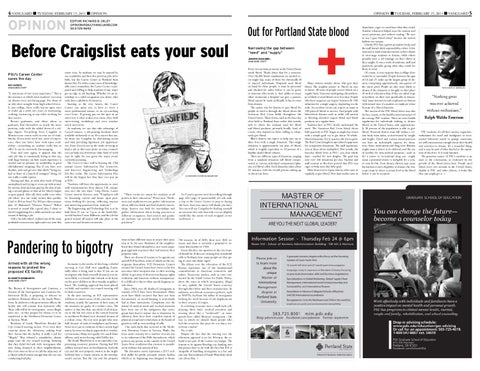
“Nothing great was ever achieved without enthusiasm.” Ralph Waldo Emerson PSU students, for all their tattoos, vegan fare, enthusiasm for travel and indulgence in recreational behaviors suited to grunge musicians, are still conscientious enough about their health and activities to donate. It’s a beautiful thing, and it may be part of what has led to the expansion of the drive. It is truly fantastic. The generous nature of PSU’s students is an asset to the community, as evidenced by the growth of the blood drives here. People need blood every two seconds in the United States; thanks to PSU and other donors, it looks like they just might get it. ■