Page 2 — THE PORTLAND DAILY SUN, Thursday, November 11, 2010
Feds propose graphic cigarette warnings RICHMOND, Va. (AP) — Corpses, cancer patients and diseased lungs are among the images the federal government plans for larger, graphic warning labels that would take up half of each pack of cigarettes sold in the United States. Whether smokers addicted to nicotine will see them as a reason to quit remains a question. The images are part of a new campaign announced by the Food and Drug Administration and the Department of Health and Human Services on Wednesday to reduce tobacco use, which is responsible for about 443,000 deaths per year. “Some very explicit, almost gruesome pictures may be necessary,” FDA Commissioner Margaret Hamburg said in an interview with The Associated Press. “This is a very, very serious public health issue, with very, very serious medical consequences,” such as cancer, heart disease, strokes and lung diseases. The share of Americans who smoke has fallen dramatically since 1970, from nearly 40 percent to about 20 percent, but the rate has stalled since about 2004. About 46 million adults in the U.S. smoke cigarettes. In the same period, the average cost per pack has gone from 38 cents to $5.33. Much of those increases are from state and federal taxes. It’s unclear why declines in smoking have stalled. Some experts have cited tobacco company discounts or lack of funding for programs to discourage smoking or to help smokers quit. The new prevention plan is part of a law passed in June 2009 that gave the FDA authority to regulate tobacco, including setting guidelines for marketing and labeling, banning certain products and limiting nicotine. The law doesn’t let the FDA ban nicotine or tobacco. The FDA is proposing 36 labels for public comment. They include phrases like “Smoking can kill you” and “Cigarettes cause cancer” and feature graphic images to convey the dangers of tobacco. “It acts as a very public billboard because you all of the sudden are reading something about lung cancer from that pack behind the cash register, whereas before you were just reading ‘Marlboro,’” said David Hammond, a health behavior researcher at the University of Waterloo in Canada, who is working with the firm designing the labels for the FDA.
SAYWHAT...
“
A woman is an occasional pleasure but a cigar is always a smoke.” —Groucho Marx
–––––––––––––––––––––––––––––––––––––––––––––––––––––––––––––––– DIGEST––––––––––––––––––––––––––––––––––––––––––––––––––––––––––––––––
3DAYFORECAST Today High: 50 Record: 65 (2002) Sunrise: 6:30 a.m. Tonight Low: 32 Record: 11 (1956) Sunset: 4:20 p.m.
MARKET
Tomorrow High: 54 Low: 33 Sunrise: 6:31 a.m. Sunset: 4:18 p.m. Saturday High: 57 Low: 37
DOW JONES 10.29 to 11,357.04 NASDAQ 15.80 to 2,578.78 S&P 5.31 to 1,218.71
LOTTERY#’S
THETIDES
DAILY NUMBERS
MORNING High: 2:26 a.m. Low: 8:19 a.m.
Day 9-1-6 • 6-9-7-5
1,378 U.S. military deaths in Afghanistan.
EVENING High: 2:32 p.m. Low: 9:01 p.m. -courtesy of www.maineboats.com
––––––––––––––––––––––––––––––––––––––––––––––––––––––––––– WORLD/NATION–––––––––––––––––––––––––––––––––––––––––––––––––––––––––––––
Cracks found in shuttle fuel tank CAPE CANAVERAL, Fla. (AP) — NASA discovered cracks in Discovery’s fuel tank Wednesday, an added problem that will complicate trying to launch the space shuttle on its final voyage this year. The two cracks — each 9 inches long — were found on the exterior of the aluminum tank, beneath a larger crack in the insulating foam that covers the 15-story tank. The cracks are in an area that holds instruments, not fuel. NASA spokesman Allard Beutel said engineers believe the tank can be repaired at the launch pad, although it’s never been tried before. It’s unclear, though, whether the work can be done in time to meet a Nov. 30 launch attempt. Discovery was grounded Friday by a hydrogen gas leak that cropped up during fueling Friday. It was the latest in a weeklong string of technical and weather postponements. A
20-inch crack in the foam was discovered soon after the last countdown was halted. NASA managers said at the time they did not know if the foam crack itself would have postponed liftoff. But on Wednesday, officials said they will not attempt another launch until the foam and tank are patched. The space agency has been cautious about fuel-tank foam ever since a slab broke off during Columbia’s 2003 launch and pierced the left wing. The shuttle was destroyed during re-entry. Discovery — NASA’s oldest and most-traveled shuttle — must be flying by Dec. 6 or so, otherwise the flight to the International Space Station will be off until approximately February. That’s because the Russians need to launch a new station crew in mid-December, creating a blackout period for a visiting shuttle. Then early next year, there is a
series of unmanned supply ships, as well as a span of unacceptable solar angles. The cracks in the ribbed section of the tank — the so-called central intertank region — were discovered as workers removed pieces of the damaged foam for analysis. This region joins the upper oxygen and lower hydrogen chambers that make up the rustcolored tank. Since that section contains only instruments, no explosive fuel would have leaked, had the shuttle launched with the defects. Beutel said it’s possible NASA may have unknowingly launched shuttles in the past with these type of cracks in the tank. If it wasn’t for the cracks traveling up to the surface of the foam this time, they would have gone unnoticed, he noted. The tank is discarded once a shuttle reaches orbit and breaks up while plunging back through the atmosphere.
Risks grow for those whose lives straddle border EL PASO, Texas (AP) — Eder Diaz and Manuel Acosta were Americans whose lives straddled the border, business students attending classes at the University of Texas at El Paso but living in Ciudad Juarez amid family and friends. They had been on their campus, a peaceful enclave of grassy plazas flanked by breathtaking desert mountains, just hours before they were gunned down last week in Juarez, their car riddled with bullets as they headed home. Commuting from Mexico to the United States was as natural to them as taking the Holland Tunnel from New Jersey into New York. It’s a life many border residents continue to embrace even as the death toll from the drug war in Mexico continues to rise. Six Americans were killed in Juarez last week alone, and for the last several years Mexico’s border region has been more dangerous for Americans than the rest of the country. In all of Mexico, 47 Americans were killed during the first six months of 2010, on track to pass the 79 homicides of U.S. citizens in 2009 and close to the 56 killings in all of 2008. Roughly 1,400 of UTEP’s 22,000 students live in Juarez and cross the border to go to class, even though many are Americans who could live in safety on U.S. soil. One is Ruben Tarango, a 21-year-old
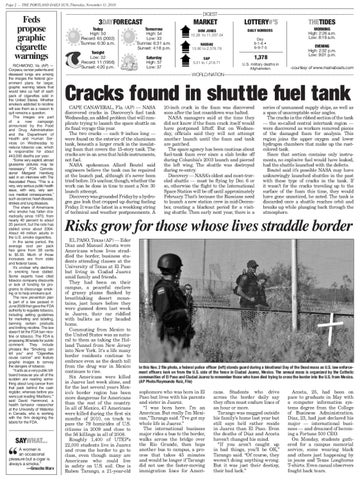
In this Nov. 2 file photo, a federal police officer (left) stands guard during a binational Day of the Dead mass as U.S. law enforcement officers look on from the U.S. side of the fence in Ciudad Juarez, Mexico. The annual mass is organized by the Catholic communities of El Paso and Ciudad Juarez to remember those who have died trying to cross the border into the U.S. from Mexico. (AP Photo/Raymundo Ruiz, File)
sophomore who was born in El Paso but lives with his parents and sister in Juarez. “I was born here. I’m an American. But really I’m Mexican,” Tarango said. “I’ve got my whole life in Juarez.” The international business major rides a bus to the border, walks across the bridge over the Rio Grande, then hops another bus to campus, a process that takes 45 minutes and would be longer if Tarango did not use the faster-moving immigration lines for Ameri-
cans. Students who drive across the border daily say they often must endure lines of an hour or more. Tarango was mugged outside his family’s home last year but still says he’d rather reside in Juarez than El Paso. Even the deaths of Diaz and Acosta haven’t changed his mind. “If you aren’t caught up in bad things, you’ll be OK,” Tarango said. “Of course, they weren’t doing anything wrong. But it was just their destiny, their bad luck.”
Acosta, 25, had been on pace to graduate in May with a computer information systems degree from the College of Business Administration. Diaz, 23, had just declared his major — international business — and dreamed of becoming a Fortune 500 CEO. On Monday, students gathered for a campus memorial service, some wearing black and others just happening by in jeans and Texas Longhorns T-shirts. Even casual observers fought back tears.