8 m a rch 31, 2011
news@ da ilyor a nge.com
housing
steinberg
from page 1
pus housing options. These buildings, however, do not cut it for some SU seniors. Jacqueline Klingler, a senior international relations and Spanish major, said she wanted to try something different after living in on-campus housing for three years. Klingler said she would have preferred a larger variety of room options. “The lack of diversity on Main Campus was definitely something I considered when moving off campus,” she said. “As a senior, I really wanted my own space.” Klingler also said living off campus was a cheaper option for her in the long run. It is easier to work a lot of hours during the semester to pay her rent, she said, than to take out loans to pay for on-campus housing. But Klingler noticed some downsides in her decision to live off campus. She chose a house on Redfield Place, more than a mile walk down Euclid Avenue to campus. Her street barely gets plowed during storms, making travel back and forth from campus difficult, she said. “Especially with the snow, it takes me half an hour to get to my house from campus when it snows,” she said. But the long walk in the snow is worth it because rent is low compared to that of other students who live on campus, Klingler said. Simmons, SU’s housing director, said the prices of on-campus housing at SU are comparable with off-campus housing options. “Price comparison is difficult to measure since university housing includes utilities and we are 10-month opportunities,” she said. “Certainly, there are cheaper opportunities and very expensive ones.” Katie Lewinski, a senior class marshall and policy studies and international relations major, lives in a single in Ernie Davis. Having the privacy of a single made the decision to stay on campus easier for Lewinski, although she said she believes living on campus could be more expensive for students. Lewinski said she thinks the on-campus housing options for student are limited by what SU offers. The only choice she considered, she said, was a single, and she thinks that’s the only choice most other seniors consider as well. “It’s part of the stigma: You don’t want to be a senior living in an open double,” she said. If SU could match what Emily Romano, a senior geology and geography major, is paying now, she said she would have considered staying in on-campus housing. But Romano likes being off campus because she can control what she eats, how she decorates and who she lives with, she said. Romano said her off-campus apartment on Comstock Avenue is significantly cheaper than
from page 1
big number
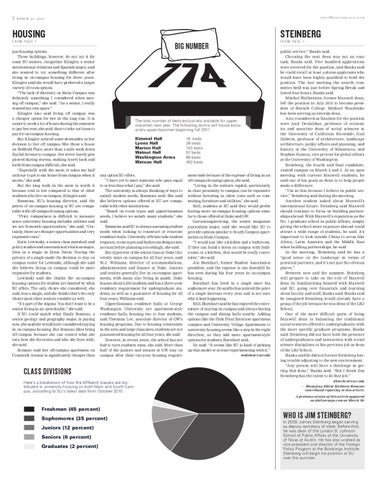
The total number of beds exclusively available for upperclassmen next year. The following dorms will house exclusively upperclassmen beginning fall 2011:
Kimmel Hall Lyons Hall Marion Hall Walnut Hall Washington Arms Watson Hall any option SU offers. “I have yet to meet someone who pays equal to or less than what I pay,” she said. The university is always thinking of ways to satisfy student needs, Simmons said. She said she believes options offered at SU are comparable with other institutions. “Based on room types and upperclassman needs, I believe we satisfy many students,” she said. Simmons said SU is always assessing student needs when looking to construct or renovate residence halls. University officials take student requests, room types and bathroom designs into account before planning accordingly, she said. But 42 percent of the senior class at Duke University stays on campus for all four years, said M.J. Williams, director of accommodations, administration and finance at Duke. Juniors and seniors generally live in on-campus apartments, with many also living in quads. Duke houses about 5,500 students and has a three-year residency requirement for undergraduate students, as well as a guarantee of housing for all four years, Williams said. Upperclassman residence halls at George Washington University are apartment-style residence halls, housing two to four students, said Tawanna Lee, associate director of GW’s housing programs. Due to housing constraints in the area and large class sizes, students are not guaranteed housing for all four years, she said. However, in recent years, the school has not had to turn students away, she said. More than half of the juniors and seniors at GW stay on campus after their two-year housing require-
Class divisions Here’s a breakdown of how the different classes are distributed in university housing on both Main and South Campus, according to SU’s latest data from October 2010.
18 beds 38 beds 143 beds 57 beds 66 beds 452 beds ment ends because of the expense of living in an off-campus housing option, she said. “Living in the nation’s capital, particularly in close proximity to campus, can be expensive without factoring in other costs such as commuting, furniture and utilities,” she said. Still, students at SU said they would prefer having more on-campus housing options similar to those offered at Duke and GW. Garunrangseewong, the senior magazine journalism major, said she would like SU to provide options similar to South Campus apartments on Main Campus. “I would just like a kitchen and a bathroom. If they can build a dorm on campus with bathrooms or a kitchen, that would be really convenient,” she said. Jon Barnhart, former Student Association president, said the expense is one downfall he has seen during his four years in on-campus housing. Barnhart has lived in a single since his sophomore year. He said he has noticed the price of a single increase every year and is not sure why it kept happening. Still, Barnhart said he has enjoyed the convenience of staying on campus and always having the campus and dining halls nearby. Adding options like the Park Point Syracuse apartment complex and University Village Apartments to university housing seems like a step in the right direction, as they add more apartment-style options for students, Barnhart said. He said: “It seems like SU is kind of picking up that model or at least experimenting with it.” medelane@syr.edu
public service,” Banks said. Choosing the next dean was not an easy task, Banks said. Five hundred applications were received for the position, and Banks said he could recall at least a dozen applicants who would have been highly qualified to hold the position. The last meeting the search committee held was just before Spring Break and lasted four hours, Banks said. Mitchel Wallerstein, former Maxwell dean, left the position in July 2010 to become president of Baruch College. Michael Wasylenko has been serving as interim dean. Also considered as finalists for the position were Anil Deolalikar, professor of economics and associate dean of social sciences at the University of California Riverside; Gail Dubrow, professor of architecture, landscape architecture, public affairs and planning, and history at the University of Minnesota; and Stephen Hanson, vice provost for global affairs at the University of Washington. Steinberg, the fourth and final candidate, visited campus on March 2 and 3. At an open meeting with current Maxwell students, he said one of his goals as dean is to help people make a difference. “I’m in this because I believe in public service,” Steinberg said during the meeting. Another student asked about Maxwell’s international future. Steinberg said Maxwell should continue to focus on building partnerships abroad. With Maxwell’s reputation as the No. 1 graduate school in public affairs, simply giving the school more exposure abroad could attract a wide range of students, he said. It’s important to look outside China to areas like Africa, Latin America and the Middle East when building partnerships, he said. In the meeting, Steinberg said he has a “good sense on the landscape in terms of potential partners, and it’s not just the obvious places.” Between now and the summer, Steinberg will prepare to take on the role of Maxwell dean by familiarizing himself with Maxwell and SU, going over financials and learning about faculty and staff, Banks said. Banks said he imagined Steinberg would already have a grasp of the job because he was dean of the LBJ School. One of the more difficult parts of being Maxwell dean is balancing the traditional social sciences offered to undergraduates with the more specific graduate programs, Banks said. Steinberg did not have both the presence of undergraduates and interaction with social science disciplines at his previous job as dean of the LBJ School. Banks said he did not foresee Steinberg having trouble adjusting to the new environment. “Any person will have a challenge in getting that done,” Banks said. “But I think Jim Steinberg has the talent to do that job.” dkmcbrid@ syr.edu — Managing Editor Kathleen Ronayne contributed reporting to this article. A previous version of this article appeared on dailyorange.com on March 30.
Freshmen (45 percent) Sophomores (35 percent) Juniors (12 percent) Seniors (6 percent) Graduates (2 percent)
Who is Jim Steinberg?
In 2009, James Steinberg began serving as deputy secretary of state. Before that, he was dean of the Lyndon B. Johnson School of Public Affairs at the University of Texas at Austin. He has also worked as vice president and director of the Foreign Policy Program at the Brookings Institute. Steinberg will begin his position at SU over the summer.