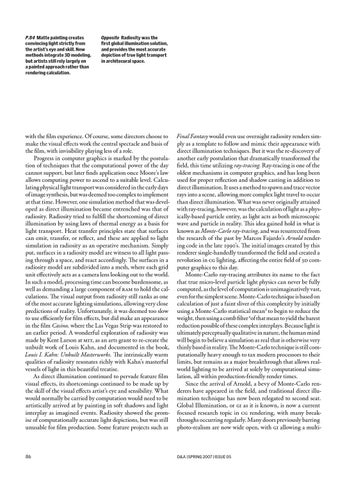
P.84 Matte painting creates convincing light strictly from the artist’s eye and skill. New methods integrate 3D modeling, but artists still rely largely on a painted approach rather than rendering calculation.
Opposite Radiosity was the first global illumination solution, and provides the most accurate depiction of true light transport in architecural space.
with the film experience. Of course, some directors choose to make the visual effects work the central spectacle and basis of the film, with invisibility playing less of a role. Progress in computer graphics is marked by the postulation of techniques that the computational power of the day cannot support, but later finds application once Moore’s law allows computing power to ascend to a suitable level. Calculating physical light transport was considered in the early days of image synthesis, but was deemed too complex to implement at that time. However, one simulation method that was developed as direct illumination became entrenched was that of radiosity. Radiosity tried to fulfill the shortcoming of direct illumination by using laws of thermal energy as a basis for light transport. Heat transfer principles state that surfaces can emit, transfer, or reflect, and these are applied to light simulation in radiosity as an operative mechanism. Simply put, surfaces in a radiosity model are witness to all light passing through a space, and react accordingly. The surfaces in a radiosity model are subdivided into a mesh, where each grid unit effectively acts as a camera lens looking out to the world. In such a model, processing time can become burdensome, as well as demanding a large component of RAM to hold the calculations. The visual output from radiosity still ranks as one of the most accurate lighting simulations, allowing very close predictions of reality. Unfortunately, it was deemed too slow to use efficiently for film effects, but did make an appearance in the film Casino, where the Las Vegas Strip was restored to an earlier period. A wonderful exploration of radiosity was made by Kent Larson at MIT, as an arts grant to re-create the unbuilt work of Louis Kahn, and documented in the book, Louis I. Kahn: Unbuilt Masterworks. The intrinsically warm qualities of radiosity resonates richly with Kahn’s masterful vessels of light in this beautiful treatise. As direct illumination continued to pervade feature film visual effects, its shortcomings continued to be made up by the skill of the visual effects artist’s eye and sensibility. What would normally be carried by computation would need to be artistically arrived at by painting in soft shadows and light interplay as imagined events. Radiosity showed the promise of computationally accurate light depictions, but was still unusable for film production. Some feature projects such as
Final Fantasy would even use overnight radiosity renders simply as a template to follow and mimic their appearance with direct illumination techniques. But it was the re-discovery of another early postulation that dramatically transformed the field, this time utilizing ray-tracing. Ray-tracing is one of the oldest mechanisms in computer graphics, and has long been used for proper reflection and shadow casting in addition to direct illumination. It uses a method to spawn and trace vector rays into a scene, allowing more complex light travel to occur than direct illumination. What was never originally attained with ray-tracing, however, was the calculation of light as a physically-based particle entity, as light acts as both microscopic wave and particle in reality. This idea gained hold in what is known as Monte-Carlo ray-tracing, and was resurrected from the research of the past by Marcos Fajardo’s Arnold rendering code in the late 1990’s. The initial images created by this renderer single-handedly transformed the field and created a revolution in CG lighting, affecting the entire field of 3D computer graphics to this day. Monte-Carlo ray-tracing attributes its name to the fact that true micro-level particle light physics can never be fully computed, as the level of computation is unimaginatively vast, even for the simplest scene. Monte-Carlo technique is based on calculation of just a faint sliver of this complexity by initially using a Monte-Carlo statistical mean 2 to begin to reduce the weight, then using a comb filter 3 of that mean to yield the barest reduction possible of these complex interplays. Because light is ultimately perceptually qualitative in nature, the human mind will begin to believe a simulation as real that is otherwise very thinly based in reality. The Monte-Carlo technique is still computationally heavy enough to tax modern processors to their limits, but remains as a major breakthrough that allows realworld lighting to be arrived at solely by computational simulation, all within production-friendly render times. Since the arrival of Arnold, a bevy of Monte-Carlo renderers have appeared in the field, and traditional direct illumination technique has now been relegated to second seat. Global Illumination, or GI as it is known, is now a current focused research topic in CG rendering, with many breakthroughs occurring regularly. Many doors previously barring photo-realism are now wide open, with GI allowing a multi-
86
D&A spring 2007 Issue 05