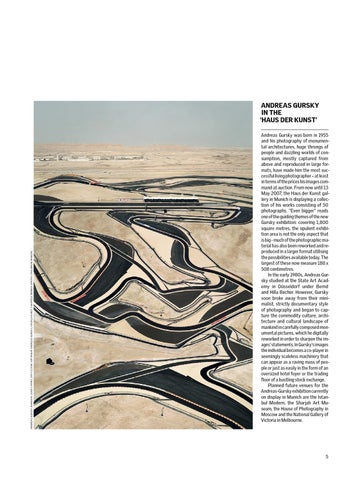
Andreas Gursky: Bahrain I, 2005 C-Print, 299 × 215 cm. Copyright Andreas Gursky / VG Bild-Kunst. Courtesy Monika Sprüth / Philomene Magers
Andreas Gursky in the ‘Haus der Kunst’ Andreas Gursky was born in 1955 and his photography of monumental architectures, huge throngs of people and dazzling worlds of consumption, mostly captured from above and reproduced in large formats, have made him the most successful living photographer – at least in terms of the prices his images command at auction. From now until 13 May 2007, the Haus der Kunst gallery in Munich is displaying a collection of his works consisting of 50 photographs. “Even bigger” reads one of the guiding themes of the new Gursky exhibition: covering 1,800 square metres, the opulent exhibition area is not the only aspect that is big - much of the photographic material has also been reworked and reproduced in a larger format utilising the possibilities available today. The largest of these now measure 188 x 508 centimetres. In the early 1980s, Andreas Gursky studied at the State Art Academy in Düsseldorf under Bernd and Hilla Becher. However, Gursky soon broke away from their minimalist, strictly documentary style of photography and began to capture the commodity culture, architecture and cultural landscape of mankind in carefully composed monumental pictures, which he digitally reworked in order to sharpen the images’ statements. In Gursky’s images the individual becomes a co-player in seemingly scaleless machinery that can appear as a raving mass of people or just as easily in the form of an oversized hotel foyer or the trading floor of a bustling stock exchange. Planned future venues for the Andreas-Gursky exhibition currently on display in Munich are the Istanbul Modern, the Sharjah Art Museum, the House of Photography in Moscow and the National Gallery of Victoria in Melbourne.
5