art
A
i Weiwei is one of the most significant and influential artists of the last decade. His works in porcelain, wood, marble, jade, crystal, bamboo and silk, together with wallpaper, photographs and videos, testify to the rich variety of his work as an artist and his profound knowledge of his country’s cultural heritage. At the same time, in a playful or iconoclastic way he re-channels traditional motifs, methods and materials into a critique, overt or covert, of the Chinese political system. Son of the famous poet Ai Qing, Ai Weiwei was born in Beijing in 1957. Ai grew up in Xinjiang province, where his father was sent into exile for 20 years after being accused in the Anti-Rightist Campaign in 1958. In 1981, Ai emigrated to the United States, settling in New York in 1983, where he discovered Marcel Duchamp’s readymades and the Pop Art of Andy Warhol. Returning to China in 1993, he set about broadening the scope of his work and helping fellow Chinese artists by curating exhibitions including Fuck Off (Shanghai, 2000) and organising underground publications. Following the Sichuan earthquake in 2008, Ai organised a Citizens’ Investigation to uncover and account for the student deaths caused by shoddy construction. In 2011, he was arrested and secretly detained for 81 days. In 2015, Ai’s passport was returned to him and his freedom to travel freely was restored. He currently lives and works in Berlin. In his work, Ai Weiwei reactivates and alters Chinese craft traditions while at the same time co-opting Pop Art and American Minimalism. In his photography and films, he records urban transformation
and population shifts. His most recent works relate to the troubling complexity of international matters including economic dependency and refugee flows. In The Animal That Looks Like a Llama But Is Really an Alpaca (2015), for instance, Ai Weiwei has created a 360 degree installation that looks at first glance like a gold, decorative wallpaper. A closer inspection however reveals surveillance cameras, handcuffs and Twitter bird logos, referencing Ai Weiwei’s tweets to challenge authority. Another major work, Sunflower Seeds (2009), features 13 tons of hand-painted porcelain sunflower seeds, a sample of the 150 tons commissioned by Ai Weiwei from 1,500 craftspeople at the Jingdezhen workshops. These seeds, which took over two-and-a-half years to make, had a universally obvious symbolic value: like sunflowers, the citizens of the People’s Republic of China were turning their heads towards their sun, Mao Zedong. The ironic implications of this installation lie in its making, at the opposite pole from “Made in China” mass production; each seed is hand painted and thus unique, and the political message is unambiguous. Ai Weiwei’s work is currently on show at the Musée Cantonal des Beaux-Arts in Lausanne until January 28 2018. The exhibition Ai Weiwei: D’ailleurs c’est toujours les autres brings together more than 40 items dating from 1995 up to the present. It hails a true all-rounder: a remarkable visual artist, an encyclopaedic mind, a gifted transmitter of ideas and a man coming to grips with the major issues of today’s world. Ai Weiwei may well be the first truly “global” artist.
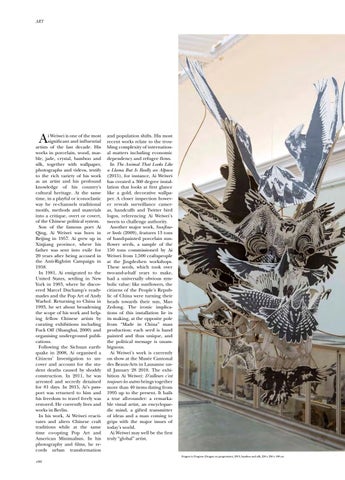
Dragon in Progress (Dragon en progression), 2013, bamboo and silk, 250 x 250 x 180 cm
166