EXPLORING E-READERS ON CAMPUS Will E-books replace textbooks? Technology impacts the book market Leah Hovde
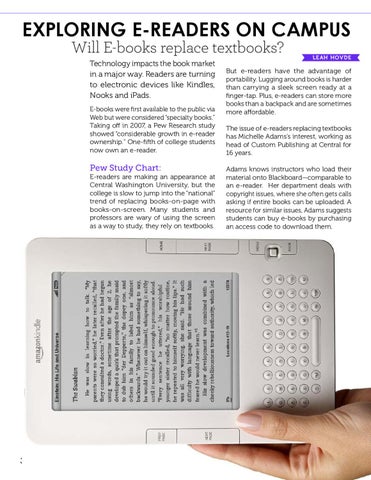
in a major way. Readers are turning to electronic devices like Kindles, Nooks and iPads. E-books were first available to the public via Web but were considered “specialty books.” Taking off in 2007, a Pew Research study showed “considerable growth in e-reader ownership.” One-fifth of college students now own an e-reader.
Pew Study Chart: E-readers are making an appearance at Central Washington University, but the college is slow to jump into the “national” trend of replacing books-on-page with books-on-screen. Many students and professors are wary of using the screen as a way to study, they rely on textbooks.
37
But e-readers have the advantage of portability. Lugging around books is harder than carrying a sleek screen ready at a finger-tap. Plus, e-readers can store more books than a backpack and are sometimes more affordable. The issue of e-readers replacing textbooks has Michelle Adams’s interest, working as head of Custom Publishing at Central for 16 years.
Adams knows instructors who load their material onto Blackboard—comparable to an e-reader. Her department deals with copyright issues, where she often gets calls asking if entire books can be uploaded. A resource for similar issues, Adams suggests students can buy e-books by purchasing an access code to download them.