The Crazy Wisdom Community Journal • January - April 2013 • Page 58
EMDR: Recovering Lives by Moving Out Trauma Continued from page 57 But what protects Kennard the most from becoming burned-out is hope. She says, “I really do think hope…is a great protection for me…It really helps. And I do see them [my clients] progress, which is really a wonderful honor. What a great thing to have a job where you can see people healing!” Kennard is currently developing a community website in which EMDR trainers can talk to people. Called the Center for Personal Transformation, the theme of this website is how to actively open up the heart in order to discover one’s path in life. “That’s really how I see my clients,” Kennard says. “What they really need is to get whatever there is out of the way that keeps them from having an open heart, from just being who they are, and connecting with their essence. EMDR is really a great tool for that.”
c
When Dr. Carrie Hatcher-Kay first heard about EMDR in graduate school, she didn’t think she’d have a use for it. “I thought it was so odd,” she admits. As she earned her doctorate of psychology from the University of Michigan in 2001 and went on to do two years of post-doctorate work at UM Department of Psychiatry, she didn’t give EMDR much more thought. Then in 2002, one of her colleagues, whom she highly respected, had a car accident. As her friend healed through EMDR and went on to become trained in it, Hatcher-Kay investigated EMDR further and found that she, too, could be healed from an earlier trauma. When she was 30 years old, a tragedy (that Hatcher-Kay prefers to remain private) occurred. At the time, she processed it through traditional therapy, but it was still “gripping.” Processing her loss through EMDR changed that. It was, she says, “like moving from an active gash on your body to a scar that is a memory but it is faded, it’s not actively hurting…It’s got its place in the fabric of your skin, your story. And that’s what I experienced. And so I quickly felt compelled to pursue this training and offer it to numerous clients that I could immediately think of helping.”
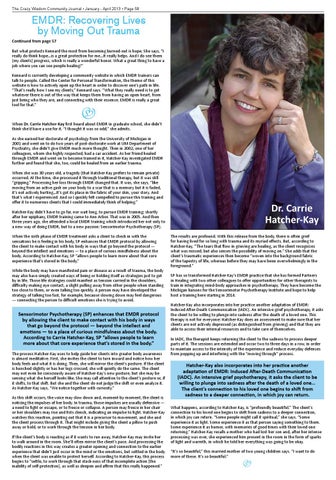
Dr. Carrie Hatcher-Kay
Hatcher-Kay didn’t have to go far, nor wait long, to pursue EMDR training: shortly after her epiphany, EMDR training came to Ann Arbor. That was in 2005. And then three years ago, she attended a local EMDR training which introduced her not only to a new way of doing EMDR, but to a new passion: Sensorimotor Psychotherapy (SP). When the sixth phase of EMDR treatment asks a client to check in with the sensations he is feeling in his body, SP enhances that EMDR protocol by allowing the client to make contact with his body in ways that go beyond the protocol — beyond the intellect and emotions — to a place of curious mindfulness about the body. According to Hatcher-Kay, SP “allows people to learn more about that core experience that’s stored in the body.” While the body may have manifested pain or disease as a result of trauma, the body may also have simply created ways of being or holding itself as strategies just to get by in life. Those life strategies could manifest as tension carried in the shoulders, difficulty making eye contact, a slight pulling away from other people when standing too close to them, or even talking too quickly. A person may have developed the strategy of talking too fast, for example, because slowing down may feel dangerous — connecting the person to difficult emotions she is trying to avoid.
Sensorimotor Psychotherapy (SP) enhances that EMDR protocol by allowing the client to make contact with his body in ways that go beyond the protocol — beyond the intellect and emotions — to a place of curious mindfulness about the body. According to Carrie Hatcher-Kay, SP “allows people to learn more about that core experience that’s stored in the body.” The process Hatcher-Kay uses to help guide her clients into greater body awareness is almost meditative. First, she invites the client to turn inward and notice how her body feels and what it is doing. Then, she will mirror the client’s posture. If the client is hunched slightly or has her legs crossed, she will quietly do the same. The client may not even be consciously aware of Hatcher-Kay’s new posture, but she may be sensing what she herself looks like. She may call attention to the client’s posture or, if it shifts, to that shift. But she and the client do not judge the shift or even analyze it. As Hatcher-Kay says, “We notice together with curiosity.” As this shift occurs, the voice may slow down and, moment-by-moment, the client is noticing the impulses of her body. In trauma, those impulses are usually defensive — a need to fight or escape, or to freeze or collapse. A person may freeze in her chair or her shoulders may rise and fists clench, indicating an impulse to fight. Hatcher-Kay watches this reaction, pointing out that it is a precursor to movement, and she and the client process through it. That might include giving the client a pillow to push away or hold, or to work through the tension in her body. If the client’s body is reacting as if it wants to run away, Hatcher-Kay may invite her to walk around in the room. She’ll often mirror the client’s pace. And processing the bodily reactions in this way creates a greater opening and connection to the earlier experience that didn’t just occur in the mind or the emotions, but settled in the body when the client was unable to protect herself. According to Hatcher-Kay, this process begins to “settle, to work through that stuck-ness of that incomplete action [the inability of self-protection], as well as deepen and affirm that this really happened.”
The results are profound. With this release from the body, there is often grief for having lived for so long with trauma and its myriad effects. But, according to Hatcher-Kay, “The tears that flow in grieving are healing, as the client recognizes what was missed, but also senses the possibility of moving on.” She adds that the client’s traumatic experiences then become “woven into the background fabric of the tapestry of life, whereas before they may have been overwhelmingly in the foreground.” SP has so transformed Hatcher-Kay’s EMDR practice that she has formed Partners in Healing with two other colleagues to offer opportunities for other therapists to train in integrating mind-body approaches in psychotherapy. They have become the Michigan liaisons for the Sensorimotor Psychotherapy Institute and hope to help host a training here starting in 2014. Hatcher-Kay also incorporates into her practice another adaptation of EMDR: Induced After-Death Communication (IADC). An intensive grief psychotherapy, it asks the client to be willing to plunge into sadness after the death of a loved one. This therapy is not for everyone: Hatcher-Kay does an assessment to make sure that her clients are not actively depressed (as distinguished from grieving) and that they are able to access their internal resources and to take care of themselves. In IADC, the therapist keeps returning the client to the sadness to process deeper parts of it. The sessions are extended and occur two to three days in a row, in order to maintain access to the intensity of the experience and reduce everyday defenses from popping up and interfering with the “moving through” process.
Hatcher-Kay also incorporates into her practice another adaptation of EMDR: Induced After-Death Communication (IADC). An intensive grief psychotherapy, it asks the client to be willing to plunge into sadness after the death of a loved one… The client’s connection to his loved one begins to shift from sadness to a deeper connection, in which joy can return. What happens, according to Hatcher-Kay, is “profoundly beautiful.” The client’s connection to his loved one begins to shift from sadness to a deeper connection, in which joy can return. “Some people might call it spiritual,” she says. “Some experience it as light. Some experience it as that person saying something to them. Some experience it as humor, with memories of good times with their loved one returning.” Hatcher-Kay recalls a mother who had lost her son and, after her intense processing was over, she experienced him present in the room in the form of sparks of light and warmth, in which he told her everything was going to be okay. “It’s so beautiful,” this married mother of two young children says. “I want to do more of these. It’s so beautiful.”
c