GUARDIAN

“Guardian”
Copyright 2024, CVSA. All rights reserved. No part of this issue may be reproduced without written permission from the publisher.
For comments, suggestions or information, email communications@cvsa.org.


CVSA is looking for interesting, relevant content for its quarterly magazine. We would be happy to consider your news, ideas, insights and articles on issues facing the commercial motor vehicle safety community for upcoming editions of “Guardian” magazine. The deadlines for upcoming editions are available at www.cvsa.org/guardian-
Questions? Please contact CVSA Writer-Editor Emily Moorhead at emily.moorhead@cvsa.org.

By Capt. John Hahn, Motor Carrier Safety Section, Colorado State Patrol; CVSA President
It is tough to imagine that it has been two years since taking the nomination for the position of secretary at the CVSA Workshop in Bellevue, Washington. When I ran for the position, I did so with the focus on wanting to take on a larger role in our organization, which frankly has become something of a second home to me over the last decade. Over time, I have met so many individuals who make up our organization, whether at a workshop, annual conference or other function, but I recognize that is not all of us within CVSA. We will have time to discuss specific initiatives or the challenges of our ever-increasingly difficult operating environment. But now, I would like to use this opportunity to start on a personal note and introduce myself to the organization.
My name is Capt. John Hahn, and I serve as the commander of the Motor Carrier Safety Section of the Colorado State Patrol (CSP). This July, I celebrated my 25th anniversary with the agency in a career that has been a winding path leading to the commercial motor vehicle (CMV) safety community. I recall taking the North American Standard Part A Inspection course in the final week of my academy training, which was my first exposure to this world we call CMV safety. Somewhat baffled but also intrigued by its complexity, I set out to complete my initial 32 inspections. As a road trooper, I found CMV enforcement a
bit of a mystery, but it was also interesting because of its complexity. However, early on in my career, it was not a passion of mine.
As I was promoted within my agency, I found myself moving away from anything related to CMV safety. I spent time running our public affairs unit and then took an assignment as the commander of operations at the Colorado state capitol in Denver. In 2014, I ended up back in this community in a way I would not have predicted. I transferred to an assignment within my agency’s hazmat unit, and in that role, I found my way to CVSA.
I began as a voting member of the Hazardous Materials Committee before serving as vice president and president of Region III. I also served as chair of the Policy and Regulatory Affairs Committee and played a role in developing the strategic plan under which we operate today. In a future article, I intend to discuss my introduction to CVSA. But for now, I will say that our organization has truly taken me in and shown me the ropes. It is through CVSA that I went from being a road trooper who could knock out some Level III Inspections when needed to finding a passion for what we do day in and day out.
There are 13,000 members of the Alliance, many of whom I will never have the privilege to meet. As you read these pages, there
are officers and inspectors at our roadsides interacting with drivers, inspecting vehicles, and enforcing our laws and regulations. Industry members are in our communities, whether working behind the wheel, processing at a workstation, managing drivers, or doing their best wherever they are to help ensure goods and services continue moving safely. Our federal partners work diligently to make sure we all have a regulatory framework to keep our roads safe. Indeed, individuals in each class of CVSA membership work all hours, every day of every week, in every corner of North America, to keep our roadways safe. Many of us will never get to truly know each other.
Those of us who make up the leadership of this organization were once one of those people. To those individuals, I can tell you that you are a part of something important –something special. This is your organization, and having the opportunity to represent you over this next year is truly one of my greatest honors.
Thank you for what you do, and please stay safe out there.
Respectfully,



By Collin B. Mooney, MPA, CAE, Executive Director, Commercial Vehicle Safety Alliance
In today’s fast-paced world, the trucking and commercial transportation industry is essential to the global economy. Every day, millions of goods are transported across countries by commercial motor vehicles (CMV), ensuring the smooth functioning of businesses and markets. However, with such a vast and crucial role comes a tremendous responsibility: guaranteeing safety on the road. This is where the various CMV safety regulations play a pivotal role. These regulations are not mere bureaucratic measures but life-saving rules that protect drivers, other road users and the environment. Maintaining these regulations is vital for several reasons, including reducing crashes, safeguarding public health, promoting operational efficiency and ensuring legal compliance.
The foremost reason for upholding CMV safety regulations is to reduce the number of crashes, injuries and fatalities on the road. CMVs such as trucks and buses are
significantly larger and heavier than regular passenger cars. This means they need more space to maneuver and stop, especially in emergency situations. According to the Federal Motor Carrier Safety Administration (FMCSA), CMV crashes often result in more severe consequences than those involving smaller vehicles. In 2021, large trucks were involved in more than 5,000 fatal crashes in the U.S., underscoring the importance of robust safety measures.
Regulations such as the hours-of-service (HOS) rules, which limit the amount of time drivers can be on the road without taking a rest, are designed to prevent fatigue, one of the leading causes of crashes involving CMVs. Fatigue impairs a driver’s reaction time, judgment and decision-making, which can result in a devastating crash. By strictly enforcing HOS rules, regulatory agencies aim to reduce the likelihood of fatigue-related crashes.
Additionally, regulations requiring vehicles to undergo routine inspections and maintenance ensure that trucks are roadworthy and safe to operate. Issues such as brake failures, tire blowouts and steering malfunctions can be catastrophic at high speeds. Mandating regular vehicle checks significantly reduces the likelihood of such mechanical failures.
Beyond preventing crashes, CMV safety regulations play a crucial role in protecting public health. One example is the proper transportation of hazardous materials. Vehicles transporting hazardous materials, such as chemicals, fuel or explosives, must adhere to strict guidelines to prevent leaks, spills or explosions that could have disastrous consequences for nearby communities. Maintaining these regulations guarantees that hazardous materials are transported safely and securely, minimizing the risk of crashes that could lead to widespread harm.

Maintaining CMV safety regulations is critical to ensuring the safety of drivers, the public and the environment.
While safety regulations may seem like additional burdens to fleet operators, they actually contribute to long-term operational efficiency. Well-maintained vehicles are less likely to break down, reducing costly repairs and delays. Moreover, by adhering to safety standards, companies can reduce the risk of crashes, which often lead to expensive legal fees, insurance claims and settlements.
In many cases, safety and efficiency go hand in hand. For example, the electronic logging device (ELD) mandate, which requires drivers to use digital devices to track their hours of service, not only promotes compliance with HOS regulations but also streamlines fleet management. ELDs allow companies to monitor driver performance, optimize routes and reduce fuel consumption, all of which contribute to cost savings and better business performance. In the long run, maintaining safety regulations helps companies operate more efficiently and sustainably while also protecting their bottom line.
Failure to comply with CMV safety regulations can result in severe penalties, both for drivers and the companies that employ them. Regulatory agencies, such as FMCSA, have the authority to shut down operations for non-compliance with safety standards. In addition to financial losses, companies found in violation of safety regulations may suffer reputational damage, which can lead to the loss of contracts and customers.
Moreover, legal non-compliance can expose companies to liability in the event of a crash. If a crash occurs and it is discovered that the vehicle was not in compliance with safety regulations – such as being overloaded, having defective brakes or being driven by a fatigued driver – the company could be held responsible for the damages. This may result in costly lawsuits, settlements and higher insurance premiums. By maintaining compliance with CMV safety regulations, companies can mitigate their legal risks and avoid the financial repercussions of noncompliance.
Finally, maintaining CMV safety regulations is a matter of ethical responsibility. The trucking industry plays a central role in the economy, and with that comes a moral obligation to prioritize the safety and well-being of the public. When companies cut corners or fail to adhere to safety standards, they not only put their own drivers at risk but also endanger everyone on the road.
Ethical business practices go beyond profit margins; they reflect a commitment to do what is right. By upholding safety regulations, companies demonstrate their dedication to protecting lives and maintaining the highest standards of safety and professionalism. This commitment not only builds trust with customers, regulators and the public but also fosters a culture of safety and accountability within the organization.
In conclusion, maintaining CMV safety regulations is critical to ensuring the safety of drivers, the public and the environment. These regulations reduce crashes, protect public health, enhance operational efficiency and ensure legal compliance. Moreover, they represent an ethical commitment to safety and responsibility. As the commercial transportation industry continues to grow, the importance of adhering to safety regulations cannot be overstated. Only by upholding these standards can we ensure that our roads remain safe for everyone while cultivating a sustainable and efficient transportation system. n
In 2021, large trucks were involved in more than
5,000 fatal crashes in the U.S.

Region I
Connecticut, Delaware, District of Columbia, Maine, Maryland, Massachusetts, New Hampshire, New Jersey, New York, Pennsylvania, Puerto Rico, Rhode Island, U.S. Virgin Islands and Vermont
Region II
Alabama, American Samoa, Arkansas, Florida, Georgia, Kentucky, Louisiana, Mississippi, North Carolina, Oklahoma, South Carolina, Tennessee, Texas, Virginia and West Virginia
Region III
Colorado, Illinois, Indiana, Iowa, Kansas, Michigan, Minnesota, Missouri, Nebraska, North Dakota, Northern Mariana Islands, Ohio, South Dakota and Wisconsin
Region IV
Alaska, Arizona, California, Guam, Hawaii, Idaho, Mexico, Montana, Nevada, New Mexico, Oregon, Utah, Washington and Wyoming
Region V
Alberta, British Columbia, Manitoba, New Brunswick, Newfoundland and Labrador, Northwest Territories, Nova Scotia, Nunavut, Ontario, Prince Edward Island, Quebec, Saskatchewan and Yukon
By Jonathan Nicastro, Director, Motor Carrier Compliance Program, New York State Department of Transportation Utility Commission
In June, members of the New York State Department of Transportation (NYSDOT) Motor Carrier Compliance Bureau were honored by Commissioner Marie Therese Dominguez as she awarded them meritorious achievement awards. The awards were issued for accomplishing critical work supporting a limousine safety task force implemented by New York Governor Kathy Hochul and the legislature. Motor Carrier Compliance Bureau members provided subject matter expertise for the task force members. The task force developed critical safety recommendations that were implemented under the commissioner's leadership and with Governor Hochul's support.

Pictured left to right: Assistant Commissioner Janet Ho; Motor Carrier Compliance Bureau Director Jonathan Nicastro; Commissioner Marie Therese Dominguez; Modal Safety Director Cliff Thomas; Passenger Carrier Bureau Director Marc Berger; Chief Counsel and Assistant Commissioner Tim Lennon; Motor Carrier Compliance Bureau members Chad Smith, Jeff Corey, Justin Zimmerman and James Leonard; Lead Counsel Louis DelGiacco; and Motor Carrier Compliance Bureau member Steve Farina.
In June, NYSDOT Motor Carrier Compliance Bureau members were honored by Commissioner Dominguez, who awarded them meritorious achievement awards. The awards recognize their critical work in implementing and delivering the motor carrier safety assistance program, innovative technology deployment grants and critical safety programs. This Motor Carrier Compliance Bureau supports the work of NYSDOT’s roadside inspection program, delivered by NYSDOT inspectors and investigators, New York State Police troopers, and dozens of local police departments. They are also vital in supporting NYSDOT’s investigation and safety enforcement and outreach programs. n
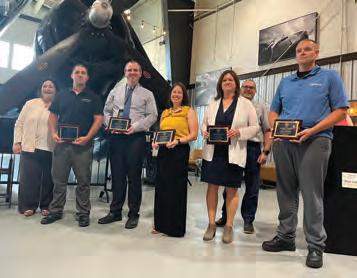
Pictured left to right: Commissioner Marie Therese Dominguez and Motor Carrier Compliance Bureau members Justin Coon, Martin Duffy, Kimberly Schewtschenko, Suzanne Keiffer and Richard Lindemann. Foreground: Assistant Commissioner Patrick Barnes.
By West Seneca (New York) Police Department
An Indiana man wanted by Indiana State Police and the U.S. Marshals Service was taken into custody by the West Seneca (New York) Police Department on July 30. Ofc. Travis Deubell was on I-90 westbound and initiated a traffic stop of a Ford F350 for a cracked windshield and a passenger not wearing a safety belt. The truck was pulling a trailer with a children's carnival ride.
The driver stated he was on his way to the Erie County Fairgrounds but could not produce a driver's license. He could only provide his carnival company ride operator identification card with the name "James Davis." The vehicle was directed to an off-site New York State Department of Transportation (NYSDOT) commercial motor vehicle (CMV) inspection station, where the driver provided a false date of birth. After Ofc. Deubell, NYSDOT Supervising CMV Inspector Ryan Pokojski and NYSDOT CMV Inspector Dave Charles found no record of his identity, further investigation revealed the driver to be Michael Wayne Gordon from Kokomo, Indiana. Gordon was found to have extraditable warrants in Indiana for two Level 1 felony counts of Child Molestation and a Level 5 felony count of Failure to Register as a Sex Offender. Gordon was taken into custody and returned to the
West Seneca Police Department, where he was cited for several CMV violations and taken to the Erie County Holding Center to await extradition. The CVSA Level I Inspection conducted by the officers found 24 violations, including five imminent hazard violations involving brakes and hours of service.
Subsequently, it was learned that Gordon is NOT an employee of the Erie County Fair or a carnival company ride operator but was hired as an independent contractor to transport the ride to the Erie County Fair only.
Records show Gordon was convicted of child molestation in Indiana in 1994. In April 1998, he was again convicted in a child molestation case and required to register as a sex offender. He was convicted of failure to register as a sex offender in March 2004. According to court records, prosecutors in Miami County, Indiana, filed a child molestation case against Gordon in February 2021. He failed to attend a hearing in March 2023, leading a judge to issue an arrest warrant.
The West Seneca Police Department would like to thank the New York State Department of Transportation and the U.S. Marshals Service for their assistance. n

On Aug. 26, City of Pittsburgh (Pennsylvania) Commercial Vehicle Enforcement (CVE) officers Eric Churilla and Vincent Gelpi hosted CVSA Writer-Editor Emily Moorhead for a day of roadside inspections, which occurred during CVSA’s Brake Safety Week.
Ofc. Churilla performed two Level I Inspections, and Ofc. Gelpi performed three Level I Inspections. Ofc. Gelpi is new to the City of Pittsburgh CVE team; he recently participated in training for North American Standard Inspection Parts A and B, received his certifications, and completed the required mentored inspections. Ofc. Churilla is Pittsburgh's longest-serving CVE officer.
Ofc. Gelpi’s last inspection of the day was an owner-operator in a truck-trailer that had four out-of-service (OOS) tire violations, falling under 393.75(a)(1) and 393.75(a)(2). Moorhead was grateful for the opportunity to witness these local members performing their daily duties, including placing a truck OOS. She also witnessed driver interviews and got underneath a truck to learn more about brakes. n

By Ofc. Courtney West, Commercial Vehicle Safety Division, Connecticut Department of Motor Vehicles
On Sept. 18, Phoenix Express Trans Corp was stopped in the town of Branford, Connecticut, for a North American Standard Level I Inspection. The truck-tractor was a 2009 white Freightliner bearing a New Jersey registration and the trailer was a 2006 orange Wabash bearing a Maine registration. It was discovered that the truck-tractor had been operating unregistered since Feb. 29. A check of the previous inspection showed a Level II Inspection was completed in Connecticut on April 25 by Ofc. Spencer. This inspection showed a violation for operating unregistered on the same New Jersey registration.
During my inspection on Sept. 18, I found some of the same violations cited on Ofc. Spencer’s inspection that had not been corrected – since April. I completed my own Level I Inspection and proceeded to place the truck-tractor and trailer out of service (OOS). The owner of the company arrived during my inspection and advised she was making her own arrangements with a local tower (KT Towing) to have the unit towed. KT Towing later confirmed that upon arrival, the truck-tractor and trailer had vacated the rest area, and they were out $1,500 worth of towing equipment and personnel for the disappearing load.
The following morning, Ofc. Dawson and I were working on a different section of I-95 at the Waterford scale. The scale was operational, and vehicles were actively entering. While standing outside observing the trucks entering the scale, I saw a white Freightliner and orange trailer coming down the ramp. It was the same exact truck-tractor, trailer and driver I had inspected the day before in Branford, carrying the same load and shipping documents as the previous day.
I stopped the vehicle on the scale and asked the driver if all the OOS items had been addressed. He said they had. I looked at the driver’s side front brake hose that I had marked with a white grease pen and marked as a critical inspection item. The hose had not been repaired. We told the driver to park, and Ofc. Dawson completed another Level I Inspection. During his inspection, it was confirmed that nothing had been corrected from the previous day’s inspection, and the truck-tractor was still unregistered. The truck-tractor and trailer were again placed out of service, and Ofc. Dawson called for a heavy-duty wrecker.
The driver was issued a misdemeanor summons for reckless driving. Throughout the
inspection, the driver was very nonchalant and did not appear to be concerned at all. The same alleged carrier owner arrived at the scale and attempted to request the wrecker operator tow and drop the truck-tractor as if this were a standard business transaction and not a carrier neglecting safety. A check with the Federal Motor Carrier Safety Administration showed that the carrier had a risk assessment that was completed in April of this year.
Looking back through other inspections completed on Phoenix Express Trans Corp, we discovered this was not the first time this company had been stopped and found that they were jumping an OOS order. The driver was stopped in April 2023 on I-90 in New York and was cited for the air brake hose behind the cab actively chafing against the frame with the ply frayed. Then, later that month, the driver was stopped at the Waterford scale in Connecticut. Ofc. Gauthier cited the company for operating a commercial motor vehicle (CMV) while an existing OOS order was in effect; the violation from earlier in the month had not been corrected.
The following violations issued to this company are some of the more egregious ones.

1. Level I Inspection in Connecticut on March 21, 2022
Brakes OOS – Two out of six brakes on the tractor were defective. Axle two, right side – 2 1/4 inches on a C-30, full defect, and the clevis pin was missing on axle two left side. (OOS)
Flat tire – Axle four, right side inner tire flat with 0 pounds per square inch (psi) out of 110 psi and the inner core was showing. (OOS)
Unregistered – Tractor unregistered as of Feb. 28, 2022.
2. Level II Inspection in New York on April 3, 2023
Driver – False report of record of duty status. Driver remained on duty for the entire eight days. (OOS)
Brake hose – Air brake hose behind cab actively chafing against frame, ply is frayed. (OOS)
3. Level I Inspection in Connecticut on April 20, 2023
Brake hose – From tractor to trailer, the emergency air line is worn down so far the inner ply is frayed. (OOS)
Brakes OOS – Axle one, left and right C-24 brakes were inoperative. When the driver applied the service brake, neither pushrod moved to make the brake linings make contact with the drums. (OOS)
OOS order – Motor carrier operating a CMV while an existing out-of-service order is in effect. (OOS)
4. Level III Inspection in Rhode Island on Oct. 20, 2023
Excessive weight – Posted 15-ton bridge (30,000 lbs.). Weight restriction for fiveaxle tractor-trailer unit. Unit overweight by 3,550 lbs.
5. Level I Inspection in Connecticut on Jan. 24, 2024
Driver – Operating while commercial driver’s license (CDL) is suspended for safety-related or unknown reason and out the state of the driver’s license issuance. Driver was suspended from New York. (OOS)
Hubs – On the trailer, the outer wheel had no fluid, and the cap was missing. A fire originated here. (OOS)
Tire – Axle five, right side outer tire flat.
Reservoir – Right side mounting bracket for air reservoir between axle four and five was broken, and the air reservoir was hanging freely and resting on the axle lines. (OOS)
6. Level II Inspection in Connecticut on April 25, 2024
Driver – Operating while CDL is suspended for safety-related or unknown reason and out the state of the driver’s license issuance. The driver was suspended from New York. (OOS)
ELD – No record of duty status, electronic logging device (ELD) required. The driver had no ELD and no paper logs. Spoke with the owner who stated she does not keep time records. (OOS)
Unregistered – Tractor unregistered as of Feb. 28, 2022.
Steering wheel – Excessive lash, 18” steering wheel and 9” lash. Max lash allowed is 7 1/8 inches. (OOS)
Steering components – Pitman arm is loose on the steering gear output shaft. (OOS)
Reservoir – Right side mounting bracket for air reservoir for trailer between axle four and five is loose at both mounting brackets and is moveable with hand pressure over 1” in all directions. (OOS)
7. Level I Inspection in Connecticut on Sept. 18, 2024
Unregistered – Tractor unregistered as of Feb. 28, 2022.
Brake – Axle one, left side brake hose chafed against fender well. Ply is visible and frayed. (OOS)
Brake – Axle three, right side service brake hose chafed against plastic antilock braking system (ABS) cable. Ply is visible and frayed. (OOS)
Brake – Axle two, left side emergency brake hose chafed against frame. Ply is visible and frayed. (OOS)
Brakes OOS – Axle five, left and right brakes are completely inoperative and are both rusted with the brake lining extending outside of the brake drum on the top and bottom. (OOS)
8. Level I Inspection in Connecticut on Sept. 19, 2024
Unregistered – Tractor unregistered as Feb. 28, 2022.
Brake – Axle one, left side brake hose chafed against fender well. Ply is visible and frayed. (OOS)
Brake – Axle three, right side service brake hose chafed against plastic ABS cable. Ply is visible and frayed. (OOS)
Brake – Axle two, left side emergency brake hose chafed against frame. Ply is visible and frayed. (OOS)
Brakes OOS – Axle five, left and right brakes are completely inoperative and are both rusted with the brake lining extending outside of the brake drum on the top and bottom. (OOS)
OOS vehicle – Truck and trailer were placed out of service on Sept. 18 in Branford, Connecticut. Vehicle stopped in Waterford, Connecticut, on Sept. 19, with no violations corrected, including the OOS violations.
These eight inspections, spanning from March 2022 to September 2024, all involved the same driver. Six of the eight inspections were completed in Connecticut. Four of the eight inspections had the same truck-tractor. Five of the eight inspections had at least one brake defect. Seven of the eight inspections had at least one OOS violation.
With the court’s approval, Ofc. Dawson is currently writing a warrant for the owner. The warrant will consist of Reckless Endangerment and Larceny in the Fifth Degree.
This is why we do what we do every day. We may never know the people we save or the impact we have, but we’re out here day in and day out. There is no reason for a company to operate in this manner, and I am highly disappointed with the actions of the owner of this company and the driver. n
By Chief Troy Thompson, Office of Commercial Vehicle Enforcement, Florida Highway Patrol
On July 23-24, Florida Highway Patrol (FHP) Capt. Amos Santiago, along with Compliance Investigations Sgt. Mateusz Wisz and Tpr. Paul Thompson, participated in a safety event in Orlando with the American Bus Association. On July 23, Capt. Santiago was a panel member during a question-and-answer session for carriers, safety officers, insurance companies and industry representatives from all over the U.S. Topics covered included crimes, post-crash investigations, unpaid penalties and regulatory questions.
On July 24, Capt. Santiago, Sgt. Wisz and Tpr. Thompson attended safety meetings hosted by MCA Transportation in Orlando. The group was split into two groups due to the number of attendees, and Tpr. Thompson conducted two mock Level II Inspections on a motorcoach. After the presentations, the two groups participated in safety seminars discussing topics related to maintenance, electronic logging devices, driver qualifications and new safety products within the industry. Participants asked questions pertaining to enforcement and compliance issues. The group also covered human trafficking awareness and prevention, and TAT provided handouts on the material. n


From July 30-Aug. 1, FHP Sgt. Denise Meredith presented multiple two-hour training sessions on large truck and bus enforcement to more than 20 law enforcement agencies, totaling 78 members, in Brevard, Orange and Volusia counties. Topics included crash-causing behaviors, conducting safe traffic stops, laws and regulations for commercial motor vehicles (CMV), documenting traffic stops, criminal activity involving CMVs, and human trafficking prevention and awareness, including the TAT program. n

From Aug. 5-9, FHP held a General Hazardous Materials Training Course for members who recently joined the FHP Office of Commercial Vehicle Enforcement. These members also participated in the Cargo Tank Inspection and Other Bulk Packaging Inspection courses during the weeks of Aug. 19-23 and Sept. 9-13, respectively.

The course instructors are kneeling in the above photo and, from left to right, include Lt. Steve Brown, Tpr. Jacob McMahan and Tpr. Kevin Helms. The students in attendance are standing in the above photo and, from left to right, include Tpr. Payton Smalley (FHP), Deputy Joshua McCoy (Palm Beach Sheriff Office), Deputy Nicodemus Machin (Palm Beach Sheriff Office), Tpr. Jayson Deese (FHP), Tpr. Kevin Hamilton (FHP), Tpr. Brian Timmons (FHP), Tpr. James Allen (FHP), Tpr. Cynthia Cayce (FHP), Tpr. Kyle Skeely (FHP), Tpr. Michael Davis (FHP), Tpr. William Bontrager Jr. (FHP), Tpr. Alexandro Costales (FHP), Tpr. Brett McCranie (FHP) and Tpr. James Whitmore (FHP). n
On Aug. 28-29, FHP attended the 2024 Southeast CMV Safety Research Summit, hosted by the University of Alabama. The summit brought together a variety of CMV safety stakeholders, including government, industry, universities, law enforcement and nonprofits, to form meaningful partnerships and discuss best practices. This event had more than 200 registrants, representing 22 states, and 40 speakers who delivered insightful and informative presentations spanning freight operations, automated vehicle technologies and first responder interaction, electric vehicles, human trafficking, data collaboration, crash reduction strategies, grant funding opportunities and other resources to support transportation safety and efficiency. n

Continued on next page
Continued from page 9
On Sept. 18, FHP partnered with the Florida Trucking Association, Florida Department of Transportation (DOT) and the Federal Motor Carrier Safety Administration (FMCSA) to recognize outstanding truck drivers at the Madison Weigh Station in Madison, Florida, for National Truck Driver Appreciation Week. During the event, approximately 200 truck driver professionals were greeted by team members and presented with a recognition bag that included candy, t-shirts and agency souvenirs. Professional drivers were thanked for their efforts in keeping the U.S. supply chain going and for their commitment to transportation safety. All drivers were also given TAT awareness cards and reminded to be vigilant on our roadways to prevent the crime of human trafficking. n


From Aug. 6-8, partner agencies, including FHP, participated in the third of five SafeDRIVE (Distracted-Reckless-Impaired-Visibility-Enforcement) waves scheduled for 2024. The strategic objective of SafeDRIVE is to provide high-visibility enforcement along targeted corridors, along with education and outreach events, to prevent crashes and reduce the number of fatalities, injuries and property damage.
Although primarily driven by state agencies, SafeDRIVE partners include local law enforcement agencies and FMCSA. These agencies participate in three-day waves each quarter to promote enforcement and outreach efforts regarding passenger and commercial motor vehicles.
Although Hurricane Debby heavily impacted this wave, member agencies completed 4,649 inspections. During the wave, 273 drivers and 635 vehicles were placed out of service. A total of 846 drivers (173 CMV and 673 non-CMV) were issued citations for moving infractions. Speeding was the most issued citation, with 121 CMV drivers and 756 non-CMV drivers being issued citations for unlawful speed.
For more information on SafeDRIVE, visit www.fmcsa.dot.gov/ourroads/safedrive-outreach-materials. n

On Sept. 5, FHP Lt. Niles Daughtry and FHP Tpr. William Wannall conducted an outreach event in Port Charlotte, Florida, for the Ford Central Florida Truck Club, representing 22 Ford dealerships and 18 vendors with more than 100 attendees. The event covered requirements for driver and vehicle safety regulations, commercial driver’s license requirements, registration laws, size and weight laws, and human trafficking. n

By David Driskill, Austin (Texas) Police Department
On July 23, I responded to a commercial motor vehicle crash involving multiple vehicles on I-35 in Austin, Texas. A passenger vehicle was merging from the entrance ramp into highway traffic and, in doing so, cut into the path of a flatbed tractor-trailer loaded with other flatbed trailers. As a result, the tractor-trailer struck several vehicles, went into the ditch and struck the concrete median barricade. The load came off the trailer and went over the concrete barricade into oncoming traffic, where it was struck by a passenger van, which caught fire. This chain-reaction crash resulted in non-life-threatening injuries. A load securement violation was identified on the trailer, which resulted in a load loss. n


By Lesli Duncan, Commercial Vehicle Enforcement, Oklahoma Highway Patrol
In a bold and innovative step toward enhancing road safety and law enforcement efficiency, the Oklahoma Highway Patrol (OHP) has introduced its newest asset: a Ford F-250 truck wrapped in a striking American flag theme. The truck, aptly named “The Patriot,” with its blend of patriotic flair and powerful capabilities, is not just a utility vehicle; it’s a mobile symbol of the dedication and service of OHP. Wrapped in the stars and stripes, this truck stands out on the road, serving as a reminder of the values and commitment that drive OHP’s mission. The eye-catching design is not merely decorative; it reinforces a sense of national pride and vigilance in protecting the state’s highways.
This vehicle will serve multiple crucial functions within our commercial motor vehicle enforcement division. It is equipped to tow
a series of specialized enforcement trailers, enhancing its versatility and functionality, including the performance-based brake tester trailer and Kapsch trailer. The Patriot is fully equipped with radar, radios and other essential law enforcement tools, ensuring it meets all operational needs. Additionally, it will be showcased at various public events, enhancing our visibility and community engagement.
It’s more than just a truck – it’s a testament to Oklahoma’s resolve to lead in safety, innovation and efficiency on the roads. As it begins its patrols, The Patriot, with its distinctive American flag wrap and powerful towing capabilities, is set to become a familiar and welcome sight, embodying the future of commercial vehicle enforcement in Oklahoma. n

By Sgt. Gregory Handy Jr., Louisiana State Police Transportation Safety Services
Human traffickers take heed: the Louisiana State Police Transportation Safety Services (LSPTSS) are vigilant and ready to combat your illicit activities. While you may believe you’re eluding law enforcement, the dedicated troopers of the LSP-TSS are committed to ensuring justice prevails. If you exploit vulnerable individuals, rest assured the Louisiana State Police will show you that good always defeats evil.
A 24-year veteran trooper from LSP-TSS recently encountered a commercial motor vehicle (CMV) with a juvenile in the passenger seat while conducting routine inspections at one of the state's stationary scale facilities. While passengers in CMVs are not unusual, the presence of a minor warranted further investigation. After interviewing both the driver and the juvenile, the trooper arrested the driver for Carnal Knowledge and Indecent Behavior with a Juvenile. The juvenile was safely placed under the care of the Louisiana Department of Children and Family Services.
The LSP-TSS section remains resolute in its mission to enhance the identification, prevention, reporting, enforcement and public awareness of human trafficking within the commercial transportation sector. While significant progress has been made, our work is far from over. LSP’s Special Victims Unit has equipped all inspectors with specialized training on identifying human trafficking, supplemented by intelligence resources from the LSP Fusion Center.
Public outreach is a cornerstone of our efforts. Through a comprehensive education campaign, we strive to inform the public about recognizing signs of human trafficking and how to report suspected activity. We encourage you to view our latest public service announcement on human trafficking at www.facebook.com/LouisianaStatePolice/ videos/1909586549482045. Be sure to follow our Facebook page for regular updates on human trafficking prevention and other safety initiatives.
It is critical to remember that human trafficking is one of the most egregious human rights violations of our time. This modern-day form of slavery victimizes millions of women, children and men globally, and the fight to end it requires collective action. Law enforcement cannot do this alone; we need the public’s assistance as our eyes and ears on the roadways. Together, we can make a difference. If you see something, say something. n
By Monica Greiss, Commercial Vehicle Enforcement Section, North Carolina State Highway Patrol, North Carolina Department of Public Safety
The North Carolina Trucking Association (NCTA) Truck Driving Championship took place June 7-8 at the North Carolina State Fairgrounds in Raleigh. Members of the North Carolina State Highway Patrol (NCSHP) Commercial Vehicle Enforcement (CVE) Section were selected to participate in this event. The members served as judges during the skills/driving portion of the competition. An awards ceremony took place on June 8, attended by commercial motor vehicle (CMV) drivers and their families. During the ceremony, Tpr. Christopher S. Baker conducted a traffic safety information presentation. He presented the Transport Research and Education for Driving Safety (TREDS) Just Drive Deliver Distraction-Free Program training.
The TREDS program is designed to address the risks and consequences of distracted driving and provide strategies to prevent this behavior, focusing primarily on the use of cell phones and electronic devices. Tpr. Baker also presented on the topic of human trafficking awareness. The annual NCTA Truck Driving Championship strengthens the partnership between NCTA and NCSHP. n

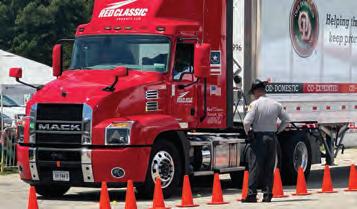


A Traffic Safety Information presentation took place on May 15 at the Volvo North America Group Headquarters in Greensboro, North Carolina. Capt. T. G. Wilson, Lt T. L. Ingold, Sgt. M. G. Conley, and Tpr. B. M. Albertson were in attendance. Tpr. Albertson and Sgt. Conley presented on the topic of pre-trip inspections and conducted a demonstration. The audience included members from Volvo Europe, Canada and North America. n


On Sept. 10, 1st Sgt. Kendell E. Jackson, newly appointed chair of the CVSA Size and Weight Committee, demonstrated the new Intercomp LTR788 Dual Tire Scale. The demonstration was conducted during the Size and Weight Committee Meeting at the 2024 CVSA Annual Conference and Exhibition in Big Sky, Montana. The audience included members of the CVSA Size and Weight Committee, which was composed of enforcement personnel and industry representatives.
The LTR788 Dual Tire Scale is designed to weigh each individual tire separately in a dual-tire setting. The scale can safely measure the weight on each tire so that weight is distributed equally across the entire body of the truck. The goal of the demonstration was to show the effect of equal distribution across a load. Participants were afforded an overview of how to find the gross vehicle weight rating of the tire and the suggested tire pressure. They also received an explanation of the applicability of Title 49 Code of Federal Regulations § 393.75 and how to enforce over-rating of a dual tire.
1st Sgt. Jackson was offered the opportunity to create a training video that CVSA is developing. The training video will show signs of unequal weight distribution and over-rating suspensions as well as over-rating a vehicle. This video will also help with post-crash investigations.
1st Sgt. Jackson would like to thank Brad Marten with the Montana Department of Transportation – Bridge Inspection Department for coordinating and providing a bridge inspection truck for the demonstration.
1st Sgt. Jackson would also like to thank CVSA Traffic Enforcement Specialist Kevin Andrews and CVSA Multimedia Specialist Terry Moore from CVSA for their assistance during the demonstration. n
Continued on next page
Continued from page 15
The 2024 Morehead City Port Check took place in September in Morehead City, North Carolina. Participating members included troopers from NCSHP Troops A, C and D. During the Port Check, weigh-in-motion (WIM) technology was used in conjunction with the Drivewyze Mobile Screening Van to assess weight penalties and violations.
The Drivewyze van is used to screen CMVs for enforcement operations. This tool provides automated readings of USDOT numbers, license plates and any hazardous material placards the CMV may have. A thermal imaging camera on the van helps check brakes as well as tires. The van is equipped with a surveillance camera that monitors traffic and can be used for other patrol needs. During the port check, training was also provided on the operational benefits of the van. The Drivewyze van will serve as an additional tool for our members to help ensure safety on our roadways.
During the week, Troop A District 9 performed 35 Level I Inspections, 89 Level II Inspections, 130 Level III Inspections and one Level IV Inspection. Out of the 255 inspections, there were 41 out-of-service (OOS) driver violations and 74 OOS vehicle violations. Over the course of the four days, troopers weighed a total of 70 CMVs using the portable scales and WIM. n

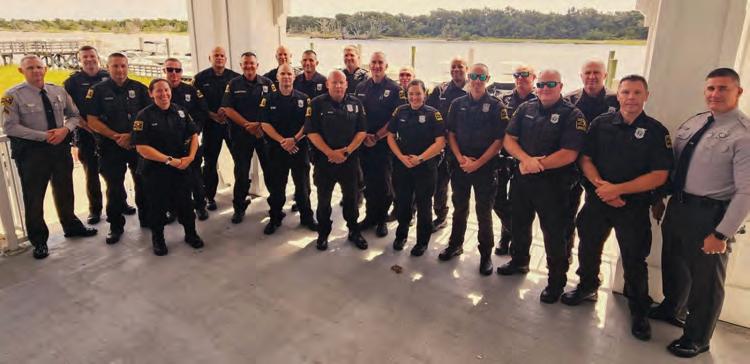


Over a four-day span, a total of 70
In July, Tpr. Brandon S. Johnson was invited by the Texas Department of Public Safety (DPS) – Commercial Vehicle Enforcement (CVE) Training Unit to attend the 2024 Texas Challenge held in Corpus Christi, Texas. This trip was intended to get first-hand exposure to the Texas Challenge and bring home ideas for creating North Carolina’s own inspector challenge. North Carolina has sought to develop its own inspector challenge for several years in conjunction with the North Carolina Truck Driving Championship. Seeing first-hand how Texas DPS coordinates and sets up this event will hopefully help make the North Carolina Challenge a reality.
Tpr. Johnson stated that the Texas DPS CVE Training Unit was very hospitable and provided an opportunity for him to shadow inspectors as they went through the scenarios. This event showed the level of cooperation that Texas DPS has with industry. Tpr. Johnson also stated it was apparent from conversations with industry that they clearly saw value in the competition of the Texas Challenge and felt that the challenge makes inspectors more proficient.
Tpr. Johnson, who has competed at the North American Inspectors Championship (NAIC), was extremely impressed with the Texas DPS’s ability to accurately recreate the NAIC competition. He said, “Walking on the competition floor felt like I was right back at NAIC and waiting for my time to compete.” Tpr. Johnson also had the opportunity to ride on the Texas DPS tactical boat in the Port of Corpus Christi and really enjoyed the experience.
He said that any state wanting to create a state inspector competition should look at Texas DPS because they have a gold standard event. Thank you, Texas, for allowing Tpr. Johnson to attend and be a part of the Texas Challenge. n

Tpr. Brandon S. Johnson competed in the 2024 NAIC in August. He was assigned to the purple team, which included members from all over North America. He praised the hydraulic brake training this year and spoke highly of the opportunity to touch and see the types of brake assist systems and learn how to distinguish a working system from a nonworking system.

When asked about the difference between this trip and past championships, Tpr. Johnson stated that the nerves were still there, but he had a better understanding of the competition and what was expected at each station. “NAIC is unique because even though it’s a competition and each person is there to win, we are always rooting on our peers and sharing information, tips and techniques to help each other. I was just as excited to watch the others win because I knew they earned it.”
Tpr. Johnson stated that a highlight of attending NAIC is getting to know many new people and seeing a lot of familiar faces. He also indicated that the training was great, and he enjoyed interacting with other inspectors to discuss common issues seen when inspecting CMVs in their home states. Tpr. Johnson emphasized the importance of teamwork, collaboration and sharing ideas during events like NAIC by stating, “We’re all smart, but none of us are as smart as all of us.” n
During the 2024 CVSA Conference in Big Sky, Montana, Sgt. Michael G. Conley presented on post-crash investigations during the Crash Data and Investigation Standards Committee meeting on Sept. 11.
Sgt. Conley began by providing an overview of North Carolina-specific crash statistics from 20222024. He also provided the history of how the post-crash training began. The presentation included a thorough explanation of the various tools, technology and components of a post-crash trailer. Sgt. Conley detailed instances when there is a need to obtain a search warrant. He also explained the process of downloading engine control modules from the CMV and the programs used to store and read the data.
Team members with the NC State University – Institute for Transportation Research and Education created a database within our internal COVERLAB system. This database was designed specifically to aid in tracking pertinent information when documenting a CMV post-crash inspection. Some items in the database include the kind of software used, engine make and model, equipment used and type of download for each collision.
Upon completing his presentation, Sgt. Conley received feedback and questions from the Crash Data and Investigation Standards Committee members in attendance. A few of the questions pertained to how the post-crash training will be implemented into policy, how the trailers are used and what steps are taken regarding certain crashes. Members from various states requested further information to model the program and to implement the trailer builds and equipment used. n


By Christopher Vinson, Midlothian (Texas) Police Department of Public Safety
Ofc. David Phillips of the Mesquite (Texas) Police Department (PD) gets just a little bit dirty while completing one of his initial 32 supervised inspections. He is pictured here speaking with the truck driver as he completes an inspection. Ofc. Phillips spent the day working toward completing his supervised inspections on I-30 in Mesquite, Texas. Ofc. Alexis Crockett of the Garland (Texas) PD assisted and provided supervision. n

By Christopher Vinson, Midlothian (Texas) Police Department
On Sept. 18, CVSA Local Members from Texas provided refreshments to truck drivers at a TA Travel Center in Terrell, Texas, as a thank you during National Truck Driver Appreciation Week, which was held Sept. 15-21. Participants included Ofc. Christopher Vinson (Midlothian Police Department), Ofc. Jason Belz (Arlington Police Department) and Ofc. Alexis Crockett (Garland Police Department), along with the Dallas-Fort Worth Council of Safety Professionals.
It's always a pleasure to celebrate National Truck Driver Appreciation Week as a way to thank all the truck drivers who work many hours to deliver all types of goods across the country. n


By Christopher Vinson, Midlothian (Texas) Police Department
Texas held its annual Texas Commercial Vehicle Inspection Challenge – commonly known by competitors as the “Texas Challenge” – for local officers across the state from July 15-17. The competition included all North American Standard Inspections to determine who would attend the North American Inspectors Championship (NAIC) in Indianapolis, Indiana.
Jared Koester of the Fort Worth (Texas) Police Department (PD) won the Texas Challenge and later won the Jimmy K. Ammons Grand Champion Award at NAIC. n

The CVSA Instructor In-Service is a three-day training event and will cover inspector in-service training materials for current certified state and federal inspectors and all changes to the certification training courses.
The CVSA/FMCSA Data Quality and Systems Training brings states together to share data quality stories and solutions. Participants will experience the synergy that happens when peers problem solve together.
To learn more, visit www.cvsa.org/events.

By Lt. Stephen Burnham, Administrative Services Assistant Director, Motor Carrier Compliance Division, Georgia Department of Public Safety
In 2019, the Georgia Motor Carrier Compliance Division (MCCD) started with an ambitious goal to implement a driving simulator program as part of its safety outreach and educational efforts. The initiative was one aspect of its broader mission to enhance highway safety for commercial motor vehicles (CMV), their operators and the general motoring public while operating on Georgia’s roadways. During the program's initial planning and developmental phase, MCCD established an additional committed goal to use this program to reach youth drivers.
Through a comprehensive selection and procurement process, the Georgia Department of Public Safety (DPS) elected to invest financial resources and give life to the program by acquiring a new truck-tractor and a 53’ custom trailer in spring 2021. Housed within
the trailer are six simulators that display realistic graphics, enhanced interactive gaming steering wheels and foot pedals. Two primary objectives were established by the Georgia DPS and put into action when the program was unveiled:
Provide realistic, hands-on training to non-commercial vehicle drivers to help them better understand the challenges and limitations CMV operators face on a dayto-day basis. Essentially, let them see the road through the eyes of a CMV driver. Does a CMV driver need more distance to stop? Does a CMV need more space to make a turn safely? Is there a difference in the blind spots of a passenger car versus a big truck? Through the simulator program, non-CMV drivers learn that the answer to each of these questions is
a resounding “yes.” Creating a safe training environment where non-CMV drivers can experience these challenges firsthand can significantly improve their understanding of how to share the road with CMVs safely.
Reach the youth driving population at school and other educational affiliated events. Per a report in the U.S. Department of Transportation National Roadway Safety Strategy, crashes are the leading cause of death for teenagers in America. Youth driving education is crucial for developing safe and responsible young drivers. By simulating real-world driving scenarios, the simulator improves youth driving skills and awareness, ultimately reducing the risk of crashes. The variety of different driving scenarios allows students to practice and make mistakes

The driving simulator program is a forward-thinking initiative aimed at improving highway safety in Georgia
without real-world consequences, giving them an opportunity to improve and build their driving confidence. Drivers developing their driving skills through the simulator can experience scenarios both in a CMV and a passenger vehicle.
MCCD has partnered with a host of organizations, schools and government agencies to raise CMV safety awareness and provide training. Since the implementation of the program, the driving simulator has proven to be a significant resource for the department’s safety and outreach initiatives. In summary, the driving simulator program is a forward-thinking initiative aimed at improving highway safety in Georgia. By offering non-commercial drivers a firsthand experience of the challenges CMV operators face, the program enhances understanding
and promotes safe driving behaviors. Targeting younger drivers ensures that these crucial safety lessons are learned early, contributing to a safer driving environment for everyone on the road.
This initiative highlights the department’s dedication to fostering a culture of safety and awareness among all drivers traveling the state. This proactive effort highlights the Georgia Department of Public Safety’s commitment to creating safer roadways for everyone through innovative, non-traditional law enforcement methods and driver engagement.
If you have any questions, we can be reached at (770) 624-7700. To request the driving simulator in Georgia, visit dps.georgia.gov/ form/request-a-driving-simulator. n


By Capt. Stephen Holmes, South Carolina State Transport Police, South Carolina Department of Public Safety
Members of the South Carolina State Transport Police (STP) Motor Carrier Compliance (MCC) Unit joined representatives from the South Carolina Department of Motor Vehicles (SCDMV) Motor Carrier Services Division at the South Carolina Department of Public Safety headquarters on July 11 for a workshop geared toward new motor carriers.
This workshop, the first of its kind, saw more than 45 new motor carriers and industry members in attendance. STP and SCDMV provided attendees with an overview of several areas that can help motor carrier operations, including new entrant safety audit guidelines, International Fuel Tax Agreement information, International Registration Plan information and more. Motor carriers were also introduced to the new Motor Carrier Services mobile application from the SCDMV, which provides real-time information about their motor carrier account. n


Officers and staff of the South Carolina State Transport Police joined a compassionate crew of truck drivers on Aug. 24 to escort the Truck Convoy for Special Olympics South Carolina to raise awareness and funds for more than 30,000 Special Olympics athletes while changing attitudes toward people with intellectual disabilities.
The Truck Convoy is a national celebration of the trucking industry and its support of the Special Olympics. Inspired by the powerful impact Special Olympics has had on his life through his participation in the Law Enforcement Torch Run, combined with his job duties as an STP officer and respect for the trucking industry, Mike Still, retired STP sergeant and current Special Olympics South Carolina Law Enforcement Torch Run
liaison, organized the first Truck Convoy in 2008. This one-day celebration of the trucking industry has helped raise awareness and funds for Special Olympics South Carolina and brought the community together for more than 15 years. This event marked the largest to date, with approximately 250 trucks coming out to support Special Olympics athletes. Together, the community raised more than $90,000, which directly supports Special Olympics athletes in South Carolina.
A lunch celebration was followed by an awards ceremony to recognize participating truckers and their support of the trucking industry and the Special Olympics. n


The South Carolina Department of Public Safety Director, Robert G. Woods IV, named a new South Carolina State Transport Police commander on June 3, in conjunction with two command staff promotions.
Dwayne D. Wilson, a 29-year veteran of STP, was chosen to succeed Col. Dean M. Dill, who retired at the end of June after nearly 30 years of service to the state. Wilson began his career with STP in 1994.
“I am proud to be a part of this agency, and I am both humbled and grateful to accept this new responsibility,” said Wilson. “I have worked closely alongside Col. Dill for a number of years, and I will miss his leadership and direction. However, I have a great command staff, and together, I am confident that we will continue to push STP forward and carry on the positive legacy that Col. Dill has modeled.”
Dill served as commander of STP since 2020 and retired on July 1. Since his career began in 1994, he has served in both enforcement and administrative capacities. Dill was the first STP commander to work his way up through the ranks, from officer to colonel.
Two additional command structure promotions were announced on June 3. Maj. Lee T. Catoe was promoted to the rank of major and named as the next STP executive officer to replace Wilson. Major Catoe began with STP in 2007, most recently serving as captain over the Lower State Regions 1, 5 and 6, along with the Community Education and Outreach unit since 2020. Catoe is an eight-year veteran of the U.S. Army, where he achieved the rank of sergeant.
Capt. Charles T. Norton Jr., a Darlington native, was named captain of the STP lower state region to replace Maj. Catoe. Capt. Norton began with STP in 2010, most recently serving as a lieutenant at STP Headquarters since 2021. A 31-year law enforcement veteran, he previously served with the Florence Police Department and Darlington County Sheriff’s Office. n


The South Carolina State Transport Police held a graduation ceremony on Aug. 16 for 17 new officers and three new auditors for the Motor Carrier Compliance Unit. This graduating class included 10 pre-certified law enforcement officers and seven new to the profession. These recruits came from all areas of the state, as well as from other states such as Missouri, New York and North Carolina.
“It is an honor to welcome the latest graduating class to STP and the broader family of DPS as a whole," Woods said. “As officers, they have chosen a selfless and often challenging line of work. We are grateful they have risen to the challenge, and I look forward to seeing them excel in this profession.”
New STP officers attend and graduate from basic training at the South Carolina Criminal Justice Academy. Each officer then goes on to complete more specialized commercial motor vehicle training. The total training time for a new STP officer is nine months. Training includes basic law enforcement, size and weight enforcement, hazardous materials regulations, safety inspections and Federal Motor Carrier Safety Regulations.
“Words can only begin to describe how proud I am of these exemplary individuals,” said Col. Wilson. "As colonel, I have the unique opportunity to see firsthand the tireless work the men and women of STP put in on a daily basis. I am confident that these graduates will make an invaluable addition to our team and continue to make us proud.” n


By 1st Sgt. Larry Montgomery Jr., Motor Carrier Safety Unit, Virginia State Police
The Virginia State Police Motor Carrier Safety Unit (MCSU), in cooperation with the Federal Motor Carrier Safety Administration (FMCSA), conducted six weeks of concentrated enforcement projects on I-81 from June 10 to Aug. 30. The project, called the I-81 Initiative and formerly known as “The 100 Days of Summer,” involved the MCSU troopers, supervisors, patrol troopers and area troopers working the I-81 corridor. The project focused on large trucks, buses and passenger vehicles in special emphasis areas. The special emphasis areas included high crash areas on I-81, across the corridor to include the boundaries of Virginia State Police Bureau of Field Operations (BFO) Division II (Culpeper), Division III (Appomattox), Division IV (Wytheville) and Division VI (Salem).
Inspectors conducted 1,714 CMV safety inspections, with the following results:
3,111 total violations cited
303 vehicles placed out of service
144 drivers placed out of service
1923 total summonses issued
The results of this enforcement initiative indicate the extraordinary efforts our MCSU troopers and BFO area troopers put forth daily as they work to improve passenger and commercial motor vehicle (CMV) safety across the commonwealth. n

On Aug. 6, the Virginia State Police MCSU Area 64 Wytheville, in partnership with the Virginia State Police Auto Theft Unit (HEAT), participated in the Town of Wytheville's First Annual National Night Out. The event was sponsored by the Town of Wytheville and held in the Wytheville town park. MCSU Master Tpr. Joseph Ferland and HEAT Special Agent Jared Goad represented the agency and interacted with those in attendance. The attendees were provided information on CMV and passenger vehicle safety, auto theft deterrence and human trafficking. BFO area troopers put forth daily as they work to improve passenger and commercial motor vehicle (CMV) safety across the commonwealth. n

On July 30, World Day Against Human Trafficking, the Virginia State Police MCSU, FMCSA, Virginia Department of Motor Vehicles (DMV) Commercial Vehicle Enforcement (CVE), Virginia Tech Traffic Institute and Virginia Trucking Association conducted a press conference for the kickoff of the I-81 Crash Reduction Initiative. The event was held at the Stephens City scales on I-81 in Frederick County. Each agency discussed its efforts in relation to the initiative.
Additionally, all the agencies spoke about their involvement in the epidemic of human trafficking. After the press conference, the members of the Virginia State Police MCSU and Virginia DMV CVE conducted CMV inspections, providing an educational element to drivers on crash reduction and human trafficking. n
On July 23 and Aug. 28, Virginia State Police MCSU Area 65 Suffolk participated in two different motorcoach projects in cooperation with the Virginia Motorcoach Association (VMA). The July project involved conducting Level V Inspections on motorcoaches at Venture Tours in Virginia Beach. Venture Tours provided their inspection and repair facility for this operation in cooperation with VMA. These projects were a success in the collaboration between industry and enforcement. During the August project, the MCSU conducted a short presentation and an inspection demonstration for the joint conference in Williamsburg of the VMA, North Carolina Motorcoach Association and Motorcoach Association of South Carolina. n

By Job Huisman, Commercial Motor Vehicle Unit, Iowa State Patrol, Iowa Department of Public Safety
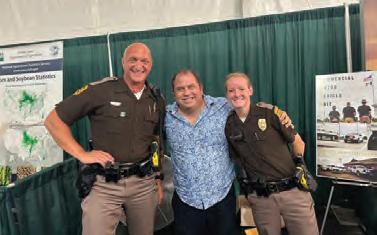
On Aug. 27, the Iowa State Patrol Commercial Motor Vehicle Unit (CMVU) conducted Passenger Carrier Vehicle Inspections at the 2024 Farm Progress Show in Boone, Iowa. Over the course of the three-day event, 46 buses were inspected, and inspectors identified 11 violations, with one being placed out of service. Our goal is to have all attendees traveling by bus to this large-scale event arrive and return home safely.
This event wasn’t just about inspections and enforcement; it also had an education and outreach component. The CMVU training team and road troopers operated an information booth within the Farm Progress Show. This booth facilitated interaction between agricultural industry representatives and enforcement personnel, allowing them to learn about each other’s daily operations while providing a platform for discussions regarding enforcement and regulations affecting the agriculture sector. n



By Tpr. Jay Kirkpatrick, Commercial Motor Vehicle Unit, Iowa State Patrol, Iowa Department of Public Safety
Whether you just passed your initial North American Standard Part A Inspection exam or have been on the business end of a creeper for a quarter of a century, there is always room to improve. Below are a few hints for all of us to stay out of bad habits and avoid complacency.
The primary thing we should all try to drive home when training a new trooper is something I learned from a veteran inspector: If the component has the ability to loosen or tighten, put your hands on it and check it. Whether it is an axle one-wheel fastener, a fifth-wheel fastener, a right-side axle five brake chamber bracket fastener, or anything in between, the only way to tell if it is tight is to check it.
This attitude can also give the veteran inspector a little nudge. Have you ever stopped checking something because you think, “I haven’t seen a loose one of those for five years, so I’ll just give it a quick look and move on?" I was at a scale facility working with one such inspector last month and asked why he didn’t check fifth-wheel fasteners. After a conversation, he checked the fifth-wheel fasteners on the next truck he parked, and the second fastener he checked was loose. That was an eye-opening experience for him and helped recharge his batteries. At the end of the day, he asked me to revisit that inspection. He said it was like a punch in the gut, and he was scared to think how many potential out-of-service (OOS) violations he missed due to this bad habit.
Start learning from other inspections. Ask a driver when their last inspection was and how it went. Even though we already know the answer because we have that inspection pulled up on our screen, it is valuable to see what other inspectors in other states find and how they document the violations. If your violations and code sections differ, do some digging in the code book. If another inspector placed a driver or vehicle OOS and you were not going to, or vice versa, dig into the book to find out why. Take the extra minute to get it right. It is only fair to industry that we provide consistent enforcement throughout North America. Plus, consistent enforcement will also help the DataQ processors in your state when violations are challenged.
Speaking of the code book, here’s another strategy I recommend: Make a point to read one section and the related interpretation questions a couple times a week and work your way through the book. It will only take
"Despite having been under thousands of trucks, I just learned something from a guy who has been on the job for less than a year."

a few minutes to read a section. I suggest reading the applicability and definitions first. Even after having read the code book many times, I still find nuggets of information that will make me a better inspector and a much better instructor. Are these 10 minutes really glamorous? Most definitely not! Will it make all of us better at our job? Most definitely!
While working at a scale facility with other troopers/officers/inspectors, don’t just work at the scale together – actually work together. What I mean is that, occasionally, two inspectors should work on the same truck at the same time. Do the walk around together and run your creepers side by side while underneath. Talk to each other about what you’re individually checking and what violations you have found. Swallow your pride and be receptive to what your partner has to offer. Despite having been under thousands of trucks, I just learned something from a guy who has been on the job for less than a year.
Another idea is to grab your supervisor and do an inspection with them. They are a supervisor for a reason; they know things. However, being a supervisor brings other responsibilities, and sometimes, since the 37-step process is a perishable skill, it is easy for inspection competencies to diminish. Supervisors, don’t be afraid to employ this tactic with each member of your crew. You will be amazed at the street cred you will develop.
If your department does not have a dedicated training team, volunteer to instruct/do industry presentations. When you do these, you absolutely have to prepare. If you walk in and “shoot from the hip,” your audience will sniff that out really quickly. Preparing your presentation will get you in the book, and getting in the book is how we learn the code. You will be surprised at the off-the-wall questions fired at you in these settings. When you get one of these questions, don’t give an opinion. If you don’t know the answer for sure, there is nothing wrong with admitting to the group that you have never heard of or thought of that scenario. Then, tell the group you will research, get the correct answer to the group’s point of contact, and the contact will get the answer to the group. They will appreciate your honesty, and your credibility with industry will soar when you follow through with the point of contact.
In the interest of consistent enforcement in North America, but more importantly, for the safety of the motoring public, inspect a commercial motor vehicle like somebody’s life depends on a proper inspection. Ultimately, it does. n
On July 31, the Ministry of Infrastructure, Communications and Transportation (SICT) published in the Official Gazette of the Federation (DOF) an update to the agreement regulating international longdistance trucking in Mexico for carriers from the U.S. and Canada. This is considered a significant step toward standardizing and simplifying cross-border operations between the three North American countries that comprise the Free Trade Agreement.
This update benefits carriers by aligning with the previous agreement and formalizing Mexico's trade commitments in the 20112014 Pilot Program on Transportation. The agreement facilitates authorizations for Canadian and U.S. carriers and provides legal certainty for permits issued by the General Directorate of Federal Motor Transport (DGAF) to date and for new permits to be granted.
In addition, the update includes Canada in the treaty between the three countries and establishes the operation with drivers formally hired by the companies. This not only provides legal and labor security to drivers but also ensures their access to social security and immigration services, promoting a safer and more regulated work environment. n
Rapid technological advances, changes in public policies and global economic dynamics have made the Road Transport Symposium a crucial space for discussing and analyzing the challenges and opportunities facing this vital industry.
Industry, academia, union representatives, representatives of the International Transport Workers' Federation (ITF) and the Mexican government came together on June 25-26 in Mexico City for the Road Transport Symposium: Analyzing Challenges and Opportunities for the Future.
The main objective of this symposium was to bring together leading industry players to identify and analyze emerging challenges and promising opportunities that will shape the future of road transport. From digitalization and environmental sustainability to road safety and working conditions, the event addressed a wide range of critical issues directly affecting the industry.
The event's opening was attended by SICT Undersecretary Rogelio Jiménez Pons, President of the Communications and Transport Commission of the Senate of the Mexican Republic Senator Freyda Marybel Villegas, ITF General Secretary Stephen Cotton and ITF Regional Secretary for Latin America Edgar Diaz.
During the conference, contributors identified challenges and opportunities in the road transport industry, including expanding the geographical and social coverage of infrastructure and services, improving the efficiency of different modes of transport, and enabling people and goods to move efficiently from one place to another through
sustainable transport, zero carbon emissions and responsible labor legislation.
The theme of empowering women and young workers allowed attendees to discuss challenges and solutions for integrating and training women and young workers in road transport, considering the current conditions of equity and the balance of caregiver work predominant among women.
The conference also addressed global perspectives. Foreign panelists shared knowledge and experience from their countries that could influence national policy to raise industry standards and guarantee the rights and conditions of male and female workers.
Finally, in a meeting focused on supply chain security, the discussion reflected on international trade models based on transparency, accountability, labor rights, equality and sustainability. This included the importance of the Safe Tariff model to avoid social dumping between countries and the reduction of labor rights. n
Continued on next page
Continued from page 27
On May 3, 2023, the DGAF published the Regulations for Auxiliary Services to Federal Trucking and Salvage, establishing specific rules, guidelines, and administrative provisions for this service. These regulations provided legal certainty and a transparent framework that motivated the implementation of identification plates for tow trucks.
On Aug. 30, the DGAF presented the new federal metal plates to identify towing and salvage trucks. This initiative seeks to modernize and professionalize the sector by improving road safety, increasing transparency in operations and reducing costs for users.
Implementing these plates represents a crucial step toward greater transparency in federal trucking. These new plates will allow for clear identification of the type of service provided, strengthening safety and improving traffic efficiency on Mexican highways.
Towing services have historically been one of the most challenging segments in the sector. For this reason, a new regulatory framework has been created, which includes the first Federal Regulation of Auxiliary Towing and Salvage Services and vehicle deposits. This regulation establishes a fee calculator to avoid excessive charges and guarantee fair prices for users.
The SICT has developed a solid and transparent regulatory framework that regulates the cost of services through the fee calculator, avoiding additional charges and excessive prices for users.
In addition, new information technologies, such as the SIRSE system, have been implemented, which allows remote monitoring of services provided. This ensures strict compliance with the law and prevents inappropriate practices.

The new metal plates have the following benefits:
Increased road safety: Clear identification of tow trucks facilitates better surveillance and quick response in case of accidents.
Transparency in operations: The SIRSE system makes monitoring services possible, avoiding abuse.
Cost reduction: It ensures users pay fair prices based on the fee calculator.
Strengthening the Rule of Law: The new regulation provides greater certainty to the trucking sector.
These new metal plates are not simply identification elements; they represent the government's commitment to road safety on the country's highways. The SICT concluded that allowing clear identification of tow trucks improves surveillance and response capacity in emergency situations, thus reducing risks for all drivers. n


On Sept. 11, the SICT brought together industry leaders to present the new federal license plates designed specifically for electric vehicles. Representatives of the National Association of Private Transportation (ANTP), the National Chamber of Cargo Transportation (CANACAR), the National Chamber of Passenger and Tourism Transportation (CANAPAT), and BYD Electric attended the event.
This announcement marks a crucial step toward modernizing Mexico's vehicle fleet and promoting more sustainable mobility. The new license plates, with a distinctive design, will help identify electric vehicles on public roads and align with national policies to reduce emissions and promote clean energy.
During the presentation, Nohémi Muñoz, head of the DGAF in the previous administration that ended in September, highlighted that these plates are implemented to accelerate the electrification of motor transport. “This advance is the result of the joint effort of chambers and associations to promote the transition towards cleaner technologies,” Muñoz stated.
In this context, ANTP Executive President Leonardo Gómez highlighted the need to complement the drive toward electrification with the renewal of the vehicle fleet. “The incorporation of more modern units will allow us to significantly reduce emissions of greenhouse gases and fossil pollutants, contributing to a significant reduction in pollution,” said Gómez.
The introduction of these federal license plates represents not only an innovative measure but
also a reaffirmation of Mexico's commitment to a greener and more efficient future in terms of transportation. With the new license plates in sight, the country is moving toward more sustainable mobility, demonstrating an ongoing effort to improve air quality and support the development of clean technologies.
Jiménez Pons closed the event by stressing that the presentation of these plates is the first step in a series of fundamental reforms for the country. “It is not only about complying with international agreements such as the Paris Agreement but also about ensuring a sustainable future for our families and for Mexico,” stated Jiménez Pons.
In addition, Gómez stressed the importance of developing adequate infrastructure for the freight network, a point on which CANACAR President Miguel Ángel Martínez agreed. Martínez emphasized that having the necessary infrastructure in place encourages greater adoption of electric technologies and will support the transition to a greener fleet.
With these measures, Mexico is moving closer to greener and more modern mobility, consolidating its role as a leader in the adoption of sustainable technologies in transportation. n
Continued on next page


Continued from page 29
From Sept. 23-27, a specialized training course on the application of NOM-068-SCT2-2014 was held for personnel from the SICT, the National Guard and the Mexican Institute of Transportation (IMT). This joint effort aimed to enhance road safety and ensure regulatory compliance in land transportation by properly implementing North American Standard Level V Inspections.
The course, conducted at the IMT facilities in Sanfandila, Querétaro, is vital to the DGAF's inspector training program. Its main objective is to provide inspectors with the tools and knowledge necessary to assess and verify compliance with the safety requirements outlined in NOM-068-SCT2-2014, which sets the minimum criteria for the safe operation of cargo vehicles.
During the training sessions, participants analyzed the regulations in depth, learning how to identify vehicle deficiencies and apply CVSA’s 2024 Out-of-Service Criteria. These criteria are essential for ensuring vehicles on the road meet the minimum safety standards, reducing risks and preventing crashes on Mexico’s highways.
The course structure included classroom and roadside sessions. Attendees familiarized themselves with state-of-the-art inspection tools and methodologies and received detailed training on evaluation and reporting techniques. National and international experts shared key experiences, providing a global perspective on challenges and best practices in vehicle inspection.
This international collaboration, which includes support from the Federal Motor Carrier Safety Administration (FMCSA) of the U.S. Department of Transportation, highlights the binational commitment to raising safety standards in land transportation. The rigorous implementation of NOM-068-SCT2-2014 is not only vital to protecting the lives of operators and road users but also fosters a culture of prevention, responsibility and compliance.
Authorities have called on various industry leaders in the transportation sector to stay up to date with regulations and actively participate in future training sessions. Only through joint efforts will it be possible to continuously improve road safety standards in Mexico and ensure safer highways for everyone. n


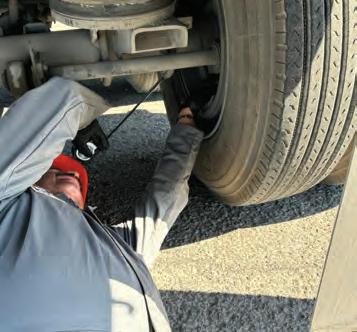
By Col. Russ Christoferson, Bureau Chief, Montana Department of Transportation; CVSA Past President
On July 11, Capt. Kevin Adkins, Montana Department of Transportation (DOT) Motor Carrier Services (MCS) District 5 supervisor, received a series of strange emails from an unfamiliar source. In the first set of emails, there was an attachment for an overweight/oversize superload permit. While inspecting the contents of the email, it was determined that the sender may be in a human trafficking or labor trafficking situation. The attachments that accompanied the emails were screenshots of a mobile device that had sexually explicit photos and sexual innuendos, along with a message insinuating the victim was being trafficked. Capt. Adkins was able to identify the vehicle from the superload permit and sent an email to his district officers asking them to look for the truck.
MCS Cpl. Justin Moran was patrolling the area west of Billings, Montana, and spotted the suspect vehicle at a truck stop in Columbus, Montana. He initiated a traffic stop on the vehicle after it entered the highway. Then, two vehicles appearing to be pilot vehicles pulled up behind the patrol vehicle. After speaking with the male driver of the truck-tractor, Cpl. Moran went back to speak with the pilot vehicle drivers. The first pilot vehicle was driven by a woman who appeared to be under duress and was identified through questioning that she was the one who had sent the emails. The victim was afraid to keep talking and didn’t want to get in trouble, but Cpl. Moran assured her that he was there to help. The woman broke down crying, thanking him. Cpl. Moran told her that he had to speak with the driver of the truck-tractor and perform an inspection because additional help was on the way, and he wanted to buy some time.
Capt. Adkins arrived on the scene shortly thereafter, along with two Division of Criminal Investigation (DCI) agents. The DCI agents interviewed the male driver and the female victim separately and pieced together what had transpired. The driver of the truck-tractor was an owner-operator who leased his trucktractor, along with the pickup truck (the pilot vehicle), to the carrier. The driver offered the victim a job to drive the pilot vehicle from Iowa to Montana and promised a certain amount of money. During the trip, the amount to be paid was reduced from what was initially promised. Whenever the victim asked about money, the man would only give her a small amount,
keeping the remaining balance to help control the victim. The man would not provide any money for lodging and would tell the victim that she could sleep with him in his truck.
The night before the stop was fairly cold, and the man refused to let the victim sleep in the pilot vehicle. He told her that she had the option of sleeping outside or in his truck. He then began to send multiple sexually explicit text messages to the victim, asking her to come into the sleeper berth of his trucktractor. When the victim told the male that she was going to leave, he stated that she could leave, but he would report the pilot vehicle as stolen. He threatened her by saying she would be arrested and no one would believe her. The man drove the victim to a nearby truck stop, would not give her any money and told her to find her own place to sleep for the night. At some point during the night, the victim began sending out emails, one of which was to Capt. Adkins.
During the interviews, the victim stated that she was in recovery from addiction and had very little trust in law enforcement. She was still worried she was in trouble because she didn’t think they believed her. The DCI agents reassured her that they did believe her and would help get her away from the situation. The DCI agents let the victim know that resources were available; they could arrange for her to stay in a motel for the night and purchase a plane ticket home for her. The victim agreed, grabbed her belongings and went with the agents to Billings, where she was given a safe location to spend the night. The following day, she was given an airline ticket to her parents’ home in Kentucky.
The human trafficking training that Cpl. Moran and Capt. Adkins received from TAT (formerly Truckers Against Trafficking) at the MCS annual in-service training in 2019 gave them the tools and knowledge to identify the trafficking situation and utilize the proper resources. Their professional and empathetic demeanor during the traffic stop and their cooperation with other agencies removed the victim from a dangerous situation.
Since the victim has returned home, she has emailed Cpt. Adkins on two separate occasions. The emails (shown at left) have been edited to remove identifying details of the victim and details of sexual harassment, sexual assault and rape. n


By Lt. Alberto Perez, Commercial Operations and Traffic Homicide Unit, Nevada Highway Patrol
On Sept. 18, the Nevada Highway Patrol (NHP) Commercial Enforcement Division held its second annual Truck Driver Appreciation BBQ in Elko, Nevada, at the Osino westbound checksite located on I-80. More than 700 professional drivers were recognized and honored for their vital contributions to our country and economy. Drivers were greeted with smiles and thanked for everything they do. Thank you to all our sponsors and volunteers for making this 2024 National Truck Driver Appreciation Week event possible. n


The NHP Commercial Enforcement Division participated in multiple radiological training events in September. At the Nevada ROAD-TREX events on Sept. 4, 5 and 7, first responders from multiple agencies had the opportunity to exercise their capabilities in response to critical incidents involving radiological materials.
The U.S. Department of Energy Transportation Emergency Preparedness Program, in cooperation with state, federal and local agencies, including the U.S. Department of Energy’s Waste Isolation Pilot Plant, Nevada State Police, Nevada Civil Support Team, Nevada Division of Emergency Management, Nevada Office of Nuclear Projects and the Nevada Radiation Control Program, conducted this transportation training and exercise event.
The ROAD-TREX events allowed first responders along and near the I-80 corridor to practice their skills in response to a transportation accident involving radiological materials. The exercises involved the use of live radiation sources. n


First responders from multiple
The NHP Commercial Enforcement Division held a 72-hour checksite event operation Aug. 27-29 in conjunction with CVSA’s Brake Safety Week. The event was held at the Osino checksite on I-80 in Elko, Nevada.
This operation resulted in 381 North American Standard Inspections; more than 600 safety violations were identified and documented, and many unsafe vehicles and drivers were removed from our roadways. n
By Piper Caravella, Safety Investigator, Motor Carrier Division, Utah Department of Transportation
Safety investigators at the Utah Department of Transportation (DOT) had quite the surprise during a North American Standard Level III Inspection at the Perry Point of Entry in Box Elder County, Utah. During a typical driver/ credential/administrative inspection, inspectors discovered a machete on the passenger sidestep of a truck. After informing the driver, he said it was not his and he had never seen it before. You just never know what you will find while inspecting at the ports. n


By Media Relations, Halton (Ontario) Regional Police Service
The Halton Regional Police Service (HRPS) is pleased to share the results of the annual Commercial Motor Vehicle (CMV) Enforcement Blitz that was held at Elements Casino Mohawk in Milton, Ontario, on Oct. 1 and 2. Working with in excess of 80 police officers and ministry officials from police services and agencies across the Greater Toronto Area and Southwestern Ontario, a total of 487 trucks were subject to mandatory inspection over the two-day event.
Police officers, who receive specialized training in commercial truck inspections, placed 132 trucks (27%) out of service until critical repairs were completed. Areas of concern included driver licensing, daily trip inspections and hours of service, along with truck-oriented issues, which included mechanical fitness, cargo securement, and weights of trucks and loads – to ensure compliance with permits and to prevent overloading of an inspected truck’s frame, which can lead to brake failures.
A total of 322 charges were laid for various violations and infractions, which is a 10%
increase from 2023. A total of 35 trucks were also found to be in such a sufficiently deteriorated state that the license plates were seized, forcing the truck owner to make repairs to recertify and re-plate the vehicle.
There was also an increase over 2023 in incidents of truck drivers found operating with a suspended driver’s license, with over a dozen charges laid. One driver was found to be prohibited from driving and was criminally charged, with the truck impounded for 45 days at the truck owner’s expense.
“The results of this year’s HRPS CMV blitz are both impressive in terms of our ability to collaborate with our partners to achieve results; however, they’re also a disappointing reminder that unsafe trucks continue to be operated on area roadways,” said HRPS Staff Sgt. Ryan Snow. “Truck safety and enforcement is a 365-day-of-the-year commitment for police, and we encourage truck drivers and owners to do their part to maintain safe roads.” n

By Amber Davies, Commercial Vehicle Safety and Enforcement, British Columbia Ministry of Transportation and Infrastructure
A few years ago, the British Columbia (BC) Ministry of Transportation and Infrastructure posted an article titled “Throwback Look at BC’s Historical Commercial Weigh Scale Stations” on TranBC.ca. In that article (and included here), photos from the 1960s depict inspection stations and scales sized for the much smaller commercial motor vehicles of the day. Besides evoking some serious nostalgia, the contrast of these images with today’s facilities, programs and technologies tells the story of our ongoing evolution to support a safe commercial trucking industry, now and into the future.
Currently, about one-third of BC’s inspection stations are equipped with intelligent transportation systems through our Weigh2GoBC program. And the number is growing.
Six locations have automatic vehicle identification (AVI) technology, which checks
height and credentials like carrier safety ratings and insurance. While vehicles are still weighed manually at the scale, if the first station stop on a trip is an AVI, those that pass all checks may get a “green light” to bypass stations for the following 24 hours.
Five more locations have weigh-in-motion (WIM) technology, which does everything AVI does and measures vehicle weights and dimensions as vehicles pass sensors at the site. Those which clear all checks may get an automatic green light to bypass that and other stations for the next 24 hours.
Other technologies, like tire anomaly and classification systems that detect missing or underinflated tires, are also being implemented in our new locations. This June, we opened a WIM station near the city of Terrace. Not just for inspections, this location provides drivers with access


to oversize-vehicle staging for interregional transport trips as well as amenities, including short-term and overnight parking, washrooms accessible during office hours, rest-area toilets open 24/7, refrigeration unit plug-ins and Wi-Fi.
Work on two more WIM stations is also underway, on Highway 16 near Mt. Robson and Highway 5A north of Merritt. These will be entirely virtual, transmitting data in real time to officers in the area.
Our top priority is the safety of commercial motor vehicles operating on provincial highways. As we look to the future, we intend to upgrade existing inspection stations, build new locations with these technologies, continue improving goods movement and enhance commercial motor vehicle safety throughout BC. n


In the world of transportation, commercial motor vehicles (CMV) are the lifeblood of commerce, delivering everything across North America, from food and medicine to building materials and technology. With an estimated 4.5 million truck drivers in North America, the role of commercial vehicle enforcement (CVE) is critical. These inspectors and officers (terms which we’ll use interchangeably in this article) serve as the guardians of highway safety, ensuring vehicles and drivers adhere to complex state and federal regulations.
For those just beginning their careers in CVE, the landscape can seem daunting. However, with the right mindset, tools and support, new inspectors can quickly acclimate to their roles and make meaningful contributions to road safety. This article will explore key advice for new commercial motor vehicle enforcement officers and inspectors and the various resources available to help them succeed.
Continued on next page
Continued from page 35
Seasoned inspectors will tell it like it is: This field has a steep learning curve, and new officers must learn to embrace it. CMV enforcement involves a deep understanding of specialized laws and regulations, such as the Federal Motor Carrier Safety Regulations (FMCSRs) and the Hazardous Materials Regulations (HMRs), as well as the handbook that guides enforcement actions, CVSA’s North American Standard Out-of-Service Criteria. These regulations are designed to ensure the safety of drivers, cargo and the general public, but they are complex, everevolving and may be interpreted differently from state to state.
For new inspectors, this means dedication to learning is vital. Formal training, continuing education and self-study are all essential for staying up to date with the latest developments in CMV enforcement and becoming effective inspectors.
Fortunately, new CVE inspectors have access to a wide range of training programs to help them build a strong foundation of knowledge. To get acclimated to North American Standard Inspection procedures, new officers take certification classes offered by CVSA through a partnership with the Federal Motor Carrier Safety Administration. North American Standard Inspection Parts A (Driver) and B (Vehicle) are occasionally offered back-to-back in the same location for the convenience of students. They are also held many times in many different regions to help educate future inspectors across North America.
These training courses teach the basic knowledge, skills and procedures necessary for performing CMV inspections under the Motor Carrier Safety Assistance Program (MCSAP). Part A and B instructors teach participants how to conduct and complete inspections in accordance with the FMCSRs and apply them during a safety inspection of a CMV and its driver. Parts A and B make up a comprehensive baseline for new CVE officers to confidently perform their initial 32 inspections, supervised by a MCSAP-certified officer. In fiscal 2024, Part A was offered 135 times and Part B was offered 110 times, for a total of 3,712 individuals attending training.
“The class has an extraordinary amount of information to learn in a one-week period, but the way it is structured allows any individual to understand the information,” said a Part A participant in a recent anonymous survey.
“The class was very well put together. Stories from the instructors helped me to understand material that was, at first, confusing.”
As with any law enforcement role, mentorship is critical to a new officer’s success. Experienced officers have a wealth of knowledge that can’t always be found in a classroom or textbook. Whether learning how to handle difficult roadside situations or understanding the nuances of specific regulations, mentors play a crucial role in helping new officers acclimate to the job.
New inspectors should seek out experienced colleagues and supervisors who can provide guidance and support. These mentors can offer practical tips, share stories of past experiences and help new officers navigate the challenges of the job. Having a go-to person for advice can mean the difference between feeling overwhelmed versus being confident in your abilities. Like most other specialized units in law enforcement, no one will expect you to do this job alone, and no one will expect you to be an expert on day one. Know who and when to ask for help.
“Brian Wilson, who has since retired, was my mentor when I started in the MCSAP unit in Colorado. We would set up team operations and knock out inspections all day long,” reminisced CVSA Director of Training Services Shannon Heck. “He taught me how to do safety talks and just have fun. (He also got me hooked on breakfast burritos.) That guy stayed busier than anyone else I knew, and he knew more about the regulations than anyone else. His biggest and best piece of advice was: If you don't know, admit you don't know and then go find the answer.”
“It’s critical to take your time and observe as many different people as possible,” said CVSA Director of Compliance Programs Katie Morton. “Learning and listening to a variety of teaching styles and ways of explaining regulations will expose you to many strong skill sets to adapt into your own style.”
“Pairing seasoned CVE inspectors with new inspectors is a mutually beneficial partnership that is seldom utilized to its full potential,” added CVSA Traffic Enforcement Specialist Kevin Andrews. “Typically, it ends up with the seasoned inspector watching the new inspector, making sure they do a good job. But what about the seasoned inspector who may be a little complacent or maybe hasn’t
been back to training in a while? Are they even aware of any regulation changes? Sometimes, new inspectors can be helpful to seasoned inspectors by reminding them of things they might have forgotten.”
However, a newly trained inspector may be the only inspector in their department, especially in local jurisdictions. But, by getting involved with CVSA, new inspectors are exposed to a world of possibilities when it comes to networking and skill sharing. Attending events, such as CVSA Workshop, held each spring, and CVSA Annual Conference and Exhibition, held each fall, will give new inspectors the opportunity to meet folks from their jurisdiction who can provide jurisdiction-specific guidance and invite them to collaborative enforcement events where they can network with enforcement and industry representatives from all across North America to develop the big picture of CMV safety and enforcement in our world today.
Check out advice from CVSA Local Member President Chris Vinson on page 37.
Additionally, those new to CVE can explore CVSA’s committees and programs to learn more about and get involved in niche areas of CMV enforcement, whether they’re interested in human trafficking prevention, hazardous materials/dangerous goods (HM/DG), policy and regulatory affairs, data collection and information systems, and much, much more. Every time you’re in a room with CVSA members, you’re surrounded by colleagues with hundreds if not thousands of years of combined experience and knowledge they’re itching to share with you.
Enforcing CMV regulations often requires more than technical knowledge; it also demands strong interpersonal and communication skills. Officers frequently interact with drivers, dispatchers and company representatives. When officers must issue citations or place vehicles out of service, tense interactions can occur, so strong communication skills are paramount.
For new officers, it’s important to remember that clear communication can defuse potentially confrontational situations. Being professional, respectful and transparent about the reasons for a citation or inspection can go a long way toward fostering cooperation. In addition, officers should be prepared to explain complex regulations to drivers who may not be fully aware of the rules.
Continued on next page
By Christopher Vinson, Midlothian (Texas) Police Department; CVSA Local Member President
Getting into the world of CVE enforcement can be overwhelming at first – sorta’ like drinking from a firehose. I have been a part of two different cities’ units, and each was quite different. In my first city, we went through training and didn’t have much interaction with other inspector pools – or even CVSA, for that matter. Looking back, I can see we really did a poor job at inspections. We simply didn’t know any better, though. Sometimes, as a local inspector, you don’t get as connected with the state or other seasoned inspectors to learn the right way. Or, maybe your trainer taught you the wrong way, and you just don’t know what you don’t know. This was my case.
I had the opportunity to help develop the unit in my current city and was fortunate to be introduced to a large group of Texas city inspectors developing a working group for improvement and uniformity. We started working roadside with area state troopers and other city inspectors nearby. This allowed us to see how various inspectors were conducting roadside inspections (even though we should all do it the same way), and we began to ask questions and have open discussions.
This has made our local units exponentially stronger. Personally, I have found that everyone has a niche, and we rely on each other when we come across unfamiliar scenarios instead of ignoring or guessing at them. Fortunately, the two guys who head our group are former CVSA local member presidents (Thomas Mrozinski and Jason Belz) and have continually impressed upon us the importance of CVSA’s operational policies and the out-of-service criteria (OOSC). When we have questions, we don’t just spit out answers; rather, we help each other know how to find the answer so that it can be passed on to motor carriers.
I have found an invaluable resource in attending industry functions, like state trucking association meetings or, in our case, meetings of the Dallas – Fort Worth Council of Safety Professionals. Working together with industry representatives has
exposed me to a new understanding of the trucking industry and roadside inspections. There is a wealth of knowledge to be gained from these professionals. Things that I did not understand on a truck, these folks see every day, and they can explain them much easier than I could. Inspectors and industry have to lean on each other to fairly and effectively do their jobs.
And, of course, I cannot go without mentioning the important resource and networking goldmine of CVSA events. Once you see the work and discussions that go into the rules, you have a much better grasp on how to apply them roadside. There is no price on the contacts you can make at these events. CMV enforcement is an ever-changing field, and no one person can know it all. By making connections, you’ll have a go-to person to call when you need help.
I would say that some of the most valuable things that helped me improve are: 1) The understanding that this is a specialty job, and with that comes a responsibility to constantly engage and learn; and 2) The knowledge that the rules and regulations can change as much as every six months, and you must routinely motivate yourself with training, policies and procedures.
Each month, we conduct a Level I Inspection detail in my area that rotates between local cities. We invite area city and state inspectors as well as industry safety managers and mechanics. These are generally done in a parking lot, and we encourage everyone to ask questions and be involved. This has greatly improved the accuracy of inspections and the knowledge of inspectors and industry in our area. I’ve even made great friends through these inspection events. For a new inspector, it’s important to get engaged in efforts like this and in any type of inspector competition that you can attend, such as CVSA’s North American Inspectors Championship or local/state inspector competitions. These can be very scary or intimidating at first, but I have always learned from them. While it is nice to win,

I have found that in the inspector family, no matter what, we all try to lift each other up.
To get down to the nitty-gritty, if I had to pick documents to review, go over CVSA Operational Policies 14 and 15, as well as the OOSC. If you are familiar with them, these three documents will prevent numerous mistakes. Get comfortable in the OOSC; if you look something up every time you have a question about the regulations, you will naturally develop a strong understanding and be familiar with the layout when you need to remind yourself of a complicated regulation. For rainy days, use that time to take the CVSA Learning courses. Many are short, but all are excellent reminders of things we tend to forget from class when our brains are mush at the end of a long learning day.
We all will make mistakes at some point, and I have found that with smaller units, it is really easy for these to go undiscovered. Through inspection histories and by working with people near you, you will occasionally have your mistakes discovered. You have to let it be known (and accept within yourself) that you are open to criticism when mistakes are found. That is how we get better. So, in developing these working networks, try to monitor each other’s work; or, if you are new, identify that smart guy or gal and ask for peer review. You’d be surprised what you can teach each other.
When things get overwhelming, know you will always have a lifeline or resource available to you. Someone will know where to point you for an answer. Finally, have fun. After 12 years inspecting trucks, I stopped thinking I had seen it all. This stuff never ceases to amaze me. This job is a constantly changing world with endless learning possibilities. You have a great big family out there to help you along if you just ask.
P.S. – That “just one more” truck before the end of the shift will always be that special one that makes you late for supper. n
John Sova
CVSA Roadside Inspection Specialist, 21 years in law enforcement

“The CMV inspector that makes a difference is the one that views CMV safety as a partnership between enforcement, the motor carrier and the driver. The inspector role is a piece of the larger picture. Establishing positive relationships with these partners will improve knowledge and understanding of the regulations for all parties.”
Shannon Heck
CVSA Director of Training Services, 16 years in law enforcement

“Collaboration with other inspectors is essential, whether it's inside your agency, outside your agency, certified law enforcement, civilian MCSAP staff or port inspectors. Set up team ops, network at meetings or even join a Facebook group. You will learn so much from other people. Experienced CMV inspectors will learn more by answering questions from the new CMV inspectors. And new CMV inspectors will learn the job a lot more quickly by shadowing a more experienced inspector. Just get out there and do the job. There is no substitute for on-the-job training.”

“If a driver you’re inspecting has questions, take the time to answer them. If you can safely demonstrate the violations to the driver, do it. By talking to the driver, you’re providing education about the regulations, and this may make a great impact on the driver’s future inspections – and their safety,” said CVSA’s Chris Turner, who specializes in judicial outreach.
One of the most important qualities for any CMV inspector is patience. Conducting inspections and ensuring compliance with regulations is not a fast process. A thorough inspection may take time, and rushing through the process can lead to missed violations or safety hazards.
New officers should prioritize attention to detail. Whether checking a driver’s logbook for hours-of-service compliance or inspecting brake systems and tires, being observant is key to catching potential violations. Over time, officers will develop a keen eye for common issues, but in the beginning, it’s important to remain diligent and patient during every inspection. Like the tale of the turtle and the hare, slow and steady wins the race.
“You’ve got to be patient. ‘Read to the end.’ Rex Railsback, an experienced inspector when I was starting out, told me time and time again when I was new in the MCSAP unit. He’s referring to reading ALL of a particular regulation before taking enforcement action. The ‘and,’ ‘but,’ ‘or,’ punctuation, exceptions and allowable substitutions can change everything,” said CVSA Hazardous Materials Specialist Matt Mullen.
“There’s no replacing the value of getting out there and doing inspections. Initiative is everything. Ask questions, take notes and do more than the minimum requirements. The more you do of anything, the more proficient you will become,” added Morton.
CVE officers are equipped with various tools to help them enforce regulations and ensure CMVs on the road are safe. Understanding how to use these tools effectively is an integral part of the job.
The FMCSRs, developed and maintained by the Federal Motor Carrier Safety Administration (FMCSA), are a set of rules that establish minimum standards for the operation of commercial motor carriers, intended to promote safety and reduce the number of crashes and fatalities involving CMVs. These regulations are published in Title 49 of the U.S. Code of Federal Regulations and cover various aspects related to vehicle safety, driver qualifications, hours of service and more.
“Whether the question is ‘Why should someone comply with the regulations?’ ‘Why was this regulation created?’ ‘Why was this regulation amended?’ or the good ol’ ‘Why do we have to do this?’ – be able to explain the why of the FMCSRs,” said Morton. “If you can’t, then either you likely don’t have a good reason to be making the decision in question, or your safety guidance will have very little lasting impact because you can’t explain it well.”
Mexico’s Official Mexican Standard Official Mexican Standards (NOM) are mandatory technical regulations. They regulate products, processes and services when these may constitute a risk to people, animals, vegetables and the environment in general, among others. The NOMs also include guidance on product quality and safety; storage, labeling and packaging; hazardous materials and wastes; and more. Compliance with NOMs is mandatory for manufacturers, importers and distributors who operate within Mexican markets.
The National Safety Code (NSC) is a set of standards used by all Canadian jurisdictions to enhance the safety of truck and bus carriers. The NSC is designed to create a comprehensive code of minimum performance standards for the safe operation of passenger and commercial vehicles. The NSC provides guidance for legislative, regulatory and administrative action by each jurisdiction
and focuses on three components: the driver, vehicle and carrier. It has a specific focus on those responsible for the operation of CMVs on the road, including trucks, buses, tractors and trailers.
CVSA’s North American Standard Out-ofService Criteria (OOSC) is the pass-fail criteria for inspections. The purpose of the criteria is to identify critical violations that present an imminent hazard to safety. Those violations render the driver, vehicle and/or cargo out of service until the condition(s) or defect(s) can be fixed. CMV inspectors use the OOSC to identify critical inspection items, which prohibit a motor carrier or driver from operating a CMV for a specified period of time or until the condition is corrected. The OOSC is updated each April and is available in English, French, Spanish, bilingual FrenchEnglish and bilingual Spanish-English from the CVSA store in hard copy, PDF download and as an app. You can find it at portal.cvsa.org/ commerce/store.
CMV inspectors – new and seasoned – should use the OOSC as a tool rather than try to memorize it. “Always double-check the OOSC – don't go from memory,” said Turner.
Mullen added, “If you know how and where to find a violation in the book or app, you’ll be more successful than committing it all to memory.”
Many inspectors work with mobile enforcement units outfitted with weigh scales, inspection equipment and technology to check the credentials of drivers and vehicles. These units allow officers to conduct roadside inspections safely and efficiently. New CVE officers should take the time to familiarize themselves with the equipment in their mobile enforcement units, as these tools are essential for conducting thorough inspections.
Weigh stations are another critical component of CMV enforcement. These stations, often situated near major highways, are designed to ensure vehicles are within legal weight limits, as overweight vehicles pose a serious safety risk. CVE officers and inspectors are trained to use portable weigh scales and fixed weigh stations to verify a vehicle’s weight and ensure compliance with regulations.
New officers should become proficient in operating these scales and understand the importance of weight compliance in relation to road safety. Vehicles that exceed weight limits can cause damage to infrastructure and can be more difficult to control, especially in emergency situations.
Adopting electronic logging devices (ELDs) has transformed how CVE inspectors verify driver compliance with hours-of-service regulations. ELDs automatically document a driver’s time on the road, reducing the potential for manual logbook fraud. For new officers, understanding how to review and interpret data from these devices is crucial for ensuring drivers adhere to safety standards.
In addition to CVSA training, FMCSA offers training modules on ELD regulations. New officers should take advantage of these resources to become familiar with how ELDs work and how to identify potential violations. And Transport Canada’s ELD website (tc.canada.ca/en/road-transportation/ electronic-logging-devices) has links to helpful information on the regulations, requirements and standards.
CMV inspectors should know how to properly record evidence to write robust reports and prepare for court cases. Thoroughly document violations with in-depth descriptions and pictures.
CMV crashes can be overwhelming in their scope. Proceed slowly with attention to detail and utilize your CVSA inspection and postcrash inspection procedures to ensure you capture all relevant evidence.
Review all your materials before you go to court. Violations can be complicated to explain, so practice explaining to nonenforcement family or friends to ensure you’re using layman’s terms.
For more information on preparing for court testimony, check out the Guardian Q3 2024 cover story. You can also view our archived “Mastering the Art of Courtroom Testimony” webinar at any time on CVSA Learning. Log into your member portal (www.cvsa.org/ memberportal), click on “Learning” then select “Law/Advocacy.”
Continued on next page
Kerri Wirachowsky
CVSA Director of Inspection Programs, 27 years in law enforcement

“The job never stops changing. There is always something to learn. Regulations, technology, trucks and the OOSC are constantly changing, which makes the job interesting, but you can never stop researching and looking up information. Never assume you have arrived.”
Kevin Andrews
CVSA Traffic Enforcement Specialist, 29 years in law enforcement

“Throughout my career, I learned a lot from a lot of different people. Some of those that taught me the most were drivers and mechanics. If you approach each inspection as an opportunity to learn, every so often, you will get a driver who will teach you something you didn’t know, and those lessons stick with you. The day you start approaching inspections as if you know it all is the day you stop learning."

Continued from page 39
Katie Morton
CVSA Director of Compliance Programs, 15 years in CMV investigations

“Truth be told, it was the examples of those who demonstrated what not to do that shaped who I am more than those who demonstrated what I should do. I shadowed numerous peers in the field, learning not only inspection procedures but also investigative techniques. I could quickly see the difference between the work ethic and mentality of those who simply did the bare minimum and ‘flew under the radar’ and those who went above and beyond.
Nothing good ever came from doing the minimum. If you are passionate about a specific area of your job, whether that be hazardous materials, case development, hours of service, etc. – learn more. Do not ever let an agency budget be the determining factor in your selfeducation. That extra education you obtain from your own initiative can never be taken away and will always put you a step ahead of everyone else.”

Similar to a patrol officer starting out as a beat cop but later growing into a SWAT officer or detective, many CVE inspectors start off working roadside inspections and later discover a passion for additional niche areas, such as HM/DG, passenger-carrier vehicle inspections, investigative safety analysis, post-crash inspections – the list goes on and on. The sky is the limit when it comes to the different aspects of CMV safety a new inspector can pursue.
As you progress from a beginner to more experienced and get comfortable performing roadside inspections, consider exploring other certifications and ongoing education. This allows inspectors to personalize their experience, gain expertise in different areas, develop a professional and robust resume, and grow as leaders. All certification training and continuing education courses can be found at www.cvsa.org/training-categories.
“I knew I found my passion when I got started in hazardous materials. For hazmat, you’ve just got to get into it. It’s like learning to play guitar – there’s no way to get better besides practicing,” said Nick Wright of the Kansas Highway Patrol. “Read the regulations, do inspections, pair up with someone who knows what they’re doing and ask questions. You’re going to make mistakes at first, but you’ll learn so much from those errors. Just stick with it.”
In addition to training programs and mentorship, new CVE officers and inspectors can access a wealth of resources to help them navigate their roles. From government agencies to professional associations, numerous organizations and tools are dedicated to supporting commercial vehicle enforcement.
New inspectors should take advantage of CVSA Learning, our online training platform that offers many modules, virtual training courses, educational videos and recorded webinars, covering a variety of topics from commercial driver’s license regulations t0 case development and courtroom testimony to shipping hazardous materials to human trafficking prevention and more. Members can track their progress and print certificates to help them maintain their resumes.
Revamped in October, the CVSA Learning platform is better than ever, with improved navigation and layout and a smoother event and course registration process. To access CVSA Learning, log in to your member portal (www.cvsa.org/memberportal), then click on “Learning.”
CVSA’s emergency declarations portal (www.cvsaemergencydeclarations.org) is
an online repository for current emergency declarations, waivers, amendments, extensions, exemptions, executive orders, etc. Officers and inspectors may reference this public website at any time to quickly verify a declaration internationally, nationally, or at a state, provincial or territorial level, resulting in improved movement of critical relief supplies during national, regional and local emergencies.
FMCSA: www.fmcsa.dot.gov
As the primary regulatory agency overseeing CMV safety in the U.S., FMCSA provides inspectors with a wide range of resources. The agency’s website offers access to the FMCSRs, policy updates and training materials to help officers stay informed about the latest regulations. FMCSA also maintains a database of inspection data and violation trends, which is a valuable tool for identifying common issues in the field.
PHMSA: www.phmsa.dot.gov
The Pipeline and Hazardous Materials Safety Administration (PHMSA) is responsible for the HMRs, which dictate how hazardous materials move through various transportation infrastructures in the U.S. – by air, water, rail and highway. Hazardous materials often move through multiple modes of transportation, so enforcement personnel must be familiar with hazmat regulations for all modes. PHMSA also publishes notices and rulemaking documents on its website, and CVSA publishes these biweekly in its Legislative and Regulatory Update e-newsletter.
NHTSA: www.nhtsa.gov
The National Highway Traffic Safety Administration (NHTSA) is responsible for keeping people safe on America’s roadways. Through enforcing vehicle performance standards and partnerships with state and local governments, NHTSA aims to reduce deaths, injuries and economic losses from motor vehicle crashes. NHTSA has various programs and awareness initiatives to promote CMV safety.
Transport Canada: tc.canada.ca/en
Transport Canada is the federal government department responsible for developing regulations, policies and services related to road, rail, marine and air transportation in Canada. Transport Canada's Motor Carrier Division is primarily responsible for working to reduce fatalities, injuries and crashes involving large commercial trucks and buses in Canada. The Motor Carrier Division works closely with the provinces, territories and industry on rules and regulations governing the safe operation of CMVs, drivers and operators through the National Safety Code.
SICT: www.gob.mx/sct
The Ministry of Infrastructure, Communications and Transportation (Secretaría de Infraestructura, Comunicaciones y Transportes) of Mexico is the federal entity that regulates commercial road traffic and broadcasting, including CMVs and commercial driver’s licenses.
Inspectors work within state or local agencies, which often have their own specialized units dedicated to CMV enforcement. These agencies typically provide additional training and resources specific to the state’s regulations, which may differ from federal standards. They may also collaborate with other agencies in their state or regional area.
Lead agency contacts for each state may be found at www.cvsa.org/cvsa-contacts/lawenforcement-lead-agency-contacts.
New officers should use their agency’s internal resources, including legal advisors, policy manuals and ongoing professional development programs.
We’d be remiss if we didn’t mention the value of partnering with local motor carriers for inspection events. Such relationships benefit enforcement and industry; officers can up their inspection game and get exposed to the latest in technology, and motor carriers can ensure their fleets and drivers are knowledgeable on safety. Additionally, promoting these initiatives on social media or combining efforts for a public campaign may help grab the attention of the general driving public and promote safe driving habits on North American highways.
Continued on next page
Matt Mullen CVSA Hazardous Materials Specialist, 27 years in law enforcement

“Most of the experts I have met in the hazmat community do not consider themselves experts. This tells me we are still learning and trying to be better than we were yesterday. Letting your ego get in the way never taught anybody anything.”
Jeremy Disbrow CVSA Roadside Inspection Specialist, 20 years in law enforcement

“'When in doubt, put ‘em out’ is not an acceptable enforcement mindset. Always consult the federal regulations and OOSC to verify a violation exists before documenting it on a report. If it does, document the violation clearly so the driver and motor carrier understand the problem."


Chris Turner
CVSA Judicial Outreach, 21 years in law enforcement
“CMV crashes are often catastrophic. Make sure you have an outlet to relieve stress, time with friends and family, exercise, and enough rest and sleep."
At the heart of CMV enforcement is a commitment to public safety. New officers and inspectors must remember that their role is not just about issuing citations or catching violations; it’s about preventing crashes and ensuring commercial drivers and vehicles operate safely.

This mission often requires a balance between enforcement and education. In many cases, drivers may not be aware of certain regulations or may be operating vehicles with unintentional violations. New officers should approach their interactions with an educational mindset, helping drivers understand the importance of compliance and offering guidance on avoiding future issues.
“The biggest lesson I learned in my law enforcement career is that how you treat people matters more than anything else you do. I wrote some really steep tickets, took people to jail, chased people through neighborhoods, investigated crashes... did all the cop stuff, and at the end of the day, 99 times out of 100 I had people tell me thank you. ‘Thank you for being nice to me,’” recalled Heck.
“Treat drivers with respect and they will pay it back to you,” said CVSA Director of Inspection Programs Kerri Wirachowsky. “If you can
inspect a truck, put a vehicle out of service and give a driver a citation, and the driver still shakes your hand at the end of the inspection, you have done a good job. If you do have to charge a driver or place the driver or vehicle out of service, ensure you educate the driver as to why and how to prevent it from happening again.”
Becoming a commercial motor vehicle enforcement inspector/officer is both challenging and rewarding. For new inspectors, the key to success lies in embracing the learning curve, seeking out mentors, learning the tools of the trade and utilizing the many resources available to them. By staying informed, developing strong communication skills, and taking a patient and observant approach to enforcement, new CVE officers and inspectors can make a meaningful impact on road safety.
With the support of organizations like CVSA, FMCSA and their own agencies, new enforcement officers and inspectors can have the tools and training they need to thrive in this critical role. Above all, officers and inspectors play a vital part in ensuring roads remain safe for everyone and that responsibility should be carried out with pride. n

New CVE officers and inspectors can make a meaningful impact on road safety.

By Ofc. Jared Koester, Commercial Vehicle Enforcement Unit, Fort Worth (Texas) Police Department; North American Inspectors Championship Jimmy K. Ammons Grand Champion
First off, I’d like to take this opportunity to introduce myself and thank a few of the people who have helped me get to where I am today. I have worked for the Fort Worth (Texas) Police Department for a little more than seven years and in the commercial vehicle enforcement (CVE) unit for about three years. If you had told me when I first began my career in law enforcement that I would be in this position today, I would not have believed it. When I was first accepted into the CVE unit, I had no idea what I was really getting into. I don’t think I expected it to be easy, but I definitely had no idea how much work is required to be proficient in this career field as an inspector.
I received my initial training from the Texas Department of Public Safety (DPS) CVE Training Unit in Austin, Texas. Upon returning to Fort Worth, I was very fortunate to spend the next few months being trained by one of our great longtime inspectors, Steve Reaney. Steve showed me that even after doing this job for many years, he still loved what he did, and he was never afraid to learn something new. Those few months were the beginning of the incredible eye-opening experience that was to come. Additionally, I’d like to thank my sergeant, Sgt. Reginald Traylor, the whole Fort Worth CVE unit, all my friends and co-workers from other North Texas police agencies, and the Texas DPS CVE unit. The knowledge, support and guidance provided by these people have been invaluable.
It didn’t take long for me to recognize the importance of getting to know and forming relationships with inspectors, including those from other agencies. Many of us inspectors in North Texas have great friendships inside and outside our jobs. I’m not sure that a day goes by when one of us doesn’t reach out to another looking for advice or asking an inspection question.
It was those other inspectors who encouraged me to compete in the CVE inspector challenges. I was reluctant to do so at first, but I am glad I did. At each challenge event I attended, I was always able to walk away with

a list of lessons I had learned. The mistakes made during the scenarios pushed me to work harder, focus more on my areas of weakness and become a better roadside inspector. As stressful and tiring as it is, I am grateful for each person who encouraged and supported me all the way to this year’s North American Inspectors Championship (NAIC) event.
I imagine that there are other inspectors out there who are hesitant about competing in the challenge like I was. I was nervous about the scenarios, missing violations and not being knowledgeable enough to do well. It’s also a little intimidating to think about being in the same place as and competing against some of the top inspectors in the country. All that aside, I have to admit that I never regretted my decision to compete; it was always a rewarding experience. No matter how you do in the scenarios, you will learn new things, meet new friends and return home as a more knowledgeable inspector. I’d highly encourage
anyone who has the opportunity to give it a shot. You’ll be glad you did.
As y’all know, this job isn’t always easy, but it can be incredibly rewarding, and we are all lucky to be a part of CVSA. Work within yourself and with the others alongside you to make the most out of every day you go out and do this job. Take care of each other, and make sure everyone goes home at the end of the day. n
On Sept. 9, at the CVSA Annual Conference and Exhibition in Big Sky, Montana, professional driver Darryl Tolle, with Ryder System Inc., walked across the stage to a standing ovation from hundreds of CVSA industry and enforcement members as he accepted his award.
Tolle is this year’s International Driver Excellence Award (IDEA) recipient. With more than 41 years of crash-free professional driving experience behind the wheel, Tolle has driven 3.6 million safe miles – 2.8 million of those miles during his 35-year tenure with Ryder.
“I was ecstatic. I had goosebumps,” said Tolle when recounting the moment he found out he was the 2024 CVSA IDEA winner. “I was at a loss for words.”
When Tolle accepted his award, he thanked his wife, Connie, and Ryder for their support throughout the years. “I couldn’t have done it without you,” he said to his wife.
When Tolle first joined the Ryder team, he told the hiring manager he’d work at Ryder until he retired. Thirty-five years later, Tolle is still truckin’ at Ryder.
“Thirty-five years at one company speaks for itself, but Darryl had it in him to go further than that,” said Corey McSweeney, logistics manager at Ryder. “He has a sense of duty not only to his company but to his country as well. For the first 22 years of his employment with Ryder, Darryl was also serving in the Kentucky Army National Guard.”
“It’s crazy to think that he’s had a whole career in the National Guard and a whole career with Ryder, all while being a family man through it all,” said McSweeney.
“Ryder values someone who is responsible, determined and trustworthy. Darryl Tolle is the embodiment of this and more,” added McSweeney, who nominated Tolle for IDEA.
“CVSA proudly recognizes Darryl Tolle as a champion of the trucking industry,” said CVSA President Col. Russ Christoferson. “His unwavering commitment to safety, alongside his exceptional service to his community and country, sets a benchmark for commercial motor vehicle drivers everywhere. Mr. Tolle’s achievements underscore the vital role these unsung heroes play in our daily lives.”
As a four-time-decorated retired Kentucky Army National Guard sergeant first class (SFC) with 32 years of service, Tolle has a distinguished military record, including natural disaster response, humanitarian operations and clearing roadside bombs in Afghanistan. Here are just a few examples:
Worked with Barbadian and Dominican defense forces to remodel schools
Constructed schools, medical clinics and restroom facilities in Ecuador
Drove relief trucks after Hurricane Katrina
Drove dump trucks to rescue people from flooded homes after the 1997 flood in Cynthiana, Kentucky
Hauled soldiers near fire zones during Kentucky’s 2002 wildfire season
“I was deployed with Darryl from 2002 to 2003,” said Steven T. King, retired brigadier general with the U.S. Army. “His selfless service made it evident that he placed the needs of the mission and the soldiers over his own. His work ethic and dedication made him stand above others as he was often seen working late to ensure the mission was completed to a high standard and his soldiers were taken care of in the process.”
“I served with Darryl Tolle for more than 20 years,” said Michael S. Ferguson, retired colonel with the U.S. Army. “Countless soldiers have been mentored by SFC Tolle. He was a longtime standard bearer, the go-to guy when you needed something done. This is a testament to SFC Tolle’s dedication to duty and selfless service.”
“Tolle has shown his bravery and dedication to helping keep civilians and his fellow service members safe,” said McSweeney. “It’s just who he is, and that sense of safety and security is just one of the reasons Darryl Tolle’s name is so widely known among Ryder and its customers.”
Tolle retired from the National Guard in 2012; however, his call to service didn’t stop there. He still finds ways to care for and serve his community – the United Veterans Group organization is one of those ways. From assisting local food banks and elementary schools to servicing local cemeteries, Tolle –along with fellow retired veterans he served with in the National Guard – continues to support the community.
During his acceptance remarks at the awards ceremony in Big Sky, Tolle thanked Ryder for all they did to support him and his family when he was deployed. When he was overseas, the team at Ryder would call his wife to check in and make sure she had everything she needed. “I can’t thank Ryder enough,” said Tolle.
When his in-laws’ health started to decline, Tolle and his wife vowed to give them the best care possible, and they never wavered in that commitment.
“My father had a sharp and intelligent mind, but his body was failing him,” said Connie, Darryl’s wife of 43 years. “Darryl went out of his way to care for my elderly father. He would drive an hour and a half twice a week to aid with my father’s hygiene, collect dirty linens and clothes, pick up groceries and mail, pay bills, and run errands. Dad never had to go to a nursing home. He got to keep his independence, living in his home, because of Darryl.”
Connie added, “A couple of years later, my mother was diagnosed with dementia. Darryl and I took her into our home and created a maintenance routine. As her dementia progressed, just about everything had to be done for her. It took a strong man to handle such a challenging situation, because on top of all that, I leaned on him hard, and he kept me from falling.”
“I am the child of a dedicated truck driver who has not only shaped my life but has also demonstrated an unwavering commitment to his profession, family and the wellbeing of others,” said Karryl Boggs, Darryl and Connie’s daughter. “My father has exemplified this commitment through countless hours on the road, ensuring essential supplies reach their destination and creating cherished memories for our family.”
“My father’s engaging personality means he never meets a stranger,” added Boggs. “His extensive travels across the U.S. and beyond its borders have resulted in a plethora of stories and friendships. This ability to connect with people has not only made our lives more interesting but has also led to significant moments, such as saving a man’s life on the beach.”
Kenneth Tolle, Darryl and Connie’s son, said, “When I turned 16, my dad taught me how to drive, and I remember him always telling me to
watch out for other drivers and to be careful of the bridges in the winter. However, the most important thing I can say my dad has taught me is how to be a father.”
Tolle says he couldn’t have had his fulfilling career without the support of the teams in his life – his family, coworkers and mentors.
Tolle said his driving career all started with John Arnold, an experienced driver when Tolle first started. “He taught me a lot about safety. He taught me everything. He was a mentor to me. We worked together for years. In fact, he was the best man at my wedding.”
Speaking of marriage, Tolle also acknowledged the support of his wife over the years. “She’s the best,” he said. Plain and simple. “She raised our family when I was on the road. She was the head of the household. Took care of everything. She is an excellent mother and now, an excellent grandmother.”
CVSA’s International Driver Excellence Award isn’t the only award Tolle has received during his professional driving career. In July, Tolle received Ryder’s Driver of the Year Award – an award that recognizes the exemplary efforts of the company’s standout professional drivers –joining Ryder’s elite Driver of the Year Hall of Fame.
When asked what he enjoys most about his profession, Tolle said he likes getting to travel all over the country, and he loves the people he works with, the suppliers and the customers.
With more than four decades of professional driving experience, Tolle has many valuable safety tips for his fellow drivers.
“When you go to work, be focused on work,” said Tolle. “Don’t worry about what happened at home, what you have planned for next week, something that happened earlier that day; just stay focused on work. In fact, make sure you’re focused before you even get to work.”
The most important tip he gave was to get to work early. “That way you’re not rushing.” That’s one of the biggest mistakes people make. “They’re in a hurry and skip steps.”
When Tolle is not behind the wheel, he enjoys many hobbies and activities, including scuba diving, going on cruises, camping, hunting, fishing, cooking and vacationing with his
family. He especially enjoys spending time with his grandsons – ages 11 and 14. Whether it’s taking them hunting or snorkeling with sharks, Tolle is sure to spoil them. “He loves being a papaw,” his son proudly added.
The 2024 International Driver Excellence Award was sponsored by PrePass Safety Alliance. PrePass Safety Alliance brings together state and motor carrier industry decision-makers to advance safety and efficiency on our highways. PrePass Safety Alliance’s mission is to make highways safer and more efficient through innovative, data-driven solutions.
As the leading organization working to improve commercial motor vehicle safety and enforcement by providing guidance, education and advocacy for enforcement and industry across North America, CVSA recognizes the exceptional careers of professional commercial motor vehicle drivers and their commitment to public safety through the International Driver Excellence Award.
This annual award recognizes individuals who go above and beyond the performance of their duties as a commercial motor vehicle driver, distinguishing themselves conspicuously and beyond the call of duty through the achievement of safe operation and compliance carried out with evident distinction for an extended period of time. The nominated individual must be of personal character beyond reproach with no disqualifying past behavior, as indicated in the award criteria. Tolle more than epitomized those criteria.
Nominations for the 2025 award will open in spring 2025. n


By Rodolfo Giacoman, Fatigue Specialist, Commercial Vehicle Safety Alliance

This is part two of two. Part one was published in Guardian Q3 2024.
In compiling the 2023 Top Industry Issues, ATRI worked with CVSA to survey commercial vehicle enforcement professionals. They identified three top issues highly related to driver fatigue:
1.Driver Distraction
2.Hours of Service
3. Driver Training Standards

The American Transportation Research Institute (ATRI) publishes a yearly report titled Critical Issues in the Trucking Industry, also referred to as the Top Industry Issues, available from ATRI’s website at https:// truckingresearch.org/atri-research/topindustry-issues. As we navigated the first five issues in the Q3 2024 issue of “Guardian,” it became clear that driver fatigue is a pervasive yet often overlooked force within the trucking industry.
Do you recall Maslow's hammer analogy about the tendency to treat everything as a nail when all you have is a hammer? Robert Kagan offered a corollary: "When you don’t have a hammer, you don’t want anything to look like a nail.” This captures why driver fatigue, despite its widespread impact, does not explicitly appear on the ATRI Top Ten Industry Issues list. The industry, lacking a standardized "hammer" in the form of a fatigue management program (FMP), struggles to fully recognize and address the "nail" of driver fatigue.
Yet, as described in Part One, fatigue has an abundant impact. It is behind issues like driver retention, where burnout and exhaustion contribute to high turnover rates. Fatigue influences crash rates, fuel efficiency, insurance costs and even the industry's ability to attract new talent. It is the hidden “nail” impacting the very foundation of the trucking industry.
In Part Two, we continue reviewing the remaining five top industry issues on ATRI’s list, further illuminating how each is influenced by driver fatigue. This connection between driver fatigue and industry issues demonstrates why a fatigue management program, emphasizing risk management and safety culture, can provide the much-needed "hammer" to address these issues head-on. By acknowledging the “nail” and equipping folks with the right tools, the industry can pave the way for a safer, more efficient and more profitable future.
The NAFMP Module courses referred to below are available for free at lms.nafmp.org. The first five issues were the economy, truck parking, fuel prices, driver shortage and driver compensation. Now, let’s discuss the remaining five.
The relationship between lawsuit abuse reform (tort reform) and fatigue management for motor carriers involves several interconnected factors. FMPs can influence the frequency and severity of lawsuits, relating to the industry's broader need for tort reform.
Reduction in Crashes and Liability
FMPs reduce the incidence of driver fatigue, a significant factor in truck-related crashes. Fewer crashes result in fewer lawsuit opportunities, decreasing the effects of lawsuit abuse and reducing the potential liability for motor carriers. This can lead to fewer high-cost settlements and verdicts, often cited as reasons for seeking tort reform.
Insurance Costs and Availability
Reduced crash rates and liability directly impact insurance costs. A safe track record and fewer claims can lower insurance premiums, addressing one of the core issues tort reform aims to mitigate. Carriers with FMPs may find it easier to obtain insurance coverage as they present a lower risk profile to insurers.
Enhanced Safety Performance
Consistent implementation of FMPs can enhance a carrier's overall safety performance, providing a solid safety record that protects carriers from excessive litigation and associated costs. Using FMPs as part of their lawsuit defense demonstrates their commitment to safety and potentially reduces the likelihood of large verdicts against them.
Public and Legal Perception
Carriers that value fatigue management can build a positive public image, impacting jury perceptions in the event of a lawsuit. A reputation for safety and driver welfare can be advantageous in court, influencing legislative and regulatory bodies and supporting arguments for more balanced and fair legal standards, contributing to the tort reform agenda.
Driver distraction and driver fatigue are critical safety concerns in the trucking industry, and several interrelated aspects can exacerbate the associated risks. Understanding their relationship can help in developing comprehensive safety strategies.
Cognitive Load and Performance Degradation
Both distraction and fatigue reduce a driver’s cognitive resources, impairing attention, reaction times and decisionmaking abilities, significantly degrading driving performance. Physical symptoms, like eye strain, may also be present. Fatigue reduces vigilance, making it more difficult for drivers to stay focused on the road. Distractions further exacerbate this by diverting attention away from driving tasks.
Increased Risk of Crashes
The combination of fatigue and distraction dramatically increases the risk of crashes. A fatigued driver is already at a higher risk of lapses in attention, and additional distractions can further impair their ability to respond to sudden changes or hazards. A fatigued and distracted driver will have a slower response to critical situations, such as sudden stops or changes in traffic conditions.
Regulatory and Safety Implications
FMPs aim to ensure compliance with HOS regulations and prevent fatigue. However, if drivers are distracted, the effectiveness of these programs can be undermined. Many fatigue detection solutions include monitoring technologies that can also detect distractions (e.g., lane departure warnings, in-cab cameras). Integrating distraction detection with fatigue management can provide a more comprehensive approach to driver safety.
Intervention and Training
Education and training programs that address both fatigue and distraction can be more effective. Teaching drivers about the risks and management strategies for both issues can lead to safer driving practices. Implementing preventive measures such as mandatory breaks, restrictions on in-cab device use and promoting the healthy sleep habits described in the NAFMP Module 3 can mitigate both fatigue and distraction. Encouraging drivers to take breaks when feeling tired and to avoid distractions can reduce the incidence of both.
The relationship between driver retention and driver fatigue management is multifaceted, with effective FMPs playing a critical role in enhancing driver retention.
Improved Health and Well-Being
Effective FMPs ensure drivers get adequate rest, leading to better overall health and well-being. Healthier drivers are more likely to stay with a company that prioritizes their health. By preventing fatigue, carriers can reduce the stress and burnout that often lead to drivers leaving the industry. Drivers who take the NAFMP Module 3 and learn to feel less stressed and more energized are more likely to remain with their employer.
Enhanced Job Satisfaction
FMPs involve the sound scheduling practices described in the NAFMP Module 9 that allow for more predictable and manageable work hours, contributing to a better work-life balance. This improves job satisfaction and retention. Programs that address fatigue also tend to improve other aspects of the driving experience, such as comfort, ergonomics and sleep hygiene, enhancing driver satisfaction and loyalty.
Safer Working Environment
Less fatigued drivers are safer on the road, reducing the risk of crashes. A safer working environment is a significant factor in retaining drivers, who are more likely to stay with a company where they feel secure. Companies known for prioritizing safety and reducing fatigue-related risks can attract and retain drivers who value a responsible and safety-focused employer.
Enhanced Compensation and Benefits
FMPs can improve performance and safety records, making drivers eligible for performance-based and safety bonuses, thereby improving retention. While retention bonuses are a direct method of encouraging drivers to stay, a well-implemented FMP can enhance the effectiveness of these bonuses by ensuring drivers are physically and mentally capable of continuing their work.
Professional Development and Support FMPs include education and training on best practices for managing rest and alertness. Providing ongoing professional development can increase driver loyalty
and retention. Drivers who feel supported by their management on health and safety are more likely to stay with the company. An effective FMP demonstrates a company's commitment to driver welfare.
Reduced Turnover Costs
Reducing driver fatigue can lower turnover rates, saving money on recruitment and training. These savings can be reinvested into further improving driver conditions and compensation, creating a positive feedback loop that enhances retention. Retaining experienced drivers reduces the variability in performance that can come with high turnover, leading to more stable and predictable operations.
FMPs positively impact the issue of detention/delay at motor carrier customer facilities.
Improved Efficiency and Time Management
FMPs guarantee drivers have adequate rest periods, allowing them to adhere to schedules more effectively. This can help reduce the likelihood of delays caused by fatigue-related issues. Wellrested drivers are more likely to arrive at customer facilities on time, reducing the risk of detention due to late arrivals and improving overall efficiency in the supply chain.
Enhanced Communication and Coordination
FMPs often involve clear communication protocols between drivers, dispatchers and customers. Drivers can notify customers in advance if they anticipate delays due to fatigue-related issues, allowing for better coordination and planning. By fostering a culture of open communication and collaboration, carriers can work with customers by sharing the recommendations in the NAFMP Module 6 so shippers and receivers can address potential delays and find mutually beneficial solutions.
Continued on next page
Mitigation of Driver Stress and Frustration
FMPs that prioritize the five keys to driver wellness, as elaborated in the NAFMP Module 3, help reduce physical and mental stress and fatigue. Drivers who feel supported by their company are less likely to experience stress-related issues that could contribute to delays. A supportive work environment with effective fatigue management practices can improve overall job satisfaction among drivers, reducing turnover rates and ensuring a more stable workforce.
Cost Savings and Operational Efficiency FMPs aim to optimize driver schedules, minimizing idle time and maximizing productive hours. This can help cut costs associated with unnecessary waiting and idle time at customer facilities. By reducing the risk of delays and improving efficiency, carriers can allocate resources more effectively, optimizing fleet utilization and reducing operational costs.
Positive Reputation and Customer Relationships
Carriers with FMPs that incorporate a safety culture, as detailed in the NAFMP Module 2, are viewed as reliable partners by customers. Consistently meeting delivery schedules and minimizing delays due to fatigue-related issues can strengthen customer relationships and enhance the carrier's reputation. A reputation for reliability and efficiency can give carriers a competitive edge in the market, attracting new customers and opportunities for business growth.
While there may not be a direct relationship between implementing an FMP and the issue of Zero-Emission Vehicles (ZEV) for motor carriers, there are several indirect ways in which FMPs can intersect with the challenges posed by the transition to ZEV.
Operational Efficiency and Adaptability FMPs help optimize driver schedules and resource allocation, ensuring drivers are utilized efficiently. This can be crucial during the transition to ZEV, where operational costs may increase due to vehicle range limitations and charging infrastructure availability. Implementing an FMP reflects a commitment to operational excellence and adaptability, facilitating the transition to ZEV by
fostering a culture of innovation and readiness to embrace innovative technologies and operational practices.
As carriers adopt ZEVs, drivers must familiarize themselves with new vehicle technologies, including electric drivetrains and charging systems. FMPs can incorporate training modules to educate drivers on ZEV operation, maintenance and safety aspects, ensuring a smooth transition. All NAFMP Modules on fatigue management include information on how fatigue affects driver performance and safety. By understanding the importance of managing fatigue, drivers can prioritize rest and alertness, reducing the risk of crashes during the transition period.
Strategic Planning and Investment Transitioning to ZEVs requires careful strategic planning, including considerations of infrastructure investment, fleet composition and regulatory compliance. Carriers with FMPs are more likely to engage in proactive planning efforts, anticipating the challenges and opportunities associated with the transition to ZEV. Implementing FMPs demonstrates a commitment to driver well-being and safety, benefiting carriers financially in the long term. By reducing the risk of crashes and turnover, carriers can allocate resources more effectively toward investments in ZEV technology and infrastructure.
Regulatory Compliance
Regulatory mandates at the state and federal levels may drive the transition to ZEVs. FMPs can help carriers demonstrate compliance with safety regulations, foster positive relationships with regulatory agencies and facilitate the adoption of ZEV technology. Carriers with established FMPs may be better positioned to engage in policy advocacy efforts related to ZEV adoption. By advocating for supportive policies and incentives, carriers can mitigate some of the challenges associated with the transition, such as infrastructure development and cost concerns.
Customer Relations and Market Positioning
Many customers increasingly prioritize sustainability in their supply chain operations. Carriers with a strong commitment to driver well-being and
environmental stewardship, demonstrated through FMPs and investments in ZEV technology, may gain a competitive advantage in the marketplace. Transitioning to ZEVs requires collaboration with various stakeholders, including customers, suppliers and government agencies. Carriers with established FMPs may be considered reliable and proactive partners in these collaborative efforts.
Fatigue is a central concern all top industry issues share. Solutions can rarely be found in isolation. Addressing driver distraction requires acknowledging the role of fatigue. Improving retention necessitates prioritizing driver well-being. Even the successful transition to zero-emission vehicles relies on an alert, well-trained and supported workforce.
This calls for a paradigm shift within the trucking industry. We must move beyond a reactive approach to safety and embrace a strategy that places driver well-being at its core. FMPs, emphasizing safety culture and risk management, offer a powerful framework for achieving safety and profitability.
The benefits extend far beyond simply mitigating fatigue. By investing in FMPs, the industry can unlock a ripple effect of positive change, leading to increased efficiency, reduced costs, improved driver satisfaction and higher profits. This is not merely about compliance or avoiding negative outcomes; it is about creating a thriving industry where drivers are valued, safety is paramount and businesses flourish. Please do not wait for fatigue to become a crisis before acting. The time to embrace a new era of driver-centric, fatigue-conscious trucking is now.
Get started nailing the top industry issues today with the FMP Template at www.bit.ly/fmp-template.
Get in touch if you are interested in a fatigue management consultation, presentation or course, free of charge. As always, thank you for keeping your questions and feedback coming at rodolfo.giacoman@cvsa.org. n
Every year, CVSA hosts the North American Inspectors Championship (NAIC), the only North American event that tests, recognizes and awards commercial motor vehicle inspector excellence. The individual with the highest score at the end of the competition is announced as the NAIC Jimmy K. Ammons Grand Champion, the highest honor for a roadside inspector. The award is named after Jimmy K. Ammons, a close friend of the Alliance who played a vital role in early NAIC events. CVSA honors Jimmy’s dedication to NAIC and the Alliance every time the Grand Champion award is presented.
The following letter was sent from Sandra Ammons, Jimmy's daughter, to CVSA Executive Director Collin Mooney in August. We are humbled by Sandra’s words and would like to share her letter with the CVSA membership.
I am Sandra Ammons, the daughter of the late Jimmy Ammons.
I am writing to you today to thank you personally for the continued recognition of Jimmy Ammons by CVSA and the North American Inspectors Championship (NAIC). My father loved the work he did while employed with the Mississippi Public Service Commission and growing into the work he was doing with CVSA. His passion was unwavering, and I know this because I was able to see it firsthand for many years while I worked at the Mississippi weigh stations and witnessed the road checks and inspections. He spent hours planning training classes and studying regulations. There was no area or aspect of the trucking industry that he was not aware of. He was very dedicated to the work he was doing.
I look at the CVSA website several times a year. I keep up with current and future events and remember him traveling the United States to attend the conferences and the insight he shared with me when he would return. The organization and the work you do has expanded immensely over 25 years. This time of the year I pay special attention because of NAIC and the Jimmy K. Ammons Grand Champion Award to see who will be honored for their dedication, knowledge and commitment to the safety of commercial motor vehicles.
This year marks the 25th anniversary of my father’s passing. I don’t believe the grand champion award was named after a person prior to the award being given in my fathers’ name. If a decision is ever made to change the award or to replace my father’s name with someone else, it would certainly be understandable. I felt that I should let you know that for all these years Jimmy Ammons wasn’t just a name associated with an award of NAIC. He respected everything CVSA and NAIC stand for.
I am also very thankful to PrePass Safety Alliance for their sponsorship of the Jimmy K. Ammons Grand Champion Award. Congratulations to Jared Koester on winning the 2024 award.
In closing, I wish for continued support of sponsors and the success of the North American Inspectors Championship. I am honored that this award has continued.
Thank you to the Commercial Vehicle Safety Alliance and PrePass Safety Alliance.

(right) in his CVSA jacket with an unknown peer (left). Sandra was not sure if Ammons was presenting or receiving the certificate.

on his horse, Ginger. Sandra says, “We rode the wagon train every year for two weeks from the coast to Jackson, Mississippi. This picture is one that was taken in Jackson during a parade that took place on the weekend following the ride and during the Dixie National Rodeo.”


PSP records provide access to a commercial driver’s individual crash and roadside inspection history from the Motor Carrier Management Information System (MCMIS) database.
About once a month, PSP records are updated with a new snapshot of information from the MCMIS database. Keeping track of updates to drivers’ PSP records requires a commitment of time, effort, and attention.
To help drivers easily learn about changes to their records, PSP now offers an optional monitoring service that notifies drivers each time their records are updated.
PSP Monitoring is an optional new service that automatically informs drivers when their PSP data changes.
Drivers who subscribe for the free monitoring service will receive an email each time their records change and will also see a notification on their account dashboards.
• Log into PSP and go to the Driver Dashboard.
• Click “Enroll in PSP Monitoring”
• Unsubscribe/re-subscribe anytime from the PSP Monitoring Settings Interface
This PSP monitoring service is offered free of charge and is for use by drivers only.


www.psp.fmcsa.dot.gov
Follow FMCSA at:

Click “Enroll in PSP Monitoring” from your driver dashboard to receive notifications when your records change.


By Adrienne Gildea, CAE, Deputy Executive Director, Commercial Vehicle Safety Alliance
With the fall elections approaching as I write this article, there’s very little to report on in the legislative and regulatory space. Congress has passed a funding bill through December and almost all regulatory work has paused while we await the results of the presidential election. With this downtime, I’d like to use this space to discuss the pressing need to shift our conversation on roadway safety to meaningfully drive safety culture.
Every morning, I walk my kids to school and then continue my stroll to the CVSA office in Washington, D.C. And every day, I must remind my kids to check the street before crossing – yes – even though we have the cross signal. I watch as five, six, seven or more cars go zooming through the red light while I have the cross signal, in order to continue on their trip, wherever it is they are headed. I see drivers roll through stop signs, make illegal right-on-red turns, and speed and swerve around one another, driving in bike lanes and bus lanes and the wrong way down one-way streets.
A report from the Governors Highway Safety Association, “Pedestrian Traffic Fatalities by State: 2023 Preliminary Data (JanuaryDecember),” estimates that drivers struck and killed more than 7,000 pedestrians in 2023. Part of why I enjoy working at the Alliance is that I believe very strongly in the safety mission here. I am a self-confessed safety nerd, sometimes to the annoyance of those stuck in a car with me. Most of my professional career has been working in traffic safety, even prior to joining CVSA.
In support of this shared mission to help reduce crashes, serious injuries and deaths on our roadways, I traveled to Tuscaloosa, Alabama, in August to attend the 2024 Southeast CMV Safety Research Summit (side note: these are great regional events, and I highly recommend you attend one near you). The summit brought together attendees from enforcement, state and federal government, industry, academia, and the non-profit sector to continue our ongoing dialogue on how to reduce crashes and save lives. The agenda was full of informative sessions on new technologies and strategies to advancing the cause of roadway safety.
The drive there was eye-opening and terrifying. I saw more of what I see each day walking around my city, but at much higher speeds and with the potential for even more catastrophic consequences. Almost every person on the interstate between Birmingham and Tuscaloosa was speeding to some degree, most with cell phone in hand while they drive. Then there were the drivers flying by the already speeding flow of traffic, swerving in and out of lanes and using the shoulder when (they deemed) necessary, anything at all to make sure they didn’t have to slow down.
The drive into the city was a harsh reminder of how large a task is in front of all of us. Even if we make the safest vehicles and design the safest infrastructure, we’ll still have to deal with the key contributor to crashes – people. We talk a lot about how to improve safety related to commercial motor vehicles (CMV) and the passenger vehicles that operate around them. There are countless initiatives and groups that have come together with the shared goal of reducing/eliminating crashes, serious injuries and deaths on our shared roadways – the Road to Zero Coalition, the U.S. Department of Transportation (DOT) National Roadway Safety Strategy initiative and the National Coalition for Safer Roads, just to name a few.
And each of these groups recognize that while roadway design is important and vehicle technology can make large strides in preventing and mitigating crashes, at the end of the day, we have to find a way to force a significant shift in the driving culture of the everyday driver in North America. Driving is a responsibility that should be taken seriously. The vast majority of CMV drivers on our roadways know this – but the rest of the drivers just don’t. And it’s killing people. The National Highway Traffic Safety Administration estimates that nearly 41,000 people died in motor vehicle crashes in 2023.
The fact that you are reading this piece means you know that already. You are part of this coalition dedicated to reducing that number and seeing more people arrive home safely every day. How do we, in the transportation safety community, communicate this to all the other people out there? How do we help the everyday driver realize aggressive driving, speeding and the numerous other supposed
time-saving behaviors that have become commonplace on our roads can be deadly? How do we help them understand the importance of taking the driving task seriously?
It's one of the topics that came up at the safety summit in Tuscaloosa. We need a shift in strategy, a new way to impact driver behavior in a meaningful way. There was talk in one discussion session of engaging with behavioral scientists and psychologists to explore how personal behavior is influenced and changed. I hope to hear more conversations in that space in the coming weeks and months. Because, while recent U.S. DOT data shows we may be making some progress, there is still so much work to be done to reach our shared goal of zero roadway deaths.
While we wait for this discussion with the scientific community to help us chart a path forward, we can all take small steps that will improve safety. CVSA is made up of the 13,000 truck and bus inspectors across North America, plus the thousands of colleagues that support jurisdictions’ CMV programs, as well as thousands of dedicated safety professionals at motor carriers, suppliers, vendors and more, all with friends and family and social networks that they influence.
If each of us channeled that inner safety nerd and started talking with our friends, families and people in our communities, we could start to change minds. I encourage you to hold yourself and those around you accountable and help them understand the importance and responsibility they assume each time they sit behind a steering wheel.
Want some tips on how to start? Well, if your phone has it, make sure to use the Do Not Disturb/I’m Driving setting while driving and make sure the people you ride with do the same. When you hear someone complaining about getting a ticket for speeding, running a red light or some other reckless driving behavior, instead of sympathizing with them, call them out and talk to them about how this was dangerous and why it’s important to obey traffic laws. All of this may not get you a reputation for being the life of the party, but it just might help make sure more people get home from the party. n
By FMCSA Office of Communications
The U.S. Department of Transportation’s Federal Motor Carrier Safety Administration (FMCSA) recently announced its annual discretionary grant awards to fund projects that make our roads safer and our commercial drivers more prepared for the challenges of the profession. The 2024 award recipients were selected from applicants around the country and include states, local and tribal governments; law enforcement agencies; non-profit organizations; and academic institutions.
These funds are utilized to improve safety in work zones, rural areas and high crash corridors and represent initiatives and innovations involving large commercial trucks and buses. More specifically, they are used to promote commercial motor vehicle (CMV)safety, recruit and retain more licensed commercial truck and bus drivers, deploy CMV and roadway technology and prevent human trafficking. FMCSA’s various discretionary grant programs include:
This year, $55 million in CDLPI grants were awarded to provide financial assistance to states and other entities to improve their commercial driver’s license (CDL) programs by reducing wait times, ensuring conviction and disqualification data is electronically exchanged, implementing regulatory requirements, combatting human trafficking, and achieving compliance with FMCSA regulations concerning driver’s license standards and programs. Additionally, the CDLPI grant program provides financial assistance to other entities capable of executing national projects that aid states in their compliance efforts, which will improve the national CDL program.
The CDLPI grant is focused on the execution and improvement of the national CDL program, including ensuring compliance with federal regulations governing the CDL program. State driver’s license agencies, local, state and tribal governments are awarded these grants to implement CDL programs, educational institutions and non-profit organizations. This grant has a nationwide mission of “One Driver –One License – One Record.” This added layer of safety makes it more difficult for commercial drivers with program violations originating in one state to conceal it from another state and evade driving prohibition.

This year, CMVOST grant awards totaled nearly $3.5 million and were awarded to 27 colleges and other CDL training programs. The CMVOST grant provides funds for training programs that educate and prepare commercial drivers, focused on veterans, spouses of veterans, and individuals from rural, underrepresented and refugee communities. CMVOST’s purpose is to increase the number of CDL holders who will receive enhanced operator safety training. While individuals are not eligible, they can apply to academic and training school recipients of this grant. It’s all about learning, inclusion and increasing access to the commercial transportation industry.
The HP-ITD grant is the cutting-edge side of FMCSA’s grant awards, where safety meets innovation. These grants fund projects that develop and deploy advanced technologies, bringing intelligent transportation systems and other innovations to our roadways. From automated enforcement systems to realtime data analytics, these projects are the vanguard of safety, ensuring that technology keeps us one step ahead of the next potential hazard. This year, a total of $34 million in HP-ITD grant funds were awarded to 27 state agencies to advance technological capabilities and promote the deployment of intelligent transportation system applications for CMV operations.
A total of $54 million in HP-CMV grant funds were awarded this year to state and local projects that improve CMV safety, increase public awareness, conduct safety data improvement projects and develop new technologies. The funding provides financial assistance to enhance CMV safety-related activities, including targeting unsafe driving in high-risk crash corridors, demonstrating new technologies to improve CMV safety, improving safety data, preventing human trafficking and other projects that help improve CMV safety nationwide.
Whether it’s running a CDL training program, implementing high-tech solutions or working on a local safety initiative, FMCSA grant projects strengthen America’s supply chains and support the workers who keep our economy moving.
Learn more about how your agency can apply for these prestigious grants and find free webinars on how to develop a competitive application at www.fmcsa.dot.gov/resourcesfor-grants. n

By Chevelle “Chevy” Walker, Werner Enterprises; America’s Road Team Captain
I have been a professional truck driver for Werner Enterprises for more than 20 years, and I have over 1.5 million safe miles. I currently serve on America's Road Team, Florida Road Team and Werner Road Team.
As a professional truck driver, one of the biggest concerns I face every day is truck parking. After a long day of driving, I need to find a place to shut down for my mandatory 30-minute or 10-hour break. Truck drivers look for availability at truck stops, rest areas, weigh stations or even the various places where we deliver. There are not enough truck parking spots for all the truck drivers on the road, and the public is unaware of our need for more places to park during our breaks. As drivers, we must be mindful of our hours of service, and many drivers spend valuable driving time looking for available parking spots only to find there are none. This hurts our driving time and slows down the supply chain. Because of this, some drivers park in unauthorized places, creating a huge safety risk to the driver.
Many state rest areas do not have enough parking because they were not created for the current amount of truck parking needed. My home state of Florida has a large volume of traffic from cars and trucks, and the massive influx of tourists in cars and RVs only
exacerbates this issue as it creates a high demand for rest area parking. On our turnpike, cars and RVs often share the parking spots designated for trucks so they can park their car to go inside and get something to eat or rest. But as a truck driver, when I get off the road, all I see is that my truck parking spot has been taken. When a rest area is full, some drivers pull off to the side of the rest area ramp, which is unsafe and illegal in some states. Other truck drivers try to find another rest area, but in many states, they are too far apart. The extra distance could put that driver beyond their hours of service, and then they would be forced to find a safe haven to avoid being in violation.
The frustration of looking for a place to park is a nationwide concern. Many over-the-road and regional drivers face this dilemma every day. Some drivers even switch their routes to different times so they can get a quality rest break or find that perfect parking spot. The states I drive through allow truck parking at their weigh stations, but even that has a limit.
The problem of limited parking spots for trucks has created a ripple effect of other issues. Some drivers get off the interstate to find a place to shut down, usually in areas with large parking lots like strip malls or shopping centers. Unless you have permission from the owner, these
are technically private lots, making the truck parking location unauthorized. This could lead to getting towed.
Even though there are a lot of truck stops being built, they are not building a lot of truck parking spots. Some major truck stops have transitioned to more reserved parking spots instead of regular parking spots, which forces a driver to pay anywhere from $15-30 to park. That is not deterring drivers, though! Truck stops are filling up fast; I pulled into one the other day that was full by 5 p.m.
With the number of young drivers entering the industry and the demand for more trucks on our highways to deliver freight across the country, states are struggling to keep up with the demand for parking spots that drivers need. It takes an enormous amount of money to build more extensive rest areas or truck pull-off areas. Florida was recently awarded around $20 million to build only 900 spaces on I-4.
Unfortunately, this is not an issue that can be fixed overnight. I ask that you work with us to keep our roads safe and help make truck parking spots accessible. A well-rested professional driver is a safe and alert one. To keep our roads safe, drivers need a place to rest because there is nothing without trucking. n

By Sara Alexander, Operations Supervisor, GFL Environmental Services Inc.
As a new supervisor at GFL Environmental Services (a North American waste management company), I am always looking to expand my knowledge and skills to help me perform my role to the best of my ability. Recently, I was given a supervisory role in the transportation department at GFL Debert (Nova Scotia) and began a search for ways to become more familiar with truck-tractors and trailers.
While researching, I came across Kevin Jennings, transportation safety specialist at GFL in Etobicoke, Ontario, on LinkedIn. I asked him about good training courses for an introduction to transport. He had just completed the Industry Roadside Vehicle Inspection Training Course, offered by CVSA, and he highly recommended I take it. The final date for this year was coming up quickly – just two weeks later, it was being held in Rocky View, Alberta. I quickly gained approval from my manager and booked the course on the last day of registration.
When I arrived, I had no idea how intense this course would be or how much I would
learn. The course took place June 3-7 and was scheduled with full days, from 8 a.m. to 5 p.m. At 4 p.m., we would all go out for some hands-on training under the trucks, and we would usually be there until 6 p.m. or later. On our lunch breaks, we would eat quickly so we could head out to the trucks for some more hands-on training.
During that week, I worked harder than I ever had in a training course. At the beginning of the course, I could only tell you the very basics about tractors and trailers. By the end of the course, I could tell you the different brake parts, how everything is connected, how to identify different air lines and what the underneath of a truck and trailer looks like. I can now quickly identify items that would place you in violation during a roadside vehicle inspection and if those violations would place you out of service.
This training course was an absolutely amazing experience, and I would highly recommend it to anyone involved in the trucking industry. n

To view all upcoming industry training courses, including the Industry Roadside Vehicle Inspection Training Course, go to www.cvsa.org/trainingtype/industry-training If you’re interested in bringing an industry training course to a locale near you, fill out the training interest form found on that page.

take home, reference later and share with their colleagues.

By Dave Elniski (he/they), MA, CTSP, CRSP, ATCL, Industry Advisor, Safety and Compliance, Alberta Motor Transport Association
What’s the difference between a “presumption” and an “assumption”? The definitions are quite similar, but there is a difference. According to the Merriam-Webster Dictionary, an assumption is something we accept as being true without evidence. A presumption, on the other hand, is something we accept as being true without proof.
Understandably, many use these words interchangeably. However, there’s a significant difference between something unproven yet accepted (i.e., a presumption) and something accepted without evidence (i.e., an assumption). Proof is certainty. Philosophically speaking, proof is practically unattainable outside of math and physics. Evidence, though, is different. We can have lots and lots and lots of evidence that something is true without it being proven as true.
When we presume, we expect something to go/act/be a specific way even though we’re not 100% certain. When we assume, we do the same but without any evidence to give us reason to believe so. The implication is that we have more confidence in a presumption than in an assumption. A presumption only stops short of proof, meaning we can have a lot of evidence to support it. An assumption? Not so much. We can assume something to be true with no evidence at all.
Perhaps that’s why there’s a saying for assumptions often attributed to Oscar Wilde: ASSUME makes an ASS out of U and ME. Interestingly, even attributing this quote to Wilde is an assumption according to the following article, which I recommend reading if you’re interested in this sort of thing: www.laboremploymentreport. com/2024/01/25employers-when-youassume-you-make-an-ass-out-of-u-andme-oscar-wilde-or-not. Presuming, if used as per this article, implies we at least have some evidence to support our belief. (I don’t have another funny saying for presume, unfortunately.)
Here's my point in all of this: How often do I evaluate my assumptions and presumptions? Do I even know which is which most of the time? These are useful questions, and I encourage you to give them a try.
For many things in commercial motor vehicle safety, we’ll never have proof. We can’t say with complete certainty that any particular safety management system, safety technology or regulation is effective. So, if we

Evidence is key. Data matters.
believe something is effective, we’re either assuming or presuming that to be the case. To prove a regulation will have its desired effect is, I presume, impossible, given all the different variables at play and the inability of anyone to conduct a study so perfect that it could actually prove it. Remember, when I say “proof,” I mean PROOF, like how mathematicians can prove 2+2=4.
I’m not trying to be cynical here! Proof is a very challenging standard to reach and, in my honest opinion, really shouldn’t be something about which we’re overly concerned in safety management. We can be effective when we have enough properly interpreted evidence to make good decisions.
In other words, we can presume with great confidence that many things in safety management are effective. Researchers work daily to create or refute evidence that specific safety management elements are effective (and to what degree). The international community of regulators and safety management professionals use these findings to create laws, standards, best practices, devices, training and many other things in good – and evidence-backed – faith.
We do need to be cautious, though. Are we calling something a presumption when it is actually an assumption? If so, we’re accepting
something as true without evidence. Evidence is key. Data matters.
This doesn’t mean that every single person involved in commercial motor vehicle safety needs to know and understand the evidence for all the things we presume to be correct. This is impossible. There’s just far too much to know for any single person to grasp.
This is why trust is so important. As a trucker, I had to trust that the laws governing my actions on things like cargo securement and vehicle inspections were effective. How can I possibly be expected to question and challenge everything in trucking safety in a way that’s positive or of value beyond boosting my own ego? I mean, some truckers like to challenge things – this was me at times – but the simple fact of the matter is that, in any role, I am but a small part of a very large and very complex system.
So herein lies the challenge: Effective safety management involves trusting the presumptions of others while ensuring we don’t fall victim to assumptions. If you have any questions, feel free to contact me in my role at the Alberta Motor Transport Association at memberservices@amta.ca; you can also connect with me on LinkedIn. You can presume I’ll get back to you! n
By Ron Cordova, Director of Safety and Compliance, Zonar

According to the American Transportation Research Institute, commercial motor carriers have experienced a nearly 50% increase in per-mile insurance premiums since 2013, with a 12.5% year-over-year jump from 2022 to 2023. With rising costs, fleets feel significant pressure to address minor defects before they escalate into catastrophic failures that could lead to accidents or citations. This, in turn, can not only raise Compliance, Safety and Accountability (CSA) scores but also drive up insurance rates, further straining fleet budgets.
In 2023, while most line items, such as repair and maintenance, tolls, etc., increased moderately in cost, insurance premiums and truck and trailer payments rose at higher rates. Despite these increases, fleets must continue to maintain and keep vehicles safe so as not to incur additional fees for roadside citations and costly CSA violations. To prioritize safety and compliance, fleets leverage telematics to keep themselves safe and healthy while demonstrating risk mitigation to insurers.
One example is Cowboy State Trucking, a Colorado-based fleet with 36 trucks and 120 trailers responsible for over 4 million miles annually. It successfully leveraged telematicsbased fleet health and safety solutions to achieve its goal of improving safety while lowering costs. This helped the fleet reset inspection processes, reinforce safety culture and significantly reduce its CSA score.
Since insurers consider CSA scores when determining premiums, high CSA scores directly affect a fleet's insurance rate. A high score suggests unsafe fleet operations, resulting in increased premiums, larger
deductibles and the risk of coverage being denied. More importantly, poor CSA scores signal underlying safety challenges within a fleet, some of which could present serious risks and impact reputation.
The correlation is clear: lower the risk to lower the CSA score to lower the insurance rates.
By transitioning from a paper-based inspection system to verified pre- and posttrip electronic vehicle inspections, Cowboy State Trucking digitized inspection records and work orders, streamlined maintenance reporting processes to prioritize repairs by identifying them early, and helped reset the company’s inspection expectations. This allowed the fleet to create and enforce a more robust safety culture while minimizing vehicle downtime.
Unplanned downtime is one of the costliest disruptions in fleet management. However, with digital and electronic inspection reporting, fleets can address potential vehicle issues before they arise, ensuring vehicles spend more time on the road and less time in the shop. For fleets across the nation, verified electronic inspection reporting has reduced the time drivers spend on driver vehicle inspection reports by up to 50%. This improves productivity, leading to increased revenue.
With electronic inspections, fleets can ensure that drivers are held accountable and inspections are completed thoroughly, accurately and on time. These proactive measures not only improve safety but also contribute to lower CSA scores and insurance premiums.
In just a few months, Cowboy State Trucking reduced its CSA score from 76 to 12, which reduced insurance costs and gave it a competitive advantage in contract negotiations.
Fleets also leverage telematics solutions to improve safety through connected devices and smart dual-facing in-cab camera coaching solutions. These technologies alert drivers to unsafe driving practices, such as speeding, tailgating, lane drifting, hard cornering and more, allowing them to self-correct these behaviors in real time. This can reduce accidents and minimize the risk of citations, which contribute to higher CSA scores.
Many insurance companies offer safety credits to fleets that install safety equipment and use telematics to document safe driving improvements and commitment to safety. When fleets commit to a stronger culture of safety and compliance, they should share that data with insurance companies to demonstrate safety priorities and successes.
With rising costs in trucking, including insurance premiums, fleets should turn to technology support to operate more safely and efficiently. Telematics, predictive maintenance and coaching solutions are key tools in building a safer fleet from the ground up. Lowering CSA scores, improving inspection and vehicle maintenance processes, and reducing incidents help fleets like Cowboy State Trucking save on insurance, avoid costly fines and, most importantly, protect their drivers and the motoring public. Safety is not just a priority but a long-term business strategy. n
By Mark Samber, Industry Business Advisor – Canada, J. J. Keller and Associates Inc.
The trucking industry in Canada is a vital part of the nation’s economy. It is responsible for transporting goods across vast distances and is heavily relied upon when rail and air options are affected. However, we consistently see regulations and policies at the municipal level that impact trucking operations, creating challenges for companies and drivers alike.
One of the primary issues facing the trucking industry is zoning and land use regulations. Many municipalities have strict zoning laws that dictate where trucking companies can work and where trucks can be parked. Understandably, these regulations are intended to prevent the misuse of land and ensure that commercial activities do not disrupt residential areas. However, they also tend to limit the availability of suitable locations for trucking operations, forcing companies to run in less convenient or more expensive places.
Parking restrictions are another significant challenge. Many municipalities have implemented rules that restrict where trucks can be parked, both during the day and overnight. These restrictions are often aimed at reducing congestion and improving safety on local roads. However, they can create
difficulties for truck drivers who must find safe and legal places to park during their rest periods. The lack of adequate truck parking facilities is a widespread issue, and municipalities need to recognize this and work with the trucking industry to find solutions that balance the needs of both residents and truck drivers.
Noise and emission regulations also affect trucking operations. Municipalities are increasingly adopting bylaws limiting the noise and emissions that trucks can produce. These regulations are part of broader efforts to reduce environmental impact and improve the quality of life for residents. While these goals are important, they can impose added costs on trucking companies, which may need to invest in newer, quieter and more environmentally friendly vehicles to comply with the regulations.
These days, we all often must navigate potholes, uneven surfaces and other road hazards. The widespread state of local infrastructure and road maintenance is a critical issue that is not improving. Poorly maintained roads lead to increased wear and tear, higher maintenance costs and
longer travel times. Municipalities handle maintaining local roads, but budget constraints and competing priorities can result in inadequate maintenance.
Addressing these municipal issues requires collaboration among the trucking industry, local governments and municipal officials to advocate for policies that support the industry’s needs while also addressing the concerns of residents. This can include advocating for more truck parking facilities, better road maintenance and reasonable zoning regulations that allow for efficient operation of trucking businesses.
Municipal regulations and policies play a crucial role in shaping the environment in which the trucking industry runs. While these regulations are often designed to protect the interests of residents and the environment, they can also create challenges for trucking companies and drivers.
Municipalities must find solutions that balance the needs of all stakeholders. By understanding that the trucking industry is a vital part of the nation’s economy, municipalities can ensure that the industry continues to thrive. n

By Sulev “Swede” Oun, Owner, O&K Truck Repairs
Usually, I write training and technical articles. However, this one will be a little different and more personal.
At the time I’m writing this, summer is coming to an end. Approaching fast is fall and, of course, in my region, the dreaded winter (depending upon your perspective). Actually, by the time the magazine comes out, the first snow may have fallen.
This brings to mind a couple of events that coincide with the end of summer. One is National Truck Driver Appreciation Week in September. The American Trucking Associations (ATA) launched this program in 1988 to recognize the contribution of truck drivers to our daily lives and economy. Many state associations and fleets provide different ways of showing appreciation to drivers. In this same month, the ATA Technology and Maintenance Council (TMC) has a Technician Appreciation Week, which is in its fifth year.
I Googled the two events, and to no surprise, the driver event had many articles about it, compared to just a few articles about the technician event. I do recognize there are a number of differences between drivers and technicians, and not every technician belongs to the TMC. CVSA also has the International Driver Excellence Award event/program to recognize a driver who stands out in all areas, not just in safety but also in community involvement, etc. Driver recognition is definitely important, but comparatively little is ever mentioned about technicians.
I want to take this opportunity to bring up technicians. I feel I have a good grasp of their world, not because I am a technician and own a shop but because I have been fortunate enough to provide training to thousands of technicians in my state through the Trucking Association of New York (TANY) and the Dorman Products Lunch and Learns throughout the years. But this is not about
me. This is about the guys and gals who have invested in keeping our commercial motor vehicles (CMV) safe while they travel our busy highways and keep our economy going. I have been so fortunate to work with these folks from fleets of various sizes, shops of numerous types, dealerships, authorities and agencies. I rarely run across a person in my training who cops an attitude, thinking they are only in the class because their boss told them they must be there.
Most techs are just like CMV enforcement people. They want the training. They want to do the right thing. They want to be the best. The sad part is that neither entity realizes its contribution to safety – primarily due to a lack of recognition, which goes a long way in expressing appreciation. After all, how do you gauge the number of lives saved due to proper inspections and repairs?

How do you gauge the number of lives saved due to proper inspections and repairs?
A typical technician will invest early in their career with a few thousand dollars in tools and could end up spending as much as $100,000+ in tools by the end of their career. Many technicians spend countless hours, days and weeks going through various trainings. These techs make significant investments with their time and money to keep CMVs in a safe condition.
Most companies reward their drivers for socalled “clean inspections” to coincide with the concept of driver appreciation. After all, a good safety rating is very beneficial in today’s climate of rising insurance costs and competition for loads and drivers. I have no qualms about asking fleet owners and managers: What about technicians?
When the conversation turns to drivers, pretrips and rewarding drivers for those clean inspections – do you reward technicians, too? That driver would likely not get a clean inspection if it wasn’t for a technician who goes underneath the vehicle and checks all the systems and components, whether it be a preventative maintenance (PM) routine or an annual periodic inspection. Drivers are limited to performing just a walk-around inspection, which is also essential to CMV safety. However, when I do driver training, I suggest that, from time to time, a driver should be given the opportunity and tools to get underneath the vehicle for a better perspective of what is “under the seat” to put it all together.
I feel there is a closer ethos between CMV enforcement officers and technicians. Both entities perform similar inspection tasks, regardless of the environment, such as hot sun, rain, snow or other conditions. It comes with the territory. However, it is a different kind of passion that is not for everyone. If it were, we wouldn’t have a shortage of techs or inspectors.
Quite often, we shrug off when others brag that they or a family member graduated from a prestigious college or university with a degree and ended up with a high-paying job. However, if you remove us technicians from the equation, I am quite confident that without us, there would be no trucks on the road to drive, and the economy would suffer. So, let me walk everyone through a typical day and the tasks a technician/mechanic goes through.
You come to the shop at the beginning of your shift, quite often not knowing what your first
job or task will be. It could be a PM task on a vehicle, which involves a full service, changing the oil and filters, greasing and, of course, performing the PM inspection to discover any deficiencies. Hopefully, everything goes smoothly, and you don’t get covered with oil, fuel, grease and anti-freeze in the process –not to mention water, after the truck comes off the road and hasn’t had the time to melt off the snow and ice completely. (That includes the enforcement officers, too, not just techs. Welcome to our world. It’s a messy job.)
Maybe you discover an issue with the brakes, requiring a brake job. Hopefully everything comes apart easily, which most often is not the case. But you invested in tools to assist you in those situations, not to mention your investment in training. You might get a job requiring light repairs that, back in the day, were relatively simple to diagnose. Not so today, with all the different controllers, circuits and strategies utilized in today's vehicle lighting systems. That’s when you hope the tools and electrical training you invested in pay off.
Your next task might be performing an annual inspection. Now, you want to ensure you are making the right decisions on what passes and what is rejectable. But you are confident because you were fortunate enough to participate in some form of regulations training.
(NOTE: I will not get into the deficiencies regarding annual inspections and some of the regulations making our job harder in this article, which I do bring up often in my regulations training. But those deficiencies do make our job harder to ensure that our vehicles are in a safe condition. That’s for a future article.)
All of the above are just examples of the activities in a typical day for a technician/ mechanic. Oh, but I did forget to mention the cuts, bumps and bruises that go along with the territory. Ideally, at the end of the day, the tech goes home to a family who appreciates all the hard work done to provide the best possible comfortable lifestyle: shelter, food, and care and education for your children. Let’s walk away with this final thought for all the techs – and CMV enforcement, too: Yours is an honorable profession. Be proud that all your actions save lives. Wishing everyone to be safe out there. n

Afterthought: Years ago, through TANY’s Safety and Maintenance Council, I proposed an award for technicians to provide a means of recognizing them without having a competition. We called it the “Golden Wrench Award.” It was hard putting the criteria together. I still have some issues with it when judging every year.
I developed a point system dependent on the various types of technician training. To be honest, I wind up tweaking it every year. All that to hopefully even the playing field. Some technicians have access to training through dealer systems, etc., that others don’t. I have learned to place a lot of emphasis on supervisor/company recommendation letters. We offer 1st, 2nd and 3rd place awards to participants, sectioned out into regions of New York state. It is a form of recognizing the tremendous effort our techs take to keep CMVs safe. I would greatly appreciate any thoughts on extending it beyond our state, and I welcome messages at okswede1@aol.com.
By Peter Fedechko, Vice President North America Sales, Quarterhill
Quarterhill’s Tire Anomaly and Classification System (TACS™) represents a significant step forward in the regulatory management and safety of commercial vehicles. TACS offers unparalleled accuracy in measuring tire widths, a characteristic now offering enforcement agencies a new opportunity to refine commercial motor vehicle (CMV) e-screening. British Columbia’s Commercial Vehicle Safety and Enforcement (CVSE) has been the first agency to take advantage of TACS for tire-width augmented e-screening in their Weigh2GoBC (W2GBC) program. Currently, TACS has been implemented at the Terrace, British Columbia, weigh-in-motion (WIM) inspection station for eastbound commercial vehicle screening, with westbound screening anticipated in the coming months.
The introduction of TACS at the Terrace WIM station has been vital in optimizing CMV screening based on provincial regulations. It was adopted to address the issue of various vehicle configuration steering axle weights not accurately captured by W2GBC intelligent transportation systems preTACS. Historically, assessing vehicle weight compliance with wider tires required manual intervention by enforcement personnel.
A high frequency of CMVs, particularly those in logging, mining and construction, are equipped with wider steer tires, allowing them to carry more weight. TACS recognizes and evaluates these factors at highway speeds as vehicles approach the inspection station.
The implementation of tire-width screening has allowed all types and configurations of vehicles under the W2GBC program to be processed accurately, fairly and efficiently by WIM stations where this technology is implemented.
TACS leverages VectorSense Technology, a cutting-edge tire footprint sensor technology noted for its precision in detecting tire width. This system uses high-frequency measurements that sense the tire contact thousands of times per second, creating detailed contact pressure profiles. Such accurate and detailed measurements are crucial for vehicles that can potentially carry extra weight thanks to their wider tires.
Since its implementation, the results from TACS have highly indicated its effectiveness.
Within three months of operation, the system screened 27,323 CMVs. As shown in the table below, 3,544 vehicles (or 13%) had wide-base tires on their steer axles, and 1,600 (or 6%) were above the normal-width steer axle weight limit but under the wide tire limit, proving the importance of this precise classification. Additionally, TACS identified 218 vehicles (0.8%) with significant tire anomalies, such as flats or missing tires, which would typically warrant an out-of-service (OOS) condition.
These statistics underscore the benefits of implementing WIM preclearance with tire anomaly detection, which include:
Improved Safety and Enforcement Efficiency: Early detection of tire anomalies enhances road safety.
Reduced Congestion: The system minimizes backups at weigh stations by allowing compliant vehicles to bypass, maintaining a smoother flow of traffic.
Increased Program Enrollment: A predictable and effective bypass system encourages more carriers to participate in the W2GBC program.
Cost, Time and Environmental Savings: By expediting traffic flow and reducing unnecessary weigh station stops, carriers save on fuel and operational costs, and the province benefits from reduced greenhouse gas emissions.
The Terrace site includes a fully operational weigh station and inspection facility with westbound tire screening, enhancing the coverage and capacity of the W2GBC program. Its success sets a precedent for expansion, as well as the installation of an additional provincial WIM site with TACS technology, further demonstrating its scalability and effectiveness.
These important steps will help British Columbia’s CVSE agency meet its broader objectives, which include accelerating the flow of goods through trade corridors and ensuring the safety and efficiency of road-based transport across the province. n


U.S. Human Trafficking Awareness Initiative JAN. 13-17
COHMED Conference
Costa Mesa, California JAN. 27-31

Canada Human Trafficking Awareness Initiative FEB. 17-21
CVSA Workshop New Orleans, Louisiana APRIL 27-MAY 1
Operation Safe Driver Week JULY 13-19
State Crash Reconstruction Managers Annual Meeting Date and Location TBD
U.S. Human Trafficking Awareness Initiative
International Roadcheck MAY 13-15
Brake Safety Week AUG. 24-30
North American Inspectors Championship Minneapolis, Minnesota AUG. 19-23
North American Cargo Securement Harmonization Public Forum Date and Location TBD
Jan. 13-17 (U.S.) | Feb. 17-21 (Canada) | March 17-21 (Mexico)
CVSA’s human trafficking awareness and outreach initiative educates commercial motor vehicle drivers, motor carriers, law enforcement officers and the general public about the crime of human trafficking, the signs to look for and what to do if you suspect someone is being trafficked.
Website: www.cvsahumantraffickingprevention.org
Staff Contact Person: CVSA Director of Enforcement Programs
Jake Elovirta | 202-998-1812 | jake.elovirta@cvsa.org
International Roadcheck
MAY 13-15
CVSA’s highest-profile initiative, International Roadcheck is a 72-hour high-visibility, high-volume commercial motor vehicle inspection and enforcement initiative.
Website: www.roadcheck.org
Staff Contact Person: CVSA Roadside Inspection Specialist
Jeremy Disbrow | 202-998-2963 | jeremy.disbrow@cvsa.org
Instructor In-Service and CVSA/FMCSA Data Quality and Systems Training St. Louis, Missouri MARCH 4-6
Mexico Human Trafficking Awareness Initiative MARCH 17-21
Summer Board of Directors Meeting Quebec City, Quebec JUNE 2-5
CVSA Annual Conference and Exhibition Denver, Colorado SEPT. 21-25
Winter Board of Directors Meeting Washington, D.C. Date TBD
Operation Safe Driver Week JULY 13-19
Operation Safe Driver Week is a safe-driving awareness and outreach initiative aimed at improving driving behaviors through educational and traffic enforcement strategies.
Website: www.operationsafedriver.org
Staff Contact Person: CVSA Director of Enforcement Programs
Jake Elovirta | 202-998-1812 | jake.elovirta@cvsa.org
Brake Safety Week AUG. 24-30
During Brake Safety Week, inspectors conduct inspections on commercial motor vehicles to identify brake-system violations.
Website: www.operationairbrake.org
Staff Contact Person: CVSA Director of Inspection Programs
Kerri Wirachowsky | 202-998-1650 | kerri.wirachowsky@cvsa.org
PRESIDENT
Capt. John Hahn
Colorado State Patrol
VICE PRESIDENT
Maj. Erick McGuire
Florida Highway Patrol
SECRETARY
Sgt. William Alarcon
New Jersey State Police
PAST PRESIDENTS
Col. Russ Christoferson
Montana Department of Transportation
John Broers
South Dakota Department of Public Safety
REGION PRESIDENTS
Region I
Tpr. Brian Pfarrer
New Jersey State Police
Region II
F/Sgt. Travis Ingold
North Carolina State Highway Patrol
Region III
Lt. Mike Maytum
Nebraska State Patrol
Region IV
Tpr. Chase Livingston
Arizona Department of Public Safety
Region V
Krista Cull
Newfoundland and Labrador
Transportation Regulation Enforcement
REGION VICE PRESIDENTS
Region I
Sgt. Abraham Rosario
Connecticut Department of Motor Vehicles
Region II
Lt. Virgil Verduzco
Texas Department of Public Safety
Region III
Lt. Christopher Keller
Michigan State Police
Region IV
Capt. Kevin Adkins
Montana Department of Transportation
Region V
Richard Robinson
Ontario Ministry of Transportation
LOCAL PRESIDENT
Ofc. Christopher Vinson
Midlothian (Texas) Police Department
LOCAL VICE PRESIDENT
Ofc. Derek Malena
Allen (Texas) Police Department
ASSOCIATE MEMBER PRESIDENT
Brett Graves, CDS
Maverick Transportation LLC
ASSOCIATE MEMBER VICE
PRESIDENT
Stephen Keppler
Scopelitis Transportation Consulting
LLC
COMMITTEE CHAIRS
Audits and Investigations
Committee
Keith Kerns
Public Utilities Commission of Ohio
Crash Data and Investigation
Standards Committee
Lt. Mike Maytum
Nebraska State Patrol
Hazardous Materials Committee
Tpr. Joshua Anderson
North Dakota Highway Patrol
Information Systems Committee
Holly Skaar
Idaho State Police
Passenger Carrier Committee
Tpr. Brian Pfarrer
New Jersey State Police
Policy and Regulatory Affairs Committee
Maj. Jon Smithers
Indiana State Police
Size and Weight Committee
Sgt. Kendell Jackson
North Carolina State Highway Patrol
PROGRAM CHAIRS
Commercial Vehicle Brake
Manufacturers Council
Greg Dvorchak
Hendrickson International
Cooperative Hazardous Materials
Enforcement Development
Sgt. Robert Daniels Jr.
California Highway Patrol
Human Trafficking Prevention
Lt. Christopher Keller
Michigan State Police
International Driver
Excellence Award
Paul Claunch
PrePass Safety Alliance
International Roadcheck
North American Cargo Securement
Harmonization Public Forum
Lt. Roger Eberle
Oklahoma State Patrol
North American Inspectors
Championship
Richard Roberts
British Columbia Ministry of Transportation and Infrastructure
Operation Airbrake
Ofc. Thomas Mrozinski Jr. Frisco (Texas) Police Department
Operation Safe Driver
Jonathan Nicastro
New York State Department of Transportation
PBBT Users
Colorado State Patrol NON-VOTING LEADERSHIP
Driver-Traffic Enforcement Committee
Capt. Chris Barr
Indiana State Police
Enforcement and Industry
Modernization Committee
Lt. Marcus Studer
Michigan State Police
Training Committee
Lt. Ronald Jenkins
Oklahoma Highway Patrol
Vehicle Committee
Sgt. Robert Wittkowski
Iowa Department of Transportation
Terry Renfrow
Reliance Inc.
Level VI Inspection
M/Sgt. Todd Armstrong
Illinois State Police
Tpr. Lew Thomas
Collin B. Mooney, MPA, CAE Executive Director collin.mooney@cvsa.org
Adrienne Gildea, CAE Deputy Executive Director adrienne.gildea@cvsa.org
Nicole Leandro Director of Communications nicole.leandro@cvsa.org
Katie Morton Director of Compliance Programs katie.morton@cvsa.org
Kristin Yednock, CMP, DES Director of Conference and Event Services kristin.yednock@cvsa.org
Jake Elovirta Director of Enforcement Programs jake.elovirta@cvsa.org
Bill Reese Director of Hazardous Materials Programs bill.reese@cvsa.org
Kerri Wirachowsky Director of Inspection Programs kerri.wirachowsky@cvsa.org
Ken Albrecht
Director of Multimedia Development ken.albrecht@cvsa.org
Shannon Heck Director of Training Services shannon.heck@cvsa.org
Terry Kummer Crash Investigation Specialist terry.kummer@cvsa.org
Rodolfo Giacoman
Fatigue Management Specialist rodolfo.giacoman@cvsa.org
Kevin Hogan
Hazardous Materials Specialist kevin.hogan@cvsa.org
Matt Mullen Hazardous Materials Specialist matt.mullen@cvsa.org
Brett Dimmerling Learning Management System Specialist brett.dimmerling@cvsa.org
Wendy Smith
Learning Management System Specialist wendy.smith@cvsa.org
Carlisle Smith Level VI Inspection Specialist carlisle.smith@cvsa.org
Mark Mills Multimedia Specialist mark.mills@cvsa.org
Terry Moore Multimedia Specialist terry.moore@cvsa.org
Jeremy Disbrow Roadside Inspection Specialist jeremy.disbrow@cvsa.org
John Sova Roadside Inspection Specialist john.sova@cvsa.org
Kevin Andrews Traffic Enforcement Specialist kevin.andrews@cvsa.org
Byron Sullivan Manager of Accounting byron.sullivan@cvsa.org
Wendy Hall Manager of Administrative Services wendy.hall@cvsa.org
Dan Parks Manager of Federal Contracts and Grants dan.parks@cvsa.org
Margaret Edwards Manager of Government Affairs margaret.edwards@cvsa.org
Cassy Dafin Manager of Meetings and Events cassy.dafin@cvsa.org
David Findlay Manager of State and Local Contracts and Services david.findlay@cvsa.org

Paola Berridi Certification Coordinator paola.berridi@cvsa.org
Angela DiLeo Membership Coordinator angela.dileo@cvsa.org
Amy Molina Training Coordinator amy.molina@cvsa.org
Chris Turner Judicial Outreach chris.turner@cvsa.org
Emily Moorhead Writer-Editor emily.moorhead@cvsa.org









American Bus Association
Austin Powder Company
Brake Tech Tools
Cargo Transporters Inc.
FoxFury LLC
Hoffman Transportation LLC/G&D Trucking Inc.
Independent Carrier Safety Association
J.J. Keller and Associates
Kistler Instrument Corporation
Link Engineering Company
MANCOMM Inc.
Marathon Petroleum Company
R+L Carriers Inc.
Republic Services
Seikosoft
Techni-Com Inc.
United Motorcoach Association
UPS
Werner Enterprises Inc.
Zonar Systems
American Pyrotechnics Association
AWM Consulting Service
Cassidy’s Transfer & Storage Ltd.
DATTCO Inc.
Fast Enterprises
Greyhound Lines Inc.
Groendyke Transport Inc.
Charles E. Boyk Law Offices LLC
General Electrodynamics Corporation
GFL Environmental Services Inc.
Hendrickson
Jade Transportation Services
Laser Technology Inc.
Marsh McClennan Agency
Oak Harbor Freight Lines Inc.
Pressure Systems International
Railsback HazMat Safety Professionals LLC
J.E.B. Environmental Services LLC
Linde Gas and Equipment Inc.
Scopelitis Transportation Consulting LLC
The Davey Tree Expert Company
Torc Robotics Inc.
Trimble
Twin Lake Trucking LTD
Usher Transport
Wilbur-Ellis Co. LLC
XPO
99
