8 \\ COACHELLA VALLEY INDEPENDENT
AUGUST 2021
NEWS
CVINDEPENDENT.COM/NEWS
STOPPING SUFFERING T
by kevin fitzgerald
he California End of Life Option Act (ELOA) went into effect in June 2016, and in the years since, the law has been challenged in court on multiple occasions by its adamant opponents. Ever since the California Supreme Court upheld the law in February 2019, California residents diagnosed as having less than six months to live have been fairly secure in their right to participate in the law. However, the law is slated to expire on Jan. 1, 2026. Today, supporters of the medical-aid-in-dying movement—led by representatives of the nonprofit organization Compassion and Choices—are putting considerable lobbying support behind Senate Bill 380. The goals of the new bill are to remove the ELOA’s sunset provision, and came together. streamline the process for patients to get life“I believe it was well thought out,” she ending medications upon the completion of said. “It was put together with (the input of) the lengthy, 13-step process laid out in the doctors, nurses, social workers, health-care original ELOA. SB 380 was authored by Sen. Susan Eggman, system advisers and hospices. Also, we worked with the California Medical Association and who was instrumental in the original ELOA the California Hospital Association on this bill. as well. It passed in the Senate on a 26-8 vote, So I think it became the best bill possible. It’s and is now moving through the Assembly. exactly what’s needed for our state to make Samantha Trad, the California state director sure that all terminally ill Californians have for Compassion and Choices, said the bill has access to this option.” a chance to succeed due to the work of Sen. Dr. Catherine Forest is a faculty member at Eggman, who moved to the Senate late last UCSF’s Natividad Family Medicine Residency year following eight years in the Assembly. in Salinas and the Northern California medical “She has been such an incredible champion director for Curative. At a recent online and proponent of the End of Life Option Act,” Trad said. “Not only was she one of the original lobbying-prep event held by Compassion and Choices, Forest told the participants, authors back in 2015, when she was in the “Since the California End of Life Option took Assembly, but she’s also held select hearings effect, I’ve prescribed medical aid-in-dying over the years so that she could find out what for numerous terminally ill Californians and was happening on the ground: Is the law trained hundreds of physicians on aid-in-dying working as intended? Is it safe, or do we need best practices. to go back? From the select hearings, we saw “But right now, I’m before you speaking that we needed to go back sooner rather than as a spouse of someone who, just last week, later to remove some of these unnecessary used medical aid-in-dying to peacefully end his barriers.” suffering,” Forest continued. “Will Forest, my Trad elaborated on those “unnecessary beloved of 37 years, was diagnosed with the barriers.” disease initially thought to be ALS, also known “Aside from repealing the sunset provision, as Lou Gehrig’s disease … and he was admitted the most important change will be to reduce to hospice in May. On our way home from the the 15-day waiting period,” Trad said; SB 380 visit with his remarkable physician (where) would reduce that waiting period for aidWill’s terminal diagnosis was confirmed, he in-dying medication to 48 hours. “It’s just a turned to me and said, ‘Catherine, if you’d not suffering period, and there’s absolutely no fought for the legal right for me to use medical reason for it. A patient will still have to go aid-in-dying to hasten my inevitable death through the 13-step process to access the law. from this suffering, I would be terrified for They will still have to be evaluated by two every remaining moment of my life. I would be different physicians. … We know now that absolutely terrified. Thank you.’ many people die during that 15-day waiting “You see, although his brilliant public-health period, and even for people who survive it, scientist mind, which had served California it’s just excruciating. … I was on a legislator tirelessly for 37 years, remained untouched, his call yesterday with three different people, body muscles would deteriorate rapidly until all of whom (had) loved ones who took the he could barely function at all. Ultimately, he medications the day that they got them. They would lose the ability to communicate, move, weren’t able to calmly plan a ceremony or read or swallow, all while being fully aware. In anything, because being in so much pain, they this last month, however, knowing that he had were just counting down the days until they the option (to access medical-aid-in-dying), he could peacefully end their suffering.” was able to be fully present in the life he had Trad said she’s happy with the way SB 380 CVIndependent.com
Supporters of California’s End of Life Option Act work to remove ‘unnecessary barriers’ via a new Senate bill
left with our friends and our family.” Forest said that it was difficult, even for them, to use the ELOA. “The No. 1 barrier: Our primary-care physician offices are now owned by a Catholic system, which keeps its doctors from participating in medical aid-in-dying. Therefore, his primary care physician could not be a prescriber. The No. 2 barrier: It’s hard to find out which physicians in systems participate in medical aid-in-dying. Luckily, Will was already a patient at Stanford for his other specialist care, and Stanford does participate in medical aid-in-dying. Can you imagine if someone doesn’t speak English or know how the system works in order to access medical aid-in-dying? And the No. 3 barrier: Delays in care. The law requires people to have appointments for (doctor) visits, to confirm diagnosis and prognosis, at least 15 days apart. At the end of his life, and at the end of anyone’s life, these delays are inhumane, since it’s impossible to get appointments for nearly any health-care problem. For Will, it took upwards of a month.” Dan Bass also lobbied on behalf of SB 380. He lived in Palm Springs from 1994 until just a few months ago and is a clinical social worker by trade. He cared for his terminally ill spouse prior to her death in 1999. “There are plenty of obstacles (under the current ELOA) that people have to work through,” Bass said. “Finding physicians who are willing to participate can be a challenge, as it was in the Coachella Valley when I was working in hospice care there. If the patients who I worked with wanted to take advantage of the law, they had to find doctors outside of the valley. … Eliminating the 15-day waiting period is incredibly important as well. In both my personal and my work experience, a person with a terminal diagnosis … can go from being really highly functioning to transitioning to death within just a matter of hours.” Bass told us about a recent conversation he had with District 42 Assemblymember Chad Mayes, who represents a large portion of the Coachella Valley. “A few weeks ago, just prior to a meeting of the Assembly’s Committee on Health, where they were going to be taking a vote (on SB 380), myself, Samantha Trad, of Compassion and Choices, and Chad Mayes participated (in a Zoom session together). I wanted to talk to him about my personal feelings about the importance of SB 380, but during the meeting, he shared a very heart-warming, touching and
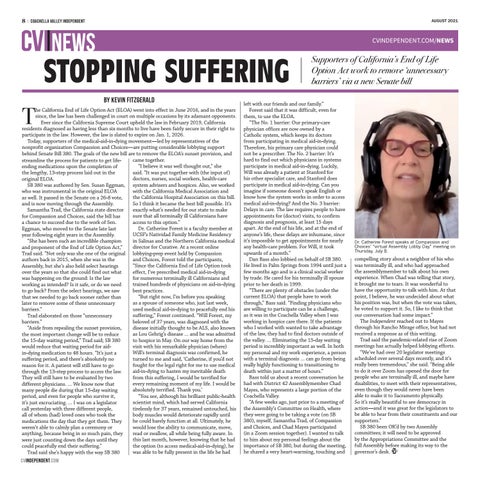
Dr. Catherine Forest speaks at Compassion and Choices’ “virtual Assembly Lobby Day” meeting on Thursday, July 8.
compelling story about a neighbor of his who was terminally ill, and who had approached the assemblymember to talk about his own experience. When Chad was telling that story, it brought me to tears. It was wonderful to have the opportunity to talk with him. At that point, I believe, he was undecided about what his position was, but when the vote was taken, he voted to support it. So, I like to think that our conversation had some impact.” The Independent reached out to Mayes through his Rancho Mirage office, but had not received a response as of this writing. Trad said the pandemic-related rise of Zoom meetings has actually helped lobbying efforts. “We’ve had over 20 legislator meetings scheduled over several days recently, and it’s really been tremendous,” she said. “Being able to do it over Zoom has opened the door for people who are terminally ill, and maybe have disabilities, to meet with their representatives, even though they would never have been able to make it to Sacramento physically. So it’s really beautiful to see democracy in action—and it was great for the legislators to be able to hear from their constituents and our supporters.” SB 380 been OK’d by two Assembly committees; it will need to be approved by the Appropriations Committee and the full Assembly before making its way to the governor’s desk.