2 \\ COACHELLA VALLEY INDEPENDENT
AUGUST 2021
A NOTE FROM THE EDITOR Mailing address: 31855 Date Palm Drive, No. 3-263 Cathedral City, CA 92234 (760) 904-4208 www.cvindependent.com
Editor/Publisher Jimmy Boegle staff writer Kevin Fitzgerald coveR and feature design Dennis Wodzisz Contributors Kevin Allman, Charles Drabkin, Max Cannon, Kevin Carlow, Katie Finn, Bill Frost, Bonnie Gilgallon, Bob Grimm, Valerie-Jean (VJ) Hume, Clay Jones, Matt Jones, Jocelyn Kane, Kay Kudukis, Matt King, Keith Knight, Cat Makino, Brett Newton, Dan Perkins, Guillermo Prieto, Theresa Sama, Andrew Smith, Jen Sorenson, Robert Victor, Madeline Zuckerman The Coachella Valley Independent print edition is published every month. All content is ©2021 and may not be published or reprinted in any form without the written permission of the publisher. The Independent is available free of charge throughout the Coachella Valley, limited to one copy per reader. Additional copies may be purchased for $5 by calling (760) 904-4208. The Independent may be distributed only by the Independent’s authorized distributors. The Independent is a proud member and/ or supporter of the Association of Alternative Newsmedia, the California Newspaper Publishers Association, CalMatters, the Desert AIDS Project, the Local Independent Online News Publishers, the Desert Business Association, the LGBT Community Center of the Desert, and the Desert Ad Fed.
CVIndependent.com
When Los Angeles County restored its indoor mask mandate on July 18, a whole bunch of business owners sighed in despair. They were not sighing because they disagreed with the mandate; they were sighing because, yet again, they, along with their employees, were thrust onto the front lines of COVID-19 rules enforcement. As the Delta variant ravages through unvaccinated populations around the world, I’d like to take a moment to say to my fellow local small-business owners—especially restaurants and retailers—as well as their employees: Thank you for all you’ve done to both survive and serve our community during this seemingly never-ending pandemic. It’s not police officers or city/county code-enforcement officers who have done the bulk of the “policing” around rules like mask mandates; it’s been businesses. I doubt there’s a single employee of a local restaurant or retail store who doesn’t have multiple stories about dealing with ignorant and rude members of the public—jerks who refused to follow a simple, basic, life-saving rule. Not only have business owners and employees become the de facto mask police; they’ve done so without a choice, at a time when they were risking serious illness by the simple act of going to work. It seemed that as of June 15, these owners and employees could finally relax. California had reopened, and masks were strictly optional (at least for vaccinated folks). Then came the Delta variant. As of this writing, no Coachella Valley governments have re-enacted an indoor mask mandate such as Los Angeles County’s restored rules. However, this is a monthly publication, and as quickly as Delta is spreading, I wouldn’t be surprised if stricter rules were put in place while this issue is out on newsstands. I don’t know what’s going to happen next. I do know I’m filled with gratitude for the local business owners and their employees who have tried to do the right thing over the last year and a half. This brings us to our August print edition. Seeing as it’s hot out there, and seeing as there’s SARS-CoV-2 out there, this is a perfect time to find a nice, cool space to enjoy a good book. To whet your literary whistle, this month, we’re presenting excerpts from two local authors: Michael Craft, whose story “VIP Check-In” is part of new collection Palm Springs Noir; and Rodney Ross, who just published his new novel, Diversionary Fires. Welcome to the August 2021 print edition of the Coachella Valley Independent. As always, thanks for reading. Drop me a line at the email address below if you have any feedback. —Jimmy Boegle, jboegle@cvindependent.com
COACHELLA VALLEY INDEPENDENT // 3
AUGUST 2021
www.GayAndLesbianPages.com SPECIAL THANK YOU!
FREE • SOUTHERN CALIFORNIA
Defending Marriage Equality! It’s The Law! Your Family Hardware Store Since 1947!
EUROWÜRX
Hardware • Electrical • Plumbing Locksmith • Screens Glass - Repairs & Custom Orders Drywall • Computer Color Paint Matching & Much Much More!!
the truth in european automotive tuning Audi – BMW – Mini – VW All Factory Scheduled Maintenance APR, Neuspeed, BBS, Bilstein, Brembo Our Technicians are Former Dealer Techs Over 40 Years of Combined Experience
EMIL’S
HARDWARE
COX PAINT
Shop Online @ www.EmilsHardware.com
SINCE 1945
Free Shipping on Ship to Store Orders!
We Carry Environmentally Friendly Paints
(310) 839-8571
509 South Victory Blvd. • Burbank, CA 91502 vic@eurowurx.com
2525 South Robertson Blvd. Los Angeles, CA 90034
www.EurowurxAutoBurbank.com
Entrance on Corner of Robertson Blvd. & Beverlywood St. (1 Mile South of Pico Blvd. or 1/2 Mile North of Santa Monica Freeway Exit)
Marc Berton, Agent
YOUR HOME TOWN VETERNARIAN
Insurance Lic. #: 0630665
Bus: 818-905-1911 Toll Free: 800-924-4459 Bus: 323-872-0482
MEDICINE - SURGERY - DENTAL CARE - FLEA CONTROL - X-RAYS
HOLLYWOOD CAT & DOG HOSPITAL
S
Fountain
Lexington
www.marcberton.com
1146 N. La Brea, LA 90038 (North of Santa Monica Blvd.) Across the Street from McDonald’s on La Brea Supporting the Gay Community
We all feel the same commitment to care for our families. Helping you meet your insurance needs is part of my commitment to you.
20%
You’ll Never Count These Guys Again.™
OFF
HOT BUY
399
$
Not good with any other discounts.
50 BUSINESS
$
PLUS YEARS IN
599
We don’t need Holidays, Gimmicks or Package Deals... “Just Everyday Low Prices”
Individually Alarmed Units 24 Hour Video Surveillance Gated On-Site Security Environmentally Controlled Wine Storage Air Conditioned Units Same Staff for Past 12 Years Best Gate Hours in Town 6am - 10 pm Open 7 days a Weeks
Limit 2 per customer
818.766.4289
Mon-Fri Mon-Fri10am8-pm 10am-8pm Sat • Sun 10am6-pm Sat10am7-pm 10am-7pm • Sun 10am-6pm
WEBSITE: WWW.ALSDISCOUNTFURNITURE.COM
aidswalk.net
Created and produced by MZA Events. AIDS Walk Founder/Senior Organizer: Craig R. Miller. © MZA Events, 2017
EMPOWERMENT • EXCELLENCE • EMPATHY • EFFECTIVENESS
Custom-Designed Cakes for All Occasions
www.palmspringsselfstorage.com
RV Units - 13’ x 50’ & Up to 90’ x 60’ Warehouse Size Units Purchase or Lease Starting at $97,500 Washer & Dryers Ice Machine Limited RV Supplies
3690 Airport Center Drive Palm Springs, CA 92264
760-318-1105 Right next to Palm Springs Airport Self Storage
Law Office of David Lee Moore
www.SHGEsq.com
Gourmet Cupcakes, Chocolates and Other Tantalizing Desserts
Temperature & Humidity Controlled 55 - 58 Degrees 70% Humidity Controlled Access Deliveries upon Request
318-9166
7 6 0
Fall 2017
BENEFITING
Special thanks to Essential Gay & Lesbian Directory
310.641.8259
NORTH HOLLYWOOD (NOHO Art District) - 4900 Lankershim Boulevard
Cake and Art “The Edible Art Experience”
Palm Springs Wine Storage
3950 Airport Center Drive Palm Springs, CA 92264
Starting and ending at the steps of L.A. City Hall
213.201.WALK
7601 Goddard Ave. Los Angeles, CA 90045-3219
Queen Mattress
The Best Buy Seal and other licensed materials are registered certification marks and trademarks of Consumers Digest Communications, LLC, used under license. For award information, visit ConsumersDigest.com.
AL’S DISCOUNT FURNITURE 1-800-RING-ALS •
State Farm, Bloomington, IL
Self Storage 760-318-9166 www.palmspringsselfstorage.com
WALK
Visit our website at: www.CakeandArt.com 8709 Santa Monica Blvd.
West Hollywood, CA 90069
310.657.8694 order@cakeandart.com
Celebrate your day to remember surrounded by your closest friends and family and leave the details to us. Palm Springs has ideal wedding weather and the Riviera Palm Springs is the perfect backdrop, offering luxurious and contemporary indoor and outdoor weddings.
Say “I do” in your style. 1600 North Indian Canyon Dr. Palm Springs, CA 92262
760.327.8311 rivierapalmsprings.com
Plug and go without worries till your next trip
NOBODY TAKES CARE OF YOU LIKE STATE FARM®.
Open 7 Days a Week
JULY
At State Farm® you get a competitive rate and an agent dedicated to helping you get the coverage that’s right for you and the discounts you deserve. I’d love to take care of you too. Call me today.
OurGayApp.com
GLPages.com
Proudly Representing the LGBT Community and Everyone for Equal Justice for Over 30 Years Client Testimony - “It may sound dramatic but I owe my legal motherhood to David Moore. During a tenuous legal time, I began working with him in 2005. His attentiveness to my queer identity, my relationship with my daughter and family dynamics assured me in a way for which I will be forever grateful.” Frankie Travis “non-bio” mother
• Adoptions • Child Visitation • Divorce • Litigation • Restraining Order
• Asset Divisions • Child Custody/Support • Alternative Dispute Resolution • Dissolutions • Domestic Partnerships • Real Property Divisions • Pre/Post Nuptial Agreements • Estate Planning • Mediation/Negotiation • Wills & Trusts
Equality and justice using our laws and court systems demands representation by an experienced legal representative who knows the law, understands the application of the law, and that is capable of overcoming legal inequities that sometimes exist for Community members. Using my legal experience, knowledge of the court system and dedication to justice for all, I lead my clients through family law litigation, negotiation, and collaborative agreements. In addition my office provides mediation and alternative dispute resolution, custody advice, and other valuable services to address client’s individual legal needs.
Los Angeles, Ventura & Santa Barbara Counties
(323) 680-0210 • (805) 643-1671 • (805) 660-8066 Vivian Lee Arber M.S./M.P.S. • Alternative Dispute Resolution • (805) 746-4586 www.DivorceCalif.com
Se habla español
• Wrongful Termination • Employment Discrimination/Harassment • Workers’ Compensation • Sexual Harassment • Work Place Civil Rights Issues • Serious Personal Injury Please e-mail your concerns or questions at: shg@shgesq.com
So Comfortable,
All Serta products with this coupon
Palm Springs Airport
OCT. 15, 2017
Spectrum Quality Paint Woodkote
Kelly-Moore Paint
Civil Trial Practice
Queen Adjustable Bed
As Low As
Proudly Serving Our Community Since 1982 ‘Sustaining Donor’ LA LGBT Center
Pratt & Lambert Purdy
Farrow & Ball Fine Paints of Europe Frescatti Modern Masters
Stuart H. Garrison Over 30 Years of Dedicated Trial Experience on Your Side
12 Months Same as Cash!
CALL ME TODAY.
• Auto • Business • Life • Homeowners
Featuring These Fine Paint Products: Benjamin Moore Donald Kaufman Color
Law Offices of
Queen Mattress Starting at
0907504
AIDS
310.838.2284 Hours: Monday to Friday 6:30 - 5:30 Saturday 7:00 - 4:30
www.coxpaint.com
Same Sex
Santa Monica
DR. PAUL GIRGIS, D.V.M.
(323) 469-3000 www.HollywoodCatDog.com
LOS ANGELES
Cox Paint - Culver City 11153 Washington Blvd. Culver City, CA 90232 (1/2 Block East of Sepulveda)
310.393.7208 Hours: Monday to Friday 6:30 - 5:30 Saturday 7:00 - 5:00
Family $199 is why we do it all.
Like a good neighbor, State Farm is there.®
Sunset
E
Highland
N
N. La Brea
W
Sycamore
Detroit
FULL BOARDING FACILITIES • LOW COST VACCINATIONS ON WED. & SAT. • SPAY • NEUTER BATHING • ULTRASOUND • MICRO CHIPPING • LASER THERAPY • X-RAY • SURGERY • DENTAL IN-HOME EUTHANASIA • HABLAMOS ESPAÑOL Come See Our Newly Remodeled Hospital!
Call For Doctor’s Hours
Cox Paint - Santa Monica 1130 Santa Monica Blvd. Santa Monica, CA 90401 (Corner of 12th St.)
CERTIFIED SERVICE & REPAIR
Like Us on Facebook for Upcoming Sales and Special Offers
ONE ON ONE SPECIALIZED CARE
Office Hours: Mon-Sat: 8am – 6pm Sun: Closed
Specialist in Custom Blended Colors Two Convenient Westside Locations:
818.843.4400
MON-FRI 8AM-5:30PM • SAT 8AM-5PM • SUN 9AM-1PM
FULL SERVICE VETERINARY CLINIC
B.G Loan & Jewelry ..................................13 years Cal Pet Crematory .................................... 13 Years Ed’s Coffee Shop .......................................13 years Eurosport German Auto Performance ...13 years Greg Cash Tax Plus ................................... 13 Years Hollywood Cat & Dog Hospital ............... 13 Years Hollywood Divers .................................... 13 Years Jeffrey Greathouse Attorney ................... 13 Years Sea View Optometric ............................... 13 Years Signal Hill Pet Hospital ............................ 13 Years Twenty Four 7 Cleaning ........................... 13 Years Canyon Interiors ...................................... 12 Years Cox Paints ................................................. 12 Years Done Right Discount Flooring ................ 12 Years Emil’s Hardware ....................................... 12 Years Gregory Cason Psychologist ................... 12 Years JR Hardware Sash & Door ........................ 12 Years KFK Jewelers ............................................. 12 Years Marc Berton Insurance ............................ 12 Years North Hollywood Hardware .................... 12 Years Paragon Cleaners ..................................... 12 Years Rush Hour Jewelery .................................. 12 Years Stuart Garrison Attorney .........................12 Years The Mail Box ............................................. 12 Years Venice Beach Suites ................................. 12 Years Abe’s Garage Door ................................... 11 Years Alcid Hair Design ..................................... 11 Years Animal Dermatology ............................... 11 Years Barak Chiropratic ..................................... 11 Years Dana Bruce Attorney ............................... 11 Years Elliott Salter Pawnshop ........................... 11 Years Jaguar Car Service ................................... 11 Years Japanese Auto Center .............................. 11 Years Larry’s Custom Furniture ......................... 11 Years Max Muscle of Long Beach ...................... 11 Years New England Divers ................................. 11 Years Santa Monica Yoga ................................... 11 Years
2018
$75 - 4 Wheel Alignments $50 - 2 Wheel Alignments
“Truly a first-class salon offering an experience unlike any other I have
(Most cars) Car - Truck - Boat - RV
Auto Fire Business Life • Health
Kristin Brinkema Agent
850 Colorado Blvd, Suite 204 Eagle Rock, CA 90041-1733
323-256-2251 Fax 323-256-6339
www.kbrinkema.com kristin.brinkema.c8o8@statefarm.com
$26.75 + Cert. 3449 E. Pacific Coast Hwy. • Signal Hill, CA 90755
Toll Free 877-226-2668 Fax 562-597-0249
www.signalhillpethospital.com
Ragi Boctor, D.V.M. Mirette Attalla, D.V.M. Complete Service Hospital & Boarding Facility General Medicine • Internal Medicine • Orthopedic Surgery General Surgery • Laser Surgery • Dentistry • Radiology • Ultrasound • Low Cost Spay & Neuter Clinic on Wednesdays • Low Cost Vaccinations Every Day Extended Hours for Easier Drop Off/Pick Up Mon-Fri. 7am-7pm • Sat. 7am-4pm • Sun. 9am-4pm
Most Cars from 1996 to Today Not valid with other offers.
Coupon Required $30 off regular price. Most cars & light trucks
$50 OFF Not valid with other offers. Coupon Required
$50 OFF Brake Service
Not valid with other offers. Coupon Required
Not valid with other offers. Coupon Required
$40 off regular price. Most cars & light trucks
AC Service & Inspection $50 off regular price. Most cars & light trucks
$40 OFF
Transmission Service
$50 off regular price. Most cars & light trucks
$24.95
FREE Inspections • FREE Tire Inspection • FREE Belt & Hose Inspection • FREE All Fluid Inspection • FREE Brake Inspection • FREE Estimates on Repair Jobs • FREE Filter Inspection • FREE Body Work Estimates
OIL CHANGE SPECIAL
• Oil Drain & Fill • Perform Multipoint Inspection • Including Filter & 5 Quarts Oil • $5 Extra for Each Additional Quart • Syntetic Extra • On most cars
(323) 462-8383 • (323) 462-2764 1787 North Highland Ave. Hollywood, CA 90028
www.FSARepair.com
Support Those Who Support Our Rights!!
2017-2018 www.GLPages.com
SERVING THE LESBIAN, GAY, BI-SEXUAL AND TRANSGENDER COMMUNITY
13th Edition
Facebook.com/GayYellowBook Twitter.com/GayYellowPages YouTube.com/GayYellowBook
COMPASS ROSE
had in the greater Palm Springs area.” —Phillip
FI NANCIAL PLAN N I NG A FINANCIAL PLANNING & INVESTMENT MANAGEMENT FIRM
Your Fiduciary Advisor DESERT BUSINESS ASSOCIATION’S 2019 BUSINESS OF THE YEAR
Call us today to schedule a complimentary consultation and get acquainted with an independent, Fee-Only financial planning & investment management firm located here in the Coachella Valley. Allow us to show you the benefits that result from a financial plan tailored to helping you achieve your goals.
750 E. Tahquitz Canyon Way, Suite 3 Palm Springs • (760) 904-0434 psfinemenssalon.com COMPASS ROSE FINANCIAL PLANNING 760-322-5200 • www.compassrosefp.com 333 N. Palm Canyon Drive, Suite 112-A • Palm Springs, CA 92262
@psfinemenssalon on Instagram and Facebook
Created for men ... by men! Open Tuesday through Saturday 10-6 Book online at psfinemenssalon.com! CVIndependent.com
4 \\ COACHELLA VALLEY INDEPENDENT
AUGUST 2021
OPINION OPINION
THE XX FACTOR W
CVINDEPENDENT.COM/OPINION
Meet Rachel Reedy, the real-life cowgirl and doctor at Ridgeline Veterinary Clinic
BY KAY KUDUKIS
elcome to The XX Factor. I recently read an article about 1950s-1980s advertising targeting women. The ads played on perceived insecurities and emphasized how women could “please their men.” Do housework in heels, they suggested, and paint your lips with a bright-red smile while you do it … because everyone is watching you, and you have to be perfect. One of my favorite “women empowerment” slogans from back then was, “You’ve come a long, long way.” It was hilarious, because the lead-in line was: “You’ve got your own cigarette, now, baby!” A skinny cigarette that doesn’t distract from my outfit?! You’re killing me, Virginia Slims. However, this column is not some feminist manifesto. Its purpose is to celebrate the badass It’s a lot of fun and really hard.” females in our valley—the ones who paved the In 2019, Reedy took home second in a nonway, the ones who built the infrastructure, and pro, two-rein-class contest. the ones who continue to improve life in the While reined cow horse competitions sound Coachella Valley. These are their stories. like a lot of work, Reedy works even harder at her day job. A doctor of veterinary medicine hings you should know about Rachel since 2010, she’s been saving animals’ lives in Reedy: She was born and raised in Idaho; the Coachella Valley since 2012. at 5 years of age, she announced she was Last year, Reedy came upon an opportunity going to be a veterinarian (there’s video she just couldn’t turn down. She had evidence); she loves puzzles; and she’s a realalready been working toward purchasing a life cowgirl who competes in a sport called fully operating clinic. When that purchase reined cow horse. opportunity became unstable, the space “(You do) sliding stops and spins; you’re formerly known as Southwest Veterinary Clinic scored based on the maneuvers,” Reedy said. in Cathedral City was brought to her attention. “And then there’s a cutting portion where Rumor has it that the former owner came into you have a large herd of cows, and then you an inheritance, locked the doors and went off separate one from the herd.” There’s one more part: “You get one cow you to enjoy his windfall. “(The space) had been sitting empty with a have to do certain maneuvers with. We’re not whole bunch of equipment still in it,” Reedy roping; we’re not knocking them over. We’re not doing anything like that. You basically hold said. “Whoever had the lease had never come in and touched anything.” them to the wall, turn them and circle them.
T
The staff at Ridgeline Veterinary Clinic.
CVIndependent.com
Rachel Reedy in a reined cow horse competition.
She had about two weeks to decide. In October 2020, Reedy hung her own shingle, opening Ridgeline Veterinary Clinic. Starting a business during the pandemic turned out to be the perfect storm, in a good way: People were adopting more pets, and many clinics weren’t taking new patients; some closed up shop completely. As a Ridgeline client, I can say: Right out of the gate, the clinic had superior COVID-19 protocols. Friendly staff ushered pets from the car into the clinic and back out again, with a visit from Reedy at the end to discuss the results/treatment. The entire experience was comforting; I was impressed. My cats loved them, too (as shown by their lack of complaining on the way home). There are things Reedy would like pet owners to know: “(Veterinarians) not only take care of general complaints; they play a big role in food safety, the spread of disease and containment of disease, and epidemiology, so it’s not just clinical practice.” Reedy does a lot of work with soft-tissue problems and injuries. A recent pup and its parents made an impact on her. “There was a gentleman who came in with his wife; he had Parkinson’s, and they had a yellow lab,” Reedy said. “(The dog had) this massive tumor, like 13 pounds. I removed it; the dog did really well.” After saying that, Reedy got a distant look
on her face, which surprised me. She generally has a very kind but professional demeanor. “The guy got out of his wheelchair and gave me a big hug,” she said. “A week later, I got a really big thank-you card. It still brings tears to my eyes, remembering how grateful those people were. When I have bad days, I remember that story.” Reedy is incredibly self-effacing. When I asked her to do an interview, she said, “I’d love to, but there are so many other women vets in the valley who I think are more deserving.” I asked her why. “Because they come from a generation where women were still a minority (in veterinary care), and they still had successful businesses and did well. It was harder then to be a woman and do that; they’ve paved the way for women like me.” Reedy offered shout-outs to Dr. Shakira Jameson, of Paws and Claws Pet Care in Palm Desert; Dr. Lillian Roberts, of Country Club Animal Clinic in Palm Desert; and Dr. Kathryn Carlson, of Village Park Animal Hospital in La Quinta. I’ll add my personal shout out to Rachel Reedy, DVM, owner and operator of Ridgeline Veterinary Clinic—and badass cowgirl. For more information on Ridgeline Veterinary Clinic, visit www.ridgelinevetclinic.com. Have an idea for someone to be profiled? Email kayku1956@gmail.com.
COACHELLA VALLEY INDEPENDENT // 5
AUGUST 2021
DESERT AIDS WALK OCTOBER 30, 2021
together again
PRESENTED BY
Register today at desertaidswalk.org CVIndependent.com
6 \\ COACHELLA VALLEY INDEPENDENT
AUGUST 2021
OPINION OPINION
THE XX FACTOR Y
CVINDEPENDENT.COM/OPINION
Meet Joy Brown Meredith, a badass Palm Springs businesswoman and a tireless advocate for the homeless
BY KAY KUDUKIS
ears ago, my badass therapist, Jennifer Hilt, told me about another badass woman named Joy Brown Meredith. I had heard of her, of course. Meredith is well-known in Palm Springs for many reasons. The owner of Crystal Fantasy and Joy of Life Wellness Center, she is also active in the “politics” of downtown via the Main Street Palm Springs business association, and is a co-admin for many local Facebook pages, including Palm Springs Neighborhood Group, one of my favorite places to find service recommendations in Palm Springs. Here’s the story I was told: Hilt was doing intake at Desert Regional Medical Center when a homeless man was admitted. Part of intake is getting the name of the person’s next of kin, a lot of circumstances that make somebody caretaker or contact person. This gentleman produced Joy Brown Meredith’s business card. homeless.” She pauses for a moment. “Can you imagine Hilt was skeptical, but called anyway: “Hi, living on the street in 120-degree weather?” I’m calling from Desert Regional, and this I break into a sweat just thinking about is likely a mistake, but I have a homeless it as she continues: “There are just so many gentleman who says you are his contact.” different things we could do that can, at “Oh yeah,” Meredith replies. “That’s my least, help alleviate that suffering to some homeless guy, William.” extent. In my opinion, the only way you In my hopeful mind, the story continues really succeed with the homeless problem is that all of the merchants in her area adopted one-on-one. Like, you see a homeless guy on homeless people and took care of them, and your block every day. Go over there and talk in return, they stayed away from the stores to him. Sometimes they just need something during business hours, and were allowed to little, like they lost their driver’s license, so sleep outside at night to deter burglars. now they can’t get a job anywhere. Sometimes Meredith dispels that myth. “I wanted that it’s so minute.” to be,” she sighs, “but it never happened.” Meredith has never been homeless, but she Her first homeless guy, she tells me, was was a victim of some awful things as a prenamed Fred. teen in Chicago. Those horrific events were “Fred taught me something,” Meredith compounded when she ended up in a school says. “He said there’s three kinds of homeless that was the subject of two documentaries. It people: There’s homeless; there’s helpless; was the worst of times. and there’s hopeless. … The ‘hopeless people’ Although Meredith is a self-proclaimed didn’t mean that they were actually hopeless, open book, some of her family members have but it was probably hopeless for me to be strong feelings recalling the trauma she went able to help them. Some of them just need a through, and I respect that, so I won’t say home, which could be a more simple solution. much more. What I will say is that Meredith Some of them are just helpless; they needed is a living, breathing example of an incredibly some stuff, but they needed somebody to brave woman who has overcome life’s champion them to help them be able to fix injustices—and made the decision to not just some things. Maybe they had fines. There are
CVIndependent.com
The Meredith family, circa 1991.
survive, but to thrive. Meredith recalls the moment she stepped off the plane in Palm Springs. “It was springtime—April, I think. I was still wearing a winter coat, because there was snow on the ground in Maine. This was back when they used to roll the stairs up for you to get off the plane, and I got off, and the whole sky was a color blue I had never seen before. It was 360 degrees of WOW! I never wanted to leave.” So she didn’t. Palm Springs is where, at 19, she married the love of her life, Scott Meredith. Together, they built their family, and then their first business—Crystal Fantasy, the latter with the help of her landlord, Henry Frank. He was her benefactor, as well as an advocate for the homeless. Meredith’s father, a well-known contractor, gave her some great life advice: “Find something you love, then build a business around it.” Her belief in the healing power of crystals (she had migraines; a friend recommended a crystal she rubbed on her temples; it worked) is why she came to open Crystal Fantasy in 1987, as well as, eventually, a marijuana dispensary, the Joy of Life Wellness Center, in 2018. Crystal Fantasy is now in its third location. The couple made sure, from the starting line,
that every space had a family area. The adult Merediths took turns running the store; she and Scott made sure they never had to choose between their family and their livelihood. Meredith is as friendly as the day is long, but make no mistake: She is no pushover. She’s tireless in her quest to help the homeless, passionate about teaching people the powers of crystals, and devoted to making her adopted town of Palm Springs the best place to live in the world—not just for herself, but for the entire community. One anecdote, to take us out on a fun note: I asked if the family had pets. “Oh, all kinds,” she replies. “An iguana, a potbellied pig. I had a rat that used to sit on my shoulder. Generally, people get weird about rats, but you put Barbie clothes on a rat, and suddenly, it’s adorable.” I let out a genuine laugh. That little moment, that simple sentence, has kept me chuckling since. Her name, Joy, absolutely suits her. For more information on Crystal Fantasy, visit www.crystalfantasy.com. For more information about Joy of Life Wellness Center, visit www. joyoflifewellnesscenter.com. Have an idea for someone to be profiled? Email kayku1956@gmail.com.
COACHELLA VALLEY INDEPENDENT // 7
AUGUST 2021
OPINION OPINION
HIKING WITH T W
CVINDEPENDENT.COM/OPINION
The Coachella Valley’s central location means there are nearby mountains and beaches where you can beat the extreme heat
BY THERESA SAMA
e have spent much of June and July under excessive heat warnings here in the Coachella Valley—and it’s possible the worst is yet to come: The Old Farmer’s Almanac predicts this year’s summer heat could peak in late August into early September. So how do we get outside and exercise during all of this continuous extreme heat? Last month, I mentioned making schedule adjustments to beat the heat by getting outside early, and discussed some day trips to cooler climes just an hour or so away, including the Palm Springs Aerial Tramway, Idyllwild and Oak Glen. This month, I am extending that day-trip distance to 100 miles or so. One great perk of living in the Coachella Valley is that it’s very centrally located: We’re just a short drive to both quaint cascade down from Big Falls. Big Falls, the top mountain towns and gorgeous Southern waterfall with an approximate 150-to-200California beaches, where one can find a wide foot drop, can be viewed from the overlook. range of fun, exhilarating, outdoorsy things to (The trail to the top has been closed for do—including trails everywhere! the past two years due to a high number of An hour or so away, off Highway 38 rescues in the area.) in San Bernardino County, is the small, Also located near Forest Falls, at the east unincorporated community of Forest Falls. end, is the Vivian Creek Trail, which goes At an elevation of 5,700 feet with average all the way to the summit of San Gorgonio summer temperatures in the low- to mid-80s, Mountain (Old Greyback), the tallest Forest Falls is the home of Big Falls waterfall, mountain in Southern California, at 11,503 one of the largest year-round waterfalls in feet. This is a significant hike—19 miles out Southern California. It’s spectacular! and back—and while I have not yet done it, Forest Falls Trail is a dog-friendly path this trail is definitely on my bucket list. that’s very short—less than a mile out and Crestline/Lake Gregory, located in the back—and it’s a very easy hike, at that. There San Bernardino Mountains, is the closest are many different waterfalls in the area that mountain resort town to the largest cities in Southern California. The easiest way to get to Crestline from the desert is to take Interstate 10 west, to Interstate 210 west, to Highway 18. The elevation of Crestline is just over 4,600 feet, with average summer temperatures in the low- to mid-80s. One dog-friendly trail in the area is a loop, just a bit more than two miles, that goes around beautiful Lake Gregory. Other activities at Lake Gregory include fishing, boating, swimming and more. Another favorite trail, an easy loop under two miles, is Heart Rock Trail. Located near Cedarpines Park and Camp Seely, the dogfriendly trail meanders along a creek with some small waterfalls, including a 10-15 foot waterfall near Heart Rock. It’s the perfect place to pack in a picnic lunch—but always remember to pack everything back out! From Crestline, you can continue on Highway 18 to Lake Arrowhead (the Alps of Southern California) and then Big Bear Lake (the jewel of the mountain), two of Southern California’s most-popular mountain resorts. Lake Arrowhead is about a 15-minute drive from Lake Gregory and is over 5,000 feet in elevation, while Big Bear Lake is further up the mountain at 6,700 feet. The average summer temperatures range from the midSammy the dog enjoys life at Lake Gregory. 70s to low-80s, and both mountain towns
Located near Lake Gregory, the dog-friendly Heart Rock Trail meanders along a creek with some small waterfalls, including a 10-15 foot waterfall near Heart Rock.
offer a vast variety of things to do. They’re perfect for a day trip, a weekend getaway or a week-long stay. Beyond the many mountain trails, both places have shopping, fine dining and entertainment, while the lakes offer activities such as boating, water-skiing, jetskiing, kayaking, paddle boarding and so much more. And then there are nearby beaches! One of my favorite beach cities is Laguna Beach, a small coastal city in Orange County. Laguna Beach has much to offer, with average summer temperatures in the mid-70s to low80s on the hottest of days. You can enjoy a
nice run on the beach, a hike along one of the many coastal canyon trails, or browsing at the most amazing art galleries. About 100 miles away from Palm Springs, Laguna Beach is perfect for a day trip to get in a great hike, enjoy a nice meal and catch a beautiful sunset before returning to the desert. The Coachella Valley is an amazing place to live—but the summers present challenges, and it is important to know that there is life outside of the desert. All desert-dwellers should enjoy a nice summer breakaway now and then—so we can continue to get outdoors, keep exercising and having fun! CVIndependent.com
8 \\ COACHELLA VALLEY INDEPENDENT
AUGUST 2021
NEWS
CVINDEPENDENT.COM/NEWS
STOPPING SUFFERING T
by kevin fitzgerald
he California End of Life Option Act (ELOA) went into effect in June 2016, and in the years since, the law has been challenged in court on multiple occasions by its adamant opponents. Ever since the California Supreme Court upheld the law in February 2019, California residents diagnosed as having less than six months to live have been fairly secure in their right to participate in the law. However, the law is slated to expire on Jan. 1, 2026. Today, supporters of the medical-aid-in-dying movement—led by representatives of the nonprofit organization Compassion and Choices—are putting considerable lobbying support behind Senate Bill 380. The goals of the new bill are to remove the ELOA’s sunset provision, and came together. streamline the process for patients to get life“I believe it was well thought out,” she ending medications upon the completion of said. “It was put together with (the input of) the lengthy, 13-step process laid out in the doctors, nurses, social workers, health-care original ELOA. SB 380 was authored by Sen. Susan Eggman, system advisers and hospices. Also, we worked with the California Medical Association and who was instrumental in the original ELOA the California Hospital Association on this bill. as well. It passed in the Senate on a 26-8 vote, So I think it became the best bill possible. It’s and is now moving through the Assembly. exactly what’s needed for our state to make Samantha Trad, the California state director sure that all terminally ill Californians have for Compassion and Choices, said the bill has access to this option.” a chance to succeed due to the work of Sen. Dr. Catherine Forest is a faculty member at Eggman, who moved to the Senate late last UCSF’s Natividad Family Medicine Residency year following eight years in the Assembly. in Salinas and the Northern California medical “She has been such an incredible champion director for Curative. At a recent online and proponent of the End of Life Option Act,” Trad said. “Not only was she one of the original lobbying-prep event held by Compassion and Choices, Forest told the participants, authors back in 2015, when she was in the “Since the California End of Life Option took Assembly, but she’s also held select hearings effect, I’ve prescribed medical aid-in-dying over the years so that she could find out what for numerous terminally ill Californians and was happening on the ground: Is the law trained hundreds of physicians on aid-in-dying working as intended? Is it safe, or do we need best practices. to go back? From the select hearings, we saw “But right now, I’m before you speaking that we needed to go back sooner rather than as a spouse of someone who, just last week, later to remove some of these unnecessary used medical aid-in-dying to peacefully end his barriers.” suffering,” Forest continued. “Will Forest, my Trad elaborated on those “unnecessary beloved of 37 years, was diagnosed with the barriers.” disease initially thought to be ALS, also known “Aside from repealing the sunset provision, as Lou Gehrig’s disease … and he was admitted the most important change will be to reduce to hospice in May. On our way home from the the 15-day waiting period,” Trad said; SB 380 visit with his remarkable physician (where) would reduce that waiting period for aidWill’s terminal diagnosis was confirmed, he in-dying medication to 48 hours. “It’s just a turned to me and said, ‘Catherine, if you’d not suffering period, and there’s absolutely no fought for the legal right for me to use medical reason for it. A patient will still have to go aid-in-dying to hasten my inevitable death through the 13-step process to access the law. from this suffering, I would be terrified for They will still have to be evaluated by two every remaining moment of my life. I would be different physicians. … We know now that absolutely terrified. Thank you.’ many people die during that 15-day waiting “You see, although his brilliant public-health period, and even for people who survive it, scientist mind, which had served California it’s just excruciating. … I was on a legislator tirelessly for 37 years, remained untouched, his call yesterday with three different people, body muscles would deteriorate rapidly until all of whom (had) loved ones who took the he could barely function at all. Ultimately, he medications the day that they got them. They would lose the ability to communicate, move, weren’t able to calmly plan a ceremony or read or swallow, all while being fully aware. In anything, because being in so much pain, they this last month, however, knowing that he had were just counting down the days until they the option (to access medical-aid-in-dying), he could peacefully end their suffering.” was able to be fully present in the life he had Trad said she’s happy with the way SB 380 CVIndependent.com
Supporters of California’s End of Life Option Act work to remove ‘unnecessary barriers’ via a new Senate bill
left with our friends and our family.” Forest said that it was difficult, even for them, to use the ELOA. “The No. 1 barrier: Our primary-care physician offices are now owned by a Catholic system, which keeps its doctors from participating in medical aid-in-dying. Therefore, his primary care physician could not be a prescriber. The No. 2 barrier: It’s hard to find out which physicians in systems participate in medical aid-in-dying. Luckily, Will was already a patient at Stanford for his other specialist care, and Stanford does participate in medical aid-in-dying. Can you imagine if someone doesn’t speak English or know how the system works in order to access medical aid-in-dying? And the No. 3 barrier: Delays in care. The law requires people to have appointments for (doctor) visits, to confirm diagnosis and prognosis, at least 15 days apart. At the end of his life, and at the end of anyone’s life, these delays are inhumane, since it’s impossible to get appointments for nearly any health-care problem. For Will, it took upwards of a month.” Dan Bass also lobbied on behalf of SB 380. He lived in Palm Springs from 1994 until just a few months ago and is a clinical social worker by trade. He cared for his terminally ill spouse prior to her death in 1999. “There are plenty of obstacles (under the current ELOA) that people have to work through,” Bass said. “Finding physicians who are willing to participate can be a challenge, as it was in the Coachella Valley when I was working in hospice care there. If the patients who I worked with wanted to take advantage of the law, they had to find doctors outside of the valley. … Eliminating the 15-day waiting period is incredibly important as well. In both my personal and my work experience, a person with a terminal diagnosis … can go from being really highly functioning to transitioning to death within just a matter of hours.” Bass told us about a recent conversation he had with District 42 Assemblymember Chad Mayes, who represents a large portion of the Coachella Valley. “A few weeks ago, just prior to a meeting of the Assembly’s Committee on Health, where they were going to be taking a vote (on SB 380), myself, Samantha Trad, of Compassion and Choices, and Chad Mayes participated (in a Zoom session together). I wanted to talk to him about my personal feelings about the importance of SB 380, but during the meeting, he shared a very heart-warming, touching and
Dr. Catherine Forest speaks at Compassion and Choices’ “virtual Assembly Lobby Day” meeting on Thursday, July 8.
compelling story about a neighbor of his who was terminally ill, and who had approached the assemblymember to talk about his own experience. When Chad was telling that story, it brought me to tears. It was wonderful to have the opportunity to talk with him. At that point, I believe, he was undecided about what his position was, but when the vote was taken, he voted to support it. So, I like to think that our conversation had some impact.” The Independent reached out to Mayes through his Rancho Mirage office, but had not received a response as of this writing. Trad said the pandemic-related rise of Zoom meetings has actually helped lobbying efforts. “We’ve had over 20 legislator meetings scheduled over several days recently, and it’s really been tremendous,” she said. “Being able to do it over Zoom has opened the door for people who are terminally ill, and maybe have disabilities, to meet with their representatives, even though they would never have been able to make it to Sacramento physically. So it’s really beautiful to see democracy in action—and it was great for the legislators to be able to hear from their constituents and our supporters.” SB 380 been OK’d by two Assembly committees; it will need to be approved by the Appropriations Committee and the full Assembly before making its way to the governor’s desk.
COACHELLA VALLEY INDEPENDENT // 9
AUGUST 2021
SUMMER SECRETS AND OBSERVATIONS
MARKET
GET 25 TO 50 PERCENT OFF GIFT CERTIFICATES TO SOME OF THE VALLEY'S TOP RESTAURANTS!
Current deals include: 25 percent off gift cards for Eight4Nine Restaurant and Lounge 50 percent off gift certificates for Johannes Restaurant 25 percent off gift cards for Acqua California Bistro 25 percent off gift cards for Lulu California Bistro 50 percent off gift certificates for Rio Azul Mexican Bar and Grill 50 percent off gift certificates for Shabu Shabu Zen
By Shonda Chase, FNP Nurse Practitioner, Co-owner, Artistic Director and Advanced Aesethetic Injector at Revive Wellness Centers in Palm Springs and Torrance, and Medweight, Lasers and Wellness Center in Irvine
T
hese medical aesthe�c secrets are presented with “Hot August Nights” in mind. This summer you will hopefully get some �me to read an extra book or two. I’m offering this month’s secrets more concisely—to help get you back to your book! I was watching the last episode of this season’s SEAL Team TV show. In the last few scenes, all of the characters had their beards shaved off as part of a funeral tradi�on for one of the team members. With their beards, all of the actors looked fine and chiseled on the screen—but I was shocked to see how much filler they all needed without their beards hiding their features. Secret No. 1: A�er 35, we lose a teaspoon of volume in our faces each year. This volume loss occurs because we’re losing our suppor�ng fat and bone mass. Even people who start gaining weight lose the structures that supported our faces before 35. I use different fillers to restore what each person is losing, according to their to age and lifestyle. Restoring bone loss requires different fillers than fat and volume loss. Secret No. 2: In skilled hands, we can overcome this aging process, and you can look great for 50 years or more a�er your 35th birthday. As I’ve seen for years, even a�rac�ve or handsome actors have the same volume-loss issues as the rest of us. That’s why they’re all ge�ng fillers and extending their careers. Secret No. 3: There’s a recent FDA-approved filler that moves with your facial muscles. This filler’s ability to move with your expressions slows the normal breakdown that comes with �me and movement. This filler has been used in Europe and the Far East for years. I am having good success with it in my pa�ents. This filler made by Revance and is called RHA in the U.S. Depending or where RHA is injected, can last 1218 months. Enjoy your other summer reading. Next month, I’ll share the latest health benefits of hormone op�miza�on. Un�l then, keep the “Secrets.” Our Revive Wellness Center loca�ons are in Palm Springs (760-3254800) and Torrance (310-375-7599); www.revivecenter.com. Our Medweight, Lasers and Wellness Center office is in Irvine (949586-9904); www.medweightandlasers.com.
You can email your individual ques�ons to Shonda Chase FNP, or Allan Y. Wu MD, Revive’s cosme�c surgeon, at shonda@revivecenter.com.
ONLY AT CVINDEPENDENT.COM CVIndependent.com
10 \\ COACHELLA VALLEY INDEPENDENT
AUGUST 2021
NEWS
CVINDEPENDENT.COM/NEWS
COVID CONSEQUENCES L
by kevin fitzgerald
uis Valentino is the brand-new Coachella Valley Unified School District superintendent. When he accepted the position after spending 3 1/2 years as the chief academic officer at Portland Public Schools, it meant he could finally come home to his family. “When we left Albuquerque, (N.M., in 2015), I had become a consultant here in California, primarily. We knew we were going to come back to California; we just didn’t know where,” he said. “That summer, we needed some vacation down time, and as we were driving through, we ended up staying here for a couple of days in a hotel. Then, because we had a time share, we stayed in Indio for a month. Even as hot as it was, we actually enjoyed it. Our son needed to students would not immediately return to enroll in school, so we were on our way to live in-person learning, because the district’s in Long Beach—but, as we’d started to enjoy survey of families had not yet been finalized. it here, one thing led to another, and before “That’s something that we should have we knew it, we enrolled him in school here. already begun to put in place, but we “The plan was to stake some roots here will,” Valentino said. “I (recently) had a and become part of the Coachella Valley, but conversation with one of our directors who soon, the superintendent in Portland asked is working on registration and enrollment. me to do some consulting work for him. So, I asked her if we are seeing more or fewer thinking I’d be there for a month or two, the families than expected enrolling their plan was always to stay here. Then he invited me to stay and work for him—and I was there students in the school district. She said that, surprisingly, it’s been very positive.” for 3 1/2 years. Still, there was no plan to Valentino conceded that the Delta variant uproot my family. So, for me, getting this job and the resulting rise in COVID-19 cases may was a blessing, as you can imagine.” change some families’ minds. In a recent phone interview, Valentino “We know that there are going to be some discussed the challenges being faced by the families who are going to want independent east valley school district, as all CVUSD (schooling), especially if we can’t demonstrate schools get set to welcome students back on to them that we’re going to keep their child Aug. 12—for what will surely be a unique and safe,” he said. “That makes sense. That’s why challenging school year. He said that he plans it’s so important for me to get a safety plan to do a lot of observing and learning to start. that will help ensure that families who are “In looking at the practical aspects, we nervous will see when they come on campus have to get back to school,” Valentino said. that we are doing everything we can to keep “We have to re-enter—and then how are we their child safe.” going to address the academic slide that took It’s possible the Delta variant may result place during this whole period? All districts were impacted, including this one, so we can’t in stricter county and state guidelines for schools. shy away from the fact that there’s a lot of “Right now, we’re following the latest news, work ahead in getting students back on track, and then accelerating their learning. And how and we’re building off of that,” Valentino said. “… For our school district, that puts us in the are we going to do it in a way that keeps studifficult position of not being able to finalize dents safe?” any policy (regarding masks, social distancing, Valentino said the district also needs to etc.). School principals need to speak to meet the needs of students whose families their staff, and to the parents, and they decide it’s best for them to continue distancedon’t want us to be wishy-washy about what learning from home, due to the ongoing we’re sharing. They want us to really know pandemic. what we’re talking about. So my concern is “Also, how are we going to address the that we might not have the (COVID safety) trauma that everyone faced, whether it information soon, which means will have to was a student, a teacher or a central office postpone our final decisions.” (staffer)?” Valentino said. “In CVUSD, the Valentino said the district is also weighing district lost people, and there’s emotion whether or not to require that students 12 attached to that. How are we going to years and older be vaccinated for COVID-19 return to some level of normalcy around the in order to attend school in person—and emotional aspects? How are we going to help what exceptions would be allowed to such a people get whole again?” policy if it were enacted. Valentino said he did not yet know, as “Our board members are really thinking of our mid-July conversation, how many CVIndependent.com
Luis Valentino, the new CVUSD Superintendent, talks about the challenges the district faces in 2021-2022 and beyond
hard about that question,” Valentino said. It’s also unclear whether sports will fully return to “normalcy” once school starts in August. “I don’t have a definitive answer for that, but I do have hopes and expectations,” Valentino said. “That’s because in my previous district, Portland Public Schools, I supervised athletics as well. We were the first ones out of the gate to bring students back (to athletics), because what we found is that the students who came back to participate in extracurricular activities saw their social and emotional well-being improve. We had a lot of challenges with depression and suicide ideation, so we needed to find a way to bring some of those students back … If we can keep our athletes safe here, then I believe, personally, that they would benefit greatly from being able to participate in athletic events.” Valentino said he anticipates it will take more than a one-year plan for students to make up for the learning that was lost during the pandemic closures. “Part of the first year (of recovery) included the summer-school programs. I was really pleased that in California—and actually in most states—there was more-robust summerschool programming than there has been in the past,” he said. “This district had a lot more students participating, which is great. … So we already have some data to start us off in understanding how severe the academic slide was. Also, when we return, we need to assess the social and emotional well-being of our students. … (We’ll be) learning more and building out a short-term, a mid-term and a long-term plan. Interventions are going to be a part of this work throughout the school year. I know that CVUSD has both afterschool programs and Saturday school.” Since a substantial segment of the CVUSD student body may not return to in-classroom learning right away, I asked Valentino what was being done to bridge the “digital divide”—a lack of internet access suffered by some families within the district. “One of the things that this pandemic magnified has to do with internet access and the divide that exists,” Valentino said. “Actually, some communities have zero (internet access). They rely on the school. So, the role of the school will be expanding access at the school. Also, we can work with the community and the service providers. My understanding is that Verizon has
CVUSD Superintendent Luis Valentino, on bridging the “digital divide”: “The permanent fix, quite frankly, is for the school district to plan for owning its own network.”
been a good partner here, especially in the eastern-most part of the valley, where the digital divide is magnified even more. So, (we need) to identify how free and low-cost services could be made available. I know we have portable Wi-Fi (hotspots) that enable students to gain access, and that was put in place early on in the pandemic. We need to expand that option.” Valentino said he hopes a permanent fix to internet-access issues will come one day in the not-too-distant future. “The permanent fix, quite frankly, is for the school district to plan for owning its own network,” Valentino said. “The state of California has made quite a large amount of money available—and the federal government has, too—to help districts, especially those with rural communities within boundaries, build out networks. … Is there a way where we can actually create community-based access? That’s possible, especially now. CVUSD has been thinking about this for over a year.”
COACHELLA VALLEY INDEPENDENT // 11
AUGUST 2021
OPINION NEWS
CVINDEPENDENT.COM/NEWS
SURF’S UP?
La Quinta residents battle a proposed development— with a Kelly Slater Wave Pool as its centerpiece
A
Take The Dive into a new desert home!
by cat makino
proposed 386-acre development in La Quinta is facing determined opposition from nearby residents—who have thus far raised about $66,000 to fight the project. The Coral Mountain Resort would include 600 homes, with prices starting at $2.5 million; a 150-room hotel; hiking and biking trails; spa and wellness facilities; adventure-sports facilities; and a restaurant and market. It’s being proposed by Meriwether Companies, a real estate development and investment firm based in Colorado. It’s the development’s planned centerpiece that has neighbors most upset: a half-mile long wave pool, created by the Kelly Slater Wave Company, containing 18 million gallons of water, with artificial waves provided for surfers. It would be beautiful trails,” Baez said. one of the largest such facilities in the world. Bruce Bauer, an attorney with Slovak Baron Despite the opposition, a draft Empey Murphy and Pinkney LLP, was hired by environmental impact report prepared by the LQRRD. He said that while the proposed Coral city of La Quinta says the project would use Mountain Resort makes economic sense for an allowable amount of water, and would have Meriwether, it doesn’t make economic sense minimal impacts on neighboring residents. for nearby residents. Garrett Simon, a partner with Meriwether “We believe the resort will create an ongoing Companies, explained why the company chose festival (amusement park) atmosphere,” Bauer the location and purchased the land, which is said. “Many of these residents in the adjoining largely vacant, in 2019. communities invested their life savings in their “We have been active in the area for 10-plus residences, and they invested in La Quinta. No years, and it is close to Los Angeles, San one understood that this sort of development Diego,” Simon said. “From the weather to its would be next to them.” beautiful scenery, La Quinta is already on the Despite the neighbors’ concerns, the city’s map as one of the best destinations. There’s draft environmental impact report—prepared golf and tennis—just a fantastic destination.” with the assistance of MSA Consulting, Inc.— Simon said the Coral Mountain Resort concludes that projected water usage, as well would be “revenue positive” for the city due to as traffic, noise and lighting, will all be within the taxes it would bring in. “The project has an the scope of local regulations. Though these annual revenue surplus of an estimated $1.6 factors will be reviewed at five-year intervals, million (phase 1) to $2.2 million (buildout),” he it’s unclear what would happen if the resort said via email. fails to meet these standards. If the project is approved, Meriwether plans The draft environmental impact report to start construction in the second quarter of is viewable at www.laquintaca.gov. The city 2022. is accepting public comments through Aug. A number of nearby residents hope to stop 6. Comments may be submitted with “Coral that construction, and have formed a group Mountain Resort DEIR” in the subject line at called La Quinta Residents for Responsible consultingplanner@laquintaca.gov. After public Development (LQRRD) to fight the project. hearings, the city Planning Commission will The property is currently zoned for lowmake its recommendation to the La Quinta density residential use, as well as a golf City Council, which is slated to make the final course and some commercial use. LQRRD decision sometime in the fall, according to representatives say the proposed change to Cheri Flores, La Quinta’s planning manager. allow “tourist commercial” zoning violates the 2035 general plan for La Quinta. Ramon Baez, a LQRRD representative, said residents of surrounding neighborhood communities—including Andalusia, Trilogy and The Quarry—fear the proposed development will harm their quality of life. LQRRD claims the zoning change would allow an “amusement-like theme park that operates from 7 a.m. until 10 p.m., 365 days of the year.” “Imagine you live at La Quinta Cove, where they don’t have any night streetlights—then An artist’s rendering of the proposed wave park at they build a surf wave park on one of your the Coral Mountain Resort. Courtesy of Meriwether Companies
TownCA.com
LET OUR EXPERIENCE AND LOCAL KNOWLEDGE HELP TO GUIDE YOU! KEVIN STERN KEVIN STERN
760-250-1977
OWNER/BROKER CalDRE #01376548
I love this town. Thomas Gleeson Ins Agcy Inc Thomas Gleeson CLU ChFC, Agent Insurance Lic#: 0K08021 225 S. Civic Drive, Suite 1-1 Palm Springs, CA 92262 Se habla Español
2007004
Thanks, CV Independent. I love being here to help in a community where people are making a difference every day. Thank you for all you do.
State Farm, Bloomington, IL
CVIndependent.com
12 \\ COACHELLA VALLEY INDEPENDENT
AUGUST 2021
NEWS
CVINDEPENDENT.COM/NEWS
YOUNGER VOICES I
by kevin fitzgerald
n 1998, the city of Indio formed its Youth Advisory Council in an effort to engage the city’s youth more with local elected leaders. Now more than 20 years later, the council remains a unique presence in the Coachella Valley. “The Youth Advisory Council program gives youth the opportunity to learn about local city government,” said Rosalva Campos, Indio’s community program administrator; she has managed all of YAC’s affairs for more than a dozen years now. “It’s an opportunity to see how the city works. They attend the City Council meetings and sit on the dais with the mayor and the other City Council members—and they have the opportunity to provide (the youth of the city) with a sell lottery tickets to minors. I thought that voice on youth-related issues in here the city we couldn’t really tell (the business owners) of Indio.” anything, and that they would just do what Lupe Ramos Amith has served on the Indio they wanted. So it was a great experience to City Council since 2004. learn that there are things you can do to solve “The Youth Advisory Council has been problems that we see in our community.” integral to the development of all youth Katherine Escalante is another recent Indio programs (in Indio), and with the Teen Center,” High graduate and outgoing YAC member. she told the Independent in a recent interview. “Coming from a person who didn’t really “Early on, when we created the youth master participate much in high school, one thing plan, we, as a council, recognized that our I’m proud of as a part of YAC is that it really population is 25 percent under the age of 18— and if we wanted to grow a healthy community helped me express myself more, and learn more about my community (in relation) to that offered positive programs for our youth, certain events that I didn’t even know the city then we needed to get them involved early on of Indio would do around this community,” in their development to become part of our said Escalante, who plans to attend Cal State city’s future. San Bernardino as an art and design major this “So, (YAC members) were part of designing fall. “So, it’s crazy. One thing I learned from the Teen Center, (including) deciding what the experience is to talk more. Since I was a programs and facilities the Teen Center kid, I’ve been timid and shy. So I learned to would offer, and they continue to give input be more expressive and to give more of my on policy direction that affects the youth opinions when we wanted to do certain things of our community. We really appreciate the for our community. I was able to be involved input they’ve given us. They’ve given us a that way.” dimensional perspective that can only come Campos explained how the program works. from that age demographic. (One member “There is no set number (of members), so it sits) on the dais with us during sessions, and really just depends,” she said. “This past year, they report to us on their research for their there were 14. While only one YAC member activities. Also, they’re big into giving back to sits on the dais at each City Council meeting, the community. I believe that we’re building a all the other members attend and are seated foundation for our youth to eventually be the in the audience. They rotate who is on the leaders of our city.” dais. It actually depends on the YAC mayor, Recent Indio High School graduate Denise who decides how it works, but, typically, they Campos-Lagunas has served on the Youth rotate.” Advisory Council for the last three years. YAC members must live within Indio’s city “I feel like I learned a lot from YAC. I learned limits, maintain at least a 2.5 grade point time management and juggling multiple average, and be in grades 9-12. activities,” she said. “But I guess the most How often does the group meet? “It depends important thing I learned was (how to go on the group,” said Campos. “I just leave it about) looking at something, and then finding up to them. I always tell them, ‘You can meet a way to work with it. So, like, if there was an as much or as little as you want to make it. issue that YAC as a whole was interested in, I This is your group.’ Basically, I just consider learned the problem-solving skills (needed to myself their personal Uber. With most of our address it). kids, transportation is always an issue. So “Over my years, we did a lot. In my first I’ll get them somewhere as long as there’s a year, we did an anti-youth gambling campaign. consensus, and there are going to be enough We did things I didn’t know would be possible, of them to make it worth the trip. During like going to talk to local shop owners and the pandemic, they were meeting every other having them promise that they wouldn’t CVIndependent.com
The city of Indio’s Youth Advisory Council offers elected leaders input—and takes on initiatives of its own
Indio Youth Advisory Council members deliver lunch to JFK Memorial Hospital’s essential workers. Courtesy of the city of Indio
week, and I was surprised. I was setting up the Zoom meetings for them, and they were on it. They were super-active during the pandemic, which really impressed me.” Both the adult and youth councils hope to return to in-person meetings in August. Campos-Lagunas said her interactions with the City Council during her three years on the YAC had a definite impact. “Meeting the City Council felt encouraging to me,” Campos-Lagunas said. “To actually get involved, once I was 18 and was allowed to vote, I felt like my vote does matter, and my voice can have an effect. Before that, I felt like (City Council business) was all private matters—that they knew what they were doing, and (citizens) would only vote now and then. But meeting the City Council members—I know it sounds weird, but you realize that they’re real human beings. I felt more comfortable knowing that they’re normal people.” The Desert Sands Unified School District will open its doors to students on Aug. 18, and the new Youth Advisory Council will get together quickly to choose two specific issues to address during the coming year. “What they’ve been doing is choosing a local and a global issue, and then they determine how they want to fulfill those goals,” Campos said. “Also, what do they need to do? If it requires funds, and most of the time it does, then (they plan out) how they’re going to fundraise, and what they’re going to achieve with it.” Over the years, various iterations of the YAC have done things such as contribute $2,300 to build a well in Uganda, and provide clothes to shelters in Mexico. This past year’s student group wanted to support education in El
Salvador, but the pandemic interfered. “During the pandemic, they had chosen (to provide) hygiene kits for the Coachella Valley Rescue Mission,” Campos said. “For the global (objective), they had chosen education in El Salvador. However, during the pandemic … they couldn’t reach anyone. So, I tried too, and everything (in El Salvador) was pretty much on lockdown. So … they decided to do an additional local issue, which was to support small businesses in Indio by helping essential workers. So, first, they gave pizza from Mario’s Italian Café in Indio to staff at JFK (Memorial Hospital). Next, they served a burrito lunch at the Dr. Carreon (Academy), and that supported Tacos Gonzalez as well. … To see them evolve and actually support small businesses was really cool. Also, they promoted these (efforts) online on their social media. They promoted different businesses and tried to get people to shop local.” The admiration and appreciation between Campos and her YAC mentees seems to be mutual. “Rosalva was a great adviser to have,” said Campos-Lagunas, who will attend UC Irvine this fall. “I’m not sure how to say this, but she’s very relatable. She knows how to talk to the youth and get messages to the youth—but also she gets the job done. My experience with most advisers was that they were scary. They were like, ‘Yeah, we need to do this!’ and they were very distant. But Rosalva has a really great way of reaching out to youth. Not in a way like, ‘I’m in charge of you,’ and, ‘I need to make sure that this gets done,’ but in a way that says, ‘We’re a group, and let’s get this done, but let’s also have some fun.’ She wanted us to enjoy the experience.”
COACHELLA VALLEY INDEPENDENT // 13
AUGUST 2021
NEWS
CVINDEPENDENT.COM/NEWS
AUGUST ASTRONOMY V
The moon makes way for what could be a brilliant Perseid meteor shower
By Robert Victor
enus, Saturn and Jupiter are all easy to see in August’s early evenings. Jupiter and Saturn, up in nearly all of August’s dark hours, reach their closest and brightest points of the year. The best chance to see a fourth planet—Mercury—comes late in the month; faint Mars is unlikely to be seen through haze and bright twilight glow. If you enjoy a very thin crescent moon, watch at dawn on Aug. 7 and dusk on Aug. 9. The diminished moon should make for a great Perseid meteor shower this year, peaking on night of Aug. 11-12. Finally, the blue moon on the night of Aug. 21-22 may attract little media attention—because of a mistake in a respected astronomy magazine many years ago. In the evening sky: Three planets are well seen in all of August: Brilliant Venus, of magnitude -4, low in the west at dusk; Jupiter, of magnitude at dusk, with Spica 33 degrees to its lower -2.9, rising in the east-southeast; and Saturn, of left. Look for the Summer Triangle of Vega, magnitude +0.2, some 19 degrees to the upper Altair and Deneb high in the eastern sky at right of Jupiter. dusk. In mid-August, a line from Vega to Altair, Finding Mars is a challenge! At magnitude 34 degrees long, extended 31 degrees, locates +1.8, it’s as faint as it ever gets, and is mired very Saturn. Antares, red supergiant heart of the low in bright twilight. You’ll need binoculars, Scorpion, is in the south to south-southwest at very clear skies and an unobstructed view. Try dusk. The Milky Way is spectacular in August at for the red planet 11 degrees to the lower right nightfall when a bright moon is absent. of Venus on Aug. 1. On Aug. 9, look low, 17 Follow the moon at dusk as it waxes from a degrees to the lower right of Venus, for a thin thin crescent to full, Aug. 9-22. On Aug. 10, the crescent moon, 37.5 hours after new. Binoculars 8 percent crescent is 5 degrees to the right of may show Mars 3 degrees to the lower left of the Venus; on Aug. 11, the 14 percent crescent is 9 3 percent lunar crescent. That evening, Mars will degrees to Venus’ upper left. set less than an hour after sunset, and Jupiter As mentioned above, this should be an will rise less than a half-hour before Mars sets. excellent year for the annual Perseid meteor Mars and Jupiter are just 2 to 3 degrees above shower. On the evening of Wednesday, Aug. 11, opposite horizons 44 minutes after sunset the 15 percent crescent moon sets just 3/4 of on Aug. 9, so a sighting of all four planets an hour after twilight ends, leaving the sky dark simultaneously requires good low views toward and moonless. The greatest number of “shooting the east-southeast and 10 degrees north of west. stars” will occur during predawn darkness on Mercury (magnitude -0.5) emerges, passing Thursday, Aug. 12, until twilight begins, about only four arcminutes (1/15 of a degree) to the 90 minutes before sunrise. Meteors can be seen lower left of Mars on Aug. 18. A telescope will anywhere in the sky; what the shower meteors be required to split the tight, unequal pair. If have in common is their paths: All originate you succeed in spotting the pair, then you can from a common radiant, in the constellation see five planets simultaneously! After Aug. 18, Perseus in the northeast. Mercury climbs 2 degrees higher in twilight by At dusk on Aug. 12 and 13, the moon is 8 the month’s end, and is easier to find, though degrees from Spica. On Aug. 16, the two-thirds faded to magnitude -0.1. Find Mercury 20 to 16 gibbous moon is 5 degrees to the upper left of degrees to the lower right of Venus Aug. 19-31, Antares. On Aug. 20 at dusk, the 98 percent as both planets shift south of west. moon is 5 degrees below Saturn. On Aug. 21, Telescopic views: Watch Saturn’s rings for the moon at dusk is 5 degrees to the lower right several nights before and after its opposition of Jupiter. The full moon occurs the same night, on Aug. 1. The rings are currently tipped at 5:02 a.m. on Sunday, Aug. 22. It’s also called 18 degrees from edgewise, and extend 42 a blue moon—the third full moon of a season arcseconds in width. Follow Titan, Saturn’s with four full moons. What, you thought a blue largest moon, in its 16-day orbit around the moon meant the second full moon of a calendar planet. Jupiter, at opposition on Aug. 19, month? Not so! displays parallel belts of clouds on a disk 49 The moon passes just 4 degrees south of arcseconds wide. Venus this month shows a Jupiter about 3 a.m. on Aug. 22. Note Jupiter tiny gibbous disk, 82 to 73 percent illuminated, is still within 5 degrees of the “blue moon” as and 13 to 15 arcseconds across. dawn begins to brighten on Sunday. Other evening sights: Golden Arcturus At dusk on Aug. 22, the 99 percent moon begins the month high in the west-southwest rises within 13 degrees to Jupiter’s lower left.
August's evening sky chart. ROBERT D. MILLER
All the lunar and planetary groupings mentioned here are illustrated on the Sky Calendar. To subscribe for $12 per year, or to view a sample issue, visit www. abramsplanetarium.org/skycalendar. Morning planets: Jupiter, with Saturn to its lower right, is low in the southwest at dawn at the start of the month. The two giant planets drop lower each morning. Saturn is at opposition on the night of Aug. 1-2. Jupiter is at opposition on Aug. 19, as Earth passes between the sun and these planets. Bright stars in morning: They are plentiful— the same stars which adorn the evening sky in January. The last to rise is Sirius, the Dog Star. Follow Orion’s belt down to the east-southeast horizon to catch Sirius rising in the morning twilight glow in August’s second week. Over many years, I have often ended my Perseid meteor vigil waiting for Sirius to appear before
calling it a night. The moon wanes to a thin crescent through Aug. 7, and Aug. 22-Sept. 5. Watch the waning moon pass through Taurus (Pleiades, Aldebaran and horns) as a crescent Aug. 2-4 and again near last quarter phase, Aug. 29-31. Catch a beautiful crescent moon with earthshine among the stars of Gemini on Aug. 5 and 6 (near Pollux and Castor). On Aug. 7, catch the thin, 1 percent old crescent moon, 25.5 hours before new, rising 10 degrees below Pollux. Catch the waxing gibbous moon near Saturn most of the night of Aug. 20-21. Catch the full “blue” moon near Jupiter throughout the night of Aug. 21-22. Robert Victor was a staff astronomer at Abrams Planetarium at Michigan State University. When the coast is clear, he looks forward to sky-watching sessions, hopefully in time for the fine display of three planets in the evening sky in autumn 2021. CVIndependent.com
14 \\ COACHELLA VALLEY INDEPENDENT
AUGUST 2021
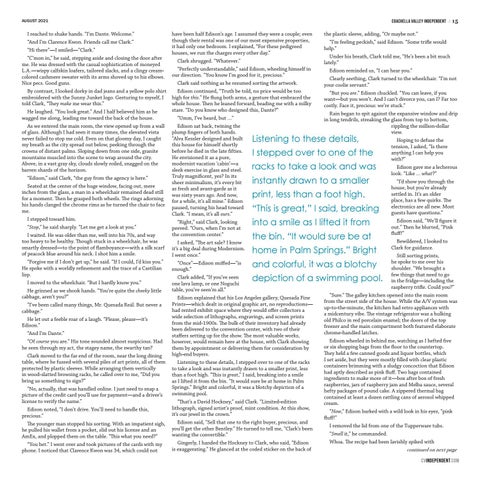
Books’ award-winning series of original noir anthologies, launched in 2004 with Brooklyn Noir. Each book includes all new stories, each one set in a distinct location within the geographic area of the book. Palm Springs Noir includes brandnew stories by T. Jefferson Parker, Janet Fitch, Eric Beetner, Kelly Shire, Tod Goldberg, Michael Craft, Barbara DeMarcoBarrett, Rob Roberge, J.D. Horn, Eduardo Santiago, Rob Bowman, Chris J. Bahnsen, Ken Layne and Alex Espinoza. Here is an excerpt of from “VIP Check-In,” by Michael Craft.
The move, the new job, the fresh
Dante From Sunny Junket An excerpt from ‘VIP Check-In,’ part of new short-story collection ‘Palm Springs Noir’ The editor of Palm Springs Noir, Barbara DeMarco-Barrett, writes in the introduction: “The best noir writers make us feel the heat of the sun, the touch of a lover. Setting can be gritty but can also be sublime, no longer relegated to urban locales and seedy hotel rooms but also mansions and swimming pools. Hence, Palm Springs, which may seem like an odd setting for a collection of dark short stories— it’s so sunny and bright here. The quality of light is unlike anywhere else, and with an average of 300 sunny days a year, what could go wrong? … “The stories in this collection come on like the wicked dust storms common to the area. More than half are by writers who live here full-time; all have homes in Southern California. They know this place in ways visitors and outsiders never will. These are not stories you’ll read in the glossy coffee-table books that feature Palm Springs’ good life. There is indeed a lush life to be found here, but for the characters in these stories, it’s often just out of reach.” Palm Springs Noir, released on July 6, is the latest in Akashic CVIndependent.com
beginning, none of that was my idea. But for two men, together for years—hell, decades—the time had come to plot a path toward retirement. And to Dr. Anthony Gascogne, ophthalmologist, Palm Springs felt like the logical destination. To me, not so much. That was seven years ago, when Anthony was dead set on relocating his practice from L.A. Because I balked, he said I could join him in the business as his office manager and assistant. My lackluster career as an actor and model had sputtered to a standstill, so I tagged along to the desert. Soon after, when the law finally allowed, he asked me to marry him. Then, two years ago, Anthony divorced me. And fired me. And my career path took another unexpected turn—a much darker turn. Starting over, pushing 60, I was broke, unemployed, and couch-surfing. On the brighter side, I was now in Palm Springs. Well-heeled snowbirds fled for the long summers, but for the rest of us, 12 months of sunshine provided a constant tan, inspiring me to stay fit. And while the sizable gay populace skewed toward the rickety side of Medicare, this demographic twist had its upside: In the eyes of the local gentry, I was still pretty hot (which had a little something to do with the divorce). My immediate need for income and a cheap apartment led me to consider—briefly—a stint as an escort. But I wasn’t getting any younger, and time would quickly take its toll, as it had on my starstruck dreams, so I settled on a bartending gig to get back on my feet. When I took the job, the manager said, “We already have a Danny.” He rummaged through a drawer and pulled out a name tag. “Here you go: Dante.” The job lasted only five months, but the name stuck, trailing me as I sniffed around for more durable employment. And
that’s when a friend tipped me off to a vacation-rental agency that had an immediate opening for a field inspector. I landed the job, which involved checking the condition of properties before guests arrived and after they left. My duties also included occasional VIP check-ins and minor service calls during their stay. “Yes?” crackled the intercom after I rang the doorbell. “Dante from Sunny Junket.” A befuddled pause. “What?” “My name’s Dante. I’m from Sunny Junket Vacation Rentals.” “Oh. Just a minute.” This was one of our premier properties, up in the Little Tuscany neighborhood, where the bohemian feel of steep, winding streets gave no hint of the million-dollar views enjoyed by residents behind their walled courtyards. In the gravel parking court on that rare cloudy afternoon in February, my battered Camry looked especially pathetic— huddled next to an elegant champagne-colored SUV. When did Bentley start making those? The party of two was registered under the name Edison Quesada Reál, booked for 11 nights, the entire duration of Modernism Week. It was a prime booking in high season, costing north of a thousand a day. The office said the guy was a bigwig art dealer from L.A., and they wanted him happy, so they sent me out for the VIP treatment. I intended to greet them when they arrived at the house, but they’d driven over early, letting themselves in with the keypad code we provided. The front door now rattled as someone fussed with the lock from inside. I waited with my slim folder of paperwork, standing under the cantilevered roof of the boulderlined entryway. A small peeping bird flitted from the top of a barrel cactus and darted into the darkening sky when the door swung open. “Well, hello.” His Asian eyes widened with interest as he sized me up. I grinned, returning the once-over. He didn’t fit my picture of anyone named Edison Quesada Reál. And he was too young for a titan of the art world, maybe in his 30s. He had delicate features and a prettiness about him, like a twink who’d grown up, but he’d also hit the gym and was pleasingly buff, for a short guy. I’ve always had a thing for short guys.
The party of two was registered under the name Edison Quesada Reál, booked for 11 nights, the entire duration of Modernism Week. It was a prime booking in high season, costing north of a thousand a day.
COACHELLA VALLEY INDEPENDENT // 15
AUGUST 2021
I reached to shake hands. “I’m Dante. Welcome.” “And I’m Clarence Kwon. Friends call me Clark.” “Hi there”—I smiled—“Clark.” “C’mon in,” he said, stepping aside and closing the door after me. He was dressed with the casual sophistication of moneyed L.A.—wispy calfskin loafers, tailored slacks, and a clingy creamcolored cashmere sweater with its arms shoved up to his elbows. Nice pecs. Good guns. By contrast, I looked dorky in dad jeans and a yellow polo shirt embroidered with the Sunny Junket logo. Gesturing to myself, I told Clark, “They make me wear this.” He laughed. “You look great.” And I half believed him as he wagged me along, leading me toward the back of the house. As we entered the main room, the view opened up from a wall of glass. Although I had seen it many times, the elevated vista never failed to stop me cold. Even on that gloomy day, I caught my breath as the city spread out below, peeking through the crowns of distant palms. Sloping down from one side, granite mountains muscled into the scene to wrap around the city. Above, in a vast gray sky, clouds slowly roiled, snagged on the barren shards of the horizon. “Edison,” said Clark, “the guy from the agency is here.” Seated at the center of the huge window, facing out, mere inches from the glass, a man in a wheelchair remained dead still for a moment. Then he grasped both wheels. The rings adorning his hands clanged the chrome rims as he turned the chair to face me. I stepped toward him. “Stop,” he said sharply. “Let me get a look at you.” I waited. He was older than me, well into his 70s, and way too heavy to be healthy. Though stuck in a wheelchair, he was smartly dressed—to the point of flamboyance—with a silk scarf of peacock blue around his neck. I shot him a smile. “Forgive me if I don’t get up,” he said. “If I could, I’d kiss you.” He spoke with a worldly refinement and the trace of a Castilian lisp. I moved to the wheelchair. “But I hardly know you.” He grinned as we shook hands. “You’re quite the cheeky little cabbage, aren’t you?” “I’ve been called many things, Mr. Quesada Reál. But never a cabbage.” He let out a feeble roar of a laugh. “Please, please—it’s Edison.” “And I’m Dante.” “Of course you are.” His tone sounded almost suspicious. Had he seen through my act, the stagey name, the swarthy tan? Clark moved to the far end of the room, near the long dining table, where he fussed with several piles of art prints, all of them protected by plastic sleeves. While arranging them vertically in wood-slatted browsing racks, he called over to me, “Did you bring us something to sign?” “No, actually, that was handled online. I just need to snap a picture of the credit card you’ll use for payment—and a driver’s license to verify the name.” Edison noted, “I don’t drive. You’ll need to handle this, precious.” The younger man stopped his sorting. With an impatient sigh, he pulled his wallet from a pocket, slid out his license and an AmEx, and plopped them on the table. “This what you need?” “You bet.” I went over and took pictures of the cards with my phone. I noticed that Clarence Kwon was 34, which could not
have been half Edison’s age. I assumed they were a couple; even though their rental was one of our most expensive properties, it had only one bedroom. I explained, “For these pedigreed houses, we run the charges every other day.” Clark shrugged. “Whatever.” “Perfectly understandable,” said Edison, wheeling himself in our direction. “You know I’m good for it, precious.” Clark said nothing as he resumed sorting the artwork. Edison continued, “Truth be told, no price would be too high for this.” He flung both arms, a gesture that embraced the whole house. Then he leaned forward, beading me with a milky stare. “Do you know who designed this, Dante?” “Umm, I’ve heard, but …” Edison sat back, twining the plump fingers of both hands. “Alva Kessler designed and built this house for himself shortly before he died in the late fifties. He envisioned it as a pure, modernist vacation ‘cabin’—a sleek exercise in glass and steel. Truly magnificent, yes? In its sheer minimalism, it’s every bit as fresh and avant-garde as it was sixty years ago. And now, for a while, it’s all mine.” Edison paused, turning his head toward Clark. “I mean, it’s all ours.” “Right,” said Clark, looking peeved. “Ours, when I’m not at the convention center.” I asked, “The art sale? I know it’s a big deal during Modernism. I went once.” “Once”—Edison sniffed—”is enough.” Clark added, “If you’ve seen one lava lamp, or one Noguchi table, you’ve seen’m all.” Edison explained that his Los Angeles gallery, Quesada Fine Prints—which dealt in original graphic art, no reproductions— had rented exhibit space where they would offer collectors a wide selection of lithographs, engravings, and screen prints from the mid-1900s. The bulk of their inventory had already been delivered to the convention center, with two of their staffers setting up for the show. The most valuable works, however, would remain here at the house, with Clark showing them by appointment or delivering them for consideration by high-end buyers. Listening to these details, I stepped over to one of the racks to take a look and was instantly drawn to a smaller print, less than a foot high. “This is great,” I said, breaking into a smile as I lifted it from the bin. “It would sure be at home in Palm Springs.” Bright and colorful, it was a blotchy depiction of a swimming pool. “That’s a David Hockney,” said Clark. “Limited-edition lithograph, signed artist’s proof, mint condition. At this show, it’s our jewel in the crown.” Edison said, “Sell that one to the right buyer, precious, and you’ll get the other Bentley.” He turned to tell me, “Clark’s been wanting the convertible.” Gingerly, I handed the Hockney to Clark, who said, “Edison is exaggerating.” He glanced at the coded sticker on the back of
the plastic sleeve, adding, “Or maybe not.” “I’m feeling peckish,” said Edison. “Some trifle would help.” Under his breath, Clark told me, “He’s been a bit much lately.” Edison reminded us, “I can hear you.” Clearly seething, Clark turned to the wheelchair. “I’m not your coolie servant.” “But you are.” Edison chuckled. “You can leave, if you want—but you won’t. And I can’t divorce you, can I? Far too costly. Face it, precious: we’re stuck.” Rain began to spit against the expansive window and drip in long tendrils, streaking the glass from top to bottom, rippling the million-dollar view. Hoping to defuse the tension, I asked, “Is there anything I can help you with?” Edison gave me a lecherous look. “Like … what?” “I’d show you through the house, but you’re already settled in. It’s an older place, has a few quirks. The electronics are all new. Most guests have questions.” Edison said, “We’ll figure it out.” Then he blurted, “Pink fluff!” Bewildered, I looked to Clark for guidance. Still sorting prints, he spoke to me over his shoulder. “We brought a few things that need to go in the fridge—including the raspberry trifle. Could you?” “Sure.” The galley kitchen opened into the main room from the street side of the house. While the A/V system was up-to-the-minute, the kitchen had retro appliances with a midcentury vibe. The vintage refrigerator was a hulking old Philco in red porcelain enamel; the doors of the top freezer and the main compartment both featured elaborate chrome-handled latches. Edison wheeled in behind me, watching as I hefted five or six shopping bags from the floor to the countertop. They held a few canned goods and liquor bottles, which I set aside, but they were mostly filled with clear plastic containers brimming with a sludgy concoction that Edison had aptly described as pink fluff. Two bags contained ingredients to make more of it—box after box of fresh raspberries, jars of raspberry jam and Melba sauce, several hefty packages of pound cake. A zippered thermal bag contained at least a dozen rattling cans of aerosol whipped cream. “Now,” Edison barked with a wild look in his eyes, “pink fluff!” I removed the lid from one of the Tupperware tubs. “Smell it,” he commanded. Whoa. The recipe had been lavishly spiked with
Listening to these details,
I stepped over to one of the
racks to take a look and was instantly drawn to a smaller print, less than a foot high.
“This is great,” I said, breaking into a smile as I lifted it from
the bin. “It would sure be at
home in Palm Springs.” Bright
and colorful, it was a blotchy
depiction of a swimming pool.
continued on next page CVIndependent.com
16 \\ COACHELLA VALLEY INDEPENDENT
AUGUST 2021
continued from Page 15
MAKE THE EASY CHOICE
THE #1 CHOICE COMFORT AIR WE'RE #1 FOR A REASON
ASK US
ABOUT OUR 0% FINANCING
Awarded Best AC Repair Company By Coachella Valley Independent Up to $1000 Off + Special Financing On A New HVAC System HIGHEST QUALITY EQUIPMENT EXTENSIVE WARRANTIES
BEST PRICE GUARANTEED 24/7 LOCAL SUPPORT
SAVE UP TO
60% ON YOUR ELECTRIC BILL*
LENNOX SIGNATURE SERIES SYSTEM
*SAVINGS AND RESULTS MAY VARY
CALL TODAY FOR DETAILS! CVIndependent.com
760.320.5800 comfortac.com
Cointreau. The piercing boozy scent of orange melded with the tart perfume of crushed berries, making both my mouth and my eyes water. “Now,” he repeated, reaching with trembling hands. I gave it to him, then slid a drawer open. “Fork? Or spoon?” “It doesn’t matter.” He looked ready to slop into it with his fingers. I gave him a spoon. He rolled a few feet back and gobbled the trifle. Between swallows, he groaned and gurgled. I glanced over at Clark, who seemed unfazed by this behavior. In fact, he gave me a thumbs-up. So, I returned to the task of putting things away. I had to tug at the Philco’s heavy ornamental latch (which brought to mind the hardware on a casket) and soon had the beast filled. Its condenser hummed in earnest. Edison was now banging his spoon on the sides of the plastic container as he scraped at the last of the trifle. I asked if he needed anything else from me, but he shook his head without looking up from his scavenging. I stepped around the wheelchair, took my folder from the dining table, and told Clark I was leaving. He followed me toward the front of the house. When I stepped outside, he went with me and gently closed the door behind us. We stood together on the landscaped walkway, protected by the jutting cantilever of the roof. It rained heavily now—straight down, with no wind to drive it—like a translucent curtain blurring the gray afternoon. Raindrops danced wildly on the windshield of the polished Bentley. In the hushed racket of the pelting water, the world was still. “It’s … exhausting,” said Clark, his words no louder than a whisper as he gazed into the courtyard. “Edison?” Nodding, Clark turned to me. “Ten years ago, I knew what I was getting into, and I was sure I could deal with the age difference. He’s always been pampered and fussy—that was part of his charm. But now, Jesus. It gets worse by the month, like he’s regressing into childhood. You’ve seen the pink fluff; that’s been going on awhile. As of last week, about the only other thing he’s willing to eat is canned spaghetti, like a kid.” I’d noticed the SpaghettiOs while unpacking in the kitchen. Clark said, “What’s next—diapers?” “Maybe.” He was quiet for a moment, then laughed. Stepping near, he clasped my hand with both of his. “You’ve been super, Dante. Really helpful. Thank you.” I grinned. “Anything else, just let me know.”
I could hear him breathing. I could almost hear his thoughts. Was he open to a fleeting kiss? Or did he want something less innocent— something more animal and lusty? He moved closer still, brushing against me and lolling his head back to fix me in his stare. His dark almond-shaped eyes appeared black in the dusky shadows that hugged us. I could hear him breathing. I could almost hear his thoughts. Was he open to a fleeting kiss? Or did he want something less innocent—something more animal and lusty? When his lips parted, he broke the spell. “Can you fix this weather?” I backed off a few inches. “It’ll dry up. We never get much, but they say we need it.” “Yeah,” he agreed coyly, “we need it.” Which left me unsure if this was small talk—or foreplay. Either way, the time was right for a quick exit. I turned to leave but paused. “Enjoy your Sunny Junket.” Clark rolled his eyes. “Let me guess. They make you say that.” With a wink, I sprinted off toward my car. Excerpted from “VIP Check-In” by Michael Craft, copyright 2021 Michael Craft, originally published in Palm Springs Noir, edited by Barbara DeMarco-Barrett, used with permission of the author and Akashic Books.
COACHELLA VALLEY INDEPENDENT // 17
AUGUST 2021
Her First Blaze An excerpt from Rodney Ross’ new novel, ‘Diversionary Fires’ di-ver-sion-ary: intended to distract attention from something more important. Where there’s smoke, there’s fire. And where there’s fire, there’s Tara Atwater, the character at the center of Diversionary Fires, the new novel by Rodney Ross. Left in her grandparents’ care while her reckless mother worked the Ohio carnival circuit, Tara learned the strange art of the diversionary fire in 1970 from grandmother Beryl, her mentor in flame. She grows too quickly into a mother who never knew her own, raising a son who will never know his father, along Ohio’s Fuego River, where everyone is disparaged as “water bugs.” She mows yards, empties bedpans and presses shirts and, when she dreams, it’s for her son, Dare. So, when Tara comes to hold the right combination of numbers to a record-breaking lottery, she has one problem before she can claim the winnings: What to do about the dead boyfriend, stabbed by her teenage son, on the kitchen floor? It was, after all, his ticket. Author Rodney Ross lives, writes and sweats in Rancho Mirage. His previous novel, The Cool Part of His Pillow, is now in its second edition from JMS Books (first published by Dreamspinner Press), won the LGBT Fiction category from both the Indie Excellence Awards and the Next Generation Indie Book Awards; was a silver medalist in the 2013 Global EBook Awards; and earned an honorable mention in the 2012 Rainbow Book Awards. Learn more at www.rodneytross.com. Here are portions of the first chapter of Diversionary Fires.
Teryl hated the Sturdivant man
from the get-go, even before he moved in across the street. That’s my house. She’d had the run of the vacant property since she came to live with her grandparents. It was her playground. Hopscotch was still faintly chalked on the driveway. Hidden somewhere was a box of Lemonheads. She’d even buried a pair of her drawers after accidentally soiling them. It was the nicest house on the block, although repairs were needed. The door of the attached garage had been only nine-tenths closed for over a year; a lush poison-something cloaked the chimney; and the front steps had chipped into little slate piles. Because it also featured a large barn-like shed
independent of the house, it always commanded a higher rent. Her ownership came to its end when a bundle of Mr. Sturdivant’s redirected mail to Hobart, Ohio, had been inadvertently left by the postman with her grandmother. With her lower lip tucked under, Beryl announced, “Boyohboy-ohboyohboy, how can you trust a man with a turd in his name?” From the change-of-address affixed to the bundled envelopes, he was moving from a town called Niles in Kentucky. “And what attracts all these Kentuckians here?” To Beryl, the only thing worse than dealing with a Kentuckian was being one. Teryl remembered a little about Kentucky. Kentucky was goldfish in plastic baggies, rolling over railroad tracks into the next town and a Ferris Wheel in a parking lot. Those were the days when she, her mother Cheryl and a man named Grover worked the fairs, living in a trailer with Monticello Attractions painted on both sides, one of a caravan that quickly set up carnivals, monster truck rallies and demolition derbies. Then Monticello Attractions said they couldn’t live in the trailer anymore. She was brought to Hobart to her grandmother Beryl, who she called Grandma Ber like bear, and Grandpa Merrill, who she called DewDad. “Quit your spying out the screen door, Teryl Lyn.” With her teeth out, Grandma Ber was almost unintelligible. In the three years that Teryl had resided at 912 O’Leary, she had watched Ber lose teeth to a dinner roll and corn on the cob (two on the same ear). When she broke one of her canines while eating cantaloupe, she had them all pulled. DewDad had dentures too. A can of Mountain Dew was always at-hand and the high sugar content had dissolved DewDad’s tooth enamel, then every tooth, which was why the nickname and the dentures. He wore the same black sunglasses as his singing hero, Roy Orbison, and the same dyed black hair, the color of a new tire. Most interpreted his nickname as DoDad, like he made things happen, but he was really a Don’tDad. Even what he did for a wage was a throwaway; he worked for a firm that manufactured paint stirsticks. Mostly, he sat outside their back door in a folding chair with his Mountain Dew, eating tablespoons of A1 Steak Sauce or watching UFOs seen only by him. Mr. Sturdivant climbed out his Chevrolet C10 pickup and disappeared into the mouth of the moving truck. Her grandmother put in her teeth. “He lives there now. Keep away.” The biggest worry for Teryl was what already lived there. Ber had forgotten about the family in the garage. Teryl had been skating on the driveway after supper, scissor-turning to dodge the cracks, when something colorless lumbered by. Its sagging belly barely managed to
squeeze under the garage door. Teryl peered under. Pink eyes on a sooty pointed face stared back. Teryl started transporting over remainders from supper, whatever Ber couldn’t repurpose. Tapping the plate forward to the far right side of the garage door was best. She knew when it neared from its very bad breath. Fingernails that looked like long, sharp grains of rice, the color of pencil lead, would snatch the paper plate inside. One evening, after watching from afar, Ber wanted an explanation. When told, she suggested, “Let’s look up your pet.” They went to a ragged animal book bought for a quarter at a rummage sale. Teryl flipped through pages the color of a used teabag until she recognized what Ber called a possum. Without a raccoon’s bandit mask to redeem them, they “sure are butt-ugly.” Ber tried to pronounce marsupial. “Just don’t get close to it. It’s got ticks and maybe rabies.” “It’s as fat as Mrs. Zimmer’s Himalayan.” “Your possum might be knocked up, then.” “Knocked up” was a term Teryl understood to mean baby, like when DewDad had men over for cards and they’d laugh about the horse-faced woman at Star Cafeteria “left in a predicament.” When the babies came, Teryl knew, the boys were jacks, the girls jills, and that they would attach to a teat within mama’s continued on next page CVIndependent.com
18 \\ COACHELLA VALLEY INDEPENDENT “One got away. How will it live?!”
continued from Page 17 pouch. The possum hid her new passel behind a wheelbarrel in the corner. Once, she saw the rubbery tail of a baby clinging to its mother’s back. Teryl would lay very still to watch the mother measure out bites from the paper plate with the same efficiency that Ber doled out a frugal dinner the night before DewDad picked up his salary check. “Sometimes she squawks at me,” Teryl reported. “Fear turns to rage, especially if she’s protecting her babies. Mamas are unpredictable,” Beryl replied. Like mine, thought Teryl. They drop you off with the vow to retrieve you, then they don’t.
Teryl pushed open the screen door for a better look.
AUGUST 2021
“Jack or jill went on a great adventure, and it will grow up to have babies who won’t trust human beings.” “It’s an orphan, like me,” she cried. Ber rose from crouching. “Your mama is saving up money with your daddy out there somewhere, plus you got us. You are a long road away from being an orphan.” It was already too late to shield Teryl from the hurt Cheryl had infected her with. But she could equip her with the skills to break, if not a heart, something else in retribution. “Dry your tears, sweet potato. You said Mr. Sturdivant had fish tanks? Let’s go kill something he loves” was her dark suggestion. “It’ll be our secret.”
They went to a ragged animal book bought for a quarter at a rummage sale. Teryl flipped through pages the color of a used teabag until she recognized what Ber called a possum. Without a raccoon’s bandit mask to redeem them, they “sure are butt-ugly.” Ber tried to pronounce marsupial. “Just don’t get close to it. It’s got ticks and maybe rabies.”
“Don’t go no farther than your yardball.” Ber was referring to the red gazing ball in their front yard. Teryl was fond of staring into the mirrored world, curved and crimson. Sometimes she pretended she had a lookalike, trapped within. Mr. Sturdivant’s thickly muscled arms strained his shirt and sleeves. The long sideburns that bent like an L toward the corners of his mouth made him especially unapproachable. The two movers were transporting a rolling cart with several filled aquariums. Water sloshed out. Teryl dashed across O’Leary behind the truck as a pool table clattered down the ramp. She peered in the back. A lawnmower and a stepladder had been brought forward. They were next off, bound for the garage. Nothing would dislodge the possums during daylight hours, Teryl knew, but she hurried to skim white rock from the foundation plantings under the garage door into its dark recesses. She listened for stirring. Mr. Sturdivant signed forms and waivers. The empty moving truck rumbled away. He pushed the lawn mower toward the garage. Teryl ran. By the time Mr. Sturdivant took the garage door above his broad shoulders, he was shouting, “Holy smokes, what a stink!” Teryl heard the gnashing sounds of distress that intuited imminent death. “Goddamn tree rats!” he howled.
“He beat and cut up the pasel and the mom didn’t protect them!”
Ber gritted her teeth. “That doesn’t make her bad, just scared.” CVIndependent.com
Ber had secrets,
too. A summer camp accident was her first diversionary fire. She would never have coined such a phrase, nor comprehended it, but the result was the same.
The three days of recreation had been a Red Cross initiative to benefit World War II and to free parents for weekend volunteerism. Four girls were assigned to a tent, two older to watch over two younger. Supervised co-mingling between boys and girls occurred once in an afternoon of outdoor games, nothing too roughhouse. Beryl was hopeful that after the hayride she would be the girl chosen to perform a round of Frere Jacques with a boy. She had every expectation, since she knew the lyrics. When Nils was selected, her heart leapt. He was sixteen and had walked her home several times. When Evangeline was chosen to sing with him, Beryl’s heart fell. Why the girl, breasts already mounding and cheekbones emerging from baby fat, who shared her tent? Evangeline sounded like the beginning of a poem. Beryl was something that was rolled out for a polka. Afterward, their chaperone turned the kerosene lamp to a soft glow so the younger ones wouldn’t be scared by shadows on the tent. Beryl plotted. How to humiliate Evangeline? Ants in her pants? Give her a hot foot? Beryl had heard about this in a W.C. Fields movie but didn’t know what it involved except someone hopping. She decided on a sleepover fallback: the warm rag. Evangeline would hold it as she slept and release her bladder’s contents. She’d awaken with her nightgown soaked.
until it was saturated. She enclosed it in Evangeline’s hand. But she didn’t sigh, relax and pee. Her hand spasmed and knocked over the kerosene lamp, alighting the tent in flames. Beryl bleated “Fire!” then rushed out the two terrified little girls and helped her nemesis to her feet. She grabbed the washcloth before the tent collapsed in flames while other campers screamed. At breakfast assembly, Beryl was scared she’d be uncovered as the instigator, but she was publicly praised for her quick thinking and got a roll of Lifesavers. She also learned that confusion can make bad look good through the power of a diversionary fire.
In the storm shelter, Teryl reached around halfempty paint cans DewDad refused to discard and returned to Ber shaking the lighter fluid. “It’s almost empty.” “We only need a dab. Take this Clorox.” Teryl watched Ber grab their rattan picnic basket, lay in the bleach, lighter fluid and matches, then clap it shut. Like everyone, they occasionally spent a sunny afternoon with the basket on land just beyond town known as The Manor. Most of its fences were easily scaled and the No Trespassing signs easily ignored. The Manor was owned by a wealthy Catholic family Ber called The Richeys, the name pinned to anyone of affluence who knew the difference between French dressing and Catalina. Teryl and her grandmother took a walk to the end of O’Leary, then around the block. They passed Mrs. Mechem, pulling a wagon of glass bottles. “Where y’all picnicking?” she inquired. “We’re taking a casserole to a sick friend over on Kyger,” Ber said. They strolled down an alley, onto Mr. Sturdivant’s property, to what Ber called the outbuilding. Several windows had been smashed by kids. The door had a latch for a padlock, but no padlock. Inside, the contents looked a lot like DewDad’s workshop: vises, a table saw, scraps of latticework and wood pegboard. Ber placed a single drop of lighter fluid, no bigger than a thumbtack, on piled wood scraps. The young fire, a pale orange, was impregnated by piles of sawdust and birthed by a sudden breeze that tucked under the door.
Ber had secrets, too. A summer camp accident was her first diversionary fire. She would never have coined such a phrase, nor comprehended it, but the result was the same.
A kettle had been left outside for the leaders’ coffee. Beryl quietly tilted the spout, holding the cloth under the water
goddamn hose?!”
They walked swiftly to the corner of the block. In a disguised voice that sounded a little like Tony the Tiger, Grandma Ber yelled, “Mister! Mister! It’s on fire! Fire!” Mr. Sturdivant came running out of the house and saw the smoke and that some spots of dry grass had ignited, too. “Someone call the fire department!” He didn’t know that the hub was across town and that the battle would be his alone for several minutes. He soared across yards. “Do any of you hillbillies own a
This was clandestine, thrill and trepidation. They flattened themselves against houses, then raced, suddenly over
COACHELLA VALLEY INDEPENDENT // 19
AUGUST 2021
the threshold and into Mr. Sturdivant’s house. They scuttled through a maze of boxes. Her grandmother peered around the corner into what had clearly been designated the game room. Teryl stared, transfixed, at a deer head on the wall. “He prob’ly killed it, too, right, Ber?” “And what we’re standing on.” Teryl realized it was a bearskin rug and jumped off. Ber was standing at the aquariums, bubbling and active. Ber unscrewed the cap from the bleach. Mesmerized by a group that looked like Skittles skimming languidly on the bottom among plastic coral, Teryl suggested, “These down here are a family. I think they’re babies. Maybe we don’t need to hurt his fishies.”
Ber placed a single drop of lighter fluid, no bigger than a thumbtack, on piled wood scraps. The young fire, a pale orange, was impregnated by piles of sawdust and birthed by a sudden breeze that tucked under the door. “Please, Ber, not the fishies,” Teryl asked. Ber heard the fire sirens and quickly recalibrated today’s lesson. She flung the bleach on the deer head. A section of its neck dissolved onto the floor. They worked quickly, until their eyes teared. The green pool table felt turned pink, then white. Ber sloshed bleach into the pockets, onto the rich mahogany finish.
2022 Civic Sponsors as of July 15, 2021. Photo by Monica Orozco.
“He has to pay, Teryl Lyn.”
Fall Preview
October 14-17, 2021 TICKETS ON SALE NOW
modernismweek.com Civic Presenting
Civic Partners
Teryl popped up the flaps of an opened box. “What’s this?” She withdrew a cardigan bearing the letter of scholastic sports. Beneath were ribbons, blue green and red, touchstones of sports superiority. “We’ll soak his glory days, too!” Quickly, they were all the color of band-aids. Parachute silk with military patches was draped over a small round table. Ber hit that. The color of Mr. Turd’s proud memorabilia was now a runny orange/pink. Ber pushed the back of Teryl’s head. “Out we go!” They patted their way along converging angles of the house. Neighbors emerged from the smoke to watch the firemen redirect hoses toward an untamed thicket. Briefly separated, Teryl and her grandmother reunited at the red gazing ball to watch Mr. Sturdivant go into his house then, eyes bulging out, race back out. “Who did it?! You set a fire then break into my house??!!! Is this your fucking idea of hospitality?!” he raged. “Let’s wash up real good,” Ber suggested. “Don’t look back. Hearing Mr. Turd’s screams are enough.” DewDad appeared to be napping in his chair. “Merrill Atwater can sleep through anything. Sirens … yelling … his own life,” Ber said. The pink jelly of tomatoes and seeds lay in his chest hair. A strand of spittle stretched from his mouth to his sternum, catching the twilight, bouncing with his intake of breath. “He’s probably dreaming up his own movie. Roy Orbison Versus The Martians.” Teryl reminded her grandmother, “We still have Mr. Sturdivant’s mail.” “We’ll pop over tomorrow and say howdy-do,” Ber answered, “and tell him how clean his house smells.” Excerpted from Diversionary Fires by Rodney Ross, copyright 2021 Rodney Ross, used with permission of the author.
CVIndependent.com
20 \\ COACHELLA VALLEY INDEPENDENT
CVIndependent.com
AUGUST 2021
COACHELLA VALLEY INDEPENDENT // 21
AUGUST 2021
ARTS & CULTURE
CVINDEPENDENT.COM/ARTS-AND-CULTURE
BACK IN BUSINESS P
After a year of relocation and construction, the Desert Rose Playhouse settles into its new home—and gears up for a busy year
By MATT KING
erformers and fans all agree: The absence of performing arts during the pandemic truly sucked. “I know a lot of my friends and other actors in town who went through a serious depression when this was taken away, because this is such a big part of so many people’s personalities and their lives and mental state,” said Robbie Wayne, the artistic director of the Desert Rose Playhouse. “When it’s just taken away without warning for so long, it wears on people—so that was part of my drive. I was focused on knowing that we could get back to business here soon, and I wanted to be ready for it as soon as we could. That’s what I thought the week before. We put out a video (asking every day.” Wayne’s drive—shared by managing director for help), and the community is what made it Matthew McLean, who is also Wayne’s fiancé— happen. In 10 days, we had enough to sign the lease and get started on the project. … We’ve led Desert Rose to not only move to a bigger, put a lot into it monetarily, but the project’s better location during the pandemic; it led much bigger than us, so it took the whole Desert Rose to become the first local theater community—and we couldn’t let them down. company to put on a full, live production since It was a matter of integrity when it came down the shutdowns. to it, because we had told everybody that this is On the heels of that first production—a successful two-week run of The Miss Firecracker what we’re doing, and we took their money and invested it into this building, and we couldn’t Contest—the theater opened The Great American Trailer Park Musical on Thursday, July just say, ‘Oh, well, sorry, it didn’t work out.’ That wasn’t an option.” 22, for a three-week run. That show will be After a year of hard work converting the followed The Rocky Horror Show, which will be shuttered nightclub into the new Desert performed Aug. 26 to Sept. 12. Rose Playhouse, Wayne and McLean set their “It’s surreal,” Wayne said. “It’s been exciting, sights on a June grand opening with The Miss exhausting, scary, funny—you name it. It’s Firecracker Contest. However, they came close been a whole spectrum of emotions with to a last-minute postponement when the June everything.” 23 opening date arrived. Christine Michele was part of The Miss Make that very close. Firecracker Contest cast, and is set to return as “We weren’t planning on being that late Columbia in The Rocky Horror Show. in the game; we were supposed to open on “Definitely the best feeling in the world for Wednesday, and on Tuesday, they came in me is to be back onstage,” Michele said. to do the final inspection,” Wayne said. “We After the pandemic hit—shutting down thought everything would go fine, but they Desert Rose’s March 2020 production of Beautiful Thing after just one weekend—Wayne uncovered an exit door that Zelda’s had sealed shut that opened inward, had no panic and McLean decided they had no choice but to leave the Rancho Mirage space Desert Rose had hardware, and was dead-bolted. They told us that we couldn’t open until this got fixed. called home since 2012. This thing was literally glued into place with “Our old space was just too small to be able a deadbolt on it. When I heard that, my heart to do anything,” Wayne said. “Even now (due sank, because we’ve been working on this place to pandemic precautions), we wouldn’t be since August of last year. This was the final able to go in there and have shows, because it thing we needed to get done, and they were had 8-foot ceilings, and it only sat about 75 telling us that we couldn’t open until we got a people. It was a very small, intimate space, door that was on backorder for four weeks. I which we loved at the time, but when we gave saw everything that we had been trying to do it up, it was because we were paying rent for a go down the tubes, all at once. building that we couldn’t use for months at a “I got on the internet—this was at 9 o’clock time. That’s after refunding all the tickets for in the morning (on Tuesday)—and I called the shows we’d canceled, and also not getting everybody in Southern California that could our money back for the show that we had possibly carry this door. Everyone said that produced, and any of the licensing fees that it was backordered for three to four weeks, we’d lost. so we were going to have to refund all of our “We were packing up to go into a storage tickets. It would have been the death of us, facility, and Matthew McLean saw this ‘for rent’ because we’re at the end of our finances now. sign suddenly pop up at Zelda’s—literally, like,
The view from the Desert Rose Playhouse control booth.
… I just kept going; I wouldn’t take no for an answer, and I found this guy in San Clemente. He had the door, but he didn’t have the frame that it fits into. I told him my situation, and he said, ‘Well, you’ve got a 2 1/2 hour drive. I’ll fabricate it for you while you’re on the road.’ So that Tuesday afternoon, I went and got it, and we had it installed Wednesday morning, and passed the fire inspection at 2 o’clock. It was literally that close.” Wayne and McLean were not only feeling pressure to make sure the building was ready; they also felt compelled to put on a good first show. “We didn’t even know how to set up the seats; we’ve never done a show there,” Wayne said. “All of the lighting, we had to take down and service it, and then reinstall it in a theater setting rather than a nightclub setting, and then add all the equipment that we had as well. Every day, we’re finding little tweaks and things where we say, ‘Oh, we didn’t think about this,’ or, ‘We didn’t think about that sideline,’ or, ‘We didn’t think about how this curtain’s going to fall and how this is going to open.’ We’re learning the space as we’re putting on a show. “I don’t know why—I guess because I’m crazy—but I put everything into building the actual theater, then directed and produced the show, and also am in the show. It’s like, ‘What was I thinking?’ But I’m glad I did it, because it’s been really rewarding. … It has been a lot of pressure and a lot of stress. It’s starting to subside a little bit now that we’ve got the doors open, but it has definitely been one of the hardest things I’ve ever done in my life.” The Miss Firecracker Contest was a fairly simple, straightforward show, with few special effects and not a lot of special lighting. Wayne said the theater would ramp things up with future productions.
“We’re going to pull out all the stops and show them everything we’ve got, in every light I can possibly show,” Wayne said. “I’m going to pull out the fog machine, the LED wall and our rain curtain. We just want to show everybody that this place can literally do anything. It’s got the makings and the technology of a Broadway theater.” Michele said she found performing in the new space to be incredibly exciting. “You can do so much in that theater, with so many shows,” Michele said. “It’s seriously one of the best theater venues we have out here, besides McCallum Theatre, obviously.” While Wayne has an ambitious slate of shows scheduled for 2021, he’s also got his eyes set on 2022, which will be a special year for the playhouse. “We’ve got The Great American Trailer Park Musical, Xanadu, Rocky Horror, Hedwig and the Angry Itch and Christmas With the Crawfords,” Wayne said. “Next year is our 10-year anniversary, so we’re doing a lot of reprise productions and bringing back some of the best stuff, like the first production I ever directed for Desert Rose Playhouse. Rocky Horror has been the one that really kind of started the buzz again. Everybody asked me about Rocky, and we’re really looking forward to it, because we’re going to pull out all the stops on that one. I think everybody is really going to be surprised and very happy with what we have in mind for that production.” The Desert Rose Playhouse will perform The Great American Trailer Park Musical through Sunday, Aug. 8, and The Rocky Horror Show, from Thursday, Aug. 26 through Sunday, Sept. 12, at 611 S. Palm Canyon Drive, Suite 15, in Palm Springs. Tickets start at $34. For tickets or more information, call 760-202-3000, or visit desertroseplayhouse.org. CVIndependent.com
22 \\ COACHELLA VALLEY INDEPENDENT
WANT TO JUMP START YOUR WORKOUTS? TruSculpt ID permanently reduces stubborn fat by 25% with one, pain-free treatment.
AUGUST 2021
MARKET
GET 25 TO 50 PERCENT OFF GIFT CERTIFICATES TO SOME OF THE VALLEY'S TOP RESTAURANTS!
Current deals include: 25 percent off gift cards for Eight4Nine Restaurant and Lounge 50 percent off gift certificates for Johannes Restaurant 25 percent off gift cards for Acqua California Bistro 25 percent off gift cards for Lulu California Bistro
Judge for yourself. ID results a�er one treatment. Revive has ID discounts! Show this ad and get $100 off per area Expires 8/31/2021 650 E. Tahquitz Canyon Way: (760) 325-4800 Torrance Ofice: (310) 375-7599 Irvine Office: (949) 586-9904 www.revivecenter.com CVIndependent.com
50 percent off gift certificates for Rio Azul Mexican Bar and Grill 50 percent off gift certificates for Shabu Shabu Zen
ONLY AT CVINDEPENDENT.COM
COACHELLA VALLEY INDEPENDENT // 23
AUGUST 2021
FOOD & DRINK
CVINDEPENDENT.COM/FOOD-DRINK
CAESAR CERVISIA R
Beer lovers can learn a thing or two from wine lovers when it comes to enjoying our favorite beverages
BY brett newton
egular readers may have the impression that I don’t give much thought to wine—and they’d be right. That doesn’t mean wine isn’t interesting or exciting; it certainly can be. A couple of years ago, I joined fellow Independent columnist and sommelier Katie Finn, and we presented each other (and friends) with the beverages we’re each passionate about; we then wrote about our experiences. I hope we can do that again someday soon. In the meantime, what follows was inspired by a job Katie gave me: She asked me to set up a Father’s Day beer-tasting for wine people at her place of work, the Desert Wine Shop on 111. information regarding tasting the wines, and The experience drove home the notion that, what that entails, along with terms to be in general, zythophiles (beer-lovers) could used while evaluating the aromas and flavors. stand to take a page out of an oenophile’s Additionally, with wine, you can gain much of (wine lover’s) book when it comes to the experience from rolling a sip around your approaching beer. palate—and spitting it out. I can imagine what a possible craft-beer Tasting beer at a brewery is an entirely nerd might say here (and by this, I include a different experience. With beer, you lose previous, less-enlightened version of myself): a whole dimension of the flavor by not “Why bring the pretension of the wine world swallowing—namely, the varyingly bitter into beer?” First, I’d like to apologize for that finish in many beers—and most breweries previous version of myself. Second, this is not don’t include any sort of evaluation of their to say that no pretentiousness exists in the beers. This is a bit of an opportunity missed, beer realm, although, from my experience, and it may be due to the general view that it occurs less often. Third, there is definitely beer is a drink for the plebians, while wine is more that we can learn from your average for the patricians. wine connoisseur. While preparing for the beer-tasting, I realThere’s a decided difference in the cultures ized something else: Information surrounding surrounding beer versus wine. If you are the making of a beverage and its history, or the interested in wine and go to a winery for history of the drink’s producer, seems to be a tour, you will likely get hit with a lot of more prized by wine drinkers than beer drink-
ers. I get it; it’s a particularly rough summer, and sometimes just unthinkingly enjoying a kölsch or a pilsner is the order of the day. However, the way I’m built, I’m compelled to learn about what is in my glass, and I think that has heightened my appreciation of drinking. Obviously, I’m not suggesting everyone sets about studying to become a Certified Cicerone—but there is a lot of gold to be found by looking just a little deeper. Think about the things we do a lot of in our lifetimes, and how little attention we often pay to those things, such as eating, drinking or sleeping. I haven’t been as successful with lucid dreaming, but when it comes to eating and drinking, I have cultivated more mindfulness, and it has resulted in a deepening of my enjoyment and a sharpening of my ability to detect different aromas and flavors (both good and bad). When I can learn more about something I’m interested in, I’m at my happiest. Researching where a particular beer style comes from, or referencing the Beer Judge Certification Program’s information on a subject, might be as helpful to you as it has been to me. Some style histories can be downright dramatic and/or ridiculous. You might also find that what’s in your glass doesn’t jibe with what you’re reading—and that knowledge may lead you to seek out a
more faithful example of a style. Having that knowledge in your arsenal is well worth it, because ultimately, you want to have more experiences you can enjoy ... right? In this vein, there’s an upcoming local opportunity to do some learning: The Ace Hotel and Swim Club will be bringing back its Craft Beer Weekend on Aug. 7 and 8, and if past years are any indication, it will be worth enduring a little August heat (with the help of air conditioning and a pool, of course) to get your fully vaccinated self out there, to enjoy beers from some great (mostly) Southern California breweries. One example: Sour Cellars out of Rancho Cucamonga, which had a world-class lambic-style ale last time the event was held. Mumford Brewing and El Segundo Brewing, both out of L.A., are also worth checking out. I’ll miss the Craft Beer Weekend, because I’ll be out of town then, but feel free to let me know what beers blew you away. Please eat, drink and be sweaty in my stead—and take a cue from those wine people by learning more about the beers that you enjoy, so you can enjoy them even more. Brett Newton is a certified cicerone (like a sommelier for beer) and homebrewer who has mostly lived in the Coachella Valley since 1988. He can be reached at caesarcervisia@gmail.com. CVIndependent.com
24 \\ COACHELLA VALLEY INDEPENDENT
AUGUST 2021
Photo By: John Warden
Photo By: John Warden
Photo By: Aaron Marrero
GayDesertGuide.LGBT We Look Forward to Celebrating Our Pride Together Again! Visit the new GayDesertGuide.LGBT website and sign up for our weekly email today.
Photo By: Larry Matsui
CVIndependent.com
Photo By: Larry Matsui
COACHELLA VALLEY INDEPENDENT // 25
AUGUST 2021
FOOD & DRINK
CVINDEPENDENT.COM/FOOD-DRINK
VINE SOCIAL JASON DAVID
In the last few years, (some) canned-wine offerings have gotten increasingly better
HAIR STUDIO
T
By KatieLOVE finn YOUR
HAIR
ombstone is one of my all-time-favorite movies. There is just something about the friendship between Wyatt Earp and Doc Holliday that gives me all the feels—and I could listen to Val Kilmer’s sexy Southern drawl deliver those witty one-liners all day. Yes, I’d let him be my huckleberry. Country Club and Cook Street I bring this up, because when I was recently presented with cans of Lucky Rock Wine Co.’s De sert sauvignon blanc and pinot noir, I couldn’t help but notice aPalm classic Doc Holliday quote on the label: You’re a daisy if you do. If you’re not a Tombstone fan or weren’t born in the 1800s, this expression might be a little lost on you, but in with 760-340-5959 a little chill. short, it means that if you’re “a daisy,” you’re Honestly, I have no idea what grapes go www.jasondavidhairstudio.net something very special. into these two wines; a small amount of Over the last few years, canned wine has each was produced, and there are zero notes exploded in the marketplace. Naturally, available about them. But knowing that because of COVID-19, the more convenient Andrew loves working with lesser-known and travel-friendly a product is, the better. varietals like Touriga Nacional, tannat, This is especially true about conveniently charbono and gruner veltliner, they could be packaged alcohol, which, for many, became as made from just about anything! essential as toilet paper and hand sanitizer There are tons of canned rosés on the during the shutdowns. market, and I’ve tried an exhausting amount At the beginning of the can craze, I sat of them (and have not been impressed). But down with some friends, ordered a bunch when I got hold of the Richvale Pool Party of In-n-Out burgers, and proceeded to taste Pink, I couldn’t put it down. This is a new dozens of canned wines. Trust me when I tell project by famed Sans Liege winemaker you: They were not all diamonds. In fact, I Curt Schalchlin, and it delivers the same remember only really being impressed with a handful; even some of the “good” ones were simply better than the other terrible options in front of me. In the years since, I have tasted myriad wines in aluminum, and I am pleased to report they are only getting better—so much so, in fact, that it’s time I revisit this alternative to glass and offer a new list of truly great wines with a pop top. Andrew Jones from Field Recordings is not one to rest on his laurels. He is continually creating some of the most exciting and unique wines from the Central Coast of California. Andrew is a pioneer when it comes to this alternative packaging and put his first wine under tab way back in 2013 … long before we knew that drinking in public parking lots was gonna be a legit thing. It’s amazing how damn delicious these wines are—and for those of us who came of age in the ’80s and ’90s, the labels will trigger some serious high school flashbacks: The Field Recordings Dookie white can is a riff on the Green Day album cover by the same name. The wine is crisp and fresh, like a crunchy Granny Smith apple that has been blended with ripe kiwis and mangos. The red blend features the Beastie Boys’ Licensed to Ill cover and is full of dark-red cherries, blackberries and a fun cardamom spice note. It’s an intense, full-bodied red that is so good
exceptional quality and masterful winemaking we’ve come to expect from his other wine labels. It has weight and depth while still offering up that quintessential refreshing rosé experience. Dry and zippy on the palate, I loved the flavors of barely ripe berries and Valencia oranges. A blend of organically farmed grenache and mourvèdre from the Santa Barbara Highlands, this is serious stuff. The Lucky Rock Wine Co. was established by two brothers, Aaron and Jesse Inman, who had a rather unusual upbringing: Their parents were gold-miners in Northern California and lived in a bus that traveled from mine to mine. Lucky Rock is the name of one of the mines where they spent time as children. I met with Jesse a few weeks ago and tasted the lineup. There was no doubt the wines out of the bottle were fantastic—bright and clean and balanced and flavorful. But how would the canned versions hold up? It’s rare to taste the exact same wine poured out of two different vessels at the same time, so we did a little blind head-to-head: the canned
sauvignon blanc versus the bottled sauvignon blanc. Would I be able to taste the difference? Would the lack of oxygen and light change the flavor? Would the aluminum reveal itself against its glass counterpart? The answers: Each a definite no. There was absolutely zero perceivable difference between the two wines. Both were delicious, with citrus aromas bursting from the glass, wonderful minerality and a touch of lemon blossom. The Lucky Rock pinot noir is juicy and lush, with flavors of raspberries, Thanksgiving cranberries and boysenberries mixed with baking spices. This is a classic California pinot noir that you will not believe comes out of a can. I’d be willing to bet if I poured any of these wines for you in a blind tasting, you wouldn’t be able to tell whether they came out of a can … but you’re a daisy if you do. Katie Finn is a certified sommelier and certified specialist of wine with two decades in the wine industry. She can be reached at katiefinnwine@ gmail.com.
CVIndependent.com
26 \\ COACHELLA VALLEY INDEPENDENT
AUGUST 2021
FOOD & DRINK
ON COCKTAILS Y
CVINDEPENDENT.COM/FOOD-DRINK
When temps break into the tripledigits, it’s time for tequila drinks
BY kevin carlow
eah, it’s tequila weather. I mean, I drank tequila after nearly every shift back in Boston, no matter the weather, but I never really “got it” until I moved here. If it’s pushing 120 degrees, and your sweat is sublimating off of your skin, it’s tequila time. Forget the dainty tipples of England and the Northeast—the Collins, the Pimm’s cup, even the southside. When it’s hot, you need salt, ice and tequila. I have covered the margarita and its cloudy history before in this column. I touched on the it had to go away and come back much later to Mexican “firing squad” in a column on the great Charles Baker. I mentioned the Oaxacan get any traction outside of Texas. These days, you’re much more likely to old fashioned at some point, but if you order try one at a craft cocktail bar using ruby-red old fashioneds when it’s 118, please seek grapefruit juice (another American invention), help. Let’s diversify your tequila portfolio fresh lime, sugar and club soda. Here’s a basic with some other classics, shall we? template: The Paloma 1 1/2 ounces of tequila, either blanco or Mexico’s favorite cocktail is the paloma. reposado That’s right, gringo: You’re doing it wrong 3/4 ounce of grapefruit juice with those margaritas. At its simplest, this 1/2 ounce of lime juice cocktail is grapefruit soda (like Squirt or 1/2 ounce of simple syrup (or 2:1 agave Jarritos—not La Croix Pamplemousse, and water syrup) please) and tequila in a tall glass with ice, Tall, salted, glass with ice; soda to top. lime and sometimes salt. That was the way Garnish with grapefruit peel; express the oil I first tried this drink, at college in the late ’90s, thanks to a Texan buddy (from YOUThe El Diablo stuhn) and a vending machine that gave out Feeling extra-midcentury? Try this Tiki free Fresca when my roommate tipped it over classic, first in print in 1946 in Trader Vic’s just so. Book of Food and Drink. It’s an easy one. The history of this drink is rather muddy. Some sources attribute its creation to Don 1 ounce of tequila Javier Delgado Corona of the La Capilla 1/2 ounce of creme de cassis bar in Jalisco, or someone by the name of Juice of half a lime Evan Harrison from a 1953 pamphlet called Collins glass, ice; top with ginger ale and “Popular Cocktails of the Rio Grande.” I dug a little deeper and found a wonderfully sleuth-y spent lime shell post on Alcademics debunking both theories. Most craft bars do their own take on this— I thoroughly recommend reading it in its adding mezcal, more tequila, some jalapeño; entirety if you are feeling drink-nerdy. or substituting ginger beer for ginger ale; or I will summarize it here: It seems that Don all of the above. All of these make for a great Javier never claimed to have invented the drink; feel free to experiment. Use vintage cocktail, and Evan Harrison is a bartender Collins glasses for extra credit, and don’t and proprietor in Massachusetts born forget a cherry or two. decades after the drink was popular. Some jokers in Boston apparently rewrote a bunch Tequila Sunrise of Wikipedia pages back in the early 2010s to Add some Mick Jagger to your sweaty attribute classic cocktails to local bar buddies. swagger! He popularized this cocktail in (Come on, people! Like this job isn’t hard enough as it is!) The author of the Alcademics the 1970s, although he didn’t invent it. Some say it was invented at The Trident in piece (Camper English), cocktail history god Sausalito; some say it was created by sleepless David Wondrich and others have sought to bartenders in San Francisco—who knows? find a paloma recipe printed from before My bet is that it traveled north from Mexico, the current century without luck. Wondrich since a similar drink was documented by found a few ads from Squirt recommending Charles Baker in the 1930s. So many roads adding tequila to their soda; these go back lead to Charles Baker. to at least the ’70s. Squirt is an American Forget the dive-bar version, with orange product, created in 1938 in Phoenix, so is the juice from the gun and grenadine from a paloma an American invention? Shrug. If so, CVIndependent.com
plastic bottle. Use fresh-squeezed orange juice and real grenadine (or even just pomegranate juice), as well as a quality tequila, for a nice “eye-opener.” I used to make one with some added citric and malic acid in solution, so the cocktail ended up with more tang and balance.
water. The simplest version is just that, tequila and lime over ice. Other recipes call for sweetened lime juice. Some recipes are basically a margarita with soda water added as it’s consumed. Everybody has a version now, it seems. Try this one.
2 ounces of reposado tequila Collins glass, ice; top with fresh orange juice (Optional: citric/malic acid solution to taste) 3/4 ounce of grenadine, drizzled over the top and allowed to sink
1 1/2 ounces of blanco tequila 3/4 ounce of lime juice 3/4 ounce of simple syrup Build in a Collins glass over ice; top with Topo Chico
Ranch Water I couldn’t end this without mentioning this über-hip West Texas highball. There’s not a lot of history to speak of here, although it seems that it’s been a regional favorite there for many decades. I imagine the name is a take on ‘branch water,” as in “bourbon and branch water,” the low-iron spring water traditionally added to whiskey in the Southern states. In this case, the water is Topo Chico mineral
Then again, you can always just enjoy your tequila “cruda”—with salt and lime (made even better with the addition of an iced-cold Mexican beer). I love a Boilermaker, and this is one of the best. If you can find a place that does “sangrita” (a mix of tomato and orange juice, a little lime, some Worcestershire and dash of hot sauce), even better. It’s hot out, and you’ll need those electrolytes. Kevin Carlow can be reached at CrypticCocktails@gmail.com.
AUGUST 2021
COACHELLA VALLEY INDEPENDENT // 27
Opens August 6!
350 S. Indian Canyon Drive, Palm Springs Open 4 to 9 p.m. Tuesday-Saturday Order online at rioazul.pay.link CVIndependent.com
28 \\ COACHELLA VALLEY INDEPENDENT
AUGUST 2021
the
FOOD & DRINK INDY ENDORSEMENT This month, we’re admiring simple food that’s been elevated by talented restaurateurs By Jimmy Boegle
according to Yelp, Tripadvisor & OpenTable WE ARE ONE OF THE VERY BEST with 9,000 Sq feet keeping you safe is easy OPEN DAILY FROM 11AM - 3PM & 5PM - 9PM 849 N PALM CANYON DRIVE . PALM SPRINGS EIGHT4NINE.COM 760.325.8490 CVIndependent.com
WHAT The margherita pizza WHERE Ferro, 25840 Cedar St., Idyllwild HOW MUCH: $14 CONTACT 951-659-0700; www.ferrorestaurant.com WHY It’s one of the best pizzas I’ve had in SoCal. I was part of a group of friends who decided to splurge for a cabin in Idyllwild one recent weekend. We were celebrating a birthday, and we figured it would be lovely to escape the broiling heat for a few days. Unfortunately, the cabin wasn’t airconditioned. And temperatures rose into the mid-90s each of the days we were there. Oops. Despite the sweatiness, it was still a nice weekend—and one of the highlights didn’t even take place at the cabin. It happened a couple of miles down the hill from our non-climatecontrolled cabin, at Ferro restaurant. While we dined in for most of our meals, we decided to give ourselves a break from cooking for two dinners. Both Ferro’s dog-friendly patio and outdoor wood-fire pizza oven caught my eye during my Idyllwild-restaurant research. We initially tried to go on Friday night, sans reservations—but we were politely told there was no availability. We promptly made reservations for Sunday. We are very glad we did. From the polenta con parmigiano side ($8) to the cacio e pepe (spaghettoni and pecorino romano with black pepper, $18) to the salmone arrosto ($34), everything we had was fantastic. But my personal favorite was the oh-so-simple, oh-so-good margherita pizza. Dough, San Marzano tomatoes, mozzarella, basil and garlic—that’s all there is to this pizza. But the dough was fresh and delicious; the ingredients were all high quality and perfectly proportioned; and the pizza was expertly cooked in that aforementioned woodfire oven. Our meal was so scrumptious that we’re already plotting another trip to Idyllwild— perhaps just for dinner. In my mind, that margherita pizza alone is worth making the twisty, turny drive up the mountain.
WHAT The chopped salad WHERE The Slice Pizzeria Ristorante, 72775 Dinah Shore Drive, No. 107, Rancho Mirage HOW MUCH $11 half-order (as shown), $15 entrée CONTACT 760-202-3122; www.theslicepizza.com. WHY Everything is in perfect proportions. There are few dishes more basic than a green salad. Take lettuce (usually); dice up and then add featured ingredients; put on the dressing; combine; boom, you have a salad. No heat or cooking necessary. But … raise your hand if you’ve ever had a subpar salad at a restaurant— perhaps because the greens were past their prime. Or the ingredients were improperly proportioned. Or there was too much dressing. Or there wasn’t enough. There are myriad reasons why a restaurant salad can disappoint—but none of them were to be found during my recent lunch visit to The Slice. I was feeling hungry, so I ordered three things—a cup of minestrone ($5), the stromboli (with pepperoni, Italian sausage, cheese and a side of marinara; $8) and the half chopped salad—and figured I could take whatever I didn’t eat home. The soup and the stromboli were both pretty good, but my taste buds kept wanting more of the chopped salad Slice’s menu says the chopped salad includes lettuce, red onions, black olives, salami, turkey, tomatoes, garbanzos and a Dijon vinaigrette, and is garnished with fresh basil. I didn’t taste the basil, but that’s fine, because I tasted everything else—and everything else was fantastic. The lettuce was fresh and crisp; the quality ingredients were properly proportioned with both each other and the lettuce; and there was just enough dressing. Forgive the cliché, but this salad was greater than the sum of its parts. If I had that lunch to do all over again, and I suspect I will soon, I’d forgo the soup and the stromboli, as enjoyable as they both are. Instead, I’d order a full chopped salad—and enjoy.
COACHELLA VALLEY INDEPENDENT // 29
AUGUST 2021
CVINDEPENDENT.COM/FOOD-DRINK
Restaurant NEWS BITES By charles drabkin GREATER PALM SPRINGS OFFERS DISCOUNTS VIA ITS SUMMER EATS PASS I’m not sure if you have heard, but it is HOT in the Coachella Valley—and although out-of-towners still seem to be flocking here, now is the perfect time to check out one of those restaurants you have been meaning to try (presuming it didn’t close for the summer). And here’s how you can possibly get discounts while doing so: The Greater Palm Springs Convention and Visitors Bureau is offering its Summer Eats Pass! Why heat the kitchen at home when you can eat out and take advantage of someone else’s air conditioning, as well as dining deals—like a free dessert or 10% off your meal? The same day I signed up, I found myself at French Rotisserie Café (44489 Town Center Way, Palm Desert; frenchrotisseriecafe.com) and scored a complimentary and delicious Belgian chocolate mousse; it was a perfect ending to my lunch (a delicious rotisserie chicken sandwich topped with fennel slaw). By checking in at a participating restaurant, you will also be entered into a weekly drawing to win restaurant gift cards. Sign up and learn more at www.visitgreaterpalmsprings.com/ summer-eats-gps. IN BRIEF In Indio, Pablo’s Tacos and Beer, 42425 Jackson St., has replaced Los Pablos Taqueria. The new owners have remodeled the space and are serving Mexican standards—and staying open late! Learn more by searching for Pablo’s on Facebook. … More and more chains are setting up shop here. SoCal staple Dave’s Hot Chicken has opened its first location in the Coachella Valley, at 42213 Jackson St., in Indio. Dave’s specializes in hot chicken tenders and sliders, with seven spice levels, ranging from “No Spice” to “Reaper,” as well as sides like a house-made kale slaw and creamy mac ’n’ cheese. What began as a parking-lot pop-up in L.A. has become a 20-or-sorestaurant juggernaut, with more locations on the way; in fact, the second area location is slated for Cathedral City, at the Date Palm Plaza. Visit www.daveshotchicken.com to learn more. … And now some annoying chain news: Coachella Valley will soon be home to a Chick-fil-A. The popular Atlanta-based restaurant will open just off Interstate 10, at Monterey Avenue and Dinah Shore Drive. The fact that Chick-fil-A’s sandwiches are served with a side of anti-LGBTQ bigotry is well-documented, so we’ll just say we encourage you to spend your hard-earned dollars at nondiscriminatory businesses, and leave it at that. … It seems chicken is the Big Thing at the moment, because SoCal Mexican-style rotisserie chicken chain Juan Pollo opening its second area location (the other is in Coachella, at 50225 Harrison St.), at 69160 Ramon Road, No. 101, in Cathedral City. This is rotisserie chicken people are willing to drive miles for, we’ve heard; details at juanpollo. com. … Grocery Outlet, the bargain grocery-store chain, has opened yet another new location, at 30025 Date Palm Drive, in Cathedral City. If you like to add a treasure-hunt element to your grocery shopping, this is the place for you. Visit www.groceryoutlet.com to learn more. … New: Taste the World Bar and Grill has opened in the Caliente Tropics Hotel, at 411 E. Palm Canyon Drive, in Palm Springs, where Evzin once reigned. Offering flavors of the Eastern Mediterranean like baba ghanoush, falafel and Lebanese stews, this place serves desert food to sustain you through the summer. Learn more at tastetheworldpalmsprings.com. … The Ace Hotel and Swim Club, 701 E. Palm Canyon Drive, in Palm Springs, is bringing back its annual Craft Beer Weekend, on Saturday and Sunday, Aug. 7 and 8. More than 30 local, regional, national and international craft breweries will keep the golden elixir flowing, while attendees enjoy live music and unique vegan and meat-based barbecue. Tickets are $75 per day at acehotel.com/craftbeer. … And now, back to chain news: A Wahlburgers is opening at the Morongo Casino Resort Spa, 49500 Seminole Drive, in Cabazon. The popular casual-dining concept, founded by brothers Mark, Donnie and executive chef Paul Wahlberg, features a menu emphasizing made-to-order food inspired by favorite family recipes. The burgers include Mark’s Choice: a plant-based patty with smoked cheddar, lettuce, caramelized onions, house-made chili-spiced tomatoes and Paul’s Wahlsauce. More details at wahlburgers.com. … Ring them bells, because Michael Holmes’ Purple Room is slated to reopen its doors on Aug. 31! This gem of a restaurant/entertainment venue has been dearly missed during the pandemic. Expect a fabulous happy hour with live entertainment every Tuesday, Wednesday and Thursday, and headliners Friday and Saturday nights. Sunday nights showcase the crown jewel of Palm Springs entertainment: The Judy Show. Get the full schedule at purpleroompalmsprings.com/home. Got a hot tip? Email me: foodnews@cvindependent.com.
Patio and indoor dining takeout 4 to 9 p.m. Tuesday-SUNday 1775 E. Palm Canyon Drive (760) 778-6595 www.533vietfusion.com
CVIndependent.com
30 \\ COACHELLA VALLEY INDEPENDENT
AUGUST 2021
31 31 35 37
Surfer Blood, at long last, gets to play songs from its new album at Pappy and Harriet’s the venue report: August brings tons of tribute acts, haute chile, jody watley—and more! Leanna and Miguel join The Jazz Collective to perform at the Palm Springs Cultural Center The lucky 13: the guitarist making the Night Owls fly; the bassist rounding out More Than Circles
www.cvindependent.com/music
NOT YOUR PARENTS’ PARENT S’ JAZZ SHOW
Jazzville continues Palm Springs’ notable jazz history in its new home at the Cascade Lounge
32 Forrest Funk/Agua Caliente Casinos
CVIndependent.com
COACHELLA VALLEY INDEPENDENT // 31
AUGUST 2021
MUSIC MUSICAL MYSTIQUE
CVINDEPENDENT.COM/MUSIC
Surfer Blood, at long last, gets to play songs from its new album at Pappy and Harriet’s
By matt king
M
usic can create powerful emotional reactions—and nobody is really sure why. Simple guitar chords and pedals can cause a wide range of emotions with no true explanation, and indie-rock band Surfer Blood is a prime example of this musical conundrum. Surfer Blood is set to perform at Pappy and Harriet’s Pioneertown Palace on Saturday, Aug. 21. Worn-Tin will open. “Pappy and Harriet’s is one of the most reveals some quarantine covers and revisits, as magical places on Earth, as far as I’m well as a few in-person live sessions. concerned,” said John Paul Pitts, frontman “I always want to stay busy,” Pitts said. and guitarist of Surfer Blood, during a recent “We’ve done some web concerts, which are fun, phone interview. “Joshua Tree is an amazing but they’re kind of hard to do. You have to get place. I used to live in California, and we’d go really good at video editing and mixing and out there on the weekends. I just love it. stuff, as opposed to when there’s a show, and “It’s been a weird year. It’s exciting to get you just have to show up with your equipment. back on the road and play a bunch of shows, We edit and mix everything ourselves. But and Pappy and Harriet’s is the cherry on top of there’s nothing like playing to a crowd, and the sundae.” getting that energy off of people, you know?” The month-long tour which includes the Pitts said he learned some new skills during stop in Pioneertown will comprise the band’s the shutdown—and he’s looking forward to not first live shows in front of audiences since using those new skills for a while. Surfer Blood released its newest album, “You naturally get better at things like Carefree Theatre, last September. video editing, for example,” said Pitts. “It’s “We expected to be touring it back in May something that I’ve never really cared for that 2020—and that obviously didn’t happen,” I’m now kind of good at. But … just not the Pitts said. “This is the first time we’re going same, so I’m super-excited to get back on the to be playing these songs on the road, so I’m road and play for people in real time.” super-excited.” Carefree Theatre marks a stark contrast when The band members are hopeful that the new compared to the sounds Surfer Blood explored tracks will quickly come back to memory. previously. “We’re now shaking the rust off, but I’m “The new record is like, if I had to compare it sure two or three shows in, it’ll all fall off,” to our other records, a lot more up front and a Pitts said. “That’s the way it usually works, lot more poppy,” said Pitts. “It’s just short, comright? A show on the road is worth five pact, two-minute songs, which I’m really excited practices. Don’t see our first show, because to play live, because it’s just very immediate. we’re going to be garbage.” “I feel like you’re always reacting to the last The pandemic didn’t cause the band to thing you did, which in our case was a record completely step away from performances. called Snowdonia, where all the songs were, like, A glance at Surfer Blood’s YouTube channel 7 1/2 minutes. I love that record, and I’m really
Surfer Blood. David Hamzik
proud of it. It was an album like Daydream Nation by Sonic Youth, and the newest one is more like Alien Lanes by Guided by Voices.” Pitts said the variance in the band’s albums offers him some perspective. “Every night, when we lay out the seven different full-length vinyls on the merch table, I’m like, ‘Wow, it’s been a crazy time,’” Pitts said. “It’s a different chapter in the life of the band, and I’m excited for people to hear some extremely punchy music.” I was curious if the experimentation between the different albums had anything to do with the longevity of the band, which released its first music in 2009. “Never let yourself get bored—I think that’s the most important thing,” Pitts said. “We’ve made five or six records that all sound radically different from each other. This way, you never have to go back in time.” Most fans agree that despite the changes in sound, every release from Surfer Blood still somehow sounds like Surfer Blood. “I think that part is unconscious,” Pitts said. “You put your fingerprint on every record, whether you know you’re doing it or not.” We ended our conversation by talking about how music and culture vary by location. Pitts, who has lived in both California and Florida, said he looks forward to traveling again. “I can’t think about how different Carefree Theatre, the newest record (made in Florida), sounds compared to 1000 Palms, or Pythons, records made while I was living in L.A.,” he said. “I think these things get inside of you, and again, are out of your control. “I’m super-grateful that I was able to travel all around the world in my 20s, with my best friends, with Thomas (Fekete, who passed away after a bout with cancer in 2016), with the band, with Mikey (McCleary) and Lindsey (Mills). I wouldn’t trade that for anything. There’s something different about traveling and meeting people who are fans of your band, who will talk to you about their actual lives instead of just viewing you as a tourist. It’s opened my mind to a lot of shit. “I’m just excited that it’s all happening again. It’s been a year since we played a show. It’s not optimal.” Surfer Blood and Worn-Tin will perform at 8 p.m., Saturday, Aug. 21, at Pappy and Harriet’s Pioneertown Palace, 53688 Pioneertown Road, in Pioneertown. Tickets are $20. For more information, call 760-365-5956, or visit pappyandharriets.com.
The Venue REPORT August 2021 By matt king
Mirage
Happy August! The Rock Yard at Fantasy Springs rolls on with its series of tribute shows every Friday and Saturday from 7 to 11 p.m., which are appetizing for all music fans 18 and older. On Friday, Aug. 6, get your fixin’s of Southern charm with Lynyrd Skynyrd cover band Southbound and Company. On Saturday, Aug. 7, pay tribute to Guns N’ Roses with Appetite for Destruction. If you’re looking for something a little more modern, check out Rage Against the Machine tribute Renegades of Rage on Friday, Aug. 20, or Pearl Jam tribute Vitalogy on Saturday, Aug. 21. Every Thursday from 7 to 11 p.m. is Country Night in the Lit Lounge. Country Nation is set to perform Aug. 12; The Troubadour Experience, a tribute to George Strait, is taking place on Aug. 19. Noches De Fuego is also happening every Wednesday and Sunday from 7 p.m. to midnight, featuring events like Latin Divas Tribute, a tribute to Shakira, J.Lo, Celia Cruz, Selena and Gloria Estefan, on Sunday, Aug. 8. Admission is free; you must be 21 or older to attend any event, except for the classic-rock series at the Rock Yard, for which you must be 18-plus. Fantasy Springs Resort Casino, 84245 Indio Springs Parkway, Indio; 760-342-5000; www. fantasyspringsresort.com. Spotlight 29 is again featuring entertainment, and is kicking off the return with a series of tribute concerts every Friday night at 7 p.m. On Aug. 6, Mirage will pay tribute to Fleetwood Mac. One of These Nights will pay tribute to the Eagles on Aug. 13. You can catch an award-winning tribute to the Rolling Stones, Mick Adams and the Stones, continued on Page 36 CVIndependent.com
32 \\ COACHELLA VALLEY INDEPENDENT
AUGUST 2021
MUSIC NOT YOUR PARENTS’’ JAZZ SHOW By matt king
T
he pandemic sadly killed off some local performing-arts productions—but the people behind Jazzville Palm Springs would not let the concert series, which honors the historic Palm Springs jazz scene, go gentle into that good night. Jazzville Palm Springs celebrated its return on July 1, in a brand-new location: The revamped concert series takes place every Thursday at 7 p.m. at Agua Caliente Palm Springs’ Cascade Lounge. “Jazzville is four years strong, and has had a number of different venues—but none as illustrious as the Cascade Lounge,” said Adam Levy, executive producer of Jazzville. “I had been behind the scenes helping founders Mark acoustics were nice, and I’m like, ‘Let’s just do Alan and Barry Martin fulfill their vision, something.’ The owner, Dan, agreed, and gave and serendipitously, we connected over the me Wednesday nights.” pandemic when I heard that Jazzville was The Chi Chi was located on Palm Canyon probably going to disappear. The pandemic Drive, near Andreas Road. really did Jazzville dirty—and I wanted to keep “It was the hottest nightclub west of the the vision alive. Mississippi for about 18 years,” Martin said. “We were exploring different venues, and I “Nobody could touch it, and everybody who bumped into some former colleagues I knew was anybody wanted to play there. All the from when I was working at Agua Caliente Black jazz singers who couldn’t get work in as their advertising manager. They asked L.A. and other states always played at Irwin’s about the Jazzville show and other events I club. They also had some bawdy burlesque had produced in the past, and they sounded shows that couldn’t be performed anywhere interested—and everything worked out.” else at the time. Palm Springs has a history of Levy said it became apparent when the first bringing the real cabaret-jazz style and the big shows went on sale that audiences were eager show, and kept it alive for many, many years for Jazzville’s return. after jazz had started to get into the bebop “Some were driving from L.A., Orange age. The Chi Chi kept early jazz alive, and it County and, of course, all over Palm Springs was such a huge, phenomenal, world-famous and the Coachella Valley,” Levy said. place—so we get all of our inspiration from the Barry Martin—also known as DJ Baz—is style of the Chi Chi club.” the co-founder of Jazzville. Jazzville moved from Oscar’s to Hotel Zozo, “What we’re doing is sustaining a culture then to Wang’s in the Desert, before making that’s over 100 years old now, and some the Cascade Lounge its current home. Levy people just have to take it upon themselves said the biggest challenge for producers has to keep this art form alive,” Martin said. “The been continual improvement. musicians do it on their own, but they need “Jazzville has always been an event where places to play and audiences to play for, and we’ve tried to really honor the traditions of that’s where Jazzville comes in.” Palm Springs and the culture of jazz music, In the 1940s, ’50s and ’60s, Palm Springs was mainly the Chi Chi club,” Levy said. “The home to one of the most popular jazz clubs on pressure that we have here is really taking our the West Coast—the Chi Chi, which featured production values and our new venue to the performances by Louis Armstrong, Nat King next level. It’s something we’ve been more Cole and Sophie Tucker, among others. excited to do than ever before, and in this new “I read an article, in an older issue of Palm venue, we’re able to incorporate multimedia Springs Life, about Irwin Schuman and the Chi presentations before the show—a pre roll of Chi club,” Martin said. “They could entertain curated vintage videos, tours, clips from Palm 700 people on that stage, and everybody who Springs in the ’50s, snippets of Frank Sinatra, was anybody played on that stage. It all goes etc. We even had showgirls passing out candy back to reading that article, as it was the first cigarettes. The only pressure, really, is just time the thought popped up in my mind, and razzling and dazzling on a consistent basis.” I wondered why Palm Springs didn’t have While Jazzville is committed to honoring something like that.” the history of the valley, its producers also That thought led to the first iteration of want to show off jazz music to younger Jazzville, at Oscar’s Palm Springs. audiences. “One night, I saw this indoor cabaret “One thing we want to make really loud room not being used,” Martin said. “It and clear is that Jazzville isn’t your parents’ had a beautiful red velvet curtain, and the jazz show,” Levy said. “The groups that are
350 S. Indian Canyon Drive, Palm Springs Open 4 to 9 p.m. Tuesday-Sunday Order online at rioazul.pay.link
CVIndependent.com
CVINDEPENDENT.COM/MUSIC
Jazzville continues Palm Springs’ notable jazz history in its new home at the Cascade Lounge
the first couple of Jazzville shows at the performing are younger than me, and I’m in Cascade Lounge. my mid-30s. This is stuff that has always had a “I kind of expected an older, retirement-age place in musicians’ and aficionados’ hearts, and crowd to be there, and I was very pleasantly what we’re doing is bringing that culture to surprised to see that nearly half the crowd was Palm Springs and making it hip again. We have younger couples and younger people who were a lot of young folks coming in, and (one of the in their late 20s and early 30s,” said Stephenie first shows back), about 50% of the room were Streiff-Process, director of marketing at Agua in their 20s. I feel like what we’re trying to Caliente Palm Springs. “It’s encouraging to accomplish here translates to the rock ’n’ roll watch a younger generation just fall in love demographic, rockabilly and even metal. When with or continue to love what’s truly the most you listen to heavy metal, the technicalities unique art form to come out of the United of playing are the same in jazz music. We’re States.” trying to spread awareness of not only the Martin said the Cascade Lounge is a perfect music, but the whole vibe and the culture fit for Jazzville. that Palm Springs brings in creating that “That was the only room in Palm Springs experience. You can watch jazz anywhere for free, but we’re trying to give you the experience, that I really wanted,” Martin said. “There’s no and I feel like that’s really our biggest mission.” other room in Palm Springs like it as far as seating, comfort, the look and feel of the room, Martin said jazz music has always been hip. the service, the stage and the lights, the staff, “It’s the audience that became un-hip, so and everything. It was either build something we’re got to make them hip again,” Martin from the ground up, or go to that space—and said. “Jazz was the only music that people when it was offered, I was thrilled.” used to listen to; there was nothing else on Martin said he’s proud to be continuing the radio. Everything came out of jazz—R&B, Palm to Springs’ jazz history. soul and pop music. It’sSafety the beginning it all, From Netofprograms Lifeproud Enrichment “Our mission is to make more jazz lovers out and it has a very illustrious history. There are a of people who would love jazz if they would lot of styles of jazz, so we focus on everything only go to one show,” Martin said. that’s perfectly in the middle. We don’t do lazy jazz, and we don’t do loud, crazy jazz. Jazzville Palm Springs takes place every Thursday “We did a Jazzville at The Abbey in West at 7 p.m. at the Cascade Lounge, inside Agua Hollywood, and Lady Gaga was in the audience Caliente Palm Springs, 401 E. Amado Road. for that show. We had a nice little gypsy jazz Tickets start at $10. Upcoming shows include trio on a beautiful Sunday afternoon outside The Abbey, and The Abbey is now interested in Angel Town Combo on Aug. 5; Pino Noir Quartet on Aug. 12; Conganas on Aug. 19; and Nutty on having a regular thing happening there.” Aug. 26. For tickets or more information, visit Management at the Agua Caliente Palm www.jazzvillepalmsprings.com. Springs has liked what they’ve seen during
we are here for you visit us online at
www.thecentercv.org 1301 N. Palm Canyon Dr., Palm Springs, CA 92262 & 1515 Sixth Street, Coachella, CA 92236 Lizzy and the Triggermen perform at Jazzville on Thursday, July 1. Forrest Funk/Agua Caliente Casinos
COACHELLA VALLEY INDEPENDENT // 33
AUGUST 2021
YOU ARE INCLUDED Two-Day PRIDE
Festival November 6 & 7 Downtown Palm Springs PRIDE 5K
Run/Walk November 6 8 - 10am Uptown
George Zande r Candlelight Hate Crime
Vigil & Mar ch November 1 6 - 7pm
PS Drag
ch Brun DITION PRIDE E r7 Novembe 9am - 1pm a Roly Chin Fusion
TRIO
rings Palms Sp UT O COMING
Parad Partye
ion t a r b e l Ce r5
Novemb e 9am - 12 r 7 :30pm
Novembe 5 - 10pm r. on D Palm Cany
Champagne Brunch & Parade
Viewing Party November 7 9am - noon Eight4Nine
ings Palm Spr PRIDE
e d a r Pa r 7 Novembe pm :30 10am - 12
November 1-7, 2021 Festival Poster by SHAG available at Destination PSP
MEDIA SPONSORS
Barbara Barrett Attorney
CVIndependent.com
34 \\ COACHELLA VALLEY INDEPENDENT
AUGUST 2021
www.GayAndLesbianPages.com SPECIAL THANK YOU!
FREE • SOUTHERN CALIFORNIA
Defending Marriage Equality! It’s The Law! Your Family Hardware Store Since 1947!
EUROWÜRX
Hardware • Electrical • Plumbing Locksmith • Screens Glass - Repairs & Custom Orders Drywall • Computer Color Paint Matching & Much Much More!!
the truth in european automotive tuning Audi – BMW – Mini – VW All Factory Scheduled Maintenance APR, Neuspeed, BBS, Bilstein, Brembo Our Technicians are Former Dealer Techs Over 40 Years of Combined Experience
EMIL’S
HARDWARE
COX PAINT
Shop Online @ www.EmilsHardware.com
SINCE 1945
Free Shipping on Ship to Store Orders!
We Carry Environmentally Friendly Paints
(310) 839-8571
509 South Victory Blvd. • Burbank, CA 91502 vic@eurowurx.com
2525 South Robertson Blvd. Los Angeles, CA 90034
www.EurowurxAutoBurbank.com
Entrance on Corner of Robertson Blvd. & Beverlywood St. (1 Mile South of Pico Blvd. or 1/2 Mile North of Santa Monica Freeway Exit)
ONE ON ONE SPECIALIZED CARE
Marc Berton, Agent
YOUR HOME TOWN VETERNARIAN
Insurance Lic. #: 0630665
FULL SERVICE VETERINARY CLINIC
Bus: 818-905-1911 Toll Free: 800-924-4459 Bus: 323-872-0482
MEDICINE - SURGERY - DENTAL CARE - FLEA CONTROL - X-RAYS
HOLLYWOOD CAT & DOG HOSPITAL
S
Fountain
Lexington
www.marcberton.com
1146 N. La Brea, LA 90038 (North of Santa Monica Blvd.) Across the Street from McDonald’s on La Brea Supporting the Gay Community
We all feel the same commitment to care for our families. Helping you meet your insurance needs is part of my commitment to you.
20%
You’ll Never Count These Guys Again.™
OFF
HOT BUY
399
$
Not good with any other discounts.
50 BUSINESS
$
PLUS YEARS IN
599
We don’t need Holidays, Gimmicks or Package Deals... “Just Everyday Low Prices”
Limit 2 per customer
818.766.4289
Mon-Fri Mon-Fri10am8-pm 10am-8pm Sat • Sun 10am6-pm Sat10am7-pm 10am-7pm • Sun 10am-6pm
WEBSITE: WWW.ALSDISCOUNTFURNITURE.COM
Starting and ending at the steps of L.A. City Hall
Custom-Designed Cakes for All Occasions
318-9166
7 6 0
Fall 2017
aidswalk.net
Special thanks to Essential Gay & Lesbian Directory
www.palmspringsselfstorage.com
RV Units - 13’ x 50’ & Up to 90’ x 60’ Warehouse Size Units Purchase or Lease Starting at $97,500 Washer & Dryers Ice Machine Limited RV Supplies
BENEFITING
213.201.WALK
3690 Airport Center Drive Palm Springs, CA 92264
760-318-1105 Right next to Palm Springs Airport Self Storage
Created and produced by MZA Events. AIDS Walk Founder/Senior Organizer: Craig R. Miller. © MZA Events, 2017
www.SHGEsq.com
Gourmet Cupcakes, Chocolates and Other Tantalizing Desserts
Palm Springs Wine Storage
3950 Airport Center Drive Palm Springs, CA 92264
WALK
310.641.8259
NORTH HOLLYWOOD (NOHO Art District) - 4900 Lankershim Boulevard
Cake and Art “The Edible Art Experience”
Temperature & Humidity Controlled 55 - 58 Degrees 70% Humidity Controlled Access Deliveries upon Request
OCT. 15, 2017
7601 Goddard Ave. Los Angeles, CA 90045-3219
Queen Mattress
The Best Buy Seal and other licensed materials are registered certification marks and trademarks of Consumers Digest Communications, LLC, used under license. For award information, visit ConsumersDigest.com.
AL’S DISCOUNT FURNITURE 1-800-RING-ALS •
State Farm, Bloomington, IL
Self Storage 760-318-9166 www.palmspringsselfstorage.com
EMPOWERMENT • EXCELLENCE • EMPATHY • EFFECTIVENESS
Visit our website at: www.CakeandArt.com 8709 Santa Monica Blvd.
West Hollywood, CA 90069
310.657.8694 order@cakeandart.com
Celebrate your day to remember surrounded by your closest friends and family and leave the details to us. Palm Springs has ideal wedding weather and the Riviera Palm Springs is the perfect backdrop, offering luxurious and contemporary indoor and outdoor weddings.
OurGayApp.com
GLPages.com
Proudly Representing the LGBT Community and Everyone for Equal Justice for Over 30 Years
• Adoptions • Child Visitation • Divorce • Litigation • Restraining Order
• Asset Divisions • Child Custody/Support • Alternative Dispute Resolution • Dissolutions • Domestic Partnerships • Real Property Divisions • Pre/Post Nuptial Agreements • Estate Planning • Mediation/Negotiation • Wills & Trusts
Equality and justice using our laws and court systems demands representation by an experienced legal representative who knows the law, understands the application of the law, and that is capable of overcoming legal inequities that sometimes exist for Community members. Using my legal experience, knowledge of the court system and dedication to justice for all, I lead my clients through family law litigation, negotiation, and collaborative agreements. In addition my office provides mediation and alternative dispute resolution, custody advice, and other valuable services to address client’s individual legal needs.
Los Angeles, Ventura & Santa Barbara Counties
(323) 680-0210 • (805) 643-1671 • (805) 660-8066 Vivian Lee Arber M.S./M.P.S. • Alternative Dispute Resolution • (805) 746-4586 www.DivorceCalif.com
B.G Loan & Jewelry ..................................13 years Cal Pet Crematory .................................... 13 Years Ed’s Coffee Shop .......................................13 years Eurosport German Auto Performance ...13 years Greg Cash Tax Plus ................................... 13 Years Hollywood Cat & Dog Hospital ............... 13 Years Hollywood Divers .................................... 13 Years Jeffrey Greathouse Attorney ................... 13 Years Sea View Optometric ............................... 13 Years Signal Hill Pet Hospital ............................ 13 Years Twenty Four 7 Cleaning ........................... 13 Years Canyon Interiors ...................................... 12 Years Cox Paints ................................................. 12 Years Done Right Discount Flooring ................ 12 Years Emil’s Hardware ....................................... 12 Years Gregory Cason Psychologist ................... 12 Years JR Hardware Sash & Door ........................ 12 Years KFK Jewelers ............................................. 12 Years Marc Berton Insurance ............................ 12 Years North Hollywood Hardware .................... 12 Years Paragon Cleaners ..................................... 12 Years Rush Hour Jewelery .................................. 12 Years Stuart Garrison Attorney .........................12 Years The Mail Box ............................................. 12 Years Venice Beach Suites ................................. 12 Years Abe’s Garage Door ................................... 11 Years Alcid Hair Design ..................................... 11 Years Animal Dermatology ............................... 11 Years Barak Chiropratic ..................................... 11 Years Dana Bruce Attorney ............................... 11 Years Elliott Salter Pawnshop ........................... 11 Years Jaguar Car Service ................................... 11 Years Japanese Auto Center .............................. 11 Years Larry’s Custom Furniture ......................... 11 Years Max Muscle of Long Beach ...................... 11 Years New England Divers ................................. 11 Years Santa Monica Yoga ................................... 11 Years
Say “I do” in your style. 1600 North Indian Canyon Dr. Palm Springs, CA 92262
760.327.8311 rivierapalmsprings.com
Plug and go without worries till your next trip
NOBODY TAKES CARE OF YOU LIKE STATE FARM®.
Open 7 Days a Week
JULY
At State Farm® you get a competitive rate and an agent dedicated to helping you get the coverage that’s right for you and the discounts you deserve. I’d love to take care of you too. Call me today.
Client Testimony - “It may sound dramatic but I owe my legal motherhood to David Moore. During a tenuous legal time, I began working with him in 2005. His attentiveness to my queer identity, my relationship with my daughter and family dynamics assured me in a way for which I will be forever grateful.” Frankie Travis “non-bio” mother
Se habla español
• Wrongful Termination • Employment Discrimination/Harassment • Workers’ Compensation • Sexual Harassment • Work Place Civil Rights Issues • Serious Personal Injury Please e-mail your concerns or questions at: shg@shgesq.com
So Comfortable,
All Serta products with this coupon
Palm Springs Airport Individually Alarmed Units 24 Hour Video Surveillance Gated On-Site Security Environmentally Controlled Wine Storage Air Conditioned Units Same Staff for Past 12 Years Best Gate Hours in Town 6am - 10 pm Open 7 days a Weeks
Law Office of David Lee Moore
Spectrum Quality Paint Woodkote
Kelly-Moore Paint
Civil Trial Practice
Queen Adjustable Bed
As Low As
Proudly Serving Our Community Since 1982 ‘Sustaining Donor’ LA LGBT Center
Pratt & Lambert Purdy
Farrow & Ball Fine Paints of Europe Frescatti Modern Masters
Stuart H. Garrison Over 30 Years of Dedicated Trial Experience on Your Side
12 Months Same as Cash!
CALL ME TODAY.
• Auto • Business • Life • Homeowners
Featuring These Fine Paint Products: Benjamin Moore Donald Kaufman Color
Law Offices of
Queen Mattress Starting at
0907504
AIDS
310.838.2284 Hours: Monday to Friday 6:30 - 5:30 Saturday 7:00 - 4:30
www.coxpaint.com
Same Sex
Santa Monica
DR. PAUL GIRGIS, D.V.M.
(323) 469-3000 www.HollywoodCatDog.com
LOS ANGELES
Cox Paint - Culver City 11153 Washington Blvd. Culver City, CA 90232 (1/2 Block East of Sepulveda)
310.393.7208 Hours: Monday to Friday 6:30 - 5:30 Saturday 7:00 - 5:00
Family $199 is why we do it all.
Like a good neighbor, State Farm is there.®
Sunset
E
Sycamore
N
Highland
W
N. La Brea
Detroit
FULL BOARDING FACILITIES • LOW COST VACCINATIONS ON WED. & SAT. • SPAY • NEUTER BATHING • ULTRASOUND • MICRO CHIPPING • LASER THERAPY • X-RAY • SURGERY • DENTAL IN-HOME EUTHANASIA • HABLAMOS ESPAÑOL Come See Our Newly Remodeled Hospital!
Call For Doctor’s Hours
Cox Paint - Santa Monica 1130 Santa Monica Blvd. Santa Monica, CA 90401 (Corner of 12th St.)
CERTIFIED SERVICE & REPAIR
Like Us on Facebook for Upcoming Sales and Special Offers
Office Hours: Mon-Sat: 8am – 6pm Sun: Closed
Specialist in Custom Blended Colors Two Convenient Westside Locations:
818.843.4400
MON-FRI 8AM-5:30PM • SAT 8AM-5PM • SUN 9AM-1PM
From Safety Net programs to Life Enrichment
2018
$75 - 4 Wheel Alignments $50 - 2 Wheel Alignments (Most cars) Car - Truck - Boat - RV
Auto Fire Business Life • Health
Kristin Brinkema Agent
$26.75 + Cert. 3449 E. Pacific Coast Hwy. • Signal Hill, CA 90755
Toll Free 877-226-2668 Fax 562-597-0249
www.signalhillpethospital.com
850 Colorado Blvd, Suite 204 Eagle Rock, CA 90041-1733
Ragi Boctor, D.V.M. Mirette Attalla, D.V.M.
323-256-2251
Complete Service Hospital & Boarding Facility General Medicine • Internal Medicine • Orthopedic Surgery General Surgery • Laser Surgery • Dentistry • Radiology • Ultrasound
Fax 323-256-6339
www.kbrinkema.com kristin.brinkema.c8o8@statefarm.com
• Low Cost Spay & Neuter Clinic on Wednesdays • Low Cost Vaccinations Every Day Extended Hours for Easier Drop Off/Pick Up Mon-Fri. 7am-7pm • Sat. 7am-4pm • Sun. 9am-4pm
Most Cars from 1996 to Today Not valid with other offers.
Coupon Required $30 off regular price. Most cars & light trucks
$50 OFF Not valid with other offers. Coupon Required
$50 off regular price. Most cars & light trucks
$40 OFF
$50 OFF
Transmission Service
Brake Service
Not valid with other offers. Coupon Required
Not valid with other offers. Coupon Required
$40 off regular price. Most cars & light trucks
$50 off regular price. Most cars & light trucks
$24.95
FREE Inspections
AC Service & Inspection
• FREE Tire Inspection • FREE Belt & Hose Inspection • FREE All Fluid Inspection • FREE Brake Inspection • FREE Estimates on Repair Jobs • FREE Filter Inspection • FREE Body Work Estimates
OIL CHANGE SPECIAL
• Oil Drain & Fill • Perform Multipoint Inspection • Including Filter & 5 Quarts Oil • $5 Extra for Each Additional Quart • Syntetic Extra • On most cars
(323) 462-8383 • (323) 462-2764 1787 North Highland Ave. Hollywood, CA 90028
www.FSARepair.com
Support Those Who Support Our Rights!!
2017-2018 www.GLPages.com
SERVING THE LESBIAN, GAY, BI-SEXUAL AND TRANSGENDER COMMUNITY
13th Edition
Facebook.com/GayYellowBook Twitter.com/GayYellowPages YouTube.com/GayYellowBook
we are here for you visit us online at
www.thecentercv.org 1301 N. Palm Canyon Dr., Palm Springs, CA 92262 & 1515 Sixth Street, Coachella, CA 92236
Call 760-779-5000 Open Thursday through Tuesday 71680 Highway 111 #F, Rancho Mirage (Next to Hilton Garden Inn)
CVIndependent.com
COACHELLA VALLEY INDEPENDENT // 35
AUGUST 2021
MUSIC
CVINDEPENDENT.COM/MUSIC
SUMMER JAZZ
Leanna and Miguel join The Jazz Collective to perform at the Palm Springs Cultural Center
By matt king
F
ew words are more synonymous with Palm Springs than “summer” and “jazz”—so when “summer” and “jazz” come together in Palm Springs, it’s worth taking notice. The Palm Springs Cultural Center’s new Summer Concert Series began with a performance by Leanna and The Jazz Collective on Friday, July 16, and will continue with a show on Friday, Aug. 20. Leanna Rodgers said the shows came to saved us—but the music is full-time now.” fruition after Cultural Center management Given Rodgers’ busy events schedule, plus reached out and said they wanted to add more hours of practice and planning, I asked her if music performances to the schedule. she ever felt like music was becoming more “I was referred by a friend, and I’m really of a job. excited and honored that they called me, and “I don’t feel that way about music,” Rodgers that they trusted my friend’s word on it,” said. “It’s always challenging and always Rodgers said. “I think that goes to show that changing, depending on the venue, the fans if you just keep plugging away at what you’re and the people who show up. It’s always doing, things unfold in really amazing ways. So keeping me on my toes in a good way, and it I gave the center our two booking packages— doesn’t become mundane. I never do the same we have a duo, and we have a four-piece, fiveset twice. I always change it up, so you never piece, six-piece or seven-piece band.” know what’s going to come each evening that The group performing at the Cultural Center we’re out. Some venues are more jazz- and will be a six-piece, with Rodgers on vocals, bossa nova-centric, and then some crowds Miguel Gomez on congas, Mark Massey on like dance music, so it just depends on the piano, Sam Montooth on bass, Ishmael Hunter venue. That’s how it stays fresh and doesn’t on drums and Aaron Merc on saxophone. feel like work.” “We didn’t even have a title for the event or Having performances be completely anything, so I just thought we should call it the different each night is as impressive as it is Summer Concert Series, and they were totally challenging. Yet on top of everything, Rodgers for it,” Rodgers said. “They’ve been so gracious is a mother of three. How in the world does she with allowing me to bring in my own ideas to do it all? the event.” “I find time in pockets of our day,” Rodgers While Rodgers’ shows have become fairly said. “Sometimes I’ll just change the setlist ubiquitous ever since the state began allowing while we’re driving to the venue. Some days live performances again, she said she had are busier than others, but I just found a good to reinvent herself artistically during the routine where I don’t stress about it. It can shutdowns. become stressful—like before a big show that “I was doing these large macramé tapestries, I’m producing, like our Drag Pop production because we couldn’t do any music,” Rodgers (at V Wine Lounge every first Thursday), and said. “It was just another way of supporting also this one, which we’re sort of co-producing our family, although it wasn’t even close to with the Cultural Center—but I like to let the comparing financially. Miguel, my husband universe or God or whatever flow through the and conga player, was helping me, and that’s experience, so it never becomes too stressful. what we were doing. I was just looking for “I’m very anal retentive when it comes to another creative outlet, and it took off. A lot our shows, so I want to make sure everything of our friends, followers and fans ordered is organized, from the back of the house all pieces, and then I started to get into the retail the way to the front. If I have too many hats industry, and I sold a bunch of pieces to an on, that’s when it can become too much, interior designer in Northern California. They but generally, when we’re doing our regular do staging for high-end homes, and my pieces residencies during the week, I pretty much were in their store.” have that dialed in. I have all of our songs—all “I’ve put that on the backburner, because of our various genres from the 1930s on up we’re working so much now with music that it to the 2000s—kind of organized, so I can doesn’t make sense to divide my energy and my go in and switch or move a song and bring time. After doing it for a year, it started to feel something else in. There’s the old, old adage like work instead of art, and every single piece that if you find something you love to do, it I was doing was custom-made, so it was taking doesn’t feel like work, and that’s kind of where a lot of energy. It was great, because it really I’m at in our career, which is amazing.”
Leanna and Miguel will join The Jazz Collective to perform at the Cultural Center on Aug. 20. Aaron Jay Young
While Rodgers has been busy, she’s still being COVID-conscious. “I erred on the side of caution for quite a while when the restrictions were lifted and as the tiers changed color,” said Rodgers. “I didn’t give people hugs; I would keep my distance, and when we were onstage, people would keep their distance as well. I didn’t even really post any photos, because I know that, in the beginning, people were so sensitive. … We followed all the protocols and wore our masks until we got onstage and kept our distance from the audience. “Miguel and I were both ready to return, and the shutdown really gave us an opportunity to hone in on certain things that we really didn’t have time to do before, like working on new songs, researching different genres and finding songs that fit my vocal range. There have been some songs that I didn’t think would work with my voice, and I have found a way to make them work.” Rodgers said she’s excited to be playing with the members of The Jazz Collective, as a whole, for the first time. “I’m playing with my cats from L.A., whom I’ve known for 30 years,” she said. “… This is just a dream come true for me to put this show
together and to just have the artistic license to be able to create something so magical, and really bring straight-ahead jazz to Palm Springs in a new, fun way. I resonate with all the people who used to play here—Peggy Lee, Ella Fitzgerald, Billie Holiday, Sarah Vaughan, Nina Simone—so for me, this is really just bringing back that Palm Springs style when it comes to music, and I think that’s why the ticket sales are going so well. “The goal for this show is to really take people on a journey from the 1930s to the 1970s. It’s going to be a multi-decade jazz experience with phenomenal musicians. It’s the first time that we’re all going to be playing together. I’ve played individually with all the cats at various times, but to put all of these professional musicians together is going to be something that the audience is going to take in and really experience.” The Summer Concert Series with Leanna and The Jazz Collective continues at 7 p.m., Friday, Aug. 20, at the Palm Springs Cultural Center, 2300 E. Baristo Road, in Palm Springs. Tickets are $12 to $25. For tickets or more information, visit psculturalcenter.org. For more on Leanna Rodgers, visit leannalive.com. CVIndependent.com
36 \\ COACHELLA VALLEY INDEPENDENT
AUGUST 2021
Roger Bengston
Trent Maggard
Jeffrey Bernstein
Alex McCune
Christine Biesele Christine Brown
Alan McPhail David Mendez Sheila Miller Lex Ortega
Kellin Defiel
Marsha Pare
Anthony Gangloff
Scott Phipps
Mike Genova Ted Guice Laura Hein C. Stuart Kent James Lawrence John Lindner
Raul Rodriguez Mark Talkington
The Venue REPORT continued from page 31 on Aug. 27. Admission is free. Spotlight 29 Casino, 46200 Harrison Place, Coachella; 760775-5566; www.spotlight29.com. Good news: Agua Caliente in Rancho Mirage is busy for the month. Bad news: Most of the shows are sold out. Tickets are still available for Hotel California: A Salute to the Eagles, on Saturday, Aug. 14, at 8 p.m. Prices range from $20 to $35. Agua Caliente Resort Casino Spa Rancho Mirage, 32250 Bob Hope Drive, Rancho Mirage; 888-999-1995; www. hotwatercasino.com. Agua Caliente in Cathedral City continues its residency events, but is also hosting a special concert: At 9 p.m., Saturday, Aug. 7, Haute Chile is giving a free performance at the Agave Caliente Terraza. This show band features both musicians and choreographers—and they are not to be missed. Admission is free, but you must be 21 or older. Agua Caliente Cathedral City, 68960 E. Palm Canyon Drive, Cathedral City; 888-999-1995; www. aguacalientecasinos.com/cc. Agua Caliente in Palm Springs is continuing its residency events, including the newly relocated Jazzville, which you can read all about on Page 32. Tickets for all shows start at $10, and you can find complete details at www.jazzvillepalmsprings.com. You must be 21 or older to attend. Agua Caliente Casino Palm Springs, 401 E. Amado Road, Palm Springs; 888999-1995; www.sparesortcasino.com. Morongo Casino Resort and Spa has also
brought back shows—on two different stages! The Morongo Ballroom is featuring some ticked events, starting with Jody Watley, formerly of funk group Shalamar, at 8 p.m., Thursday, Aug. 19. Tickets are $29. At 9 p.m., Friday, Aug. 20, Mexican music star Roberto Tapia is set to perform. Tickets range from $49 to $69. At 6 p.m., Sunday, Aug. 22, country music singer/songwriter Ryan Hurd will take the stage. Tickets are $15, and all proceeds go to charity. The Sideline Stage, meanwhile, is hosting some great free shows. At 9 p.m., Friday, Aug. 13 and Saturday, Aug. 14, local musician Eevaan Tre is sure to wow the crowd. You can also catch Forward Motion at 9 p.m., Friday, Aug. 20, and Saturday, Aug. 21. Morongo Casino Resort Spa, 49500 Seminole Drive, Cabazon; 800-252-4499; www. morongocasinoresort.com. The Coachella Valley Brewing Co. continues to host great free shows with an assortment of local talent. On Sunday, Aug. 1, at 3 p.m., catch an Acoustic Afternoon with Adam Gainey, Mario Quintero and others. Catch yet Acoustic Afternoon on Sunday, Aug. 29, at 3 p.m., with Switcharoo, Kelsey Manning and Matt Davin. Witness some standup comedy at 7:30 p.m., Saturday, Aug. 21, and/or some live electric music with Krystopher Do at 7 p.m., Friday, Aug. 27. All shows are free and open to all ages. Coachella Valley Brewing Company, 30640 Gunther St., Thousand Palms; 760-343-5973.
Kathleen Weremiuk Christopher Winslow
Thank you for being Supporters of the Independent! CVIndependent.com/support-our-publication CVIndependent.com
Eevaan Tre
COACHELLA VALLEY INDEPENDENT // 37
AUGUST 2021
MUSIC
CVINDEPENDENT.COM/MUSIC
the
LUCKY 13
The guitarist who makes the Night Owls fly, and the bassist who rounds out More Than Circles by matt king
What was the first album you owned? Appetite for Destruction by Guns N’ Roses. What bands are you listening to right now? Khruangbin, Durand Jones, Vulfpeck and Alabama Shakes. What artist, genre or musical trend does everyone love, but you don’t get? Tekashi69/6ix9ine.
What was the first album you owned? Nirvana, Unplugged. What bands are you listening to right now? Royal Blood, Wilco and … And You Will Know Us by The Trail of Dead. What artist, genre or musical trend does everyone love, but you don’t get? Mumble rap.
What’s your favorite musical guilty pleasure? “Take on Me” by a-ha.
What musical act, current or defunct, would you most like to see perform live? Jimi Hendrix or Joy Division.
What’s your favorite music venue? House of Blues Hollywood.
What’s your favorite musical guilty pleasure? Natalie Imbruglia.
What band or artist changed your life? Guns N’ Roses, man. That two-guitar layering I heard in Appetite and the tone were something else. I learned every solo and every riff from that album. It’s probably the reason why I use a Marshall and a Les Paul.
What was the first concert you attended? A Led Zeppelin tribute show.
What was the first concert you attended? Deftones, Foo Fighters and Incubus (When Bands Attack show).
What musical act, current or defunct, would you most like to see perform live? Led Zeppelin, man, hands down. Those were some killer jam sessions. Jimmy Page is out of this world.
What’s the one song lyric you can’t get out of your head? “I love you, for so many reasons,” from the song “I Love You” by East of Underground. 21 Savage sampled it a lot, and it gets stuck in my head all the time.
NAME Christian Colin GROUP Giselle Woo and the Night Owls MORE INFO Pre-pandemic, Giselle Woo and the Night Owls were the talk of the town. The group’s live shows were master courses in musical versatility, and their Latin-infused psychedelic rock landed them a spot at Coachella 2020. Of course, Coachella 2020 didn’t happen—but the group is back with a Hermano Flower Shop concert video; watch it with this story at CVIndependent.com. Christian Colin is the lead guitarist.
instrumentation between cover bands, rock bands and solo endeavors. He is performing solo at Coachella Valley Brewing in Thousand Palms on Sundays, Aug. 15 and 22.
You have one question to ask one musician. What’s the question, and who are you asking? Robert Johnson: “Where did you go?” What song would you like played at your funeral? Beethoven’s 21st piano sonata, the “Waldstein.”
What’s your favorite music venue? Hollywood Palladium. What’s the one song lyric you can’t get out of your head? “I’ve got a gun for a mouth and a bullet with your name on it,” Royal Blood, “Out of the Black.” What band or artist changed your life? Radiohead proved to me that you don’t have to stick to a genre or have limitations as to what music can be. You have one question to ask one musician. What’s the question, and who are you asking? To Trent Reznor of Nine Inch Nails: “What keeps you evolving and creating music after your successes and failures?”
What song would you like played at your funeral? “Televators” by The Mars Volta. Figurative gun to your head, what is your favorite album of all time? White Pony by Deftones. What song should everyone listen to right now? “Left Behind” by More Than Circles.
Figurative gun to your head, what is your favorite album of all time? Houses of the Holy (by Led Zeppelin) is another album I really picked apart. That whole album is so diverse. What song should everyone listen to right now? “Headshots (4r Da Locals)” by Isaiah Rashad. NAME Miguel Arballo GROUP More Than Circles and more MORE INFO The Coachella Valley is full of busy musicians—and Miguel Arballo is far busier than most. He divides his time and
MARKET GET 25 TO 50 PERCENT OFF GIFT CERTIFICATES
TO SOME OF THE VALLEY'S TOP RESTAURANTS!
ONLY AT CVINDEPENDENT.COM
CVIndependent.com
38 \\ COACHELLA VALLEY INDEPENDENT
AUGUST 2021
CANNABIS IN THE CV
CVINDEPENDENT.COM/NEWS
CANNABIS CHEMISTRY C
by jocelyn kane
annabis is a legal and maturing industry in the state of California, embraced by five of the nine Coachella Valley cities. But as a consumer, it can be hard to figure out what products to buy—and even visiting a store can be difficult for some, due to lingering stigma and fear of the unknown. The brands, packaging and labeling can be confusing, and customers aren’t allowed to try samples before purchasing. While some retail workers are very helpful, others are not. But even if packaging and labeling were better, and all cannabis-dispensary employees were amazing, figuring out what to buy would still be difficult—because we all have our own endocannabinoid systems. different types of plants—primarily indica The ECS, as Healthline.com puts it, “is a versus sativa. It was thought that indicas were complex cell-signaling system identified in “relaxing” while sativas were “energizing.” the early 1990s by researchers exploring THC, However, most strains now sold in stores are a well-known cannabinoid.” Our bodies are hybrids of the two, making this distinction hard-wired with a lock-and-key mechanism increasingly irrelevant. In many cases, products that uses endocannabinoids—made by our are sold based on their cannabinoids—CBD, bodies, but similar to compounds found in THC, THC-A, CBN, etc. There are hundreds of cannabis—and receptors, found all over the cannabinoids, with many yet to be discovered. body, to bring the body back to a state of However, it’s become clear that terpenes— balance called “homeostasis.” Research has organic compounds produced by a variety linked the ECS to processes including appetite of plants, including cannabis—separate one and digestion; metabolism; chronic pain; strain from another in terms of benefits, inflammation and other immune-system effects and flavor. Terpenes are found in responses; mood; learning and memory; and almost all of nature’s gifts, including flowers, more. When cannabinoids from cannabis are fruits, trees, vegetables, spices and more. introduced into a body, they will have different Plants have terpenes to ward off predator effects from one person to the next because of insects, avoid fungus growth and general the ECS. protection. Aromatherapy uses terpenes in A few years ago, the cannabis community aromatic essential oils to improve the health was fixated on the distinctions between
We’re Doing Business with PRIDE in the Coachella Valley. Our 250 members support equality – and they support you! See what our members have to offer at desertbusiness.org CVIndependent.com
Affiliate Chamber
Finding the right product can be difficult—but learning more about terpenes helps
of the body, mind and spirit. Terpenes give cannabis strains their wide array of tastes and aromas. Dr. Corey Anden, a board certified physician and recommending cannabis doctor, explained to MarijuanaDoctors.com: “Phytocannabinoids are plant compounds in cannabis that share a similar structure, and can therefore mimic our own endocannabinoids, and interact with receptors throughout the body. Terpenes, though not as strong, are helper-compounds that step in to support and activate the phytocannabinoids in cannabis. Funnily, both work better together than they do on their own, a phenomenon called the ‘entourage’ effect. In other words, using the whole plant can be far more powerful than any of its components in isolate.” Scientists—including those involved with a study published in 2019 by the National Institutes of Health—now think terpenes may play a crucial, synergistic role in allowing cannabinoids to work therapeutically. Terpenes may make a cannabis strain awakening, creativity-inspiring, relaxing, mood-boosting, stress-relieving, sleep-promoting, etc. They may also contribute to strains’ unique medical and medicinal applications. Some are antiinflammatory, while others calm anxiety, repel insects or relieve pain. Some of the most common cannabis terpenes include: Myrcene: This is the most common cannabis terpene. It has a very earthy, musky smell and is found in lemongrass, mango, thyme and hops. It’s good for relieving muscle tension and reducing inflammation. Some cannabis strains with myrcene include Blue Dream or OG Kush. Linalool: This is found in abundance in lavender and is known for reducing stress, anxiety and depression. It works as a topical that can reduce acne and help with other skin conditions. Cannabis strains with linalool include Lavender Kush and Skywalker OG. Limonene: This is commonly found in citrus and peppermint, and is a great mood booster. It’s also used as an anti-fungal and anti-bacterial agent. Cannabis strains with limonene include Banana OG and Liberty Jack. Pinene: This is found in pine needles, rosemary, basil and parsley. It is known to increase alertness, creativity and memory retention, and is sometimes used as an antiseptic. Cannabis strains with pinene include Blue Dream or Jack Herer. Caryophyllene: This is found in black pepper and cloves, and is known to be gastroprotective as well as anti-inflammatory; it can
also enhance mood. Cannabis strains with caryophyllene include Sour Diesel and Cookies and Cream. Valencene: This is found in oranges, tangerine and grapefruits. It’s used commercially as an insect repellent and is also known to be an anti-allergen and a skin protectant. Cannabis strains with valencene include AC/DC and Sour Diesel. Eucalyptol: This is found in eucalyptus leaves, cardamom, bay leaves and tea tree, and is known as a calming and pain-relieving terpene used often for sinus and nasal congestion. Cannabis strains with eucalyptol include Dutch Treat and GSC. It’s always important to discuss cannabis use with a trusted doctor if you have a serious medical condition; we’re not doctors here, and as mentioned above, everyone has a different ECS, and that means different cannabis types will work differently with different people. It’s also work noting that we’re all still learning: Though there are many amazing applications for cannabis, research on terpenes and other cannabis compounds is scant due to the federal prohibition of cannabis. Also, there are thousands of cannabis strains, and a strain grown in certain conditions (outdoor, sun-grown) can be very different than the same strain grown in other conditions (indoor, artificial lights). Your best bet is to learn about terpenes; see how they impact your own body; and then ask your local retailer what they carry with the terpene profile you need. As the industry continues to mature, and we all learn more, it will get easier to find the right cannabis product. Jocelyn Kane can be reached at jocelyn@ coachellavalleycan.org.
COACHELLA VALLEY INDEPENDENT // 39
AUGUST 2021
OPINION COMICS & JONESIN’ CROSSWORD
“Go Get ’Em”—actually, this is my first rodeo. By Matt Jones
39 Drum kit cymbal stand 40 Stumbles 42 “... the bombs bursting ___” Across 44 ___ speak (as it were) 1 11th graders’ exam 45 Start a meal (abbr.) 47 Shoelace tip 5 “Now, ___ from our 49 “Shiny Happy People” sponsor” group 10 Hill’s high point 50 Casino worker 14 “It’s ___ Quiet” (Bjork 52 Camera that gets remake) strapped on 15 Doritos flavor 54 Name, in Latin 16 Any of the three 56 Vacationing traveler Survivor motto words 60 Ray gun sound 17 Place to make a vinyl 62 Came up short purchase 64 “___ just not, please?” 19 He’ll give you a ride, 65 “___ please the court on The Simpsons ...” 20 Muse for Keats 67 Protester’s forum 21 Norse pantheon chief 70 Wine valley 23 Oedipus ___ 71 Spanish footballer 24 Scarface director Brian Sergio 27 Mushroom with white 72 Miners’ quarries buds 73 Acceptability, for short 29 Second side in a game, 74 Painter Gustav who perhaps often used gold leaf 31 Cherry ___ (Ben & 75 Rodeo item that I can’t Jerry’s offering) seem to properly get 34 “Can’t Fight This around the theme Feeling” band ___ answers Speedwagon 37 A little above the pitch
Down 1 Read carefully (over) 2 The Jungle Book tiger ___ Khan 3 Music licensing org. 4 Greet with a honk 5 “What next?” 6 Existed 7 Eight, in El Salvador 8 Half a state name 9 Olympic athlete’s violation 10 Guac ingredient, casually 11 Scent after the first rain in a while 12 Mononymic Art Deco designer 13 Microsoft system launched in 2001 18 Acting jobs 22 The Daily Show host Trevor 25 Half a Hawaiian fish? 26 Kitchen appliance manufacturer 28 Khloe’s mom 30 “Thatcherites” singer Billy 32 “... can’t believe ___ the whole thing!” 33 Tiniest speck 34 SNL cast member Chris
35 Lake on four states and a province 36 Component of some church instruments 38 First show 41 Grain storage tower 43 Govt. auction auto, perhaps 46 Finding Dory fish 48 It may be called 51 Edit considerably 53 One who talks the talk 55 Tibet’s neighbor 57 Opening notes 58 Win all the games 59 Brief 60 Most of a penny’s makeup 61 From a long way 63 Singer Lovato who announced their new pronouns in 2021 66 Lincoln’s son 68 Chow down, slangily 69 Amphibious WWII vessel © 2021 Matt Jones Find the answers in the “About” section at CVIndependent.com!
CVIndependent.com
40 \\ COACHELLA VALLEY INDEPENDENT
CVIndependent.com
AUGUST 2021