
Sadler
Sadler
Sadler
Sadler
Rex Sadler
Sandra Sadler
Viv Winter
This edition published in 2021 by
Matilda Education Australia, an imprint of Meanwhile Education Pty Ltd
Level 1/274 Brunswick St Fitzroy, Victoria Australia 3065
T: 1300 277 235
E: customersupport@matildaed.com.au www.matildaeducation.com.au
First edition published in 2015 by Macmillan Science and Education Australia Pty Ltd
Copyright © Rex Sadler, Sandra Sadler and Viv Winter 2015 The moral rights of the author have been asserted.
All rights reserved.
Except under the conditions described in the Copyright Act 1968 of Australia (the Act) and subsequent amendments, no part of this publication may be reproduced, stored in a retrieval system, or transmitted in any form or by any means, electronic, mechanical, photocopying, recording or otherwise, without the prior written permission of the copyright owner.
Educational institutions copying any part of this book for educational purposes under the Act must be covered by a Copyright Agency Limited (CAL) licence for educational institutions and must have given a remuneration notice to CAL.
Licence restrictions must be adhered to. For details of the CAL licence contact:
Copyright Agency Limited, Level 11, 66 Goulburn Street, Sydney, NSW 2000. Telephone: (02) 9394 7600. Facsimile: (02) 9394 7601. Email: info@copyright.com.au
Publication data
Authors: Rex Sadler, Sandra Sadler and Viv Winter
Title: Focus on English 7: A Language, Literature and Literacy Course
ISBN: 978 1 4586 5041 2
Publisher: Viv Winter
Project editor: Barbara Delissen
Editor: Ronél Redman
Cover designer: Dim Frangoulis
Text designer: Norma van Rees
Production control: Janine Biderman
Permissions clearance and photo research: Vanessa Roberts
Typeset in Melior Medium 10.75/14 pt by Norma van Rees
Cover image: Shutterstock/Edhar Shvets
Printed in Malaysia by Vivar Printing Pdt Ltd
1 2 3 4 5 6 7 25 24 23 22 21 20
Internet addresses
At the time of printing, the internet addresses appearing in this book were correct. Owing to the dynamic nature of the internet, however, we cannot guarantee that all these addresses will remain correct.
Warning: It is recommended that Aboriginal and Torres Strait Islander peoples exercise caution when viewing this publication as it may contain images of deceased persons.
Focus on English 7 covers essential English skills for students in their first year of secondary school. It is a carefully sequenced program that enables students to develop and reinforce their literature, language and literacy skills.
There are twenty cohesive units, each of which focuses on a specific text type, literary technique, writing skill, genre or theme that is relevant to any Year 7 English program. The featured texts provide a meaningful context for language and literacy learning.
For consistency and ease of navigation, each unit is organised into the umbrella strands of Literature, Language and Literacy. Most Literature sections are four pages long. The Language and Literacy sections are divided into one- and two-page segments.
The format of every unit is as follows:
Literature
• Introduction: a brief overview of basic skills, terms or concepts covered in the unit
• Texts: high-interest literary, non-literary and multimodal texts for comprehension and analysis.
Language
• Language and grammar: sequential explanations of rules and conventions, clear examples, and exercises for major parts of speech, phrases, sentences and much more
• Punctuation: sequential explanations of rules and conventions, clear examples, and exercises to practise correct usage.
Literacy
• Word skills: a spelling and vocabulary word list, exercises on list words and a word origins task
• Creative writing: imaginative writing tasks that are linked to the ideas and techniques contained in the Literature section.
Our primary goal in writing this book is to develop essential English skills, but we also hope that students will feel motivated to engage with the world of texts and develop confidence in their own ability to make the best possible language choices and become effective communicators.
Rex Sadler, Sandra Sadler and Viv Winter
The term ‘text’ is used to describe almost any written, spoken or visual communication. The world is full of texts—from jokes, timetables and television advertisements through to novels, stage productions and films.
Whenever you analyse or create a text, think about the following questions.
• What is the purpose or reason for creating the text? Is it to entertain, persuade, provide information, give instructions or express personal thoughts and feelings?
• Who is the intended audience? Is it other students, sports lovers, the general public, a politician, a company manager or travellers?
• What language choices will be suitable for the audience? Will the language be formal or casual, descriptive or concise, simple or technical? Will the sentences be short, long or varied?
Here are three very different types of texts. As you read them, think about their purpose, audience and the language choices that have been made.
What inspired you to write for children?
I became an English teacher and was trying to encourage my Year 7 students to read. Many of my students told me they wanted something funny to read, but nobody seemed to be writing anything very funny at that time. I decided to have a try …
What other genres have you written in?
Hardly any! No matter what I try to write my ‘funny instinct’ takes over and I find I’m writing humour. I once tried to write a romance story for a competition, but pretty soon the hero and heroine were melting in each other’s arms … literally melting all over the floor … at that point I gave up trying to write anything but humour.
Why do you write?
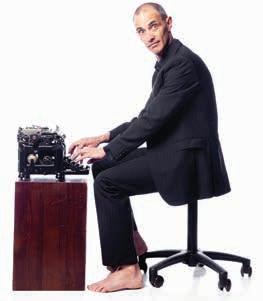
Because it’s just like play for me … I love playing with words and experimenting with ideas. I also love being able to make people laugh with what I write. It’s wonderful to receive letters from readers telling me how much the books mean to them and often how they turned their attitude around from ‘reading is boring’ to ‘reading is fun’!
Have you experienced any blocks or obstacles in your path to writing books?
At first, publishers rejected my early efforts. They found them a bit too crazy. It took a while for me to learn how to rein myself in. I had to learn to start stories sounding very normal and reasonable and slowly lead the reader into a world of nonsense ...
What is the best thing about writing books for children?
The endlessly fascinating puzzle of constructing really interesting plots and characters. It’s like assembling a vast, three-dimensional jigsaw that is completely involving. The other great thing is receiving letters from—and meeting—the readers who’ve enjoyed the books.
What is the hardest thing about writing books for children?
It takes a LOT of time and a LOT of discipline. Coming up with the books is one thing, but a great deal of work goes into rewriting the books many many times until they’re as perfect as I can make them.
from www.kids-bookreview.com
1 W hat is the purpose of the interview?
2 W ho is the intended audience?
3 W hat inspired Andy Griffiths to start writing children’s books?
4 How did his attempt at writing a story in the romance genre turn into humorous writing?
5 W hy does Andy Griffiths write? Give two reasons.
6 W hy did publishers reject his early efforts?
7 W hat is ‘endlessly fascinating’ about writing children’s books?
8 W hat is the hardest thing about writing books for children?
The world’s most venomous fish is the stonefish. This tropical fish is so named because its brown and grey colouring enables it to camouflage itself to look like a stone. Many stonefish also have tinges of pink, orange or yellow that give them the appearance of a piece of coral. In addition, some of the fish have algae on their skin and this increases their ability to become part of their natural surroundings.
Usually a stonefish lies motionless, camouflaged by coral or a rocky reef, waiting for small fish or shrimp to swim past. These are sucked quickly into its mouth. If it needs to chase prey, it can swim very fast. If left alone these fish are not dangerous to humans, but because they look like stone or coral it is not unusual for unsuspecting swimmers or waders to step on them.
Along the dorsal fin of a stonefish there are 13 deadly spikes that can easily penetrate strong rubber shoes. When they are threatened or disturbed, the fish raise these spikes, each one being capable of injecting venom into the victim. Venom is released when pressure is applied by
1 W hat is the purpose of this report?
2 W hy is the fish called a stonefish?
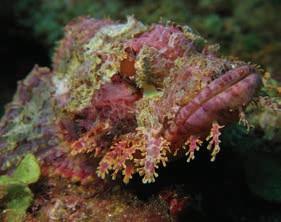
someone accidentally touching or stepping on the fish. The amount of venom released depends on the amount of pressure. The venom can cause agonising pain, paralysis and often severe illness. In serious cases, an antivenom is administered to neutralise the poison. The venom of stonefish can kill a human in two hours.
An interesting fact is that stonefish are considered a delicacy in some Asian countries. Their venom becomes harmless after it is heated.
3 W hy are some stonefish able to conceal themselves in coral?
4 W hat makes stonefish dangerous to humans?
5 W hen do stonefish raise their deadly spikes?
6 W hat symptoms do victims of their sting experience?
7 W hy is it possible for people to eat stonefish?
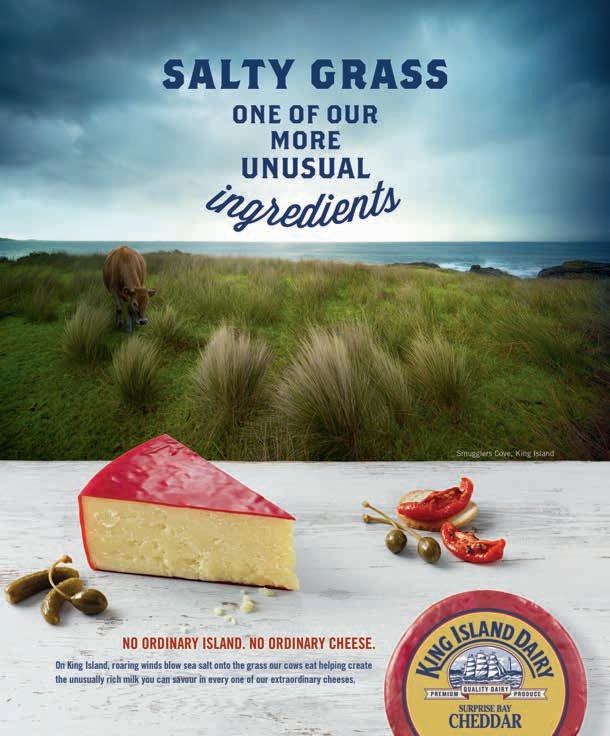
1 W hat is surprising about the headline of this advertisement for cheese?
2 W hat does the photograph of King Island show about the landscape?
3 W hat two colours make the food stand out in the bottom panel?
4 What message is conveyed by the repetition in ‘No ordinary island. No ordinary cheese’?
5 How does ‘salty grass’ become an ingredient in the King Island cheese?
A sentence is a group of words that expresses a complete thought and makes sense by itself. It is made up of two parts: a subject and a predicate. The part that tells us who or what does the action is called the subject. The rest of the sentence is called the predicate.
• The subject of a sentence is usually either a noun or a pronoun (naming words).
Andy Griffiths [noun] has created some entertaining characters.
He [pronoun] enjoys writing humorous stories.
• The subject of a sentence may be more than one word.
Paul Jennings and Jackie French have written many books for children.
• The subject is made up of all the words that are attached to the noun.
The house at the top of the hill has been vacant for many years.
Grey-headed old Tom lived near the railway station.
• The subject does not always come at the beginning of a sentence.
Across the paddocks ran the frightened rabbit
The predicate is everything else in the sentence apart from the subject. It contains the verb (action word) that tells us what the subject is doing.
Our English teacher praised [verb] the Harry Potter stories
The diver was searching [verb] for sponges on the sea floor.
The best way to find the subject and the predicate is to find the verb in the sentence and then ask ‘Who?’ or ‘What?’ before the verb. Look at the following sentence.
The surfer was swimming towards the beach.
The verb is ‘was swimming’. Ask: Who was swimming? The answer to the question is ‘the surfer’ (the subject). The rest of the sentence, ‘was swimming towards the beach’, is the predicate. It contains the verb.
Using the information above, identify the subject and the predicate in each of the following sentences. You should also underline the verb.
1 Shopping trolleys were invented in 1937.
Subject:
Predicate:
2 Most monkeys and apes live in families.
Subject:
Predicate:
3 One in five children in the world has never attended school.
Subject:
Predicate:
4 T he Romans invented concrete.
Subject:
Predicate:
5 Talking parrots have a vocabulary of about twenty words.
Subject: Predicate:
6 C ane toads secrete a toxin poisonous to humans and other animals.
Subject: Predicate:
7 T he Sahara Desert was covered by glaciers many millions of years ago.
Subject:
Predicate:
Complete each sentence by choosing the correct subject from the box.
A zoologist A milliner A compere A courier A forester A detective An astronaut A florist A decorator An acrobat A psychiatrist
1 looks after people’s mental health.
2 introduces the acts in a television or variety show.
3 t ravels in space.
4 investigates crimes.
5 carries messages and parcels.
6 designs and furnishes rooms.
7 s tudies animals.
8 grows or sells flowers.
9 performs dangerous gymnastic tricks.
10 makes women’s hats.
11 takes care of forests by planting trees.
There are four types of sentences: statements, questions, exclamations and commands.
• Statements: A sentence that makes a statement begins with a capital letter and ends with a full stop.
King Island is located in Bass Strait between Victoria and Tasmania.
• Questions: A question mark is used at the end of a sentence to indicate that a direct question is being asked.
What types of cheese are made on King Island?
• Exclamations: An exclamation mark is used at the end of a sentence that expresses urgency or a strong outburst of emotion.
I just won a trip to King Island! [excitement]
• Commands: These are sentences that tell you what to do. They usually end in a full stop, but may end in an exclamation mark if they are expressed forcefully enough. Shut the gate when you leave the paddock. Shut that gate now!
Rewrite each sentence, adding a full stop, a question mark or an exclamation mark at the end.
1 W hat is the best book you have ever read
2 M y favourite writers are JK Rowling and Roald Dahl
3 Would you rather see a film, read a book or play a video game
4 Save our whales
Change each of the following statements into a question. The first word is given as a clue.
1 S tonefish are venomous. Are
2 T here will be a fishing trip tomorrow. Will
3 Sea turtles do not have teeth. Do
4 T he museum has a marine display. Does
5 Sea snakes cannot survive on land. Can
6 We saw many dolphins today. Did
7 S ting rays are very common here. Are
speech diary cartoon anecdote autobiography
lullaby myth legend narrative advertisement
fiction novel drama brochure dictionary
ballad f able comedy fantasy newspaper
atlas script tragedy interview documentary
menu r eport obituary catalogue biography
1 A suffix is a word part added at the end of a word to change its meaning. By adding a suffix, write down the name of the person derived from each of the following words. Hint: You may have to change some letters before adding the suffix. For example: novel novelist ; psychology—psychologist.
a drama
b interview
c comedy
d speech
e ballad
f diary
g narrative
h biography
i cartoon
j report
2 Give the plural form of each of the following words.
a comedy
b documentary
c speech
d diary
e catalogue
f fable
g fantasy
h brochure
i dictionary
j menu
Find words in the list to match the definitions and clues below.
1 a personal record of daily happenings
2 an account of a person’s life written by that person
3 a humorous drawing or animated film
4 a poem or song that tells a story
5 a notice of death, often published in a newspaper
6 t he written text of a play or movie
7 a r eference book of words and meanings listed in alphabetical order
8 a T V program reporting a factual record of events
9 a long, fictitious story
10 a short, interesting story about a real incident
11 an announcement promoting a product
12 a short tale to teach a moral, often with animal characters
13 an event causing suffering and distress
14 a conversation between a TV presenter and an interesting person
Complete each phrase with the appropriate word from the list. The first letter is given as a clue.
1 my private d
8 a monotonous s
2 an Aesop’s f 9 a popular folk b
3 t he library c
4 a baby’s l
10 my first job i
11 a Shakespearean c
5 a personal a 12 a Roman m
6 a movie s
7 t he weather r
13 a phonetic d
14 t he daily n
The English word ‘script’ comes from the Latin word scribo/scriptus, which means ‘I write’. There are many words in the English language that are derived from scribo/ scriptus. Here are some of them. Use the dictionary at the back of the book to write their meanings.
scribe: inscription:
conscription:
transcript: postscript:
Choose an activity that you love doing. It could be a sport or a hobby, or anything else you enjoy. Write answers to the interview questions below. Try to make your audience feel as enthusiastic about the activity as you are by including interesting details or anecdotes. After you have finished, form pairs to play the roles of interviewer and interviewee, then take turns to interview each other for the class.
Some ideas for activities are given below to start you thinking.
• Horseriding
• Skateboarding
• Juggling
• Blogging
• Camping
• Snorkelling
• Dancing
• Making jeweller y
• Reading
• Magic tricks
• Collecting shells
• Chess
• Fishing
• Astronomy
• Yoga
• Electronic games
• Photography
• Painting
• Music
• Flying kites
An interview with [your name]
Topic [your chosen activity]
When did you first become interested in this activity?
What new skills did you have to learn?
What is the best thing about doing this activity?
What is the most challenging thing about doing this activity?
What has been your funniest experience?
What do your family or friends think about it?