The moral rights of the author have been asserted.
All rights reserved.
Except under the conditions described in the Copyright Act 1968 of Australia (the Act) and subsequent amendments, no part of this publication may be reproduced, stored in a retrieval system, or transmitted in any form or by any means, electronic, mechanical, photocopying, recording or otherwise, without the prior written permission of the copyright owner.
Educational institutions copying any part of this book for educational purposes under the Act must be covered by a Copyright Agency Limited (CAL) licence for educational institutions and must have given a remuneration notice to CAL.
Licence restrictions must be adhered to. For details of the CAL licence contact: Copyright Agency Limited, Level 11, 66 Goulburn Street, Sydney, NSW 2000. Telephone: (02) 9394 7600. Facsimile: (02) 9394 7601. Email: memberservices@copyright.com.au
Publication data
Authors: Rex Sadler and Sandra Sadler
Title: Complete English Basics 4: A Class and Homework Course
ISBN: 978 1 4202 3711 5
Publisher: Emma Cooper
Project editor: Barbara Delissen
Cover and text designer: Dim Frangoulis
Production control: Janine Biderman
Photo research and permissions clearance: Annthea Lewis, Katy Murenu and Vanessa Roberts
Typeset in Heuristica Regular 10.5/12pt by DiZign Pty Ltd
Cover image: Shutterstock/EpicStockMedia
Printed in Malaysia by Vivar Printing Pdt Ltd
1 2 3 4 5 6 7 25 24 23 22 21 20
Warning: It is recommended that Aboriginal and Torres Strait Islander peoples exercise caution when viewing this publication as it may contain images of deceased persons.
Preface
Complete English Basics 4 sets out to present essential English skills in an interesting and meaningful way for middle secondary students.
This third edition covers essential language and literacy skills underpinning the new Australian Curriculum. Additional high-interest literacy texts have been added for comprehension and analysis.
The workbook can be used as a class or homework text. One approach would be to have students complete each unit over a two-week period.
The stimulus materials and exercises are designed to improve comprehension and vocabulary skills, as well as language usage and spelling. A special feature is the back-ofthe-book dictionary, which encourages students to expand their vocabulary by looking up the meanings of unfamiliar words.
Correct spelling is essential for good communication. Research has shown that in those classrooms where teachers are concerned about correct spelling and vocabulary enrichment, the students’ spelling level improves significantly. It is a good idea, if time allows, to have a brief spelling test at the end of each unit using the words from the spelling and vocabulary list.
The extracts are engaging and cover a diverse range of topics—from superheroes to Shakespeare. A range of genres is represented, including autobiography, science fiction, humour and romance.
Above all, we hope that students will enjoy their studies as they gain basic English skills.
Rex and Sandra Sadler
Acknowledgements
The author and publisher are grateful to the following for permission to reproduce copyright material:
Extract from Angela’s Ashes by Frank McCourt, 1996, reprinted by permission of Abner Stein (ROW print, e-book rights) 160; Extract and cover image from Secrets in the Fire by Henning Mankell, Allen & Unwin, 2000, reproduced with permission of Allen & Unwin, 109; Review of To Kill a Mockingbird by Steve Creedy, Weekend Australian, 3 May 2008, reproduced with permission of The Australian, 121-2; Extract from Down Under by Bill Bryson, published by Broadway Books, 2000, reproduced with permission of Bill Bryson, 31; Extract from ‘The relative advantages of learning my language’ by Amy Choi from Growing up Asian in Australia, edited by Alice Pung, Black Inc, 2008, reproduced with permission of Amy Choi, 39-40; Cartoon from The Cobb Book: Cartoons by Ron Cobb, published by Wild & Woolley Pty Ltd, Sydney, 1975, reproduced with permission of Ron Cobb, 11; Poem ‘Children’ from Showground Sketchbook and other Poems by Nancy Keesing, published by Angus & Robertson, 1968. By Arrangement with the Licensor, The Nancy Kessing Estate, c/- Curtis Brown (Aust) Pty Ltd, 13; Extract from Goldfinger by Ian Fleming, Hodder and Stoughton, 1959, reproduced with permission of Curtis Brown, 141; Extract from My Family and Other Animals by Gerald Durrell, Penguin, 1959, reproduced with permission of the Durrell Wildlife Conservation Trust, 10; Article ‘Looking under the Hood’ by Leigh Paatsch, The Daily Telegraph, May 13 2010, reproduced with permission of The Daily Telegraph, 20; Review of Romeo + Juliet by John Spence, Daily Telegraph, 12 November 2008, reproduced with permission of The Daily Telegraph, 123; Extract from The Chronicles of Robin Hood by Rosemary Sutcliff, Oxford University Press, 1978, reproduced with permission of David Higham and Associates, 22-3; Extract from Going Solo by Roald Dahl, Jonathan Cape, 1986, reproduced with permission of David Higham and Associates, 37-8; Extract from article ‘Ocean ghosts wait for the unwary’ by Emma Blacklock, Sydney Morning Herald, 15 October 2008, reproduced
The author and publisher would like to acknowledge the following:
Poem ‘School social’ by BA Breen, 53; Extract from My Simple Little Brother by Lilith Norman, Collins, 1979, 100; Review of The Inheritance Trilogy: Eldest, The Daily Telegraph, Weekend magazine, 21–22 July 2007, 124; Review of Eco-Warrior by Lucy Clark, The Sunday Telegraph, ‘Insider - Books’ section, 21 September 2008, 127; Extract from My Steve by Terri Irwin, Simon and Schuster, 2008, 5; Snake comic strips www.snakecartoons.com, 85, 94; Extract from A Dagg at My Table by John Clarke, Text Publishing, 1998, 93
While every care has been taken to trace and acknowledge copyright, the publisher tenders their apologies for any accidental infringement where copyright has proved untraceable. They would be pleased to come to a suitable arrangement with the rightful owner in each case.
The world of texts
Comprehension
Read and view the following texts and answer the questions.
Information report
The cane toad
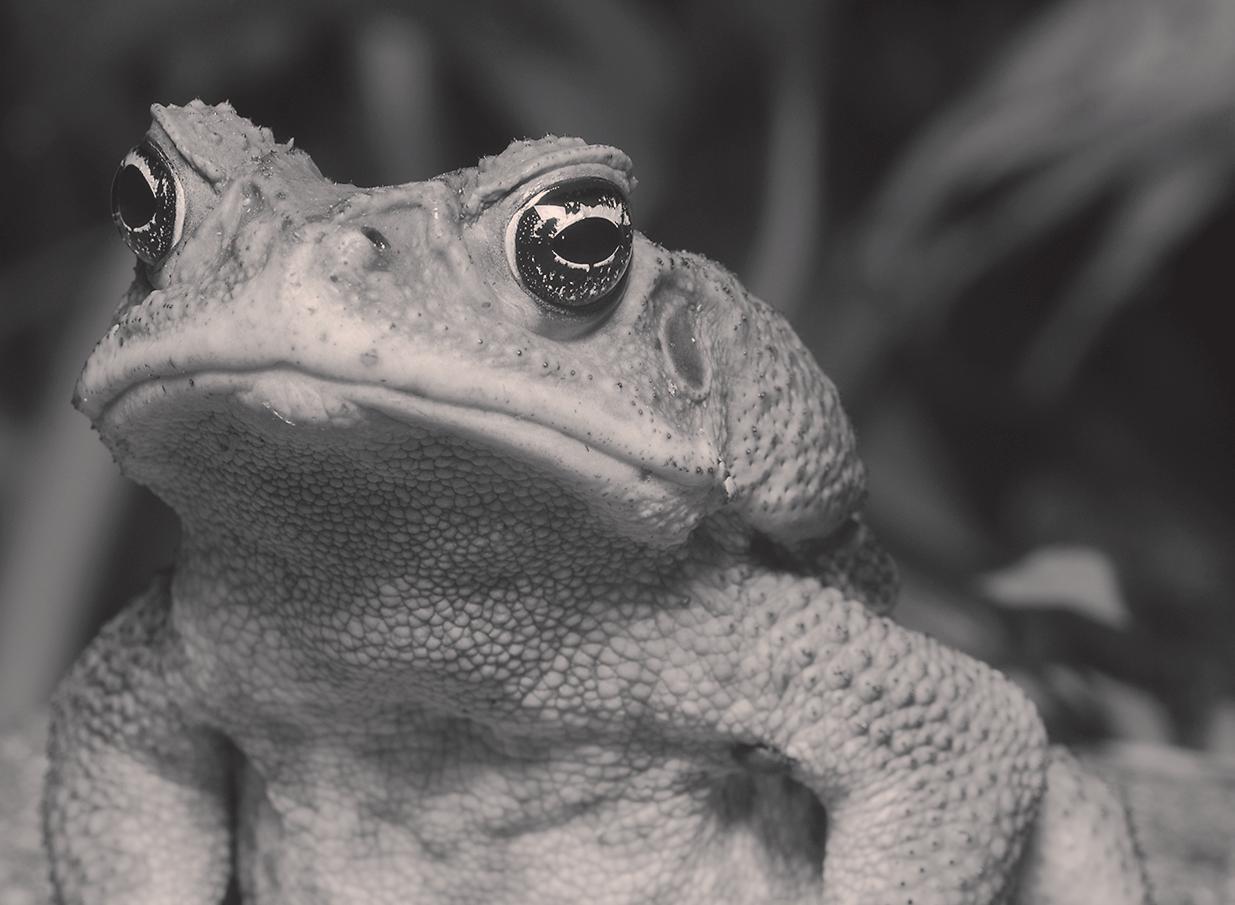
IN THE 1930s, sugarcane crops in Queensland were being destroyed by infestations of cane beetles. To try to combat the beetle, cane toads were introduced from Central and South America in 1935. This attempt to eradicate the beetle was unsuccessful, and now the cane toad has become a serious threat to native animals, humans and their pets.
Cane toads have spread throughout Queensland, northern New South Wales and the Northern Territory. They are prolific breeders and adapt to many different environments. Each season, the female lays thousands of black eggs in long, sticky strands, which then attach to water plants, etc. Because cane toads produce a poison—even at the egg and tadpole stages— they can cause the water in which they live to become polluted. This can have a deleterious effect on native frogs and other water creatures.
Both the male and female toads are heavily built and can weigh up to 2.5 kilograms. They have thick, leathery skin with wart-like bumps. The male toad has more bumps on his skin than the female. Cane toads have been known to reach an age of up to 16 years.
As the toads grow, they threaten the survival of many native animals. Their venom (bufotoxin) is produced in two glands on the head behind the ears. It is toxic if ingested and extremely painful if it is rubbed into the eyes. The bufotoxin exudes over the cane toad’s body when it is frightened or
squeezed. This causes predators such as snakes, goannas, freshwater crocodiles and egrets to be affected by the toxin when they try to eat the toads. Affected animals suffer profuse salivation, foaming at the mouth, violent vomiting and even death.
Cane toads survive in many environments because they can live on a varied diet of dead or living plants, household rubbish, insects, frogs, small reptiles and mammals, and even pet food. If they do invade private properties, they often like to rest in pets’ water bowls, poisoning the water and causing health problems for domestic animals.
The population of some native animals was dramatically reduced when cane toads were
first introduced, but over the years many native animals have learned not to include the toad in their diet.
There are no known predators of the cane toad. Viruses that keep the cane toad numbers under control in its native Venezuela are lethal to Australia’s native frogs. One of the best ways of reducing the population of toads is to destroy the eggs and tadpoles before they mature.
The Queensland government has suggested a humane way of killing adult cane toads. The toad should be caught with care and placed in a plastic bag. The bag should be tied and placed in the refrigerator for an hour to make the toad comatose. Then the bag should be placed in the freezer compartment for a minimum of sixteen hours. The dead toad can then be buried or put into a compost heap.
Reading for understanding
1 Why was the cane toad brought to Queensland from Central and South America in 1935?
2 Give two reasons for the rapid spread of the cane toad in Queensland.
3 How does the cane toad—even at the egg and tadpole stages—endanger native frogs and other water creatures?
4 How does the cane toad become dangerous to predators when it is frightened?
5 How does the diet of the cane toad enable it to survive in many environments?
6 What is one of the best ways of preventing the cane toad from reaching maturity?
7 Why is the cane toad population under control in Venezuela but not in Australia?
8 Use the back-of-the-book dictionary to find the meanings of these words:
a eradicate:
b prolific:
c deleterious:
d ingest:
e predator:
f comatose:
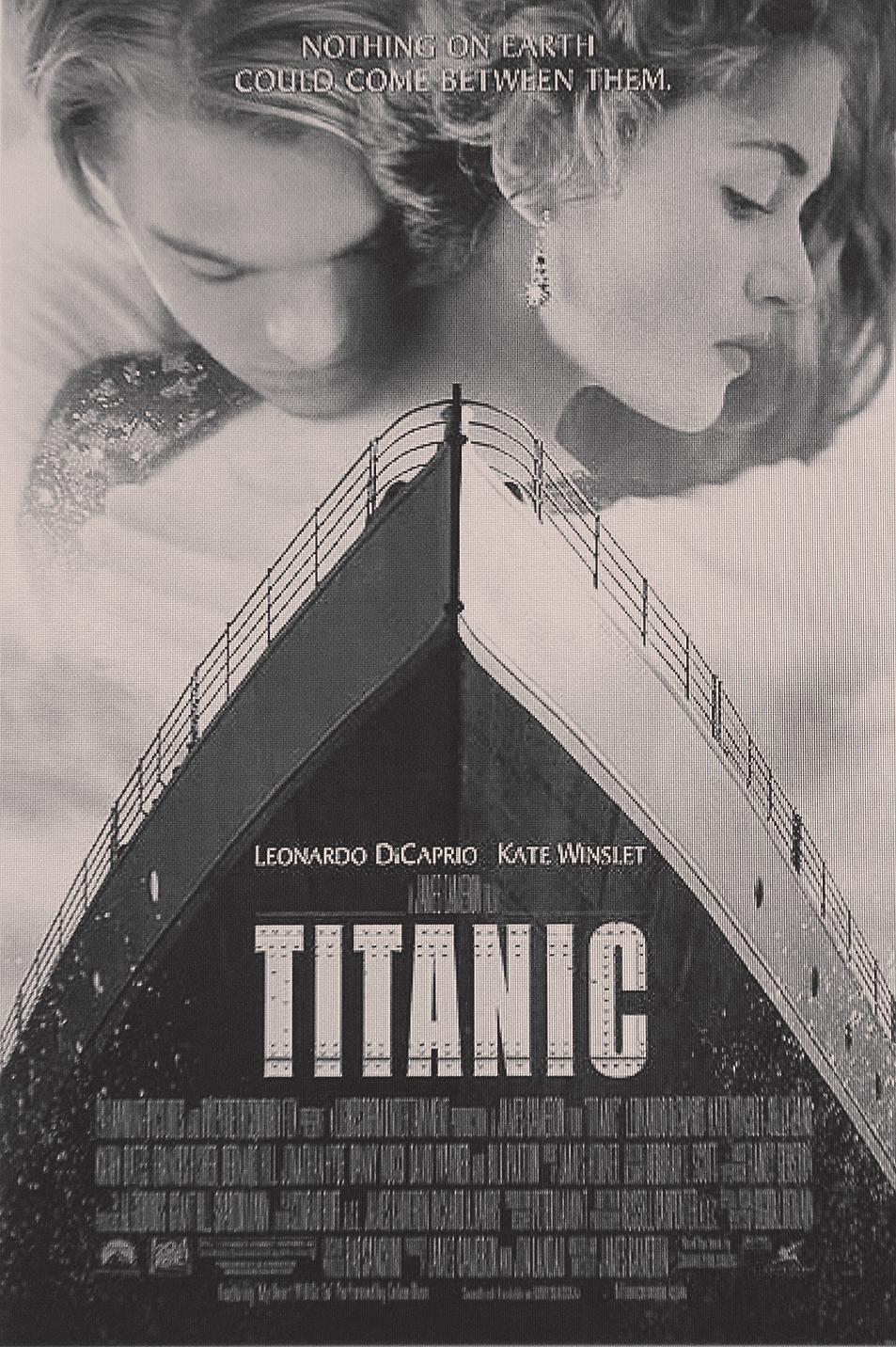
Film poster
Reading for understanding
1 What is the purpose of this film poster?
2 What techniques has the advertiser used to show that the movie’s focus is the love between the two young people?
3 Why do you think the names of the two main actors are on the poster?
4 What impression does the poster give of the ship?
5 Why is the audience positioned below the subject of the poster? 5 marks
Poem
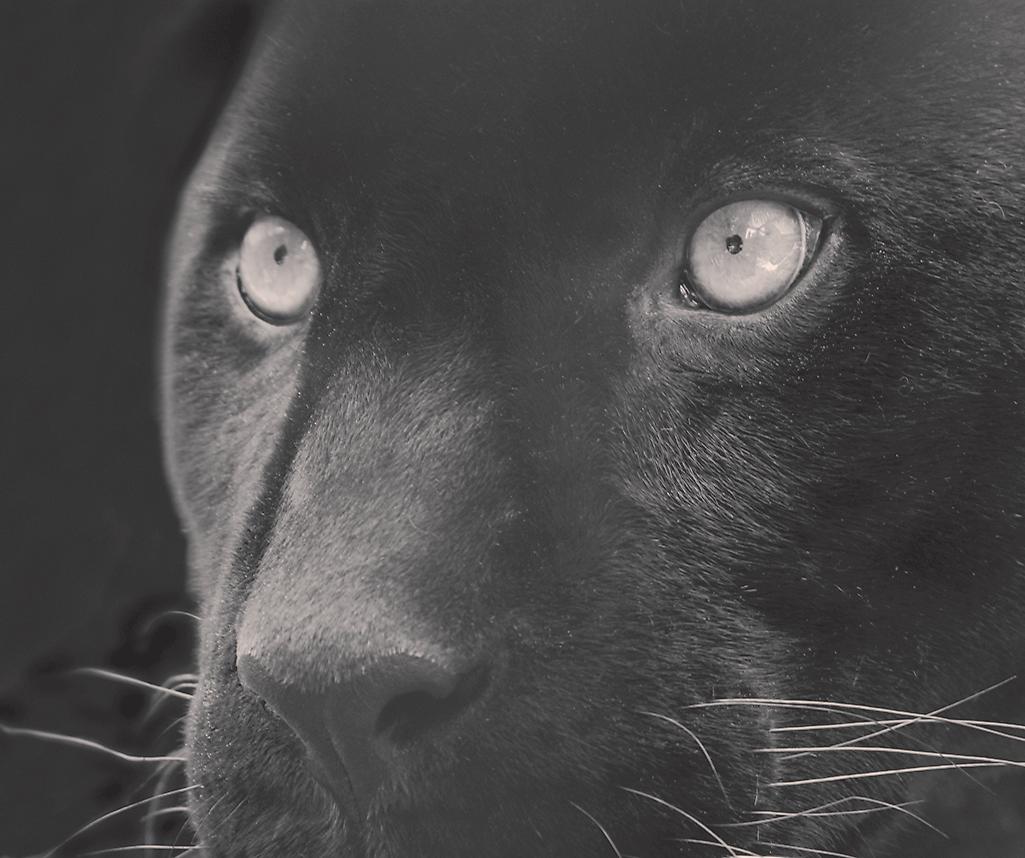
The panther
His weary glance, from passing by the bars, Has grown into a dazed and vacant stare; It seems to him there are a thousand bars And out beyond those bars the empty air.
The pad of his strong feet, that ceaseless sound Of supple tread behind the iron bands, Is like a dance of strength circling around, While in the circle, stunned, a great will stands.
But there are times the pupils of his eyes Dilate, the strong limbs stand alert, apart, Tense with the flood of visions that arise Only to sink and die within his heart.
Rainer Maria Rilke
Reading for understanding
1 Why is the panther’s glance ‘weary’?
2 Which words in the first stanza suggest that there is an impossible barrier to freedom?
3 How does the poet use alliteration in the second stanza to suggest the panther’s movements?
4 Which words show that the panther is a powerful animal?
5 Explain the meaning of ‘stunned, a great will stands’.
6 What do you think ‘the flood of visions’ could be?
7 Explain how the poem ends in a message of despair.
8 What is the poet’s purpose in writing this poem?
8 marks
Biography
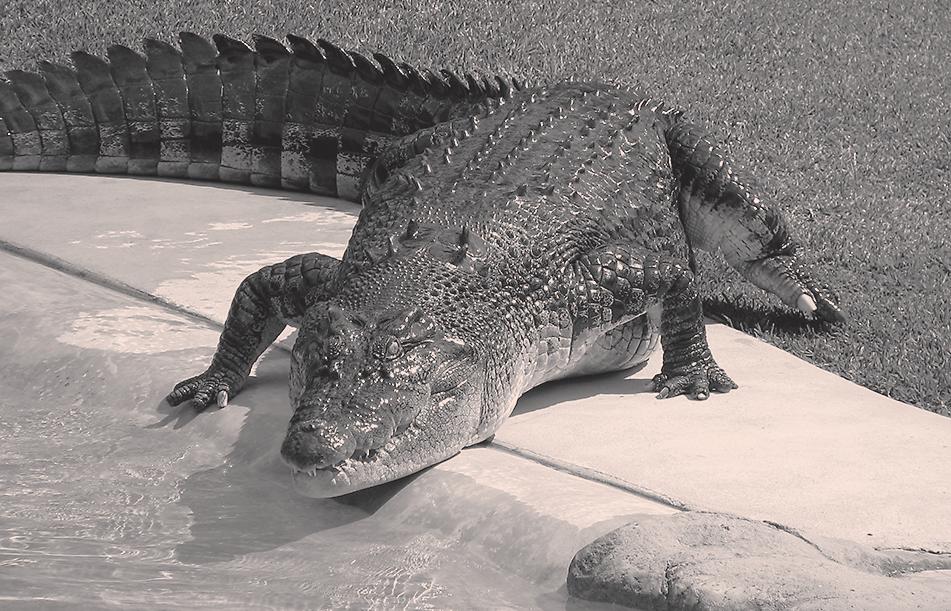
Encounter with a crocodile
IT WENT like clockwork. Steve top-jaw roped Toolakea, and we all jumped her. He decided since she was only a little over nine feet long, we would be able to just lift her over the fence and carry her to her other enclosure.
Steve never built his enclosures with gates. He knew that, sooner or later, someone would make a mistake and not latch a gate properly. We had to be masters at fence jumping. He picked up Toolakea around her shoulders with her neck held firmly against his upper arm. This would protect his face if she started struggling. The rest of us backed him up and helped to lift Toolakea over the fence.
All of a sudden she exploded, twisting and writhing.
‘Down, down, down,’ Steve shouted. That was our signal to pin the crocodile again before picking her up. Not everyone reacted quickly enough. As Steve moved to the ground, the people on the tail were still standing up. That afforded Toolakea the opportunity to twist her head around and grab hold of Steve’s thigh.
The big female croc sunk her teeth deep into his flesh. I never realised it until later. Steve didn’t flinch. He settled the crocodile on the ground, keeping her eyes covered to quiet her down. We lifted her again. This time she cleared the fence easily. I noticed the blood trickling down Steve’s leg.
We got to the other enclosure before I asked what had happened, and he showed me. There were a dozen tears in the fabric of his khaki shorts. Half-a-dozen of Toolakea’s teeth had got through to his flesh, putting a number of puncture holes in his upper thigh.
from My Steve by Terri Irwin
Reading for understanding
1 Why did Steve decide that they would be able to lift Toolakea over the fence?
2 Why hadn’t Steve built his enclosures with gates?
3 What afforded Toolakea the opportunity to grab hold of Steve’s thigh?
4 Why was the narrator at first unaware that Steve had been bitten?
5 How did Steve quieten down the crocodile?
6 What evidence was there to show that Steve had received a dangerous bite?
7 What does this incident reveal about the character of Steve Irwin?
Find words in the spelling list that match the meanings of the following phrases. The first letter of each word is given to help you.
1 a talk in which opinions are shared d
2 an expression of dissatisfaction c 3 a reply r 4 to interest and amuse e 5 a remark made to interrupt a conversation or speech i
6 praise or approval expressed by handclapping a
7 a representation by written or spoken words
8 to make clear
9 to examine in detail
10 to make known for the first time
11 a likening that shows similarities or differences
to convince or make someone believe
13 the power to affect people, actions or events i 14 to outline the main points
Word forms
Form nouns from the verbs in brackets to complete the phrases. 1 heated
Back-of-the-book dictionary
The word ‘interjection’ is derived from the Latin words inter, meaning ‘between’, and iacere, meaning ‘to throw’. An interjection is literally ‘a throwing between’. There are many words in the English language that are derived from inter. Use the back-of-the-book dictionary to write the meanings of the following inter words.
intercede: interloper: intermittent:
interpose: interrogate:
Language
Text types
5 marks
A text is a spoken, written or visual communication used to convey meaning to an audience. Five main categories of texts can be identified: factual texts, literary texts, visual texts, media texts and everyday texts. Well-known texts include novels, poems, newspaper articles, films, reviews, jokes, cartoons, comic strips, advertisements, emails, scripts, diaries, letters, paintings, posters, photographs, brochures and autobiographies.
Identifying purpose and audience
Write the purpose and audience for each of the following texts.
1 A school report
a Purpose:
b Audience:
2 A letter to the editor of a newspaper
a Purpose:
b Audience:
3 A car manual
a Purpose:
b Audience:
4 A travel brochure about travelling to Alaska
a Purpose:
b Audience:
5 Nursery rhymes
a Purpose:
b Audience:
6 A television guide
a Purpose:
b Audience:
7 The blurb on the back cover of a novel
a Purpose:
b Audience:
8 A film scr ipt
a Purpose:
b Audience:
Tone
16 marks
The choice of words in a written text enables the writer to introduce certain attitudes and feelings; for example, angry, informative, ironical, gentle, sympathetic, critical, joyful. These attitudes and feelings form the tone of the text. It is through the writer’s tone that the emotional message of the text is communicated to the audience.
Identifying tone
Read the following passages and identify the tone in each one.
1 ‘ The strength of fire, the taste of salmon, the trail of the sun, And the life that never goes away, They speak to me
And my hear t soars.’ (from And My Heart Soars by Chief Dan George)
Tone:
2 ‘Give a man a fish; you have fed him for today. Teach a man to fish; and you have fed him for a lifetime.’ (Anonymous)
Tone:
3 ‘ The town had a black canal in it, and a river that ran purple with ill-smelling dye.’ (from Hard Times by Charles Dickens)
Tone:
4 ‘Death of much-loved leader’ (Newspaper headline)
Tone:
5 ‘ Troops without ammunition or food. 18,000 wounded without any supplies or dressings or drugs.’ (General von Paulus’s communiqué to Adolf Hitler)
Tone:
6 I eat my peas with honey; I’ve done it all my life. It makes the peas taste funny, But it keeps them on the knife. (Anonymous)
Tone:
6 marks
Euphemism
A euphemism is a pleasant or mild expression used to replace one that is considered harsh or blunt. A coach driver, for example, might tell passengers of a ‘comfort stop’ rather than a toilet stop.
Using euphemisms
Rewrite the following sentences, replacing the term shown in italics with a suitable euphemism from the box.
senior citizen pre-loved a custodial facility perspire between jobs waste disposal specialist dentures under the influence economically disadvantaged mobile home put to sleep courtesy reminder
1 The lecturer purchased a second-hand computer online.
2 The tenant received a warning for not paying the rent.
3 The old-age pensioner had lost his false teeth
4 The garbage collector found a valuable antique.
5 The poverty-stricken family had to live in a caravan.
6 The thief was sentenced to five years in jail.
7 The racehorse with a broken leg had to be euthanised.
8 The tr uck driver was arrested for driving while drunk.
9 The television executive was now unemployed.
10 Soon after the start of the marathon, the runners began to sweat.
10 marks
The craft of writing
An encounter
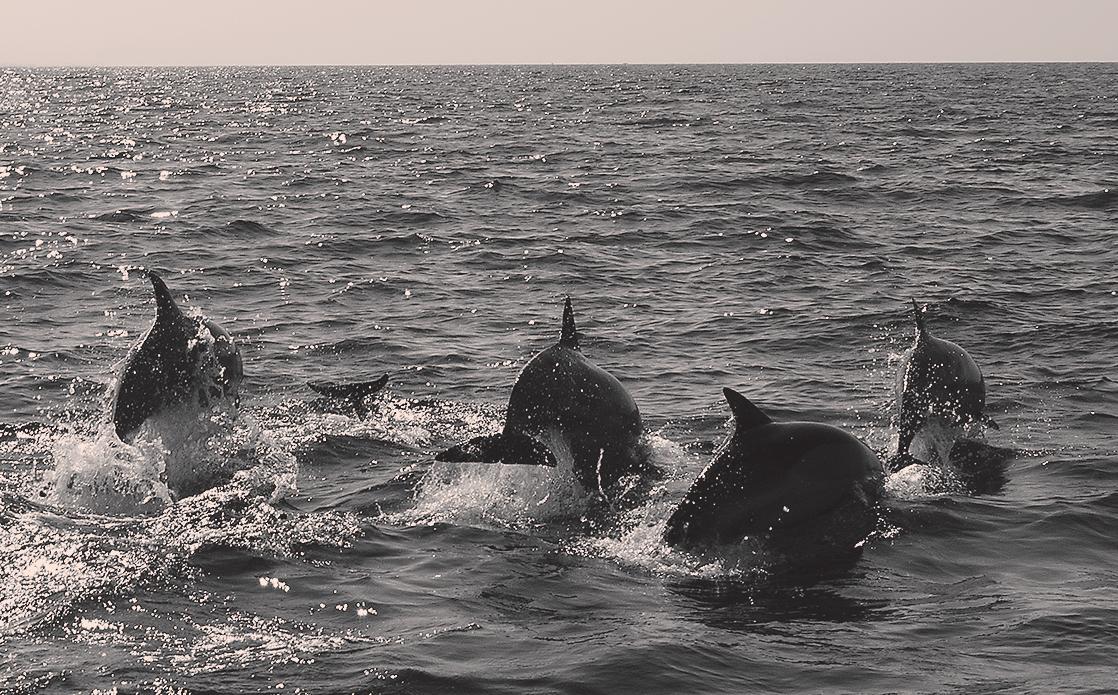
In this unit you have read texts describing the cane toad, a panther and a crocodile. The extract below is from a true encounter that Gerald Durrell had with a pod of dolphins while swimming in a bay off the island of Corfu.
Swimming with porpoises
some twenty feet away from me, the sea seemed to part with a gentle swish and gurgle, a gleaming back appeared, gave a deep satisfied sigh, and sank below the surface again. I had hardly time to recognize it as a porpoise before I found I was right in the midst of them. They rose all around me, sighing luxuriously, their black backs shining as they humped in the moonlight. There must have been about eight of them, and one rose so close that I could have swum forward three strokes and touched his ebony head. Heaving and sighing heavily, they played across the bay, and I swam with them, watching fascinated as they rose to the surface,
Describing an animal encounter
crumpling the water, breathed deeply, and then dived beneath the surface again, leaving only an expanding hoop of foam to mark the spot. Presently, as if obeying a signal, they turned and headed out of the bay towards the distant coast of Albania, and I trod water and watched them go, swimming up the white chain of moonlight, backs agleam as they rose and plunged with heavy ecstasy in the water as warm as fresh milk. Behind them they left a trail of great bubbles that rocked and shone briefly like miniature moons before vanishing under the ripples.
from My Family and Other Animals by Gerald Durrell
Using any kind of text you like, describe an interesting animal encounter. Your description may be factual or fictional. One of the following creatures might interest you.
family pet dog cat octopus ants spider kangaroo crocodile vulture whale shark horse mouse seal
Context
Comprehension
2
View and read the following texts, then answer the questions. Each text has a short introduction to place it in context.
Modern society
Ron Cobb has won fame as a political cartoonist, artist, writer and film designer. As a film designer, he has been involved in the production of popular science fiction films such as Star Wars, Back to the Future and Aliens. In his cartoons he ridicules and condemns the behaviour of modern society.
Reading for understanding
1 What comment about moder n living is Ron Cobb making in the cartoon?
2 Why is the small plant impor tant in this cartoon?
3 What is the significance of the high-r ise buildings?
4 The old man appears happy and contented. Why is this?
5 What evidence can you find to show that this is a modern-day cartoon?
6 What attitude to life do you think Ron Cobb would recommend?
7 Why are cartoonists such as Ron Cobb important in today’s society?
Of peace and war
7 marks
As the poem ‘Children’ begins, the poet, Nancy Keesing, is watching her children surfing at an Australian beach. It is the time of the Vietnam War, when the United States of America and Australia are fighting on the side of South Vietnam in a war against North Vietnam. Keesing is also reading a newspaper and sees horrifying pictures of innocent village children being blown apart in the conflict. While she has concerns for her own children being hurt by the occasional dumpers, she suffers anguish for the Vietnamese children who have become casualties of the war.
Children
Long-summer scorched, my surfing children Catch random waves or thump in dumpers, Whirling, gasping, tossed, disjointed. I, watching, fear they may be broken— That all those foaming limbs will never Reassemble whole, together.
All under such a peaceful sky.
Reading for understanding
1 What is the setting as the poem begins?
All under such another sky. The pictures show some village children Caught at random, tossed, exploded, Torn, disjointed, like sticks broken, Whose jagged scorching limbs will never Reassemble whole, together.
Nancy Keesing
2 What does ‘long-summer scorched’ tell you about the poet’s children?
3 ‘… thump in dumpers’. What does the assonance suggest about the waves?
4 Why is the poet afraid for her children?
5 How does the poet prepare the reader for a change of setting?
6 Explain the difference between ‘Catch random waves’ and ‘Caught at random’.
7 Why are village children ‘disjointed, like sticks broken’?
8 Explain the difference in the poem between ‘foaming limbs’ and ‘jagged scorching limbs’.
Find words in the spelling list that match the meanings of the following phrases. The first letter of each word is given.
1 the time and place s
2 to go before p
3 moder n; existing now
4 famous or distinguished
5 an argument or difference of opinion
6 the handing down of beliefs or customs
7 relating to the study of past events
8 books and other for ms of writing
9 valuable things passed from one generation to the next h
10 infor mation that gives reasons for believing something e
Completing the phrases
Complete the phrases by adding suitable words from the spelling list. The first letters are given to help you. Use each word once only.
1 a w
Back-of-the-book dictionary
The word ‘significance’ comes from the Latin word signum, which means a ‘sign’, ‘mark’ or ‘seal’. Below are some more English words derived from signum. Use the back-of-the-book dictionary to write their meanings.
insignia: signature: signet:
designate: signatory:
Language
Understanding sentences
5 marks
A sentence is an arrangement of words that expresses a complete thought or idea. Below is an example of a simple sentence expressing a complete thought.
The hallway smelt of boiled cabbage. (from Nineteen Eighty-Four by George Orwell)
A sentence presents a subject (noun) and then reveals some information about it. The subject of the above sentence is ‘the hallway’. What is said about the hallway is that it ‘smelt of boiled cabbage’. This part is called the predicate of the sentence. Notice that the predicate contains the verb or action word ‘smelt’. To help you create complete sentences, each containing a complete thought, it is important to understand that sentences contain a subject and a predicate.
Forming sentences
Here are twelve sentences from the pens of famous novelists. The subjects have been removed from their predicates. Complete each sentence by inserting the correct subject from the list below.
The old man
Dinner
The print of a man’s foot
The swarm of students
Three sailors A weak trickle of steam
Her teeth
1
2
3
The Grand Trunk Road
( Jaws, Peter Benchley)
(Flying Colours, CS Forester)
(For Whom the Bell Tolls, Ernest Hemingway)
The unconscious patient
The shark’s dorsal fin
The poster with the huge face
The cave bear’s sacred bones
cut the glassy water with a hiss.
were the barest crew for a cutter.
were white in her brown face.
4 vandalised the classroom.
(The Blackboard Jungle, Evan Hunter)
5
6
7
(The Clan of the Cave Bear, Jean Auel)
(Nineteen Eighty-Four, George Orwell)
(One Pair of Feet, Monica Dickens)
were placed in the bear’s cave.
gazed from the wall.
had been in a motor accident.
8 was thin and gaunt with deep wrinkles.
(The Old Man and the Sea, Ernest Hemingway)
9
10
11
(Bleak House, Charles Dickens)
was handsomely served at a groaning table.
runs straight without crowding India’s traffic for fifteen hundred miles. (Kim, Rudyard Kipling)
was plain to be seen in the sand.
(Robinson Crusoe, Daniel Defoe)
12 hissed from the engine’s outlet valve.
(Puckoon, Spike Milligan)
Subject and predicate
12 marks
When you consider the examples above and the ones that follow, you will notice that the subject of a sentence can be a single word or a group of words. The same rule applies to the predicate. To find the subject, it is a good idea to ask ‘who?’ or ‘what?’ before the verb. The verb (and any additional information relating to that verb) forms the predicate.
Subject Shakespeare
William Shakespeare, a famous dramatist, Predicate wrote plays. wrote tragedies, comedies and histories.
It is also important to note that the subject does not always have to come at the beginning of a sentence. For example:
At the beginning of his career, Shakespeare had been an actor.
Identifying the subject and predicate
Divide each sentence below into its subject and predicate.
1 The r umbling of thunder was heard after the lightning flashes.
Subject:
Predicate:
2 The bushrangers bailed up the stagecoach at the top of the hill.
Subject:
Predicate:
3 A Norwegian engineer named Erik Rotheim invented the aerosol can.
Subject:
Predicate:
4 High above the plains soared the wedge-tailed eagle.
Subject:
Predicate:
5 The head of the snake appeared through the undergrowth.
Subject:
Predicate:
6 In front of the explorers stood an escaped convict, thin and hungry.
Subject:
Predicate:
The craft of writing
Text and context
12 marks
Texts are not created in isolation. Many personal, social, cultural, historical and natural influences and factors affect their creation.
All texts are influenced in some way by the society and culture in which they are created. They reflect the values and attitudes of the time and place of their creation. These influences, together with the surrounding circumstances, background and setting of a text, are all part of its context.
Your context as the reader of the text is also important. Your life experiences, values, education and background combine to determine how you react to a particular text.
The following extract is an abridged version of what one student wrote about the background of the author Harper Lee and the context of her book To Kill a Mockingbird.
Time and place
In 1863, during the American Civil War, Abraham Lincoln issued a proclamation for the freeing of the slaves in the southern states of America. However, this did not provide equal status between the black people living in the South and the white people. Most black people were impoverished and received little education. The rigorous policy of segregation resulted in them being denied job opportunities and equal rights. In addition, thousands were lynched and terrorised by white people through organisations such as the Ku Klux Klan. It was only when the civil rights movement came to the fore in the 1960s that changes began to take place.
Harper Lee, who was born on 28 April 1926, grew up in the small south-western town of Monroeville in Alabama. She was well aware of the legal and social injustices endured by the black people in the South. Her father—like Atticus Finch in the novel— was a lawyer and she had also studied law, but withdrew from the course six months before graduation.
From an early age Harper Lee always wanted to be a writer. She stated in an interview that ‘a writer should write about what she knows and write truthfully’. She applied this advice to her own work. Her childhood friend and neighbour, Truman Capote, influenced her creation of the character Dill, and some critics have suggested that she herself, a tomboy and keen reader,
Researching the context
was the model for Scout. Her depiction of the rich social patterns of life in Maycomb County resulted from her own experiences in the South during the period of the Great Depression. The universal themes of the story in To Kill a Mockingbird have had worldwide appeal and the novel has now sold over 40 million copies.
Researching the context of a particular work will give you greater understanding and help you to discover a deeper meaning of the text. Use the internet or your library resources to research the context of a story of your choice. If you cannot think of a title, you may like to research the context of one of the well-known literary works listed below.
• Eragon by Christopher Paolini
• The Lord of the Rings by JRR Tolkien
• The Cat in the Hat by Dr Seuss
• Frankenstein by Mary Shelley
• Animal Farm by George Orwell
• Jane Eyre by Charlotte Brontë
• Possum Magic by Mem Fox
• Lord of the Flies by William Golding
• The Harp in the South by Ruth Park
• The Magic Pudding by Norman Lindsay
• The Host by Stephenie Meyer
• Tomorrow, When the War Began by John Marsden
Related texts— outlaws
Comprehension
Read and view the following texts and answer the questions.
Film review
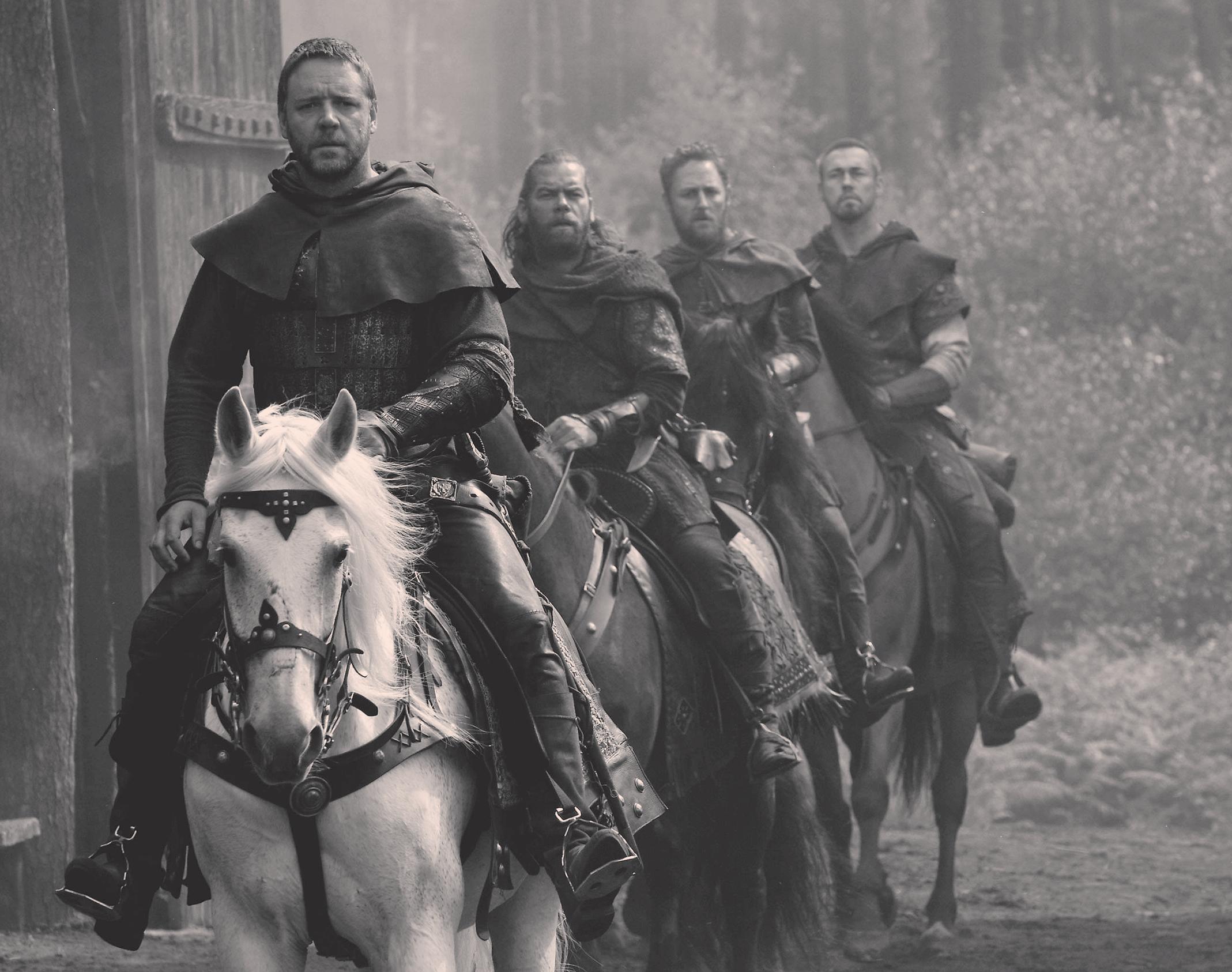
Riding through the glen: Russell Crowe in Sherwood Forest with fellow outlaws
Russell’s deeper Robin Hood is all talk, and some action too …
Robin Hood (M) sss
Director: Ridley Scott (Blade Runner)
Starring: Russell Crowe, Cate Blanchett, Mark Strong, Max von Sydow, Oscar Isaac
by Leigh Paatsch
Sherwoodn’t recognise him if you didn’t know his name
A regular figure on movie screens since the silent era, Robin Hood is back yet again. But not in his usual guise.
If you’re after the basics of the famous Mr Hood—you know, robbing from the rich, giving to the poor, and so on—you’ve come to the wrong film.
That means no base camp in Sherwood Forest. No trademark feather in his pointy green hat. And most importantly, no tights. (Do the math: Russell Crowe plus chunky thighs plus skimpy 12th-century leggings equals urgent need to wash eyes.)
This epic reboot of the enduring medieval legend winds the clock back to the years before the title character earned his reputation as ‘the prince of thieves’.
As played by Crowe, this Robin Hood evolves from lowly soldier of fortune to high-minded social justice campaigner across the complex tale outlined here.
Though just as likely to deliver a fiery extended speech as shoot a flaming arrow, the new Robin Hood is still very much a man of action.
Trading under his original surname of Longstride, the crack sharpshooter Robin is first seen fighting alongside Richard the Lionheart (Danny Huston) at the tail end of the Crusades.
After Richard perishes on the field of battle, Robin makes tracks home, only to discover England is teetering on the brink of civil war.
A villainous double agent, Godfrey (Mark Strong) is using his influence in the royal court to fan the flames of discontent on behalf of the French. Should Godfrey’s scheme succeed, England is sure to be invaded by the enemy from across the Channel when the time is right.
Though Robin becomes a key figure in the turmoil threatening the reign of the weak-willed King John (Oscar Isaac), he also finds himself attracted to the fairest widow in Nottingham, Lady Marian Loxley (Cate Blanchett).
As you would expect of a movie priding itself on its unorthodox take on a familiar tale, the angle from which the Robin–Marian romance is developed is anything but straightforward.
In a convoluted charade to save the embattled estate of Marian’s father-in-law, the blind nobleman Sir Walter Loxley (Max von Sydow), Robin must pretend to be her late husband.
This section of the picture doesn’t quite integrate with the many other components in play. Marian is portrayed ably by Blanchett as a self-
sufficient, self-righteous firebrand, but the speed with which she falls for Robin (helping him undress for a candlelit bath mere hours after learning her husband is dead) is strange to say the least.
Though the teaming of Crowe and director Ridley Scott will invite comparisons to their 2000 smash hit Gladiator, Robin Hood is closer in spirit (if not cohesive execution) to Mel Gibson’s Braveheart
A busy screenplay by Brian Helgeland ( Mystic River ) plays down the usual storytelling devices associated with the tale— for instance, the evil Sheriff of Nottingham is just a bit player here—but does not do away with them altogether.
If this vehicle is very much an origin story for Robin Hood, the same also applies to his loyal band of off-siders, led by Little John (Kevin Durand), Will Scarlet (Scott Grimes) and Friar Tuck (Mark Addy).
The trio supply what passes for light relief in a movie heavy with political manoeuvering in the royal court.
There is arguably one too many scenes of Robin’s entourage partying like it’s 1199, but hey, merry men will be merry men.
Production values are first-class and the combat scenes are genuinely exciting.
If Robin Hood has just one flaw, it is that sometimes the complicated plotting—and the copious chatter needed to explain it—will test a viewer’s patience.
from The Daily Telegraph
Reading for understanding
1 What does the film still show about Robin Hood and his men?
2 In the film still, how is Robin Hood made to appear the most important of the four horsemen?
3 Where is the viewer of the film still positioned? Why?
4 Why do you think this shot was chosen to promote the film?
5 What is meant by the words, ‘looking under the hood’?
6 In previous films, what were ‘the basics of the famous Mr Hood’ referred to in the review?
7 In previous films, how was Robin Hood dressed?
8 At the beginning of the film, what is the setting and what is Robin doing?
9 What does Robin discover on his return to England?
10 What does Robin do to help save the estate of Marian’s father-in-law?
11 How is Marian portrayed by the actor Cate Blanchett?
12 What character in this version of Robin Hood is not as important as in previous versions?
13 What features of the film does the reviewer find particularly worthy of praise?
14 In the final paragraph, what criticism does the reviewer make of the film?
15 Use the back-of-the-book dictionary to find the meanings of these words:
a guise:
b skimpy:
c teetering:
d convoluted:
e cohesive:
f entourage:
20 marks
Novel
Shooting for the silver arrow
LAST of all, that afternoon, Robin Hood himself took his bow and moved out onto the range. Every eye was upon him as he raised his bow and nocked the arrow to his string. The bowstring hummed its deep music in his ear as he loosed; the shaft droned away down the sunlit range, to hang quivering in the target, a finger’s breadth from the peg. He drew and loosed again, and his second arrow grazed the peg on the other side. An utter silence had fallen on the crowd, and they scarcely breathed as he bent the great bow for the third time. Every eye followed the flight of that third arrow as it hummed on its way, burning like a streak of fire as the sun caught it, to thud into the target. Then a roar went up from the crowd: the ladies in the stand leaned forward, clapping their hands, and even the sheriff sat up and snorted with approval. Robin had done the thing that he had done once before in that same place—he had split the peg!
The crowd had surged forward and were spilling out onto the range. Two foresters, having examined the target, went up to the stand and spoke in the sheriff’s ear. The sheriff, in his turn, spoke to his lady wife, and she rose from the cushioned bench, shook out her skirts, and took up the gleaming gold and silver arrow from the place where it had rested all day.
Robin found himself being hustled towards the steps of the stand. He mounted them and dropped on one knee before the sheriff’s lady, who bent forward, smiling very prettily, with the silver arrow in her hand. He looked up at her, and as he did so, the low rays of the westering sun slanted in under his hood, lighting up his lean brown face with its glare; and the man in the deep hood, who had been standing beside the sheriff, leaned forward suddenly, to stare at him with fixed intensity. Robin caught the sudden movement out of the corner of his eye, and looking round, found himself staring into the narrowed dark eyes of Guy of Gisborne, steward of the Manor of Birkencar.
For a moment the two men looked into each other’s eyes, with hatred like a naked sword between them; and then Guy of Gisborne laughed exultantly, and cried out: ‘You were ever a fine bowman, but I think you have loosed your last arrow—Robin Hood!’
In an instant Robin had sprung to his feet and turned to leap down the steps. Behind him he heard a bellow of astonished rage from the sheriff, and the voice of his old enemy shouting to the men-at-arms to take him. At the foot of the steps he turned about to face their attack; his broadsword glittered in his hand, and he knew that his own men were closing up behind him, the six who had shot with him being quickly joined by the rest, who came thrusting through the crowd, their strung bows across their shoulders, their good blades naked in their hands.
The whole crowd was in an uproar around the outlaws, and the sheriff’s men-at-arms and archers came closing in on their flanks. They withdrew steadily: a little band of grimfaced, desperate men, their broadswords biting deep. The sheriff’s men dared not shoot in that crowd, and press inward as they would, they could not break through the menace of those leaping sword-blades; and the outlaws, in close formation, retreated steadily, slipping away as it were from between their fingers.
In a few moments more the forest-rangers were clear of the crowd, and with the men-atarms pressing round them like hounds about their quarry and outnumbering them four to one, they sprang back and turned to run. Weaving from side to side as they ran, they sped
over the turf. A flight of arrows hummed after them, but none found a mark; and the fleetfooted men of the forest were drawing steadily away from the full-fed men-at-arms.
As they ran, they slipped their bows from their shoulders, and when they turned again, two hundred yards nearer the forest, each man
Reading for understanding
had an arrow nocked to his string. The deadly clothyard shafts hummed away like a flight of angry hornets, and several of the men-at-arms dropped and rolled over.
from The Chronicles of Robin Hood by
Rosemary Sutcliff
1 Identify seven onomatopoeic words in the first paragraph that describe the actions of the arrows and the onlookers.
2 Identify the simile in the first paragraph. Why is it effective?
3 What does the first paragraph establish about Robin Hood?
4 How was Guy of Gisborne able to identify Robin Hood?
5 What words in the extract indicate that Guy of Gisborne was also trying to conceal his identity?
6 Identify the simile that shows the intense hatred between Robin and Guy of Gisborne.
7 ‘I think you have loosed your last arrow—Robin Hood!’ Why does Guy of Gisborne believe this?
8 Why, at first, did the sheriff’s men not shoot their arrows?
9 What was the final act of the forest-rangers as they headed towards the forest?
10 Use the back-of-the-book dictionary to find the meanings of these words:
a exultantly:
b broadsword:
c flanks:
d clothyard:
13 marks
Cartoon
Reading for understanding
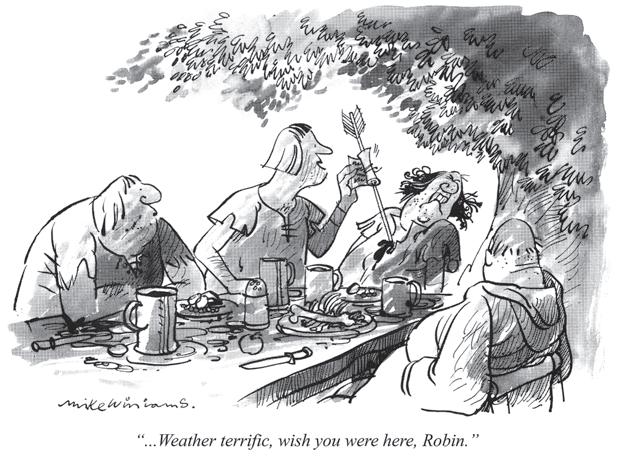
1 How does the cartoon relate to the passage from The Chronicles of Robin Hood?
2 What is the car toonist’s purpose?
3 How does the cartoonist indicate that the setting is Sherwood Forest?
4 How does Robin’s message show that he is on holidays?
5 How does the cartoonist use exaggeration to create humour? 5 marks
Find words in the spelling list that match the meanings of the following phrases. The first letter of each word is given to help you.
1 fair ness, especially in the treatment of people j
2 the state of being able to think or act freely l
3 distr ustful; tending to believe that something is wrong s
4 filth and miser y s
5 allowed to be done p
6 cr uel; unjustly harsh o
7 to r ule over or control d
8 easily reached; approachable a
9 causing great dislike or disgust
10 showing great care and attention
11 a person who chooses to die for a cause
12 to express an intention to cause harm
13 a cause for complaint g
14 capable of being wounded or hur t v
15 having unlike qualities; being dissimilar d
16 to put into pr ison
17 to feel or express regret for something
18 to kill someone, especially a public figure, by a sudden attack
19 to get or obtain
20 threatening behaviour or actions
Back-of-the-book dictionary
The word ‘desolation’ comes from the Latin word solus, meaning ‘alone’. Use the back-of-the-book dictionary to find the meanings of the following words derived from solus
solitude:
soliloquy:
soloist:
solitaire:
Language
Prefixes
4 marks
A prefix is a word-part that is added to the beginning of a word to alter its meaning or to create a new word. In the following examples, the prefix is in bold type.
The box below lists some common prefixes, their meanings, and words that are formed by using them. Use this word list to find words that match the meanings below. The relevant prefixes are given in brackets to help you.
Prefix Meaning
Words that contain the prefix ad- towards, to adhere, adjacent, advertise, adaptable, adjourn hyper- over, excessive hyperbole, hyperactive, hypertension, hypersensitive dys- ill, bad dysenter y, dysfunctional, dyslexia, dyspepsia di- apar t, two divert, digress, dilute, divulge, dilemma, divorce, divide pre- before prevent, precocious, preface, preamble, prejudice
1 an impaired ability to understand written language
(dys-)
2 developed, especially mentally, at an unusually early age (pre-)
3 an abnor mally high blood pressure (hyper-)
4 to promote or make known to the public (ad-)
5 to disclose or reveal information (di-)
6 to suspend a meeting to a later time or place (ad-)
7 the introduction to a book, speech or document
8 excessively sensitive
9 not functioning properly or normally
10 the ending of a marr iage by a court decree
(pre-)
(hyper-)
(dys-)
(di-)
10 marks
Suffixes
A suffix is a word-part that is added to the end of a word to alter its meaning or form. In the following examples, the suffix is in bold type.
The table below lists some common suffixes, their meaning and words that are formed by using them. Use this word list to find words that match the meanings below.
Suffix Meaning
Words that contain the suffix
-ish having the nature of childish, foolish, fiendish, impish -less without merciless, breathless, motherless, defenceless -ous full of dangerous, adventurous, zealous, mountainous -ist one who dentist, chemist, psychiatrist, pianist, optometrist
1 having the nature of a child (-ish)
2 without mercy (-less)
3 a person who tests eyes (-ist)
4 full of adventure (-ous)
5 without breath (-less)
6 a doctor who treats mental illnesses (-ist)
7 having the nature of an elf (-ish)
8 full of eager ness or enthusiasm (-ous)
The craft of writing
Script layout
Scriptwriters are the unsung heroes of film, television, stage, radio and even some computer games. Scripts usually follow a particular pattern so that the actors can readily act out the written material. Scriptwriters usually provide background information about the characters, and give information about the time and place of the events taking place. The title page of the script gives a list of all the characters. The sample script that follows is for the opening scene of one of Robin Hood’s adventures.
When the character’s name comes before the stage direction, the first word inside the brackets does not begin with a capital letter.
ACT 1
robin ’ s camp in the forest of Greenwood near Nottingham. robin and marian are arguing about the need for safety.
8 marks
The stage directions are shown in italics. They may give details about the setting, costume, lighting, props and sound effects.
marian: (worried) You know how closely the Sheriff of Nottingham is watching you. Yet, you see no harm in going to the highway.
robin: You always imagine the worst that can possibly happen …
The character’s name appears in the margin opposite their speech. The name is in capital letters and ends with a colon.
(peterkin and little john rush in and interrupt the domestic quarrel )
peterkin: Robin …
robin: What now, Peterkin?
peterkin: (excited) The lads have brought word … a rich merchant is due to pass along the Nottingham road today. I thought you might be interested.
Except at the beginning of each scene, all stage directions should be in brackets, beginning with a capital letter, but with no full stop at the end.
robin: You thought rightly, Peterkin. Just what I need … a little sport.
john: (laughing) And what better sport is there than relieving a rich merchant of his wares. We can pass them off to the poor who need them.
robin: (laughing) Right, come along, Little John … we’ll find a spot by the road and wait for this gentleman.
peterkin: Can I be with you, Robin?
robin: Why not, Peterkin, since you brought me the news. Action! That’s what we need.
marian: And what about me, Robin?
robin: Aye, you can come along too and see the sport. Let’s go!
(They exit together in the direction of the highway )
Writing your own script
Select an extract from a Robin Hood story, such as The Chronicles of Robin Hood, or another legend. Alternatively, you may choose an extract from your class novel. Use the layout shown above to change your selected extract into a script suitable for acting out in front of your class. Don’t forget to include stage directions. Act out your scene with other members of your class.