The moral rights of the author have been asserted.
All rights reserved.
Except under the conditions described in the Copyright Act 1968 of Australia (the Act) and subsequent amendments, no part of this publication may be reproduced, stored in a retrieval system, or transmitted in any form or by any means, electronic, mechanical, photocopying, recording or otherwise, without the prior written permission of the copyright owner.
Educational institutions copying any part of this book for educational purposes under the Act must be covered by a Copyright Agency Limited (CAL) licence for educational institutions and must have given a remuneration notice to CAL.
Licence restrictions must be adhered to. For details of the CAL licence contact: Copyright Agency Limited, Level 11, 66 Goulburn Street, Sydney, NSW 2000. Telephone: (02) 9394 7600. Facsimile: (02) 9394 7601. Email: memberservices@copyright.com.au
Publication data
Authors: Rex Sadler and Sandra Sadler
Title: Complete English Basics 3: A Class and Homework Course
ISBN: 978 1 4202 3710 8
Publisher: Emma Cooper
Project editor: Barbara Delissen
Cover and text designer: Dim Frangoulis
Production control: Janine Biderman and Katherine Fullagar
Photo research and permissions clearance: Vanessa Roberts
Typeset in Heuristica Regular 10.5/12pt by DiZign Pty Ltd
Cover image: Shutterstock/Aurelien Laforet
Printed in Malaysia by Vivar Printing Pdt Ltd
1 2 3 4 5 6 7 25 24 23 22 21 20
Warning: It is recommended that Aboriginal and Torres Strait Islander peoples exercise caution when viewing this publication as it may contain images of deceased persons.
Preface
Complete English Basics 3 sets out to present essential English skills in an interesting and meaningful way for middle secondary students.
This third edition covers essential language and literacy skills underpinning the new Australian Curriculum. New literature texts and language exercises have been included to provide a wider range of comprehension texts and to augment language development.
The workbook can be used as a class or homework text. One approach would be to have students complete each unit over a two-week period.
The stimulus materials and exercises are designed to improve comprehension and vocabulary skills, as well as language usage and spelling. A special feature is the back-of-the-book dictionary, which encourages students to expand their vocabulary by looking up the meanings of unfamiliar words.
Correct spelling is essential for good communication. Research has shown that in those classrooms where teachers are concerned about correct spelling and vocabulary enrichment, the students’ spelling level improves significantly. It is a good idea, if time allows, to have a brief spelling test at the end of each unit using the words from the spelling and vocabulary list.
The extracts are engaging and cover a diverse range of topics—from surfing to the holocaust. A range of genres is represented, including biography, crime, poetry and adventure.
Above all, we hope that students will enjoy their studies as they gain basic English skills.
Rex and Sandra Sadler
Acknowledgements
The author and publisher are grateful to the following for permission to reproduce copyright material:
Extract from Lionheart by Jesse Martin, Allen & Unwin, 2000, reproduced with permission of Allen & Unwin Pty Ltd, 1; Extract from The Happiest Refugee by Anh Do, Allen & Unwin, 2010, reproduced with permission of Allen & Unwin Pty Ltd, 3; Extract from Whatever You Do, Don’t Run—my adventures as a Botswana guide by Peter Allison, Allen & Unwin, 2007, reproduced with permission of Allen & Unwin Pty Ltd, 456; Extract from The Secret Diary of Adrian Mole aged 13 ¾ by Sue Townsend, Curtis Brown UK, 1982, reproduced with permission of Curtis Brown, 44; Extracts from Dr No by Ian Fleming, Curtis Brown, 1957, reproduced with permission of Curtis Brown, 125-6, 130; Extract from The Light Beyond the Forest by Rosemary Sutcliff, 1980, reproduced with permission of David Higham and Associates, 16; Extract from Matilda by Roald Dahl, Penguin Books Ltd, 1988, reproduced with permission of David Higham and Associates, 53; Advertisement used with permission from Energy Australia, 103; Extract from King Arthur and the Knights of the Round Table by Antonia Fraser, first published in the UK by Orion Children’s Books, an imprint of Hachette Children’s Books, Carmelite House, 50 Victoria Embankment, London EC4Y 0DZ, 9-10; Poem ‘Trails’ by Eva Johnson, reproduced by permission
of the author, 23; Extract from Lockie Leonard: Scumbuster by Tim Winton, reproduced with permission by Jenny Darling & Associates, 71-2; Extract from Everything I Know About Writing by John Marsden, Pan Macmillan Australia, 1993. Copyright John Marsden 1993. Reproduced with permission of John Marsden and Pan Macmillan Australia Pty Ltd, 16; Extract from Children of the Dust by Louise Lawrence, Random House, 1985, reproduced with permission of Penguin Random House, 17-8; Extract from Looking for Alibrandi by Melina Marchetta, Penguin Books Australia, 1992, reproduced with permission by Penguin Australia Pty Ltd, 50; Extract from To Kill a Mockingbird by Harper Lee. Published by William Heinemann. Reprinted by permission of The Random House Group Ltd, 51; Extract from Forrest Gump by Winston Groom, 1986 by Perch Creek Realty & Investment Corp. Used by permission of Doubleday, an imprint of the Knopf Doubleday Publishing Group, a division of Penguin Random House LLC. All rights reserved, 96; Extract from Cider with Rosie by Laurie Lee, 1959. Published by Chatto & Windus. Reprinted with permission of The Random House Group Limited, 148; Poem ‘The last tiger’ from Collected Poems for Children by Gareth Owen. Published by Macmillan, 2000. Copyright Gareth Owen. Reproduced by permission of the author c/o Rogers, Coleridge & White Ltd., 20 Powis Mews, London W11 1JN, 83; Cartoon ‘On the Town with King Arthur’ by Tony Lopes, reproduced with permission of Stoneytoons.com, 11; Poem ‘Son of mine’ from My People by Oodgeroo Noonuccal, Wiley UK, 1990. Reproduced with permission of John Wiley & Sons Ltd, 24
The author and publisher would like to acknowledge the following:
Extract from The Kon-Tiki Expedition by Thor Heyerdahl, 1993, Gyldendal Norsk Forlag, 102; Extract from What it Feels Like, by Lester Morlang, edited by AJ Jacobs, Harper Collins, 2003, 77; Extract from Hatchet by Gary Paulsen, Macmillan Children’s Books, 1989, 55-6; Extract from The Pearl by John Steinbeck, Mandarin Paperbacks, 1948, 97; Poem ‘The shark’ by Edwin John Pratt, from The Oxford Book of Animal Poems, by Michel Harrison and Christopher Stuart-Clark. Oxford University Press, 1992, 83; Extract from Of Mice and Men by John Steinbeck, Penguin, 1937, 76; Extract from Cannery Row by John Steinbeck, Penguin, 2000, 143-4; Extract from The Diary of a Young Girl by Anne Frank, edited by Otto H Frank and Mirjam Pressler, translated by Susan Massotty, Puffin Books, 39; Poem ‘Water skier’ by Thomas W Shapcott, University of Queensland Press, 137
While every care has been taken to trace and acknowledge copyright, the publisher tenders their apologies for any accidental infringement where copyright has proved untraceable. They would be pleased to come to a suitable arrangement with the rightful owner in each case.
1 It’s my life
Comprehension
Read the following passage and answer the questions.
Lone sailor
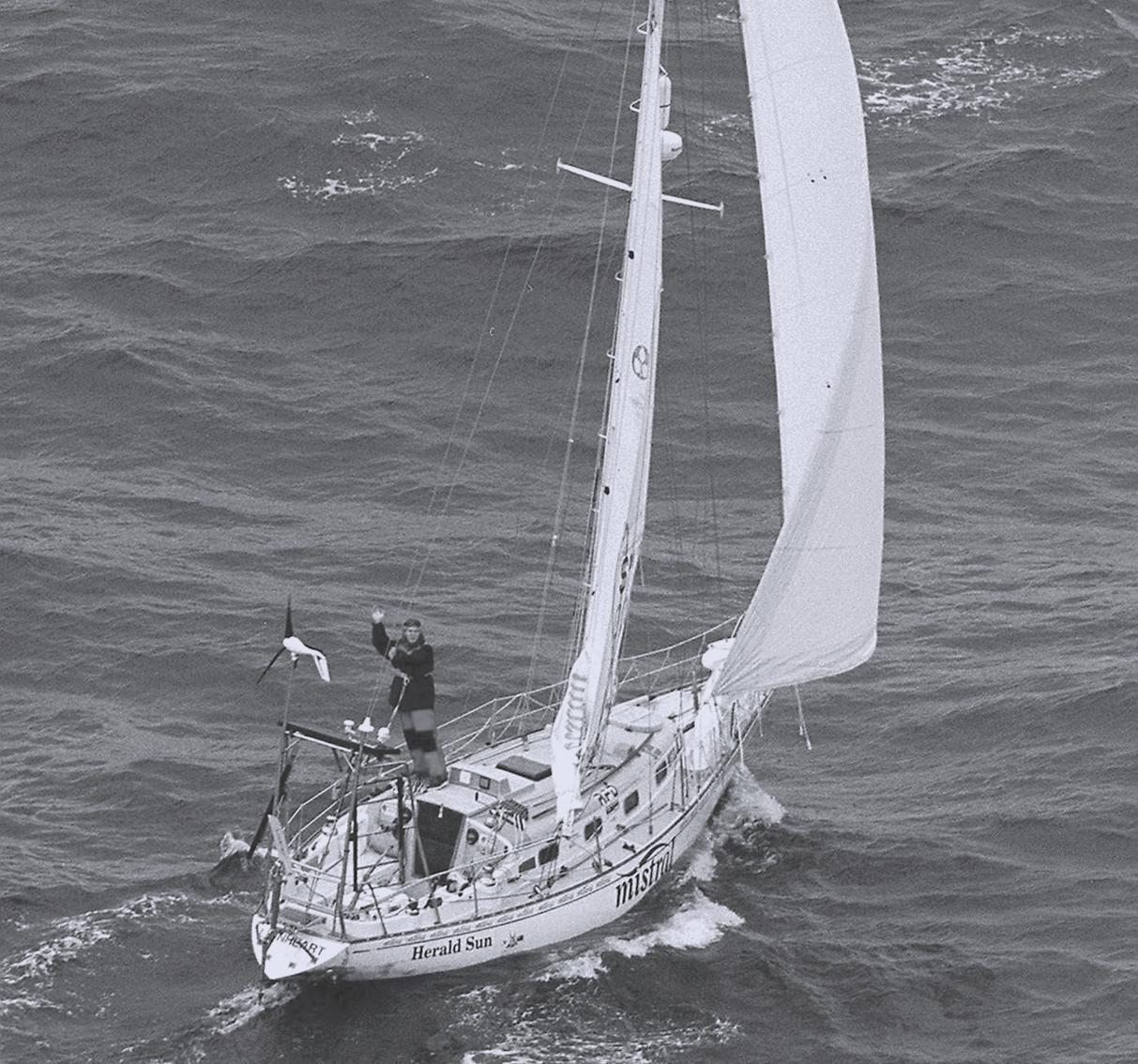
THE marine life seemed to be a lot more active in this part of the world. I soon found my first flying fish lying on deck. I was familiar with these strange creatures from the trip with Dave and there I was, on my own, with the small flying fish. It marked the beginning of the tropics for me. From then on they got bigger and bigger and the schools would sense the presence of Lionheart and take to the air in great numbers. At night I’d hear a thud followed by a few flickers to indicate one of the fish had landed on board and was stranded.
They were cute little fish but I soon came to hate the noise of one landing on board, for they played heavily on my conscience. I’d be woken by the thud of one ramming head-first into the boat then I’d try to get back to sleep. It just wasn’t possible. The noise of them flipping about the deck screamed out to me to get up and throw them back overboard. It would have been easier if they died quickly but they flip-flopped away until the flips became less and less frequent, like the last gasps of a dying person. I’d fall asleep for a minute to be woken by another flicker of life. I couldn’t bear lying there while I knew a fish was suffering. I usually couldn’t get back to sleep until I’d got out of bed and thrown it overboard. It got pretty annoying when it happened three or four times a night.
Not only could I hear them land, but I could also smell them. The fresh smell of broken scales wafted down into the cabin where I could tell if there was one on board even if it made no noise.
They could be a real problem. One morning I came out on deck and counted fifteen dead fish lying about the place: in the reefs of the sails, jammed beside the life raft and the wall, and even mixed in with the ropes in the rope bags. Some were quite large, up to 30 centimetres long. I tried to cook one once but there were too many bones and scales. At least I knew it was possible to eat them in an emergency.
from Lionheart by Jesse Martin
Reading for understanding
1 What indication did the narrator have that the marine life was a lot more active in the part of the world where he was now sailing his yacht Lionheart ?
2 ‘they got bigger and bigger …’ What evidence does the narrator give in the final paragraph to show this to be true?
3 How did the schools of flying fish react to the presence of Lionheart ?
4 At night, how did the narrator know that a flying fish had landed on his yacht?
5 In the second paragraph, the writer uses sound words (onomatopoeia) to convey the sound of the movements of the fish. Write down three examples.
6 ‘I’d try to get back to sleep.’ Why was this not possible?
7 Identify a simile in the second paragraph and explain what comparison is being made.
8 How did the narrator become aware of the presence of a flying fish on the deck even when it made no noise?
9 ‘They could be a real problem.’ Why was this so?
10 Why was the narrator not keen to eat the flying fish?
11 What did you learn about the character of the narrator from this passage?
11 marks
Head honcho school captain
ALL through my primary school years I had a thick Vietnamese accent: ‘Fipteen minat twell equal tree’. Even though my English was getting better year by year, it was still definitely not as good as an Aussie kid’s. It didn’t seem to matter too much as I did well enough academically and socially, becoming a candidate for school captain at the end of Year 5.
There were four class captains in the running to become the big head honcho school captain. It was a very big deal, and the four of us were to make a speech in front of the whole school at the next assembly, to tell everyone why we were the best candidate for the job. The teacher pulled us aside and told us that it was okay to get help from our parents to write this speech, as it was such a big deal. I went home and said to Mum and Dad, ‘You have to help me write a speech to become school captain’.
‘Six! Anh needs your help to write his speech.’
Uncle Six had done a couple of years of school in Australia, and at the time he was the best at English in our whole household, but this didn’t mean he was any good. Together we wrote my speech and on the day of the assembly I was ready to wow the school armed with a migrant’s second-year English speech.
That morning I was first to speak.
‘Hello School Peoples. I am Anh.’
I could hear a few sniggers from the other classes, but I was determined to go on.
‘I will try for my hardest to be very friendly boy, and I will always saysing hello to all you school peoples ...’
Everyone started laughing. The worst thing was when I looked down, I even saw teachers laughing. I looked across at my own teacher and she wasn’t laughing, but I could see her trying not to laugh!
I was so mad at her. I froze. I didn’t know what to do. It was almost like time stood still. In that moment I just totally blanked out and forgot what to say next.
The only people who weren’t laughing were my little classmates. They were on my side. Just then I heard a tiny girl’s voice:
‘C’mon, Anh.’
I looked down and there was Karen, an 11-year-old face full of support. A few of her friends joined in.
‘Keep going, Anh.’
‘I ... I ... should be school captains because I want to helping the students ...’
I stood as still as I could, just blanking out everyone, every noise, every snigger and laugh, and saying everything that I had to say like a monotone robot. Soon it was over. Thank God. My first ever public speaking experience.
I look back on it now and I can’t even blame people for laughing. Bloody Uncle Six must’ve skipped the classes where they taught plurals and adjectives.
from The Happiest Refugee by Anh Do
Reading for understanding
1 What problem did the narrator have because he was a refugee?
2 ‘Fipteen minat twell equal tree.’ What was Anh trying to say in English?
3 Why did Anh feel he could become a candidate for school captain?
4 What did Anh have to do before he could be chosen for school captain?
5 What help was each candidate allowed to have in preparing their speech?
6 Why was Anh’s uncle given the job of helping him prepare his speech?
7 How did Anh feel before he was to give his speech?
8 ‘Hello School Peoples.’ Why did Anh’s first three words cause sniggers from the other classes?
9 Why was Anh mad at his teacher?
10 How did Anh’s classmates encourage him to continue his speech?
11 What caused Anh to speak ‘like a monotone robot?’
12 What explanation does Anh give for his use of incorrect English in his speech?
13 What does this incident reveal about Anh’s personality?
Find words in the spelling list that are opposite in meaning to the following. The first letters are given to help you.
1 reckless c 6 lazy e
2
10 marks
Word forms
Complete the sentences by using the correct form of the words in brackets.
1 The demonstrators acted (impetuous), but (fortunate) they took (responsible) for their actions.
2 When the child had regained (conscious), the doctor advised the parents to treat the injury (cautious).
3 The evidence was (prejudice) to the case and the defendant stated that his (impulse) behaviour had been an (embarrass) to his family.
4 All were in (agreeable) that our grandmother had a wonderful (personal) and always (patient) listened to the problems of others.
5 The principal would not (tolerant) any (violent) or (deceitful) from the students.
14 marks
Back-of-the-book dictionary
Claustrophobia is defined as ‘the fear of enclosed spaces’. It is derived from the Latin word claustrum (enclosed space) and the Greek word phobos (fear). There are many phobias that humans may suffer from. Use the back-of-the-book dictionary to write the meanings of these common phobias.
A text is a spoken, written or visual communication used to convey meaning. Five main categories of texts can be identified: factual texts, literary texts, visual texts, media texts and everyday texts. Well-known texts include novels, poems, newspaper articles, films, reviews, jokes, cartoons, comic strips, advertisements, scripts, diaries, letters, paintings, posters, photographs, brochures and autobiographies.
Identifying the text
Below are definitions of texts that we come across in our daily lives. Use the list to find the name that goes with each definition.
autobiography biography atlas newspaper dictionary thesaurus menu recipe novel film script email portrait photograph cartoon encyclopaedia prescription fairytale magazine obituary limerick epitaph journal review legend street directory
Text Definition
1 a book of maps
2 electronic mail
3 an alphabetical list of words and their meanings
4 a five-line, amusing poem
5 a paper printed daily or weekly containing news, etc.
6 a long prose narrative about imaginary people and events
a picture taken by a camera
a story about fairies or magical events 9 a painting, drawing or photograph of a person
a list of dishes served at a restaurant
the words written on a gravestone 12 a story written by someone about his or her life 13 a book of information arranged alphabetically 14 an article giving an opinion about a film, book, etc.
14 marks
Texts and their purposes
Creators of a text use language for a purpose. This purpose is the reason why they write. There are many purposes for writing that you will need to be able to identify. Here are some of the important ones.
Read the following texts. In one sentence, write each writer’s purpose.
1 Come away to sunny Queensland and enjoy the wonders of the Great Barrier Reef. (advertisement)
Purpose:
2 September 25 Dear Diary, I haven’t written for about a week because nothing of interest has happened. The same old dumb teachers teaching the same old dumb subjects in the same old dumb school. At first I thought high school would be fun, but it’s just dull.
(student diary; from Go Ask Alice, anonymous)
Purpose:
3 She was unbelievably old and so thin that she was more like a skeleton than a living being: her wrinkled skin hanging from her bones; her face a gleaming skull.
(novel; from The Red King, Victor Kelleher)
Purpose:
3 marks
The craft of writing
Personal experiences
Writing is a special craft and it takes hard work—very few gifted writers claim that writing is easy. Frank McCourt, famous bestselling author of Angela’s Ashes, ’Tis and Teacher Man, gives the following advice to budding authors who are trying to improve their writing techniques.
Write about what you know with conviction from the heart. Dig deep. Find your own voice and dance your own dance.
In the following extract, famous author and journalist Phillip Adams takes this advice as he gives us a moving description of his grandfather from his childhood memories.
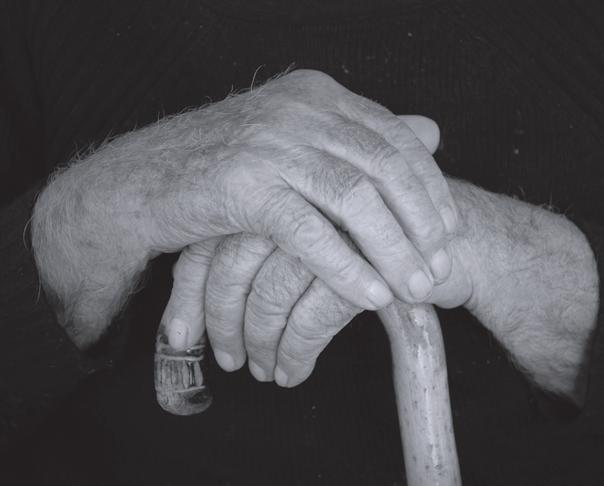
WHEN I think of my grandfather, I see his hands. In my memory they’re as gnarled as the mallee roots he’d carry from the wood-heap to the open fire where he’d have me make toast with a long fork of plaited wire. Big hands, capable of acts of extraordinary sensitivity, as when he’d use his
huge forefingers to make holes in his seed beds, deftly planting the most fragile green filaments. I can also remember the kindness in those hands when they’d tousle my hair, or hand me a crudely made sandwich.
from ‘Grandpa: the gentle giant of my childhood’ by Phillip Adams
Write a one-paragraph description of one of the following people in your life. • mother • father • brother
Intertextuality
Comprehension
2
Intertextuality is the connection that some texts have with each other. Texts make connections through their storylines, settings, themes, contexts, characters and language. A whole text may be transformed into a modern text, or a text may borrow from or refer to another text. For example, the teenage romance film 10 Things I Hate About You borrows heavily from Shakespeare’s The Taming of the Shrew
A famous story such as the legend of King Arthur may exist in various forms—a movie, poem, novel, comic strip, cartoon or biography. The three texts that follow are all derived from the original legend of King Arthur. Read them and answer the questions.
Novel
King Arthur and the Knights of the Round Table
‘THAT is the strangest sight in the world!’ exclaimed Arthur to Merlin. They were sitting in a deep embrasure in the castle walls, gazing at the road which wound up to the castle from the town. Four ox-carts were struggling along the road, weighed down by an enormous burden.
‘A Round Table,’ continued the king. ‘Yes, it’s a huge Round Table.’
Merlin sprang up from his chair and stared out of the window in great excitement. ‘It must be the famous Round Table of King Leodegrance!’ he said. ‘This famous table was specially made to the king’s requirements to hold two hundred and fifty knights, the flower of Welsh knighthood. I never thought to see the day when Leodegrance parted with the Round Table.’ But after a great deal of reflection, the King of Cameliard had decided to send the Round Table to Camelot, as a token of his loyalty to Arthur, and as a wedding present for his daughter. The days in which Leodegrance could summon up two hundred and fifty knights were long since past; the effects of numerous wars with pagans and chieftains had been to reduce his chivalry to nearer fifty than two hundred and fifty. The empty seats at the table mocked him. He decided to pass the table on to a younger man.
Arthur received the gift with joy.
‘This table is an inspiration to me,’ he told Gwenevere and Merlin. ‘You know that it is my dearest wish to drive the invaders back into the sea, and extend my kingdom from shore to shore. I shall found the Fellowship of the Round Table. Every knight who takes the oath of the Round Table shall be pledged to dedicate his life to the service of God, the hammering of his enemies and the protection of the weak.’
Merlin nodded in agreement.
‘The Round Table should stand for all that is best in chivalry,’ he answered. ‘In the days of Leodegrance’s prime it stood for high adventure. There are still many adventures to be had in Britain today, and many battles to be fought before the pagans are routed and the evil witches cast down.’
Between them Arthur and Merlin planned a triple oath for the Knights of the Round Table. First to step forward to swear the oath of the Round Table was Sir Lancelot. As he did so a clap of thunder resounded through the castle hall, and the room was plunged in darkness. When the gloom cleared it could be seen that above each seat of the Round Table a name was written in letters of gold. Many of the names were still unknown to Arthur. Merlin solved the mystery.
‘This miracle shows that God’s blessing is upon the Round Table,’ explained the wizard. ‘It will be many years before every place is filled at
the table, for as yet your knighthood does not number anything like two hundred and fifty. But in time every place shall be filled.’ Then Merlin pointed to one seat, above which no name was written. As he pointed, letters of fire formed over the seat:
‘No one shall sit here, unless he be the best knight in all the world.’
‘What can this mean?’ exclaimed the king, crossing himself.
‘That is the Seat Perilous,’ said the wizard. ‘Even Sir Lancelot may not sit in that seat.’ For the time being he refused to say more.
Then all the king’s knights took their appointed places, and swore the triple oath of the Round Table. Following Sir Lancelot, there was Sir Kay and Sir Bedevere, Sir Gawaine, Arthur’s proud nephew, Sir Egremont, Sir Walter, and many others.
from King Arthur and the Knights of the Round Table by Antonia Fraser
Reading for understanding
1 What is the novelist’s purpose in the passage?
2 As the action begins, what are Merlin and King Arthur doing?
3 What evidence can you find to show that the table was very large and heavy?
4 Why had the table been specially made?
5 What was Arthur’s ‘dearest wish’?
6 What pledge would each knight, who took the oath of the Round Table, have to make?
7 What happened as Sir Lancelot stepped forward to swear the oath of the Round Table?
8 What could be seen when the gloom cleared?
9 What explanation did Merlin give for the miracle that had occurred?
10 Why were many of the names above the seats at the Round Table unknown to Arthur?
11 Use the back-of-the-book dictionary to find the meanings of these words:
a embrasure:
b pagans:
c chivalry:
Cartoon
13 marks
Reading for understanding
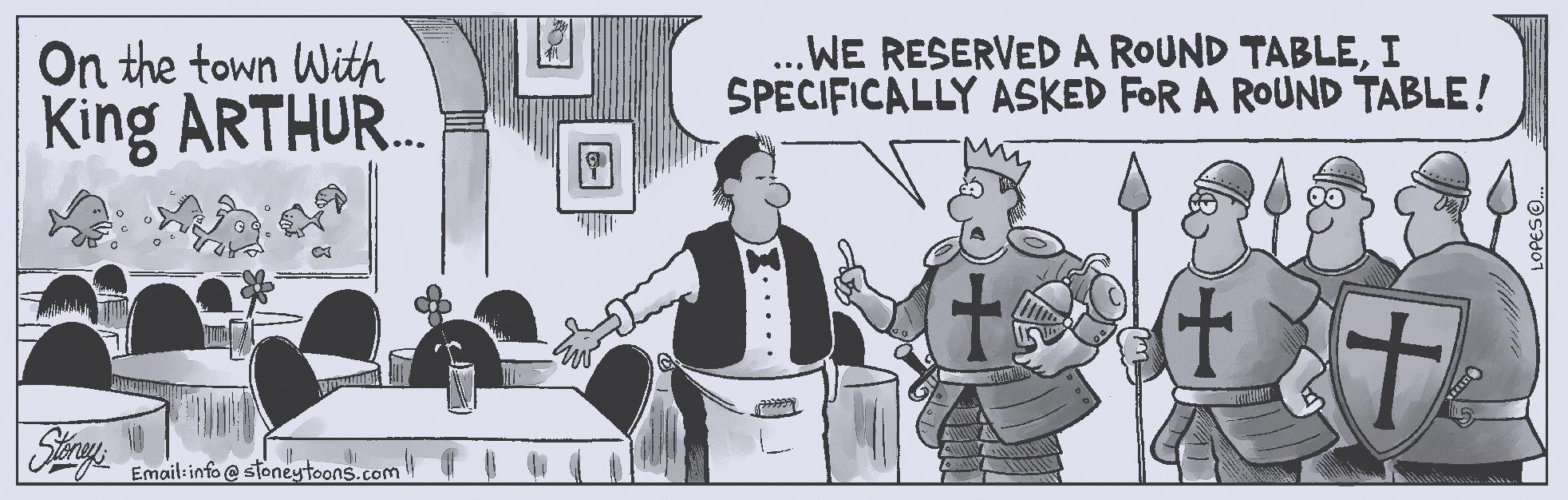
1 The cartoonist has based the cartoon on the legend of King Arthur. How has he indicated that the speaker is King Arthur?
2 What important feature of the Arthurian legend have both the cartoonist and the novelist focused on?
3 What is the cartoonist’s purpose?
4 How has the cartoonist given the legend a modern setting?
5 What impression has the cartoonist given of King Arthur’s knights?
6 What techniques are used to make fun of King Arthur and his knights?
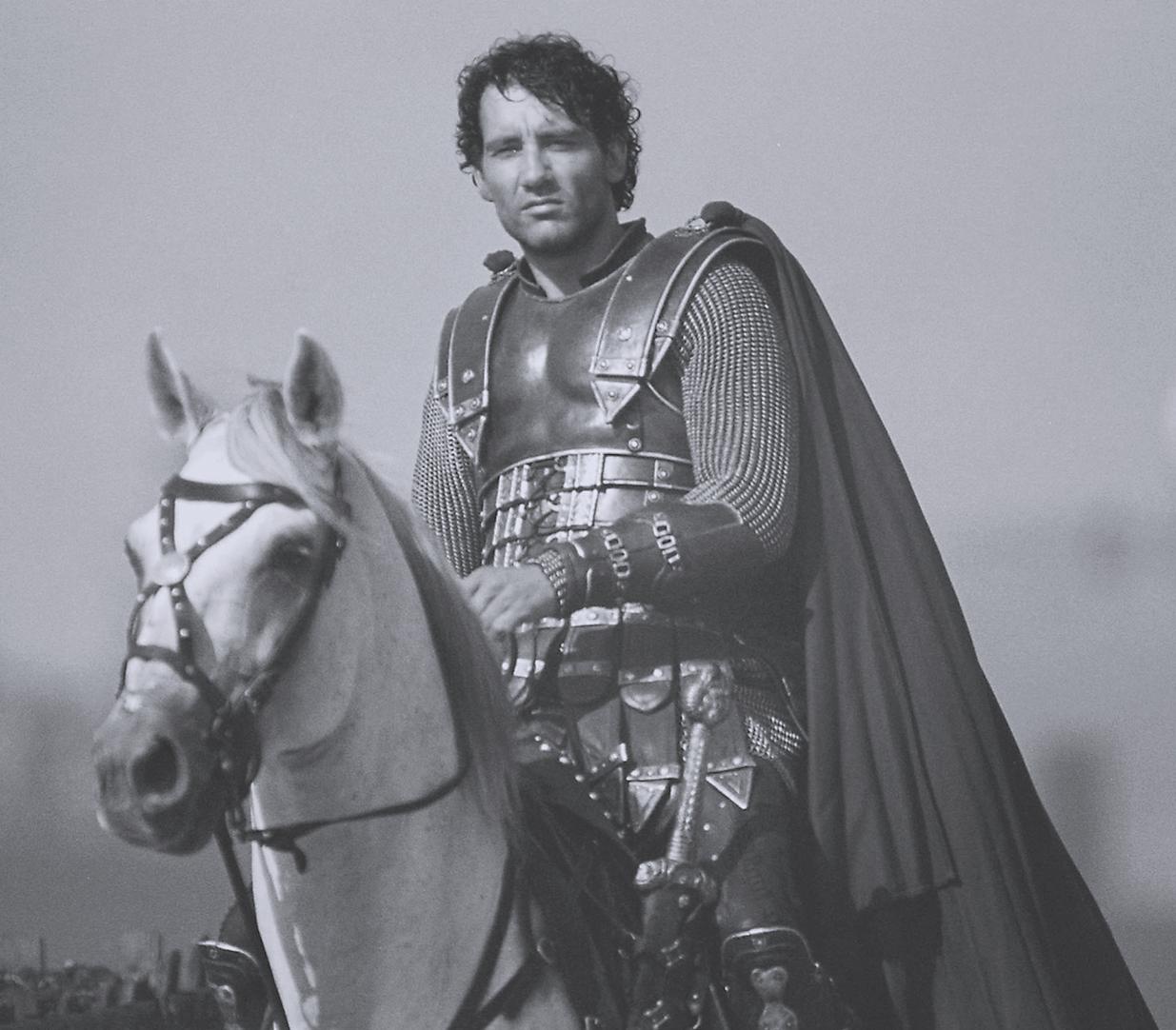
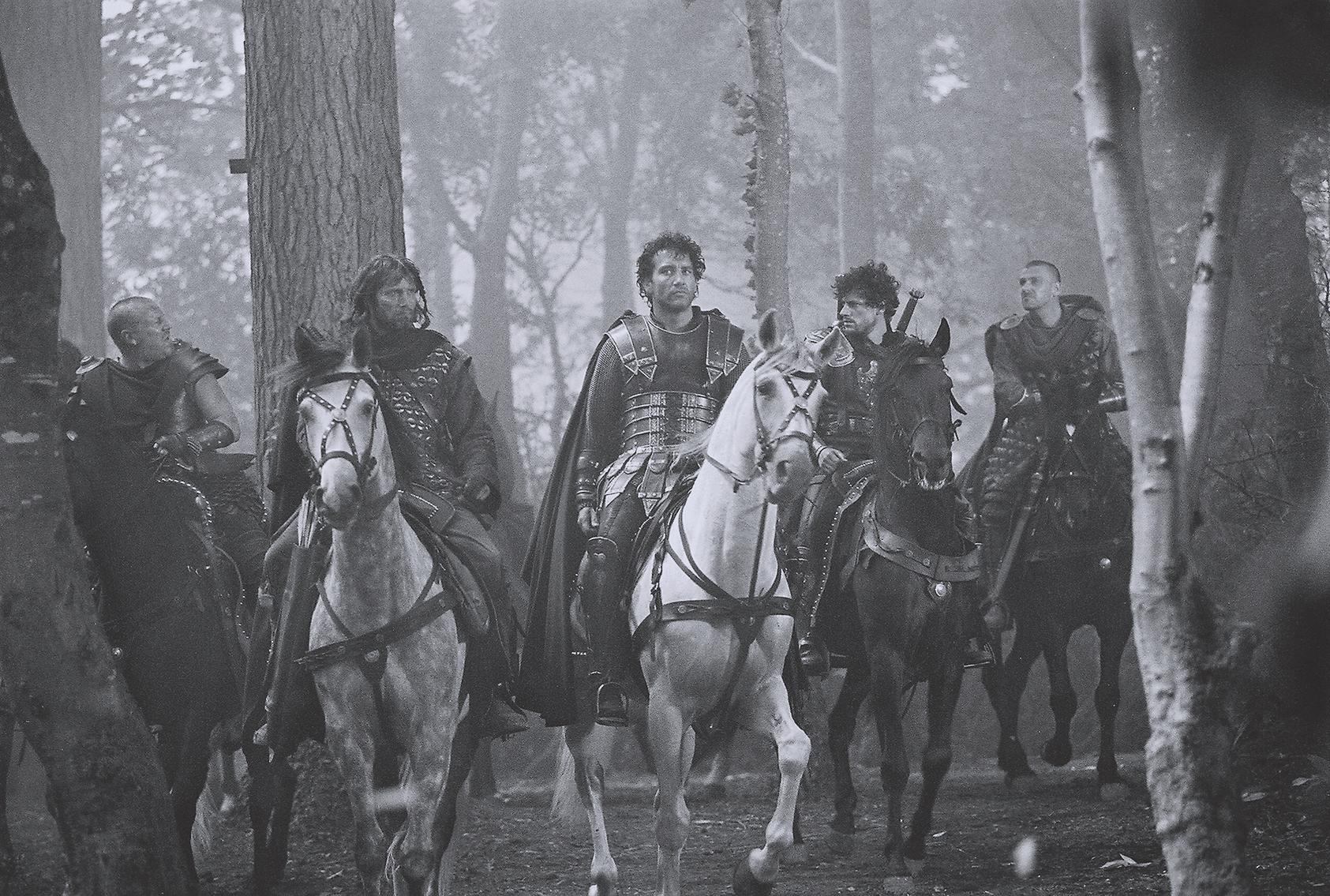
How are King Arthur and his knights different from those in the cartoon? 3 Why do you think this would be a good still to promote the movie?
4 What use is made of light and dark in this shot?
5 Where is King Arthur positioned in this shot? Why has this been done by the director?
rein illicit vacation loose confident reign elicit vocation lose confidant
6 marks
A word for a phrase
Find words in the spelling list that match each of the following definitions. Some letters are given to help you.
1 the largest type of ape
2 permitted
3 illegal
4 in a proper manner
5 a narrow street
6 a person someone trusts
7 a manner of walking
8 an understanding
9 to draw out information
a
to mislay
in earlier times
Use words from the spelling list to complete the following phrases. The first letters are given to help you.
Back-of-the-book dictionary
The word ‘vacation’ comes from the Latin word vaco (vacatum), which means ‘to be empty, vacant, unoccupied’. If you are on vacation, you are having a rest from work or school. Use the back-of-the-book dictionary to write the meanings of these words that are derived from vaco.
evacuate: vacuum:
Language
Active and passive voice
When the subject of a sentence is doing the action, the verb is said to be in the active voice.
King Arthur ruled Britain wisely. (active)
However, when the action is done to the subject, the verb is said to be in the passive voice. King Arthur was always helped by the wizard Merlin. (passive)
Both the active and passive forms of verbs are used in English. Usually, the active voice is more direct and personal than the passive voice.
Changing the subject—active to passive
Rewrite each sentence in the passive voice. The first one is done to help you. Some of the sentences may have more than one correct answer.
1 Arthur pulled the sword from the stone. The sword was pulled from the stone by Arthur.
2 The wizard Merlin loved the Lady of the Lake.
3 Merlin took Arthur to a magical lake.
4 The Lady of the Lake gave Arthur a magic sword called ‘Excalibur’.
5 Wearing the scabbard of ‘Excalibur’ protected Arthur from being hurt.
6 Arthur instructed Sir Bedevere to throw ‘Excalibur’ into the magic lake.
7 Sir Bedevere threw the sword into the lake.
8 The hand of the Lady of the Lake caught the sword.
Changing the subject—passive to active
Rewrite each sentence in the active voice. The first one is done to help you.
1 Sir Lancelot was loved by Queen Gwenevere.
Queen Gwenevere loved Sir Lancelot.
2 ‘Excalibur’s’ scabbard had been stolen from Arthur by Morgan Le Fay.
3 The royal palace was established by Arthur at Camelot.
4 Arthur and Gwenevere were given a huge round table as a wedding present by King Leodegrance.
5 The Saxons were defeated by the Knights of the Round Table at Mount Badon.
6 The princess in the tower was rescued by one of the knights.
7 Arthur’s kingdom was destroyed by the treachery of Mordred.
7 marks
The craft of writing
Creating imaginary characters
Successful novelist John Marsden has the following advice for writers who want to create memorable characters.
To make your major characters come to life you must endow them with unique details. Something about the way they dress, for example? The jewellery they wear? Do they have tattoos, braces, glasses, facial hair, make-up, painted nails? Is there something odd about them? Perhaps they wear two watches, or carry a spare pair of socks in their pocket, or wear a badge with a picture of Big Bird.
Of course it’s in their attitudes, opinions, thoughts, personalities that your characters will truly express their uniqueness, but the little details of dress and appearance help.
Think about behaviour too. Perhaps you could have a character chewing the back of their hand whenever they listen to someone, or refusing to speak when they drive, or irritatingly humming the same tune for weeks on end. These mannerisms are all important to help the reader think of people as individuals.
from Everything I Know About Writing by John Marsden
In the following detailed description of Sir Lancelot, from her novel The Light beyond the Forest, writer Rosemary Sutcliff uses techniques that John Marsden advocates.
Now Sir Lancelot of the Lake was an ugly man, with an ugliness such as women love. His dark face under the thick badger-streaked hair looked as though it had been put together in haste, so that the two sides of it did not match. One side of his mouth was grave with heavy thought, while the other lifted in joy; one eyebrow was level as a falcon’s wing and the other flew wild like a mongrel’s ear. He had lived forty-five summers and winters in the world, and loved and sorrowed and triumphed and fought to the utmost, and every joy and sorrow and striving had set its mark on him.
from The Light Beyond the Forest by Rosemary Sutcliff
Now try to create a fictional character of your own from one of these genres:
fantasy
science fiction
historical fiction
horror
3 Future shock
Comprehension
Read the following passage and answer the questions.
Holocaust
SARAH’S whole body was tense and listening. It was very dark in the room but a faint line of sunlight showed through the weave of the blanket at the top of the window. She heard a rumble in the distance, a great wave of sound that came sweeping towards her, engulfing everything in its path, drowning Catherine’s cries. Sarah blundered towards the fragile edge of light as the blast struck the house.
Roof tiles smashed and the windows were blown inward. Books and ornaments and light fittings crashed and fell in the upstairs rooms. In the howling darkness the mattress sagged and the bookcase started to topple. The black human shape that was Veronica screamed at her to help. But Sarah was already there, moved by her instinct, exerting force against force. The blanket tore at its nails, came loose at one corner. Heat screamed through the crack. Sarah had one brief glimpse of devastation, a hurricane of tearing trees and whirling leaves, the sky gone dark and lurid with fire, before the wind passed over them and things sank back into stillness.
Catherine was sobbing beneath the table.
Fragments of glass slipped and fell.
The air was stifling.
‘Is it over?’ Sarah asked.
‘That was just the beginning,’ Veronica said brutally.
‘We don’t stand a chance!’ Sarah cried.
‘There’s a torch on the mantelpiece!’ Veronica told her. ‘And the hammer is beside it. I’ll need some nails too. Hurry up!’
Veronica removed the bookcase and nailed the blanket back into place. They had to have
something heavier, she said, and between them they managed to lift the settee on top of the sideboard. It was made of leather and horsehair and its carved legs hooked over the back. Sheets and blankets were jammed into the space along the top as the next wave of sound came screaming towards them.
They applied their shoulders, all the strength they had, to hold the settee in place as the bombs fell over Bristol and Cardiff, Cheltenham and Gloucester, and the great winds followed, a roaring tide of heat and darkness that smashed like a gigantic fist against the house. Even through the thickness of the walls Sarah seemed to see it … hell-bright hues, impressions of colours that flashed and pulsed, rose and gold and red-vermilion, impaled on her eyes as the
wind screamed through the broken upstairs window and the barricade shuddered. Wave after wave of thundering sound beat at the doors and walls of their sanctuary, until it faded away into silence.
They listened and waited. Buster was howling outside in the hall and the grandfather clock struck four, a silly incongruous sound. It had
Reading for understanding
been a very short war, and they heard nothing more.
Find words in the spelling list whose meanings match the phrases below. The first letters are given to help you.
1 a ruler with unlimited power d
2 the surrounding of a place with troops s
3 complete disorder or confusion c
4 to make something dirty or impure c
5 something aimed at t
6 a person who uses methods to induce terror t
7 the rule of a cruel or unjust person t
8 to burst suddenly with a loud noise e
9 to ruin or put an end to something d
10 great sorrow or unhappiness g
11 sudden, uncontrollable fear p
Word forms
Fill the gaps by adding the correct form of the words in brackets.
1 He waited . (anxiety)
2 The governor was a . (tyranny)
3 The ransom money is . (negotiate)
4 Both bombs exploded . (simultaneous)
5 That country is a . (dictator)
6 The refugees as they fled across the border. (panic)
7 The water is . (contaminate)
11 marks
8 The of the president created fear. (assassin) 8 marks
Back-of-the-book dictionary
The word ‘dictator’ is defined as ‘one who commands’ or ‘an absolute ruler’. Dico (dictus) is the Latin word for ‘I speak’. Use the back-of-thebook dictionary to write the meanings of these dico words.
contradict:
edict:
diction:
dictionary:
indict:
5
Language Tone
The choice of words in a written text enables the writer to introduce certain attitudes and feelings. It is through the tone the writer adopts that the emotional message is communicated to the audience. The purpose of the writing and the specific audience the writing is aimed at will have a considerable effect on the writer’s tone.
Identifying tone
The following list shows examples of tones that may occur in texts. Your task is to match each tone to its appropriate text below.
despairing determined threatening gloomy
1 We shall fight on the beaches, we shall fight on the landing grounds, we shall fight in the fields and in the streets, we shall fight in the hills; we shall never surrender. (speech by Winston Churchill, 4 June 1940)
2 Stop or I’ll shoot! (command)
3 Water, water, everywhere And all the boards did shrink; Water, water, everywhere Nor any drop to drink. (poem; from The Rime of the Ancient Mariner by Samuel Taylor Coleridge)
4 The castle walls stood grim, dark and cheerless. (novel)
4
Purpose and tone
Through careful choice of words, writers can help create vivid images of life’s experiences and convey the tone or emotional meaning of what is written. Words are able to make us laugh or cry— they are a means of communicating all kinds of emotions, such as anger, fear, hope, contempt, contentment, hatred, sadness and joy.
Recognising purpose and tone
Read each of the following texts and identify the writer’s purpose as well as the tone that is expressed through the writer’s choice of words.
1 Nothing is so beautiful as spring—
When weeds, in wheels, shoot long and lovely and lush; Thrush’s eggs look like little low heavens ...
(poem; from Spring by Gerard Manley Hopkins)
Purpose:
Tone:
2 Scrooge! a squeezing, wrenching, grasping, scraping, clutching, covetous old sinner! Hard and sharp as flint ...
(novel; from A Christmas Carol by Charles Dickens)
Purpose:
Tone:
3 Only when the last tree has died and the last river has been poisoned and the last fish has been caught will we realise we cannot eat money. (Cree Indian saying)
Purpose:
Tone:
4 A wonderful bird is the pelican, His beak can hold more than his belican. He can take in his beak, Enough food for a week— I’m blowed if I know how the helican. (limerick; anonymous)
Purpose:
Tone: .
5 I have seen war. I have seen war on land and sea. I have seen blood running from the wounded. I have seen men coughing out their gassed lungs. I have seen the dead in the mud. I have seen cities destroyed. I have seen children starving. I have seen the agony of mothers and wives. I hate war.
(speech by Franklin Roosevelt, 14 August 1936)
Purpose:
Tone:
10 marks
The craft of writing
Making the beginning interesting
One of the most important things you, as writer, need to do is to make the beginning of your story as interesting as possible. You need to engage your readers so they will want to keep reading. It is a good idea to read the introduction of some popular novels, such as those in the Harry Potter series. You will soon come to see how important the first few paragraphs are.
Read the first three short paragraphs of Brother in the Land, a best-selling novel about the destruction of the world. Notice how the author gains your attention and makes you want to read on.
East is East and West is West, and maybe it was a difference of opinion or just a computer malfunction. Either way, it set off a chain of events that nobody but a madman could have wanted and which nobody, not even the madmen, could stop. There were missiles. Under the earth.
In the sky. Beneath the waves. Missiles with thermo-nuclear warheads, enough to kill everybody on earth. Three times over.
And something set them off; sent them flying, West to East and East to West, crossing in the middle like cars on a cable-railway.
from Brother in the Land by Robert Swindells
Now try your hand at writing the first paragraph for one of the following topics.