The moral rights of the author have been asserted.
All rights reserved.
Except under the conditions described in the Copyright Act 1968 of Australia (the Act) and subsequent amendments, no part of this publication may be reproduced, stored in a retrieval system, or transmitted in any form or by any means, electronic, mechanical, photocopying, recording or otherwise, without the prior written permission of the copyright owner.
Educational institutions copying any part of this book for educational purposes under the Act must be covered by a Copyright Agency Limited (CAL) licence for educational institutions and must have given a remuneration notice to CAL.
Licence restrictions must be adhered to. For details of the CAL licence contact: Copyright Agency Limited, Level 11, 66 Goulburn Street, Sydney, NSW 2000. Telephone: (02) 9394 7600. Facsimile: (02) 9394 7601. Email: memberservices@copyright.com.au
Publication data
Authors: Rex Sadler and Sandra Sadler
Title: Complete English Basics 2: A Class and Homework Course
ISBN: 978 1 4202 3708 5
Publisher: Emma Cooper
Project editor: Barbara Delissen
Cover and text designer: Dim Frangoulis
Production control: Janine Biderman and Katherine Fullagar
Photo research and permissions clearance: Fiona Byrne and Vanessa Roberts
Typeset in Heuristica Regular 10.5/12pt by DiZign Pty Ltd
Cover image: Adobe Stock/Olga Khoroshunova
Printed in Malaysia by Vivar Printing Pdt Ltd
1 2 3 4 5 6 7 25 24 23 22 21 20
Warning: It is recommended that Aboriginal and Torres Strait Islander peoples exercise caution when viewing this publication as it may contain images of deceased persons.
Preface
Complete English Basics 2 sets out to present essential English skills in an interesting and meaningful way for junior secondary students.
This third edition covers essential language and literacy skills underpinning the Australian curriculum. It incorporates a wide range of comprehension texts, spelling and vocabulary development, as well as language work on sentences, phrases, parts of speech, word families and paragraphing. It is important to note that eleven creative writing and punctuation units have been added to this new edition.
The workbook can be used as a class or homework text. One approach would be to have students complete each unit over a two-week period.
The stimulus materials and exercises are designed to improve comprehension and vocabulary skills, as well as language usage and spelling. A special feature is the back-of-the-book dictionary, which encourages students to expand their vocabulary by looking up the meanings of unfamiliar words.
Correct spelling is essential for good communication. Research has shown that in those classrooms where teachers are concerned about correct spelling and vocabulary enrichment, the students’ spelling level improves significantly. It is a good idea, if time allows, to have a brief spelling test at the end of each unit using the words from the spelling and vocabulary list.
The extracts are engaging and cover a diverse range of topics—from tornadoes to Egyptian pyramids. A range of genres is represented including biography, crime, fiction and adventure.
Above all, we hope that students will enjoy their studies as they gain basic English skills.
Rex and Sandra Sadler
Acknowledgements
The author and publisher are grateful to the following for permission to reproduce copyright material:
The author and publisher would like to acknowledge the following:
Extract from Little Brother by Alan Baillie, Puffin, 2004, 53; Extract from Frozen Fire: A Tale of Courage by James Houston, Estate of James Houston, 1992, 67.
While every care has been taken to trace and acknowledge copyright, the publisher tenders their apologies for any accidental infringement where copyright has proved untraceable. They would be pleased to come to a suitable arrangement with the rightful owner in each case.
1 Images and words
Comprehension
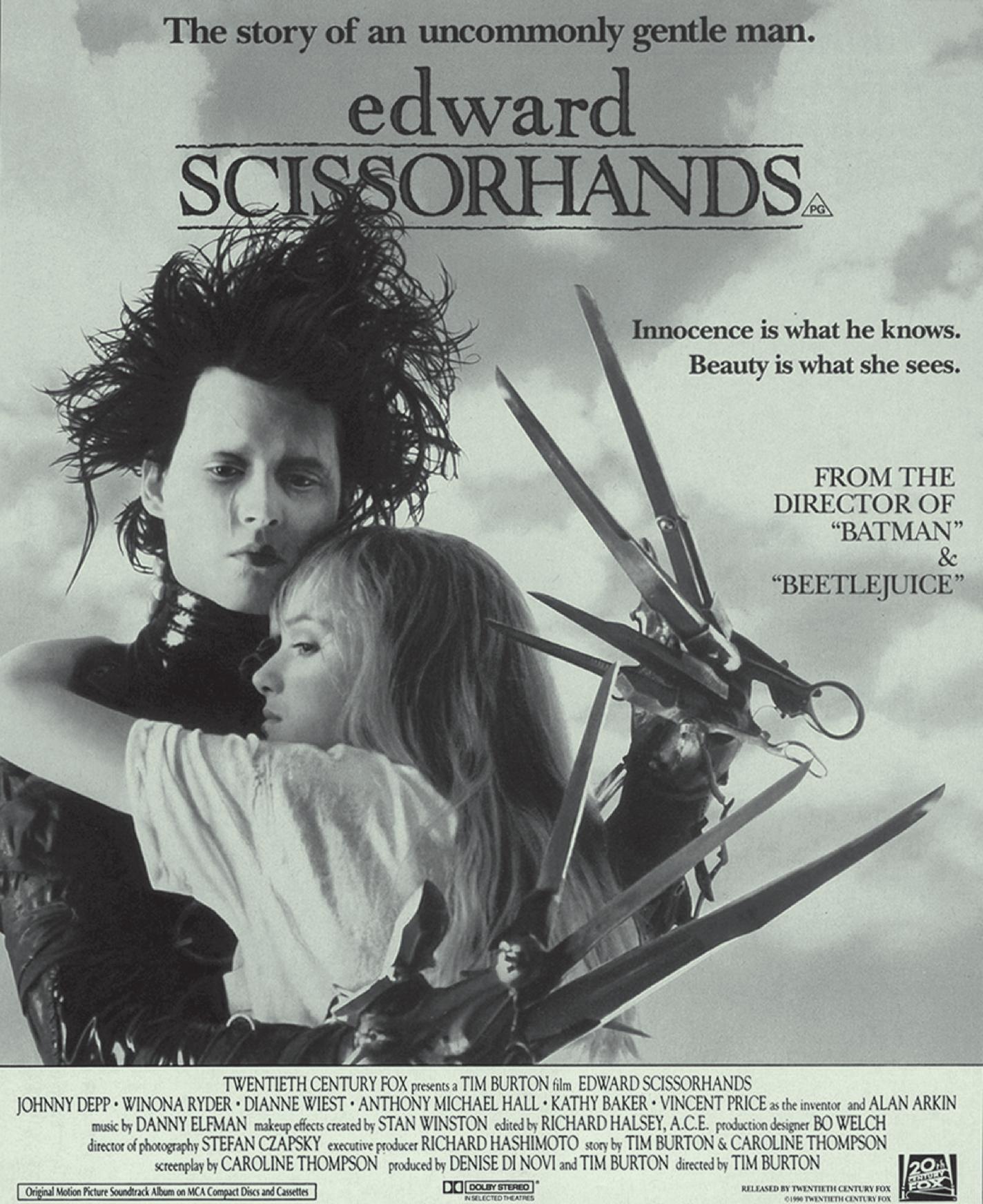
Film poster
Look at the film poster and answer the questions that follow.
Reading for understanding
1 What is the advertiser’s purpose in creating this poster?
2 In this poster, what immediately draws the audience’s attention? Why?
3 How are the scissor hands positioned in relation to the two characters?
4 How does the poster’s image show that the film is a love story?
5 Which words in the poster indicate that the young woman is attracted to Edward?
6 Which words tell the audience about the character of Edward?
7 ‘… an uncommonly gentle man.’ Why do we wonder whether Edward can be gentle?
8 How does the film image suggest that Edward is the main character?
9 Why do you think the advertiser mentions two of the director’s previous films, Batman and Beetlejuice ?
10 Why do you think the title has ‘edward’ in lower case and ‘SCISSORHANDS’ in capital letters?
11 What emotions are presented in the image?
12 What else in the image, other than his hands, suggests that Edward is an unusual character?
12 marks
Reading for understanding
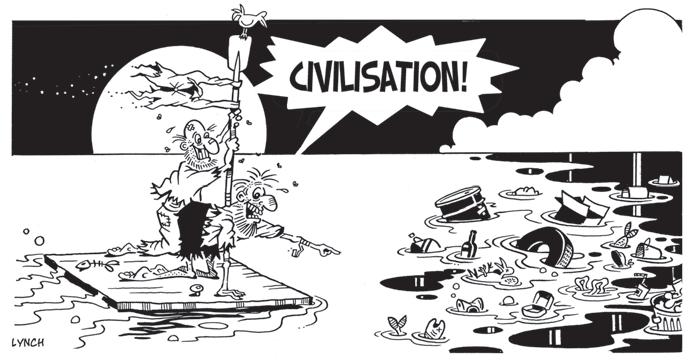
1 What is the car toonist’s purpose?
2 How do the survivors know that they have reached civilisation?
3 How does the cartoonist show that the survivors have endured much hardship?
4 What emotions do the sur vivors experience when they see the garbage floating on the water?
5 What has the car toonist identified about our society’s values?
1 Form nouns ending in ‘-ion’ for each of the following list words. a permit d confiscate b prohibit e compulsory c observant f completely
2 Write a list word similar in meaning to each of the following words. a allow c totally b sincerely d foolishness
3 Write a list word opposite in meaning to each of the following words. a voluntary c slowly b quietly d ingratitude
Adding list words
14 marks
Complete the following by using appropriate words from your list. The first letter of each word is given to help you. Use each list word once only.
The quest for freedom
The r group had made a u decision to depose the i who was trying to p them from gaining a democracy. An a letter had been h circulated and the people showed their d by an i attack on the parliament building. A r member of the community pleaded that the dictator should recognise the d faced by the people and demanded that he no longer should have the power to c their properties.
11 marks
Back-of-the-book dictionary
The list word ‘permit’ is made up of two Latin words: per meaning ‘through’ and mitto, meaning ‘I send’. ‘To permit’ is ‘to send somebody through’ or ‘to let someone pass through’. There are many words in English that begin with the Latin prefix per-. Here are a few of them. Using the back-of-the-book dictionary, write their meanings. percolate: perennial: perforate: persist: permeable:
5 marks
Language
What is a clause?
A clause is a group of words expressing a complete thought. A clause contains a subject and a verb. Clauses are often joined together to form sentences. The following sentence is made up of a main clause and two dependent clauses.
Main clause
Dependent clause
Owls are able to catch small animals because they have strong night vision, which enables them to see in the dark.
Dependent clause
(The first dependent clause begins with the conjunction ‘because’ and the second with the relative pronoun ‘which’.)
Main clauses
A main clause (also called a principal clause or independent clause) contains a verb and a subject. It usually makes sense on its own and may also form a complete sentence in itself.
A burst of lightning lit up the sea. It very often combines with other main and dependent clauses to form sentences.
Main clause
Main clause Conjunction
Falcons are not huge birds, but they can fly very fast.
Please note: in the above sentence the two main clauses are joined by the coordinating conjunction ‘but’.
Dependent (subordinate) clauses
A dependent clause (also known as a subordinate clause) is a group of words that has both a subject and a verb, but it cannot stand alone as a sentence. It is not able to function by itself. It usually begins with a conjunction or a relative pronoun, as seen in the dependent clauses in bold below.
Dark clouds scudded across the horizon as the storm approached
The old man, who was smiling happily, hugged his grandchild.
Identifying clauses
Identify the clauses as set out in each example.
1 When he was nearly thir teen, my brother Jem got his arm badly broken at the elbow. from To Kill a Mockingbird by Harper Lee
Dependent clause:
Main clause:
2 Once there were four children whose names were Peter, Susan, Edmund and Lucy. from The Lion, the Witch and the Wardrobe by CS Lewis
Main clause:
Dependent clause:
3 He was an old man who fished alone in a skiff in the Gulf Stream and he had gone eighty-four days now without taking a fish.
from The Old Man and the Sea by Ernest Hemingway
Main clause 1:
Dependent clause:
Main clause 2:
4 Once upon a time there were four little rabbits, and their names were Flopsy, Mopsy, Cotton-tail and Peter.
from The Tale of Peter Rabbit by Beatrix Potter
Main clause 1:
Main clause 2:
5 When Mr Bilbo Baggins of Bag End announced that he would shortly be celebrating his eleventy-first birthday with a party of special magnificence, there was much talk and excitement in Hobbiton.
from The Lord of the Rings by JRR Tolkien
Dependent clause 1:
Dependent clause 2:
Main clause:
6 All animals are equal, but some are more equal than others.
from Animal Farm by George Orwell
Main clause 1:
Main clause 2:
7 The drought had lasted now for ten million years, and the reign of the terrible lizards had long since ended.
from 2001: A Space Odyssey by Arthur C Clarke
Main clause 1:
Main clause 2:
8 A woman must have money and a room of her own if she is to write fiction.
from A Room of One's Own by Virginia Woolf
Main clause:
Dependent clause:
18 marks
Punctuation
How well do you punctuate?
Imagine where we’d be without punctuation. We’d have no sentences or paragraphs. There would be no capital letters to tell us where to begin a sentence, no full stops to tell us where to end one, and no commas to tell us where to pause. There would just be a never-ending block of print or writing. Reading a book, newspaper or magazine would be intolerable.
To give you an idea of what it would be like, here is a dramatic paragraph taken from the classic novel Swiss Family Robinson by Johann Rudolf Wyss. Your task is to rewrite the paragraph adding capital letters, full stops and commas. The number of sentences that you need to use is indicated in the brackets at the end.
Encounter with a boa constrictor after the donkey ran from the beach it arrived at the lair of the snake and stopped although the donkey realised its danger it could not move the poor animal should have fled but it stood fascinated and uttered a low groan the boa its hungry jaws wide open approached steadily until it was within striking distance the donkey could not move because it was paralysed with fear it gazed at the monster that quickly wound its long scaly body around him and then suffocated him in the horrible embrace we shuddered as we looked at the fearful sight
(seven sentences) from Swiss Family Robinson by Johann Rudolf Wyss
7 marks
The craft of writing
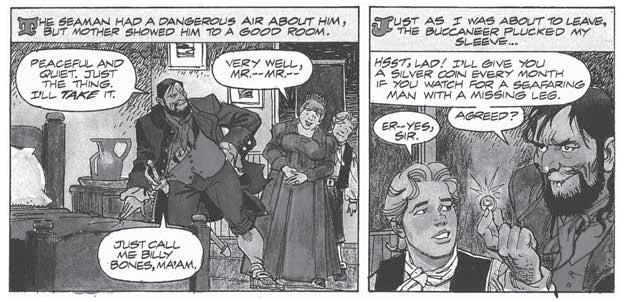
The graphic novel
A graphic novel is a novel in a comic-strip format. It is a long story told in pictures and words. It features:
• panels comprising words and pictures that show action and movement to develop the story
• gutters, which are the spaces between the panels
• speech balloons that enclose the dialogue
• caption boxes containing information about a scene or character
• visual sound effects using special lettering and onomatopoeia (e.g. ‘kapow!’).
Creating graphic novel panels
Many famous novels have been changed into graphic novels. Here are two panels from a graphic novel derived from Treasure Island by Robert Louis Stevenson. Notice how the combination of words and images brings the story to life. Now try your hand at converting an incident or scene from a novel, poem or story you have been reading. Four panels are provided for you to use.
2
Factual texts
Comprehension
Read the following two texts and answer the questions.
Information report
Polar bears
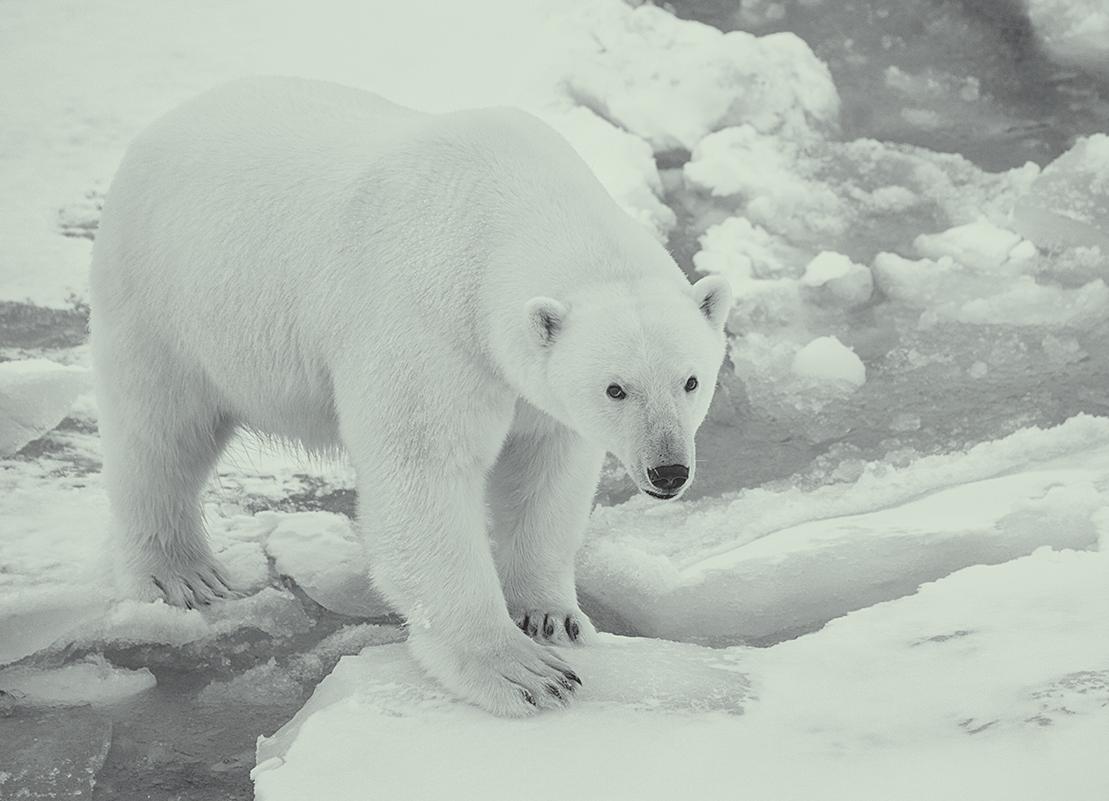
POLAR bears live in five countries— United States (Alaska), Canada, Russia, Greenland and Norway. Some have been seen near the North Pole but this is unusual as there is not much food there for them.
They are the largest land carnivore. The males grow two to three times larger than the females. Their skin is black and their fur completely covers their body except for their nose and the soles of their feet. They shed their fur completely once a year and then re-grow their coat. Although the fur looks white or creamy yellow, each hair is transparent and hollow. This special type of hair transmits the sun’s heat directly to the base of the hair where it is absorbed by the black skin. Amazingly, polar bears are so well insulated they tend to overheat, so they move slowly and take regular rests. The excess heat is released through blood vessels close to the skin.
Polar bears are strong swimmers and can swim up to 95 kilometres without resting. They can also swim underwater for up to two minutes by flattening their ears against their head and closing their nostrils.
They mainly eat seals but will also eat carcasses of beluga whales, walruses, etc. Occasionally they themselves will kill young walruses and beluga whales. When food is scarce they will eat small rodents, seabirds, eggs, berries, kelp and even human garbage. They do not drink water because they get all the fluid they need from their food. Hungry polar bears that come into towns and camping sites looking for food are very dangerous and, if they attack, a human has little chance of surviving. Bears that attack humans are
most often young adults and mothers with cubs. Most females give birth to two cubs once every three years. They enter a den where they sleep deeply. Their heart rate slows and their temperature drops slightly. This sleep is different to hibernation and the bears can be roused quickly if necessary. They give birth while in this deep sleep and remain in the den with the cubs until the outside temperature rises and the young cubs are able to travel.
In 1968 the polar bear population was reported to be 10 000 but because government regulations now limit hunting, the population is now estimated to be between 21 000 and 28 000. Even so, polar bears are classified as ‘threatened’. Polar bears hunt from large platforms of ice called pack ice. Global warming is causing the ice to melt and the bears are forced to hunt from these platforms for shorter periods of time. This means that many are starving or are undernourished. Older, weaker bears in particular are prone to starvation.
Reading for understanding
Choose the correct answer for each of the following.
1 Polar bears live mainly
a at the North Pole.
b in five different countries.
c in dens
2 The bears’ diet
a can be quite varied.
b never includes plant matter.
c would never include human’s food.
3 The male bears
a are a similar size to the females.
b are the largest land carnivores.
c cannot swim under water.
4 Polar bears
a have pure white fur.
b are poorly insulated.
c have black skin.
5 Female bears usually
a give birth to a single cub.
b take the cubs out of the den soon after their bir th.
c give birth to cubs once every three years.
6 Since 1968 the polar bear population
a has increased.
b has decreased.
c has remained stable.
7 Polar bears
a are likely to increase in numbers.
b are completely protected from hunters.
c are a threatened species.
8 Global warming
a has had little effect on polar bears.
b shor tens the length of time bears can hunt.
c has meant that fewer cubs survive.
9 A female polar bear
a gives birth to cubs while in a deep sleep.
b hunts for food dur ing the winter months.
c hiber nates during the coldest months.
10 Polar bears
a react well to humans.
b prefer human’s food to seals.
c are willing to kill humans if disturbed.
Autobiography
A young teacher asked me, as I stood uncertainly in the hall, what courses I wanted to take.
I was aghast. I had no idea what courses to take. All I wanted was to continue my education from where I had left off nearly three years earlier.
‘I’m not sure,’ I managed to mutter. ‘I know I need to learn arithmetic.’
She pointed to an open doorway farther down the hall.
‘Try bookkeeping,’ she said kindly, as she turned to attend to another lost youngster.
I did not know what bookkeeping was, but I was so scared of the shifting, staring young people crowding round me, some of whom sniggered when they looked at me, that I bolted down the corridor and turned thankfully into a classroom holding about a dozen boys and girls and a young lady teacher.
The classroom, with its walls of frosted glass and varnished wood, had enough desks, made to accommodate two pupils each, to swallow about fifty children; four electric lights hanging from the ceiling failed to illuminate it adequately; the bare wooden floor was grey from years of tramping boots. Facing the pupils’ desks was a high, single desk for the teacher and near it
stood a blackboard on an easel. The air smelled of chalk dust and damp woollens. A dingy, uninspiring room it was, but it was made more lively by the buzz of conversation among the pupils.
10 marks
As I came through the door, the teacher looked up, and a pall of silence fell upon the gathering. The mouths of the neatly clad, well-scrubbed young people fell open. Then a well-curled blonde began to giggle. She hastily stuffed her handkerchief into her mouth, while a derisive grin spread through the class.
The dim electric lights became blurred, as tears of realization welled up. I must have been a horrible sight, with hair draggling round my shoulders, its greasiness combed through with my fingers; septic acne sores all over my face;
hands with dirty, broken nails, sticking out from an ancient cardigan with huge holes in its elbows, no blouse, and a gym slip shiny with accumulated grime. Red blotches of bug bites were clearly visible on my naked legs and thighs, our new house being equally as verminous as our
Reading for understanding
old one, and my toes stuck out of the holes in the laceless gym shoes on my feet.
I fought back my tears. I was made of better stuff than the children before me.
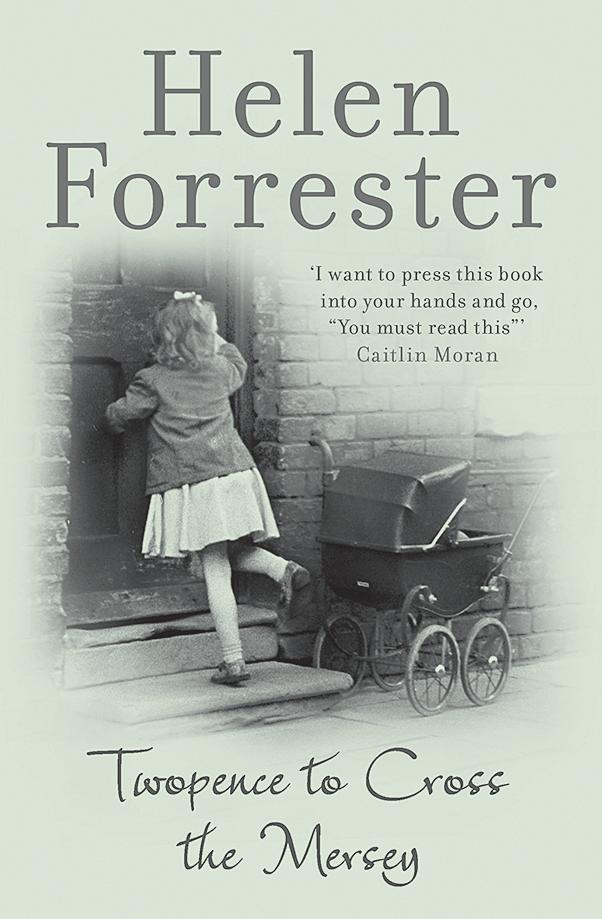
from Twopence to Cross the Mersey by Helen Forrester
1 Why was the narrator attending night school?
2 Why did the young teacher tell the narrator to try bookkeeping?
3 ‘I bolted down the corridor …’ What caused the narrator to do this?
4 What are the smells in the classroom the narrator is conscious of?
5 How did the class initially react as the narrator came through the door?
6 What comments does the narrator make about the appearance of the other young people in the room?
7 ‘I must have been a horrible sight …’ What was ‘horrible’ about her face?
8 What was wrong with the narrator’s gym shoes?
9 What does the final shor t paragraph reveal about the narrator’s character?
10 Using the back-of-the-book dictionary, write the meanings to the following words.
a aghast:
b dingy :
c pall:
d der isive:
13 marks
Spelling and vocabulary
Confusing pairs
faint barren role colonel deceased feint baron roll kernel diseased medal profit loan mail current meddle prophet lone male currant
Who am I?
Write a list word for each of the following clues.
1 I can prophesy the future.
2 I am in charge of a school.
3 I am the opposite to female.
4 I am a senior officer in the ar my.
5 I am a nobleman.
6 I am a member of a council.
7 I am an adviser ; in particular, a psychologist.
What am I?
Write a list word for each of the following clues.
1 I am the feet of an animal with nails or claws.
2 I am given as an award for bravery or as a prize.
3 I am sent by post.
4 I am a small, dr ied, seedless grape.
5 I am the par t or character an actor plays.
6 I am money given, usually to be repaid with interest.
7 I am the edible inner par t of a nut.
8 I am a shor t rest or stop when speaking, etc.
9 I am an injured, inflamed or infected part of the skin.
10 I am the time when students are taught a subject. 10 marks soar counsellor principal pause lessen sore councillor principle paws lesson
7 marks
Back-of-the-book dictionary
The word ‘current’ is a flow of air, water or electricity. It is derived from the Latin word curro, which means ‘I run’. Here are some of the words derived from curro. Use the back-of-the-book dictionary to write their meanings in the spaces below.
recurrent:
concur:
excursion:
incur:
succour:
currency:
incursion:
Language
Dependent (subordinate) clauses
There are three kinds of dependent (subordinate) clauses—adjectival, adverbial and noun. Dependent clauses cannot stand alone. They are used with a main clause.
Adjectival clauses do the work of adjectives. They describe nouns. They begin with the relative pronouns who, whose, whom, which or that
Adjectival clause
Polar bears, which are strong swimmers, can swim 95 kilometres without resting.
Adjectival clause
The students laughed at the newcomer whose clothes were in tatters.
Adverbial clauses tell how, where, when and why. They begin with conjunctions such as when, while, since, after, until, before, although, though, unless, because, then, as, whether, if, than
Adverbial clause giving the reason
Polar bears do not drink water, because they get all the fluid they need from their food
Adverbial clause of time
When the new student came through the door, the teacher looked up. Noun clauses do the work of nouns. They often begin with a word such as that
Noun clause
It is a scientific fact that polar bears are the largest land carnivore
Noun clause
The new student realised that she was a horrible sight.
Identifying clauses
Identify the clauses in each sentence, as indicated.
1 If a hungry polar bear attacks, a human has little chance of surviving.
Adverbial clause:
Main clause:
2 The Ancient Egyptians and Greeks thought that giraffes were a mixture of camel and leopard.
Main clause:
Noun clause:
3 Female polar bears give birth while they are in a deep sleep.
Main clause:
Adverbial clause:
4 There are not many bears that inhabit the North Pole, because food is in short supply there.
Principal clause:
Adjectival clause:
Adverbial clause:
5 When they are kept in captivity, African elephants prefer to eat hay, grain and vegetables.
Adverbial clause:
Main clause:
6 Although seals are mammals that live mostly underwater, they need to come up to the surface to breathe air.
Adverbial clause:
Adjectival clause:
Main clause:
7 It is hard to believe that the first email was sent in 1972.
Main clause:
Noun clause:
8 The Sumerians were the people who invented the wheel in about 3500 BC.
Main clause:
Adjectival clause:
9 Although jaguars spend most of their time on the ground, they are able to climb trees because their sharp claws allow them to grab hold of trunks.
Adverbial clause:
Main clause:
Adverbial clause:
10 Research has shown that the Earth is 4.5 billion years old.
Main clause:
Noun clause:
Punctuation
Reviewing punctuation
Punctuation marks work together to make the meaning of a sentence clearer for the reader. In its simplest form, a sentence begins with a capital letter and ends with a full stop, question mark or exclamation mark. After you have read through the review of the major punctuation marks, complete the exercise that follows.
• A capital letter begins sentences and names.
Albert Einstein was a famous mathematician.
• A full stop (.) is used at the end of a sentence or abbreviation.
School will finish at 2 p.m. today.
• A comma (,) is used to indicate a pause or to separate items in a list.
When the bell rang, the students put their books away.
Emus, kookaburras, platypuses and kangaroos are Australian native animals.
• A question mark (?) is used after a direct question has been asked. Are you going to the movies on Saturday? When is she leaving?
• An exclamation mark (!) is used to end a sentence that expresses a strong feeling. Oh! What a beautiful morning! Fire! Look out!
• An apostrophe (’) shows ownership or indicates the omission of a letter or letters from a word.
The emperor’s palace was destroyed by the barbarians’ battering ram. He can’t pay his fine. She isn’t at school today.
Punctuating sentences
Rewrite each of the following sentences, inserting all the necessary punctuation.
1 the polar bear is the biggest land hunter in the arctic
3 the fire in the department store destroyed childrens toys mens shirts and womens fashion
4 pres obama was the first african american to lead the united states.
5 its important to know whos coming to the party and when theyre arriving
6 leonardo da vincis famous painting of mona lisa hangs in the louvre in paris
The craft of writing
Point of view is the perspective from which a writer tells a story. A writer can choose to use either first, second or third person. Different points of view are as follows:
First person – I, me, my, we, our Second person – you, your Third person – he, his, him, she, her, it, its, they, them, their
Autobiography
In an autobiography, the writer tells the story from a personal point of view and uses the pronouns I, me, my, we, our. Look closely at the use of first person in the introduction to this famous autobiography.
At the hospital
THE hospital again, and the echo of my reluctant feet through the long empty corridors. I hated hospitals and hospital smells. I hated the bare boards that gleamed with newly applied polish, the dust-free window-sills, and the flashes of shiny chrome that snatched my distorted shape as we hurried past. I was the grubby five-year-old in an alien environment.
Using the first person point of view, write about one of the following.
• My biggest achievement
• There are some things I can’t stand
• The worst day of the week
• A very enjoyable party
from My Place by Sally Morgan
3 Planet Earth
Comprehension
Read the following passage and answer the questions that follow.
Global warming
The atmosphere that surrounds the Earth is a thin layer of gases, which protects us by blocking out much of the sun’s harmful rays but allowing enough warmth to be trapped so that we do not freeze to death. This is called the greenhouse effect. Without it, the Earth would be too cold to sustain life. When this delicate layer is upset or destroyed, we are bombarded with too many rays and the Earth’s temperature rises. This is known as global warming.
The world’s ecosystems are finely balanced, and even a small change in temperature can cause the extinction of a species. Baby birds often rely on one type of caterpillar for food. If the caterpillars are abundant when the chicks hatch, there will be sufficient food; if the caterpillars’ life cycle has changed because of a variation in temperature, the chicks will die and the species could face extinction. Natural climate changes have occurred over many hundreds of years and most animals and plants have been able to adapt slowly.
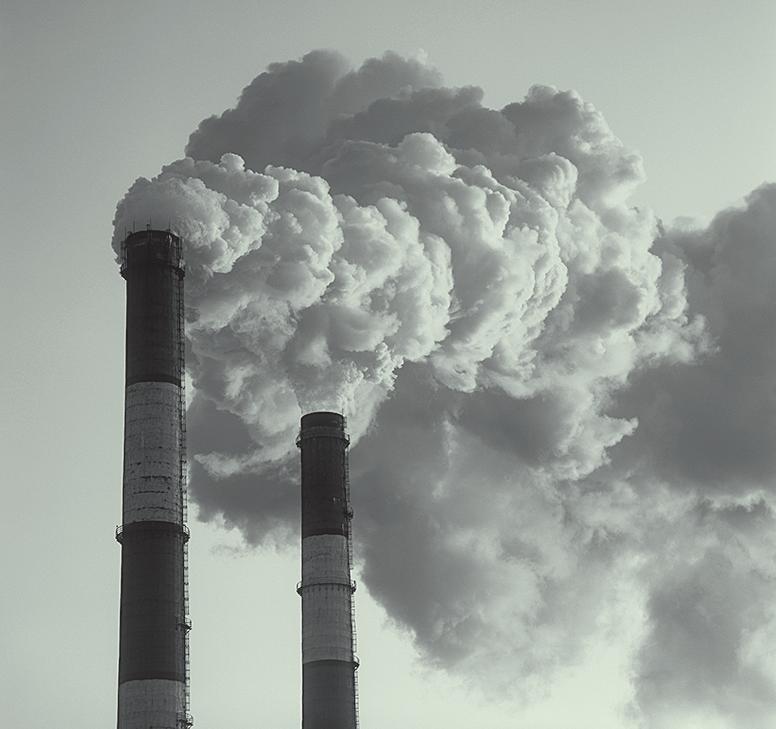
Humans began altering the environment and climate after the invention of machinery to make their lives easier. Machines need fossil fuels and the gases emitted from burning these fuels affect the Earth’s atmosphere. Industrialisation also meant the removal of millions of trees when land was cleared for farming or mining. Trees and other plants absorb carbon dioxide, one of the natural gases that trap the sun’s heat and prevent it from escaping into space. Fewer trees means that more carbon dioxide builds up and causes greater heating of the Earth. Deforestation is still occurring at frightening rates.
As the temperature rises, ice caps and glaciers begin to melt and the sea level rises. This will mean that many animal and plant habitats will
be affected, coastlines will be altered and rainfall patterns will change. The natural habitat of many creatures, among them the polar bear, will no longer exist.
Some of the ways we can improve the health of our planet are:
• developing and using energy-efficient means of transport to reduce the amount of oil we use
• saving electr icity and using energy-efficient appliances so that less fossil fuel is needed
• planting trees so that they absorb carbon dioxide
• recycling so that less rubbish is sent to landfill. Decomposing rubbish produces methane, another greenhouse gas.
1 What is the atmosphere surrounding the Earth made of?
How are we protected from the sun’s harmful rays?
How does the atmosphere prevent us from being frozen to death?
What would happen if there was no greenhouse effect?
What can be the result of a small change in temperature?
Spelling and vocabulary
The Earth
regions climate prairie equator plateau glacier valley vegetation desert endangered forest moisture continent world survival terrain recycled pollution forecast oasis
weather environment global creatures species
geography resources responsible extinct horizon
Missing words
Insert words from the spelling list to complete the sentences below. The first letters are given to help you. Each word should be used once only.
1 Hundreds of endangered animal s could become e
2 G warming will threaten the survival of many c
3 The v in the f was luxuriant.
4 An o in a d provides water and food for animals.
5 The world’s w f predicts rising temperatures.
6 G is the study of the Earth’s r
7 A p is an ecosystem with a grassy t .
8 The e is an imaginary line through the centre of the w .
9 The c of Australia is rich in natural r .
10 Humans are r for p .
A word for a phrase
20 marks
Find a word in the spelling list that has the same meaning as each of the following phrases.
1 a large, flat stretch of high ground p
2 a large mass of slow-moving ice g
3 the line where the earth appears to meet the sky h
4 placed in danger e
5 dampness or humidity m
6 an area of low land between hills or mountains v
7 the continuation of life s
8 the usual weather of a particular place c
9 converted to be used again r
10 land thickly covered with trees f
Back-of-the-book dictionary
Many words begin with the prefix re-, which means ‘again’ or ‘back’. To recycle means to ‘use again’. Use the back-of-the-book dictionary to write down the meanings of these words beginning with re-. recede: reimburse: rejuvenate: renovate:
Language
Nouns
Nouns are naming words. They are used to name people, places, things and qualities. Here are some examples:
Sort the nouns from the list into the categories ‘People’, ‘Places’, ‘Things’ and ‘Qualities’.
pencil journalist supermarket Germany bravery book Cinderella curiosity
sailor school London yacht
microscope Rebecca sorrow happiness
People: Places: Things: Qualities:
Grouping nouns
Choose pairs of nouns from the box to complete the groups below. The first one has been done for you.
cricket
Uranus
terrier
Punctuation
Starting and finishing sentences
Can you imagine how confusing it would be to read and write without punctuation? Punctuation marks were invented to clarify written language. We need to have capital letters and full stops so we know where a sentence begins or ends.
Punctuating pairs of sentences
The capital letters and full stops have been left out of the following pairs of sentences. Rewrite each pair of sentences by inserting the missing punctuation.
1 melting glaciers are an important water source in many dry countries if glaciers disappear, this water will no longer be available
2 world fisher ies have declined drastically as a result of over-fishing there has been no real attempt to conserve stocks and species
3 wildlife conser vation can help prevent extinction of animals and plants hunting needs to be limited and endangered species need to be studied and bred
4 many animals migrate to Antarctica for the summer the Arctic tern flies 9000 kilometres from the Arctic every year
5 few animals can sur vive in a very cold climate ways of coping can be by hibernating, migrating or insulating their bodies with fur, feathers or fat
6 many species of frogs could face extinction this is due to climate change, pollution, pesticides and loss of habitat
7 human activity can cause extinction of animal species altered or destroyed habitats, pollution or the introduction of new species are examples
8 a household contr ibutes an annual average of 8 tonnes of carbon dioxide this is increasing because of the many electrical appliances we have in our homes
The craft of writing
Problems of planet Earth
Planet Earth has many serious environmental problems. Chief Dan George (1899–1981), a famous member of the Canadian Tsleil-Waututh Nation, was appalled by the way white people abused the land. In the following passage, he describes some of their destructive practices and the consequences for the natural world.
My heart soars
I see my white brothers going about blotting out nature from his cities. I see him strip the hills bare, leaving ugly wounds on the face of mountains. I see him tearing things from the bosom of mother earth as though she were a monster, who refused to share her treasures with him. I see him throw poison in the waters, indifferent to the life he kills there; and he chokes the air with deadly fumes.
from My Heart Soars by Chief Dan George
Select one or two of the environmental topics listed below and write down your feelings, ideas and concerns.