The moral rights of the author have been asserted.
All rights reserved.
Except under the conditions described in the Copyright Act 1968 of Australia (the Act) and subsequent amendments, no part of this publication may be reproduced, stored in a retrieval system, or transmitted in any form or by any means, electronic, mechanical, photocopying, recording or otherwise, without the prior written permission of the copyright owner.
Educational institutions copying any part of this book for educational purposes under the Act must be covered by a Copyright Agency Limited (CAL) licence for educational institutions and must have given a remuneration notice to CAL.
Licence restrictions must be adhered to. For details of the CAL licence, contact: Copyright Agency Limited, Level 11, 66 Goulburn Street, Sydney, NSW 2000. Telephone: (02) 9394 7600. Facsimile: (02) 9394 7601. Email: memberservices@copyright.com.au
Publication data
Authors: Rex Sadler and Sandra Sadler
Title: Complete English Basics 1: A Class and Homework Course
ISBN: 978 1 4202 3709 2
Publisher: Emma Cooper
Project editor: Barbara Delissen
Cover and text designer: Dimitrios Frangoulis
Production control: Janine Biderman
Photo research and permissions clearance: Vanessa Roberts
Typeset in Heuristica Regular 10.5/12pt by Dim Frangoulis
Cover image: Shutterstock/Ipatov
Printed in Malaysia by Vivar Printing Pdt Ltd
1 2 3 4 5 6 7 25 24 23 22 21 20
Warning: It is recommended that Aboriginal and Torres Strait Islander peoples exercise caution when viewing this publication as it may contain images of deceased persons.
Preface
Complete English Basics 1 sets out to present essential English skills in an interesting and meaningful way for junior secondary students.
This third edition covers essential language and literacy skills underpinning the Australian Curriculum. It incorporates a wide range of comprehension texts, spelling and vocabulary development, as well as language work on sentences, phrases, parts of speech, word families and paragraphing. It is important to note that 22 creative writing tasks—linked to the ideas and techniques contained in the Literature section—have now been added.
The workbook can be used as a class or homework text. One approach would be to have students complete each unit over a two-week period.
The stimulus materials and exercises are designed to improve comprehension and vocabulary skills as well as language usage and spelling. A special feature is the back-of-the-book dictionary, which encourages students to expand their vocabulary by looking up the meanings of unfamiliar words.
Correct spelling is essential for good communication. Research has shown that in those classrooms where teachers are concerned about correct spelling and vocabulary enrichment, the students’ spelling level improves significantly. It is a good idea, if time allows, to have a brief spelling test at the end of each unit using the words from the spelling and vocabulary list.
The extracts are engaging and cover a diverse range of topics—from shark attacks to gladiators. A range of genres is represented, including biography, crime, fiction and adventure.
Above all, we hope that students will enjoy their English studies as they gain basic English skills.
Rex and Sandra Sadler
Acknowledgements
The author and publisher are grateful to the following for permission to reproduce copyright material:
While every care has been taken to trace and acknowledge copyright, the publisher tenders their apologies for any accidental infringement where copyright has proved untraceable. They would be pleased to come to a suitable arrangement with the rightful owner in each case.
1 Enjoying texts
Comprehension
Read the following texts and answer the questions for each one.
Film review
How to Train Your Dragon 3D
CRITICS RATING 8/10
Rated PG
WHAT if your dad was the strong, not-so-silent type, the leader of the Viking tribe, going about his daily business of slaying dragons ... and you were a spindly-legged weakling teenager?
You’d probably feel like Hiccup (voiced by Jay Baruchel), a spindly-legged weakling teenager who doesn’t fit his family’s long line of dragon slayers in the land of Berk. It’s a constant source of shame for his father, Stoick (voiced by Gerard Butler), a big, burly Viking (with a big Scottish burr).
But when Hiccup comes face to snout with one of the most feared of the dragons, he inadvertently discovers a more positive and powerful way of dealing with the Viking’s ‘dragon problem’ than using a sword or a sledgehammer and goes on to change the lives of his entire tribe—and that of the dragons. That’s the essential moral of the story, that problems can be solved without violence. Not a bad message. The film also covers the father–son relationship with an equally positive message.
Magnificent 3D animation brings this family movie to life. The screenplay is smart, funny and has something to say. But perhaps the target audience of 10- to 14-year-olds will be even more impressed with the spectacular flying sequences, with Hiccup riding bareback through the air—or the mass fly-past by a dozen different types of dragons.
The production elements all contribute to the immersive experience of an adventure in which humour plays a key role and the main characters quickly become familiar and real.
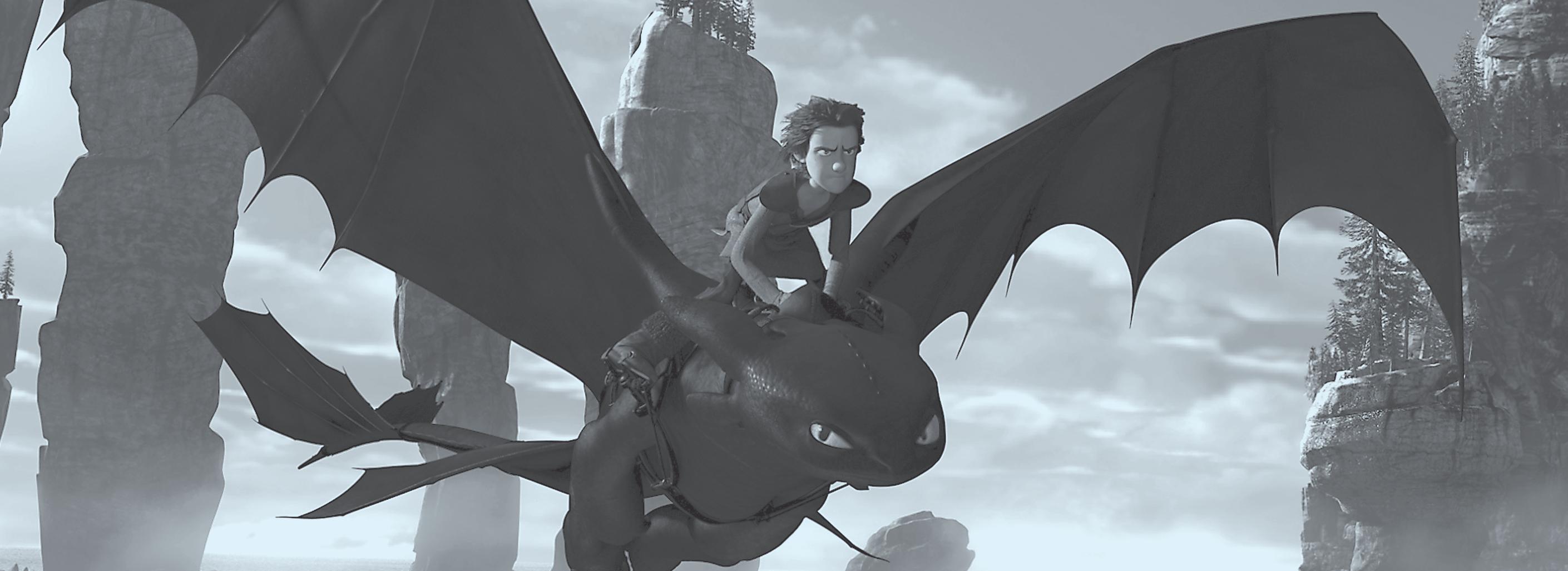
There is a hint of romance as Hiccup and the feisty Astrid (voiced by Ferrera) find common ground and the charmingly fearsome, felineinspired dragon, Toothless, makes an indelible impression.
The screenplay is based on Cressida Cowell’s popular book, which could become as hot as a dragon’s breath.
Andrew L Urban
Talk to the animals … Viking teenager Hiccup befriends Toothless the dragon
Reading for understanding
1 How do you know from the first paragraph that the movie is a fantasy?
2 What evidence can you find in the first paragraph to show that Hiccup is not a character you would expect to be the hero?
3 In what ways is Hiccup’s father different to him?
4 Where do Hiccup and his father live?
5 What is the essential moral of the story?
6 Give an example of an equally positive message in the film.
7 Who, according to the reviewer, is the target audience of the film?
8 What flying sequences did the reviewer feel would be likely to impress younger viewers?
9 Identify the reviewer’s simile that predicts an increase in popularity of the book on which the film is based.
10 Using the back-of-the-book dictionary, give the meaning of:
a burr:
b inadvertently:
c fearsome:
d feline:
e indelible:
10 marks
Poem
Our new teacher
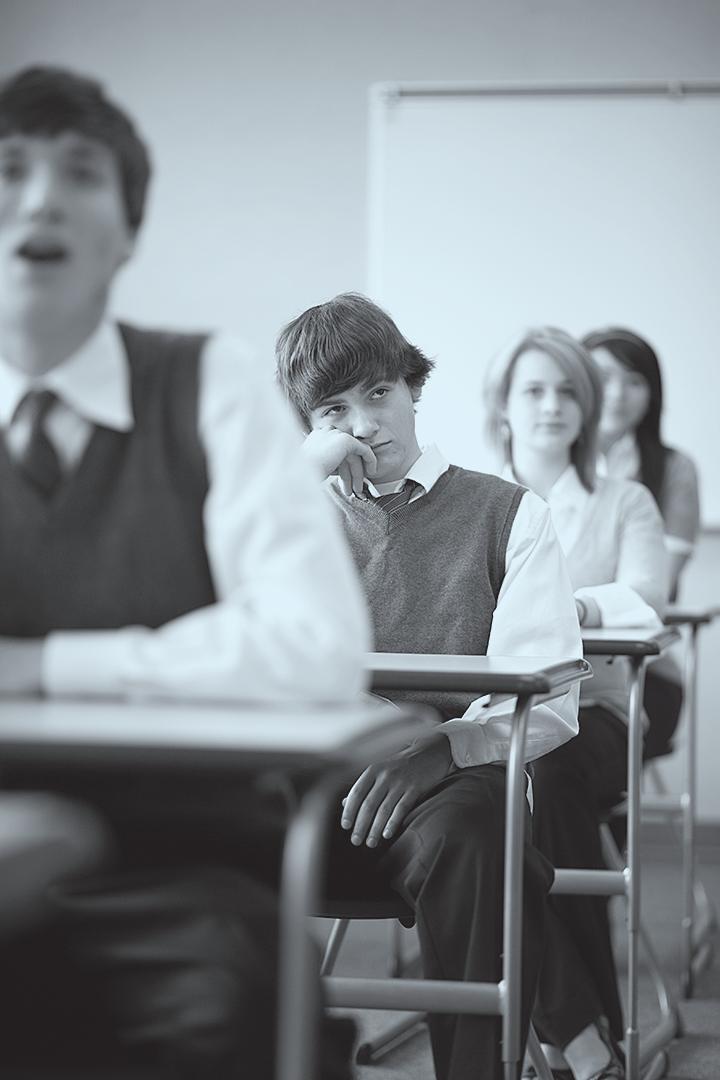
This teacher has such scary teeth, they look just like a shark’s; His eyes gleam in the sunlight like a pair of purple sparks. His voice is just as booming as the roar from some big gun; He can imitate a thunderstorm for a gruesome bit of fun. And now Billy who was silly almost every other day Does his tables, writes his spellings, hides his comic book away. Every lesson lasts a lifetime ... with our noses to each page, We imagine bars on windows and the classroom seems a cage.
So, please come back, Miss Fothergill: though you won’t believe it’s true, We all loved you as our teacher; we were oh, so fond of you!
David Bateson
Reading for understanding
1 Who seems to be the narrator of this poem?
2 What does the simile ‘like a shark’s’ suggest about the new teacher’s teeth?
3 Identify the simile that describes the gleaming of the new teacher’s eyes.
4 What is the sound of the new teacher’s voice similar to?
5 How has Billy’s behaviour changed?
6 Explain the meaning of ‘with our noses to each page’.
7 Why do you think the narrator says, ‘We imagine bars on windows’?
8 What is the narrator’s plea in the final stanza?
9 What contrast do you think there would be between Miss Fothergill and the new teacher?
10 Write down words that rhyme with each of the following:
a shark’s
b page
c true
Information
report
The taipan—the world’s deadliest snake AUSTRALIA is home to two different types of taipan—the inland taipan and the coastal taipan. The inland taipan (Oxyuranus microlepidotus), which grows up to 2.5 m, produces the deadliest venom of any snake in the world, but luckily it only lives in the deserts of central eastern Australia, where few humans visit. No human deaths caused by the inland taipan have been recorded, because an effective antivenom has been produced.
Inland taipans live in deep cracks in the soil to escape the extreme heat of summer. During summer their scales are a light straw colour to reflect the heat, whereas in winter their scales change to a dark brown in order to absorb the sun’s rays.
The inland taipan’s favourite food is native rats. When the rats are plentiful, the population of the snakes rises dramatically—female taipans lay between 12 and 20 eggs in the soil or in abandoned animal burrows. In extremely dry years, however, the rat population decreases through starvation, so there is little food for the snakes and their death rate rises.
The longest recorded coastal taipan was 3.35 m. Coastal taipans (Oxyuranus scutellatus) live in northern Queensland and in the Northern Territory. They are often seen in sugar-growing areas and on grassy sand dunes. Their favourite foods are small, warm-blooded mammals such as rats, lizards, quolls and bandicoots.
Coastal taipans are very aggressive and
10 marks
have large fangs through which they inject a very potent venom. The venom is capable of paralysing small marsupials in a very short time. One strike could potentially deliver enough toxin to kill several humans. Coastal taipans have been responsible for many human deaths. The toxins in the venom cause communication between the body’s muscles and the brain to shut down. Once bitten, the taipan’s prey convulses and suffers from internal bleeding and the taipan waits for its prey to die before devouring it.
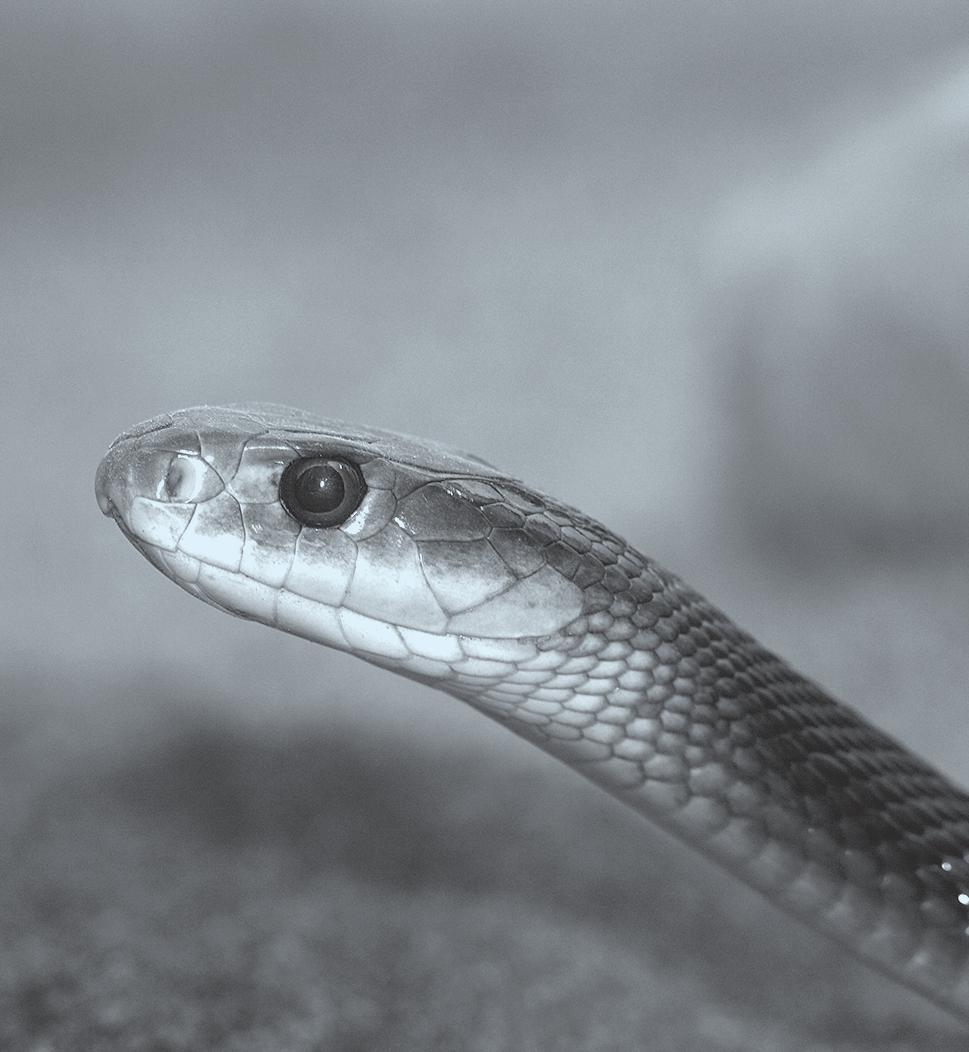
Coastal taipan
Reading for understanding
1 ‘No human deaths caused by the inland taipan have been recorded.’ Why?
2 Which type of taipan is the longer?
3 How does the inland taipan escape from the extreme heat of summer?
4 What is the reason for the difference in the colour of the inland taipan’s scales between summer and winter?
5 What causes the death rate of the inland taipan to rise?
6 Why is the coastal taipan more likely to kill a human than the inland taipan?
7 What are the coastal taipan’s favourite foods?
8 Why is the taipan’s bite extremely dangerous for humans?
9 What effect does the toxin in the taipan’s venom have on an animal’s nervous system?
10 Using the back-of-the-book dictionary, write down the meaning of these words:
a dunes:
b potent:
c toxin:
10 marks
Spelling and vocabulary
Texts
Spelling tests can be created from the word list in each unit.
myth documentary advertisement poem magazine
legend autobiography interview ballad newspaper
recipe cartoon fantasy novel epitaph
drama narrative fiction symbol menu
comedy tragedy letter haiku atlas
diary speech dictionary elegy biography
What text am I?
Use the following clues to identify the texts from the list.
1 I enable people to read the news each day
2 I give people the meanings and spellings of words
3 I am a book of maps
4 I am a list of dishes ser ved in a restaurant
5 I am a funny drawing or animated film
6 I am a three-line poem of 17 syllables
7 I am a stor y of a person’s life written by somebody else
8 I am a simple poem with shor t verses that tells a story
9 I am the words written on a tombstone
10 I am a list of ingredients in cooking instructions
11 I am a wr itten message often sent by post
12 I am a record of daily happenings
13 I am a notice about something for sale
14 I am a stor y about imaginary worlds and creatures
15 I am a meeting in which someone is asked questions
16 I am a mour nful poem ending in ‘y’
Word skills
1 Write down the following words in alphabetical order. haiku newspaper fantasy fiction documentary letter dictionary
16 marks
2 By adding the suffixes –ist or –er, write down the name of the person derived from each of these words:
a diary c interview b novel d biography
Back-of-the-book dictionary
The word ‘advertisement’ is derived from the Latin words ad and verto Ad means ‘towards’ and verto (versus) means ‘I turn’. The advertiser sets out to sell a particular product by ‘turning’ the desire of the audience ‘towards’ it. Use the back-of-the-book dictionary to write down the meanings of the following words derived from verto.
divert: reverse: vertigo: convert: invert:
5 marks
Language
Sentences
5 marks
A sentence is a group of words that makes complete sense by itself. A sentence is usually made up of two parts. The part that tells us who or what does the action is called the subject. The number of words in the subject varies. The subject can be a noun or pronoun or a group of words. The rest of the sentence is called the predicate. The predicate always includes the verb. The subject in the following sentences is in italics. The remainder in normal type is the predicate.
Gigantic updrafts and downdrafts of air swept through the vortex above them. from Blue Fin by Colin Thiele
The whole crest of the slope above them suddenly boiled over with flame. from February Dragon by Colin Thiele
Identifying the subject and predicate
To find the subject of a sentence, ask ‘Who?’ or ‘What?’ before the verb. Write down the subjects of these well-crafted sentences.
1 A great column of water rose up out of the sea. (from Blue Fin by Colin Thiele)
Subject:
Predicate:
2 Hundreds of tons of water seemed to crash down on the ship. (from Blue Fin by Colin Thiele)
Subject:
Predicate:
3
4
A burst of lightning lit up the sea with super natural brilliance. (from The Boy Who Was Afraid by Armstrong Sperry)
Subject:
Predicate:
An instantaneous crack of thunder shattered the world. (from The Boy Who Was Afraid by Armstrong Sperry)
Subject:
Predicate:
5 The anemones expand like soft and br illiant flowers. (from Cannery Row by John Steinbeck)
Subject:
Predicate:
6 The greenish purple cloud was looming heavily over and along the opposite hills. (from The Rocks of Honey by Patricia Wrightson)
Subject:
Predicate:
Missing subjects
Complete the following sentences by adding a subject from the box.
Tokyo Joan of Arc The Nile Ned Kelly
Michelangelo Harry Potter Shakespeare Greenland
Mt Everest The Pacific Mercedes Alfred Nobel
1 is the least densely populated country in the world.
2 wrote the tragedy Romeo and Juliet.
3 painted the ceiling of the Sistine Chapel.
4 is a famous character in a series of novels.
5 is a very high mountain.
6 was an Australian bushranger.
7 is the world’s largest ocean.
8 is the longest river in the world.
9 invented dynamite in 1866.
10 is a French heroine.
11 is the make of a famous car.
12 is the capital city of Japan.
12 marks
Phrases
A phrase is a group of words that does not make sense on its own. Unlike a sentence, a phrase does not have a finite (or complete) verb. at the zoo an elephant in the shower flying dragons
Identifying sentences and phrases
Write the word ‘phrase’ or ‘sentence’ next to each of the following examples.
1 At midday
2 By the river
3 He watched the movie
4 They went home
5 I love cooking
6 Inside the cave
Completing phrases
7 She visited the zoo
8 Going away
9 I‘ve been to school
10 A few days ago
11 Over the rainbow
12 The computer crashed
12 marks
Complete each of the following phrases by inserting the name of the missing object. e.g. the pendulum of a the pendulum of a clock
1 the radius of a
2 the spokes of a
3 the fuselage of an
4 the r ungs of a
5 the hilt of a
Missing phrases
6 the yolk of an
7 the lens of a
8 the ker nel of a
9 the summit of a
10 the chapter of a
10 marks
Phrases often give sentences greater vitality. In the following passage, Obie has fallen head over heels in love with Laurie. The writer uses both phrases and sentences to communicate Obie’s feelings. Correctly insert the phrases from the box that are missing from the passage. in a rosy haze in love in the movies at the sight of her into the earth on his face
Obie in love
Obie was . Wildly, improbably and wonderfully in love. The kind of thing he thought happened only . Her name was Laurie Gundarson and she was beautiful. Obie’s legs dissolved , and he felt as though he would sink and disappear. He had never known such happiness or such sweet torture. He lived his days and nights and went around with a stunned and radiant expression .
from Beyond the Chocolate War by Robert Cormier
6 marks
Punctuation
Why do we use punctuation marks?
When we are speaking, we naturally stop at the end of a sentence. We also use pauses to help our listeners follow our meaning. We can even indicate a question or exclamation by changing the pitch of our voice.
In our writing, we use punctuation marks to indicate these pauses and changes of expression. Can you imagine how confusing it would be to read and write without punctuation? The purpose of punctuation marks is to clarify written language. It is possible for one punctuation mark to alter the whole meaning of a sentence. Look at the difference a mere comma makes in these two sentences:
Let’s eat Grandma!
Let’s eat, Grandma!
Using punctuation to change the meaning
Rewrite the following sentences, changing the punctuation in each sentence to produce a more accurate meaning. Hints are given in brackets.
1 Has the doctor rung Elizabeth? (Add a comma.)
2 Have you eaten Father? (Add a comma.)
3 The visitors ate ice-cream cheese chocolate pizza and meat pies. (Insert three commas.)
4 The huskies, having eaten the explorers, moved on. (Remove the two existing commas and add a new comma.)
5 Caesar entered on his head
A helmet on each foot
A sandal in his hand he had His trusty sword to boot. (Add full stops and capital letters.)
6 Emily gets enjoyment from cooking her family and her dog. (Add a comma.)
7 The amazing giant panda eats, shoots and leaves. (Remove comma.)
7 marks
The craft of writing
Becoming a better writer
From time to time, successful writers give practical advice on what techniques have helped them in their writing careers. Here is a very important hint from author Christobel Mattingley:
When you write about something you know, the words come more easily. It may be real—a place, a person or a happening. Or it may be something in your own mind, that you’ve made up. It has to be so real to you that your words make it live for other people. Then it is true to itself. And you are true to yourself.
Here is an opportunity to write about something you know. Write 200 words on one of the following:
• Recount some of your earliest childhood memories. Begin ‘I remember when …’
• Describe your first days at high school.
• Write a description titled ‘My bedroom’.
2 Ancient times
Comprehension
Read the following passage and answer the questions that follow.
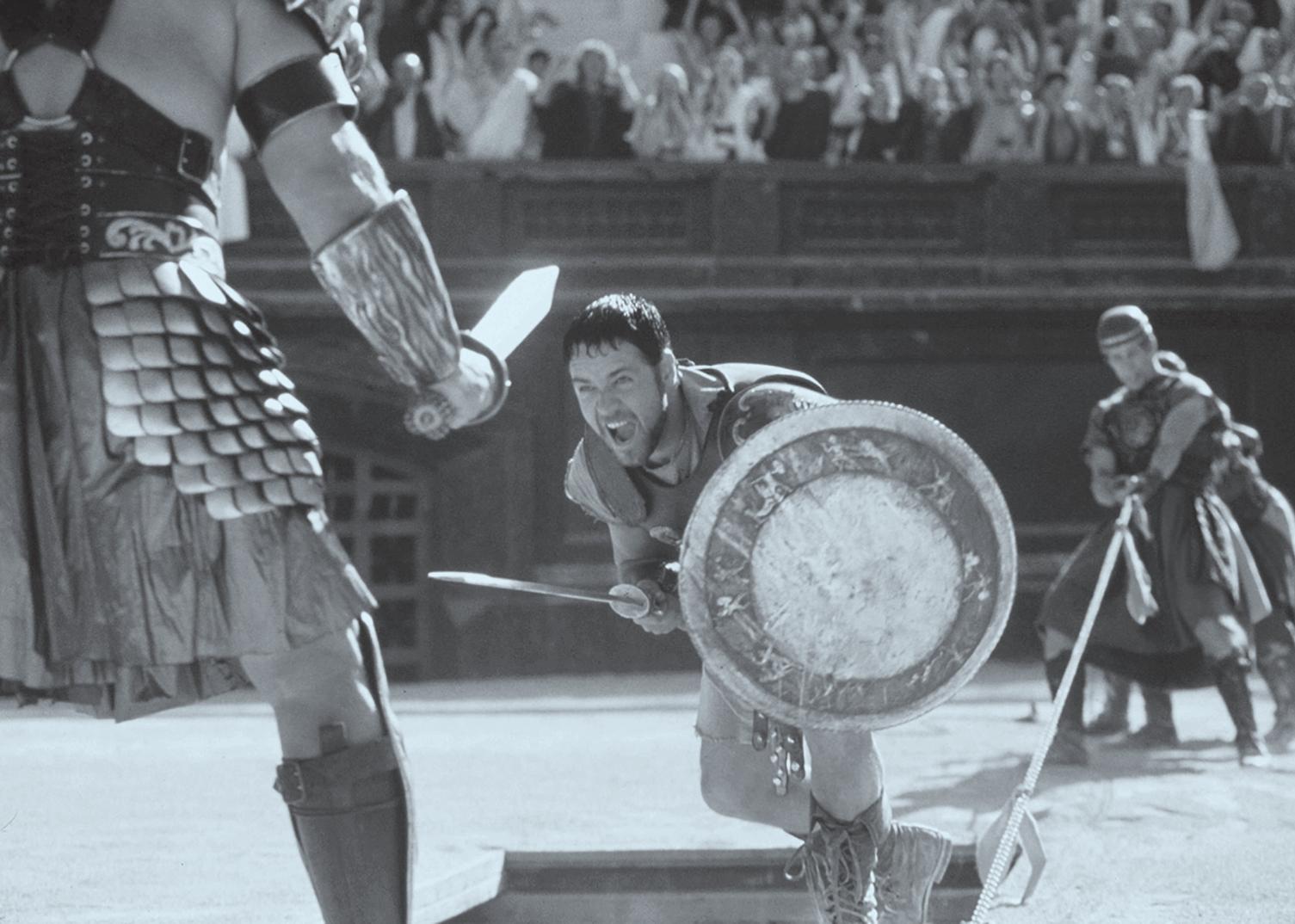
Gladiators
ROMAN gladiators were typically slaves, prisoners of war or convicted criminals. There were different types of gladiators. As the Roman Empire expanded, many of the prisoners of war who became gladiators wore the clothes and weapons associated with their conquered country. For example, Samnites carried oblong shields and short swords and wore plumed helmets with visors. Thracians used small, round shields and fought with curved daggers. The ‘net men’ carried large nets to entwine their opponent and then killed them with a trident, a threepronged weapon.
Some gladiators, called bestiarii, were trained to fight wild animals. The number of animals killed in any one day was astonishing. During the special games, which Trajan held when he became Emperor, 9000 animals were slaughtered.
Strangely enough, a number of free citizens chose to become gladiators and to renounce their rights as citizens. These were mainly poorer people who chose this life because gladiators, on the whole, were well fed and were given proper medical care. Even members of higher social status sometimes chose to enter a gladiator school if their family had financial problems. Most owners and trainers regarded their gladiators as an investment and ensured they were well looked after.
If a gladiator was wounded and unable to fight on, he gave the sign for mercy. It was up to the crowd to either give the thumbs-up sign to say they wanted him to be spared or the thumbsdown sign to say they wished to see him die.
Usually gladiators fought four or five matches a year and could win their freedom by showing bravery or becoming popular with the crowd. If a gladiator survived, he could be granted his freedom and may even be given a monetary reward. Gladiators could never become Roman citizens, but they could marry citizens and their children could become citizens.
Reading for understanding
1 What people were more likely to become gladiators?
2 Explain how gladiators came to dress differently and use different weapons.
3 What weapons did the Samnites carry?
4 What protective equipment for the head did the Samnites wear?
5 What weapons did the Thracian gladiators use?
6 Why were the bestiarii different from other gladiators?
7 What event took place when Trajan was Emperor?
8 Why did some free citizens decide to become gladiators?
9 Why did most owners ensure that their gladiators were well looked after?
10 What did a gladiator do if he was wounded or unable to fight on?
11 How did the crowd indicate that the gladiator should live or die?
12 How could gladiators win their freedom? 12 marks
Spelling and vocabulary
Ancient worlds
pharaoh weapon burial gladiator
pyramid shield conqueror centurion
tomb sword dungeon powerful
papyrus dagger heroes guard
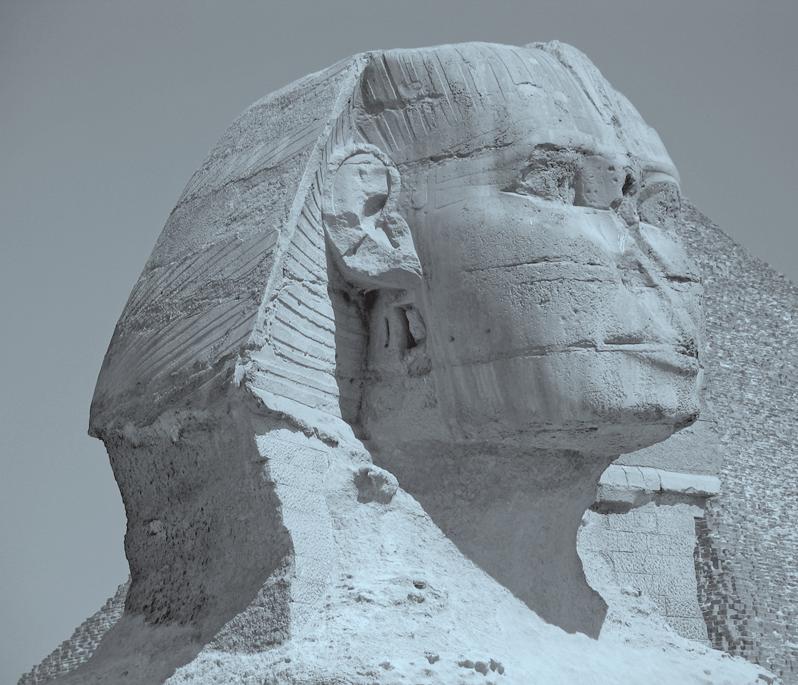
treasure soldier emperor cavalry chariot warriors sphinx military
Words and meanings
Write down a word from the spelling list for each of these meanings.
1 an Egyptian ruler
2 a group of soldiers riding horses
3 paper made from a tall water plant
4 a two-wheeled carr iage
5 a huge Egyptian tomb
6 a dark underground prison
7 men or women admired for brave deeds
8 soldiers or fighting men
9 a person who fought at the Colosseum
10 a person who r ules an empire
Missing words
Insert appropriate words from the spelling list in the spaces below. The first letters are given to help you. Each word should be used once only.
1 Sometimes gladiators were armed with a s and s .
2 A Roman c was a s in charge of a hundred men.
3 A Roman e was so p he could have any of his subjects imprisoned in a d under g .
4 In Egypt, tourists can see a s and a pyramid of a famous p .
5 T raiders broke into the b chamber of a p in search of t
6 Egyptian tombs sometimes contain a c , a w such as a d and remnants of p .
7 In ancient times, stories would be told of h and w .
8 The Egyptians were a m nation and had their own c .
22 marks
Back-of-the-book dictionary
The Latin word centum means ‘one hundred’. A centurion commanded a hundred men. With the help of the back-of-the-book dictionary, write down words beginning with cent- for each of these meanings. a period of one hundred years: one-hundredth part of one dollar: one-hundredth part of one metre: a small invertebrate animal with many (‘a hundred’) legs: a temperature scale in which there are 100 degrees between freezing (0°C) and boiling point (100°C):
Language
Nouns
Nouns are naming words. They are used to name:
people: gladiator mother teacher Roald Dahl Cate Blanchett places: harbour school hospital Egypt Colosseum things: sword apple chair car road qualities: honour sadness love happiness bravery
Missing nouns
An analogy is a form of comparison; for example: Soldier is to army as sailor is to navy Complete the following analogies by supplying the missing nouns.
1 Day is to week as month is to .
2 Wing is to as fin is to fish.
3 is to son as mother is to daughter.
4 Cat is to as dog is to puppy.
5 Aunt is to niece as uncle is to .
6 North is to as east is to west.
7 Car is to as bicycle is to cyclist.
8 Tongue is to taste as is to smell.
9 Hearing is to ear as sight is to
10 Food is to as water is to thirst.
5 marks
10 marks
Nouns in everyday life
Choose nouns from the list and insert them in the spaces below in their correct categories.
eagle Nile yacht mosquito peach Amazon soccer bee Paris cherry anger golf
fear London cicada joy tennis Murray canoe hawk banana Cairo dove catamaran
fruits cities boats birds
rivers sports feelings insects
24 marks
Noun pyramid
Find the words from the box hidden in the word pyramid. They may be horizontal or vertical, or written forwards or backwards.
pyramid soldier burial shield dagger tomb guard military
Punctuation
Starting and finishing sentences
We write in sentences so that our words will be easier to read and understand. A sentence that makes a statement begins with a capital letter and ends with a full stop. For example:
Roman gladiators were typically slaves, prisoners of war or convicted criminals.
Punctuating sentences
Rewrite these statements, using capital letters and full stops.
1 the ancient Egyptian civilisation began more than 5000 years ago
2 tomb robbers broke into the pyramids to steal the treasures inside
3 water was lifted from the Nile using a device called a shaduf
4 the r ulers of ancient Egypt were called pharaohs
5 the ancient Egyptians worshipped more than 1000 different gods and goddesses
6 the three pyramids at the town of Giza are more than 4500 years old
7 as god of the dead, Osiris was in charge of the underworld
8 each block used to build the Great Pyramid weighed as much as two-and-a-half elephants
9 the Egyptians invented a form of picture writing called hieroglyphics
10 without the Nile, Egypt would be all desert
The craft of writing
People from other times
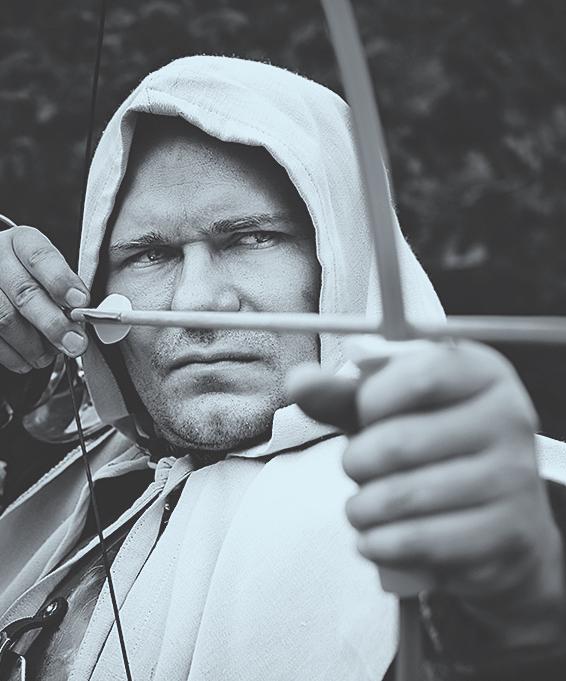
Select one of the following people from a bygone age and write a description of about 200 words. Give details of your character’s physical appearance, clothing, behaviour etc. Arthur Conan Doyle’s description of an archer from the Middle Ages will give you some ideas.
• gladiator • slave • centurion • warrior • explorer
• queen • king • monk • peasant • maid
• pharaoh • artist • pirate • sultan • duchess
The archer
He was a middle-sized man, of massive build. His shaven face was as brown as a hazel-nut, tanned and dried by the weather, with harsh, well-marked features, which were not improved by a long white scar which stretched from the corner of his left nostril to the angle of the jaw. His eyes were bright and searching, with something of menace and of authority in their quick glitter, and his mouth was firm-set and hard. A straight sword by his side and a painted long-bow jutting over his shoulder proclaimed his profession, while his scarred chainmail and his dinted steel cap showed that he was even now fresh from the wars.