
Ready for the world
We work with schools worldwide to build an education that shapes knowledge, understanding and skills. Together, we give learners the confidence they need to thrive and make a positive impact in a changing world.
As part of the University of Cambridge, we offer a globally trusted and flexible framework for education from age 3 to 19, informed by research, experience, and listening to educators like you. With recognised qualifications, high-quality resources, comprehensive support and valuable insights, we help schools prepare every student for the opportunities and challenges ahead. Together, we help Cambridge learners be ready for the world.

Welcome to Cambridge Early Years
Cambridge Early Years has been developed for young learners aged 3 to 6 year olds to give them the best start in life. The programme helps children meet key early milestones and thrive both in and beyond school. It is the first stage in our Cambridge Pathway, which provides a clear path for educational success from age 3 to 19.
Cambridge Early Years gives schools everything they need for high-quality learning: a holistic, balanced curriculum, teaching support and guidance, engaging classroom resources for teachers and learners, professional development and assessment approaches to measure learners’ progress.
We believe that Cambridge Early Years is most effective when schools use all elements of the programme together, but we give them the flexibility to decide what works best for their setting. The five stages lead seamlessly from early years to secondary and pre-university years.
clear path for educational success from age 3 to 19
Why choose Cambridge Early Years?
It gives young learners the best start in life, helping them to meet key early milestones and thrive in and outside of school.
It helps children develop the knowledge, understanding and skills they need for the next stage in their education – whether they move on to Cambridge Primary or another programme.
It offers everything you need for high-quality learning: a holistic, balanced curriculum, engaging classroom resources, professional development and assessment approaches to help you measure your learners’ progress.
It is a child-centred, play-based programme that helps young learners to develop at their own pace. It encourages them to act independently, make their own choices and discover feelings of self-worth.
It supports learners, whatever their level of English when they begin the programme. We provide guidance and support to help you offer a bilingual or multilingual approach if learners have a home language other than English.
Our flexible approach allows you to decide what works best for your setting. You can tailor the programme to each child’s needs, skills and interests.

Our approach
We developed Cambridge Early Years in collaboration with trusted early years experts, so it reflects the very latest educational thinking. Our approach is built around these key principles:
Experience
Learning should complement the social and cultural factors (like experiences of home and community) that shape a child’s learning and development.
Active
Children should be actively involved in their own learning, and helped to develop competence, responsibility, confidence and self-worth.
Balance
Learning should balance physical, cognitive, language and communication, and social and emotional development.
Play
Learning should be age appropriate, play based and child centred. It should include both child- and adult-led activities.
Transition
Early years education should help children transition successfully to primary school, moving from informal, playbased learning to teaching that is more formal.
You can find out more about how we developed our approach, and the research behind it, on our website: www.cambridgeinternational. org/earlyyears
The Cambridge Early Years curriculum
Our Cambridge Early Years curriculum:
follows a holistic approach that focuses on the whole child and connects their development with the world and people around them
develops knowledge, understanding and skills through a spiral approach, by revisiting and engaging with topics and skills in more depth at each stage
helps learners to meet internationally established milestones for early development. Although children develop at different rates, the curriculum provides a structure for teaching and learning that will help you to monitor and support each child’s progress
supports a bilingual or multilingual approach for learners with a home language other than English, as well as those with different experiences of English prepares learners to easily transition into Cambridge Primary, or the next stage in their education is built around four key areas of early development:
Curriculum areas
Our six curriculum areas help you to guide and support progress across all areas of development.
Each area is important, and they are all connected so teaching and learning should take place in a holistic way.
Creative expression
Creative expression allows children to communicate their ideas and develop their imagination through art and design, music, dance and drama. This important curriculum area brings together skills and cognitive processes from across the whole curriculum.
Communication, language & literacy
Speaking, listening, reading and writing are crucial to children’s early development. Showing children the importance of language through fun activities and encouraging them to engage with a wide range of texts helps to ignite a lifelong curiosity for learning.
Discover how our new Cambridge Phonics and Handwriting support this area of Cambridge Early Years. See page 16.

Mathematics
At an early age, it is important to help children recognise how mathematics impacts everyday life. Through games and activities, we can introduce children to mathematical language, thinking and concepts that they will need when they start their primary education.
Personal, social & emotional development
This area is central to children’s lives. It underpins their wellbeing and attainment in all other areas of their learning. This area helps them to develop social learning and friendships, regulate their emotional responses and respond to the needs of others, and develop self-esteem and confidence.
Physical development
Our curriculum encourages children to develop movement skills through play, helping them to develop positive attitudes towards exercise and laying the foundations for healthy, active lives.
Understanding the world
Children’s natural curiosity must be encouraged, so that they are equipped to reflect, question, explore and interact, and be guided in their understanding of the world. This area of the curriculum lays foundations for a range of different subjects in primary education and beyond, including science, digital literacy, computing and humanities.
Teaching support
We give you all the support and guidance you need to implement Cambridge Early Years in your setting.
This includes:
• how to implement the curriculum
• helping your learners transition into early years education and on to primary
• the teaching and learning approaches that are part of Cambridge Early Years, including active learning, a play-based approach to learning and a multilingual approach
• short, medium and long-term planning for Cambridge Early Years, including example templates and planning
• creating a safe and inclusive learning environment
• carrying out evidence-based assessments
• supporting learners with English as an additional language in an early years setting.
Find all your resources in one place with our secure online School Support Hub
Once you become a Cambridge Early Years Centre, you will have access to our password-protected School Support Hub. This is where you will be able to browse and download all the teaching and assessment resources we offer. We will provide more details once you have registered.
Support for parents
We know how important it is for parents to be invested in their child’s education, especially in the early years. Parents often have questions about what their children will be learning, and how they can contribute to their development at home.
We provide you with resources to help you explain the Cambridge Early Years programme to parents, including a factsheet, video and PowerPoint presentation.
Cambridge Early Years
The progression pathway is clear , well organised and meets learners’ needs.
Practitioner

Teaching and learning resources

Bringing together the best of play-based learning and observational assessment guidance, our resources support you and help young learners discover a curiosity for learning.
Teaching resources
Feel supported in the early years classroom with accessible teaching resources. Features include:
• guided-play ideas, safety information, and advice on promoting child-initiated play that supports the curriculum learning statements
• fun activity ideas with a focus on practical exploration, and advice for guiding learning based on observations
• additional resources such as downloadable activity sheets and song lyrics, photocopiable puppet cards, stickers, projectable stories and more
• ‘Listen and observe’ assessment guidance to help monitor learners’ development, address misconceptions and see where children need more support or challenge
• language guidance, including highlighted key vocabulary and flash cards, to support English as a second language learners
• ‘Home-link’ activities to share with parents for further learning outside the classroom.
Learner’s books
Encourage young learners to explore, play, discover and develop with learner’s books from Cambridge!

Communication and Language
Support your learners on their first steps towards developing English language skills. Our story-led Communication and Language Learner’s Books feature international fiction and non-fiction texts, as well as engaging activities that build important reading and writing skills.
Mathematics

Numbers, shapes, fun! Our Mathematics Learner’s Books help learners develop their mathematical abilities through play-based activities including counting and measuring.
Let’s Explore
It is time for an adventure! From ‘Understanding the world’, to physical, personal, social and emotional development, children learn through activities such as matching, drawing and more in our Let’s Explore Learner’s Books.

Find out more about our resources cambridge.org/education/early-years
Measuring progress –observational assessment in the classroom
Assessing young learners’ progress against key milestones is a crucial part of early years education. It helps you to understand where your input has been most successful and effectively plan future learning. Our approach is based around continuous formative assessment, including observations of children in the learning environment and evidence gathered during learning.
Cambridge Early Years includes tools and resources that help you to assess and evaluate each child’s development against the learning statements within the Cambridge Early Years curriculum framework.
Our assessment resources:
• give you guidance on the key principles of early years assessment – from observation of learning (when evidence is gathered), and evaluation (when evidence is analysed), to planning for next steps (when evidence is acted on)
• help you to make effective judgements about the development of your young learners
• explain how baseline assessments like Cambridge Early Years Check Together can complement your judgements within a threestage assessment process.
If your centre registers to offer our programme, we will provide support and training to help you use our assessment resources with confidence.

incredibly flexible adapt it to meet the learner

Check Together
As part of Cambridge Early Years, we recommend you use Check Together, a digital baseline assessment tool, alongside your ongoing observational assessment in the classroom.
Why use Check Together?
Check Together objectively demonstrates each child’s individual starting point of ability at the start of year two of Cambridge Early Years. This can help you to plan for each child and make your interactions with them more effective. Check Together allows each child to demonstrate abilities that may not be apparent through observational assessment alone.

How does it work?
Check Together:
• is an engaging, story-based digital assessment that is completed one-to-one with each child. It usually takes about 20 minutes to complete
• uses adaptive functionality so that learners see a personalised set of questions that are suited to their ability without limiting their potential
• covers early literacy, early numeracy, and personal, social and emotional development
• is automatically marked online. Practitioners receive detailed feedback reports aligned to the Cambridge International curriculum about each child’s ability at the start and end of the academic year. These reports can easily be shared with parents. Watch a demo of Check Together https://bit.ly/check_together
Cambridge Phonics and Handwriting
Building confident readers and writers from the very beginning.
Cambridge Phonics and Handwriting supports young learners as they take their first steps in English reading and writing – developing the skills they need to thrive in the classroom and beyond.
Why choose Cambridge Phonics and Handwriting?
Developed based on evidence and designed for international learners. Using data from the Cambridge English Corpus (a large collection of learners’ real-life language), we identified the words most used by young children. This guided the order of introducing letters and sounds, so children first learn those they are most likely to hear and use.
Cambridge Pathway alignment. Designed to complement Cambridge Early Years and Cambridge Primary English/English as a Second Language programmes in four steps, ensuring strong literacy foundations across your school's subjects.
Proven teaching approaches. The scheme uses systematic synthetic phonics and letter-family handwriting approaches to give teachers a clear structure and proven methods, helping children make meaningful links between sounds and letters.
Comprehensive teaching and learning support. We provide clear guidance, engaging resources, front-of-class digital support, assessment guidance and dedicated professional development to support your teaching.
Supporting all children. We support both First Language English and English as a Second Language learners, with extra guidance and a more gradual teaching approach recommended in the ESL classroom. More implementation guidance is provided on our School Support Hub to give you and your learners the best start.

Teaching and learning support
Teaching resources
Our teaching resources provide a range of hands-on teaching ideas to develop phonics and handwriting skills in a fun and interactive way, both at home and in the classroom. Our front-of-class digital platform also makes learning engaging and memorable with songs, stories, animations and pronunciation videos.
Learner’s books
Our playful learner's books complement our teaching resources and can be enjoyed at school or home with adult support. They include clear instructions for parents/carers and practitioners, while children enjoy engaging experiences alongside our lovable early years characters.
In Step 1, there is one learner's book. From Step 2 onwards, the learner's books are split into three parts - A, B and C. This structure breaks learning into manageable chunks, allowing children to build their skills progressively and giving schools flexibility to adapt the pace to their learners' needs.
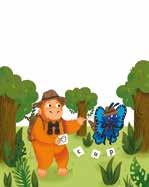
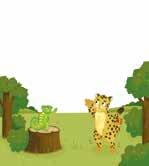
Our 76 flashcards bring phonics to life across Steps 2 to 4, covering single letters and letter combinations. Colour-coded by step for easy organisation, they're designed for short, playful sessions that build sound recognition and confidence. Also available digitally for front-ofclass display.

Professional development
Discover how to implement the framework and get the most of our resources with our new Cambridge Phonics and Handwriting self-study course (see page 16).
Learn more! For more details about Cambridge Phonics and Handwriting, just go to: www.cambridgeinternational.org/earlyyears/phonics-and-handwriting
Professional development
Good-quality professional development and reflective practice are a core part of Cambridge Early Years.
Our free Getting to know Cambridge Early Years webinar will give you a great overview of what is available in the programme and where to find further support.
Before starting to teach, we strongly recommend you attend our Introduction training, which will help you to understand and confidently teach Cambridge Early Years.
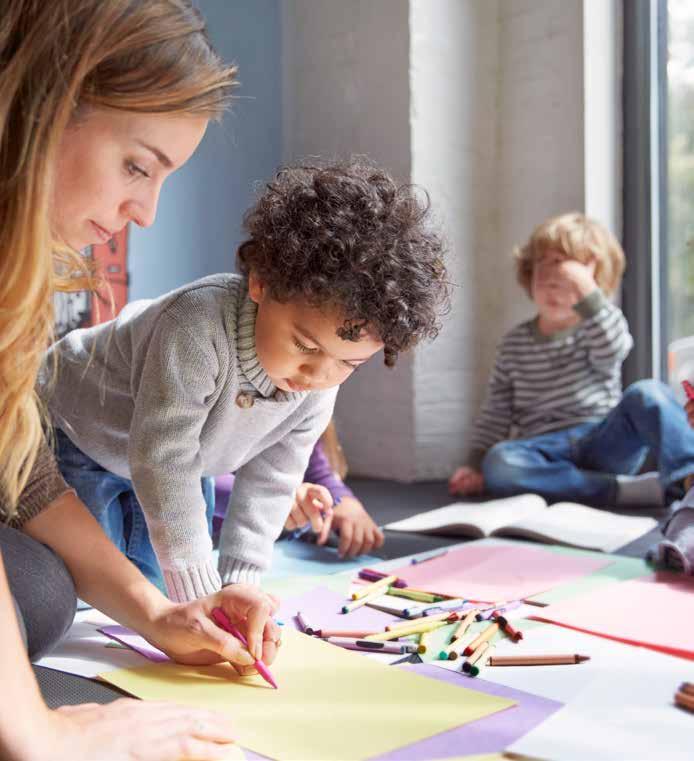
Once you have at least one year of experience with the programme, you can access other courses Assessment for Learning in Early Years’ and Focus on creating an environment for child-led ’. Our experienced trainers will share ideas, encourage you to reflect on your practice, and help you to develop practical strategies you can
We also offer a Cambridge Professional Development Qualification (PDQ) in Early Years Good Practice at Certificate and Diploma level. The Cambridge PDQ is a practice-based qualification for early years practitioners. It focuses on creating confident, innovative and reflective practitioners through a collaborative programme run by other
NEW for Cambridge Phonics and Handwriting: a 5-week self-study course that provides an overview of everything you need to know to start working with the Cambridge Phonics and Handwriting Framework.

View our professional development calendar cambridgeinternational.org/early-years-training
Get started with Cambridge Early Years
We are here to support you at every stage of your journey. From the very start of the registration process, through to implementing and teaching the programme successfully, you can rely on us to provide all the resources, training and guidance you need.
For centres that are new to Cambridge
If you would like to offer Cambridge Early Years, you need to follow four simple steps to register.
Step 1: Express your interest
We will aim to contact you within two working days of submitting your expression of interest.
Step 2: Complete our application form
We will aim to contact you within five working days of submitting your application form.
Step 3: We carry out an approval visit
We will arrange a time that is convenient to you. The approval visit will usually be carried out by your local Cambridge representative.
Step 4: Become a Cambridge Early Years Centre
If your approval visit is successful, we will send your contract letter within 30 working days.
Find out more about our registration process: cambridgeinternational.org/join
For centres that already work with us
If you are already registered to work with us, the process to begin offering Cambridge Early Years is even simpler.
You can speak to your local Cambridge representative or email info@cambridgeinternational.org to express your interest.
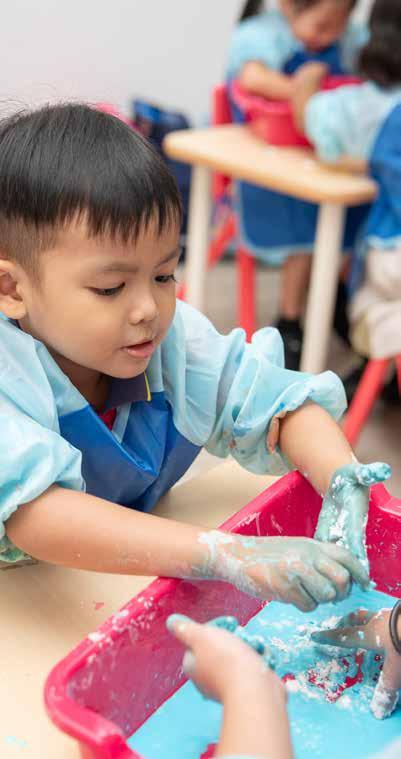
Getting
started
as a Cambridge Early Years Centre
When you have completed the registration process, you can use our Cambridge Early Years Centre logo to promote your relationship with us, and show that you are an approved provider.
You will also receive a Cambridge Early Years plaque, and all the information you need to get started.
Fees
We charge each centre an annual registration fee. Some resources and training courses also carry a fee per learner. To find out more, speak to your local Cambridge team.
Learn more
Getting in touch with us is easy.
Email info @cambridgeinternational.org
Call +44 1223 553554
Visit cambridgeinternational.org/earlyyears or cambridge.org/education/early-years
We are committed to making our documents accessible in accordance with the WCAG 2.3 Standard. We’re always looking to improve the accessibility of our documents.
If you find any problems or you think we’re not meeting accessibility requirements, contact us at info@cambridgeinternational.org with the subject heading: Digital accessibility.
If you need this document in a different format, contact us and supply your name, email address and requirements and we will respond within 15 working days.