12.3 Calculating averages and ranges for frequency data
12.4 Estimating the mean and finding the modal class for grouped data
20 Histograms and cumulative frequency diagrams 671
20.1 Histograms 673
20.2 Cumulative frequency 680
Past paper questions for Unit 5 695
Unit 5 Project 708
Unit 6
21 Ratio, rate and proportion 710
21.1 Working with ratio 712
21.2 Ratio and scale 720
21.3 Rates 725
21.4 Kinematic graphs 729
21.5 Proportion 739
21.6 Direct and inverse proportion in algebraic terms 745
22 More equations, formulae and functions 754
22.1 Setting up equations to solve problems 756
22.2 Using and rearranging formulae 763
22.3 Functions and function notation 768
23 Transformations and vectors 781
23.1 Simple plane transformations 783
23.2 Further transformations 801
23.3 Vectors 809
24 Probability using tree diagrams and Venn diagrams 830
24.1 Using tree diagrams to show outcomes 832
24.2 Calculating probability from tree diagrams 833
24.3 Calculating probability from Venn diagrams 837
24.4 Conditional probability 843
Past paper questions for Unit 6 852
Chapter 1 Review of number concepts SAMPLE
Unit 1 Two line heading
IN THIS CHAPTER YOU WILL:
•identify and classify different types of numbers
•find common factors and common multiples of numbers
•write numbers as products of their prime factors
•work with integers used in real-life situations
•calculate with powers and roots of numbers
•understand the meaning of indices
•use the rules of indices
•revise the basic rules for operating with numbers
•perform basic calculations using mental methods and with a calculator
•round numbers in different ways to estimate and approximate answers.
GETTING STARTED
1
A lot of the work in this chapter is revision. Look through the chapter to see what is covered.
a Are there any parts of this chapter that you could confidently skip? Explain why.
b If you only had to do three topics in this chapter, which would you choose? Why?
2 Look at this completed
cross-number puzzle.
a Write a set of clues for the puzzle. Each clue should include at least one of the concepts from this chapter.
b Find the sum of the three greatest numbers. Write the answer in words.
3 Write each of the following using only numbers and brackets if needed.
a nine cubed
b twelve squared
c seven to the power of five
d the reciprocal of three to the power of two
e the reciprocal of three-quarters to the power of zero
f nine to the power of half
g fourteen billion, ten thousand and nineteen
4 Look at this Problem involving calculation Is an approximate answer good enough? Do you need an exact answer? Use mental strategies Use a calculator Use a written method
decision diagram for problems involving calculation.
a Give an example of a problem where an approximate answer is good enough.
b How do you decide which method to use when an exact answer is needed?
c Estimates are useful for all of the methods in this decision tree. How could you convince someone that it is important to estimate even if you can use a calculator?
KEY
WORDS
base composite number cube cube root exponent factor index index notation integer irrational number multiple power prime factor prime number rational number reciprocal square number square root
The statue shown in the photograph is a replica of a 22 000-year-old bone found in the Congo Basin. The real bone is only 10 cm long and it is carved with groups of notches that represent numbers. One column lists the prime numbers from 10 to 20. It is one of the earliest examples of a number system using tallies. What do you think ancient civilisations used tallies for?
Our modern number system is called the Hindu-Arabic system because it was developed by Hindus and spread by Arab traders who brought it with them when they moved to different places in the world. The Hindu-Arabic system is decimal. This means it uses place value based on powers of ten. Any number at all, including decimals and fractions, can be written using place value and the digits from 0 to 9.
1.1 Different types of numbers
Make sure you know the correct mathematical words for the types of numbers in the table. NumberDefinition
Natural number
Any whole number from 1 to infinity, sometimes called ‘counting numbers’. 0 is not included.
2, 3, 4, 5, …
Odd numberA whole number that cannot be divided exactly by 2. 1, 3, 5, 7, …
Even number A whole number that can be divided exactly by 2. 2, 4, 6, 8, …
Integer Any of the negative and positive whole numbers, including zero. … −3, −2, −1, 0, 1, 2, 3, …
Prime number A whole number greater than 1 which has only two factors: the number itself and 1. 2, 3, 5, 7, 11, …
Square number The product obtained when an integer is multiplied by itself. 1, 4, 9, 16, …
FractionA number representing part of a whole number, written in the form a b , where a and b are non-zero integers. 1 2 , 1 4 , 1 3 , 1 8 , 13 3
DecimalA number that used place value and a decimal point to show a fraction. 0.5, 0.2, 0.08, 1.7
The set of real numbers is made up of rational numbers and irrational numbers
Rational numbers can be written as fractions in the form a b where a and b are non-zero integers. The set of rational numbers includes all integers, all fractions, all terminating decimals and all recurring decimals.
SAMPLE
Irrational numbers cannot be written as fractions. The set of irrational numbers consists of non-terminating, non-recurring decimals. The square root of a non-square number (such as √ 2 ), the cube root of a non-cube number (such as 3 √ 12 ) and p are all irrational numbers.
TIP
‘Find the product’ means ‘multiply’. So, the product of 3 and 4 is 12, i.e. 3 × 4 = 12.
MATHEMATICAL CONNECTIONS
You will deal with rational and irrational numbers in more detail in Chapter 9.
LINK
Some numbers, for example √ 1 and other roots of negative numbers, are not real numbers. They are neither rational nor irrational. Mathematicians call these imaginary numbers and you may learn about them if you study maths beyond Cambridge IGCSE.
Exercise 1.1
1 Here is a set of numbers: {−4, −1, 0, 1 2 , 0.75, 3, 4, 6, 11, 16, 19, 25}
List the numbers from this set that are:
a natural numbers b even numbers c odd numbers
d integers e negative integers f fractions
g square numbers h prime numbers i neither square nor prime.
2 List:
a the next four odd numbers after 107
b four consecutive even numbers between 2008 and 2030
c all odd numbers between 993 and 1007
d the first five square numbers
e four decimal fractions that are smaller than 0.5
f four common fractions that are greater than 1 2 but smaller than 3 4
3 State whether the following will be odd or even.
a the sum of two odd numbers
b the sum of two even numbers
c the sum of an odd and an even number
d the square of an odd number
e the square of an even number
f an odd number multiplied by an even number
INVESTIGATION
4 There are many other types of numbers. Find out what these numbers are and give an example of each.
a Perfect numbers
b Palindromic numbers
c Narcissistic numbers (in other words, numbers that love themselves!)
MATHEMATICAL CONNECTIONS
You will learn much more about sets in Chapter 9. For now, just think of a set as a list of numbers or other items that are often placed inside curly brackets.
SAMPLE
TIP
Remember that a ‘sum’ is the result of an addition. The term is often used for any calculation in early mathematics, but its meaning is very specific at this level.
TIP
Being able to communicate information effectively is a key 21st-century skill. As you work, think about what you are being asked to do in this task and how best to present your answers.
Using symbols to link numbers
Mathematicians use numbers and symbols to write mathematical information in the shortest, clearest way possible.
Exercise 1.2
1 Rewrite each of these statements using mathematical symbols.
a 19 is less than 45
b 12 plus 18 is equal to 30
c 0.5 is equal to 1 2
d 0.8 is not equal to 8.0
e −34 is less than 2 times −16
f therefore the number x equals the square root of 72
g a number (x) is less than or equal to negative 45
h p is approximately equal to 3.14
i 5.1 is greater than 5.01
j the sum of 3 and 4 is not equal to the product of 3 and 4
k the difference between 12 and −12 is greater than 12
l the sum of −12 and −24 is less than 0
m the product of 12 and a number (x) is approximately −40
2 Say whether these mathematical statements are true or false.
a 0.599 > 6.0
c 8.1 = 8 1 10
e 20 × 9 > 21 × 8
b 5 × 1999 is approximately equal to 10 000
6.0 = 6 g 12 . 4
i 1000 . 199 × 5
k 35 × 5 × 2 ≠ 350
m 20 4 ≠ 4 20
INVESTIGATION
3 Work with a partner.
20 ÷ 4 = 5 ÷ 20
a Look at the symbols used on the keys of your calculator. Say what each one means in words.
b List any symbols that you do not know. Try to find out what each one means.
TIP
Remember: = is equal to ≠ is not equal to , is less than < is less than or equal to . is greater than > is greater than or equal to ∴ therefore √ the positive square root of
1.2 Multiples and factors
Multiples
A multiple of a number is found when you multiply that number by a positive integer. You can think of the multiples of a number as the ‘times table’ for that number. For example, the multiples of 3 are 3 × 1 = 3, 3 × 2 = 6, 3 × 3 = 9 and so on. The first multiple of any number is the number itself.
WORKED EXAMPLE 1
a What are the first three multiples of 12?
b Is 300 a multiple of 12?
Answers
a 12, 24, 36 Multiply 12 by 1, 2 and then 3.
12 × 1 = 12
12 × 2 = 24
12 × 3 = 36
b Yes, 300 is a multiple Divide 300 by 12. If it goes exactly, then 300 is of 12. a multiple of 12.
300 ÷ 12 = 25
Exercise 1.3
1 List the first five multiples of:
2 Use a calculator to find and list the first ten multiples of:
3 List:
a the multiples of 4 between 29 and 53
b the multiples of 50 less than 400
c the multiples of 100 between 4000 and 5000.
4 Here are five numbers: 576, 396, 354, 792, 1164. Which of these are multiples of 12?
5 Which of the following numbers are not multiples of 27?
The lowest common multiple (LCM)
The lowest common multiple of two or more numbers is the smallest number that is a multiple of all the given numbers.
1 Review of number concepts
WORKED EXAMPLE 2
Find the lowest common multiple of 4 and 7.
Answer
M4 = 4, 8, 12, 16, 20, 24, 28, 32List several multiples of 4.
M7 = 7, 14, 21, 28, 35, 42 List several multiples of 7.
LCM = 28
Find the lowest number that appears in both sets. This is the LCM.
Exercise 1.4
1 Find the lowest common multiple of: a 2 and 5 b 8 and 10 c 6 and 4 d 3 and 9 e 35 and 55 f 6 and 11
2 Is it possible to find the highest common multiple of two or more numbers? Give a reason for your answer.
Factors
A factor is a number that divides exactly into another number with no remainder. For example, 2 is a factor of 16 because it goes into 16 exactly 8 times. 1 is a factor of every number. The largest factor of any number is the number itself.
WORKED EXAMPLE 3
List the factors of: a 12 b 25 c 110
Answers
a F12 = 1, 2, 3, 4, 6, 12
b F25 = 1, 5, 25
Find pairs of numbers that multiply to give 12: 1 × 12 2 × 6 3 × 4
Write the factors in numerical order. 1 × 25 5 × 5
Later in this chapter you will see how prime factors can be used to find LCMs.
TIP
F12 means the factors of 12.
Exercise 1.5
1 List all the factors of:
a 4 b 5 c 8 d 11 e 18 f 12 g 35 h 40 i 57 j 90
k 100 l 132 m 160 n 153 o 360
2 Which number in each set is not a factor of the given number?
a 14 {1, 2, 4, 7, 14}
c 21 {1, 3, 7, 14, 21}
e 42 {3, 6, 7, 8, 14}
3 State true or false in each case.
a 3 is a factor of 313
b 15 {1, 3, 5, 15, 45}
d 33 {1, 3, 11, 22, 33}
b 9 is a factor of 99
c 3 is a factor of 300 d 2 is a factor of 300
e 2 is a factor of 122 488
g 210 is a factor of 210
f 12 is a factor of 60
h 8 is a factor of 420
4 What is the smallest factor and the largest factor of any number?
The highest common factor (HCF)
The highest common factor of two or more numbers is the highest number that is a factor of all the given numbers.
WORKED EXAMPLE 4
Find the highest common factor of 8 and 24.
Answer
F8 = 1, 2, 4, 8
F24 = 1, 2, 3, 4, 6, 8, 12, 24
List the factors of each number.
Underline factors that appear in both sets. HCF = 8 Pick out the highest underlined factor (HCF).
Exercise 1.6
1 Find the highest common factor of each pair of numbers.
a 3 and 6 b 24 and 16 c 15 and 40 d 42 and 70
e 32 and 36 f 26 and 36 g 22 and 44 h 42 and 48
2 Not including the factor provided, find two numbers less than 20 that have:
a an HCF of 2 b an HCF of 6
3 What is the highest common factor of two different prime numbers? Give a reason for your answer
MATHEMATICAL CONNECTIONS
You will learn how to find HCFs using prime factors later in the chapter.
APPLY YOUR SKILLS
4 Simeon has two lengths of rope. One piece is 72 metres long and the other is 90 metres long. He wants to cut both lengths of rope into the longest pieces of equal length possible. How long will the pieces be?
5 Ms Sanchez has 40 canvases and 100 tubes of paint to give to the students in her art group. What is the largest number of students she can have if she gives each student an equal number of canvasses and an equal number of tubes of paint?
6 A jeweller has 300 blue beads, 750 red beads and 900 silver beads, which are used to make bracelets. Each bracelet must have the same number and colour of beads. What is the maximum number of bracelets that can be made with these beads?
1.3 Prime numbers
Prime numbers have exactly two different factors: one and the number itself. Composite numbers have more than two factors.
The number 1 has only one factor so it is not prime and it is not composite.
MATHEMATICAL CONNECTIONS
Later in this chapter you will learn how to write integers as products of prime factors. One of the reasons why it is important for 1 to NOT be defined is prime is to make sure that the prime factorisation of any number is unique.
Finding prime numbers
Over 2000 years ago, a Greek mathematician called Eratosthenes made a simple tool for sorting out prime numbers. This tool is called the ‘Sieve of Eratosthenes’ and the diagram shows how it works for prime numbers up to 100.
Cross out 1, it is not prime.
Circle 2, then cross out other multiples of 2.
Circle 3, then cross out other multiples of 3.
Circle the next available number then cross out all its multiples.
Repeat until all the numbers in the table are either circled or crossed out.
The circled numbers are the primes.
TIP
Recognising the type of problem helps you to choose the correct mathematical techniques for solving it.
Word problems involving HCF usually involve splitting things into smaller pieces or arranging things in equal groups or rows.
Other mathematicians over the years have developed ways of finding larger and larger prime numbers. Until 1955, the largest known prime number had less than 1000 digits. Since the 1970s and the invention of more and more powerful computers, more and more prime numbers have been found. The graph below shows the number of digits in the largest known primes since 2000.
You should try to memorise the prime numbers between 1 and 100.
SAMPLE
Source: https://www.mersenne.org/primes/
INVESTIGATION
Why do mathematicians find prime numbers exciting?
One reason why prime numbers are interesting and intriguing is because there is a lot about them that we don’t know and that mathematicians have not been able to prove.
1 Goldbach’s conjecture (1742) is one of the oldest and best-known unsolved problems in number theory.
a What is Goldbach’s strong conjecture?
b A Peruvian mathematician, Harald Helfgott, has published a largely accepted proof of Goldbach’s weak conjecture. Find out more about this.
LINK
Today anyone can join the search for Mersenne prime numbers. This project links thousands of home computers to search continuously for larger and larger prime numbers while the computer processors have spare capacity.
LINK
Prime numbers are used in codes and codebreaking. The larger the prime you use, the harder it is to break the code. This is why it is more and more important to find larger and larger primes.
INVESTIGATION
2 The Mersenne prime number search relies on massive computing power to find large primes. There is no other way to work out where the nth prime number will be or what the distance between large primes will be. Riemann’s hypothesis (1859) claims you can accurately pinpoint the distribution of prime numbers. An Indian mathematician, Dr Kumar Eswaran published a proof for this hypothesis in 2016, but it has received mixed responses and is not yet fully accepted.
a Riemann built his ideas on the prime number theorem. Find out what this is and express it in simple language.
b Is there a proof for the existence of infinitely-many prime numbers?
3 And just for fun … What is an emirp? Find some examples to show what these are.
Exercise 1.7
1 Which is the only even prime number?
2 How many odd prime numbers are there that are less than 50?
3 a List the composite numbers greater than four, but less than 30. b Try to write each composite number on your list as the sum of two prime numbers. For example: 6 = 3 + 3 and 8 = 3 + 5.
4 Twin primes are pairs of prime numbers that differ by two. List the twin prime pairs up to 100.
5 Is 149 a prime number? Explain how you decided.
Prime factors
Prime factors are the factors of a number that are also prime numbers. Every composite whole number can be broken down and written as the product of its prime factors. You can do this using tree diagrams or using division. Both methods are shown in Worked example 5.
TIP
Remember, a product is the answer to a multiplication. So to write a number as the product of its prime factors you write it like this:
12 = 2 × 2 × 3.
WORKED EXAMPLE 5
Write the following numbers as the product of prime factors. a 36 b 48
Answers
Using a factor tree
Write the number as two factors.
If a factor is a prime number, circle it.
If a factor is a composite number, split it into two factors.
Keep splitting until you end up with two primes.
Prime numbers only have two factors: 1 and the number itself. As 1 is not a prime number, do not include it when expressing a number as a product of prime factors.
Write the primes in ascending order with × signs.
Divide by the smallest prime number that will go into the number exactly.
Continue dividing, using the smallest prime number that will go into your new answer each time.
Stop when you reach 1.
Write the prime factors in ascending order with × signs.
Choose the method that works best for you and stick to it. Always show your method when using prime factors.
Exercise 1.8
1 Express the following numbers as the product of prime factors.
When you write your number as a product of primes, group all occurrences of the same prime number together.
TIP
TIP
TIP
Using prime factors to find the HCF and LCM
When you are working with larger numbers you can determine the HCF or LCM by expressing each number as a product of its prime factors.
WORKED EXAMPLE 6
Find the HCF of 168 and 180.
Answer
168 = 2 × 2 × 2 × 3 × 7
180 = 2 × 2 × 3 × 3 × 5
2 × 2 × 3 = 12
HCF = 12
WORKED EXAMPLE 7
Find the LCM of 72 and 120.
Answer
72 = 2 × 2 × 2 × 3 × 3
120 = 2 × 2 × 2 × 3 × 5
First express each number as a product of prime factors. Use tree diagrams or division to do this.
Underline the factors common to both numbers.
Multiply these out to find the HCF.
First express each number as a product of prime factors. Use tree diagrams or division to do this.
Underline the largest set of multiples of each factor.
2 × 2 × 2 × 3 × 3 × 5 = 360 List these and multiply them out to find the LCM.
LCM = 360
Exercise 1.9
1 Find the HCF of these numbers by using prime factors.
a 48 and 108 b 120 and 216 c 72 and 90 d 52 and 78
e 100 and 125 f 154 and 88 g 546 and 624 h 95 and 120
2 Use prime factorisation to determine the LCM of the following numbers.
a 54 and 60 b 54 and 72 c 60 and 72 d 48 and 60
e 120 and 180 f 95 and 150 g 54 and 90 h 90 and 120
3 Determine both the HCF and LCM of the following numbers.
a 72 and 108 b 25 and 200 c 95 and 120 d 84 and 60
MATHEMATICAL CONNECTIONS
You can also use prime factors to find the square and cube roots of numbers if you don’t have a calculator. You will deal with this in more detail later in this chapter.
APPLY YOUR SKILLS
4 A radio station runs a phone-in competition for listeners. Every 30th caller gets a free airtime voucher and every 120th caller gets a free mobile phone. How many listeners must phone in before one receives both an airtime voucher and a free phone?
5 Li runs round a track in 12 minutes. Jaleel runs round the same track in 18 minutes. If they start together, how many minutes will pass before they both cross the start line together again?
6 The number p can be written as a product of the three prime numbers x, y and z, where x, y and z are all different.
a How many factors does the number p have?
Another number q can be written as the product of four different primes.
b How many factors does q have?
The number r can be written as a product of n different prime numbers.
c How many factors does r have?
1.4 Working with directed numbers
When you use numbers to represent real-life situations like temperatures, altitude, depth below sea level, profit or loss and directions (on a grid), you sometimes need to use the negative sign to indicate the direction of the number. For example, you can show a temperature of three degrees below zero as −3 °C. Numbers like these, which have direction, are called directed numbers. So if a point 25 m above sea level is at +25 m, then a point 25 m below sea level is at −25 m.
TIP
Once a direction is chosen to be positive, the opposite direction is taken to be negative. So:
• if up is positive, down is negative
• if right is positive, left is negative
• if north is positive, south is negative
• if above 0 is positive, below 0 is negative.
TIP
Recognising the type of problem helps you to choose the correct mathematical techniques for solving it. Word problems involving LCM usually include repeating events. You may be asked how many items you need to ‘have enough’ or when something will happen again at the same time.
Exercise 1.10
1 Express each of these situations using a directed number.
a a profit of $100
c a drop of 10 marks
e a loss of 1.5 kg
g a temperature of 10 °C below zero
i a debt of $2000
k a time two hours behind local time
b 25 km below sea level
d a gain of 2 kg
f 8000 m above sea level
h a fall of 24 m
j an increase of $250
l a height of 400 m
Calculating with directed numbers
In mathematics, directed numbers are also known as integers. You can represent the set of integers on a number line like this:
The further to the right a number is on the number line, the greater its value.
LINK
Directed numbers are important when describing temperatures. The Celsius (or centigrade) temperature scale places the temperature at which water freezes at zero. Positive temperatures indicate ‘above freezing’ and are warmer. Negative temperatures are ‘below freezing’ and are colder.
When you calculate with negative and positive integers, you need to pay attention to the signs and remember these rules:
• Adding a negative number is the same as subtracting the number. 3 + −5 = −2
• Subtracting a negative number is the same as adding a positive number. 3 − −5 = 8
• Multiplying or dividing the same signs gives a positive answer. −3 × −5 = 15 and −20 ÷ −4 = 5
• Multiplying or dividing different signs gives a negative answer. 3 × −5 = –15 and 15 ÷ −3 = −5.
Exercise 1.11
1 Copy the numbers and fill in , or . to make a true statement.
MATHEMATICAL CONNECTIONS
You will use similar number lines when solving linear inequalities in Chapter 14.
TIP
Your calculator will have a [+/−] key that allows you to enter negative numbers. Make sure you know which key this is.
2 Arrange each set of numbers in ascending order.
a −8, 7, 10, −1, −12 b 4, −3, −4, −10, 9, −8
c −11, −5, −7, 7, 0, −12 d −94, −50, −83, −90, 0
3 Write down the missing integer in each of these calculations.
a 7 + = 3
−1.7 + = 8.3
−7 + = −21 d 8 − = 11 e 4 − = 6.7 f −8 − = −13 g 12 ÷ = −2 h −18 ÷ = 3 i ÷ 3 = −9 j −3 × = 12 k × 4 = −16 l × −4 = 20
APPLY YOUR SKILLS
4 Study the temperature graph carefully.
SAMPLE
a What was the temperature on Sunday 14 January?
b By how much did the temperature drop from Sunday 14 to Monday 15?
c What was the lowest temperature recorded?
d What is the difference between the highest and lowest temperatures?
e On Monday 29 January the temperature changed by −12 degrees. What was the temperature on that day?
5 Manu has a bank balance of $45.50. He deposits $15.00 and then withdraws $32.00. What is his new balance?
6 A bank account is $420 overdrawn.
a Express this as a directed number.
b How much money needs to be deposited for the account to have a balance of $500?
c $200 is deposited. What is the new balance?
7 A diver 27 m below the surface of the water rises 16 m. At what depth is the diver now?
TIP
The difference between the highest and lowest temperature is also called the range of temperatures.
APPLY YOUR SKILLS CONTINUED
8 On a cold day in New York, the temperature at 6 a.m. was −5 °C. By noon, the temperature had risen by 8 °C. By 7 p.m. the temperature had dropped by 11 °C from its value at noon. What was the temperature at 7 p.m.?
9 Local time in Abu Dhabi is four hours ahead of local time in London. Local time in Rio de Janeiro is three hours behind local time in London.
a If it is 4 p.m. in London, what time is it in Abu Dhabi?
b If it is 3 a.m. in London, what time is it in Rio de Janiero?
c If it is 3 p.m. in Rio de Janeiro, what time is it in Abu Dhabi?
d If it is 8 a.m. in Abu Dhabi, what time is it in Rio de Janeiro?
10 A fuel tank at a workshop should be refilled when the gauge shows 0; however, there is a 100 litre reserve in the tank, so the level can drop below 0 if the tank is not filled on time.
a On 3 March, the gauge indicated 412 litres above the 0 mark. On 31 March the level had dropped to −66 litres. Calculate the mean rate of fuel use per day.
b On 1 April, the tank was topped up. The workshop owner estimates that this amount of fuel would be enough for 30 days, after which the level should be 0. How much fuel was added to the tank?
1.5 Powers, roots and laws of indices
You know that 2 × 2 × 2 × 2 = 16
You can write this in index notation as:
24 = 16
2 is the base
4 is the index
The index is also called a power or an exponent.
24 base
Square numbers and square roots
A number is squared when it is multiplied by itself. For example, the square of 5 is 5 × 5 = 25. The symbol for squared is 2. So you can write 5 × 5 as 52
The square root of a number is the number that was multiplied by itself to get the square number. The symbol for square root is √ .
You know that 25 = 52, so √ 25 = 5. index
MATHEMATICAL CONNECTIONS
In Section 1.1 you learned that the product obtained when an integer is multiplied by itself is a square number.
You also know that −5 × −5 = 25. However, the mathematical convention is that the square root sign only refers to the positive square root. This is why if you enter √ 25 in your calculator you will always get the positive answer, 5.
If you want to indicate both the positive and negative square roots of 25 you need to write ± √ 25 .
Cube numbers and cube roots
A number is cubed when it is multiplied by itself and then multiplied by itself again. For example, the cube of 2 is 2 × 2 × 2 = 8. The symbol for cubed is 3. So 2 × 2 × 2 can also be written as 23
The cube root of a number is the number that was multiplied by itself twice to get the cube number. The symbol for cube root is 3 √ . You know that 8 = 23, so 3 √ 8 = 2
Finding powers and roots
You should know the squares of numbers from 1 to 15 (and their roots) and the cubes of numbers from 1 to 5 as well as the cube of 10. For other numbers, you can use your calculator to square or cube numbers quickly using the x2 and x3 keys or the x key. Use the or 3 keys to find the roots.
TIP
Not all calculators have exactly the same buttons. x xy and all mean the same thing on different calculators. Make sure you know how to find powers and roots on your calculator.
WORKED EXAMPLE 8
Use
If you don’t have a calculator, you can use the product of prime factors method to find square and cube roots of numbers. This method is shown in Worked example 9.
MATHEMATICAL CONNECTIONS
To solve equations like x2 = 25, you need to find both the positive and negative square roots, so if x2 = 25, then x
25 = 5 and −5.
WORKED EXAMPLE 9
Without using a calculator find: a √ 324 b 3√ 512
Answers
a 324 = 2 × 2 ⏟ 2 × 3 × 3 ⏟ 3 × 3 × 3 ⏟ 3
2 × 3 × 3 = 18
√ 324 = 18
2 × 2 × 2 = 8
3√ 512 = 8
Exercise 1.12
1 Write down the value of:
Group the factors into pairs, and write down the square root of each pair.
Multiply the roots together to get the square root of 324.
Group the factors into threes, and write the cube root of each group.
Multiply together to get the cube root of 512.
2 Calculate:
3 Find a value of x to make each of these statements true.
4 Use a calculator to find the following roots.
5 Use the given product of prime factors to find the square root of each number. Show your working.
a 324 = 2 × 2 × 3 × 3 × 3 × 3
b 225 = 3 × 3 × 5 × 5
c 784 = 2 × 2 × 2 × 2 × 7 × 7
d 2025 = 3 × 3 × 3 × 3 × 5 × 5
e 19 600 = 2 × 2 ×
=
6 Use the given product of prime factors to find the cube root of each number. Show your working.
a 27 = 3 × 3 × 3
b 729 = 3 × 3 × 3 × 3 × 3 × 3
c 2197 = 13 × 13 × 13
d 1000 = 2 × 2 × 2 × 5 × 5 × 5
e 15 625 = 5
7 Calculate:
Brackets act as grouping symbols. Work out any calculations inside brackets before doing the calculations outside the brackets.
Root signs work in the same way as a bracket. If you have √ 25 + 9 , you must add 25 and 9 before finding the root.
8 Find the length of the edge of a cube with a volume of:
9 If the symbol ★ means ‘add the square of the first number to the cube of the second number’, calculate:
TIP
REFLECTION
You have covered many of the concepts in this chapter earlier in your study of mathematics.
• Which concepts did you remember really well?
• Why do you think you remembered these so well?
• Did you find any new ways of doing things or better ways of explaining things as you worked through this chapter? Share your ideas with a partner.
Other indices and roots
You have seen that square numbers are all raised to the power of two (5 squared = 5 × 5 = 52) and that cube numbers are all raised to the power of three (5 cubed = 5 × 5 × 5 = 53). You can raise a number to any power. For example, 5 × 5 × 5 × 5 = 54. You read this as ‘5 to the power of 4’. The same principle applies to finding roots of numbers.
52 = 25 √ 25 = 5
53 = 125 3 √ 125 = 5
54 = 625 4 √ 625 = 5
You can use your calculator to perform operations using any roots or squares.
The y x key calculates any power.
So, to find 75, you enter 7 y x 5 and get a result of 16 807.
The x key calculates any root.
So, to find 4 √ 81 , you enter 4 x 81 and get a result of 3.
Make sure that you know which key is used for each function on your calculator and that you know how to use it. On some calculators these keys might be second functions.
MATHEMATICAL CONNECTIONS
You will work with higher powers and roots again when you deal with indices in algebra in Chapter 2, standard form in Chapter 5 and rates of growth and decay in Chapters 17 and 18.
Index notation and products of prime factors
Index notation is very useful when you have to express a number as a product of its prime factors because it allows you to write the factors in a short form.
WORKED EXAMPLE 10
Express these numbers as products of their prime factors in index form.
a 200 b 19 683
Answers
These diagrams are a reminder of the factor tree and division methods for finding the prime factors.
Exercise 1.13
1 Evaluate.
2 Which is greater and by how much?
3 Express the following as products of prime factors, in index notation.
4 Write several square numbers as products of prime factors, using index notation. What can you say about the index needed for each prime?
TIP
Remember that anything raised to the power of zero is equal to 1.
The laws of indices
The laws of indices are a set of mathematical rules that allow you to multiply and divide numbers written in index notation without having to write them in expanded form.
Make sure that you remember these three important rules.
To multiply different powers of the same number, add the indices.
For example, 32 × 35 = 32 + 5 = 37 and 4−2 × 43 = 4−2 + 3 = 4.
To divide different powers of the same number, subtract the indices.
For example, 36 ÷ 32 = 36 − 2 = 34 and 4 3 4 7 = 43 − 7 = 4−4
To find the power of a power you multiply the indices. For example, (33)2 = 33 × 2 = 36 and (42)−3 = 42 × −3 = 4−6
In general terms:
Zero and negative indices
Do you remember how to work with zero and negative indices? Read through this information to refresh your memory.
In this table, each value is 1 5 of the one to its left. For example, 54 ÷ 5 = 53
The pattern in the table shows that 50 = 1. This is true for any number to the power of 0.
We can say a0 = 1 (where a ≠ 0, because 00 is undefined.).
You can also see from the table that a number with a negative index is equal to its reciprocal with a positive index. For example: 5−2 = 1 5 2 . This is true for all negative indices.
We can say a m = 1 a m (where a ≠ 0).
Exercise 1.14
1 Decide whether each statement is true or false. If it is false, work out the correct answer.
2 Simplify. Leave your answers in index notation.
3 Substitute a = 2, b = 3 and c = 1 2 to find the value of each expression.
4 Evaluate.
5 Express each value with a negative index.
6 Evaluate.
7 Rewrite each expression in the form of 3x (in other words, as a power of 3).
Fractional indices
Do you remember what a fractional index such as 5 1 2 means?
You can use the laws of indices to show the meaning of fractional indices.
5 1 2 × 5 1 2 = 5 ( 1 2 + 1 2 ) = 51 = 5
You also know that √5 × √5 = 5
So, 5 1 2 = √ 5
LINK
Fractional indices and roots are used in many different financial calculations involving investments, insurance policies and economic decisions.
So, 5 1 3 = 3 √ 5
In general terms, for unit fractions: a 1 2 = √ a a 1 3 = 3 √ a a 1 n = n √ a
You can use the rule for finding the power of a power to show the meaning of fractional indices where the numerator is not 1 (non-unit fractions).
(4 1 4 ) 3 = 4 ( 1 4 × 3 1 ) = 4 3 4
This shows that a number such as 5 2 3 can be written with a unit fraction index as (5 1 3 ) 2 .
You already know that you can write a unit fraction (such as 1 3 ) as a root.
So 5
It is simpler to input the value in root form into your calculator than to enter 5 2 3 . In general terms, for non-unit fractions: a m n = (a 1 n ) m = (n
WORKED EXAMPLE 11
Work out the value of: a 27 2 3 b 251.5 Answers
Change the decimal to a fraction. 3 2 = 3 × 1 2 , so you need to cube the square root of 25.
Exercise 1.15
1 Rewrite each expression using a root symbol.
2 Write each expression using index notation.
3 Use a calculator to evaluate.
TIP
Multiplication is commutative, so (a 1 n ) m is the same as
APPLY YOUR SKILLS
4 The number of calories a mammal uses when they are at rest can be worked out using the formula C = 70 × m 3 4 , where m is the mass of the animal in kilograms.
a Express the formula using a root sign.
b A cat has a mass of 5.5 kilograms. Work out how many calories it consumes while it is at rest.
c How many calories would a 5000 kg elephant consume at rest?
1.6 Order of operations
At this level of mathematics you are expected to carry out calculations involving more than one operation (+, −, × and ÷). When you do this you have to follow a sequence of rules so that there is no confusion about what operations you should do first. The rules for the order of operations are:
• complete operations in grouping symbols first
• deal with powers and roots next
• do division and multiplication next, working from left to right
• do addition and subtraction last, working from left to right.
Many people use the letters BODMAS to remember the order of operations. The letters stand for:
Brackets Orders Divide Multiply Add Subtract
BODMAS indicates that indices (powers of ) are considered after brackets but before all other operations.
Grouping symbols
The most common grouping symbols in mathematics are brackets. Here are some examples of the different kinds of brackets used in mathematics:
(4 + 9) × (10 ÷ 2)
[2(4 + 9) − 4(3) − 12]
{2 − [4(2 − 7) − 4(3 + 8)] − 2 × 8}
MATHEMATICAL CONNECTIONS
You will apply the order of operation rules to fractions, decimals and algebraic expressions as you progress through the course.
When you have more than one set of brackets in a calculation, you work out the innermost set first.
Other symbols used to group operations are:
• fraction bars, e.g. 5 − 12 3 − 8
• root signs, such as square roots and cube roots, e.g. √ 9 + 16
WORKED EXAMPLE 12
Simplify.
Answers
WORKED EXAMPLE 13
Calculate.
Now that you know what to do with grouping symbols, you can apply the rules for order of operations to perform calculations with numbers.
Exercise 1.16
1 Calculate. Show the steps in your working.
2 Calculate.
3 Simplify. Show the steps in your working.
a 5 × 10 + 3 b 5 × (10 + 3) c 2 + 10 × 3
d (2 + 10) × 3 e 23 + 7 × 2 f 6 × 2 ÷ (3 + 3)
g 15 − 5 2 × 5 h (17 + 1) ÷ 9 + 2
j 17 + 3 × 21 k
15 + 30 ÷
4 Simplify.
a 18 4 × 2 3 b 14 (21 ÷ 3) c 24 ÷ 8 × (6 5)
d 42 ÷ 6 3 4 e 5 + 36 ÷ 6 8 f (8 + 3) × (30 ÷ 3) ÷ 11
5 Simplify. Remember to work from the innermost grouping symbols to the outermost.
a 4 + [12 (8 5)]
b 6 + [2 (2 × 0)]
c 8 + [60 (2 + 8)] d 200 [(4 + 12) (6 + 2)]
e 200 × {100 [4 × (2 + 8)]} f {6 + [5 × (2 + 30)]} × 10
9 Place the given numbers in the correct spaces to make a correct number sentence.
a 0, 2, 5, 10 − ÷ =
b 9, 11, 13, 18 − ÷ =
c 1, 3, 8, 14, 16 ÷ ( − ) − =
d 4, 5, 6, 9, 12 ( + ) − ( − ) =
TIP
A bracket ‘type’ is always twinned with another bracket of the same type or shape. This helps mathematicians to understand the order of calculations even more easily.
Using your calculator
A calculator with algebraic logic will apply the rules for order of operations automatically. So, if you enter 2 + 3 × 4, your calculator will do the multiplication first and give you an answer of 14. (Check that your calculator does this!)
When the calculation contains brackets you must enter these to make sure your calculator does the grouped sections first.
WORKED EXAMPLE 14
Use a calculator to find:
Experiment with your calculator by carrying out several calculations, with and without brackets. For example: 3 × 2 + 6 and 3 × (2 + 6). Do you understand why these are different?
Exercise 1.17
1 Use your calculator to find the answers. a 10 4 ×
e 5 3 × 8 6 ÷ 2
g (1 + 4) × 20 ÷ 5 h 36 ÷ 6 × (3 3)
i (8 + 8) 6 × 2 j 100 30 × (4 3)
k 24 ÷ (7 + 5) × 6 l [(60 40) (53 43)] × 2
m [(12 + 6) ÷ 9] × 4 n [100 ÷ (4 + 16)] × 3
o 4 × [25 ÷ (12 7)]
2 Use your calculator to check whether the following answers are correct. If the answer is incorrect, work out the correct answer.
3 Each ★ represents a missing operation. Work out what they are. a 12 ★ (28 ★ 24) = 3 b 84 ★ 10 ★ 8 = 4
c 3 ★ 7(0.7
e 40
1.3) = 17
TIP
Your calculator might only have one type of bracket ( and ) . If there are two different shaped brackets in the calculation, such as [4 × (2 − 3)], enter the calculator bracket symbol for each type.
TIP
Some calculators have two ‘−’ buttons: – and (–)
The first means ‘subtract’ and is used to subtract one number from another. The second means ‘make negative’. Experiment with the buttons and make sure that your calculator is doing what you expect it to do!
4 Calculate.
5 Use your calculator to find the answer. Give your answers to 3 significant figures.
TIP
6 Use your calculator to evaluate. Give your answers to 3 significant figures.
7 Evaluate. Give your answer to 2 decimal places if necessary.
SELF ASSESSMENT
Draw up a flow chart like this one to assess your own learning. Some sentence stems are provided below each box to help you get started.
How do I describe my understanding?
I understood this easily because …
I struggled a bit with __ because …
I am still not sure of … I am con dent that I can … I would give myself [ ] out of ten for this work
What did I do well?
I was very good at … I was proud of … My best work was …
What can I improve?
To improve I can … Next time I will … I need to revise …
If you have forgotten how to round to significant figures, read through Worked example 16 in Section 1.7.
MATHEMATICAL CONNECTIONS
When you work with indices and standard form in Chapter 5, you will need to apply these skills and use your calculator effectively to solve problems involving any powers or roots.
1.7 Rounding and estimating
In many calculations, particularly with decimals, you will not need to find an exact answer. Instead, you will be asked to give an answer to a stated level of accuracy. For example, you may be asked to give an answer correct to 2 decimal places, or to 3 significant figures.
WORKED EXAMPLE 15
Round 64.839906 to:
a the nearest whole number
b 1 decimal place
c 3 decimal places.
Answers
a 64.839906
64.839906
= 65 (to nearest whole number)
b 64.839906
64.839906
= 64.8 (1 d.p.)
c 64.839906
64.839906
= 64.840 (3 d.p.)
4 is in the units place.
The next digit is 8, so you will round up to get 5.
To the nearest whole number.
8 is in the first decimal place.
The next digit is 3, so the 8 will remain unchanged.
Correct to 1 decimal place.
9 is in the third decimal place.
The next digit is 9, so you need to round up.
When you round 9 up, you get 10, so carry one to the previous digit and write 0 in the place of the 9.
Correct to 3 decimal places.
When a number has many digits or decimal places it is useful to round it to significant figures (s.f.). The first significant digit of a number is the first non-zero digit, when reading from left to right. The next digit is the second significant digit, the next the third significant and so on. All zeros after the first significant digit are considered significant.
If you are rounding to a whole number, write the appropriate number of zeros after the last significant digit as place holders to keep the number the same size.
TIP
Rounding to 1 significant figure does not mean you will only have one digit. When 13 432 is rounded to 1 significant figure it is 10 000 and not 1.
LINK
We use ‘rounding’ in all subjects where numerical data is collected. Masses in physics, temperatures in biology, prices in economics: these all need to be recorded sensibly and will be rounded to a degree of accuracy appropriate for the situation.
WORKED EXAMPLE 16
Round:
a 1.076 to 3 significant figures
b 0.00736 to 1 significant figure
c 23 512 435 to 2 significant figures
Answers
a 1.076 = 1.08 (3 s.f.)
b 0.00736 = 0.007 (1 s.f.)
c 23 512 475 = 24 000 000 (2 s.f.)
Exercise 1.18
The third significant figure is the 7. The next digit is 6, so round 7 up to get 8. Correct to 3 significant figures.
The first significant figure is the 7. The next digit is 3, so 7 will not change. Correct to 1 significant figure.
The second significant figure is 3. The next digit is 5, so 3 will round up to 4. Include the zeros and state the level of accuracy.
1 Round each number to 2 decimal places.
2 Round
3 Round each number to the nearest 10 000.
4 Express each number correct to:
i 4 significant figures ii 3 significant figures iii 1 significant figure
5 Change 2 5 9 to a decimal using your calculator. Express the answer correct to:
a 3 decimal places
c 1 decimal place
e 2 significant figures
b 2 decimal places
d 3 significant figures
f 1 significant figure
Estimating to get an approximate answer
To estimate the answer to a calculation, you need to round the numbers before you do the calculation. Although you can use any accuracy, often the numbers in the calculation are rounded to 1 significant figure:
3.9 × 2.1 is approximately equal to 4 × 2 = 8
Notice that 3.9 × 2.1 = 8.19, so the estimated value of 8 is not too far from the real value!
WORKED EXAMPLE 17
Estimate the value of:
a 4.6 + 3.9
Answers
a 4.6 + 3.9 √ 398 is approximately equal to 5 + 4 √ 400 = 9 20 = 4.5 10 = 0.45
b √ 42.2 − 5.1 is approximately equal to √ 40 − 5 = √ 35 is approximately equal to √ 36 = 6
Round the numbers to 1 significant figure.
If you use a calculator you will find the exact value and see that the estimate was good.
Begin by rounding each value to 1 significant figure.
Notice that if you round 35 up to 36 you get a square number and you can easily take the square root.
A good starting point for the questions in the Exercise 1.19 is to round the numbers to 1 significant figure. Remember that you can sometimes make your calculation even simpler by modifying your numbers again.
Exercise 1.19
1 The calculator displays show the answers that a student got for each calculation. Write an estimate for each calculation and say whether the calculator answer is sensible or not.
a (7.1)2 ÷ 9.9
b 4 × p × 32
c 5 × 7.9
d 50 × 7.9
e 3 × 292.5
f 6.28 × √ 9.78 0.53
2 Estimate the value of each of the following. Show the rounded values that you use.
TIP
When you are asked to estimate values, always show the rounded values that you use so anyone looking at your work knows what you have done.
3 Work out the actual answer for each part of question 2, using a calculator. How good were your estimates? How could you improve them?
INVESTIGATION
Making decisions about accuracy
There will be times when you have to decide how to round values to estimate. The place that you round to depends on the level of accuracy needed to solve each problem.
1 What would you round to in the following situations? Give reasons for your answers.
a A real-life problem involving whole numbers, for example bricks or numbers of people.
b Problems involving money amounts.
c Calculations using numbers in the millions.
d Scientific calculations with original values to four places.
e Problems involving irrational numbers (such as p).
2 What have these students done to estimate?
Zaf 7.6 × 0.518 is approximately equal to 8 × 1 2 = 4
SAMPLE
a Why is each strategy useful?
b Why do you use the = symbol in some parts of the estimation but state 'is approximately equal to' in others?
3 What situations can you think of where it is helpful to make sure your estimate is:
a an overestimate
b an underestimate?
PEER ASSESSMENT
Tell … Ask … Give … (TAG) feedback is a way of assessing each other’s work.
To use this method, read through your partner’s answers to Exercise 1.19.
Use the guidelines in the table to help you give a TAG feedback on their work.
Tell your partner something they did well
I liked the way you …
I could easily understand because you …
The strongest part of your work was …
You did … really well.
SUMMARY
Do you know …?
Ask a constructive or thoughtful question Give them a positive suggestion for improvement
Why did you …
Did you consider …
Would it help if you …
When does …
Have you thought about …
One suggestion would be …
Remember to …
Think about …
I’m confused by …
If you … it might …
Numbers can be classified as natural numbers, integers, prime numbers and square numbers.
A multiple is obtained by multiplying a number by a natural number. The LCM of two or more numbers is the lowest multiple found in all the sets of multiples.
A factor of a number divides into it exactly. The HCF of two or more numbers is the highest factor found in all the sets of factors.
Prime numbers have only two factors, 1 and the number itself. The number 1 is not a prime number.
A prime factor is a number that is both a factor and a prime number.
All natural numbers that are not prime can be expressed as a product of prime factors.
Integers are also called directed numbers. The sign of an integer (− or +) indicates whether its value is above or below 0.
When you multiply an integer (a) by itself you get a square number (a2). If you multiply it by itself again you get a cube number (a3).
The number you multiply to get a square is called the square root and the number you multiply to get a cube is called the cube root. The symbol for square root is √ . The symbol for cube root is 3 √
You can express numbers as powers of their factors using index notation. For example, 23 means 2 × 2 × 2. The base is 2 and the index is 3.
Any number to the power of 0 is equal to 1: a0 = 1.
A negative index can be written as a reciprocal fraction with a positive index: a m = 1 a m
SAMPLE
Fractional indices can be rewritten as roots: a 1 n = n √ a .
For non-unit fractional indices: a m n = (n √ a ) m = n √ a m .
The laws of indices are: am × an = am + n; a m a n = a m n and (am)n = amn
SUMMARY CONTINUED
Mathematicians apply a standard set of rules to decide the order in which operations must be carried out. Operations in grouping symbols are worked out first, then powers, then division and multiplication, then addition and subtraction.
Are you able to …?
identify rational numbers, irrational numbers, integers, square numbers and prime numbers find multiples and factors of numbers and identify the LCM and HCF write numbers as products of their prime factors using division and factor trees work with integers used in real-life situations apply the basic rules for operating with positive and negative numbers perform basic calculations using mental methods and with a calculator calculate squares, square roots, cubes and cube roots of numbers apply the laws of indices to find the values of numbers written in index notation round numbers to specified place to estimate and approximate answers.
Practice questions
1 Find the difference between the sum of the three largest prime numbers smaller than 20 and the product of the three smallest prime numbers. [3]
2 The product of two numbers is −36 and difference between the same two numbers is 13. Find the two possible pairs of numbers. [3]
3 Find the number that is one fifteenth of its own square. [2]
5 The number 154.45ABC, where A, B and C represent the third, fourth and fifth decimal places in the number, is rounded to 4 decimal places and the answer is 154.4574. None of A, B or C are zero.
List all the possible sets of values of A, B and C. [4]
6 By expressing 1080 as a product of prime factors, determine whether 1080 is a cube number. Explain your answer. [4]
7 a Find two numbers that have a sum of 94 and a product of 2013. [2] b Find two numbers have a difference of 19 and a product of 1170. [2]
8 Simplify. a 6 × 2 + 4 × 5
9 Insert +, −, × or ÷ into each blank square, to make the calculation work.
a 5 7 − 3 8 = 11 [2]
b (5 32) × 6 + 8 (−2) = −28 [2]
10 Add brackets to this statement to make it true.
7 + 14 ÷ 4 1 × 2 = 14 [2]
11 Use your calculator to find 5 3 − 3 2
2 3 + 3 2 × 11 − 2 √ 11
Round your answer to 3 significant figures. [2]
12 a Without using a calculator, estimate the value of 4.8 − 5. 1 2 √ 24.6 [3]
b Use your calculator to find the difference between your estimate and the exact answer. [2]
13 Arrange the following numbers in order, starting with the smallest. A 4 × (4 + 4 × 4)
14 Find the exact values of a √ 98 + √ 72 [2] b (3 −2 + 2 −3) × 216 2 3 [3]
) 2 + 23) 1
[2] d ( 36 25 ) 3 2 [2] e ( 16 81 ) 1 4 [2]
15 a Express 60 and 36 as products of primes. [2]
b Hence find the LCM of 60 and 36. [2]
c Planet Carceron has two moons, Anderon and Barberon. Anderon completes a full orbit of Carceron every 60 days, and Barberon completes a full single orbit of Carceron in 36 days. If Anderon, Barberon and Carceron lie on a straight line on 1 March 2023, on which date will this next be true? [2]
16 A code is developed as follows. Each letter of the alphabet is given a number, in order from 1 to 26. So A = 1, B = 2, C = 3, …, Z = 26.
For any word with three letters, the numbers corresponding to its letters are written as powers of the prime numbers 2, 3 and 5 in order and the answers are multiplied together.
Find the word with code 7500. [4]
SELF ASSESSMENT
Use your answers to the practice questions to assess what you already know and to analyse your strengths and weaknesses. What areas are you good at? Which areas require more work? What work will you do?
Cambridge IGCSE™ Mathematics Core and Extended
CAMBRIDGE ONLINE MATHEMATICS
Coursebook content
SAMPLE
Exercise question practice
Worksheets, Answers, etc.
SAMPLE
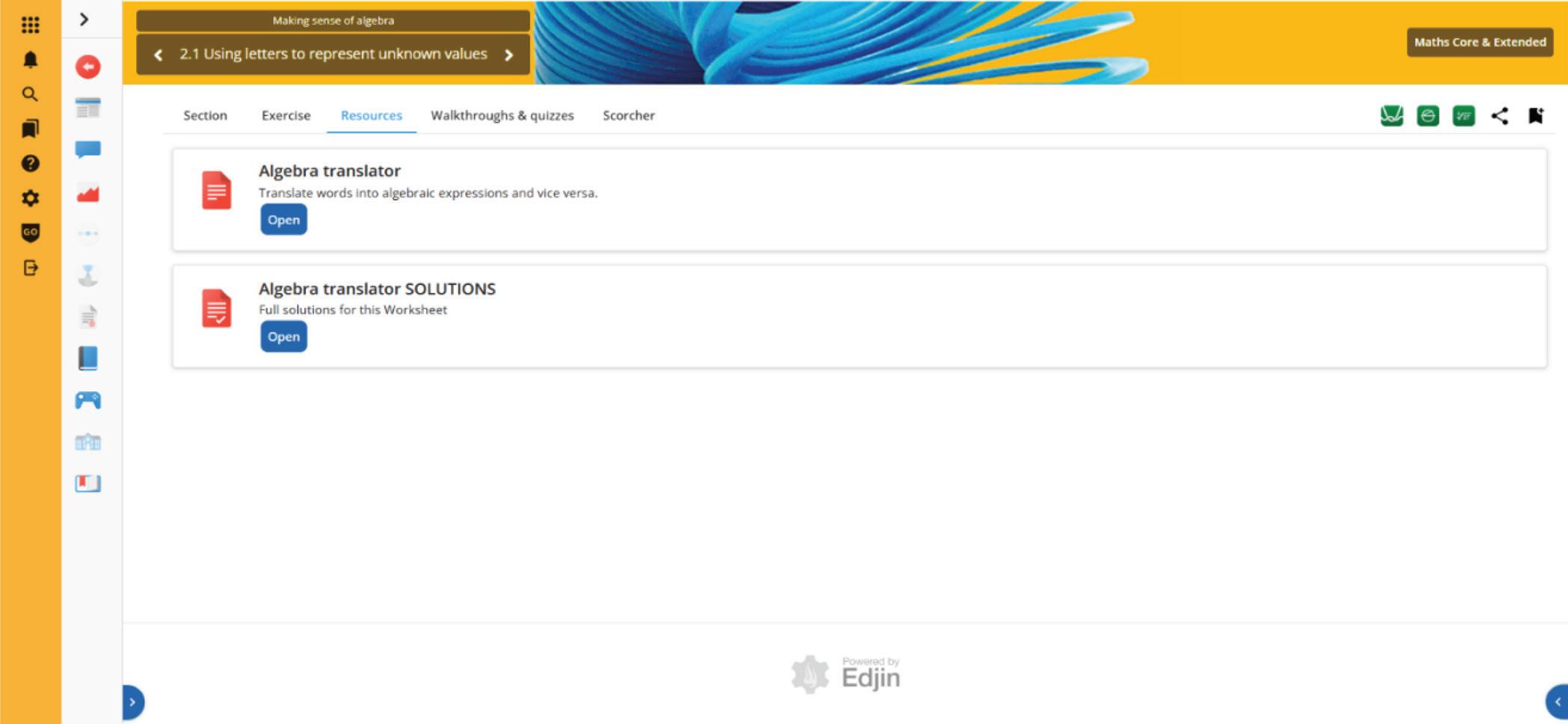
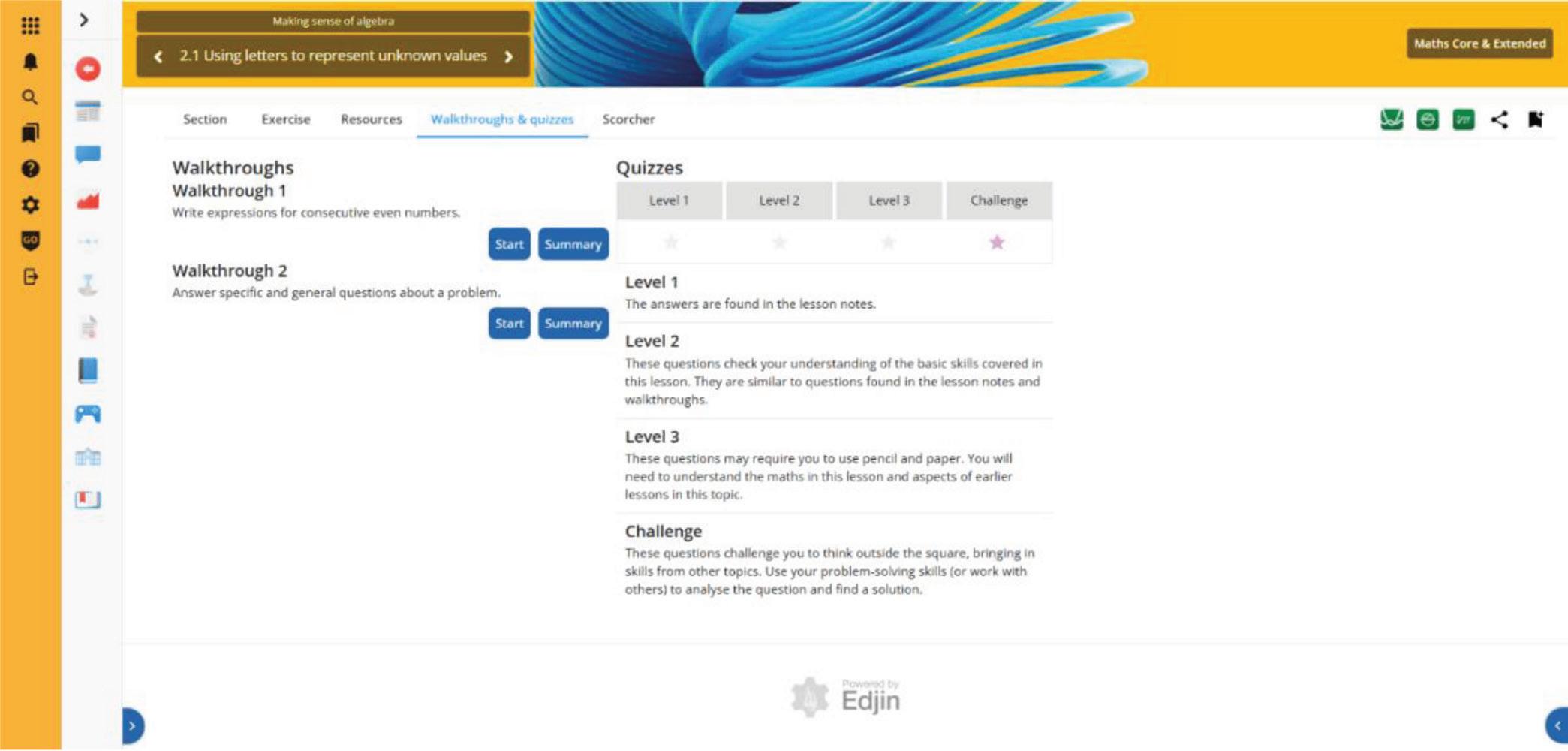
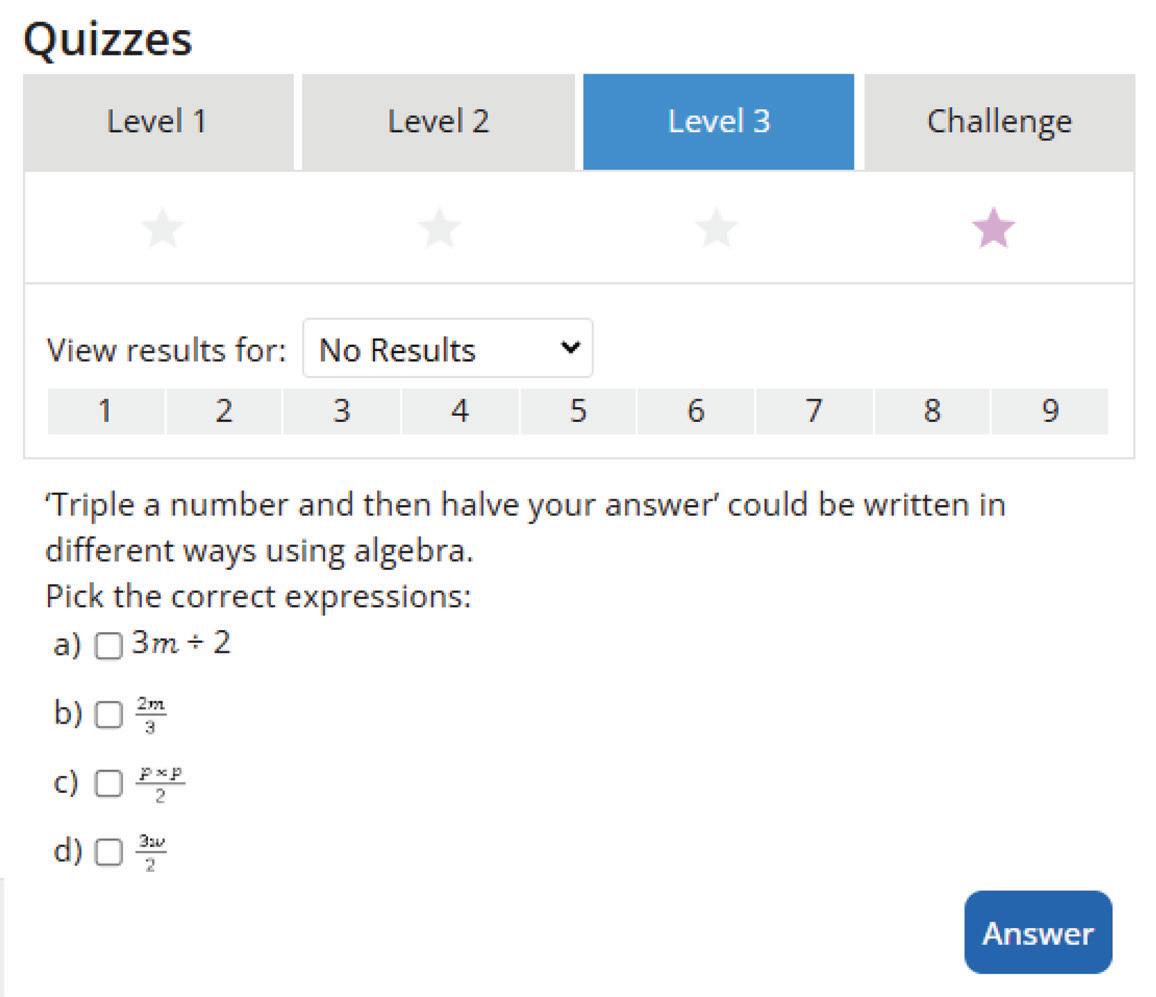
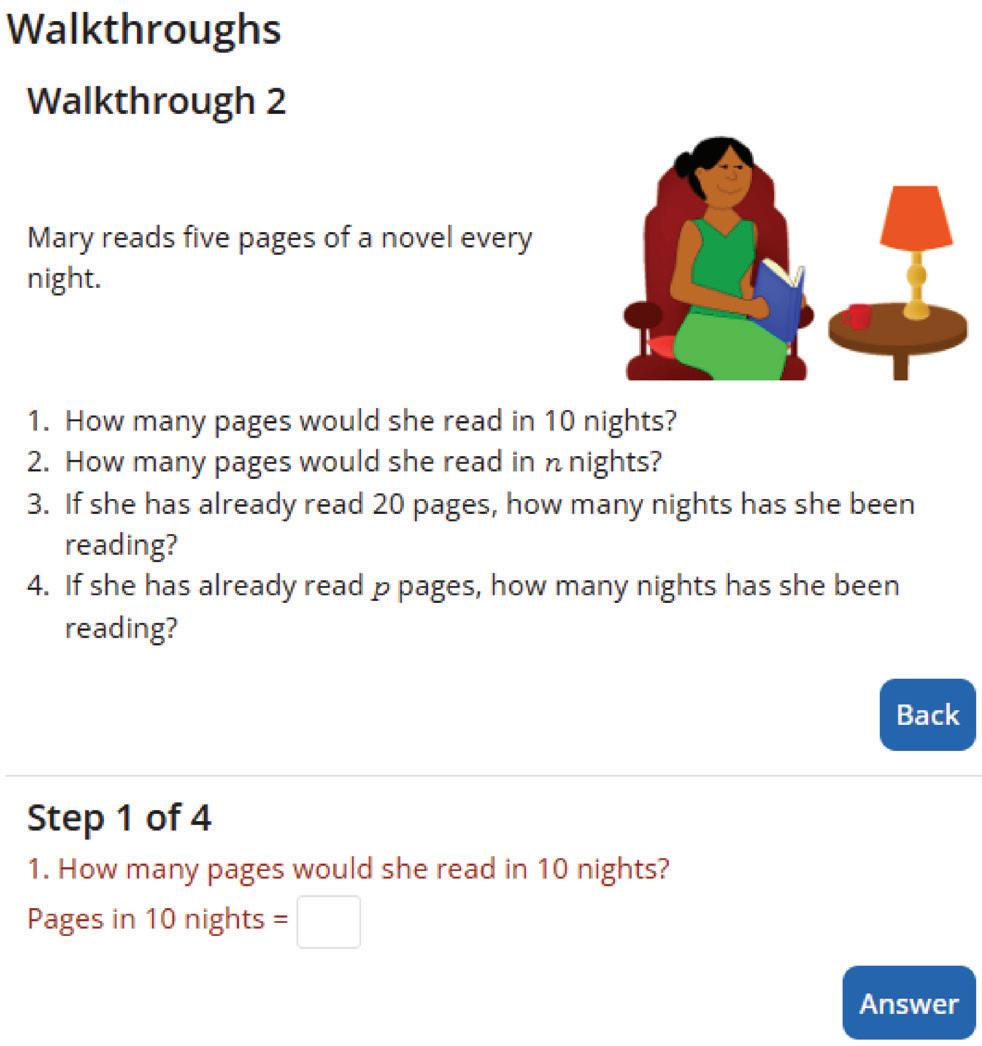
Walkthroughs and Quizzes with different levels of challenge
Games
SAMPLE
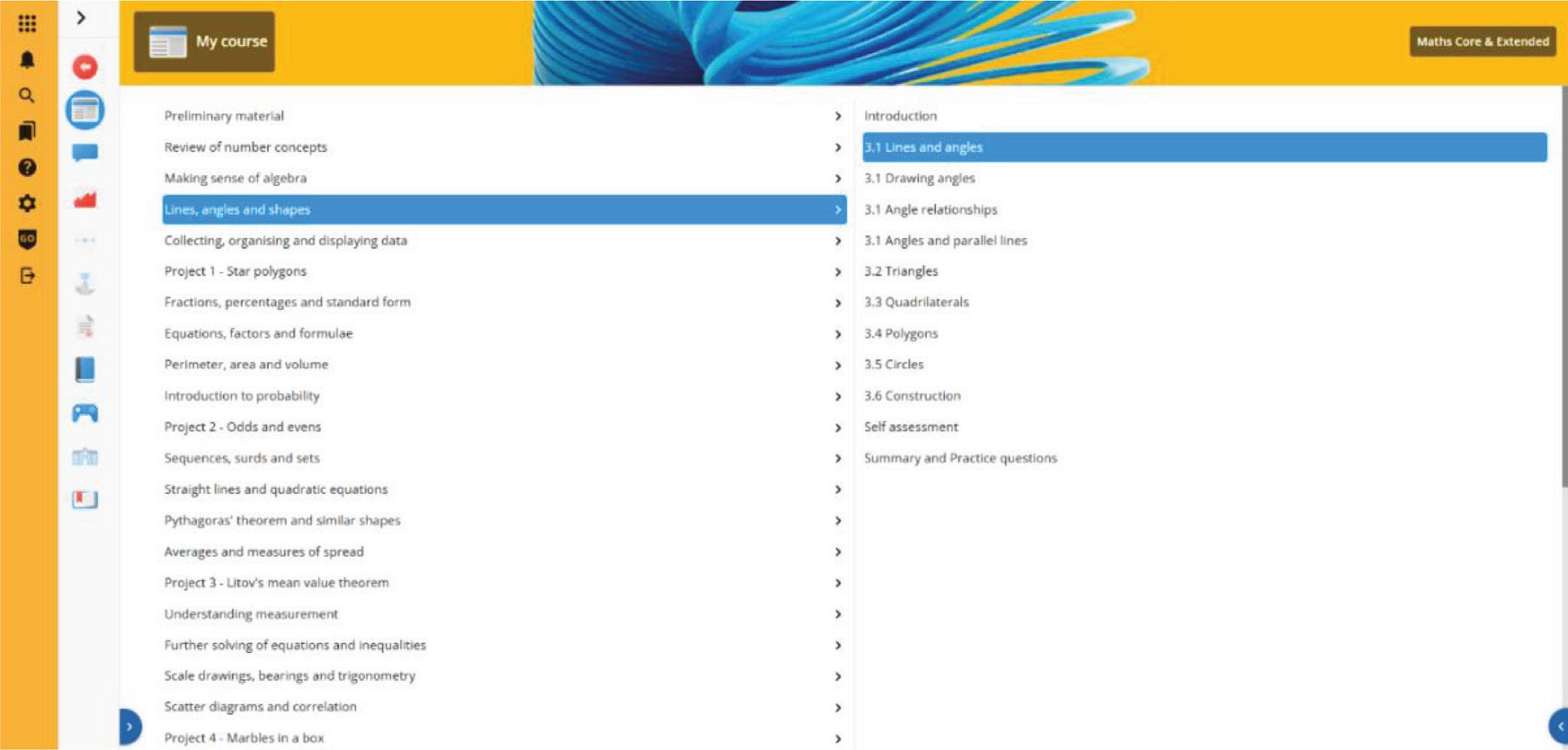
Course contents
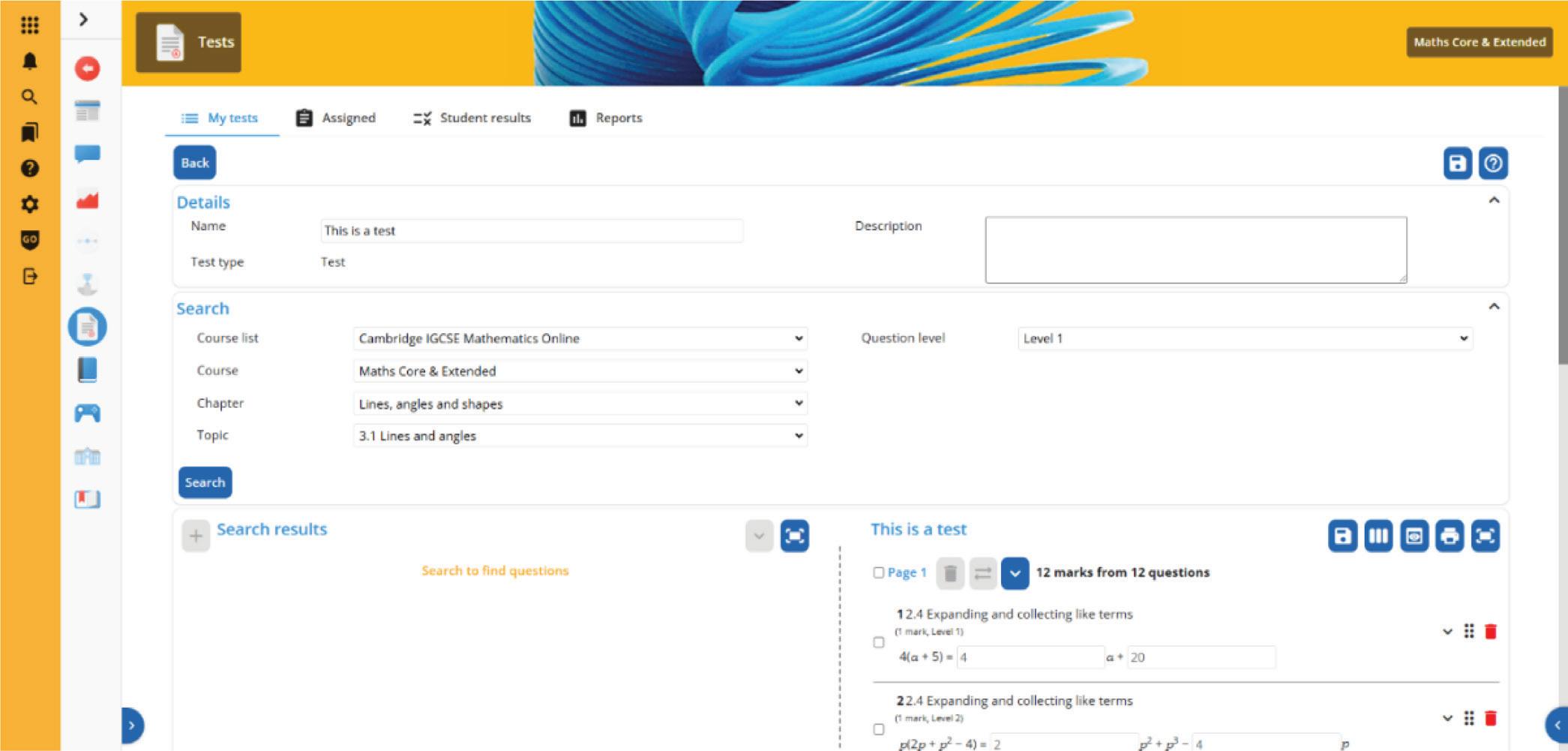
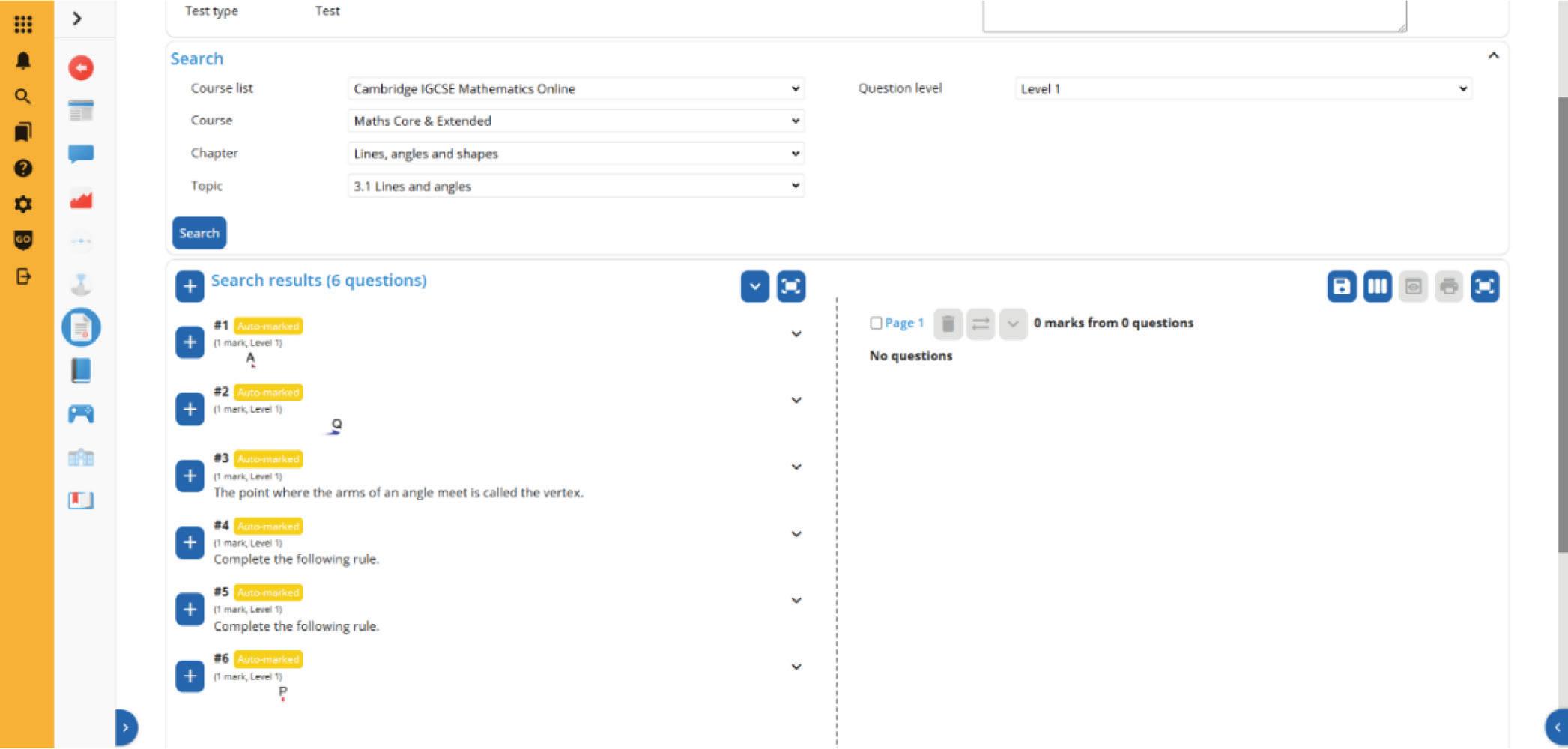
Use the wizard or manually add questions to create tests for your classes.
SAMPLE
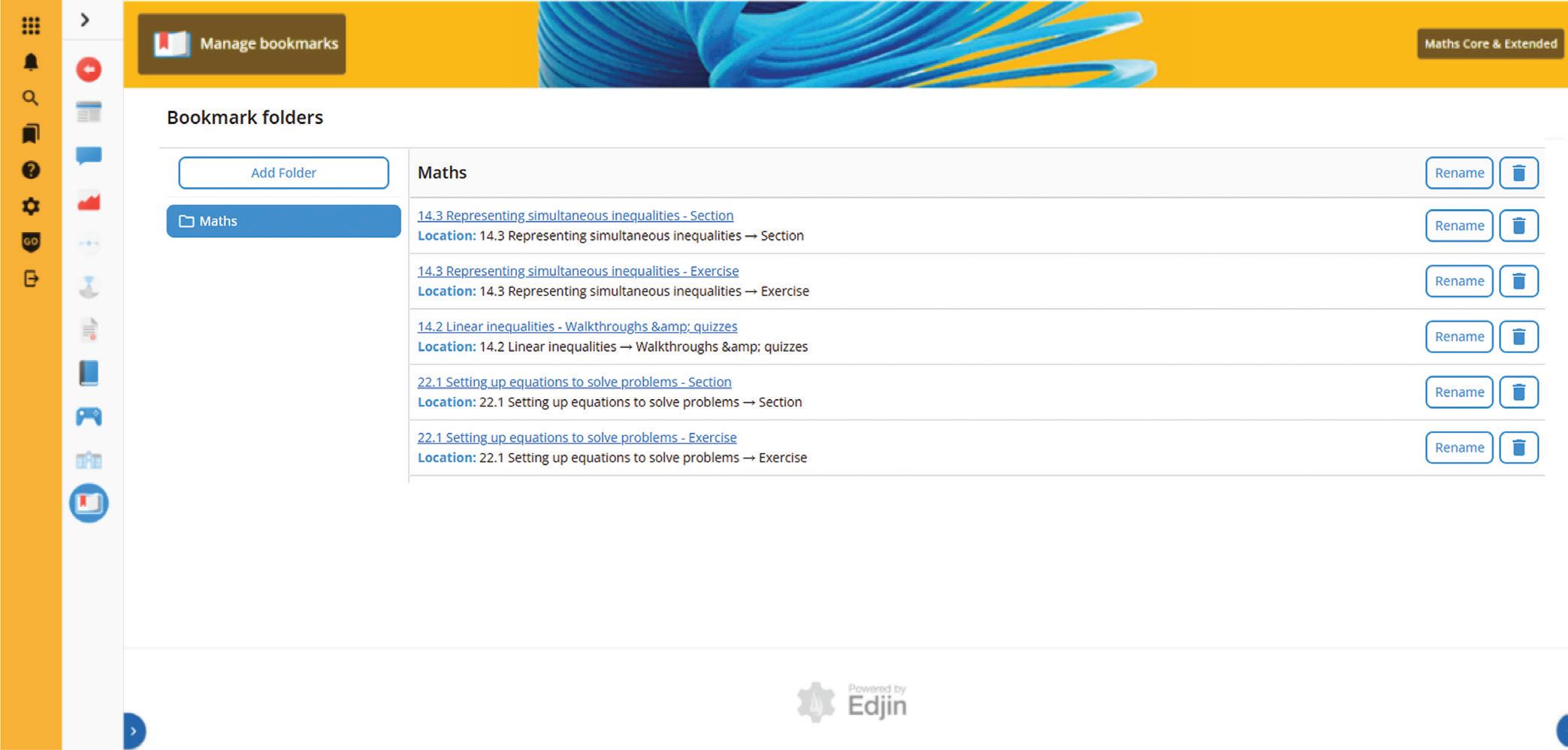
Bookmark
SAMPLE
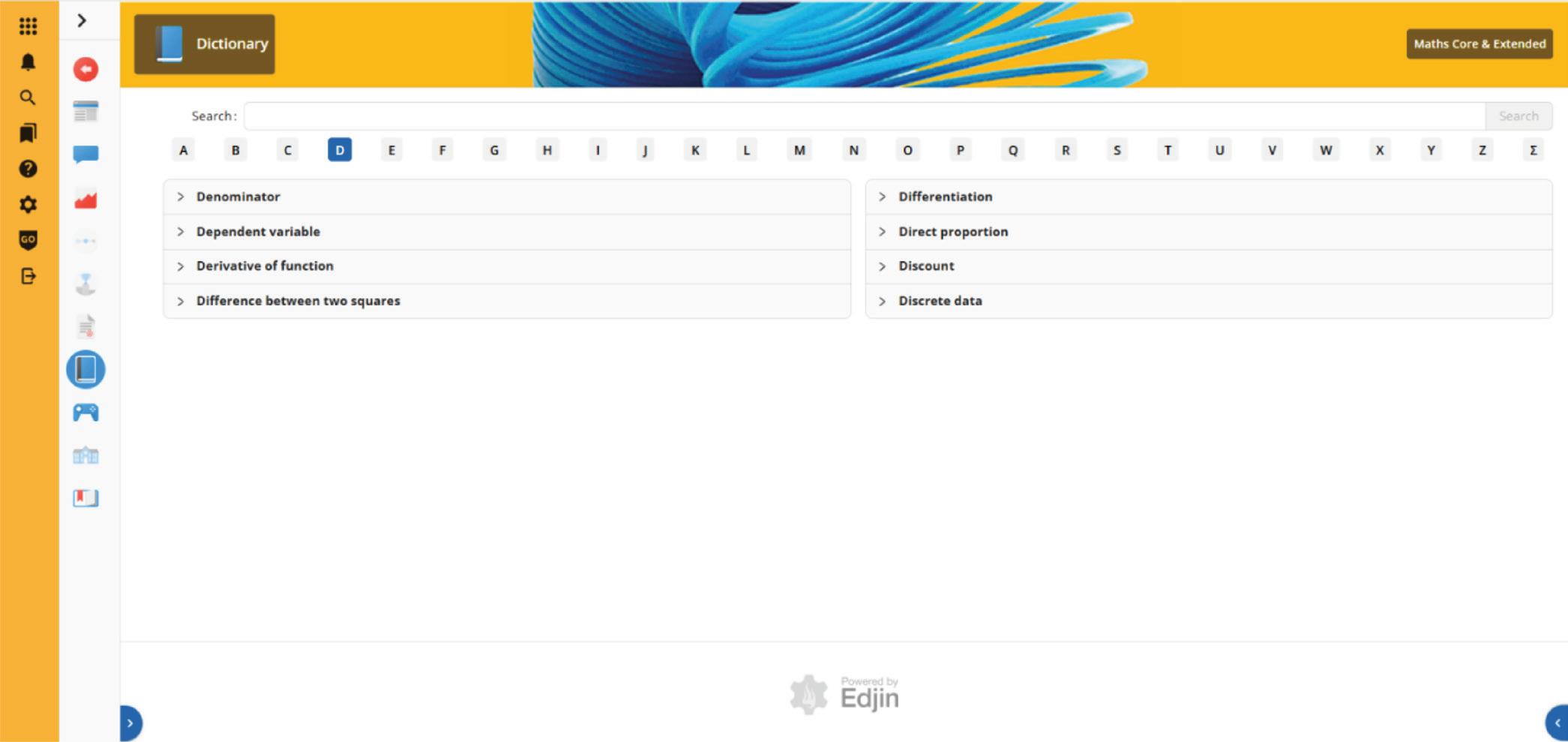
Look up key terms in the Dictionary
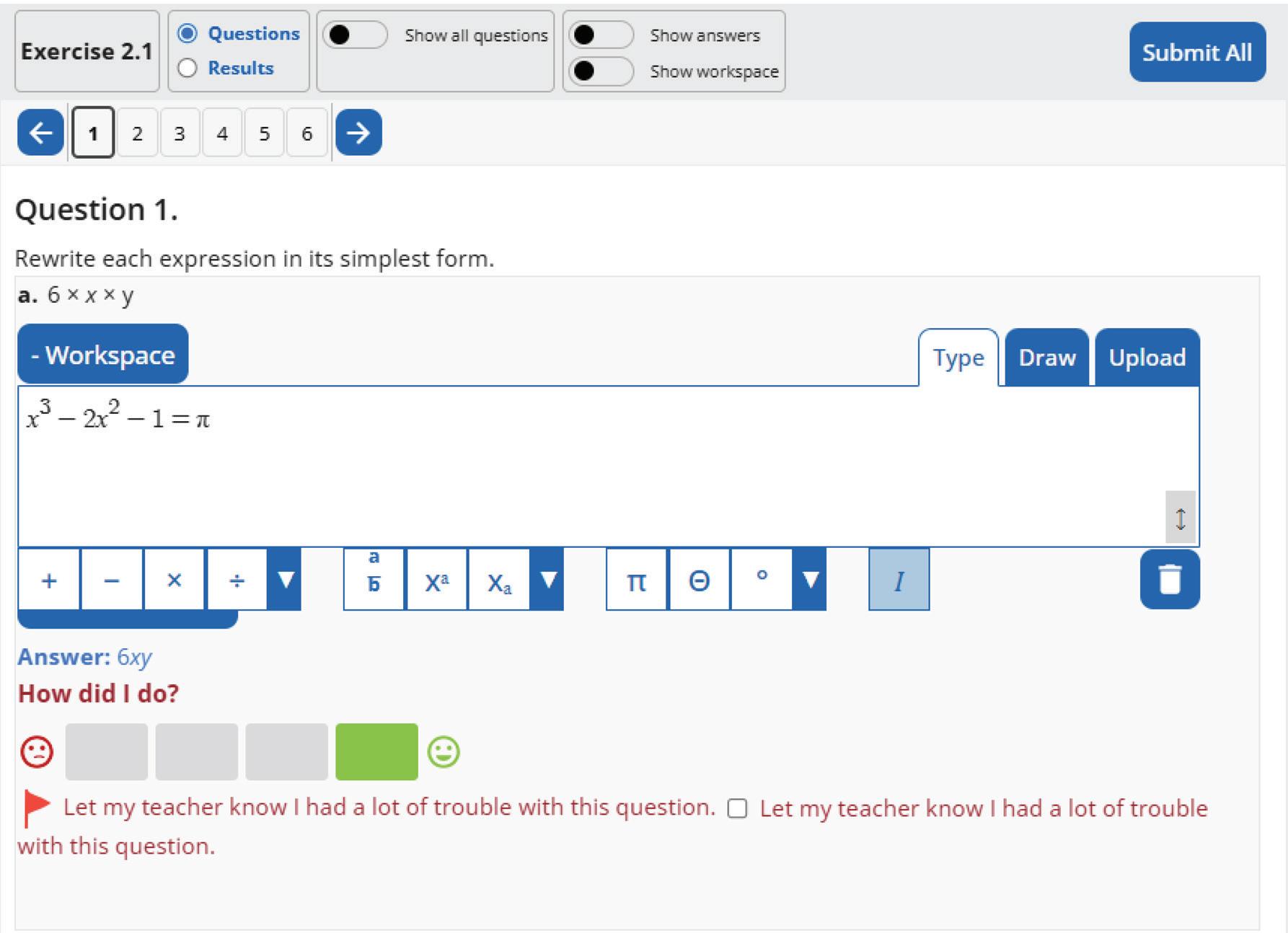
Exercises in detail
Quizzes in detail
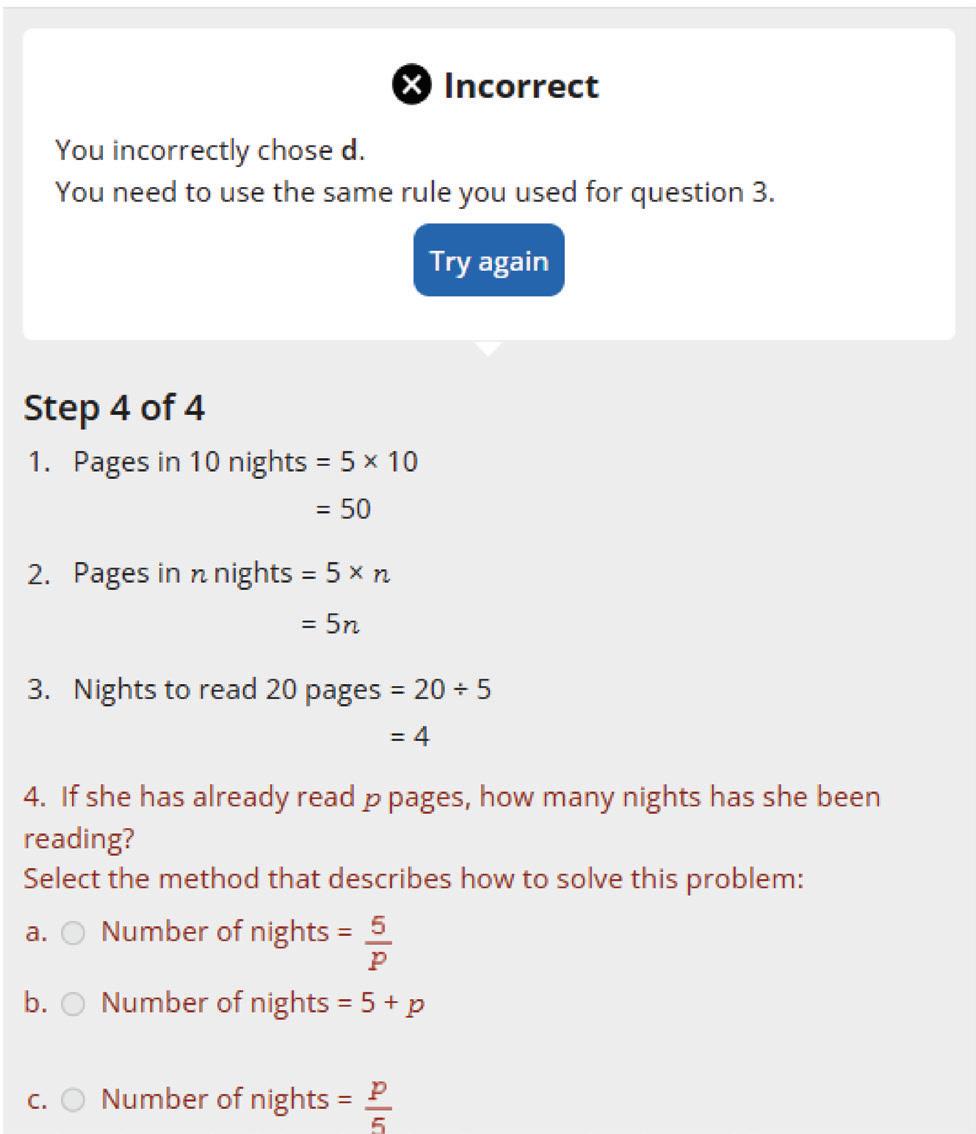
Walkthroughs in detail
SAMPLE
Interactive Worked Examples
SAMPLE
Scorcher – timed quizzes
Cambridge IGCSE™ Mathematics Core and Extended
NEW TO CAMBRIDGE ONLINE MATHEMATICS
TOPICAL PAST PAPERS AND MARK SCHEMES
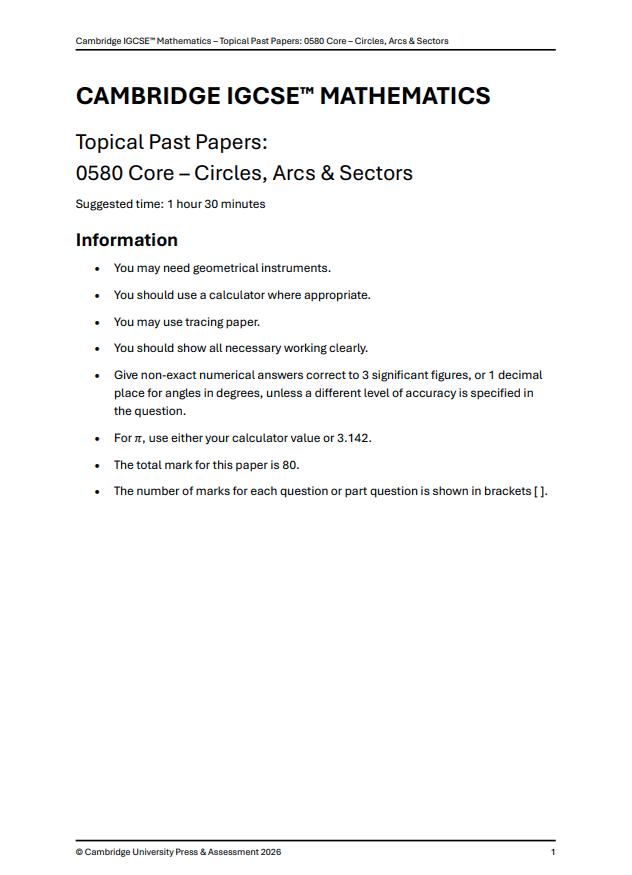
Cambridge IGCSE™ Mathematics: Core − Topical Past Papers
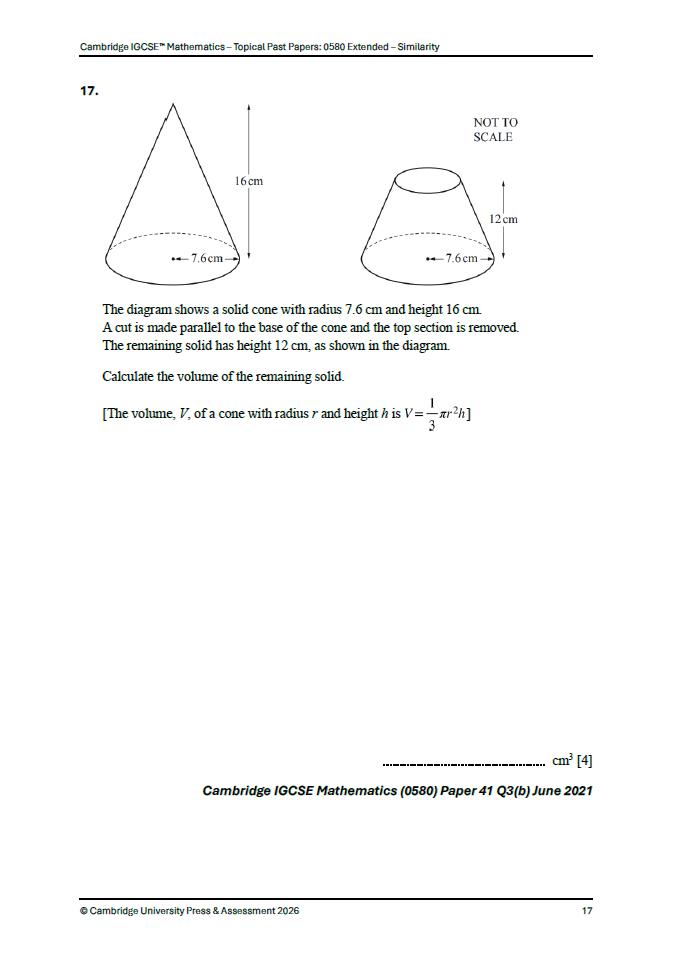
Cambridge IGCSE™ Mathematics: Extended − Topical Past Papers