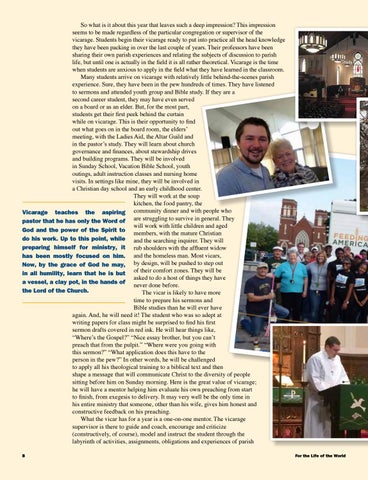
So what is it about this year that leaves such a deep impression? This impression seems to be made regardless of the particular congregation or supervisor of the vicarage. Students begin their vicarage ready to put into practice all the head knowledge they have been packing in over the last couple of years. Their professors have been sharing their own parish experiences and relating the subjects of discussion to parish life, but until one is actually in the field it is all rather theoretical. Vicarage is the time when students are anxious to apply in the field what they have learned in the classroom. Many students arrive on vicarage with relatively little behind-the-scenes parish experience. Sure, they have been in the pew hundreds of times. They have listened to sermons and attended youth group and Bible study. If they are a second career student, they may have even served on a board or as an elder. But, for the most part, students get their first peek behind the curtain while on vicarage. This is their opportunity to find out what goes on in the board room, the elders’ meeting, with the Ladies Aid, the Altar Guild and in the pastor’s study. They will learn about church governance and finances, about stewardship drives and building programs. They will be involved in Sunday School, Vacation Bible School, youth outings, adult instruction classes and nursing home visits. In settings like mine, they will be involved in a Christian day school and an early childhood center. They will work at the soup kitchen, the food pantry, the Vicarage teaches the aspiring community dinner and with people who pastor that he has only the Word of are struggling to survive in general. They will work with little children and aged God and the power of the Spirit to members, with the mature Christian do his work. Up to this point, while and the searching inquirer. They will preparing himself for ministry, it rub shoulders with the affluent widow has been mostly focused on him. and the homeless man. Most vicars, Now, by the grace of God he may, by design, will be pushed to step out in all humility, learn that he is but of their comfort zones. They will be asked to do a host of things they have a vessel, a clay pot, in the hands of never done before. the Lord of the Church. The vicar is likely to have more time to prepare his sermons and Bible studies than he will ever have again. And, he will need it! The student who was so adept at writing papers for class might be surprised to find his first sermon drafts covered in red ink. He will hear things like, “Where’s the Gospel?” “Nice essay brother, but you can’t preach that from the pulpit.” “Where were you going with this sermon?” “What application does this have to the person in the pew?” In other words, he will be challenged to apply all his theological training to a biblical text and then shape a message that will communicate Christ to the diversity of people sitting before him on Sunday morning. Here is the great value of vicarage; he will have a mentor helping him evaluate his own preaching from start to finish, from exegesis to delivery. It may very well be the only time in his entire ministry that someone, other than his wife, gives him honest and constructive feedback on his preaching. What the vicar has for a year is a one-on-one mentor. The vicarage supervisor is there to guide and coach, encourage and criticize (constructively, of course), model and instruct the student through the labyrinth of activities, assignments, obligations and experiences of parish
8
For the Life of the World