INVESTING IN SALT LAKE CITY
Tech start-up Wooly talks the future of commerce in Salt Lake City Commerce is ripe for disruption.
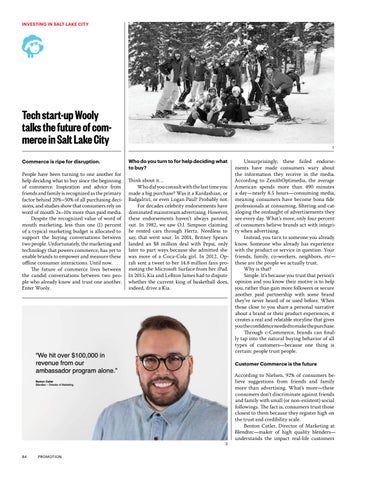
People have been turning to one another for help deciding what to buy since the beginning of commerce. Inspiration and advice from friends and family is recognized as the primary factor behind 20%–50% of all purchasing decisions, and studies show that consumers rely on word of mouth 2x–10x more than paid media. Despite the recognized value of word of mouth marketing, less than one (1) percent of a typical marketing budget is allocated to support the buying conversations between two people. Unfortunately, the marketing and technology that powers commerce, has yet to enable brands to empower and measure these offl ine consumer interactions. Until now. The future of commerce lives between the candid conversations between two people who already know and trust one another. Enter Wooly.
1
Who do you turn to for help deciding what to buy?
Th ink about it… Who did you consult with the last time you made a big purchase? Was it a Kardashian, or Badgalriri, or even Logan Paul? Probably not. For decades celebrity endorsements have dominated mainstream advertising. However, these endorsements haven’t always panned out. In 1982, we saw O.J. Simpson claiming he rented cars through Hertz. Needless to say, that went sour. In 2001, Britney Spears landed an $8 million deal with Pepsi, only later to part ways because she admitted she was more of a Coca-Cola girl. In 2012, Oprah sent a tweet to her 14.8 million fans promoting the Microsoft Surface from her iPad. In 2015, Kia and LeBron James had to dispute whether the current king of basketball does, indeed, drive a Kia.
Unsurprisingly, these failed endorsements have made consumers wary about the information they receive in the media. According to ZenithOptimedia, the average American spends more than 490 minutes a day — nearly 8.5 hours — consuming media, meaning consumers have become bona fide professionals at consuming, fi ltering and cataloging the onslaught of advertisements they see every day. What’s more, only four percent of consumers believe brands act with integrity when advertising. Instead, you turn to someone you already know. Someone who already has experience with the product or service in question. Your friends, family, co-workers, neighbors, etc— these are the people we actually trust. Why is that? Simple. It’s because you trust that person’s opinion and you know their motive is to help you, rather than gain more followers or secure another paid partnership with some brand they’ve never heard of or used before. When those close to you share a personal narrative about a brand or their product experiences, it creates a real and relatable storyline that gives you the confidence needed to make the purchase. Through c-Commerce, brands can finally tap into the natural buying behavior of all types of customers—because one thing is cer tain: people trust people.
Destinations - SLC Wooly
Customer Commerce is the future
2 84
PROMOTION
According to Nielsen, 92% of consumers believe suggestions from friends and family more than advertising. What’s more—these consumers don’t discriminate against friends and family with small (or non-existent) social followings. The fact is, consumers trust those closest to them because they register high on the trust and credibility scale. Benton Cutler, Director of Marketing at Blendtec—maker of high quality blenders— understands the impact real-life customers