the changing face of america
New American Dream
NOV/DEC 2017 | CAPITOL IDEAS
by Katherine Barrett and Richard Greene
12
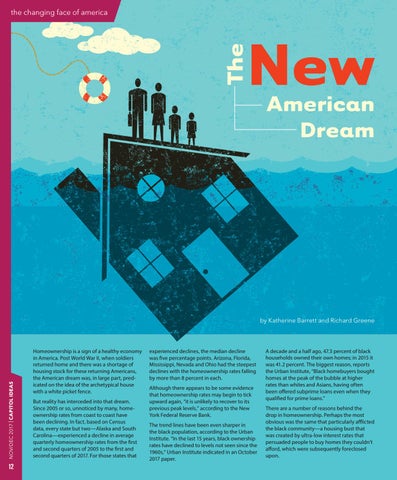
Homeownership is a sign of a healthy economy in America. Post World War II, when soldiers returned home and there was a shortage of housing stock for these returning Americans, the American dream was, in large part, predicated on the idea of the archetypical house with a white picket fence. But reality has interceded into that dream. Since 2005 or so, unnoticed by many, homeownership rates from coast to coast have been declining. In fact, based on Census data, every state but two—Alaska and South Carolina—experienced a decline in average quarterly homeownership rates from the first and second quarters of 2005 to the first and second quarters of 2017. For those states that
experienced declines, the median decline was five percentage points. Arizona, Florida, Mississippi, Nevada and Ohio had the steepest declines with the homeownership rates falling by more than 8 percent in each. Although there appears to be some evidence that homeownership rates may begin to tick upward again, “it is unlikely to recover to its previous peak levels,” according to the New York Federal Reserve Bank. The trend lines have been even sharper in the black population, according to the Urban Institute. “In the last 15 years, black ownership rates have declined to levels not seen since the 1960s,” Urban Institute indicated in an October 2017 paper.
A decade and a half ago, 47.3 percent of black households owned their own homes; in 2015 it was 41.2 percent. The biggest reason, reports the Urban Institute, “Black homebuyers bought homes at the peak of the bubble at higher rates than whites and Asians, having often been offered subprime loans even when they qualified for prime loans.” There are a number of reasons behind the drop in homeownership. Perhaps the most obvious was the same that particularly afflicted the black community—a housing bust that was created by ultra-low interest rates that persuaded people to buy homes they couldn’t afford, which were subsequently foreclosed upon.