obstacles to breastfeeding and on finding ways to alleviate those challenges. She teaches a variety of introductory and advanced courses such as Introduction to Biological Anthropology and Human Health/Disease, Evolutionary Medicine and Human Development/Sexuality. Since graduating from Saint Ben’s, Laura received a grant from the National Science Foundation to complete her research and earned a Ph.D. at the University of Minnesota. She then received a prestigious postdoctoral fellowship at Cornell University. Laura’s professional accomplishments are extraordinary, but they’re just part of the reason why she received the Decade Award. She has been recognized by her peers as a great role model and leader for young alumnae through outstanding achievements, global consciousness and community involvement in her profession.
Innovating the innovators Kari Erpelding Bunkers ’83, Distinguished Alumna Award Kari has noticed a common theme in her efforts since college: She seeks to understand the current state and do what she can to effect positive change. To say that Kari is making a difference in the world is an understatement. She is one of the key influencers and strategists behind one of the world’s top medical institutions. She is a practicing physician and the chief medical information officer at the Mayo Clinic. Kari is in charge of bringing Mayo into the digital future. She also lends her expertise to numerous boards and councils both at Mayo and throughout the greater medical community. Her goal: to create a sustainable model of healthcare for the community and regional practices of Mayo Clinic. Kari has not only made a huge contribution in the medical field, she also carefully balances work with family life and is a great role model to all who know her.
Pioneering civil rights Betty Schneider ’39, Presidents’ Award When Betty Schneider was a student at Saint Ben’s, activist Catherine de Hueck visited the college and spoke about the work she was doing in the poorest neighborhoods of New York City. Betty was inspired to make a difference and wrote to Catherine to ask if she could come and work with her that summer. This was 1937, long before the civil rights movement beckoned a segregated nation to march and dream and mend. Betty went to work with New York’s poor, beginning her long life of service with the Friendship House apostolate in Harlem and later in Chicago. Betty did not wait for a national movement to spotlight the need for interracial justice. She followed an inner calling that told her the time for equality was now and the only way to make it happen was to simply do the work.
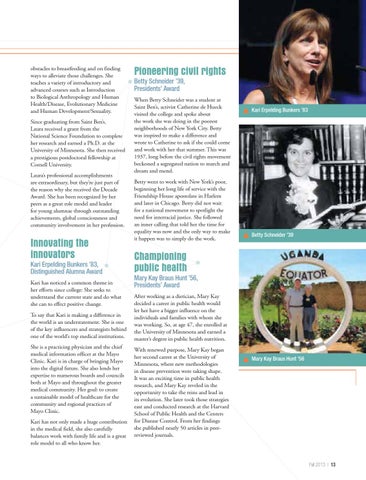
Kari Erpelding Bunkers ’83
Betty Schneider ’39
Championing public health Mary Kay Braus Hunt ’56, Presidents’ Award After working as a dietician, Mary Kay decided a career in public health would let her have a bigger influence on the individuals and families with whom she was working. So, at age 47, she enrolled at the University of Minnesota and earned a master’s degree in public health nutrition. With renewed purpose, Mary Kay began her second career at the University of Minnesota, where new methodologies in disease prevention were taking shape. It was an exciting time in public health research, and Mary Kay reveled in the opportunity to take the reins and lead in its evolution. She later took those strategies east and conducted research at the Harvard School of Public Health and the Centers for Disease Control. From her findings she published nearly 50 articles in peerreviewed journals.
Mary Kay Braus Hunt ’56
Fall 2013 | 13