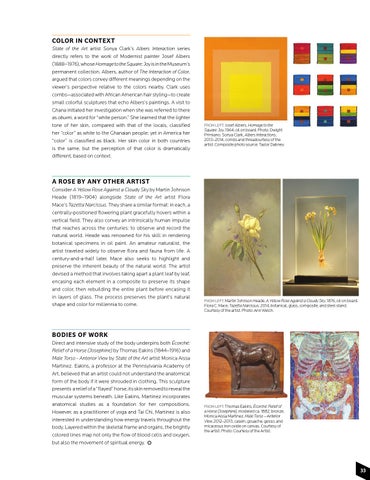
COLOR IN CONTEXT State of the Art artist Sonya Clark’s Albers Interaction series directly refers to the work of Modernist painter Josef Albers (1888–1976), whose Homage to the Square: Joy is in the Museum’s permanent collection. Albers, author of The Interaction of Color, argued that colors convey different meanings depending on the viewer’s perspective relative to the colors nearby. Clark uses combs—associated with African American hair styling—to create small colorful sculptures that echo Albers’s paintings. A visit to Ghana initiated her investigation when she was referred to there as oburni, a word for “white person.” She learned that the lighter tone of her skin, compared with that of the locals, classified her “color” as white to the Ghanaian people; yet in America her “color” is classified as black. Her skin color in both countries is the same, but the perception of that color is dramatically different, based on context.
FROM LEFT: Josef Albers, Homage to the
Square: Joy, 1964, oil on board. Photo: Dwight Primiano. Sonya Clark, Albers Interactions, 2013–2014, combs and threadourtesy of the artist. Composite photo source: Taylor Dabney.
A ROSE BY ANY OTHER ARTIST Consider A Yellow Rose Against a Cloudy Sky by Martin Johnson Heade (1819–1904) alongside State of the Art artist Flora Mace’s Tazetta Narcissus. They share a similar format: in each, a centrally-positioned flowering plant gracefully hovers within a vertical field. They also convey an intrinsically human impulse that reaches across the centuries: to observe and record the natural world. Heade was renowned for his skill in rendering botanical specimens in oil paint. An amateur naturalist, the artist traveled widely to observe flora and fauna from life. A century-and-a-half later, Mace also seeks to highlight and preserve the inherent beauty of the natural world. The artist devised a method that involves taking apart a plant leaf by leaf, encasing each element in a composite to preserve its shape and color, then rebuilding the entire plant before encasing it in layers of glass. The process preserves the plant’s natural shape and color for millennia to come.
FROM LEFT: Martin Johnson Heade, A Yellow Rose Against a Cloudy Sky, 1876, oil on board.
Flora C. Mace, Tazetta Narcissus, 2014, botanical, glass, composite, and steel stand. Courtesy of the artist. Photo: Ann Welch.
BODIES OF WORK Direct and intensive study of the body underpins both Écorché: Relief of a Horse (Josephine) by Thomas Eakins (1844–1916) and Male Torso - Anterior View by State of the Art artist Monica Aissa Martinez. Eakins, a professor at the Pennsylvania Academy of Art, believed that an artist could not understand the anatomical form of the body if it were shrouded in clothing. This sculpture presents a relief of a “flayed” horse, its skin removed to reveal the muscular systems beneath. Like Eakins, Martinez incorporates anatomical studies as a foundation for her compositions. However, as a practitioner of yoga and Tai Chi, Martinez is also interested in understanding how energy travels throughout the body. Layered within the skeletal frame and organs, the brightly colored lines map not only the flow of blood cells and oxygen, but also the movement of spiritual energy.
FROM LEFT: Thomas Eakins, Écorché: Relief of a Horse (Josephine), modeled ca. 1882, bronze. Monica Aissa Martinez, Male Torso – Anterior View, 2012–2013, casein, gouache, gesso, and micaceous iron oxide on canvas. Courtesy of the artist. Photo: Courtesy of the Artist.
33