Cry of the Hawk
Opinion/Editorial - Page 2
October 29, 2018
Swimming in whirlpool of garbage; Plastic trash consumes vast ocean EDITORIAL Coffee cups. Water bottles. Soda bottles. Straws. These everyday items can become deadly to the environment when they are not disposed of properly or recycled. According to Greenpeace, the world produces 260 million tons of plastic every year. Of this, 10% ends up in the ocean every year. 70 percent of this plastic sinks and everything else is left on top of the water. But how did it get this bad? In the late ‘60s and early ‘70s, scientists first started noticing the abundance of plastic in places where it should not be, according to britannica.com. The Science History Institute says
that around 1980, people became more suspicious about plastic. Although very useful, it began getting a negative reputation as people learned it pretty much does not decompose. To change this reputation, recycling plastic was developed. Although this process is very helpful with reusing plastic and limiting it from polluting the planet, “a whopping 91% of plastic is not recycled,” according to National Geographic. Plastic and other waste found in the environment has detrimental effects on wildlife. Although it is portrayed often to the public, like the penguin in “Happy Feet” with a soda holding ring around his neck, or the infamous video
of the sea turtle with a plastic straw stuck in its nose, filmed by marine biologist Christine Figgener, according to Time.
A Whopping 91% of Plastic Isn’t Recycled. - National Geographic
That video received so much attention, it helped start a ban on plastic straw, and help endorse reusable ones made of metal or paper straws. Based on the National Geographic, there has been
approximately 8.3 billion metric tons of plastic produced in the few decades it has been prevalent. Most of his plastic is ending up in the trash. Because plastic is petroleum based, it doesn’t decompose, or go away, like other materials can according to howstuffworks.com. In order to decompose, plastic needs sunlight to decompose, which does not come easily, and takes about 400 years. According to The Guardian, if plastic is thrown into the ocean from the coast of China, it can end up near the US coast.India produces a lot of the world’s plastic. The waste in their water can end up near the coasts of Madagascar or Bengal. Many companies however are
fighting plastic. Organizations like the Ocean Conservancy, go to some of many of the places that plastic in oceans ends up. These trips include taking volunteers to locations to clean up the acts of many. Students can take action in many ways. This includes simply cutting down on garbage production, and recycling more. Education about the environment and the horrific impact of plastic and waste being in the wrong spot can aid. Donations and volunteer work to clean up can help too. If people do not take action and take responibility, there will be no tomorrow. The world will be overrun, overpopulated, and overtaken with a material people created themselves.
Race for MD governorship heats up The art of listening: Closing mouths, opening ears
ALEAH BICKLE Reporter
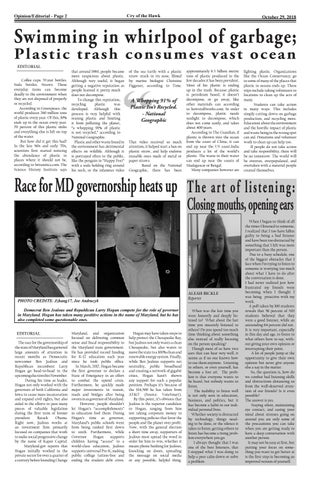
PHOTO CREDITS: Jzhang17, Joe Andrucyk Democrat Ben Jealous and Republican Larry Hogan compete for the role of governor in Maryland. Hogan has taken many postitive actions in the name of Maryland, but he has also completed some questionable ones. EDITORIAL The race for the governorship of the state of Maryland has garnered large amounts of attention in recent months as Democratic newcomer Ben Jealous and Republican incumbent Larry Hogan go head-to-head in the upcoming election this November. During his time as leader, Hogan not only worked with the governors of both California and Iowa to cease mass incarceration and expand civil rights, but also aided in the efforts to pass many pieces of valuable legislation during the first term of former president Barack Obama. Right now, Jealous works at an investment firm primarily focused on companies that work to make social progressive change by the name of Kapor Capital. Maryland.gov reports that Hogan initially worked in the private sector for over a quarter of a century before founding Change
Maryland, and organization focused on delivering common sense and fiscal responsibility to the Maryland state government. He has provided record funding for K-12 education each year since he took public office. In March, 2017, Hogan became the first governor to declare a State of Emergency in an effort to combat the opioid crisis. Furthermore, he quickly made major investments in transit, roads and bridges after being sworn in as governor of Maryland. However, people shouldn’t let Hogan’s “accomplishments” in education fool them. During Hogan’s time as governor, Maryland’s public schools went from being ranked first down to sixth. Furthermore, while Governor Hogan supports children having “access” to a world-class education, Jealous supports universal Pre-K, making public college tuition-free and ending the student debt crisis.
Hogan may have taken steps to help protect the Chesapeake Bay, but Jealous not only wants a clean Chesapeake, but also wants to move the state to a 100% clean and renewable energy system. Finally, while Ben Jealous supports net neutrality, public broadband and creating a network of gigabit cities, Hogan hasn’t shown any support for such a popular position. Perhaps it’s because of the $14,500 he has taken from AT&T (Source: VoteSmart). By this point, it’s obvious that Jealous is the superior candidate to Hogan, ranging from him not taking corporate money to supporting policies that favor the people and the planet over profit. Now, with the general election a short time away, supporters of Jealous must spread the word in order for him to win, whether it means phone banking for Jealous, knocking on doors, spreading the message on social media or any possible, helpful thing.
When was the last time you were honestly and deeply listened to? What about the last time you sincerely listened to others? Do you spend too much time thinking about something else instead of really focusing on the person speaking? Though most of us have two ears that can hear very well, it seems as if no one knows how to use them anymore. Listening to others, or even yourself, has become a lost art. The problem is that everyone wants to be heard, but nobody wants to listen. The inability to listen well is not only seen in education, business, and politics, but it has become a habit in our individual personal lives. Whether society is distracted by technology, things needing to be done, or the silence it takes to listen, getting others to listen has become a rising problem everywhere you go. I always thought that I was one of the best listeners, that I stopped what I was doing to help a peer calm down or solve a problem.
When I began to think of all the times I listened to someone, I realized that I too have fallen guilty to being a bad listener and have been too distracted by something that I felt was more important than the person. Due to a busy schedule, one of the biggest obstacles that I face when I’m trying to listen to someone is worrying too much about what I have to do after the conversation is done. I had never realized just how frustrated my friends were becoming when I thought I was being proactive with my work. A poll taken by 100 students reveals that 56 percent of NH students believed that they were a good listener, while an astounding 64 percent did not. It is very important, especially in this day and age, to listen to what others have to say, without giving your own opinion or interrupting their point. A lot of people jump at the opportunity to give their own opinion but never give anyone else a say in the matter. So, the question is, how do we combat bad listening skills and distractions distancing us from the well-deserved attention of our friends? Is it even possible? The answer is yes. Staying silent, maintaining eye contact, and easing your mind about stresses going on around you are only some of the precautions you can take when you are getting ready to have a deep conversation with another person. It may not be easy at first, but putting your focus on something you want to get better at is the first step in becoming an improved version of yourself.