6
|
ESV STUDY BIBLE
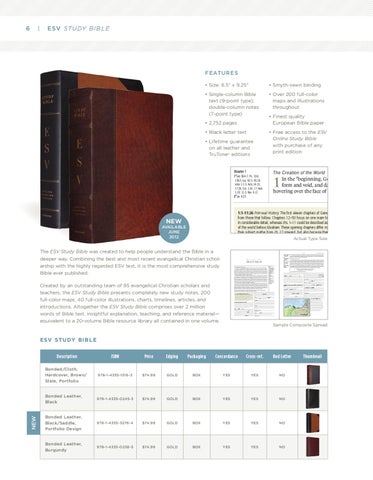
FE AT U RE S • Size: 6.5" x 9.25"
• Smyth-sewn binding
•S ingle-column Bible text (9-point type); double-column notes (7-point type)
•O ver 200 full-color maps and illustrations throughout •F inest quality European Bible paper
• 2,752 pages
Genesi
• Black letter text
•F ree access to the ESV Online Study Bible with purchase of any print edition
•L ifetime guarantee on all leather and TruTone® editions
Chapter 1 1aJob 38:4-7; Ps. 33:6; 136:5; Isa. 42:5; 45:18; John 1:1-3; Acts 14:15; 17:24; Col. 1:16, 17; Heb. 1:10; 11:3; Rev. 4:11 2bJer. 4:23
The Creation of the World
form and void, and darkness was over the f 1 hovering over the face of the waters.
In the a beginning, God created the heaven
1:1–11:26 Primeval History. The first eleven chapters of Genesis differ from those that follow. Chapters 12–50 focus on one main family line NEW in considerable detail, whereas chs. 1–11 could be described as a survey AVAILABLE of the world before Abraham. These opening chapters differ not only in JUNE their subject matter from ch. 12 onward, but also because there are no 2012 real parallels to the patriarchal stories inActual other literatures. In contrast to Type Size the patriarchal stories, however, other ancient nonbiblical stories do exist recounting stories about both creation and the flood. The existence of such stories, however, does not in any way challenge the authority or The ESV Study Bible was created to help people understand the Bible in a the inspiration of Genesis. In fact, the nonbiblical stories stand in sharp deeper way. Combining the best and most recent evangelical Christian scholMatthew contrast to the biblical account, and thus help readers appreciate the arship with the highly regarded ESV text, it is the most comprehensive study unique nature and character of the biblical accounts of creation and the 1 flood. In other ancient literary traditions, creation is a great struggle often Bible ever published. involving conflict between the gods. The flood was sent because the gods could not stand the noise made by human beings, yet they could not Created by an outstanding team of 95 evangelical Christian scholars and control it. Through these stories the people of the ancient world learned their traditions about the gods they worshiped and the way of life that teachers, the ESV Study Bible presents completely new study notes, 200 people should follow. Babylonian versions of creation and flood stories full-color maps, 40 full-color illustrations, charts, timelines, articles, and were designed to show that Babylon was the center of the religious universe and that its civilization was the highest achieved by mankind. introductions. Altogether the ESV Study Bible comprises over 2 million Reading Genesis, readers can see that it is designed to refute these deluwords of Bible text, insightful explanation, teaching, and reference material— sions. There is only one God, whose word is almighty. He has only to speak and the world comes into being. The sun and moon are not gods in their equivalent to a 20-volume Bible resource library all contained in one volume. own right, but are createdSample by the one God. This God does not need feeding Composite Spread by man, as the Babylonians believed they did by offering sacrifices, but he supplies man with food. It is human sin, not divine annoyance, that prompts the flood. Far from Babylon’s tower (Babel) reaching heaven, it became a E SV ST UDY B I B L E reminder that human pride could neither reach nor manipulate God. These principles, which emerge so clearly in Genesis 1–11, are truths that run through the rest of Scripture. The unity of God is fundamental Description ISBN Price Edging Packaging Concordanceto biblical Cross-ref. Letter power, his Thumbnail theology, as isRed his almighty care for mankind, and his judgment on sin. It may not always be obvious how these chapters relate to geology and archaeology, but their theological message is very Bonded/Cloth, clear. ReadYES in their intended sense, 978-1-4335-1516-3 $74.99 GOLD BOX YES NO they provide the fundamental presupHardcover, Brown/ positions of the rest of Scripture. These chapters should act as eyeglasses, Slate, Portfolio so that readers focus on the points their author is making and go on to read the rest of the Bible in light of them. Matthew 1:23
18 21
17tch. 2:4; 11:2; 16:16; 22:42; 23:10; Mark 8:29; Luke 3:15; [John 1:41; 4:25] 18uver. 1; Mark 1:1; John 1:17; 17:3; [ver. 16] vLuke 1:27 wLuke 1:35 19x[Deut. 24:1] 20 y ch. 2:13, 19; [ch. 2:12, 22] 21zver. 25; Luke 1:31; 2:21 a Luke 2:11; Acts 4:12; 5:31; 13:23, 38; [Acts 3:26] 22bch. 21:4; 26:56; John 19:36 cch. 2:15, 23; 4:14; Mark 14:49 23dCited from Isa. 7:14 e Isa. 8:8, 10
The Gospel AccordinG To
Chapter 1 1a[Luke 3:23-38] b2 Sam. 7:12-16; Ps. 132:11; Isa. 11:1; Jer. 23:5; Luke 1:32, 69; John 7:42; Acts 2:30; 13:23; Rom. 1:3; 2 Tim. 2:8; Rev. 22:16 cGen. 22:18; Gal. 3:16 2dGen. 21:3 eGen. 25:26 f Gen. 29:35 3g[Ruth 4:18-22; 1 Chr. 2:1-15] 5hJosh. 6:25 6i1 Sam. 16:1; 17:12 j 2 Sam. 12:24 k2 Sam. 12:10 7lFor ver. 7-10, see 1 Chr. 3:10-14 8m[2 Kgs. 15:1; 1 Chr. 3:11, 12] 11n1 Chr. 3:15, 16 oEsth. 2:6; Jer. 24:1; 27:20 12p1 Chr. 3:17-19 qLuke 3:27 rEzra 3:2 16sLuke 3:23
The Genealogy of Jesus Christ
a The book of the genealogy of Jesus Christ, b the son of David, c the son of Abraham. 2 dAbraham was the father of Isaac, and e Isaac the father of Jacob, and f Jacob the father of Judah and his brothers, 3 and g Judah the father of Perez and Zerah by Tamar, and Perez the father of Hezron, and Hezron the father of Ram,1 4 and Ram the father of Amminadab, and Amminadab the father of Nahshon, and Nahshon the father of Salmon, 5 and Salmon the father of Boaz by h Rahab, and Boaz the father of Obed by Ruth, and Obed the father of Jesse, 6 and i Jesse the father of David the king. And j David was the father of Solomon by k the wife of Uriah, 7 and l Solomon the father of Rehoboam, and Rehoboam the father of Abijah, and Abijah the father of Asaph,2 8 and Asaph the father of Jehoshaphat, and Jehoshaphat the father of Joram, m and Joram the father of Uzziah, 9 and Uzziah the father of Jotham, and Jotham the father of Ahaz, and Ahaz the father of Hezekiah, 10 and Hezekiah the father of Manasseh, and Manasseh the father of Amos,3 and Amos the father of Josiah, 11 and n Josiah the father of o Jechoniah and his brothers, at the time of the deportation to Babylon. 12 And after the deportation to Babylon: p Jechoniah was the father of q Shealtiel,4 and r Shealtiel the father of Zerubbabel, 13 and Zerubbabel the father of Abiud, and Abiud the father of Eliakim, and Eliakim the father of Azor, 14 and Azor the father of Zadok, and Zadok the father of Achim, and Achim the father of Eliud, 15 and Eliud the father of Eleazar, and Eleazar the father of Matthan, and Matthan the father of Jacob, 16 and Jacob the father of s Joseph the husband of Mary, of whom Jesus was born, who is called Christ.
1:1 The book of the genealogy. The Gospel’s opening words carried special significance for a Jewish audience, whose ancestry was inseparably intertwined with the covenants God made with Israel. Jesus (Gk. Iēsous) was the historical, everyday name, and is Yeshua‘ /Yehoshua‘ (Joshua) in Hebrew, meaning “Yahweh saves” (Neh. 7:7; cf. Matt. 1:21). Christ (Gk. Christos, from Hb. mashiakh, “anointed”) points back to David as the anointed king of Israel. The designation “Messiah” came to summarize several strands of OT expectation, especially the promise of an “anointed one” who would righteously rule God’s people (2 Sam. 7:11b–16). Son of David evoked images of a
23
Joseph and Mary travel to Bethlehem
Joseph, Mary, and Jesus escape to Egypt
Joseph, Mary, and Jesus return to Nazareth
Gaza
NEW
Bonded Leather, Black
978‑1‑4335‑0245‑3
$74.99
GOLD
BOX
Bonded Leather, Black/Saddle, Portfolio Design
978-1-4335-3276-4
$74.99
GOLD
BOX
Bonded Leather, Burgundy
978-1-4335-0238-5
$74.99
GOLD
BOX
YES
YES
20
30
40
50
20
30
50
50
60
75
40
70
100
50
75
60
100
80
90
125
70
80
125
100
150
90
110
120
175
100
150
110
175
130
200
120
140
150
225
130
200
140
225
Daphnae
160
170
0 0
50
50
Jesus’ Birth and Flight to Egypt As the time drew near for Jesus to be born, a mandatory Roman census made it necessary for Joseph to return to his ancestral home of Bethlehem. There Mary gave birth to Jesus, and later, wise men from the east came to worship him. The wise men’s recognition of a new king, however, troubled King Herod and the ruling establishment in Jerusalem, and Herod sought to kill Jesus. Joseph and his family escaped to Egypt and remained there until Herod died. When they returned to Palestine, they settled in the remote district of Galilee, where Jesus grew up in the northern village of Nazareth, to avoid the attention of the rulers in Jerusalem.
100 mi
100
150 km
6/25/08 5:54:17 PM
Miles
Km
160
250
N A B AT E A
Petra
250
150
Jerusalem Bethlehem
Beersheba
EGYPT
Memphis
map.40-2.indd 45
25
PALESTINE
Me d i t e r ra n ea n Sea
1:16–17 Jesus is the rightful legal heir to the covenant promises associated
25
Nazareth Caesarea
Alexandria
1:12 The evil of Jechoniah (2 Kings 24:8–9) was so great that his line was cursed (Jer. 22:30). While a natural, biological son could not therefore inherit the throne, the legal claim could still come through Jechoniah’s line.
10
1:23 the virgin. The Greek word parthenos (“virgin”) corresponds to the Hebrew term ‘almah, which is used in the prophecy of Isa. 7:14 regarding the virgin birth of the coming Savior (see note on Isa. 7:14). The Hebrew word ‘almah (“virgin” or “maiden”) generally denotes an unmarried woman who is a virgin (e.g., Gen. 24:43; Ex. 2:8; Ps. 68:25). The prophecy in Isaiah 7:14
***MATTHEW, MAP 2 [L] 2. (MATTHEW 2:1)
1:12–13 Zerubbabel led the first group given permission to return to Israel from the exile.
10
1:20 Behold represents Greek idou, used frequently by Matthew to signal emphasis, prompt the reader to pay special attention, or introduce something new or unusual. The angel of the Lord is Gabriel (cf. Luke 1:26).
1:21 The name Jesus was given to sons as a symbolic hope for the Lord’s anticipated sending of salvation through a Messiah who would purify his people and save them from oppression (see note on v. 1). But the angel points to a more important theme: to save his people from their sins. Salvation from sins was a repeated promise in OT prophets (e.g., Isa. 40:2; 53:6; Jer. 31:31–34; Ezek. 36:25–27; Dan. 9:24; Zech. 13:1). 1:22 All this took place to fulfill. This is Matthew’s “fulfillment formula,” by which he points to an event or teaching of Jesus that fulfills an OT passage, indicating: (1) a direct prediction-fulfillment (e.g., vv. 22–23); (2) the intended full meaning of the OT Scripture (e.g., 5:17–20); or (3) a divinely orchestrated analogical/typological correspondence to Israel’s history (e.g., 2:15, 17–18).
1:18 Mary had been betrothed to Joseph. The custom of betrothal was different from “engagement” in modern society. Customarily the parents of a young man chose a young woman to be engaged to their son. A second stage of betrothal involved official arrangements and a prenuptial agreement before witnesses, which was a legally binding contract and could be broken only by a formal process of divorce. found to be with child. Mary is about four months pregnant, having spent three months with Elizabeth, her “relative” (Luke 1:36, 56).
1:6b–11 Matthew may have drawn from 1 Chron. 3:10–14, since both genealogies omit several kings found in the narrative of Kings and Chronicles. Omitting names in a genealogy was common to make for ease of memorization. One is struck in this section by the alternately godly and wicked kings who ruled Israel.
Km 0
though they were not yet considered to be married, and having sexual relations during that period was considered immoral. put her to shame. Sexual unfaithfulness during betrothal was considered adultery, and under the Mosaic law carried the death penalty by stoning. divorce her quietly. Joseph intended to maintain his personal righteousness, yet he desired to show compassion even though Mary appeared to be an adulteress.
1:19 Betrothed partners were referred to as husband and “wife” (v. 20),
1:3 Tamar. The inclusion of five women in Jesus’ genealogy—Tamar, Rahab (v. 5), Ruth (v. 5), Bathsheba (“the wife of Uriah,” v. 6), and Mary (v. 16)—is unusual, since descent was usually traced through men as the head of the family. Rahab and Ruth were Gentiles, and Tamar, Rahab, and Bathsheba were women of questionable character. The lineage is comprised of men, women, adulterers, prostitutes, heroes, and Gentiles—and Jesus will be Savior of all.
Km 0
“Behold, the virgin shall conceive and bear a son, and they shall call his name e Immanuel”
1:18–25 The Angelic Announcement of the Conception of Jesus the Messiah. A new era in Israel’s history begins with the story of Jesus’ conception in the little town of Nazareth. The angel announces his conception (vv. 18–21), explaining that he is the prophesied Immanuel (vv. 22–23). Joseph immediately obeys the angel’s directive (vv. 24–25).
1:2–6a The four generations between Perez and Amminadab encompass approximately 450 years. The six generations from Nahshon to the rise of the monarchy with David total about 400 more.
Miles 0
d
1 Some manuscripts of the Christ 2 That is, legally pledged to be married
with the Davidic throne (v. 6) as well as the rightful legal heir to the covenant promises related to the Abrahamic seed and land (vv. 1–2).
Messiah with a royal lineage who would reestablish the throne in Jerusalem and the kingdom of Israel. son of Abraham. God’s covenant with Abraham established Israel as a chosen people and also affirmed that the whole world would be blessed through his line (Gen. 12:1–3; 22:18).
Miles 0
Now the birth of u Jesus Christ1 took place in this way. v When his mother Mary had been betrothed2 to Joseph, before they came together she was found to be with child w from the Holy Spirit. 19 And her husband Joseph, being a just man and unwilling x to put her to shame, resolved to divorce her quietly. 20 But as he considered these things, behold, y an angel of the Lord appeared to him in a dream, saying, “Joseph, son of David, do not fear to take Mary as your wife, for that which is conceived in her is from the Holy Spirit. 21 She will bear a son, and z you shall call his name Jesus, a for he will save his people from their sins.” 22 bAll this took place c to fulfill what the Lord had spoken by the prophet: 18
Nile River
1:1–17 The Genealogy of Jesus the Messiah. Jews kept extensive genealogies to establish a person’s heritage, inheritance, legitimacy, and rights (cf. Josephus, Life of Josephus 1–6). Matthew likely draws on the genealogies of the OT, with some omissions (see note on Matt. 1:17). He demonstrates Jesus’ legal claim to the throne of David, emphasizing Jesus’ legal descent from David and Abraham, while Luke’s genealogical record (Luke 3:23–38) emphasizes Jesus’ biological descent from David and Adam.
The Birth of Jesus Christ
1:17 fourteen generations. Matthew does not mean all the generations that had lived during those times but “all” that he included in his list (for he evidently skipped some, such as three generations between Uzziah [Ahaziah] and Jotham in v. 9; cf. 1 Chron. 3:10–12); cf. note on Matt. 1:6b–11. Perhaps for ease of memorization, or perhaps for literary or symbolic symmetry, Matthew structures the genealogy to count 14 generations from each major section. (According to the Jewish practice of gematria, the giving of a numeric value to the consonants in a word, David’s name would add to D + V + D or 4 + 6 + 4 = 14, and David is the 14th name on the list.)
1 Greek Aram; also verse 4 2 Asaph is probably an alternate spelling for Asa; some manuscripts read Asa; also verse 8 3 Amos is probably an alternate spelling for Amon; some manuscripts read Amon; twice in this verse 4 Greek Salathiel; twice in this verse
1:1–2:23 The Arrival in History of Jesus the Messiah. Matthew’s introduction echoes the language of Genesis. The word rendered “genealogy” (1:1) is Greek genesis (“beginning, origin, birth, genealogy”), and this is also the title of the Greek translation of Genesis, implying that it is a book of “beginnings.” “The book of the genealogy” appears to function not only as a heading for the genealogy itself (1:2–17) but also as a title for the entire story to follow: a new beginning with the arrival of Jesus the Messiah and the kingdom of God (cf. note on Gen. 2:4).
17 So all the generations from Abraham to David were fourteen generations, and from David to the deportation to Babylon fourteen generations, and from the deportation to Babylon to t the Christ fourteen generations.
170
Miles
Km
NO
1:1–2:3 God’s Creation and Ordering of Heaven and Earth. The book of Genesis opens with a majestic description of how God first created the heavens and earth and then how he ordered the earth so that it may become his dwelling place. Structured into seven sections, each marked by the use of set entire episode conveys YES phrases, theYES NO the picture of the all-powerful, transcendent God who sets everything in place with consummate skill in conformity to his grand design. The emphasis is mainly on how God orders or structures everything. The structure of the account is as follows: after giving the setting (1:1–2), the author describes the six workdays (1:3–31) and the seventh day, (2:1–3). Each ofNO the six workdays follows the same pattern: YES God’s Sabbath YES it begins with “and God said,” and closes with “and there was evening and
there was mo all things (1:1) on God bringi things (“let the earth was initi vegetation is m on day 4. Read ern scientific p Viewed in its a everything, bu ordered compl the Heavens, named by God Heavens with and the Earth human beings 1 establishes govern other c whole earth sh should display
1:1 In the be ducing the wh heavens and t of matter, spa the earth) is c nothing (Heb. for “God,” ’Elo “create” is sing is consistently Near Eastern bara’, “create, not always use ereignty and p means, then, t text indicates that he did in opening words sovereign pow
1:2 The initial a phrase repea and content. T points to the a ative activity: t of expectation that a long tim became desola tehom) is a re called Enuma Tiamat, a godd conquer the ch