6
|
ESV STUDY BIBLE, LARGE PRINT
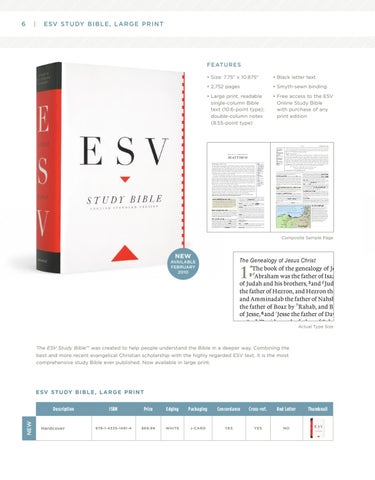
FEATURES • Size: 7.75" x 10.875"
• Black letter text
• 2,752 pages
• Smyth-sewn binding
•L arge print, readable single-column Bible text (10.6-point type); double-column notes (8.55-point type)
•F ree access to the ESV Online Study Bible with purchase of any print edition
Matthew 1:23
18 21 17tch. 2:4; 11:2; 16:16; 22:42; 23:10; Mark 8:29; Luke 3:15; [John 1:41; 4:25] 18uver. 1; Mark 1:1; John 1:17; 17:3; [ver. 16] vLuke 1:27 wLuke 1:35 19x[Deut. 24:1] 20 y ch. 2:13, 19; [ch. 2:12, 22] 21zver. 25; Luke 1:31; 2:21 a Luke 2:11; Acts 4:12; 5:31; 13:23, 38; [Acts 3:26] 22bch. 21:4; 26:56; John 19:36 cch. 2:15, 23; 4:14; Mark 14:49 23dCited from Isa. 7:14 e Isa. 8:8, 10
The Gospel AccordinG To
Matthew Chapter 1 1a[Luke 3:23-38] b2 Sam. 7:12-16; Ps. 132:11; Isa. 11:1; Jer. 23:5; Luke 1:32, 69; John 7:42; Acts 2:30; 13:23; Rom. 1:3; 2 Tim. 2:8; Rev. 22:16 cGen. 22:18; Gal. 3:16 2dGen. 21:3 eGen. 25:26 f Gen. 29:35 3g[Ruth 4:18-22; 1 Chr. 2:1-15] 5hJosh. 6:25 6i1 Sam. 16:1; 17:12 j 2 Sam. 12:24 k2 Sam. 12:10 7lFor ver. 7-10, see 1 Chr. 3:10-14 8m[2 Kgs. 15:1; 1 Chr. 3:11, 12] 11n1 Chr. 3:15, 16 oEsth. 2:6; Jer. 24:1; 27:20 12p1 Chr. 3:17-19 qLuke 3:27 rEzra 3:2 16sLuke 3:23
The Genealogy of Jesus Christ
1
a The book of the genealogy of Jesus Christ, b the son of David, c the son of Abraham. 2 dAbraham was the father of Isaac, and e Isaac the father of Jacob, and f Jacob the father of Judah and his brothers, 3 and g Judah the father of Perez and Zerah by Tamar, and Perez the father of Hezron, and Hezron the father of Ram,1 4 and Ram the father of Amminadab, and Amminadab the father of Nahshon, and Nahshon the father of Salmon, 5 and Salmon the father of Boaz by h Rahab, and Boaz the father of Obed by Ruth, and Obed the father of Jesse, 6 and i Jesse the father of David the king. And j David was the father of Solomon by k the wife of Uriah, 7 and l Solomon the father of Rehoboam, and Rehoboam the father of Abijah, and Abijah the father of Asaph,2 8 and Asaph the father of Jehoshaphat, and Jehoshaphat the father of Joram, m and Joram the father of Uzziah, 9 and Uzziah the father of Jotham, and Jotham the father of Ahaz, and Ahaz the father of Hezekiah, 10 and Hezekiah the father of Manasseh, and Manasseh the father of Amos,3 and Amos the father of Josiah, 11 and n Josiah the father of o Jechoniah and his brothers, at the time of the deportation to Babylon. 12 And after the deportation to Babylon: p Jechoniah was the father of q Shealtiel,4 and r Shealtiel the father of Zerubbabel, 13 and Zerubbabel the father of Abiud, and Abiud the father of Eliakim, and Eliakim the father of Azor, 14 and Azor the father of Zadok, and Zadok the father of Achim, and Achim the father of Eliud, 15 and Eliud the father of Eleazar, and Eleazar the father of Matthan, and Matthan the father of Jacob, 16 and Jacob the father of s Joseph the husband of Mary, of whom Jesus was born, who is called Christ.
1:1 The book of the genealogy. The Gospel’s opening words carried special significance for a Jewish audience, whose ancestry was inseparably intertwined with the covenants God made with Israel. Jesus (Gk. Iēsous) was the historical, everyday name, and is Yeshua‘ /Yehoshua‘ (Joshua) in Hebrew, meaning “Yahweh saves” (Neh. 7:7; cf. Matt. 1:21). Christ (Gk. Christos, from Hb. mashiakh, “anointed”) points back to David as the anointed king of Israel. The designation “Messiah” came to summarize several strands of OT expectation, especially the promise of an “anointed one” who would righteously rule God’s people (2 Sam. 7:11b–16). Son of David evoked images of a
18 Now the birth of u Jesus Christ1 took place in this way. v When his mother Mary had been betrothed2 to Joseph, before they came together she was found to be with child w from the Holy Spirit. 19 And her husband Joseph, being a just man and unwilling x to put her to shame, resolved to divorce her quietly. 20 But as he considered these things, behold, y an angel of the Lord appeared to him in a dream, saying, “Joseph, son of David, do not fear to take Mary as your wife, for that which is conceived in her is from the Holy Spirit. 21 She will bear a son, and z you shall call his name Jesus, a for he will save his people from their sins.” 22 bAll this took place c to fulfill what the Lord had spoken by the prophet: 23
d
“Behold, the virgin shall conceive and bear a son, and they shall call his name e Immanuel”
1 Some manuscripts of the Christ 2 That is, legally pledged to be married
though they were not yet considered to be married, and having sexual relations during that period was considered immoral. put her to shame. Sexual unfaithfulness during betrothal was considered adultery, and under the Mosaic law carried the death penalty by stoning. divorce her quietly. Joseph intended to maintain his personal righteousness, yet he desired to show compassion even though Mary appeared to be an adulteress.
1:17 fourteen generations. Matthew does not mean all the generations that had lived during those times but “all” that he included in his list (for he evidently skipped some, such as three generations between Uzziah [Ahaziah] and Jotham in v. 9; cf. 1 Chron. 3:10–12); cf. note on Matt. 1:6b–11. Perhaps for ease of memorization, or perhaps for literary or symbolic symmetry, Matthew structures the genealogy to count 14 generations from each major section. (According to the Jewish practice of gematria, the giving of a numeric value to the consonants in a word, David’s name would add to D + V + D or 4 + 6 + 4 = 14, and David is the 14th name on the list.)
1:20 Behold represents Greek idou, used frequently by Matthew to signal emphasis, prompt the reader to pay special attention, or introduce something new or unusual. The angel of the Lord is Gabriel (cf. Luke 1:26). 1:21 The name Jesus was given to sons as a symbolic hope for the Lord’s anticipated sending of salvation through a Messiah who would purify his people and save them from oppression (see note on v. 1). But the angel points to a more important theme: to save his people from their sins. Salvation from sins was a repeated promise in OT prophets (e.g., Isa. 40:2; 53:6; Jer. 31:31–34; Ezek. 36:25–27; Dan. 9:24; Zech. 13:1).
1:18–25 The Angelic Announcement of the Conception of Jesus the Messiah. A new era in Israel’s history begins with the story of Jesus’ conception in the little town of Nazareth. The angel announces his conception (vv. 18–21), explaining that he is the prophesied Immanuel (vv. 22–23). Joseph immediately obeys the angel’s directive (vv. 24–25).
1:22 All this took place to fulfill. This is Matthew’s “fulfillment formula,” by which he points to an event or teaching of Jesus that fulfills an OT passage, indicating: (1) a direct prediction-fulfillment (e.g., vv. 22–23); (2) the intended full meaning of the OT Scripture (e.g., 5:17–20); or (3) a divinely orchestrated analogical/typological correspondence to Israel’s history (e.g., 2:15, 17–18).
1:18 Mary had been betrothed to Joseph. The custom of betrothal was different from “engagement” in modern society. Customarily the parents of a young man chose a young woman to be engaged to their son. A second stage of betrothal involved official arrangements and a prenuptial agreement before witnesses, which was a legally binding contract and could be broken only by a formal process of divorce. found to be with child. Mary is about four months pregnant, having spent three months with Elizabeth, her “relative” (Luke 1:36, 56).
Messiah with a royal lineage who would reestablish the throne in Jerusalem and the kingdom of Israel. son of Abraham. God’s covenant with Abraham established Israel as a chosen people and also affirmed that the whole world would be blessed through his line (Gen. 12:1–3; 22:18).
1:23 the virgin. The Greek word parthenos (“virgin”) corresponds to the Hebrew term ‘almah, which is used in the prophecy of Isa. 7:14 regarding the virgin birth of the coming Savior (see note on Isa. 7:14). The Hebrew word ‘almah (“virgin” or “maiden”) generally denotes an unmarried woman who is a virgin (e.g., Gen. 24:43; Ex. 2:8; Ps. 68:25). The prophecy in Isaiah 7:14
1:19 Betrothed partners were referred to as husband and “wife” (v. 20),
1:2–6a The four generations between Perez and Amminadab encompass approximately 450 years. The six generations from Nahshon to the rise of the monarchy with David total about 400 more.
***MATTHEW, MAP 2 [L] 2. (MATTHEW 2:1) Joseph and Mary travel to Bethlehem
1:3 Tamar. The inclusion of five women in Jesus’ genealogy—Tamar, Rahab (v. 5), Ruth (v. 5), Bathsheba (“the wife of Uriah,” v. 6), and Mary (v. 16)—is unusual, since descent was usually traced through men as the head of the family. Rahab and Ruth were Gentiles, and Tamar, Rahab, and Bathsheba were women of questionable character. The lineage is comprised of men, women, adulterers, prostitutes, heroes, and Gentiles—and Jesus will be Savior of all.
Nazareth Caesarea
Joseph, Mary, and Jesus escape to Egypt Joseph, Mary, and Jesus return to Nazareth
PALESTINE
Me d i t e r ra n ea n Sea
Gaza
1:6b–11 Matthew may have drawn from 1 Chron. 3:10–14, since both genealogies omit several kings found in the narrative of Kings and Chronicles. Omitting names in a genealogy was common to make for ease of memorization. One is struck in this section by the alternately godly and wicked kings who ruled Israel.
Jerusalem Bethlehem
Alexandria
Beersheba Daphnae
N A B AT E A
EGYPT
1:12–13 Zerubbabel led the first group given permission to return to Israel from the exile.
Petra
1:12 The evil of Jechoniah (2 Kings 24:8–9) was so great that his line was cursed (Jer. 22:30). While a natural, biological son could not therefore inherit the throne, the legal claim could still come through Jechoniah’s line.
Memphis
1:16–17 Jesus is the rightful legal heir to the covenant promises associated
Nile River
1:1–17 The Genealogy of Jesus the Messiah. Jews kept extensive genealogies to establish a person’s heritage, inheritance, legitimacy, and rights (cf. Josephus, Life of Josephus 1–6). Matthew likely draws on the genealogies of the OT, with some omissions (see note on Matt. 1:17). He demonstrates Jesus’ legal claim to the throne of David, emphasizing Jesus’ legal descent from David and Abraham, while Luke’s genealogical record (Luke 3:23–38) emphasizes Jesus’ biological descent from David and Adam.
The Birth of Jesus Christ
with the Davidic throne (v. 6) as well as the rightful legal heir to the covenant promises related to the Abrahamic seed and land (vv. 1–2).
1 Greek Aram; also verse 4 2 Asaph is probably an alternate spelling for Asa; some manuscripts read Asa; also verse 8 3 Amos is probably an alternate spelling for Amon; some manuscripts read Amon; twice in this verse 4 Greek Salathiel; twice in this verse
1:1–2:23 The Arrival in History of Jesus the Messiah. Matthew’s introduction echoes the language of Genesis. The word rendered “genealogy” (1:1) is Greek genesis (“beginning, origin, birth, genealogy”), and this is also the title of the Greek translation of Genesis, implying that it is a book of “beginnings.” “The book of the genealogy” appears to function not only as a heading for the genealogy itself (1:2–17) but also as a title for the entire story to follow: a new beginning with the arrival of Jesus the Messiah and the kingdom of God (cf. note on Gen. 2:4).
17 So all the generations from Abraham to David were fourteen generations, and from David to the deportation to Babylon fourteen generations, and from the deportation to Babylon to t the Christ fourteen generations.
0 0
50 50
100 mi 100
The Gospel Acc
Jesus’ Birth and Flight to Egypt As the time drew near for Jesus to be born, a mandatory Roman census made it necessary for Joseph to return to his ancestral home of Bethlehem. There Mary gave birth to Jesus, and later, wise men from the east came to worship him. The wise men’s recognition of a new king, however, troubled King Herod and the ruling establishment in Jerusalem, and Herod sought to kill Jesus. Joseph and his family escaped to Egypt and remained there until Herod died. When they returned to Palestine, they settled in the remote district of Galilee, where Jesus grew up in the northern village of Nazareth, to avoid the attention of the rulers in Jerusalem.
150 km
map.40-2.indd 45
Matth
6/25/08 5:54:17 PM
Composite Sample Page
NEW
Miles 0
10
Km 0
Miles 0
Km 0
20
30
25
10
40
50
20
25
30
50
50
60
75
40
70
100
50
75
60
100
80
90
125
70
80
125
100
150
90
110
120
175
100
150
110
175
130
200
120
140
150
225
130
200
140
225
160
170
250
150
Miles
Km
160
250
170
Miles
Km
The Genealogy of Jesus Christ
AVAILABLE FEBRUARY 2010
1
NEW
The book of the genealogy of Jesus Christ, b the son o Abraham was the father of Isaac, and e Isaac the fathe of Judah and his brothers, 3 and g Judah the father of Perez the father of Hezron, and Hezron the father of Ram,1 4 and and Amminadab the father of Nahshon, and Nahshon the the father of Boaz by h Rahab, and Boaz the father of Obed of Jesse, 6 and i Jesse the father of David the king. And j David was the father of Solomon by k the wife of U Actual Type Size of Rehoboam, and Rehoboam the father of Abijah, and Ab Asaph the father of Jehoshaphat, and Jehoshaphat the fa father of Uzziah, 9 and Uzziah the father of Jotham, and J The ESV Study Bible™ was created to help people understand the Bible in a deeper way. Combining the Ahaz the father of Hezekiah, 10 and Hezekiah the father o best and more recent evangelical Christian scholarship with the highly regarded ESV text, it is the most father of Amos,3 and Amos the father of Josiah, 11 and n Josi comprehensive study Bible ever published. Now available in large print. his brothers, at the time of the deportation to Babylon. 12 And after the deportation to Babylon: p Jechoniah wa r Shealtiel the father of Zerubbabel, 13 and Zerubbabel the father of Eliakim, and Eliakim the father of Azor, 14 and Azor E SV ST UDY B I B L E , L A R G E P R I N T the father of Achim, and Achim the father of Eliud, 15 and Eleazar the father of Matthan, and Matthan the father of Description ISBN Price Edging Packaging Concordances Cross-ref. Red Letter Thumbnail Joseph the husband of Mary, of whom Jesus was born, w Hardcover
978-1-4335-1481-4
$69.99
WHITE
J-CARD
YES
a
2d
1 Greek Aram; also verse 4 2 Asaph is probably an alternate spelling for Asa; some manuscripts read A NO spelling forYES Amon; some manuscripts read Amon; twice in this verse 4 Greek Salathiel; twice in this ve
1:1–2:23 The Arrival in History of Jesus the Messiah. Matthew’s introduction echoes the language of Genesis. The word rendered “genealogy” (1:1) is Greek genesis (“beginning, origin, birth, genealogy”), and this is also the title of the Greek translation of Genesis, implying that it is a book of “beginnings.” “The book of the genealogy” appears to function not only as a heading for the genealogy itself (1:2–17) but also as a title for the entire story to follow: a new beginning with the arrival of Jesus the Messiah and the kingdom of God (cf. note on Gen. 2:4).
Me and est wo
1:2 app mo
1:3