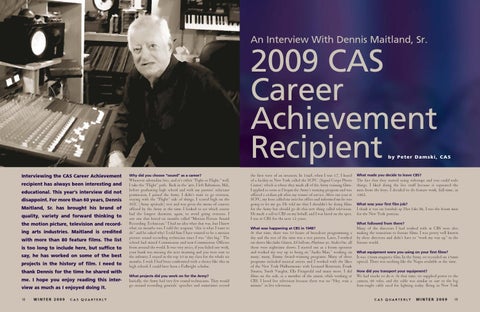
An Interview With Dennis Maitland, Sr.
2009 CAS Career Achievement Recipient
b y P e t e r D am s ki , C A S
Interviewing the CAS Career Achievement recipient has always been interesting and educational. This year’s interview did not disappoint. For more than 60 years, Dennis Maitland, Sr. has brought his brand of quality, variety and forward thinking to the motion picture, television and recording arts industries. Maitland is credited with more than 80 feature films. The list is too long to include here, but suffice to say, he has worked on some of the best projects in the history of film. I need to thank Dennis for the time he shared with me. I hope you enjoy reading this interview as much as I enjoyed doing it. 18
WINTER 2009
CAS QUARTERLY
Why did you choose “sound” as a career?
Whenever adrenaline hits, and it’s either “Fight or Flight,” well, I take the “Flight” path. Back in the ’40s, I left Baltimore, Md., before graduating high school and with my parents’ reluctant permission, I joined the Army. I didn’t want to go overseas, staying with the “Flight” side of things. I scored high on the AGC [Army aptitude] test and was given the menu of courses offered by the Army at the time. I looked to see which course had the longest duration, again, to avoid going overseas. I saw one that lasted six months called “Motion Picture Sound Recording Technician.” I had no idea what that was, but I knew what six months was. I told the sergeant “this is what I want to do” and he asked why? I told him I have wanted to be a motion picture sound recording technician since I was “this big.” The school had mixed Commission and non-Commission Officers from around the world. It was very strict, if you failed one week, your bunk was missing the next morning and you were sent to the infantry. I stayed in the top 10 in my class for the whole six months. I wish I had been confronted with a choice like this in high school; I could have been a Fulbright scholar. What projects did you work on for the Army?
Initially, the Army had very few sound technicians. They would go around recording generals’ speeches and sometimes record
the first wave of an invasion. In 1948, when I was 17, I heard of a facility in New York called the SCPC (Signal Corps Photo Center) which is where they made all of the Army training films. I applied as soon as I began the Army’s training program and was offered a civilian job after my tenure of service. After one year at SCPC, my boss called me into his office and informed me he was going to let me go. He told me that I shouldn’t be doing films for the Army but should go do this new thing called television. He made a call to CBS on my behalf, and I was hired on the spot. I was at CBS for the next 12 years.
What made you decide to leave CBS?
What was happening at CBS in 1948?
Many of the directors I had worked with at CBS were also making the transition to feature films. I was pretty well known by these directors and didn’t have to “work my way up” in the feature world.
At that time, there was 10 hours of broadcast programming a day and the rest of the time was a test pattern. Later, I worked on shows like Jackie Gleason, Ed Sullivan, Playhouse 90, Studio One, all those were nighttime shows. I started out as a boom operator and worked my way up to being an “Audio Man,” working on many, many, Emmy Award–winning programs. Many of these programs included musical artists and I worked with the likes of the New York Philharmonic with Leonard Bernstein, Frank Sinatra, Sarah Vaughn, Ella Fitzgerald and many more. I did films on the side, as a member of the union, while working at CBS. I loved live television because there was no “Hey, wait a minute” in live television.
The fact that they started using videotape and you could redo things. I liked doing the live stuff because it separated the men from the boys. I decided to do feature work, full-time, in 1962. What was your first film job?
I think it was on Somebody up There Likes Me, I was the boom man for the New York portion. What followed from there?
What equipment were you using on your first films?
It was 35mm magnetic film. In the Army, we recorded on 35mm optical. There was nothing like the Nagra available at the time. How did you transport your equipment?
We had trucks to do it. At that time, we supplied power to the camera, 96 volts, and the cable was similar in size to the big four-ought cable used for lighting today. Being in New York CAS QUARTERLY
WINTER 2009
19