066
Releases
06 06
08 Hookworms Microshift Domino
NVPR 33 33 Editions Mego
REVIEWS
NVPR is comprised of Factory Floor’s Nik Void and Peter Rehberg, head of underground record label Editions Mego. Both artists typically operate in the spaces between techno, experimental and the avantgarde. 33 33 could be described as the latter. The five-track release starts with Meantime (Part 4). Bad-tempered robotic life communicates over fractured rhythms; what sounds like a squash ball gets leathered into a wall, repeatedly, while some notes phase in sporadically and a bass drum pulses like a heartbeat. This intriguing, disorientating start is followed by Twin Cases, a tinnitus-provoking listen. Meantime follows; more subdued, but more menacing, the sounds of organic decay splitting apart. Free Founder sounds like an old computer that’s not so much reading a floppy disk as chewing it. It’s somehow one of the more accessible tracks on the album. 33 33 wraps up with DEABG. Describing the track is difficult, but try imagining several modular synths having a fight in a metallic cage full of stainless steel dustbin lids, scrapping then trash-talking, while distorted white noise starts to build and synth lines compete for dominance. And it crescendos. Several radios try to hack your ears at once, the thin, glassy attack of the synths layering over an increasingly hyperactive melody. It’s an incredibly difficult listen, and it’s the culmination of two artists’ body of work in sonic experimentalism, the spiked sign-off of their latest discombobulating creation. !
Rob Bates
07
08
In their early records and live shows, Hookworms became a totemic presence in modern psychedelia. They weren’t reinventing the wheel, but in their hands, the old unrelenting weapons of organs and feedback sounded as vital as ever and I would eagerly slurp up any recording of their catatonic swell. Imagine my excitement then, when I heard that Microshift – their first album in three years – was complete and ready for release. Less than a minute in, it’s clear this is a very different Hookworms. Gone is the deafening din that characterises most of their work to date. On Negative Space, the sevenminute opening track and lead single, singer MJ’s voice stands bare and dry, and squelchy analogue synths replace the screechy howl of their guitars. As the track erupts into its second act, it becomes a sort of euphoric release of tension, bright and emotional. It’s a brave shift. This airy pallet is the album’s prevailing mood throughout, while the lyrics are unequivocally wistful and confessional. On Ullswater they reach Springsteen levels of uplift while pulling off that magic trick of great pop music: a blank canvas onto which the listener can project the objects of their own emotional tussles. “30 years and 30 questions/ But now you can’t reply/ I hate that this is done,” MJ sings. But at this point, Microshift feels too saccharine. I ended up wishing that the squealing rattle of Boxing Day or the sombre tones of Reunion, had been given as much time as the sweeter-sounding tracks. Others, like album closer Shortcomings, just fail to land. There are moments on this record that are genuinely thrilling – particularly in the first half – and bands should be encouraged to try something new. But ultimately, Microshift’s bright sound might leave you pining for shadier textures. !
Theo Kotz
Godflesh Post Self Hospital Productions
Miguel War & Leisure ByStorm / RCA
Trepidation lingered in the buildup to Godflesh’s comeback in 2014. Would a 13-year hiatus mar the working relationship between industrial metal defilers Justin Broadrick and G.C. Green? But their seventh studio album, A World Lit Only By Fire, was a success, the sound of a band reinstating their mark as extreme music’s foreboding revisionists. In the same vein, Post Self is an obtrusive reconstruction of lo-fi industrial minimalism. While A World Lit Only By Fire was a sustained buttressing of soundscapes and distortion, we now bear witness to Godflesh in a state of metamorphoses. The opening title track is a typically tenebrous affair, propped up by atonal guitar lines and gnarled sub-bass. Similarly, Parasite’s fudged percussion dredges along to Broadrick’s Nails-esque vocal grunts. It’s a form of fine-tuned aggression that the group have standardised since their birth in the late 80s; one that remains both familiar and alien in equal measure. Yet the duo veers away from their archetypal dissonance nearing the album’s midpoint. Instead, tracks like The Cyclic End and Be God ante up the Jesu-indebted textural ambience, applying voluminous bass tone beneath high-frequency power electronics. Mortality Sorrow recontextualises aspects of synthwave and necromantic dream-pop, while In Your Shadow meddles with rasping guitars and bass that chug in similar ritualistic ilk as that of Raime’s darkly sensuous post-techno. It’s this perverse fission of styles that embodies Post Self’s design. By channelling Broadrick’s experience exploring the boundaries of industrial dub as JK Flesh, Godflesh have provided an extremely potent mix of hellish punk and electronics. And while Post Self’s opposing concoctions may, at times, be difficult to consume, it’s an addictive realm of extreme music seldom explored with such emotional dexterity.
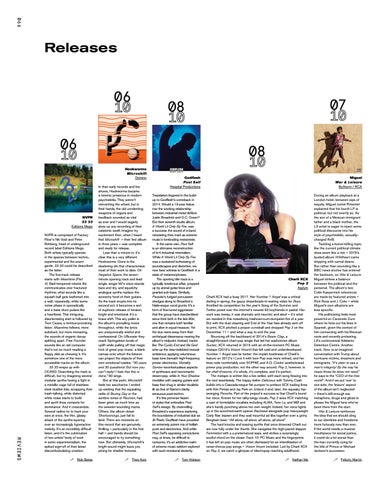
Charli XCX had a busy 2017. Her Number 1 Angel was a critical darling in spring; the gauzy dreamboats-in-waiting video for Boys throttled its competition for the year’s Song of the Summer and Twitter pored over the internet’s newest 60 boyfriends in pastel. Her work was messy, it was dramatic and neurotic and aloof – it’s what we needed in this nosediving trashcan-cum-dumpster-fire of a year. But with the dust clearing and End of the Year lists already sent off to print, XCX pitched a proper curveball and dropped Pop 2 on the December 11 – and what a way to end the year. Bouncing off the backboard of 2014’s Boom Clap, a straightforward chart-pop single that led her sophomore album Sucker, XCX returned in 2016 with an of-the-moment PC Music mixtape (2016’s Vroom Vroom) that felt cold and underdeveloped. Number 1 Angel was far better: the impish brattiness of Charli’s feature on 2012’s I Love It with Icon Pop was more refined, and her lines rode comfortably over SOPHIE and A.G. Cooks’ aestheticised power pop production, not the other way around. Pop 2, however, is her chef-d’oeuvre: it’s whole, it’s complete, and it’s perfect. The mixtape is written like a live setlist, with each song flowing into the next seamlessly. The trappy belter Delicious with Tommy Cash builds into a Cascada-esque fist pumper to preface XCX trading lines with Kim Petras and Jay Park on Unlock It and, later, the squeaky hipswinging Porsche. Part of the project’s success is that Charli’s found her voice. Known for her talky-singy vocals, Pop 2 sees XCX matching a cast of formidable vocalists including ALMA, Tove Lo, and MØ and she’s hardly punching above her own weight. Indeed, her voice lights up in the scorched-earth opener Backseat alongside pop heavyweight Carly Rae Jepsen and they wail mournful ad libs together over a grimy Berghain beat: “All alone, all alone, all alone, all alone”. The hard knocks and soaring synths that once drowned Charli out are now fully under her thumb. She navigates the high-paced slapper Femmebot with a a preternatural ease, and strikes a surprisingly soulful chord on the closer Track 10. PC Music and the fingerprints it has left on pop music are often dismissed for an infantilisation of verse-chorus pop songs – Vroom Vroom included. Led by Charli XCX on Pop 2, we catch a glimpse of electropop reaching adulthood..
During an album playback at a London hotel, between sips of tequila, Miguel Jontel Pimentel explained that his fourth LP is political, but not overtly so. As the son of a Mexican immigrant father and a black mother, the LA artist is eager to inject some political discourse into his style of psychedelic, sexuallycharged RnB. Tackling a boner-killing topic like the current political climate does seem like a risk – 2015’s lauded album Wildheart came dripping with carnal desire. But rather than sounding like a BBC news anchor has entered the bedroom, on War & Leisure Miguel strikes a balance between the political and the personal. The album’s two Colin Kaepernick references are made by featured artists – Rick Ross and J. Cole – while Miguel’s own allusions are less specific. His politicising feels most powerful on Caramelo Duro where he licks out his lines in Spanish, given the context of him connecting with his Mexican roots and recently protesting LA’s controversial Adelanto Detention Centre. Another track, Now, is an imagined conversation with Trump about hurricane victims, dreamers and immigrants. “It’s plain to see a man’s integrity/ By the way he treats those he does not need,” he says to the “CEO of the free world”. And if we put ‘war’ to one side, the ‘leisure’ aspect of the album isn’t neglected – there’s still enough sex metaphors, drugs and gloss to please the Miguel fans who’ve been there from the start. War & Leisure reinforces the idea that we should cling to our identities and freedoms more furiously now than ever. If the world needs a musical mouthpiece for social justice, it could do a lot worse than the man currently vying for the title of Prince or Michael Jackson’s successor.
Tom Watson
! Nathan Ma
! Felicity Martin
!
Charli XCX Pop 2 Asylum