Monkey see, monkey do?
Why
Three ways AI will change the workplace
Why
Three ways AI will change the workplace
Celebrate the power of great leadership—at every level, in every sector.
Whether you’re an emerging changemaker or a seasoned senior leader, these awards are your chance to shine, share your story, and inspire others. The Leadership Awards 2025
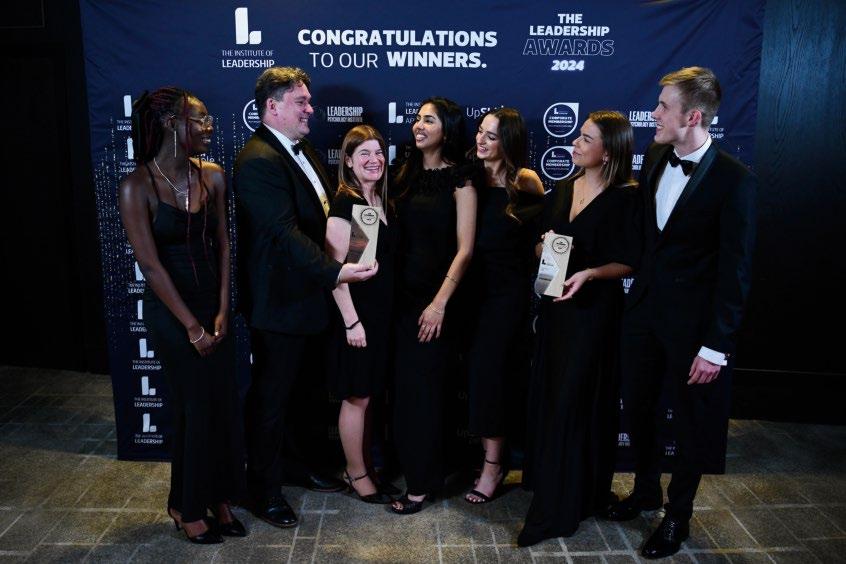
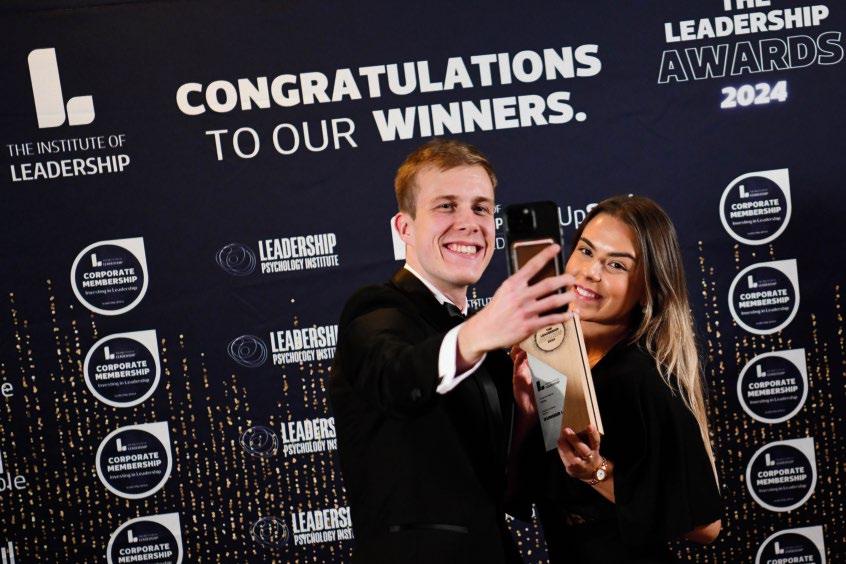




What an incredible award! We are so thankful. Our award has led to direct business with our lead client.
–2024 Winner
I am beyond thankful for this recognition and hope to continue growing as a leader while encouraging and supporting others.
–2024 Finalist Nominate today
COURAGE VISIO
16 Seeing is believing
Peter Crush investigates whether remote working is creating a skills gap in leadership development
22 The debate
Peter Watt, from the National Autistic Society, and Paul Carney, from the British Army, discuss whether you need to ‘see it to be it’ when it comes to leadership skills
32 Big interview
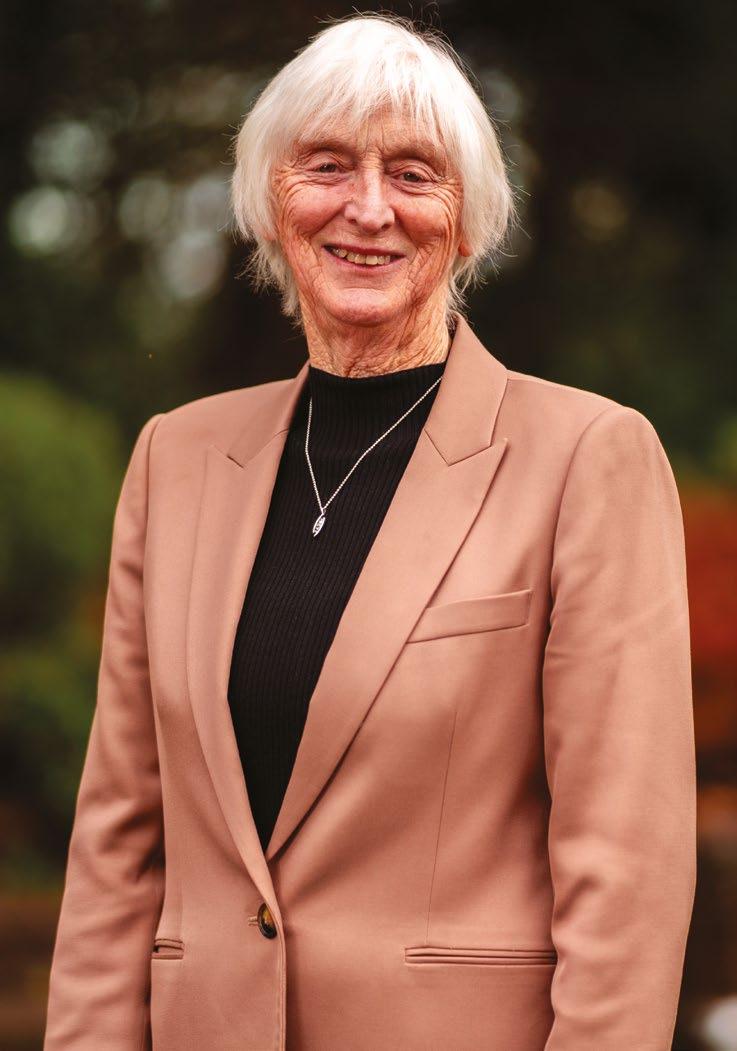
Baroness Sue Campbell DBE on her journey from the classrooms of Moss Side to pitchside at the Euros
58 Spotlight on Phoebe Water shares her fight for equality
70 6o seconds with Meet Tiwalola Adebayo
25 If not us, who?
Astrid Davies reveals the missing link in your leadership toolkit
26 Stronger together
How one local authority leader built a high-performing team
28 Leading with courage
The difference between a ‘powerover’ and ‘power-with’ approach
30 The right balance
Aligning proactivity with conscientiousness
31 Hot seat
Kate Waterfall Hill on lessons in leadership

39 Connection intention
The power of the workplace community – and how to nurture it
40 The politeness fallacy
Why a lack of friction will kill your team’s performance
42 Cracking the code
How one team uncovered the invisible dynamics that were holding them back
46 Make work fair
Can fairness and meritocracy exist in the workplace?
52 Learning new AI tricks
Integrating AI into your learning and development programmes
53 Betting big on AI
How AI is revolutionising the workplace – and what’s next
54 Bossing it
Harpreet Kaur Chahal from Milford Research chats to her boss Rob Milford about resilience, reflections and respect
56 Losing the laughs
Is it game over for remote working if you want to nurture your team?
63 The uninvited friend How to embrace uncertainty
64 Feeling like a fake Managing imposter phenomenon
66 The shadow of doubt David Tazzini Lloyd shares his story of overcoming imposter syndrome
Focus on... hospitality
48 Leadership in action
Scott Brown, from Amante Capital, on a building a career in the sector
50 In numbers
2025
Our lead feature was inspired by an interview on Radio 4 in which Nationwide’s Debbie Crosbie voiced concerns about the effect that increased home working was having on leadership development (read more on pages 16-23). We took the idea of ‘do you need to see it to be it’ to develop cover routes that illustrated the perceived value of learning leadership skills by being in close proximity to a leader. One of the concepts was based on the saying ‘monkey see, monkey do’, with the idea that imitation without reflection is not necessarily wise, right or effective. Our challenge was to strike the balance between seriousness and comedy. We wanted it to be a fun – and thoughtprovoking – image, without it being too much like a cartoon. The image of the monkey statue replicated again and again struck a chord with everyone in the team, especially with the striking bright-yellow colour treatment.
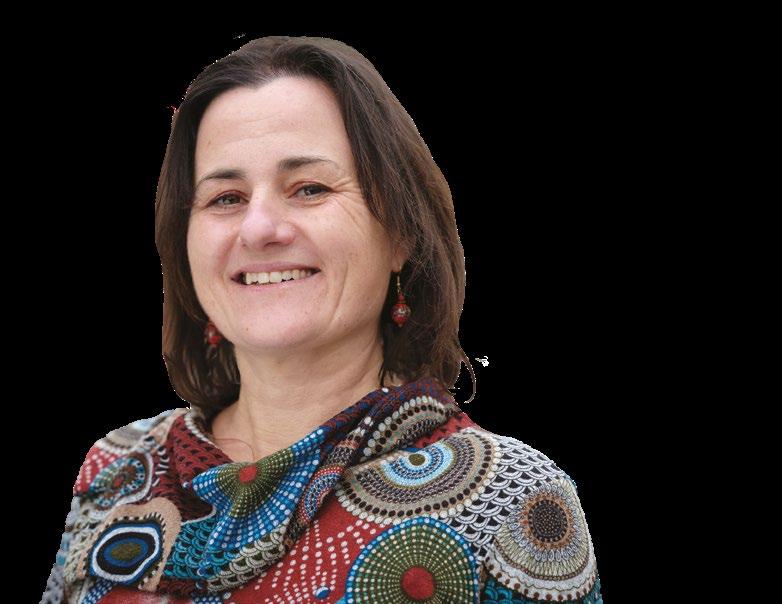
By Louise Parfitt
Welcome to your new look Edge! We have been proud to produce four issues of the magazine now and, from the start, we have been thinking about ways to develop it. There was a strong editorial and design foundation on which to build, but we wanted to evolve it to improve the pace, structure and look of the magazine.
All of this work is going hand in hand with the development of a new Edge digital content hub, which launches at the end of this month (see page 11 for more details).
We have been working across teams at CPL One and alongside the IoL team on these projects. It has been a great example of teamwork at its best, combining skills to try different approaches, having honest conversations about what works, and sharing fresh ideas.
So, how do we get the best from our teams? It’s what Leadership Live and this issue of
Edge are considering in more detail: how we build and support teams to be high-performing.
John Williams, IoL CEO, says that transformational leadership is about unleashing team potential through a journey of smaller successes combined with times of consolidation and reflection (see page 9). I hope this refresh is one of those successes on our path to support the leadership community with expert opinion, thought leadership and inspiring stories.
On the latter point, this issue is a real treat, with some exceptional people sharing their stories, including Baroness Sue Campbell DBE (see pages 32-37) and Phoebe Waters (see pages 58-62).
We’ve introduced a new series where an emerging leader gets to ask the questions (pages 54-55), and a section where we take a deeper dive into leadership in a particular sector (pages 48-51).
If you have any feedback, or if you have a story to share, please do get in touch.
louise.parfitt@cplone.co.uk
Edge is brought to you by: CPL One cplone.co.uk
Editor Louise Parfitt louise.parfitt@cplone.co.uk
Art director Robyn McCurdy
Chief sub-editor Jo Halpin
Managing editor Helen King
Reporting team Martin Bewick, Tracey Lattimore, Ian Farrell
The Institute of Leadership c/o JW Hinks LLP, 19 Highfield Road, Edgbaston, Birmingham B15 3BH.
Chief executive John Williams
Director of events and engagement Rebecca Martin
Copywriter Ciara Conway
For advertising sales, please contact ciara.conway@leadership.global
Publishing Published in the United Kingdom by The Institute of Leadership.
Disclaimer Copyright 2025 The Institute of Leadership and CPL One. All rights reserved. Material may not be reproduced without permission of the publisher. While we take care to ensure that editorial is accurate, independent, objective and relevant for the readers, Edge accepts no liability for reader dissatisfaction arising from the content of this publication. The opinions expressed or advice given are the views of individual authors and do not necessarily represent the views of Edge, The Institute of Leadership or CPL One. Edge is printed on FSC-approved paper from responsible sources. Edge takes every effort to credit photographers but we cannot guarantee every published use of an image will have the contributor’s name. If you believe we have omitted a credit for your image, please email the editor.
ISSN 2515-7809
Printed by Paragon paragon.world
Add credibility a nd recognition to your leadership programmes with our industry recognised kitemark.
Only ava i lable with I nstitute Approved accreditation.
Discover more at leadership.global/IA
or call 01543 266886
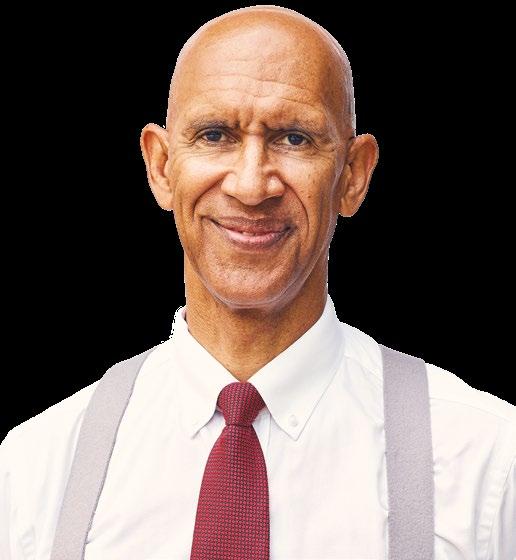
John Williams
According to Google, transformational leadership is “a style where leaders inspire and motivate followers to achieve shared goals and personal growth, fostering positive change within individuals and organisations”. To do this, leadership figures “engage with others by understanding their needs, raising their motivation and providing an ethical framework for decisions, ultimately leading to significant change”. Hm.
Let us put aside for the moment any disquiet about the use of ‘style’ to mean ‘behaviour’. Most interesting in this definition is the absence of purpose. Yes, it mentions ‘positive change’ and ‘significant change’ –but to what end? None of us, as John Donne recounts, is an island. A team is therefore the smallest unit of performance in an organisation, so success is a function of team performance. How well a team performs is a function of how well it is led.
The objective of any organisation, group or movement is to achieve a result. That presupposes change, otherwise the result would be continuation of the status quo. Yet change for its own sake is not always – or perhaps ever – the result we seek from our actions. One of the abiding challenges for leadership is the relentless demand for ‘positive change’, as if immobility was unnatural.
Accelerating success is often a desirable outcome. Yet that, also, can be deceptive. Transformational leadership, when effective, generates success, and often with rapid results. Not always, though. Sometimes, it can generate a consciousness of the need to stop, think, and only then proceed at pace. Success can come in short, bite-sized chunks, or as a huge triumph – or, more desirably, a combination of both. Transformational leadership inspires
“Unleashing the potential of our teams means generating pace and pressure when needed, with designed-in periods of reflection and consolidation”
and motivates by its ability to scan the horizon, assess the terrain ahead, and manage the balance between acceleration and deceleration to achieve optimum pace.
In sport, rest is a deliberate element of the training regime. Olympic athletes train with their focus on a single event years away. Yet they know success in that event is predicated on their success in smaller, less-demanding events on the journey. These proximal goals are used to indicate and secure the future goal by periodically stressing the athlete, and allowing rest in between.
Transformative leadership takes the same approach to organisational success. Unleashing the potential of our teams means generating pace and pressure when needed, with designedin periods of reflection and consolidation, because they are needed. Yes, we want to create momentum; we want our teams fired up and surging powerfully towards the success we seek. And, yes, we need to allow the achievement of that success to be rewarded by the mental and physical rest it deserves.
Accelerating success means accelerating successes – plural. If the goal is organisational success, transformational leadership recognises that it is a journey with twists and turns, starts and stops. It sees beyond the superficial need for speed, and manages a measured pace of organisational growth to enable inspired and motivated teams to remain that way.
As Arthur Schopenhauer said: “Talent hits a target no one else can hit; genius hits a target no one else can see.” Any fool can flog a workforce to go fast. Transformational leadership sees the invisible value of managing pace to accelerate success.
John Williams is chief executive of The Institute of Leadership.

The Institute of Leadership is investing in a major digital transformation, with a clear goal: to better support our members and provide leadership development experiences that genuinely improve performance.
As part of this transformation, we began working with digital learning experts Embed and Netex in May 2025. Together, we are reviewing and enhancing all our leadership content to ensure it meets the real needs of today’s leaders and supports practical, lasting development.
Our ambition is to curate the very best content for our leadership community – content that is high quality, engaging, accessible and supports a range of learning styles. Most importantly, it’s designed to help leaders apply what they learn, build confidence and deliver real impact in their roles.
To bring learning to life, we’re incorporating real-world case studies and first-
hand experiences from leaders across sectors. Video content, podcasts and practical scenarios will complement written materials, giving members flexible, relatable ways to engage with key concepts and ideas. This blended approach ensures learning is not only accessible but deeply embedded, supporting long-term behavioural change
Both Embed and Netex bring extensive experience in digital learning platforms and content design. Their expertise is helping us develop a learning offer that’s clear, purposeful and focused on what matters most: helping leaders grow and succeed.
Rod Jones, IoL learning quality manager, said: “We’re building a learning architecture that really works for leaders – something that feels relevant, flexible, and genuinely helps people grow. We’re excited to share what we’ve been working on.”
We aim to unveil the enhanced learning content by the end of 2025. A special launch event is planned, so keep an eye out for details.
We’re excited to share the news that Edge is evolving.
As part of our commitment to keeping leadership insight timely, accessible and engaging, we’re launching a brand-new Edge online hub this summer. This digital space will complement our much-loved print magazine by offering updates and articles, expert commentary and fresh perspectives on leadership – available anytime, anywhere.
The online hub will become a
dynamic destination for the leadership community, featuring:
• Opinion pieces and thought leadership
• Interviews with change-makers and industry experts
• Community voices and member stories
• Interactive features and deeper dives into key topics.
While we’re embracing this exciting digital transformation, we’re also staying true to what matters to our readers. The quarterly printed edition of Edge will continue for all UK members, ensuring you can still enjoy the magazine in its
classic format – at your desk, at home, or when commuting.
Our CEO, John Mark Williams, said: “Edge is well received by leaders, so this is a fantastic opportunity to expand our reach and deliver content in a more accessible, digital-first format. It’s a key step in our digital transformation for 2025. There’s much more to come!”
We can’t wait to introduce you to the new Edge online experience. Full launch details will be shared with members soon.
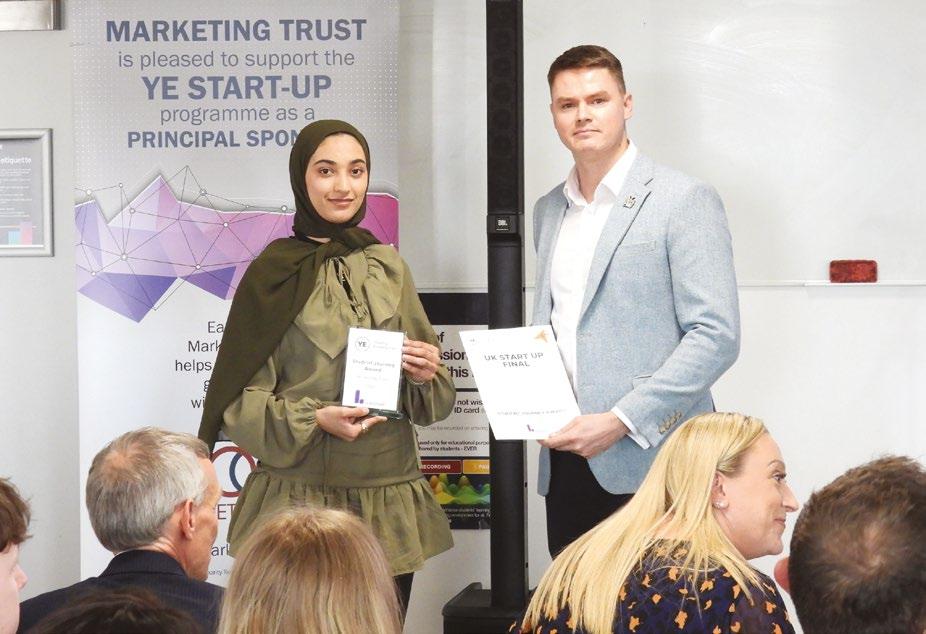
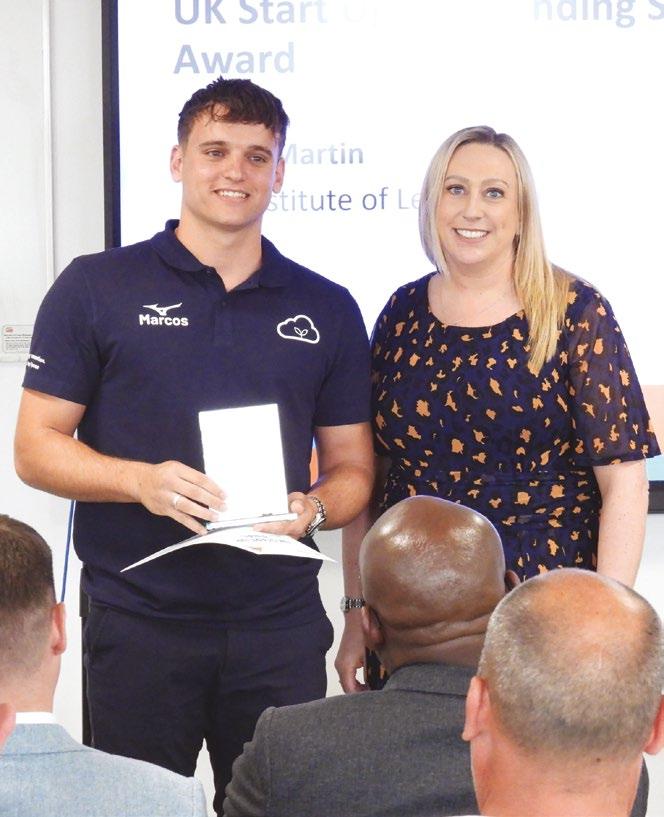
The Institute of Leadership is proud to continue its partnership with Young Enterprise, reaffirming our commitment to fostering the next generation of leaders. This year, we were honoured to sponsor two awards at the Start-Up Programme Final, held on Wednesday 14 May at the University of Hertfordshire’s Enterprise Hub.
The Student of the Year Award was presented to Marcos Knight, whose remarkable energy, focus and business acumen stood out. Marcos exemplifies entrepreneurial spirit, and we are excited to see where his journey leads.
The Student Journey Award went to Helena Bazidwal, whose inspiring story touched everyone present. Arriving in the UK as a refugee, Helena has demonstrated incredible resilience and positivity, making significant strides in her personal and professional development.
At the IoL, we believe in the transformative power of enterprise education. Supporting Young Enterprise allows us to contribute to programmes that build confidence, creativity and essential business skills among young people. These initiatives are crucial in preparing them for the evolving world of work.
Young Enterprise is a national charity that motivates and equips young people to succeed through hands-on programmes in enterprise and financial education. Its work spans schools, colleges and universities across the UK, providing opportunities that help young people develop key skills for employment and entrepreneurship.
You can find out more about its mission and programmes at young-enterprise.org.uk
We look forward to supporting both Helena and Marcos over the coming year and celebrating their continued successes.
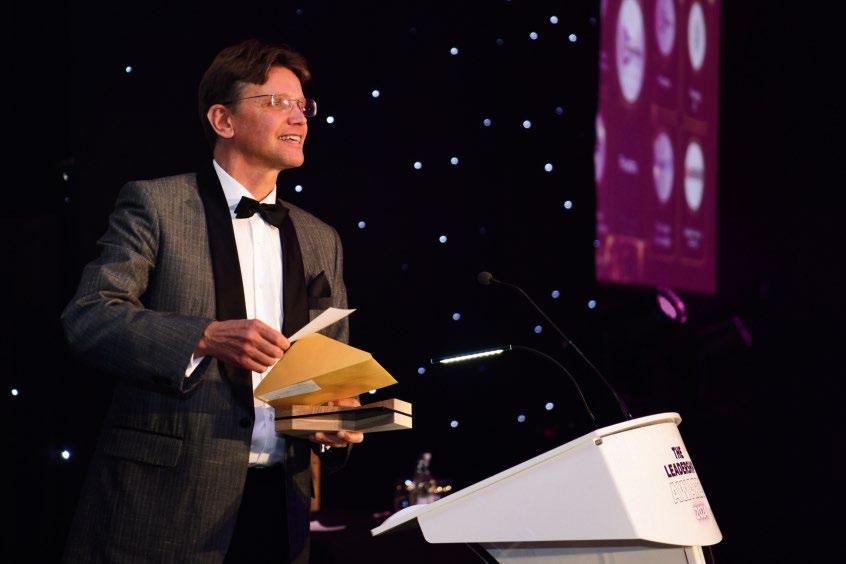
The Leadership Awards are back for 2025 – and we couldn’t be more excited.
Now in their third year, the awards have grown into something quite special. What started as a simple way to recognise great leadership has become a meaningful moment in the year where we pause, reflect and celebrate the people who lead with purpose, honesty and authenticity.
It’s not about job titles or polished CVs. It’s about showing up when it matters, bringing people with you and making a difference – whether that’s in big, bold ways or quiet, consistent ones. These awards are for the people who make things better just by being the kind of leader others want to follow.
This year’s ceremony takes place on 14 November 2025 at the Hilton London Bankside. If you’ve joined us before, you’ll know it’s a brilliant evening full of warmth, connection and stories that stay
with you. If not, this is the perfect year to be part of it.
Over the past two years, we’ve celebrated leaders who’ve guided others through change, built something new from the ground up, or kept teams going through tough times. What they all have in common is the way they lead – with clarity, care and authenticity.
Nominations are open now and we’d love to hear from you. Maybe you know someone whose leadership deserves to be seen. Maybe it’s your team. Maybe it’s you. Whatever the story, this is your chance to share it.
To nominate, visit: iol.rsvp.gther. com/leadership-awards Nominate now and help us shine a light on leadership that matters.
We’ll be sharing more in the run-up to the awards, but for now, save the date and start thinking about the leaders you know who’ve made an impact this year.
A heartfelt thank you to all our members who took the time to complete our latest research, developed in partnership with Research By Design.
This project set out to capture the realities of leadership today – how you’re navigating change, handling uncertainty and preparing for what’s next. Your honest reflections and realworld experiences are helping us build a clearer picture of what leadership truly looks like in 2025.
We’re aiming to publish the findings in June. We hope the report will offer not only meaningful perspective but also practical value to help us shape the support we offer to you and the wider leadership community.
Thank you once again for being part of this. We can’t wait to share the results with you.

Save the date
Join our next Explore session on 8 July to help you make the most of your membership. Led by our Membership Manager, Rachel Mullings, these interactive sessions offer a guided tour of our website, tips on how to showcase your credentials on LinkedIn, and the chance to ask questions about member benefits. Visit our website to book your place!
A look at recent research on leadership and management from across the UK and internationally
The world of leadership is shifting, and fast. According to the latest Digital Leadership Report 2025 from Harvey Nash UK, organisations across the UK are embracing change at speed, driven by AI, skills shortages, cybersecurity threats and evolving ways of working.
Now in its 26th year, the report is based on the views of thousands of senior leaders globally, and offers a valuable snapshot of what’s shaping leadership in the digital age. This year marks a tipping point for artificial intelligence. What was once experimental is now embedded. Nearly half of digital leaders surveyed said AI is already in active use across their organisations, supporting everything from customer service to strategic decision-making.
AI may be accelerating, but the people who know how to work with it are in short supply. For the first time in more than 15 years, AI skills have overtaken cybersecurity as the most in-demand technical expertise – and the shortage is growing. Leaders are feeling the pressure. Many are rethinking how they recruit, retain and reskill their people. It’s a reminder that talent strategy is leadership strategy. The organisations that succeed in the years ahead will be those that invest in their people – not just hiring for the skills of today, but helping teams grow into the needs of tomorrow.
Leadership takeaway: For leaders, critical questions are raised not just about how to use AI, but why and where. AI is no longer an innovation to observe from the sidelines. It’s here, it’s real, and it’s fast becoming central to how organisations operate. The challenge now is to lead with clarity and ethics: ensuring human oversight, transparent decision-making and a firm grip on how AI intersects with your values and mission. Leaders who adapt, invest in people and think boldly about technology will be best placed to thrive. Find out more at harveynash.co.uk/latest-news/ digital-leadership-report-2025
• Almost twice as many technology leaders (51%) compared with the previous report (28%) say they are suffering an AI skills shortage.
• Organisations that attract, retain and incorporate the viewpoints of Gen Z are twice as likely to be prepared for the demands of AI and one-fifth more likely to report a measurable ROI from AI.
• In the past two years, 29% of tech leaders were subjected to a major cyberattack.
• Around onefifth of a tech team could be considered neurodivergent, and nearly half of leaders (47%) have practices in place to support neurodivergent talent.
Source: Digital Leadership Report 2025
• Just 23% of tech team members are women –the same as two years ago. Women in tech leadership has dropped from 14% to 13% since the last report.

Experience an unforgettable evening at the prestigious Annual Members’ Reception at Warwick Castle on Thursday 25 September 2025.
Steeped in more than 900 years of history, Warwick Castle offers a stunning backdrop for an evening of inspiration, connection and celebration.
Join us in the castle’s historic halls and beautiful grounds to celebrate the strength and spirit of our membership community. You can immerse yourself in the historical grandeur of the location, as you indulge in drinks and canapés, engage with guest speakers
and seize the opportunity to expand your professional network within our community.
This event will be allocated via a prize draw. The entry form will open on Tuesday 1 July and close on Thursday 31 July. Winners will be notified by email on Monday 1 September, and will be asked to confirm or decline their invitation.
Please note, if we do not receive confirmation by Thursday 4 September, your place will be offered to another guest on the waiting list.
If you haven’t received an invitation by Monday 8 September, unfortunately
you have not been selected this time, but we’d love to welcome you to one of our future events.
Key dates to remember:
• Submission form opens: Tuesday 1 July
• Prize draw closes: Thursday 31 July
• Winners notified: Monday 1 September
• RSVP deadline: Thursday 4 September
• Event date: Thursday 25 September
The prize draw is open to members of the Institute only. For more information see moredetails.uk/MC25
Mel Robinson
Before stepping into my current role as deputy CEO at The Institute of Leadership, I spent more than two decades working in finance, navigating the fastpaced and often high-pressure environments of corporate restructures, complex audits and dynamic business transformations. During those 20 years, I had the privilege of leading teams through times of significant change, often under tight deadlines and with high stakes. I’m a chartered management accountant by profession, but beyond the technical expertise, I’ve always held a deep belief that high-performing teams are built through intentional effort – not born out of luck or chance.
Early in my career, I encountered both inspiring and ineffective leadership. Interestingly, it was the poor examples that had the most lasting impact on me. I worked under managers who led with fear, who withheld critical information, or who refused to take ownership when things went wrong. I saw the damaging effects this had on team morale – how mistrust and disengagement spread when people felt their voices didn’t matter or their contributions weren’t valued. These experiences shaped my leadership philosophy and sparked a commitment to lead differently, to foster environments where people feel seen, heard and empowered.
When I moved into leadership roles myself, I made it a personal mission to prioritise trust, transparency and a strong sense of shared purpose. I remember one particularly challenging year-end when we were facing a significant financial shortfall. Rather than shielding the team from the reality, I chose to share the situation openly. We came together, pooled our strengths and worked through the problem collaboratively. Not only did we recover, we exceeded our targets. That moment remains one of the most powerful examples of
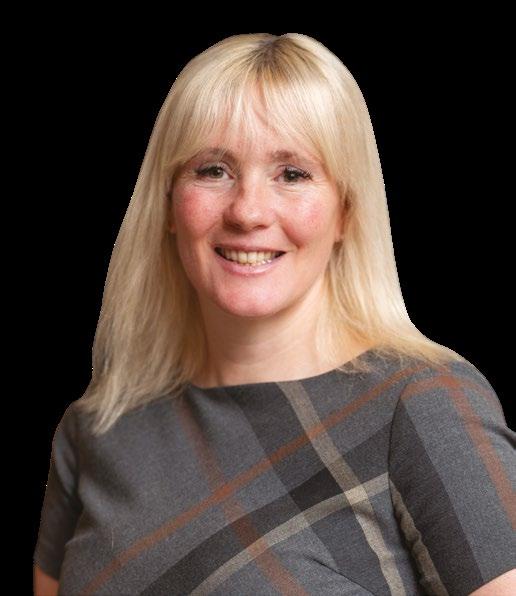
“Early in my career, I encountered both inspiring and ineffective leadership. Interestingly, it was the poor examples that had the most lasting impact on me”
what’s possible when a team is unified by trust and collective ownership.
Of course, my leadership journey hasn’t been without its missteps. There have been times I’ve misjudged a situation, communicated poorly or overlooked a key perspective. Leadership, in my view, isn’t about perfection – it’s about presence, reflection and growth. It’s a continuous practice, one that demands curiosity, courage and humility. The leaders I admire most aren’t the ones who always get it right, but those who are open to learning and willing to adapt.
That’s why I’m especially excited about this June’s Leadership Live event, which focuses on the theme of high-performing teams. It’s a topic that cuts to the core of effective leadership and long-term success. In today’s complex and rapidly changing world, the ability to build and sustain high performance is more vital than ever. I truly believe the best leaders are those who evolve alongside their teams – who embrace the journey, listen deeply and lead with intention.
That’s because high performance isn’t just a metric or a milestone – it’s a culture. One that we create together, day by day, through shared values, mutual respect and a collective commitment to grow.
Mel Robinson is deputy CEO of The Institute of Leadership.
Live
The IoL’s flagship conference takes place on Tuesday 24 June at Hilton London Wembley. For more information, see iol.rsvp.gther.com
Nationwide’s boss was recently in hot water for saying future leaders cannot develop the skills they need remotely, and that being physically around other leaders was crucial to their development. But is she right, or is she wrong?
Peter Crush Writing
By her own admission, Louise Doyle, co-founder of corporate gifting company, Needi, feels conflicted.
“People can’t ‘be’ what they don’t ‘see’,” she says thoughtfully, weighing up whether the people who report to her – her potential leaders of the future – must literally be around her, to absorb and observe her every way of working. “And yet at the same time,” she says, “we are a fully remote organisation. And at times I do find it hard to convey the sorts of behaviours I want my team to demonstrate.”
Doyle is verbalising a conundrum that scores of other leaders are increasingly uneasy about – physical proximity, an issue that was most recently thrust into the spotlight when the CEO of Nationwide, Debbie Crosbie, was interviewed for Radio 4’s Today programme. Rather than opine about remote working’s potential to impact productivity, she instead said she was concerned about the damage that Zoom calls and lack of in-office time were doing to leadership improvement. “Seeing other leaders is really important for career development,” she said, quite clearly suggesting that it’s by being directly around leaders, and observing them, that leadership osmosis happens, and new skills are absorbed.
It attracted criticism at the time, but it seems it’s still dividing opinion today – not
least because it invokes strong academic debate around the merits of concepts such as learned behaviour and mimicry, and whether it’s a good thing in the first place for the next crop of leaders to be copy-clones of their current bosses.
“Social learning theory says we learn through observation,” says Dr Maria Kakarika, professor of organisational behaviour and leadership at Durham University Business School. “Modelling behaviours and rolemodelling are important in leadership for helping create a professional identity. Shadowing leaders and being up close to them is very powerful, but often underestimated.”
And yet, this notion is not shared by everyone. “There’s very little in human learning research that actually supports what Crosbie says,” argues CoachHub senior behavioural scientist, Sarah Henson. “Watching what people do has very little bearing on what they take in. Learning is based on reflection, not copying.”
“What I think is being confused here is learning and providing role modelling/ inspiration,” says Caroline Evans, VP at FutureLearn. “Giving their underlings inspiration by having them around them is fine, but it’s not learning. Learning from leaders is variable at best – it depends on the quality of the leader. And ironically, it’s
“Modelling behaviours and rolemodelling are important in leadership for helping create a professional identity. Shadowing leaders and being up close to them is very powerful, but often underestimated”
“Close proximity to leaders sounds good in theory, but it’s laden with myriad unspoken assumptions that are questionable. It smacks of wanting a time-honoured way of learning still”
iStock
from terrible leaders that people learn best, because that’s when people reflect about why they’re bad.”
Insecurities about dispersed working
According to Henson, Crosbie is most likely revealing insecurities about having an overly distributed workforce and fearing that future leadership skills are not being transmitted because the way of working now is very different from how she likely absorbed her own skills –by being in close proximity to the senior team. “I think there’s a sense among older leaders that this is not how they were brought up to learn about managing and developing others,” she says.
But more worryingly, there is also the suggestion that wanting to be surrounded by their juniors perpetuates the idea of the hero-leader, and that others can only learn from them.
“There’s a lot of hubris in Crosbie’s statement,” suggests Nik Kinley, leadership consultant and author of Re-writing your Leadership Code: How your Childhood Made You the Leader You Are, and What You Can Do About It. “It looks like she’s wanting to mould others into her image, but it’s an old-fashioned view.”
He adds: “When leaders say things like this, it also hints that they are closed to other leadership styles. Close proximity to leaders sounds good in theory, but it’s laden with myriad unspoken assumptions that are questionable. It smacks of wanting a timehonoured way of learning still.”
A further problem in this debate is that however strongly academics and authors rally against the notion that young leaders learn best from being with their superiors, those on the ground often have a much more sympathetic point of view about it.
Lisa Ojomoh is chief revenue officer at Mentor Group, but prior to her official appointment was its interim CRO for 15 months (from 2023-end of 2024). She says the learning she gleaned from being with the senior leadership was invaluable.
“I think, fundamentally, we are herd animals. I knew that I needed to go into the office more, and be present and have more human conversations,” she says, of her interim period. “I think being in-situ creates trust and credibility. You become exposed to a leader’s style and yes, that’s fine. There is something that happens by osmosis by being around
leaders a lot – and this is something that can’t often be replicated on a 30-minute Zoom call once or twice a week. We learn from each other, and I hope that people are now learning from me. I still feel the job of a leader is to handhold others.”
At MediaVision, Annabelle Sacher, its head of digital PR, also shares a similar point of view. “I actually started my career in finance, but actively sought out good female leaders – both for guidance, and to emulate,” she says. “There have been direct lessons I feel leaders have given me to help me grow – people who I’ve seen use their voices at the right time, and not for the sake of it.”
She adds: “I’ve learned when I can be tough, for example, by observing leaders around me. But I think it can be hard for people starting their careers now – people are all working remotely. It’s not easy to demonstrate ‘presence’ – a vital leadership skill – when you’re not physically in the same room as someone.”
So where exactly does this leave discussions around whether future leaders really do learn more from being physically around their executive members?
Training company Good Shout specifically trains individuals to be better leaders. CEO Amy Kean says she encounters the dilemma leaders face around how hands-on they need to be with those around them all the time. The key, she suggests, is for leaders not to overthink things, but be intentional in thinking about how others are likely to see them.
“The first big step is accepting that leaders ‘are’ mimicked,” she says. “We can’t help it. Human beings are imitative generalists, which means we copy the language, tone and body language of those in power in order to survive socially.”
Where she says leaders need to be cognisant, however, is through giving their staff what she calls “moments of autonomy and micro-leadership that they can learn from, so they can still find their own style”. She continues: “This way we’ll avoid that horrible situation of everyone mimicking the ideal ‘type’ of irrational, confident, unemotional leader we were taught to be 20 years ago.”
The good news, suggest commentators, is that a hierarchical approach of leadership – where it is believed leaders have all the answers – isn’t what people expect or want anymore. “Humility is the real skill
12%
25% of UK employees worked from home at some point in 2019 (prior to the Covid pandemic) of employees did at least part of their job from home by April 2020 of UK employees worked from home at least some of the time in 2022
46.6%
“We are a fully remote organisation – at times I do find it hard to convey the sorts of behaviours I want my team to demonstrate”
that’s needed now,” says Evans. “Just having people hanging around you [the leader] just to make you feel important isn’t where it’s at right now.”
Inevitably, this involves leaders letting their guards down. “When leaders want others around them, they’re sort of saying they want to control variables,” says Archana Mohan, chief operations and technology officer at Meridiem Investment Management and author of forthcoming book, The Through Line: How understanding who you are empowers how you lead. “This fear needs to be removed.” She adds: “We all need teachers to learn from, and from people who are close to us, but I feel we can still feel proximity remotely.
“But more than this, I think leaders should primarily help their people to find answers themselves, rather than be the person people come to for answers.”
Leaders accepting they will likely be put on a pedestal to some degree – but that they shouldn’t take advantage of it – is the healthy place where many think a compromise position
13%
28% were working from home all of the time in 2022 of working adults were hybrid working in autumn 2024
Source: Office for National Statistics
should be found. “We need to make sure we don’t go backwards when we’ve come so far forwards in terms of letting people reflect and decide their own leadership styles for themselves,” warns Georgina Waite, CEO of the Association of Business Mentors. Her philosophy is that while (broadly) Crosbie has a point, networking is also just as important, but even more important than this is being exposed to other, competing ideas through a wider network of mentors/coaches. Then, she says, team members need to be able to reflect in a safe space.
It’s a point that seems to share a growing consensus. “Today’s leadership demands more than proximity and imitation,” asserts Dr Debbie Bayntun-Lees, professor of organisation and leadership development, Hult International Business School (Ashridge).
“It calls for adaptability, integrity, and the ability to use power responsibly in a fastchanging, often ambiguous world. That’s not something you can just watch and learn.”
She continues: “Today’s challenges around hybrid work, inclusion and the climate crisis requires a fresh kind of leadership. Blindly
replicating old models may do more harm than good.”
But this doesn’t mean it’s all out with the old. Lynda Holt, honorary professor of Social Inclusion and the CEO of Health Service 360, suggests the wisdom of experience shouldn’t entirely be ignored. She argues leaders must be cognisant of the influence they do clearly have –but they need to allow those around them to be their own authentic self.
She says: “To say people don’t learn from being directly around a leader would be naïve. To me, the bigger question is the extent to which leaders are aware they’re modelling certain behaviours, and whether these are good ones.”
She adds: “It’s absolutely the responsibility of leaders to model good behaviours, but while role-modelling is fine, copying is arguably not. I think we can model just as well on Zoom calls as in-person.”
Maybe Crosbie was suggesting that when she’s with her team, she simply feels they get more from her than they do by sitting hundreds of miles away, staring at a computer screen. Lots can attest to this being no bad thing. But maybe
“To say people don’t learn from being directly around a leader would be naïve. To me, the bigger question is the extent to which leaders are aware they’re modelling certain behaviours, and whether these are good ones”
all leaders also need to recognise that their team picks up behaviours and styles and approaches from a variety of sources, and not all of it needs to be handled to them on a plate and placed directly in front of them.
Concludes Henson: “Leadership does not need to be delivered in person any more. If anything, the leader’s job is to get out of the way!”
Peter Crush is an award-winning HR-specialist journalist, writing about all aspects of leadership and the world of work.
Peter Watt
Effective leadership is not about being physically present
To a considerable extent, the discussion over whether leaders need to be physically present with their teams to be ‘true’ leaders is moot. Of course, many workplaces require a physical presence – shop work, much of frontline health or social care, and construction, for instance. But for many others, postpandemic, being physically present is simply not an option.
Attracting and retaining staff requires organisations to offer flexibility in terms of physical location, working patterns and personal working styles. Any attempt to reverse this reduces an organisation’s ability to get the competitive advantage that attracting the very best staff brings.
Successful leaders in 2025 must be leaders of a dispersed and diverse workforce. Any discussion of whether or not this is a good or bad development is simply self-indulgent, wishful thinking from those in leadership positions hankering after something now gone.
Having a dispersed workforce and leadership, quite apart from being inevitable, offers huge benefits to current and aspiring leaders. For starters, traditional workplaces very much suited quite a narrow ‘type’. If you had no childcare responsibilities, if you happened to live in the right place, happened to be relatively social, could maximise your energies between 9am and 5pm, and liked performing in front of colleagues – all good. But, if not, then you were unlikely to progress very far. And, of course, from this

“A new cadre of leaders will be allowed to emerge. Many will be autistic, bringing passion, loyalty and creativity to a more diverse workforce; a set of skills and strengths that should be recognised and celebrated”
environment we grow a particular type of leader – oozing ‘leadership personality’, projecting strength and purpose, dynamic and charismatic.
Remote leaders do not need to
perform on the office stage, breeze into meetings with a slew of underlings and dynamically project their leadership credentials to motivate their troops. Instead, they need to work hard to nurture individuals, recognising their personal styles, preferences and ambitions.
The result: someone who hitherto would baulk at the ‘opportunity’ to present to colleagues can be more in control of their digital stage. For a neurodivergent employee for whom the ambient noise, flickering strip lights and smells of colleagues’ lunches made meeting attendance a nightmare, can now fully participate. And those who need to take breaks to recharge their batteries after one work event before (say) writing that vital report, can do so without feeling that others are questioning their resilience or work ethic. A new cadre of leaders will be allowed to emerge. Many will be autistic, bringing passion, loyalty and creativity to a more diverse workforce; a set of skills and strengths that should be celebrated. Remote leadership is inevitable. But successful remote leaders will need to be different from their physically present predecessors. By being different, they will enable this new group of leaders to emerge, who will be able to grow in ways that were denied to them by office-based working – and, further, new perspectives, different skills and fresh thinking will emerge.
Peter Watt is managing director of National Programmes at the National Autistic Society.
Paul Carney
There are huge benefits to learning directly from a leader – and, for some jobs, leaders absolutely need to be seen to get the most from their teams
Iwill start by acknowledging that leadership development is multifaceted. A single area of growth will not in itself build an individual’s or team’s skills in leadership. But after nearly 30 years in the military, I would offer that nothing provides better mass leadership development than role modelling.
For more than 350 years, the British Army has developed non-commissioned (soldiers) and commissioned (officers) leaders who have proven themselves in the most dangerous and unpredictable circumstances through role modelling and mentorship. It is critical that role models exhibit the correct behaviours for it to be used successfully for the development of future leaders.
In 2016, the British Army opened the Centre for Army Leadership to harness and distribute the best practices for leadership and followership, and to counter negative behaviours. The first ‘Army Leadership Doctrine’ delivered its Leadership Code, designed to help leaders deliver every day. It is based on the abbreviation LEADERS: Lead by example; Encourage thinking; Apply reward and discipline; Demand high performance; Encourage confidence in the team; Recognise individual strengths and weaknesses; and Strive for team goals.
Powerful impact
You can only ‘lead by example’ if you understand how you lead in the first place. The best leaders I have worked with exhibit what I believe is not only
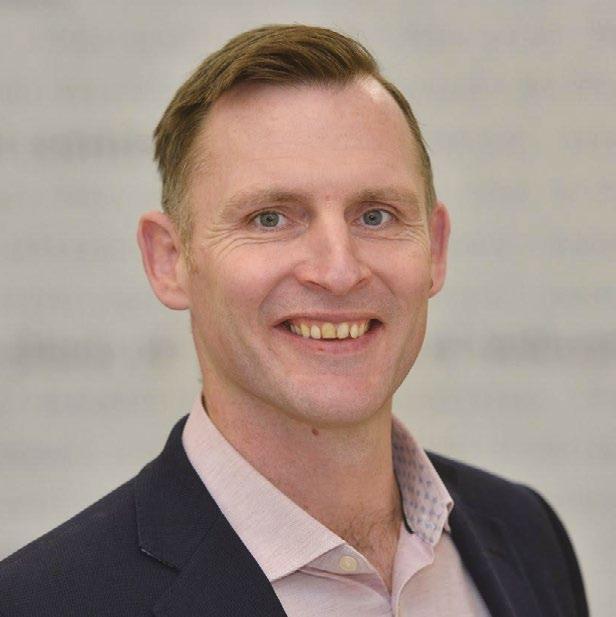
“With an increasing understanding of the neurodiverse population, different learning styles and the decreasing attention span that technology has created, we shouldn’t underestimate the strength of learning through osmosis”
worth replicating, but provide the room for others to build their own leadership style. They tend to be very humble and are always striving to make themselves better. They will draw on external influences such
as mentors and 360-degree reporting, and have a proper understanding of the organisation’s intent – and their own boundaries – to work towards it. More importantly, they conduct self-reflection, attempting to understand their strengths, areas for development and bias. When leaders know themselves, it gives them time to truly understand their people. With an increasing understanding of the neurodiverse population, different learning styles and the decreasing attention span that technology has created, we shouldn’t underestimate the strength of learning through osmosis.
Observing or being part of a team that has been led well can have a powerful impact on an individual. It can be easy to read the theory about how to be a good leader, but without overlaying that academic knowledge with experience, it can almost be worthless. Leadership, by its very nature, is most powerful in uncertain circumstances; lived experiences and watching those who have delivered previously make the impact real.
Paul Carney served in the British Army for 28 years, most recently as its most senior soldier and the senior executive workforce adviser. He is now chief of staff at Pinnacle Service Families. He is speaking at Leadership Live on 24 June: see iol.rsvp.gther.com
Would you like to take part in our next debate? Please email louise.parfitt@ cplone.co.uk to find out more.
Improve your team’s potential by creating a customised pathway through our e-learning platform, MyLeadership.
Contact us about designing your own programme at leadership.global/enquire
Astrid Davies
Is sustainability the missing link in our leadership toolkit –and what can we do about it?
If you’re reading this magazine, you’re already committed to continuous improvement in your leadership. The Institute of Leadership (IoL) is a global leader in leadership development and I am proud to be one of its Fellows. It’s good here, isn’t it?
Yet, it feels to me that something is missing, and that is sustainability. More specifically, the leadership skills required to support every organisation and home to a low- (or even no-) emission basis as soon as possible.
Sustainability is defined, according to the United Nations, as ‘meeting the needs of the present without compromising the ability of future generations to meet their own needs’. At present, we have a global economic whirl fuelled by demand, growth, demand, growth…
Leadership in sustainability is going to be tough. It is going to be helping people to stop doing the things they have normalised in their lives. To paraphrase former US President Harry S Truman, it will be persuading people to do something they didn’t know they had to do and don’t want to do now they know, and often don’t care about because it’s all a long way down the road.
The trouble is, climate change is not a long way down the road. It’s happening now. Leadership in this context is pretty quiet. It’s just too hard. Doom and gloom don’t win votes or contracts.
Make the difference
Where does all this leave us, as leaders and students of leadership? I believe that it offers us an opportunity for impact like never before. Within the IoL, we have a key role to play in modelling sustainable

behaviour and encouraging its leadership, because it is such a huge global need… and precisely because it is hard. If not us, who? We are self-defined leaders. Do we really get to pick and choose, so we are only leaders for the easy stuff; the popular stuff?
I don’t know anyone at the IoL – or any leader I have ever met – who would believe that. No, we lead because we believe in a
vision. We believe in better, for everyone –and there’s not much better than arresting the decline of our home planet.
To finish, I am going to be cheeky. May I invite you to engage on this topic so it gets onto our collective agenda? We need to discuss the leadership implications of sustainability, both the challenges and the opportunities. Whether it’s working with our clients to cut waste or improve social impact, or not serving problematic foods at our events, we all have the potential to lead in this area –and to lead well. Who’s with me?
Please connect with at me at linkedin.com/ in/astriddaviesconsulting and let’s have a conversation.
Astrid Davies MA FIoL runs her own leadership consultancy, drawing on a 30+ year leadership career in private, public and voluntary sectors. She’s a passionate advocate for sustainability and ethical leadership.
You may have come across theories in this area, such as the Sustainable Leadership Model1 or those from the University of Cambridge’s Institute of Sustainable Leadership.2
There is also the famous Butterfly Diagram from the Ellen MacArthur Foundation3 , and The Doughnut, developed by Professor Kate Raworth4, to help us gauge our environmental and social impact.
I have my own that I use with clients embarking on their sustainability journey,
which pulls heavily on John Adair’s simple Venn diagram. It’s small, imperfect, but it does the job – opening clients’ eyes to the fact they can do something that makes a real difference.
1 sustainableleaders.eu/model-part1
2 cisl.cam.ac.uk/system/files/documents/ sustainability-leadership-linking-theoryand.pdf
3 ellenmacarthurfoundation.org/circulareconomy-diagram
4 kateraworth.com/doughnut
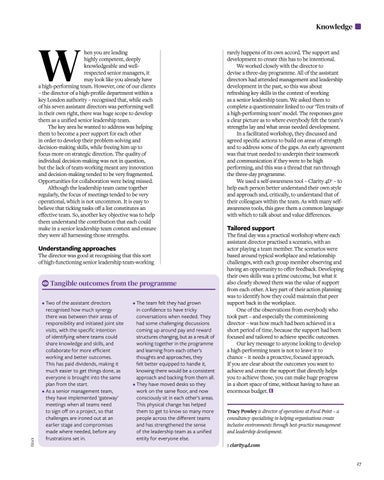
Tracy Powley, from Focal Point Training, shares a case study of a local authority’s approach to building a high-performing senior leadership team


When you are leading highly competent, deeply knowledgeable and wellrespected senior managers, it may look like you already have a high-performing team. However, one of our clients – the director of a high-profile department within a key London authority – recognised that, while each of his seven assistant directors was performing well in their own right, there was huge scope to develop them as a unified senior leadership team.
The key area he wanted to address was helping them to become a peer support for each other in order to develop their problem-solving and decision-making skills, while freeing him up to focus more on strategic direction. The quality of individual decision-making was not in question, but the lack of team-working meant any innovation and decision-making tended to be very fragmented. Opportunities for collaboration were being missed. Although the leadership team came together regularly, the focus of meetings tended to be very operational, which is not uncommon. It is easy to believe that ticking tasks off a list constitutes an effective team. So, another key objective was to help them understand the contribution that each could make in a senior leadership team context and ensure they were all harnessing those strengths.
The director was good at recognising that this sort of high-functioning senior leadership team-working
• Two of the assistant directors recognised how much synergy there was between their areas of responsibility and initiated joint site visits, with the specific intention of identifying where teams could share knowledge and skills, and collaborate for more efficient working and better outcomes. This has paid dividends, making it much easier to get things done, as everyone is brought into the same plan from the start.
• As a senior management team, they have implemented ‘gateway’ meetings when all teams need to sign off on a project, so that challenges are ironed out at an earlier stage and compromises made where needed, before any frustrations set in.
• The team felt they had grown in confidence to have tricky conversations when needed. They had some challenging discussions coming up around pay and reward structures changing, but as a result of working together in the programme and learning from each other’s thoughts and approaches, they felt better equipped to handle it, knowing there would be a consistent approach and backing from them all.
• They have moved desks so they work on the same floor, and now consciously sit in each other’s areas. This physical change has helped them to get to know so many more people across the different teams and has strengthened the sense of the leadership team as a unified entity for everyone else.
rarely happens of its own accord. The support and development to create this has to be intentional.
We worked closely with the director to devise a three-day programme. All of the assistant directors had attended management and leadership development in the past, so this was about refreshing key skills in the context of working as a senior leadership team. We asked them to complete a questionnaire linked to our ‘Ten traits of a high-performing team’ model. The responses gave a clear picture as to where everybody felt the team’s strengths lay and what areas needed development.
In a facilitated workshop, they discussed and agreed specific actions to build on areas of strength and to address some of the gaps. An early agreement was that trust needed to underpin their teamwork and communication if they were to be high performing, and this was a thread that ran through the three-day programme.
We used a self-awareness tool – Clarity 4D1 – to help each person better understand their own style and approach and, critically, to understand that of their colleagues within the team. As with many selfawareness tools, this gave them a common language with which to talk about and value differences.
The final day was a practical workshop where each assistant director practised a scenario, with an actor playing a team member. The scenarios were based around typical workplace and relationship challenges, with each group member observing and having an opportunity to offer feedback. Developing their own skills was a prime outcome, but what it also clearly showed them was the value of support from each other. A key part of their action planning was to identify how they could maintain that peer support back in the workplace.
One of the observations from everybody who took part – and especially the commissioning director – was how much had been achieved in a short period of time, because the support had been focused and tailored to achieve specific outcomes.
Our key message to anyone looking to develop a high-performing team is not to leave it to chance – it needs a proactive, focused approach. If you are clear about the outcomes you want to achieve and create the support that directly helps you to achieve those, you can make huge progress in a short space of time, without having to have an enormous budget.
Tracy Powley is director of operations at Focal Point – a consultancy specialising in helping organisations create inclusive environments through best-practice management and leadership development.
1 clarity4d.com
Rev Dr Susan Goldsworthy considers the difference between ‘power-over’ and ‘power-with’ for creating a thriving team
In an era of misinformation, complexity and rapid change, the ability to create an environment in which people can flourish amid uncertainty has never been more crucial. Yet the traditional model of leadership – where power is exerted over others –often stifles the very qualities that organisations need to thrive. Fear-based control mechanisms suppress innovation, creativity and collaboration, leading to disengagement and burnout. By contrast, leaders who cultivate power for themselves and their teams create a secure base for growth, trust and excellence.
In the words of entrepreneur Anthony Venus, founder of CEO Coaching International: “When leaders embody secure-base coaching, they create a positive environment, focus on the future, invest time in developing others, show empathy and self-awareness, and encourage others to take responsibility and try new ideas. This approach unleashes the potential in each individual to grow, contribute, impact, and help organisations thrive. It is vastly different from old-school, command-andcontrol, fear-based management techniques, which sadly still exist in the corporate world.”
Power-over leadership operates through control, coercion and hierarchy. It thrives on dominance, where decisions flow from the top, dissent is discouraged and employees are expected to comply rather than contribute. While this approach may generate short-term efficiency, it ultimately undermines motivation, curiosity and psychological safety – essential ingredients for sustained high performance. It is a style that is not fit for purpose if that purpose involves healthy human interactions.

Power-with, on the other hand, is rooted in self-awareness, trust and shared purpose. It acknowledges that true leadership is not about exerting authority, but about fostering the inner strength of individuals and teams.
When leaders empower others to step into their own potential, the collective becomes stronger, more resilient and more capable of navigating uncertainty with agility. A thriving team is not merely productive – it is dynamic, engaged and adaptable.
A power-over leader creates fear and rigidity; a power-with leader instils confidence, fostering an environment in which individuals can stretch beyond their comfort zones while knowing they have support. This is the essence of secure-base leadership where teams and organisations can ‘care, dare and share’ together.
Antje Kanngiesser, CEO at Alpiq, says: “We believe that our company culture is our competitive advantage. By both ‘caring’ and ‘daring’, as well as ‘sharing’, we nurture an environment ripe for
perpetual learning and growing, and forge secure bases for constructive dialogue and daring decisions. This is critical in supporting leaders to coach others to unleash potential and ‘a different kind of energy’.”
In today’s world, no single individual can possibly have all the answers. The complexity of modern challenges demands a collaborative approach in which diverse perspectives come together to co-create solutions. True innovation and progress emerge from collective intelligence rather than isolated expertise.
By embracing a power-with mindshift, leaders cultivate an environment in which collaboration is not just encouraged, but also essential for success. As Al Pacino’s character famously stated in Any Given Sunday: “We either heal as a team or we will die as individuals.” This sentiment rings true in business and the broader world – people who unite, share knowledge and support one another are the ones who will thrive.
In times of uncertainty, rigid structures and control mechanisms become liabilities. The organisations that flourish are those that embrace adaptability, experimentation and a willingness to pivot in response to changing landscapes.
A thriving team is one in which people feel safe to try, fail, learn and grow, both individually and together. By shifting from power-over to powerwith, leaders unlock the collective intelligence and potential of their teams.
In a volatile and unpredictable world, organisations need leaders who provide a secure base – a foundation of trust and stability from which teams can take risks, explore new ideas and perform at their best. This takes courage and leads to the release of productive energy.
Leadership is evolving. The traditional power-over model, rooted in hierarchy, dominance and control, is increasingly proving inadequate in an era when humility, agility, resilience and collaboration are paramount.
To build high-performing teams in uncertain times, leaders must foster a culture of caring, daring and sharing, co-creating the conditions for true excellence. When individuals are empowered to bring their full selves to their work, innovation flourishes, engagement deepens and teams not only perform – they thrive.
In a world facing ecological and social crises, a power-with approach not only drives performance, but also aligns human ambition with planetary wellbeing, ensuring that progress is regenerative rather than extractive. Power-with combines power with wisdom.
Therefore, the question we must ask
ourselves is clear: will we continue to lead through a fear-based, dominant, power-over approach, or do we have the courage to rise to the opportunity to lead through a love-based, collaborative, powerwith approach?
A sustainable, thriving future depends on our choice.
Rev Dr Susan Goldsworthy is an Olympic finalist, award-winning author, executive coach, and speaker, with more than 40 years of corporate experience. She is co-director (lead) of the International Institute for Management Development’s (IMD’s) Executive Coaching Certificate, and programme director of the Leadership Skills for Sustainable Change programme. She is a contributor to Leading the Sustainable Business Transformation: A Playbook from IMD and author of Care Dare Share: The Secure Base Coach.
A caring, daring and sharing culture is built on three foundational pillars:
1
Caring: creating a psychologically safe environment in which individuals feel valued, seen and heard. When people trust that they will not be judged for taking risks, they contribute more fully and authentically
2
Daring: encouraging bold thinking, experimentation and the courage to challenge the status quo. This allows teams to push boundaries, take calculated risks and drive meaningful change
3
Sharing: promoting transparency, open dialogue and collective wisdom. In high-performing teams, knowledge is not hoarded, but openly exchanged, with regular feedback, amplifying learning and progress.
A power-with approach naturally nurtures:
• Innovation: by encouraging diverse perspectives, risk-taking and creative problem-solving
• Curiosity: by fostering a ‘coaching’ culture in which questions are valued as much as answers
• Playfulness: by reducing fear of failure and enabling a mindset of exploration and learning.


Professor Sean Martin
Teams are increasingly required to anticipate and initiate change, but proactivity is nothing without conscientiousness
In today’s workplace, proactivity is often celebrated – but does more hustle always translate to better results? Together with a team of colleagues, led by Kyle Emich, of the University of Delaware, we discovered that high levels of proactivity within a group did not enhance team performance unless the more proactive members were also more conscientious. While the most successful teams may initiate change rather than simply respond to it (proactivity), the team members driving that change also need to be purposeful, well organised, and deliberate in their efforts to achieve goals and demonstrate situational judgement (conscientiousness). The alignment of proactivity and conscientiousness matters more than the extent of each trait present in a team.
We conducted a simulated six-day climb of Mount Everest. Each group interacted solely through computer chat to decide how far to climb each day and to coordinate information about the weather, oxygen supplies and medical needs. The top-performing team showed steady information-sharing, led by members who ranked high in proactivity and conscientiousness. Their lessconscientious teammates were also low in proactivity, contributing only when asked and avoiding distractions.
In contrast, one low-performing team was driven by proactive, but unconscientious, members who bypassed quieter, more conscientious colleagues. Another struggled despite having balanced members, as a highly proactive, lowconscientiousness teammate disrupted their efforts.
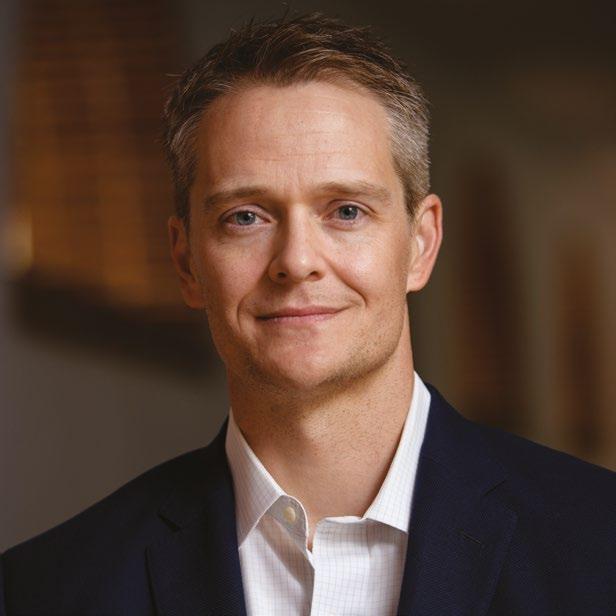
“ The alignment of proactivity and conscientiousness matters more than the extent of each trait present in a team”
1 Empower the conscientious but quiet. These individuals might not be the loudest voices, but can offer the most thoughtful insights. Notice who’s consistently taking notes, asking smart follow-up questions or thinking deeply about execution. Create intentional opportunities for them to speak up, acknowledge their strengths publicly and involve them in shaping strategies. Their attention to detail and forward-thinking can be invaluable assets.
2 Manage the noise. Ensure that group discussions are not dominated by your
highly proactive but low-conscientious team members. A tendency to speak more does not necessarily correlate with whether the person does a good job, but it often predicts whether they ascend to a leadership role on a team. Level the playing field by setting clear objectives and varying the ways input is gathered (in writing, in small breakout sessions, and so on) so that more conscientious members can have greater influence.
3
Seek flexibility in the middle. While not every team member will be a top performer, those low in both proactivity and conscientiousness play a valuable role because they help to keep operations on track. Ideally, recruit people in this category who are flexible, easy going and open to guidance. Their cooperative attitude and steady presence can support more proactive or strategic colleagues, contributing to a well-balanced team dynamic.
Building an effective team requires more than encouraging initiative. To maximise performance, proactive individuals must also be capable of following through with care and conscientiousness. By thoughtfully balancing team composition, organisations can harness the full potential of proactivity while maintaining the discipline and reliability needed for success.
Sean Martin is Donald and Lauren Morel Associate Professor of Business Administration at The University of Virginia’s Darden School of Business. He is co-author of Better Together: Member Proactivity Is Better for Team Performance When Aligned with Conscientiousness
Kate Waterfall Hill, FIoL and leadership coach at Waterhill Consulting

What does leadership mean to you?
It’s about setting the tone and the vision – people need to see where they are going and believe it’s worth the effort. A leader’s mood, clarity (or lack of it), confidence and presence set the direction of travel – consciously or not. You can’t expect your team to be calm, focused and motivated if you’re rushing in late and flapping about a printer jam. Leadership is influence, not job title. It’s less about having the answers and more about asking better questions and getting out of people’s way (while still being interested in what they’re doing).
What are your main leadership and management challenges?
Helping leaders to realise that being in charge doesn’t mean doing it all yourself. Especially founders and C-suite leaders – they’re used to wearing all the hats, but as the team grows, that becomes unsustainable and a bit suffocating for everyone involved. A lot of leaders are stuck in the weeds, not because they’re control freaks, but because they haven’t learned how to delegate well. It’s a skill – and like all skills, it can be taught.
How does the landscape of your sector affect those challenges?
I coach leaders across multiple sectors, but the common theme is pace. Everything’s urgent. Everyone’s stretched. Middle managers are getting squeezed from all angles. When time and headspace are tight, leadership becomes reactive, and that’s when the damage starts – low engagement, poor communication, burnout. Supporting people to lead with intention instead of reacting to noise is a big part of my work.
What are you focusing on from a leadership perspective?
Helping leaders go from accidental to intentional. Many of the people I
“A lot of leaders are stuck in the weeds, not because they’re control freaks, but because they haven’t learned how to delegate well”
coach were promoted because they were good at their job – not because they had any training in leading humans. So they’re winging it, quietly stressed, and wondering if everyone else knows something they don’t.
I’m focused on building their confidence and capability, so they can stop guessing and start leading on and with purpose.
How do you develop your people?
With honesty, humour and high expectations. I tell my clients the truth (kindly), ask tough questions, and challenge them to lead like they mean it. I use tools such as DiSC profiling and feedback frameworks, but the most powerful shift comes when people realise: “Oh, I’m allowed to do this differently.”
My job is to hold up the mirror and help them like what they see. I have my own team, and we’ve all done DiSC profiling (fascinating to see how different traits are needed in a team) and I certainly use the techniques I suggest in coaching with my own team – so I practise what I preach! We start each team meeting with “What successes shall we celebrate?”
What is your biggest leadership lesson over the past year?
That curiosity is one of the most underrated leadership skills. Too many leaders jump to fix, judge or assume –especially when things go wrong. But leading with curiosity changes the game. It means asking “What’s going on here?” instead of “Who messed this up?” It invites better conversations, uncovers root causes, and builds trust without needing a big dramatic team away day.
When leaders get curious instead of defensive, everyone breathes a little easier – and the solutions are usually better, too.
We’re looking for members to feature in the Hot Seat! Email louise.parfitt@ cplone.co.uk

Baroness Sue Campbell DBE on learning leadership lessons from teenagers, building back up from rock bottom and that epic 2022 Euros win
Writing Louise Parfitt
“Was it easy? No. Did I have some moments when I just wanted to disappear into a big hole in the ground? Most probably.” Baroness Sue Campbell has never been one to shy away from leadership challenges: she has trailblazed the transformation of sport in the UK and become a hero to many (David Beckham is quoted in her new book, saying “Sue’s passion for sport in this country is unmatched”).
At the Youth Sport Trust, Campbell worked with the Blair and Brown governments to overhaul sports provision in schools; as chair of UK Sport – leading up to and during the London 2012 Olympic and Paralympic Games – she helped the UK move from 10th place in the medal table at the Sydney Games in 2000 to second place in Rio in 2016. At the National Coaching Foundation, she oversaw fundamental changes to the training and status of coaches of all sports in the UK; and

at the Football Association (FA), she brought the women’s game through to a professional level, culminating in that epic 2022 Euros win.
After announcing that she was hanging up her football boots last year, she has become chair of the board at England Netball, returning to the sport in which she represented her country in the 1960s.
As well as the ‘what have I let myself in for’ moments, there have, of course, been times of sheer elation, too, such as the Euros in 2022.
“To be on the pitch with those incredible women – to see their joy, their happiness, their tears – was very special,” she says. “Chloe Kelly [who scored the winning goal] leapt on me, with her feet and arms wrapped around me, screaming in my ear ‘I love you!’ – that was an extraordinary moment of feeling someone’s complete and utter joy.”
My third parent Campbell was born in Nottingham in 1948 to “wonderful parents – Mum was a
Every leader has to be resilient, because things don’t often work out the way you plan them. Just look at the present UK government and its economic forecast – no one could have anticipated what US President Donald Trump is doing now. It doesn’t matter how good your plan is, how much thought you have put into it – something will always come along to challenge
you and knock you sideways. When it is tough, don’t be thrown off the mission – what it is you are trying to achieve. Listen to the noise, the resistance, but check that against: are you making good decisions; is this the right thing to do; and are you listening to the right people? If you still believe the mission is the right thing to do, then you keep going.
hairdresser, Dad worked for the Co-op”. When she thinks back to her childhood, she says she was never not running, or kicking a ball, or climbing a tree. “Sport was my third parent,” she says. “And football was my first love. As a girl, I thought I would one day play for England at Wembley. It was only when I reached secondary school that my dreams were dashed when I was told that girls don’t play football. I became aware that my gender was an issue to achieving my dream.”
Netball and hockey took the place of football. “I was strong, determined and competitive. I didn’t like losing – I still don’t, but I have learned to manage it. Sport helped me to channel all of that energy – physical energy, but also mental, emotional and social energy – into something positive. I learned how to manage myself in a competitive environment, which is important to do because you end up using those skills in later life in different contexts.”
After playing netball for England under-21s, Campbell decided to share her love of sport with others and trained as a PE teacher. One of her first jobs was at Whalley Range High School, in Manchester, which came as a shock to the system – but it was where she learned one of her most valuable leadership skills: how to listen.
“No one had turned up for my first lesson. I found my class in the toilets, smoking cigarettes,” she says. “They were quite an intimidating group of girls. I felt overwhelmed and rather shaky – nothing in my teacher training had prepared me for this – so I had to sit down on the floor.”
To her surprise, the girls all sat down too.
“I started asking them questions and I found out that they loved to dance. I suggested that they come to PE next week and they could dance. Bit by bit, we got to know one another and they began to trust me a little, and I began to trust that they would do what they said they would do. They went on to be very successful in dance competitions at a local level and, more importantly, out of that they found their self-esteem and self-worth.”
This was also a pivotal moment for Campbell; she realised that if she used sport as a tool, rather than an end in itself, she could change lives.
“This has been an incredible gift – and from that moment, my mission has been really clear: how do I use the position I am in to change lives for the better?”
Campbell’s career path has included roles –such as at the National Coaching Foundation and Youth Sport Trust – where she was part of the initial set-up, able to grow the team and develop the culture: “so, as a leader, your mission becomes their mission”. It was very different in organisations such as UK Sport and the FA, she says, where maybe one or two people shared the mission, but the culture was very different. She always drew on the skills that playing sport had taught her, however, to inform how she led.
“Sport helped me to understand what I was really good at, but it also helped me understand what I wasn’t great at. So I always build a team that fills in those gaps,” she explains.
“As a leader, I’ve never felt threatened by having people around me who are better than me at the things I am not very good at. In my roles at the Youth Sport Trust, National Coaching Foundation, UK Sport and the FA, one of the first things I did was establish a good team around me. High-performing teams share a belief that they have one mission – not seven different missions – and together they can get there. There is something very special when you get a team that is working collaboratively to reach an end goal – that’s when you get the best performance from everyone.”
When she first starts in a role where the culture and structure are more established, Campbell takes the time to really get to understand how the organisation works before she begins to make any changes.
“At UK Sport and the FA – and I am doing the same now, at England Netball – I ask endless questions. They get tired of me, I know they do! I call this process ‘clearing the mist from the mountain’. If we’re going to get

“If we could really achieve things for women and girls in football, could we fundamentally change and inspire people to think differently about women and girls?”
Life is not always easy. When I was a teacher in Moss Side, did I ever dream I was going to be chair of UK Sport? No, but I did crystallise a mission, something that mattered to me, where I could take the skills that I had to make a difference. So think about what it is that really sparks energy in you, that gets you up in the morning – that you want to achieve. Find that nugget, that north star, where your focus is, and work hard at it. The jobs will look after themselves – don’t overthink the journey.
to the top of the mountain – if we are going to achieve something really huge – we need to know how to get there. But when you first start in an organisation with which you are not familiar, you’ve got to clear the mist to see where you are going, and that is done by asking a lot of questions.”
One of the biggest mountains Campbell had to climb was at the FA. Brought in by then chief executive Martin Glenn in 2017, with the remit to put together a strategy to professionalise the women’s game, the climb seemed insurmountable at times.
“The attitude was very much that men are king,” she says. “One person even remarked to me ‘Don’t embarrass us’, and I thought, ‘well, this is a promising start!’”
It was a tough gig. Campbell followed her tried and tested method of asking questions and listening to people, but she had to go to Glenn and say there would be no strategy at this point. “To use the mountain analogy, we had a set of people trekking up to stage one of the climb, but then coming back with another set of ideas of how to proceed,
1960s: played for the England under-21s netball team
1970s: taught PE at Whalley Range High School, in Manchester, followed by Leicester and Loughborough universities
1980-84: regional officer for the East Midlands, Sports Council of Great Britain
1984-85: deputy CEO of the National Coaching Foundation
1985-95: CEO of the National Coaching Foundation
1995-2003: chief executive of the Youth Sport Trust
2003-13: chair of UK Sport
2005-17: chair of the Youth Sport Trust
2016-24: head of women’s football at the FA
2020: created a Dame of the British Empire (DBE) in the New Year’s Honours list
2024present: chair of England Netball
Photo by Naomi Baker/Getty Images

“Chloe Kelly [who scored the winning Euros 2022 goal] leapt on me, with her feet and arms wrapped around me – that was an extraordinary moment of feeling someone’s complete and utter joy”
because at that stage we had no idea what the rest of the mountain actually looked like.”
Campbell instead proposed having a plan that set out to achieve three things:
1 Double participation in women’s football
2 Double the fan base
3 Win a major tournament. By 2020, they were ready for a strategy. Campbell had built her team by then, so they could push ahead on all fronts – coaching, refereeing and talent participation.
“We call the strategy ‘Inspiring Positive Change’ because we all believed this was about more than women’s football. If we could really achieve things for women and girls in football, could we fundamentally change and inspire people to think differently about women and girls?”
The lowest of the low
As difficult as this role was, Campbell says the worst moment of her professional career was at the Youth Sport Trust. Having spent more than a decade building up a school sports programme that was admired and copied by other countries around the world, in 2010 the new coalition government withdrew funding and the programme ground to a halt, virtually overnight.
“Two-thirds of my staff were made redundant. They were sitting in front of me, crying, but there was nothing I could do,” she says. “It was like taking 14 years to build a house brick by brick. You were just finishing off the roof when someone burns the place down and ties your hands behind your back so you can’t put water on the fire. I felt like my insides were being ripped out – it was the most brutal, dreadful thing that ever happened to me professionally.”
Resilience came from a surprising source. Campbell was contacted by a 16-year-old girl, Debbie Foot, who had been on one of the camps
run by the trust. She told Campbell that she was going to do something about it. Sure enough, two months later, she gathered 2,012 people (a significant number given the upcoming Olympics and Paralympics) to march on Downing Street and deliver a 750,000-signature petition demanding that school sport be saved. Campbell was waiting on the green outside the House of Commons to meet them.
“I stood there and saw all these kids walking down Parliament Street and I thought to myself: ‘Sue, your mission has always been to help kids become self-aware, independent thinkers, prepared to stand up for things they believe in – and there’s your mission, walking towards you now.’
“I also thought, ‘I have lost sight of that mission and it has become too personal, so now I need to get a grip’. Sometimes it takes something outside of you to help you be resilient – and these kids did just that.”
Campbell went back to the small team she had remaining at the trust and put on a video of a boat on a stormy sea. “I told them: ‘number one, we’re built on great values, we have an amazing purpose, so we’ll be OK. Two, some of our crew have been thrown overboard and, tough as that is, we’re the ones left who have to get on and sail this ship. And, three, where the heck is some land?! Where are we going? At the moment, I don’t have a clue, but together we’ll find the answer.’ And that was the rebirth of Youth Sport Trust in a sense. We had to start again. It was brutal, but it was worth it.”
The highest of the high
The power that leaders can draw from others – and that they can give to others – is something Campbell comes back to when asked to name her standout moments from such a distinguished career. She says the highlights drop into two categories.
“You can’t beat Super Saturday at the Olympics, or Thriller Thursday at the Paralympics, when those gold medals kept pouring in. You can’t beat that moment at the

“Sport helped me to understand what I was really good at, but it also helped me understand what I wasn’t great at. So I always build a team that fills in those gaps”
Euros in 2022. But it’s not just the enormity of the Euros, but the ripple effect. I was sitting in the stadium as the team ran around to be applauded by the crowd, thinking there are 87,000 people in this arena and 17 million watching on television; I wonder how many girls’ lives we might have changed today? Because, often, you don’t realise that those are life-changing moments for people.”
When things are going well, always make sure your team gets the limelight on them – that they get recognised for the part they play –because that’s really important for their growth and development. Sharing the light is what I call it. But
when it goes wrong, it’s yours. It’s you who can’t sleep at night, who may shed a tear or two – and if you do get it wrong, learn from it. Go back to the drawing board and have another go, drawing on your team’s expertise and experience.
She pauses. “Then there are the wonderful moments with people like Debbie Foot, or my pupils back in Moss Side, where I’ve seen the very best of young people often overcome some very difficult odds to shine through in a way that has filled my heart with the greatest joy.
“I’m immensely grateful for the journey I’ve been on and the opportunities I have had.”
The Game Changer: Lessons from the Woman Who Transformed Sport, by Sue Campbell, is out now.
by
Roxy Allen
The importance of building a workplace community
Five years after the pandemic, many leaders still feel that mandating a return to office (RTO) will restore collaboration and connection. But this overlooks a deeper issue – work should never have been the sole place where people built community.
During the past 25 years, participation in local groups and community spaces has plummeted.1 This decline isn’t just about remote work – it’s a societal shift driven by many themes, including technology, social media, declining membership organisations, and individualism. Even historically strong social institutions are affected: confidence in organised religion fell from 66% in 1973 to 41% in 2016, leaving a gap in meaningful human connection.2
Instead of viewing remote work as the cause, leaders should recognise that community-building has been eroding for decades. The pandemic merely accelerated an existing trend. Expecting an office mandate to reverse years of societal change is unrealistic.
The problem with forcing connection RTO policies often focus on spontaneous interactions and casual office chats, but those alone don’t rebuild real community. While onsite employees report higher engagement (43%) than remote workers (33%), forced office attendance does not guarantee stronger workplace bonds.3
Another challenge is hyperconnectivity – constant Slack/ Teams and meeting overload. Instead of fostering relationships, employees feel drained and overstimulated. We’re

"While
onsite employees report higher engagement than remote workers, forced office attendance does not guarantee stronger workplace bonds"
more connected than ever, yet lonelier than before. Urban residents (7%) report higher loneliness than rural populations (5%).4
Intentional, not forced, community
Rather than relying on mandates, leaders must create intentional opportunities for connection, without forcing outdated office models. Simple initiatives can help:
● Book clubs with free resources (for example, Blinkist)
● Monthly movie nights in a shared space
● Game tournaments to build social bonds
● Reducing unnecessary meetings and digital noise to allow real collaboration.
Cal Newport’s book Slow Productivity suggests reducing multitasking and working at a natural pace; this principle applies to social interaction, too. Leaders must balance structure with flexibility, creating spaces for relationships to develop organically.
Rethinking leadership’s role in community building
Leaders who want to build a connected workplace must go beyond policy mandates and rethink how connection is created. HR leaders can help co-create solutions with employees, using focus groups, pulse surveys and feedback loops to design workplace experiences that align with real needs.
Workplace community isn’t about physical presence; it’s about meaningful connection. Leaders who move beyond RTO mandates and focus on intentional culture-building will create workplaces where people truly feel engaged.
Roxy Allen is a talent development leader specialising in AgileHR, workforce transformation and new ways of working. Passionate about human connection in the workplace, they write and speak on culture, collaboration, and modern workforce strategies.
1 Brookings Institution
2 Joint Economic Community Report
3 Gallup
4 Community Life Survey 2023/24
Neil Mullarkey says that without constructive friction, teams stagnate. So how can leaders foster the kind of challenge and curiosity that drive high-performing teams?
Politeness is a virtue, but in too many teams, it’s become a problem. Leaders often mistake agreement for cohesion, harmony for productivity. But when everyone nods politely and no-one pushes back, creativity and innovation wither. What looks like a well-oiled machine may actually be a team stuck in neutral.
We think that by smoothing edges, we are making progress. In reality, we are holding ourselves back. High-performing teams thrive on something far more challenging: productive tension. They ask difficult questions, challenge each other’s assumptions and embrace the discomfort that comes with disagreement.
Who’s on the bus?
Years ago, at a posh hotel in the countryside, I worked with a financial services team. Or, rather, several teams clumped together for ‘org’ reasons. I used the metaphor of a bus to help them see what was happening. Who was driving? Who was a passenger? Who was clinging to the side, trying to keep up?
In many teams there’s a ‘daddy’ or ‘mummy’ figure – someone everyone looks to for decisions. There are uncles and aunts – advisers with influence but no direct control. And there’s the ‘other’ group, not officially part of the team, but hanging around the bus stop. You can reshuffle the seats, rebrand the departments, but the same dynamics will reappear. Harmony on the surface. Underneath? Confusion and inertia. In this case, one team even admitted they weren’t facing the same way on the bus. If politeness were enough, teams like this would be unstoppable. But instead, too often they are stuck. No-one wants to challenge the hierarchy. Noone wants to ask uncomfortable questions. And so they wait for someone – anyone – to steer.
The belief that teams perform best when everyone agrees is persistent and dangerously flawed. Research by Dr Amy C Edmondson, Novartis professor of leadership and management at Harvard
Business School, has shown that psychological safety is not about avoiding tension but about creating an environment where people feel safe to speak up, challenge and even risk being wrong without fear of humiliation or retaliation. She defines psychological safety as “a shared belief held by members of a team that the team is safe for interpersonal risk taking”, not a bubble of comfort, but a foundation for challenge.1
Why excessive politeness kills performance Google’s deep dive into team dynamics, known as Project Aristotle, offers some of the clearest evidence that psychological safety underpins high performance.2 After studying 180 teams, it found that success didn’t hinge on who was in the team but how the team worked together. The best teams fostered environments where people could express ideas, ask questions, admit mistakes and voice concerns without fear of embarrassment. Even Google’s most brilliant minds needed that safety to contribute their best thinking.
But psychological safety wasn’t the only factor. Two other team norms stood out. The first was equality in conversational turn-taking: the best teams ensured that everyone had space to speak, rather than being dominated by the loudest voices. The second was high social sensitivity – the ability to read the emotions and needs of others.
Teams that tune into subtle cues, whether in person or over video calls, build deeper trust and collaboration. It’s a reminder that the strongest teams are built not just on talent but on trust, curiosity and open dialogue.
“High performance isn’t about smoothing over differences. It’s about leaning into them”
I’ve spent enough time with teams to know the signs of excessive politeness. The nervous laughter. The carefully worded emails. Conversations where people say what they really think, but only after the meeting has ended. That’s where ideas go to die.
There’s an irony here. Most organisations talk about innovation, agility, adaptability. But when it comes to real conversation they default to safety and predictability. They avoid conflict – and in doing so they avoid progress.
High performance isn’t about smoothing over differences. It’s about leaning into them. Professor Andy Cross, of Ashridge Business School, notes, for example, that you shouldn’t measure collaboration by the number of emails sent or hours spent in meetings. It’s measured by outcomes – by the creative energy that comes when people feel free to test ideas and challenge each other.3
This is where improvisation offers powerful lessons. Improv thrives on the principle of ‘yes, and’ – not passive agreement but the act of listening attentively, accepting the offer in front of you and building upon it. It turns tension into creation, not confrontation. In my own workshops over the past 25 years, I’ve seen how improv techniques help teams move beyond fear of saying the wrong thing. When everyone feels they can contribute without judgement, conversations become richer, ideas more diverse and outcomes far stronger. Pixar uses a similar concept known as ‘plussing’, where ideas are never shut down but refined and enhanced collaboratively.
None of this is about turning meetings into arguments. Not all disagreement is healthy, and poorly managed tension can easily spill into personal conflict. Research from the Chartered Institute of Personnel and Development last year highlighted that, while 70% of employers believe they have effective procedures for resolving interpersonal conflict, only 36% of employees feel their conflicts are actually resolved. And while 75% of employers trust their line managers to resolve conflict effectively and at an early stage, nearly half (49%) of those same employers acknowledge that managers themselves can be the source of conflict in their teams. In the public sector, that figure rises to 61%.4 The very people tasked with creating psychological safety and fostering healthy challenge are, all too often, contributing to the problem. This is where leaders need both skill and courage. It’s about intervening early, before issues fester, and reframing conflict as exploration rather than confrontation. Leaders need to invite challenge, and then resist the temptation to shut it down. They need to ask, ‘What are we not seeing?’ and genuinely listen to the answers. iStock
I see it in my work: the moment when a team member hesitantly offers a challenge and the leader responds with curiosity instead of defensiveness. That’s where the magic happens. That’s when teams move from politeness to performance.
If your team feels too comfortable, too smooth, it’s probably not performing at its best. Encourage friction. Invite disagreement. Celebrate curiosity. It’s not always easy, and it’s rarely neat. But that’s where the best work begins.
Neil Mullarkey is a communications expert and author of In the Moment: Build your confidence, communication and creativity at work, which was shortlisted for The Business Book Awards 2024. He delivers keynotes, workshops and coaching to organisations including Google and London Business School.
1. See moredetails.uk/ES25Pol
2. See moredetails.uk/ES25NYT
3. See moredetails.uk/ES25ret
4. See moredetails.uk/ES25thi
Leaders need to actively create the space for challenge. It starts with listening – really hearing what others are offering. This is the first step in what I call the LASER framework: Listen, Accept, Send, Explore, Reincorporate.
• Listen: hear what’s said, without immediately filtering it through your own assumptions.
• Accept: acknowledge the contribution as a starting point, even if you disagree. Acceptance is not agreement; it’s respect.
• Send: add your own offer – a perspective, a question, an idea.
• Explore: be curious about assumptions. Ask “what if” and “why not”.
• Reincorporate: revisit and adapt ideas as new insights emerge. It’s how teams learn to build, rather than block.
LASER turns friction into progress. It allows leaders to model curiosity and openness, transforming disagreement from personal threat into collective opportunity. I recall a senior military leader telling me how, on his MBA course, he had to learn to stop giving orders and start asking questions. At first, it felt unnatural. But he came to see that leadership isn’t about being the only person with the answer, it’s about making space for others to contribute.
Dr Tarek Jomaa and Vanessa Pozzali explore how one team uncovered the invisible dynamics holding them back from being a high-performing team
In today’s workplaces, teams are chasing high performance through connection, trust and collaboration – but what if the real blockers aren’t skills or motivation, but hidden dynamics and cultural blind spots?
Our client was a global organisation with a people-first reputation. One team of 12 described themselves as “like a family” – supportive, open, deeply connected. Despite the warmth, however, progress had stalled. Accountability was unclear. Feedback was rare. Projects dragged. The leader asked: “We get on really well, so why aren’t we moving forward?”
The data that changed the conversation
Our 4C Model assessment revealed 83% of the team aligned with a ‘connect’ culture – high trust, empathy and care. It seemed positive. But deeper analysis told a different story.
Traits such as feedback and conflict resolution showed wide variation. Some avoided difficult conversations entirely. Others felt uncomfortable raising concerns. The radar plots were revealing: a culture built on harmony was unintentionally avoiding friction – and growth.
In the team dynamics data, things became clearer. While ‘collaboration’ scored highly, ‘clarity’ and ‘consistency’ lagged. Our bar charts showed uneven perceptions across core areas such as communication and accountability. The red dots in our visuals highlight these misalignments – small signals of bigger systemic drift.
Moving from insight to action
We ran a half-day team workshop to explore the findings. Seeing the data visualised – radar plots, heatmaps and score spreads – gave the team language for what they’d been sensing but couldn’t
quite name. It wasn’t about blame. It was about naming the invisible.
Through coaching and peer supervision, the leader began to introduce structure, setting clearer expectations and building feedback into everyday routines. Crucially, this was done without breaking trust. We helped the team reframe structure not as control, but as clarity in service of care.
Results – and a shift in mindset
Six months later, the team’s scores told a new story:
• Clarity improved by 22%
• Consistency rose by 17%
• Response variation dropped across traits –showing stronger alignment.
Team members reported more focused meetings, clearer roles and open feedback as a norm, not a risk. The leader, once carrying the emotional weight of ‘keeping the peace’, now led with conviction –supported by a team that could challenge, align and grow together.
What this taught us
High performance isn’t just about skills: it’s about seeing the hidden dynamics. Sometimes what holds a team back isn’t a lack of care, but too much comfort. Culture isn’t what’s written in values documents – it’s what we repeat, avoid and assume. With the right insights and the courage to act, even great teams can become exceptional.
Dr Tarek Jomaa and Dr Vanessa Pozzali are cofounders of Synthosys, which specialises in bringing clarity, cohesion and high performance into the heart of teams. They are hosting sessions at Leadership Live on 24 June. See iol.rsvp.gther.com/
at a glance
• Connect: empathy, trust, belonging
• Create: innovation, curiosity, growth
• Control: stability, process, structure
• Compete: results, pace, performance
Most team members (83.3%) identified strongly with a ‘connect’ culture focused on trust, care and emotional closeness. A smaller group (16.7%) leaned toward ‘create’ – innovation and change. On the surface, this looks aligned. But high agreement doesn’t always mean high performance – sometimes it signals comfort over challenge.
“High agreement doesn’t always mean high performance”
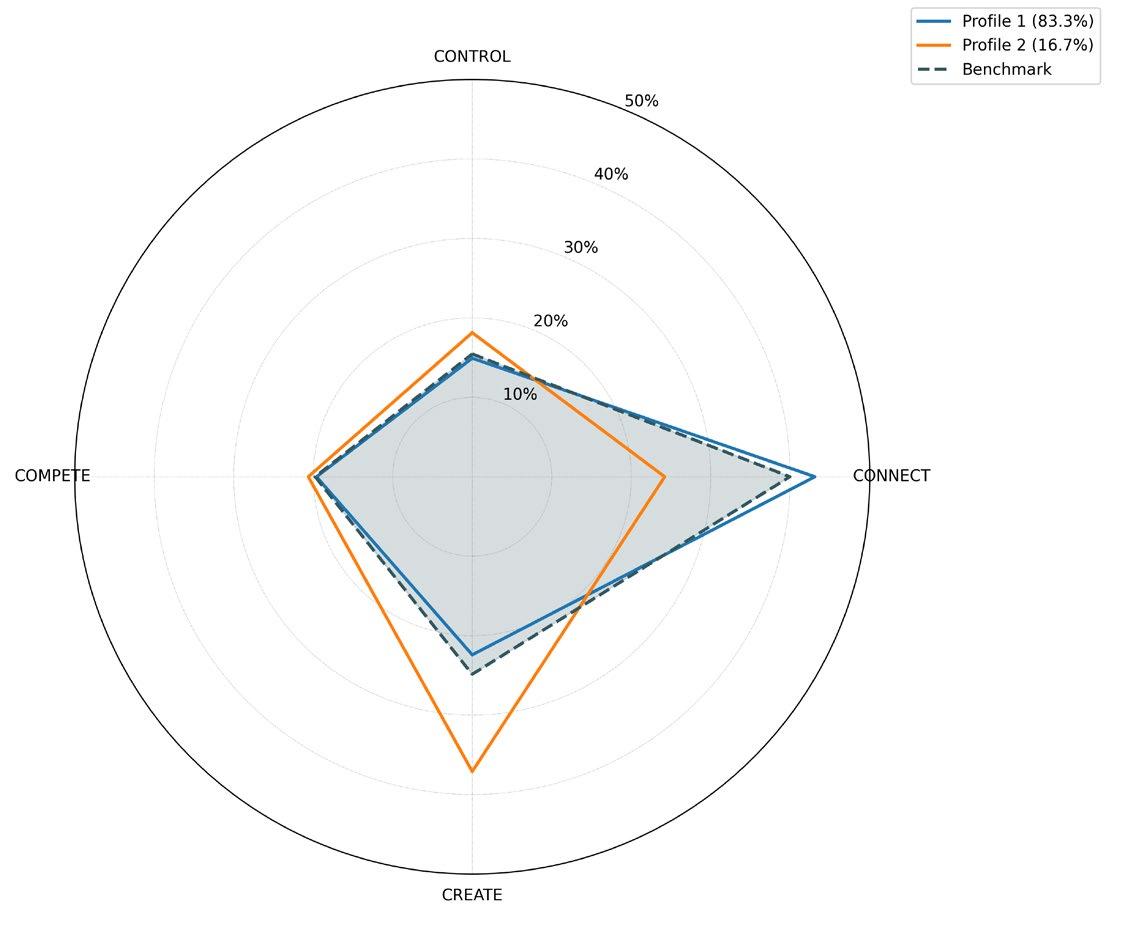
Conflict: unclear and uneven
This radar plot shows how the team perceives conflict resolution, and the differences are stark.
Half of the team saw it as part of a connect culture – safe, open, supportive.
But others placed it in control, compete or create – reflecting mixed experiences and discomfort.
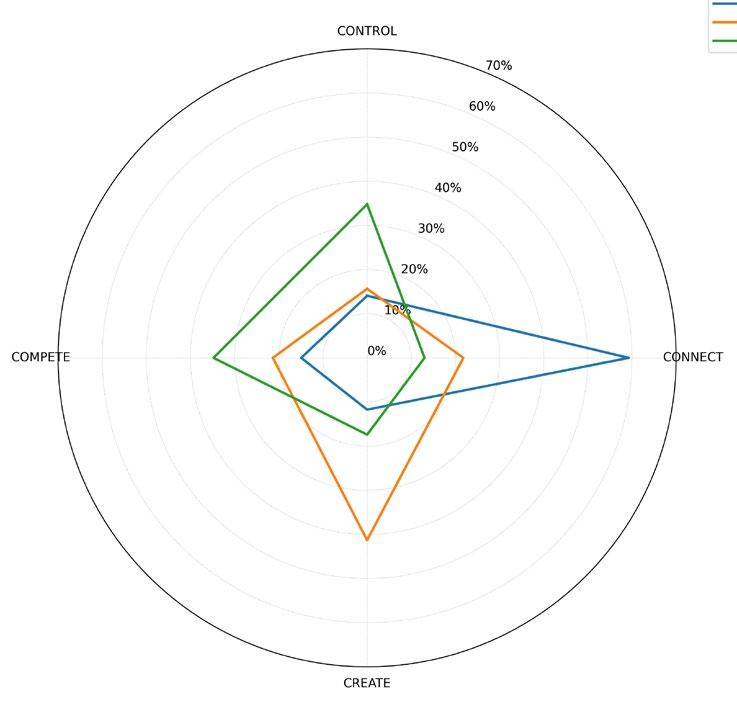
Feedback isn’t flowing
This radar plot shows how differently feedback is experienced across the team.
Despite a strong ‘connect’ culture overall, here we see no clear agreement –some associate feedback with structure (control), others with challenge (compete) or creativity (create). Only one group links it to connection.
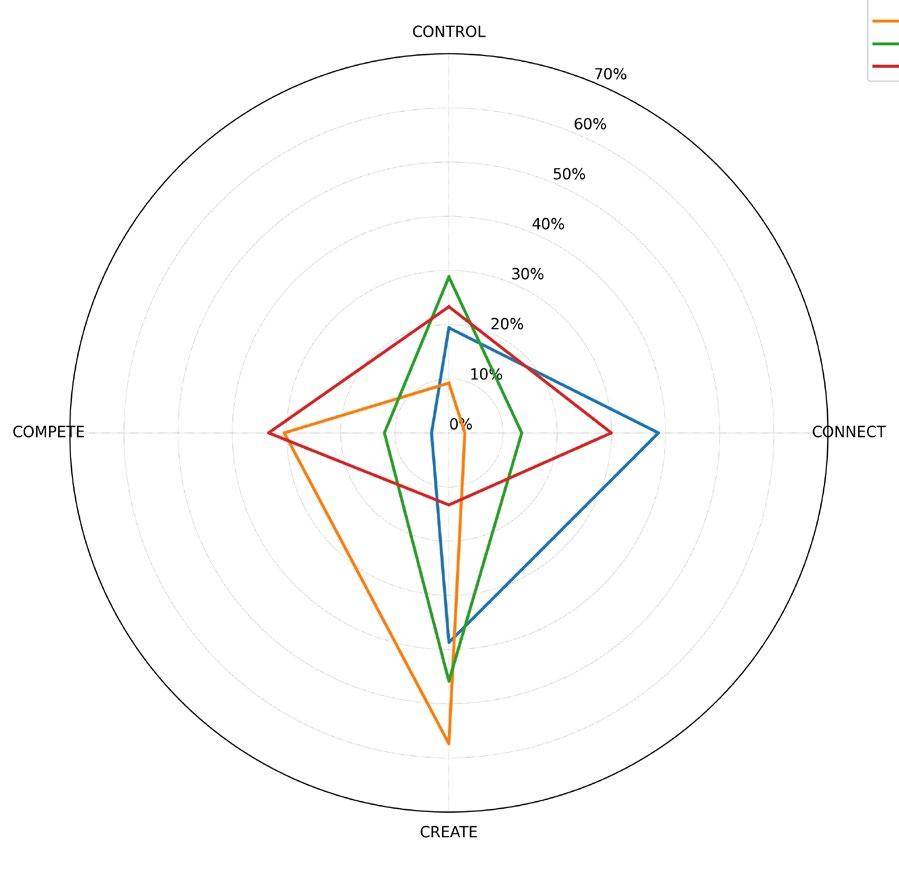
The team cared deeply but avoided discomfort. Feedback was valued in theory, but held back in practice.
What drives a high-performing team?
This heatmap shows how team members perceive their everyday dynamics across 10 essential traits.
Each cell reflects two things:
• Average score (%): how present a behaviour is
• Standard deviation (Std): how much perceptions vary across the team
Our model measures four key dimensions for high performance:
• Collaboration – how well we work together
• Clarity – how clear roles, decisions and expectations are
• Consistency – how reliably we follow through
• Consolidation – how well we stay aligned and learn as a unit
A benchmark team scores 70% or higher on all four.
sharing
9.4 (Av: 66%)
The biggest misalignments are on:
5.6 (Av: 25%)
19.2 (Av: 53%)
• Accountability, communication and information sharing. These traits show high variation in perception – key red flags for friction and confusion.
Surprisingly, the most consistent alignment appears across the consistency dimension.
Despite lower averages, team members broadly agree on what’s lacking – an important starting point for change.
Each red dot represents the % of team members selecting a specific score.
The closer the dots, the more aligned the team is in how they experience that dynamic.
• Consistency stands out with the most tightly grouped responses, but at a lower average.
This reflects a shared agreement that the team lacks consistent practices, a probable blocker to sustained high performance.
• In contrast, collaboration scores highest, but with more disagreement, suggesting strong interactions but less clarity on how they’re experienced.
Communication: everyone’s talking, not everyone’s hearing the same thing
Despite a high average in collaboration, the spread of responses shows clear misalignment – not everyone experiences communication the same way.
The most striking signals appear in consistency and clarity, where low scores combine with widely scattered perceptions. This suggests communication is happening, but not reliably, clearly or consistently.
“Without shared understanding, even frequent communication creates confusion, not cohesion”
When Sandra Day O’Connor, the first woman to serve on the US Supreme Court, graduated from law school in 1952 as one of the top-ranked students in her class, she became a legal secretary. Not because she wanted to, but because this was the only job available to her at the time.
At about the same time, in 1953 in the UK, Rosalind Franklin, a brilliant scientist, helped discover the molecular structure of deoxyribonucleic acid, or DNA, and provided new insight into viruses, creating a basis for the new field of structural virology.
Many feel she did not receive the recognition she deserved during her lifetime. After her death, the Nobel Prize was awarded to three of her
collaborators: Francis Crick, James Watson and Maurice Wilkins.
Increasingly recognising and welcoming people like O’Connor, Franklin, and many others who initially did not ‘look the part’, into the labour force has served our economies well. A move towards more equal opportunity between the 1960s and the early 21st century explains about 40% of the growth in gross domestic product (GDP) per person in the United States.1 It is not just that more people at work means a higher GDP; rather, that tapping a larger talent pool increases the chances of the right person being in the right job at the right time.
A tall order
Decreasing barriers to entry has moved us closer to a meritocracy – but also demonstrated that building
one for real and for all is a tall order. Our minds are just not quite up to the task. More than 300 studies demonstrate that when employers screen identical CVs, where only the name, age or religion of the job seekers differ, there are substantial differences in the chances of being invited to an interview. For some groups, this disadvantage matters hugely for how they fare in the labour market. In the UK, people of African, Middle Eastern and Pakistani or Bangladeshi descent pay the highest price.2
It is often people who are not members of the proverbial ‘in group’, or who try to work in ‘counterstereotypical’ occupations, who encounter the highest hurdles. O’Connor did not look the part at a time when more than 90% of lawyers and doctors were white men in the US. Even now, many men don’t make the cut when they apply for teaching or nursing jobs, and many women struggle to be taken seriously in science, technology, engineering and mathematics professions.
One large global telecommunications and engineering company tried to address these impediments to fairness by offering its hiring managers a short training session just before they moved job applicants from the long list to the shortlist. The timely and targeted training reminded managers of the importance of skillsbased assessments and the value of seeking out new employees whose talents would complement existing competencies on the team.
To measure whether this relatively lowcost intervention had any impact, the company collaborated with us in a controlled experiment. The approach worked, as we and our colleagues report in a recent science paper.3 It helped the company identify and hire more of the people who have probably traditionally been overlooked, including women and people born outside of the hiring country.
Such oversight is common, as humans tend to prefer people similar to themselves. In this company, 80% of hiring managers were men and the headquarters was located in Europe, so their natural inclination was to hire other men who came from the country in which they themselves resided. The training provided clarity on what hiring should look like, and reminded managers of the value they could add to their teams if they focused on the skills and expertise job applicants could bring. Replicating yourself is rarely the winning – though often a tempting – strategy.
The value of clarity
This should be a call to action for all of us. It is incredibly hard to make the practices and procedures that we employ to attract, screen, interview, hire, support, appraise, reward or promote employees neutral. Unchecked, more or less subtle differences in opportunity are baked into
“Tapping a larger talent pool increases the chances of the right person being in the right job at the right time”
our systems. The good news is that we can change those systems and make work fairer by using data to diagnose what is broken and inform potential cures.
When the New York Fire Department did this, it learned that a US$30 fee kept many qualified people from applying. When the fee was removed, the talent pool increased substantially. Similarly, the BBC was able to attract more viewers and listeners when its programming became more representative of the population. In both cases, data helped these organisations move closer to a meritocracy where more people were given an equal opportunity to succeed. What doesn’t get measured, doesn’t count – and cannot be fixed.
This is also the approach we took when one of the largest employers in Australia approached us with the following puzzle: when people applied to leadership positions but did not get the job, male applicants were about twice as likely as their female counterparts to reapply for another similar role. The organisation was able to close the gender gap when it added one sentence to the message that its toprejected applicants received: a simple notification that they had been in the top 20% of all applicants. A little bit of clarity and reassurance can go a long way. Reducing ambiguity is generally an evidencebased strategy to level the playing field and one of the tools companies can use to make work fair. Clarity helps managers hire with more focus and job seekers apply with more confidence.
If we want to give meritocracy a chance, we cannot go back to the 1960s, when barriers to entry and career advancement were massive. Instead, we have to apply 21st-century expertise and rigour to make work fair for all and keep our economies growing. Fairness and meritocracy not only can, but must, co-exist in the workplace. Put simply, without fairness, there is no meritocracy.
Iris Bohnet and Siri Chilazi are co-authors of Make Work Fair, from Harper Business. Bohnet is the Albert Pratt professor of business and government and co-director of the Women and Public Policy Program at Harvard Kennedy School. Chilazi is a senior researcher at the Women and Public Policy Program.
1 See moredetails.uk/ES25F
2 See moredetails.uk/ES25M
3 See moredetails.uk/3RMeow0
4 See moredetails.uk/ES25J
Scott Brown, Amante Capital’s group director of sales and marketing for hotels, tells Martin Bewick that a career in hospitality calls for good leadership – and isn’t only a short-term stay
The hospitality industry is often characterised as having a workforce that has high turnover rates – because of low wages, unsociable hours and few opportunities for promotion.
However, Scott Brown, group director of sales and marketing for hotels at Amante Capital, paints a different picture about the possibilities for careers in the industry, and how the challenges it faces can best be met.
“Like many, I started working in hospitality when I was a student,” he says. “I was a bartender at a Marriott hotel. In fact, I’m sat in that same Marriott hotel today, but in a very different role. Of a core group of friends back then who started as concierges, waiters and receptionists, some are now hotel managers, directors of finance and global account directors.
“There are so many different disciplines within hospitality – operations, marketing, PR. I went into sales.”
After working at hotel brands including Marriott and Meliá, Brown joined Amante Capital earlier this year. The move reflects the potential range of roles in which leadership is needed in the industry. Amante invests in hotel real estate across

Worsley Park Country Club, where Brown had his first waiting job and where he now visits in his leadership role

Europe, and brings its management experience and financial acumen to hotel franchises including Marriott and Delta Hotels by Marriott.
Around the world, many well-known hotel brands run on a franchise model, or a mix of owned and franchise properties, including Travelodge, Hilton, Meliá, and Radisson. The model allows local operators to gain the benefits of globally recognised brands and the standards consumers associate with them.
“It’s the brand name that consumers look for,” says Brown. “Local teams bring their own knowledge and qualities with the day-to-day management of the hotel, but the brand brings distribution and marketing at scale. The model also means we can empower and support the front-facing teams to make the best decisions.”

Brown believes that one aspect of good leadership is knowing how to cut through to what’s most important.
“From a hotel point of view,” he says, “it’s guest satisfaction and driving repeat custom. As group director of sales and marketing, my primary job is to drive sales and revenues by supporting and guiding individual hotels and their teams in terms of their strategy and delivery.”
The franchise model connects knowledge across global, national and local dynamics. Leadership must link these effectively, ensuring consistency while enabling autonomy. To ensure this happens, Brown retains a strong connection with the onthe-ground running of hotel businesses.
“It’s my responsibility when dropping into hotels to see things that could be improved, and always to be looking for new ideas. It’s where leadership really plays a part. The hotel teams on the property live and breathe it every day. When you drop in once every few months, you have to guide in the right way and see the things they don’t.
“That might mean having a few uncomfortable conversations, and that needs
clear communication from the outset, so everyone understands what your role is. If you can create trust with someone, they accept you giving that feedback. I use the term ‘radical candour’ to describe it.”
Brown says that the most acute challenges facing hospitality are currently being felt by the food and beverage (restaurant and bar) side of the industry.
“A lot of hospitality businesses are still paying back some of the deferred rents and leases from Covid,” he says. “Add to that escalating food and beverage prices and it has been a massive challenge for some.”
Innovation and building trust, he says, are key to navigating future success.
“It’s about looking for new creativity around what you offer, whether that’s cuisines or focusing on your venue as a place for celebration. Also, price is important for customers, as are facilities and location. But a customer’s trust in the people who are going to deliver the event, the conference or the Christmas party, is also a big part of it. People still play such a massive part in any success.”
Brown says three core values can be used to guide high-performing teams.
“First, be dedicated,” he says. “Success doesn’t always mean answering emails at 1am, but it does
“If you can create trust with someone, they accept you giving feedback. I use the term ‘radical candour’ to describe it”
demand commitment. The minimum expectation is maximum effort.
“The next thing I always say to people is ‘don’t lie’. By that I mean don’t overpromise then underdeliver. And don’t lie to your team. If we drop the ball, we drop the ball together. Then don’t lie to yourself by cutting corners, even if no-one else sees.
“Finally, always try to live your brand values. Know what the brand stands for and live by what that brand stands for. Hopefully you’re lucky enough to work for a company that aligns with your own values. If you don’t, maybe you shouldn’t work there, because it means you’re never going to give your best.”
From waiter to group director of sales and marketing, Brown’s career shows that employment in hospitality doesn’t need to be a short break before a move to another industry.
40%
of hospitality workers took their job because it was the only one available at the time.
15%
Hospitality is the third-biggest private sector in the UK, with 2.9 million employees. It contributes £93bn to the UK economy and supports 3.5m jobs. But how happy are its employees, and what keeps leaders awake at night?
42%
of the country’s workforce have worked in hospitality at one time or another.
68%
38%
of the sector believe long-lasting careers are possible. of hospitality workers are also in education. do it as a second or third job.
Overall retention rate:
65-70%
Stable income Career prospects compared with 85% across all sectors. More than of workers leave their job in the first month. 2/3 Just a 5% improvement in retention rate equals 225,000 fewer vacancies.
7.5 months
Average stay in a hospitality job. Better pay Better work-life balance
55% What would make you want to stay?
63%
Sources: UK Hospitality (moredetails.uk/4kby4WS); Deputy (moredetails.uk/3H5JooI)
52%
42%
Uthaya Prakash Santhanam
Key tips to integrate artificial intelligence effectively in your learning and development programmes
We have reached a point where artificial intelligence (AI) and learning and development (L&D) are seamlessly connected, transforming the way organisations design, deliver and measure employee learning experiences. AI integration in L&D entails strategic foresight, meticulous planning, a commitment to embrace innovation and, importantly, a growth mindset.
1 Understand the potential of AI
L&D practitioners must educate themselves and their teams about AI’s transformative capabilities, including creative and adaptive content delivery, personalised learning paths, virtual coaching, analytics-driven insights, and data-driven decision-making. Staying ahead means keeping pace with the latest AI tools and trends shaping the L&D landscape, enabling professionals to streamline processes, enhance learner experiences and deliver greater value to organisation objectives.
2 Carry out a needs assessment
Analyse and identify the specific needs of L&D, the evolving workforce landscape, and the overarching business demands. This ensures strategic alignment between AI’s capabilities and its potential highimpact contributions to both L&D and the organisation. Additionally, conduct a thorough evaluation of L&D goals, challenges and existing gaps, such as time-consuming processes or low learner engagement, to pinpoint areas where AI can provide solutions.
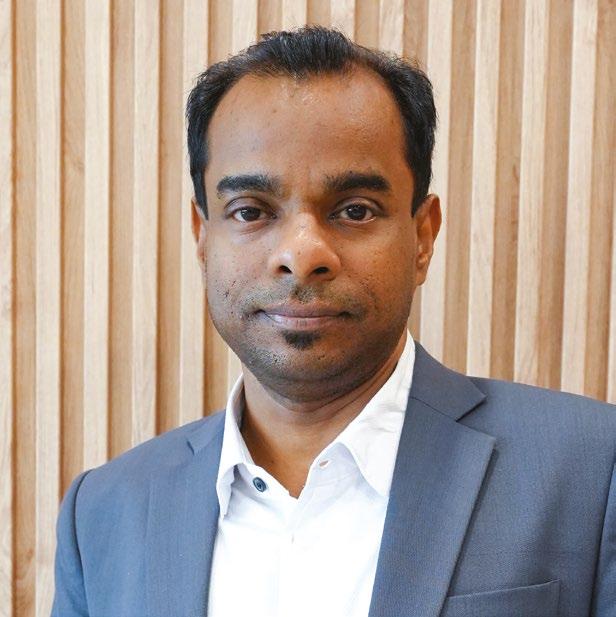
3 Select the right AI tools
Conduct a thorough evaluation of AI-powered platforms and tools to ensure alignment with your objectives. Prioritise scalable, user-friendly tools that not only meet your current requirements but also have the flexibility to grow and adapt alongside your organisation.
4 Build digital skills and capabilities
It is essential to upskill L&D teams to effectively understand, manage and leverage AI technologies, and assess the digital literacy of your workforce. Building a workforce equipped with sufficient knowledge of emerging technologies empowers them to integrate these tools seamlessly, driving innovation, efficiency and improved outcomes.
5 Design an AI-ready strategy
Integrate AI capabilities into your learning strategy and harness AI tools to analyse learner data, enabling continuous improvement across all facets of the learning experience, including content development, learner engagement, and data-driven insights for L&D optimisation.
6 Nurture a culture of innovation
L&D practitioners must foster a culture of experimentation and openness to change within the organisation. Sharing success stories and real-world case studies of AI applications in L&D can serve as powerful tools to inspire teams and engage stakeholders, demonstrating the tangible benefits and potential of embracing AI-driven innovations.
7 Ensure ethical AI use
Start establishing clear and comprehensive guidelines to ensure that AI applications adhere to principles of data privacy, fairness and transparency. These guidelines should outline how sensitive information is handled, define protocols to avoid misuse of AI, and ensure that AI-driven decisions are explainable and justifiable.
Equally important, L&D practitioners must take an active role in understanding and monitoring AI applications. This includes staying informed about emerging AI best practices, conducting regular reviews of AI systems, and implementing measures to mitigate potential biases.
8 Stay agile and future-focused
Keep looking for emerging AI trends and technologies that can further enhance L&D. Embrace continuous improvement, foster collaboration across teams, and be willing to experiment with innovative approaches.
Uthaya Prakash Santhanam is renowned for his expertise in organisational change management, cultural transformation and digital transformation.
Jeremy Campbell
Three ways artificial intelligence is revolutionising the workplace – and what’s coming next
In 2023, global artificial intelligence (AI) investments exceeded US$200bn, with governments and corporations racing to harness its potential. This isn’t just about innovation; it’s about survival. AI is fundamentally reshaping the workplace by transforming how we work, lead and learn. What does this mean for your career or business?
1
From automation to amplification
AI is making workers more productive, creative and capable, rather than simply replacing them. Take Microsoft’s Copilot, the AI-powered assistant in Office 365. Early adopters report that tasks such as report writing, data analysis and summarising meetings take half the time. Similarly, Google’s AI-powered tools are cutting down admin work in marketing, finance and HR by more than 40%, freeing employees to focus on high-value projects.
Harvard Business School professor Karim Lakhani, co-author of Competing in the Age of AI, argues that the companies that redesign workflows to maximise AI-human collaboration – rather than just automating existing processes – will be the biggest winners.
The takeaway? AI isn’t about eliminating jobs – it’s about evolving them. Businesses that integrate AI as a productivity amplifier will outpace competitors. Professionals who master AIpowered tools will become indispensable.
2
AI is reshaping decision-making
Imagine a world where CEOs never make gut decisions – where every business strategy is guided by real-time AI insights. That world is already here.

Goldman Sachs uses AI to analyse financial markets, predict economic shifts and guide billion-dollar investment decisions. AI’s ability to process vast amounts of real-time data allows leaders to make faster, more precise choices.
Deloitte has embedded AI-driven simulations into its strategy consulting, allowing leaders to stress-test different strategies before implementing them.
The future of leadership is about blending AI-powered precision with human judgement. Executives who leverage AI insights will make better decisions, faster – giving their businesses a major competitive edge.
3
Perhaps the most profound change isn’t in what we do, but in how we prepare for work itself. AI is rapidly reshaping the global jobs market, forcing businesses and employees to rethink skills, training and career paths.
The World Economic Forum predicts that 44% of workers will need reskilling within the next five years because of AIdriven workplace transformations.
Leading organisations are already responding. IBM has committed to training 30 million people in AI-related skills by 2030, and Google’s ‘AI for Everyone’ initiative is offering free AI courses across all industries.
But it’s not just about reskilling – it’s about entirely new roles emerging:
• AI ethics officers, ensuring AI is deployed responsibly
• Prompt engineers, who specialise in designing AI-generated content
• Human-AI collaboration managers, who help integrate AI into existing teams.
A recent MIT Sloan study found that employees who actively engage with AI tools become far more valuable to their organisations than those who resist them. Embracing AI isn’t optional – it’s the key to future-proofing your career.
Jeremy Campbell is CEO of Black Isle Group and creator of Nudge.ai – turning learning into lasting habits.
As AI advances, the most important shift won’t be technological – it will be cultural.
Leaders who invest in AI augmentation rather than pure automation will build the most innovative, resilient companies. Businesses that prioritise workforce reskilling will stay ahead of disruption – and employees who see AI as a tool, not a threat, will thrive in the AI-powered workplace.
In our new series, an emerging leader and their boss sit down together to talk about their ambitions, and to find out more about the different paths to leadership. In this issue, Milford Research’s Harpreet Kaur Chahal (team leader, law and governance) and Rob Milford (managing director) chat openly about their career experiences
Harpreet Kaur Chahal (HKC): Has there been anything about leadership that has surprised you?
Rob Milford (RM): Yes, that it’s not often recognised as different to management! As a manager, you expect to have clear processes to work through, but a leader has to be prepared to take on dramatic change with no clear script. Also, a leader has to know when not to jump in. It’s about enabling emerging leaders such as yourself to succeed in the best way – to be able to encounter problems, and be innovative and excel.
HKC: I couldn’t agree more. It’s so important to foster the right environment, because that’s where it all starts. If you don’t have that from the get-go, you can’t grow as a professional.

RM: A lot of leadership is about listening, because everybody will have their strengths and weaknesses. A good leader sifts through that and thinks, ‘OK, I will need to help you on that, but maybe you can help me on this’.
HKC: It definitely does go both ways. A great example is that I’ve been able to ask you why you took a certain decision. I may not necessarily agree with it, but it’s good to have the environment to be able to ask those questions.
RM: The ultimate responsibility that comes with leadership is, sooner or later, a decision has to be made. That’s a call a leader has to make, and live with the consequences. Some of the new programmes we’ve done were challenging: working with different age groups, demographics and businesses. I think we both had our leadership skills tested, but what’s been beautiful is that we’ve been able to work as ‘we’. It comes back to mutual respect and listening.
HKC: How is being a leader today different from 10 years ago?
RM: The impact of Covid on communication styles was immense. We are now talking through screens more often, so my leadership style has to adapt. But it’s still just as challenging today as it was 10 years ago, 20 years ago, 30 years ago, when I was a Venture Scout, leading
teams around the Brecon Beacons. Leadership is always challenging. If it wasn’t, it would be very dull. You just have to keep learning and adapting.
HKC: Has being resilient and determined got you through challenges over the years, or has that adaptability skill been driven by those values?
RM: I think they play into each other. You are resilient because you can adapt when you’re hit with a problem, but it’s the determination that will drive you through those moments when everything looks bleak, because it’s up to the leader to help everybody over the wall. And sometimes you have to reach out for help. It can be very lonely as a leader unless you put things in place to support you. One of the most important lessons I’ve learned is that, if you have faith in your team and you share the same values, they’ll be there when you’re up against it.
HKC: Would you say that it’s important to reflect on the decisions you take as a leader?
RM: Self-reflection is very important, but not to the point where it paralyses you. You do need to look at your decisions and think, why did I do that? Was that good? It’s useful to have that as a team exercise as well.
HKC: I really appreciate that we are able to do that at Milford Research. There’s an openness and respect to know we are helping each other improve, and learning along the way.
RM: It’s necessary in an inclusive organisation where people with neurodiversity or physical disabilities may find some things incredibly challenging to do in a certain way. You have to reflect on whether something works for them and, if it doesn’t, what can we change? A leader has to think about what will get the best for, and from, their team.
RM: Do you think young people today are being supported to become leaders?
HKC: It’s a grey area. I don’t think any generation is fully supported because, often, you are thrown in at the deep end. But there are organisations out there that foster environments to encourage young leaders to practise leadership in a safe space. But not all organisations do this and a lack of support becomes a barrier to people achieving their potential.
RM: I agree that more can be done, certainly among smaller firms. I think some shy away from taking on a young leader, thinking it’s going to be a burden – but if those organisations are given the right support, too, then it can work for everyone.

HKC: Sometimes, young people feel that leadership and authority is something you have when you get older – that we don’t have the years of experience required to be a leader.
RM: I remember one expo where you and I were on the company stand. People were waiting to talk to me rather than talking to you. It’s this opinion that, if you don’t have sufficient grey hair, why should I talk to you because, obviously, you are not the person in charge.
HKC: A colleague and I discussed this afterwards, and we felt quite down, because we thought maybe we are not as good as we thought we were. But then we’ve been to some networking events where we’re treated as professionals. That mutual respect really helps you develop as a young leader – it’s important at any age, to be honest.
RM: Is there any support you think is needed or would be useful?
HKC: Support through collaboration empowers us as young leaders. The IoL is a great example of this. It’s been uplifting to be treated as an equal, so you’re able to build on that relationship. I think it is so important because it’s not generally spoken about or encouraged in the corporate world.
Dr Robert Milford is managing director of Milford Research and Consultancy. Harpreet Kaur Chahal is team leader – governance and law at Milford Research and is studying law at the University of Worcester.
We’re looking for people to take part in ‘In conversation’. Please email louise.parfitt@ cplone.co.uk to express your interest
Paul Boross MBE
Laughter is the unsung hero of human connection, a glue that binds us in shared understanding and joy. But as home working continues to reshape the modern workplace, have we lost the laughter that made the office not just bearable, but enjoyable?
Science tells us that laughter isn’t just a moment of fleeting joy – it’s a physiological and psychological powerhouse. According to research published in Psychological Science, laughter is a fundamental social signal that fosters bonding, reduces stress and enhances creativity. The late Dr Robert Provine, a leading laughter researcher, stated: “Laughter is a social phenomenon. It disappears when we’re alone.”
This brings us to the world of Zoom and Teams. Yes, technology keeps us connected, but are we missing the subtle social cues and shared moments that spark spontaneous belly laughs?
Virtual meetings allow us to communicate effectively, but they often lack the nuanced, unplanned interactions that occur in physical spaces. A colleague’s witty remark, a shared chuckle over a workplace mishap, or even the contagious giggles that ripple through a crowded room – these moments are hard to replicate through a screen.
As someone who spent more than a decade working at the Comedy Store, I can attest to the power of physical proximity in amplifying laughter. The club was meticulously designed with human social psychology in mind,

packing people closely together to create an atmosphere where laughter flowed effortlessly. It wasn’t just about the jokes; it was about the shared experience, the connection and the chemistry that only comes when people are physically present.
We are, after all, a profoundly social species. Human evolution has hardwired us to live, learn and laugh together. Studies show that shared laughter builds trust, reduces conflict and increases cooperation – key ingredients for both personal and professional success. In the workplace, laughter isn’t just a morale booster; it’s a productivity enhancer. A 2016 study from the University of Warwick found that happier employees are 12% more productive, and humour is a significant contributor to workplace happiness.
Great leaders understand this. They know that creating an environment where laughter is encouraged isn’t just about lightening the mood; it’s about fostering creativity, collaboration and connection. Leaders who embrace humour are seen as more relatable,
approachable and inspiring. But humour in leadership doesn’t mean stand-up comedy routines; it means creating opportunities for people to connect, share, and laugh together.
However, the rise of remote work poses a challenge. While home working offers flexibility and efficiency, it risks isolating employees from the human interactions that fuel camaraderie and innovation. Leaders need to ask themselves: are we losing something irreplaceable by removing the informal, spontaneous interactions that occur in shared spaces?
The answer isn’t to abandon remote work, but to reimagine how we create opportunities for connection. Regular in-person gatherings, teambuilding events and even lighthearted virtual icebreakers can go a long way to bringing back the laughs. Leaders must be intentional about building chemistry, even if it requires stepping outside the confines of a Zoom call.
As Victor Borge, actor and comedian, once said: “Laughter is the shortest distance between two people.”
If we want to build teams that thrive, we need to prioritise not just efficiency, but humanity. After all, in work and in life, it’s the moments of shared laughter that we remember the most.
Paul Boross MBE is a globally recognised authority on communication and leadership. Known as The Pitch Doctor, Paul is a bestselling author, awardwinning speaker, and host of the acclaimed Humourology podcast.
Standing up for the rights of women in the workplace is the mantra by which Phoebe Waters lives. She has worked with organisations from the UN to the University of Cambridge – and set up plenty of her own – to support women and businesses to thrive. She chats to Louise Parfitt about meritocracy, negative rhetoric, and why we cannot rest on our laurels until every woman has equality
Sights set on being the first female James Bond aged nine. Living with a babushka in rural Russia aged 19. Winner of Management Today’s 35 Women Under 35 Award aged 29 (for the first time; she has won it again since and is now the chair of judges for the whole award scheme). I am sure there will be another milestone at age 39 – but, at 33, the inimitable Phoebe Waters has a few years yet in which to pack even more achievements and experiences. And she will.
In the 10 years since she graduated with a Master’s degree in international security and terrorism, Waters has been a private and corporate investigator, and was chair of the Female Fraud Forum, spearheading its impressive expansion and reputation. She is co-founder and partner of consultancy business Optimising Potential (OP); a faculty member at the University of Cambridge’s Institute for Sustainability Leadership (CISL); sole leadership consultant for UN Women UK’s Commission on the Status of Women; and runs London’s Female City Supper Club with cofounder Lucy Pert.
Waters is also a judge for the Women and Diversity in Law Awards and the UK StartUp Awards, and co-founder of Project UpLift, a non-profit forum that provides support, networking, advocacy and mentoring for the LGBTQI+ community and allies working in the legal, investigations and forensic fields.
She is an alumna of the Aspen Institute Rising Leaders Fellowship programme and a guest lecturer at multiple universities, focused on teaching gender equality. Crucially for her, she is also a committed daughter, sister, friend and ‘fun’ auntie.
People joke that she has fitted two decades of a career into one. “It’s been exciting, amazing… a lot of work and determination,” Waters says.
As well as feeling incredibly impressed and slightly in awe of the woman sitting in front of me, I am curious as to what has driven her to achieve so much in such a short space of time?
“It’s knowing that there is a possibility of a world in which women are considered and treated as equals and with respect. At the current rate of progress, it is going to take 300 years to achieve gender equality internationally, according to UN Women. I fiercely support women to be who they are and who they want to be – to be seen for who they want to be seen as, for who they have the right to be treated as – harnessing their authentic selves in their professional settings, while supporting them and others to break down systemic gender inequalities.”
The key to this, Waters explains, lies in education and re-education – including when it comes to leadership. “One of

“One of the major hurdles to breaking down gender inequality is the lack of women in leadership”
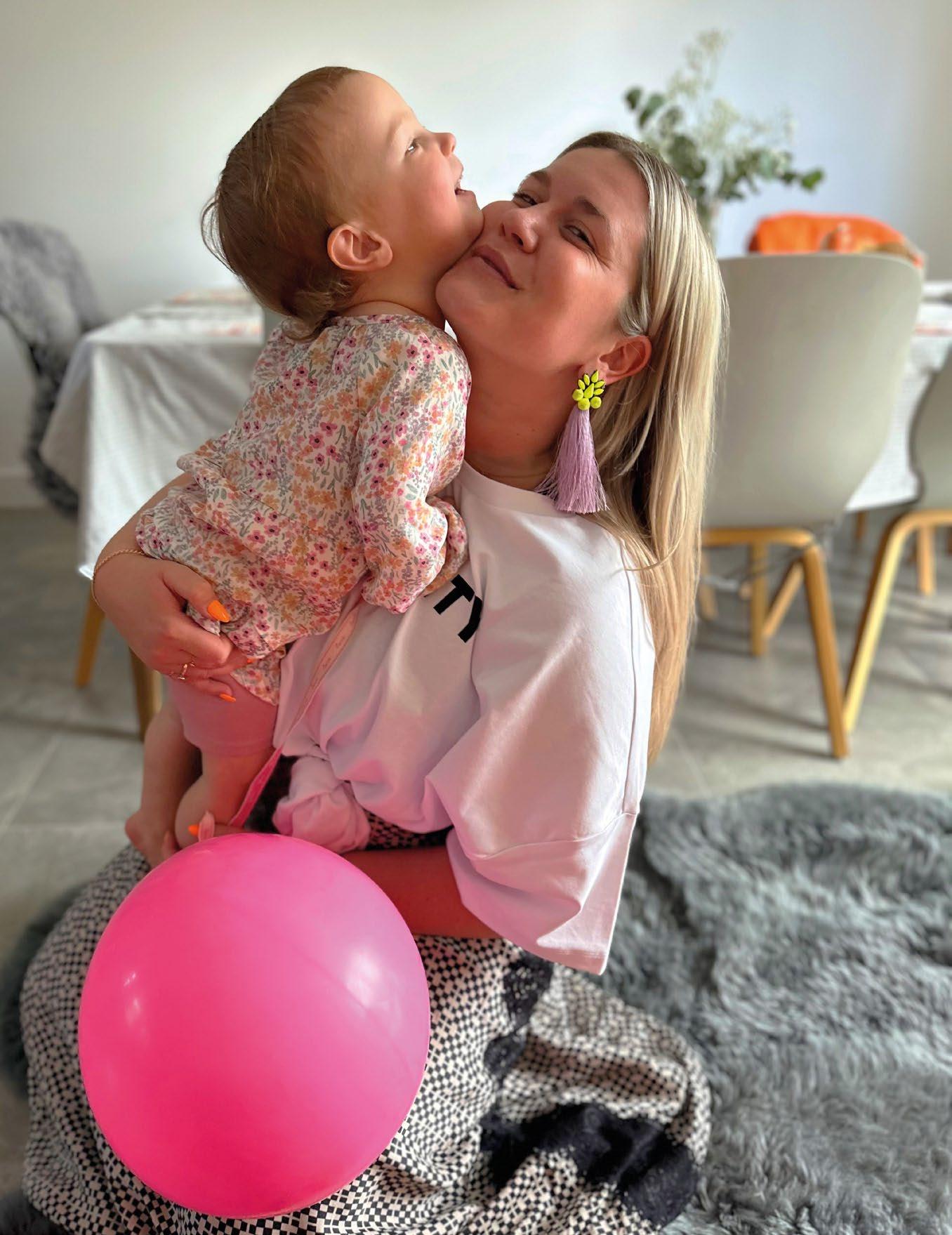
the major hurdles to breaking down gender inequality is the lack of women in leadership. Globally, it will take 140 years for women to achieve equal representation in leadership positions in the workplace, according to UN Women. And there is a huge problem in getting and retaining women in these more senior roles. IMF [International Monetary Fund] research states that closing the gender gap in leadership alone adds US$28tn to global GDP [gross domestic product]. There is both a moral and financial obligation to achieve gender equality.”
She believes organisations, leaders, and people of all gender identities and intersectionality need to reassess what a leader needs to be. “There’s still a flood of archaic language in our global society – and conceptualisations around this language – about what a leader (and, indeed, an effective one) is. When asked what characteristics a leader needs to have, we hear time and again words such as ‘power’, ‘charisma’ and ‘vision’. What we need –
“We need to ask why [we] don’t think someone is ‘right’ for a job in the first place. What are our conceptualisations around what a leader is and why are women not being given the same opportunities as men”
Waters with her niece, for whom she is fighting to achieve gender equity and equality
and there is a plethora of academic and privately funded studies supporting this – are leaders who have vulnerability, humility, transparency. These traits, which have traditionally been considered ‘softer’ – or even ‘weaker’ – are incredibly important when it comes to being a high-impact and transformative leader, and are more often associated with women. These traits are, of course, in individuals of all gender identities, and everyone needs to embrace them. Nevertheless, it is vital that women’s capacity to deliver these is highlighted.”
That’s not to say there isn’t a place for charisma or vision, Waters adds, but there needs to be a refocus to understand that these other traits are required to produce long-lasting effectiveness at the systems level in order to achieve progress in our global society.
She emphasises that everyone needs to be involved to effect change. “We all need to be leaders in transformational systems change. I think of it like a light that shines outwards from the micro [individual] to the meso [organisational] to the macro [global], breaking down systemic inequalities on every level – starting with the drive from the individual at the core.”
On the day we meet, Waters is celebrating one year to the day since she launched OP with her mum, Deborah Glassbrook (herself an inspirational woman, who was a founding director of ChildLine in 1986).
As with everything, Waters has poured her heart and soul into the company – and it all comes back to the women she supports. “We provide the tools and strategies to help women to be the best they can be,” she explains.
OP is a strategic business consultancy –specialising in high-impact leadership (Waters’ focus is on female leadership). Waters and her mum predominantly work within
different sectors and industries, but adore being able to push forward together on changing systems and lives.
“It blows my mind that so many intelligent, creative and successful women still feel insecure in a role they are clearly great at doing – and have the potential to be thriving in,” Waters says. “This is because we are working within systems that are not created by us, and that are not supporting us.
“Women have been forced into certain behaviours and into holding certain values, and the average workplace is not fit for purpose –it can be very disillusioning. But because gender is a social construct, we can adapt our actions and thought processes to change the boundaries and barriers we put around women –remembering that this is about choice for each individual woman.”
Waters has been asked if it is not women who need to change. She states firmly: “Of course it is not, but what we do still need as women is the support at the individual level to be the people we want and deserve to be – in the context of these stuck-in-time systems, and our VUCA [volatile, uncertain, complex and ambiguous] world. Women already have the power within themselves. What I do is work closely with them at the micro and meso levels to identify, use and communicate that power. I help them harness it.”
Systems and opportunities
In a world where diversity, equity and inclusion policies are coming under increasing fire, Waters sees disparity, underestimation, lack of opportunities, sexualisation, misinformation, and some levels of ignorance as key challenges for women.
“You wouldn’t believe how many people –women included – say to me that they don’t think that gender inequality is a problem any more,” she says. “This is reflected in recent
“There is a possibility of a world in which women are considered and treated as equals and with respect. At the current rate of progress, it is going to take 300 years to achieve gender equality internationally, according to UN Women”
I have mentored in an unofficial capacity for as long as I can remember. Some of the individuals I mentored are now my clients – I supported them and now they want to support my business, because they believe in what I am doing, which is absolutely gorgeous. My clients are some of the most professional, hardworking (and fun) women in the City, across a range of sectors and industries, and I am hugely lucky to have their support.
statistics. For example, in early 2025, Ipsos and King’s Global Institute for Women’s Leadership published that almost one in two Britons says gender equality has ‘gone too far’.”
How does she think meritocracy relates to putting more women forward for leadership positions? “The UN definition of gender equality refers to different gender identities having equal rights, responsibilities and opportunities – not that we need to be, or become, the same as one another,” Waters says. “So, yes, absolutely we need to employ the right people for the job. But we need to go back to those leadership traits and theories, and ask why leaders, firms, colleagues don’t think someone is ‘right’ for a job in the first place. What are their conceptualisations around what a leader is and why are women not being given the same opportunities as men to go for the senior roles?”
Waters is also aware, because she has experienced it herself, that it is not uncommon for women to be competitive with and unsupportive of other women in the workplace – with, unsurprisingly, detrimental effects.
She gives an example of a board of 20 people where only one is a woman: there’s going to be more competition between the women looking to get to the top, because they can see that there are only one or two places for them.
“This results in the wrong kind of tension: some senior women are not wanting to pull others up with them. Of course, this is also about the systems within which we operate,” she explains. “That’s why it is the opportunities that are so important.
“I work with organisations to see how they can make sure these promotions or chances for development are available to all. A lot of it comes back to the point of education and re-education. We need a level playing field.”
As a young female investigator, Waters was treated differently from her male colleagues, and she is determined to make a difference to the lives of women. A huge turning point was becoming involved in the Female Fraud
“Some senior women are not wanting to pull others up with them. Of course, this is also about the systems within which we operate”
Forum, the purpose of which is to support and encourage the advancement of women. She was membership secretary for two years, chair for two years, and then held a non-portfolio role for a year until February 2025.
Another springboard moment was studying at CISL. She signed up to the online course ‘Women Leading Change: Shaping Our Future’ (‘WLC’) in 2021. “I had quit the role I had, and knew I wanted to really focus some time on what I was most excited and driven by –female leadership. My tutor was the fantastic Janice Lao, who is still the head tutor, and I completed the course feeling that my life trajectory was going to change.
“A year later, Janice personally recommended to Cambridge that I assess and coach on the course. I could not recommend WLC enough: we – Janice, Claire Goodman and I – support women across the globe to identify, define and communicate their own purpose and power.
“For almost a year now, I have also been supporting on a second CISL course – High Impact Leadership – for all gender identities.”
After OP launched, it was only a month or so later that Waters presented to UN Women UK’s delegates at the 68th session to the Commission on the Status of Women (CSW) – quite a feat for Waters’ first client in this capacity. OP was the sole leadership consultant for the CSW69 in March of this year.
“Last year was the first time that UN Women UK had done any form of leadership consulting with its delegates and it was a huge success,” Waters enthuses. “I worked so hard
My biggest cheerleaders are my mum – I am hugely lucky to have her as a mentor and coach in a professional and personal sense –my sister, and my truly phenomenal friends, who have my back no

Waters with three of her close friends, who are all current or former chairs of the Female Fraud Forum.
From left: Rachael Gregory, Waters, Molly Sandquest and Josie Welland
matter what (as I do theirs). They provide me with a deeper level of resilience in order to be brave and push forward for what I believe in. They challenge me, too, which, for the most part, I enjoy!
to get that in place (I facilitated the first time with mum, which was very special) because I knew we could support CSW participants –men, women, other gender identities – to go forth and break down systems that, quite simply, are pitted against us all. UN Women UK rightly always reminds us that we do not have equality for women until that includes every single woman.”
As part of breaking down deeply entrenched inequalities, Waters believes we need to adapt how we perceive leadership and change our systems accordingly. “We need to recognise, celebrate and take seriously women as leaders. We need more women in leadership positions to prosper. Equality is beneficial for us all. We need to challenge the status quo.
“To be changemakers, we need to be courageous, feisty, authentic – and we need to be kind. As long as we continue to push against barriers, then we are going in the right direction, no matter how small (or backwards) the progress might seem at times.
“This means we fight against harmful decisions and negative rhetoric to try to achieve a fairer – and more sustainable –world, in which individuals, communities and businesses can thrive.”
Lee Chambers
Lee Chambers invites us to welcome uncertainty
Uncertainty and business go hand in hand. It’s like that friend you didn’t invite who somehow ends up at the party. I’ve come to accept that uncertainty isn’t an obstacle, but an opportunity to grow, to evolve and to learn. As I’ve practised embracing uncertainty, I have come to realise it’s a catalyst for building momentum and for building resourceful and sustainable businesses.
Many of us have grown up in cultures where stability and control are championed, and this conditioning shapes our perspective and appetite for uncertainty. The stories we hear of business rarely talk about how uncertainty is the norm. My career started in financial services, a job for life until the 2008 economic crash. My rigid plan was suddenly obsolete. I started a business, because I felt I’d have more control over external circumstances. I quickly learned that uncertainty was ever present, but also an opportunity to craft a flexible vision that could adapt as the landscape changed. Reframing uncertainty allowed me to stay open to opportunity, rather than being paralysed by a need for stability.
Uncertainty provides a lens to learn from failures. When I was younger, I feared failure and worried it would reflect on my abilities. But I realised that I learn the most about myself through uncertain times and through the experiments that fail, not the ones that are successful.
Another thing to consider is your resilience level. Whether that is
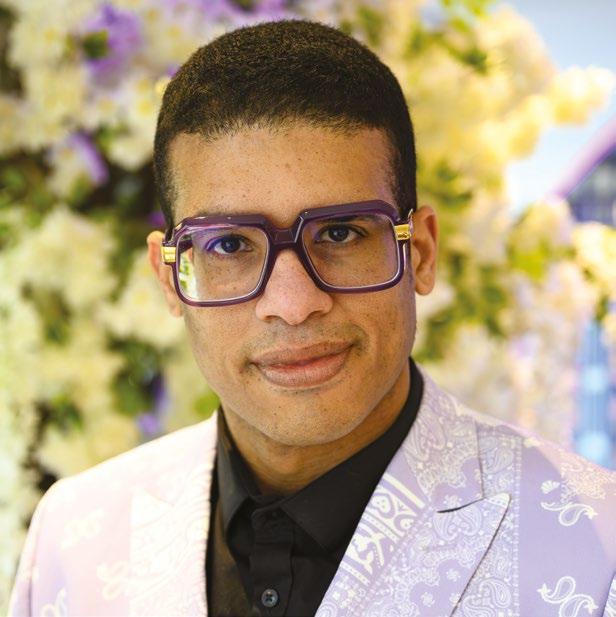
"Uncertainty invites us to get uncomfortable and explore how we can change, and what actions we need to take to move towards certainty within ourselves"
your personal resilience, your team’s resilience or overall business resilience, it provides the energy and foundation to recover from setbacks and adapt to change. Instead of reacting, you create the space to choose your response, and this allows us to maintain perspective and be more considered – even when it feels like we are in the eye of the storm.
Uncertainty can generate fear. I have found curiosity to be a powerful vehicle for navigating the roads of uncertainty
on which I have found myself driving. Whether asking questions, seeking new ideas or being open to different perspectives, we end up seeing more and missing less, and keep moving in the process.
Possibly the biggest lesson I have learned is the need to redefine success as the world changes and as we ourselves grow. Earlier in my journey, revenue, EBITDA (earnings before interest, taxes, depreciation and amortisation) and my ratios were the metrics that signalled success, and there was value in this. But when I became ill and couldn’t walk, suddenly they didn’t feel so important in the grand scheme of things. It was this uncertainty that gave me space to think about what success would be if it were aligned with my values and how much I had pulled away from them in the pursuit of metric success.
Uncertainty invites us to get uncomfortable and explore how we can change, and what actions we need to take to move towards certainty within ourselves.
Business uncertainty has often been framed as the ghost that lingers over us, when, in reality, it can be a teacher sent to challenge us to think differently. It’s rarely easy, and unlikely to be comfortable, but stepping into uncertainty in a considered, intentional way can be the best thing you can do for your business.
Lee Chambers is a psychologist and the author of Momentum: 13 Ways to Unlock Your Potential, published by Kogan Page.
From the first minutes of the Zoom call, I sense that Clare* is down. Sighing heavily, she tells me she feels like a fraud. Despite her glittering CV, she worries if her promotion to CEO has been a mistake and worries what her colleagues will think of her when she is found out.
Clare is not alone. Feeling like an impostor at work is common, and leaders are not immune. In a 2022 survey of 500 UK business leaders, 78% reported experiencing impostorism.
Coined in 1978 by psychologists Pauline Clance and Suzanne Imes, the ‘impostor phenomenon’ describes feeling like a fraud despite evidence of achievement, and fear of being found out. They used ‘phenomenon’ as opposed to the more commonly referenced ‘syndrome’ intentionally – reasoning that it is a natural experience, not a clinical disorder.
Yet for those affected, the impostor phenomenon can feel debilitating (see Figure 1). Leaders may be especially vulnerable, with elevated expectations placed upon them, along with high levels of responsibility and visibility.
When we talk about thoughts and feelings of impostorism, they become just that – thoughts and feelings, not facts. Speaking out creates a psychological distance whereby impostorism moves from a spirit within us to a more distant, if annoying, niggle. Playfulness can help – one client envisaged their impostorism as a devil cartoon character to be swatted away like a fly. The impostor cycle may be deep rooted, so vocalising successes regularly is important. This helps us selectively attend to the evidence of achievements we might ignore, training our brain to think more helpfully over the long term.
In a virtuous cycle, speaking out can help others too. In 2010, Professor of Physiology Melanie Stefan proposed publishing a ‘CV of failures’ to expose the multiple setbacks behind any single success. While acknowledging the embarrassment this might cause, she argued it could help build perspective, motivate and empower. Talking honestly about our highs and lows, including our fleeting moments of impostorism, may be viewed not as a weakness, but as courageous leadership.
Managing impostorism is not just an ethical responsibility but is fundamental to organisational success. Individuals who feel like impostors may be more risk averse and less adaptable, leaving them more likely to shun innovation, and shy away from challenging opportunities.
To remedy impostorism in themselves and others, leaders can boost psychological safety by promoting a growth mindset culture and knowledge sharing. They can prioritise ‘learn it all’ over
‘know it all’, and act as role models by showing it is acceptable to make mistakes in the pursuit of innovation, and essential to speak up about mistakes in the interest of safety.
While research suggests minorities may be more susceptible to feeling like an impostor, causal links are unclear. Some reject the concept of impostorism altogether, asserting that discrimination and subtle microaggressions make people feel unworthy and unwelcome, not internal cognitive distortions.
Meanwhile Professor Kevin Cokley, an expert on impostor phenomenon among minoritised populations, maintains that people of colour experience impostorism just like anyone, but their feelings may also be rational reactions to racism, and these feelings interact. People may feel like impostors when they are treated in ways to suggest they are. Impostor feelings can be mitigated when individuals are treated as a person of value and worth. Leaders might reflect critically on the organisational climate to check for bias. Focus groups, anonymous surveys and informal discussions can help provide useful temperature checks.
Provide support
Leaders who prioritise clear, specific feedback as part of regular performance reviews help create a culture of open communication in which impostor feelings can be acknowledged and addressed.
Transparent career progression programmes, thoughtfully designed mentoring schemes, oneto-one, strengths-based coaching, and wellbeing policies, such as explicit expectations regarding not emailing outside of work hours, may help. Support may be especially beneficial for employees stepping up in their careers as enhanced responsibilities and visibility take their toll.
Yet, despite these efforts, some may still struggle. Non-work factors, including family upbringing and individual personality traits such as perfectionism, have been shown to slightly increase vulnerability to impostorism. Research shows that men and women both experience impostorism, albeit differently, with men tending to react more strongly to negative feedback, for example. While recognising the significance of individual context, a recent meta-analysis found that women may experience the impostor phenomenon slightly more frequently and intensely than men.
The imposter cycle
Fear and doubt when faced with a new project
Self-doubt reinforced
Discounting positive feedback
Selfquestioning
Adapted from Clance & O’Toole, The Imposter Phenomenon.
Women & Therapy, 6(3) (1987)
Upon task completion, receipt of positive feedback
Overworking or Procrastination
Anxiety, psychosomatic symptoms
1. Assess. Rate the state of your wellbeing, including nutrition, exercise, sleep and hormones. Note down thoughts, feelings and coping behaviours over at least one week.
2. Personalise tools. Consider appropriate action based on your notes. For example, if you feel lonely, lean into your social circles; if you feel exhausted, prioritise rest.
3. Normalise. Impostor phenomenon is a natural emotion to be managed. Try to step back from feeling ashamed to noticing your emotions and let them go.
4. Commit. Move on from asking how and why, and commit to action.
Embrace giving and receiving clear, specific, constructive feedback.
5. Seek out support. Learning about other people’s experiences can help build perspective. Join a support group, reach out to a mentor, or engage with like-minded friends.
6. Speak out. Talking dismantles shame, normalises feelings and creates distance from the impostorism. It also helps others.
7. Experiment with risk, reward effort. Aim to lean into discomfort (not pain). Celebrate the process of trying, not just achievement. Prioritise ‘learn it all’ over ‘know it all’.
preoccupied about what others think of them, but also more aware of others’ needs. In small, brief doses, the impostor phenomenon might just show us how to be a better leader.
As for Clare, she is thriving. After exploring her values and strengths, her attention shifted away from a concern of what her team thinks of her, to concern for her team.
*Name changed for confidentiality.
Nina Hobson is a coaching tutor and coach at Barefoot Coaching. iStock
Fleeting feelings of impostorism are normal. They may be managed by interventions such as coaching and mentoring, and they may dampen naturally with leadership experience. Interestingly, while the imposter phenomenon is associated with increased levels of depression and anxiety, it has also been linked to certain positive traits, such as modesty. People experiencing impostorism may be
David Tazzini-Lloyd shares his personal journey through the insidious doubt that is imposter syndrome
Imposter syndrome is a term I came across many years ago, but it wasn’t until much later that I understood how deeply it resonated with my own experience. I’ve spent countless nights lying awake, convinced that at any moment the façade I’d so carefully maintained would come crashing down. The most unnerving part wasn’t that others might discover I didn’t belong – it was that I, too, believed it.
Early signs: the seeds of doubt
Growing up, I didn’t get good grades, but I was well liked at school. Upon reflection, this was the beginning of my low self-esteem. Over my formative years, my experience taught me, rightly or wrongly, that ‘nice’ people didn’t really make headway in the world of work, but are an essential asset to communities and society. As a ‘nice’ person, I then set my sights on excelling at adding value to my community.
College was where imposter syndrome began to sink its claws in deeply. As soon as I arrived, I felt out of place. My peers seemed brilliant, ambitious and self-assured. Meanwhile, I secondguessed every move I made, terrified of being ‘found out’. Group projects were particularly

painful. While others confidently shared ideas, I hesitated to speak, worried that my suggestions would sound naïve or outright wrong. I began to feel like an outsider in my own life, someone who was playing a part in a story that didn’t quite fit.
The workforce: a new stage, same fear
I learned that the professional world brought its own challenges. On paper, I was qualified for my role. In practice, I felt woefully inadequate. My colleagues seemed effortlessly competent, rattling off ideas in meetings and tackling tasks with ease. Meanwhile, I agonised over every decision, certain that one misstep would reveal my incompetence.
Feedback became a double-edged sword. When it was positive, I assumed it was exaggerated or insincere. When it was critical, it confirmed my worst fears: “You’re not good enough.”
Each work day felt like a tightrope act where I was constantly on the edge of failure. I kept
“I began to feel like an outsider in my own life, someone who was playing a part in a story that didn’t quite fit”
waiting for the moment when someone would pull me aside and say, “we’ve realised you don’t belong here”.
Daily life: the emotional toll
Living with imposter syndrome is emotionally draining in ways that can be difficult to articulate. At its core is a relentless fear of not just failure itself, but the exposure that comes with it. For me, this fear created a constant undercurrent of anxiety. It seeped into every aspect of my life, from professional endeavours to personal relationships.
Social comparisons became an unhealthy habit. I’d scroll through social media, seeing updates about promotions and accomplishments, and feel an overwhelming sense of inadequacy. The gap between my perception of others and my perception of myself felt insurmountable.
Even moments of joy were tinged with selfdoubt. When I received recognition or praise, my first instinct was to downplay it. “It’s not a big deal,” I’d say; or: “Anyone else would’ve done the same.” Over time, this pattern eroded my self-confidence, leaving me with a fragile sense of self-worth.
Breaking point: a moment of reflection
There was one moment in my current role that forced me to confront my imposter syndrome. A colleague took me to one side and asked me outright: “How are you doing really?” Because of the trust and confidence that I have in my colleague, I blurted out my fear.
My colleague told me: “You’re doing an exceptional job. The team really values your contributions.” They shared with me some of their fears and that I was not alone.
I decided to confront my fears in the only way I knew how: I owned it. It was a painful realisation, but an important one. I wasn’t just struggling with occasional self-doubt – I was battling a pervasive pattern of thinking that undermined my every success.
Acknowledging my imposter syndrome was the first step towards healing. It wasn’t an overnight transformation, but a gradual process of unlearning and reframing. I started by reading about the psychology behind it. Learning that it was a common experience, especially among high achievers, was both comforting and empowering. I also began opening up to people I trusted. Sharing my feelings of inadequacy was terrifying at first, but it led to some of the most meaningful conversations I’ve ever had. Colleagues, friends and mentors admitted they’d felt the same way at various points in their lives. Hearing their stories helped me see that I wasn’t alone – and
If you are struggling with imposter syndrome, know you are not alone. The feelings of inadequacy, the fear of being ‘found out’, the relentless pressure to prove yourself – they are more common than you might think. But they don’t define you.
You are more capable than you realise. Your achievements are not accidents or flukes; they are the result of your effort, talent and perseverance (and often sheer bloody-mindedness!). When you stumble, it doesn’t mean you don’t belong. It means that you’re human.
Imposter syndrome is a powerful force, but it doesn’t have to control your life. With time, reflection and support, you can rewrite the narrative. You can learn to see yourself as others see you – not as an imposter, but as the remarkable individual you are.
“I’ve learned to recognise it for what it is: a voice of doubt, not a reflection of reality”
that maybe I wasn’t a fraud after all. I began a journey of completing regular micro-learning in work and embarked upon a more formal training programme. Achieving a new qualification at a level I didn’t think was possible was a gamechanger and taught me that I could achieve it.
One of the most transformative practices I adopted was keeping a success journal. Each week, I wrote down specific accomplishments, big or small, and reflected on the effort and skill they required. Over time, this helped me build a more balanced perspective on my abilities.
Today, I’m in a much better place. That doesn’t mean imposter syndrome has disappeared – it still creeps in, especially in new or highpressure situations. But I’ve learned to recognise it for what it is: a voice of doubt, not a reflection of reality.
When those thoughts arise, I think about the challenges I’ve overcome, the projects I’ve completed, and the people who believe in me. I also remind myself that perfection isn’t the goal. Mistakes are a natural part of growth, not a sign of failure.
If there’s one thing I’ve learned through this journey, it’s that self-compassion is essential. Fighting imposter syndrome isn’t about eliminating doubt altogether – it’s about learning to co-exist with it, to quieten its voice and amplify the voice of self-belief.
David Tazzini-Lloyd is a domestic abuse specialist working for a large UK retail banking group. He is a Fellow of the Institute of Leadership.
club REVIEW
WHICH BOOKS SHOULD BE KEEPING LEADERS AND MANAGERS AWAKE AT NIGHT? EDGE REVIEWS SOME OF THE MOST INTRIGUING TITLES AROUND
Author Tiwalola Ogunlesi Price £14.99, HQ
Confidence: “The belief that you are capable of succeeding in whatever you want to do in life and become whoever you want to be.” This quote in the introduction had me hooked!
Ogunlesi has written a brilliant self-leadership book that takes readers on a voyage of self-discovery. On this journey you will find psychology-
Author Jose Ucar
Price £16.99, Rethink Press
Business and leadership happen on a global scale, so mastering the ability to communicate effectively internationally is an invaluable capability.
An accomplished communication and influence expert, Ucar has written a compelling and deeply insightful book to help leaders achieve success at an international level.
Comprising three parts –Understanding Global Influence, Developing Your Global Influence and Exercising Your Global Influence – it
based advice and actionable guidance on how to uncover your authentic self, overcome negative self-talk, tap into and leverage your capabilities, turn procrastination into productivity, reframe fear and rebuild confidence, creating success on your own terms, and uncovering your purpose – as well as the importance of self-care.
Ogunlesi shares her own ‘awakening’ journey and the array of learnings along the way.
The book is written in a very userfriendly style, with Ogunlesi’s insights in the area of confidence development shining through every page of this comprehensive guide towards achieving self-empowerment.
With a clever use of stories,
is a straightforward and practical read, containing storytelling, case studies, lightbulb moments, selfreflection questions, action points and cartoon-like illustrations, offering wonderful learning with a novel feel and relaxed flow.
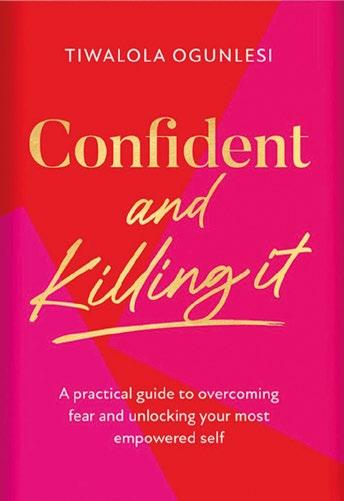
diagrams, self-reflection exercises, bold print and powerful quotes, this book is one to which you will refer time and time again.
In the conclusion, Ogunlesi says: “This book is designed to equip you with the tools to thrive and flourish” – and it certainly lives up to this impactful statement.
At whatever stage in life and leadership you find yourself, this book will act as reminder that you are worthy. It will be a companion to support you at every step of your onward journey.
An empowering read.
Ucar invites readers to find out where they are communicating from – the heart, the mind or both – and cleverly weaves a mix of frameworks and acronyms throughout, showcasing his communication expertise, which caters for a variety of learning styles.
I particularly liked the ‘BEST’ model – Build, Explain, Stories, Time
– in relation to presenting with impact; and the ‘TACO’ analogy – Tailoring, Authenticity, Candour, Optimism – when seeking to build trust with others. With so many more to explore and choose from, you will have an abundance of tools to support you to become the global communicator you seek to be. As Ucar states: ‘People are part of your magic, and you are part of theirs.’
This is a fascinating book, bursting with insights, tools and techniques to support leaders to enhance their effectiveness and influence on the international stage.
I absolutely loved it and have a feeling you will, too. One to add to your leadership book collection.
Author Sarah Langslow Price £16.99, Practical Inspiration Publishing
It all starts with you!
Leaders have a responsibility to others, a duty of care and the power to leave a lasting impact on people. Langslow begins her book by sharing a personal negative work experience, early in her career, that had a lasting effect. Listening to similar experiences from others motivated her to write this powerful leadership-development
Author Beth Stallwood Price £14.99, Practical Inspiration Publishing
Joy – a glorious word that inspires a smile. This book embodies joy. Through passionate writing, Stallwood gently guides and equips readers with the tools to cultivate joy, even in the often challenging world of work.
A coach, speaker, facilitator and consultant, Stallwood began her working life when she was cast in a TV commercial at the age of eight. In the book, she shares her insights on how to create joy at work, showcasing a highly practical and action-orientated toolkit, organised into four parts, with her inspiring personality evident throughout. You will discover many learnings
book. An executive coach and leadership development specialist, Langslow states: ‘We deserve better leaders’ – words that will resonate with many.
In the book, which has four parts, Langslow explains what is meant by ‘the small stuff’ – the importance of self-awareness, how leadership begins from within, guiding you to become the leader you want to be, while remembering it’s a journey, not a destination.
She invites readers to combine insights in the book (which are abundant) with action to successfully achieve different results. There are reflection, speaking and writing exercises, which add a deeper sense
from reading this book – for example, the differences between workjoy and workgloom, and understanding your current work state. You will learn the inner workjoy factors, the myth of the work/life balance, and how to define your personal values and create boundaries.
You will explore the power of stories in all forms and why continuous learning is so important. You will also become more aware of the outer workjoy factors, and be guided on how to create a goalbased roadmap and make workjoy a reality for you.
of self-leadership development. I found the ‘defining your leadership footprint’ exercise intriguing, while the Leadership Shadow framework was another favourite. It invites you to analyse four areas: what you say, how you act, what you prioritise, and how and what you measure. A highly insightful exercise.
Langslow has created a wonderful book that acts as a conduit to creating better leadership, better workplaces, and better experiences for all. An excellent read!
Stallwood uses real-life stories and case studies, frameworks, formulae, and reflection questions, plus a free online workbook, making the toolkit relevant, relatable, reflexive, and resourceful. This book places joy front and centre, and is brimming with strategies to achieve workjoy. Wherever you are on your leadership journey, this book will become a joyful companion. An inspirational read.
Belinda O’Neill is a business, leadership and wellness consultant, and founder of Be Inspired To Be. She is an award-winning author, speaker, event facilitator, podcaster and educator. She is also a business and community ambassador, having held many voluntary roles, and is currently a judge for the National StartUp Awards. She lives in Co Down, Northern Ireland, with her husband, Peter, and their son, Leo.
QHow did you come to be doing the job you are doing today?
I started Confident and Killing It because I noticed there was a generational cycle of low self-esteem in women and girls. As a teenager, I struggled with negative thinking and comparison, and I definitely wasn’t the only one. One day, through divine intervention, I started my own journey of building confidence and clarity, and when I began sharing that with others, the impact was undeniable. What began as a passion project grew into a global movement and media organisation, with books, coaching, podcasts and community all helping people unlock their power and show up fully in life and work.
Q What is the highlight of your working week?
Getting messages from people about taking bold steps after engaging with my work. Whether it’s a woman finally speaking up in a meeting or someone telling me my talk gave them the courage to start their own business, I always feel so grateful for the opportunity to have that impact. It’s the magic I work for.
“What began as a passion project grew into a global movement and media organisation... helping people unlock their power...”
QWhat surprised you when you first started your job?
How many people are silently struggling with confidence, regardless of how accomplished they are. I thought imposter syndrome only happened to people at the start of their careers, but it’s everywhere, from interns to CEOs.
Q
If you could offer a piece of advice to your 18-yearold self, what would it be?
You matter simply because you exist. Your worth doesn’t come from your grades or what other people think of you. You are good enough just as you are, so be kind and patient with yourself. Everything is working out for you. Trust God and trust the timing of your life.
Q How do you switch off from work?
Long walks in the park, listening
to gospel music, pilates, dancing to Beyoncé and being very intentional with rest days. I’ve learnt to protect my peace just as fiercely as I chase my purpose.
Q If you had a superpower, what would it be and how would you use it?
Ohh that’s hard… On the surface level, I’d want to teleport, so I could travel the world with the snap of my fingers and never have jet lag. On a deeper level, I’d love a superpower that eradicates world poverty.
Tiwalola Adebayo (née Ogunlesi) is a globally recognised and qualified life coach, international speaker, positive psychology specialist, author, podcast host and founder of Confident and Killing It. She is speaking at Leadership Live in London on 24 June: see iol.rsvp.gther.com
We’ve enhanced our membership offering by delivering monthly, live masterclasses on essential topics, with a practical focus. Reserve your place, today.
Go to the website and look for 'What’s On'.
Tune in to our monthly podcast with The Institute of Leadership’s CEO, John Mark Williams, and guests.