16 | On Topic
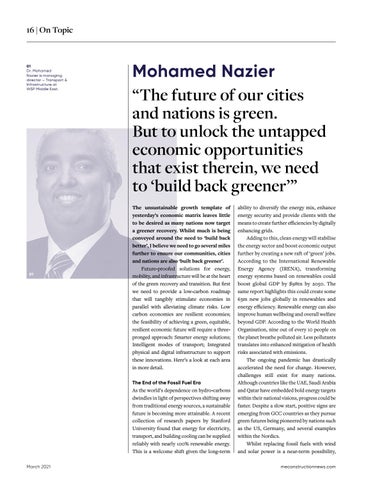
01 Dr. Mohamed Nazier is managing director – Transport & Infrastructure at WSP Middle East.
01
Mohamed Nazier “The future of our cities and nations is green. But to unlock the untapped economic opportunities that exist therein, we need to ‘build back greener’” The unsustainable growth template of yesterday’s economic matrix leaves little to be desired as many nations now target a greener recovery. Whilst much is being conveyed around the need to ‘build back better’, I believe we need to go several miles further to ensure our communities, cities and nations are also ‘built back greener’. Future-proofed solutions for energy, mobility, and infrastructure will be at the heart of the green recovery and transition. But first we need to provide a low-carbon roadmap that will tangibly stimulate economies in parallel with alleviating climate risks. Low carbon economies are resilient economies; the feasibility of achieving a green, equitable, resilient economic future will require a threepronged approach: Smarter energy solutions; Intelligent modes of transport; Integrated physical and digital infrastructure to support these innovations. Here’s a look at each area in more detail. The End of the Fossil Fuel Era
As the world’s dependence on hydro-carbons dwindles in light of perspectives shifting away from traditional energy sources, a sustainable future is becoming more attainable. A recent collection of research papers by Stanford University found that energy for electricity, transport, and building cooling can be supplied reliably with nearly 100% renewable energy. This is a welcome shift given the long-term March 2021
ability to diversify the energy mix, enhance energy security and provide clients with the means to create further efficiencies by digitally enhancing grids. Adding to this, clean energy will stabilise the energy sector and boost economic output further by creating a new raft of ‘green’ jobs. According to the International Renewable Energy Agency (IRENA), transforming energy systems based on renewables could boost global GDP by $98tn by 2050. The same report highlights this could create some 63m new jobs globally in renewables and energy efficiency. Renewable energy can also improve human wellbeing and overall welfare beyond GDP. According to the World Health Organisation, nine out of every 10 people on the planet breathe polluted air. Less pollutants translates into enhanced mitigation of health risks associated with emissions. The ongoing pandemic has drastically accelerated the need for change. However, challenges still exist for many nations. Although countries like the UAE, Saudi Arabia and Qatar have embedded bold energy targets within their national visions, progress could be faster. Despite a slow start, positive signs are emerging from GCC countries as they pursue green futures being pioneered by nations such as the US, Germany, and several examples within the Nordics. Whilst replacing fossil fuels with wind and solar power is a near-term possibility, meconstructionnews.com