ANALYSIS
where the true value can then be created for the betterment of lives. Another important announcement also made the news mid of March 2021: Dubai2040 Urban Master Plan. It is “a comprehensive plan that lays out the future of Dubai’s sustainable urban development … with the aim of transforming the emirate and creating a truly interconnected, people-led city that balances community with tourism and modernity with heritage and nature.” This futuristic plan requires modern construction engineering activities that will be successful only if they are based on a thoughtful collaboration between all stakeholders along the entire Lifecyle of the project. Thus, we need to re-think how construction projects must be initiated, developed, constructed, and operated in a collaborative manner. COLLABORATION There have been many attempts in the region to increase the level of collaboration amongst the four major stakeholders (Client/ Developer, Consultant/Engineer, Contractor, Regulator), and all have contributed to increasing awareness and finding solutions for certain issues. However, none of these attempts has worked on the concept of “Collaborative Advantage” which allows a deeper analysis of issues and relationships as a way of finding solutions that are aligned with the different players’ diverse, and sometimes contradictory objectives. In 1994, the Harvard Business Review published a paper by Rosabeth Moss Kanter which uncovered three fundamental aspects of alliances/collaboration: • They must yield benefits for the partners, but they are more than just the deal. They are living systems that evolve progressively in their possibilities. Beyond the immediate reasons they have for entering into a relationship, the connection
offers the parties an option on the future, opening new doors and unforeseen opportunities. • Alliances that both (or all) partners ultimately deem successful involve collaboration (creating new value together) rather than mere exchange (getting something back for what you put in). Partners value the skills each brings to the alliance. • They cannot be “controlled” by formal systems but require a dense web of interpersonal connections and internal infrastructures that enhance learning. Thus, Collaborative Advantage must consist of shared gaols (Bryson, Ackermann, and Eden 2016) that guarantee achieving together what cannot be achieved separately (Huxham and Vangen 2005). For engineering construction, any attempt to explore a brighter future without finding Collaborative Advantage is futile. This unfortunately does not happen overnight or through a few workshops that do not dig deep enough to understand, and stand on, the purpose and objectives of each of the major players. Senior executives know that each of the four major stakeholders
19
have different sets of goals and that they will do “anything” to achieve these goals, even if this means not letting others achieve their goals when things get messy, or even worse when things are still working fine, but each wants the ultimate control and win. The main question is, thus, how to help the players in achieving this “Collaborative Advantage”?
It is time that stakeholders discussed what, where, how, why and when they need to do things differently, sustainably, and profitably for the benefit of all. It is their collective duty to find the advantage that allows their firms to be part of the future”
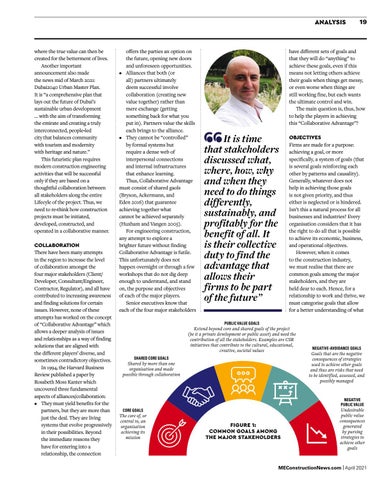
OBJECTIVES Firms are made for a purpose: achieving a goal, or more specifically, a system of goals (that is several goals reinforcing each other by patterns and causality). Generally, whatever does not help in achieving those goals is not given priority, and thus either is neglected or is hindered. Isn’t this a natural process for all businesses and industries? Every organisation considers that it has the right to do all that is possible to achieve its economic, business, and operational objectives. However, when it comes to the construction industry, we must realise that there are common goals among the major stakeholders, and they are held dear to each. Hence, for a relationship to work and thrive, we must categorise goals that allow for a better understanding of what
PUBLIC VALUE GOALS
Extend beyond core and shared goals of the project (be it a private development or public asset) and need the contribution of all the stakeholders. Examples are CSR initiatives that contribute to the cultural, educational, creative, societal values SHARED CORE GOALS
Shared by more than one organisation and made possible through collaboration
NEGATIVE-AVOIDANCE GOALS
Goals that are the negative consequences of strategies used to achieve other goals and thus are risks that need to be identified, assessed, and possibly managed
NEGATIVE PUBLIC VALUE
CORE GOALS
The core of, or central to, an organisation achieving its mission
FIGURE 1: COMMON GOALS AMONG THE MAJOR STAKEHOLDERS
Undesirable public value consequences generated by pursing strategies to achieve other goals
MEConstructionNews.com | April 2021