HUMAN RIGHTS
AND CLIMATE CHANGE UNEP DTU Partnership
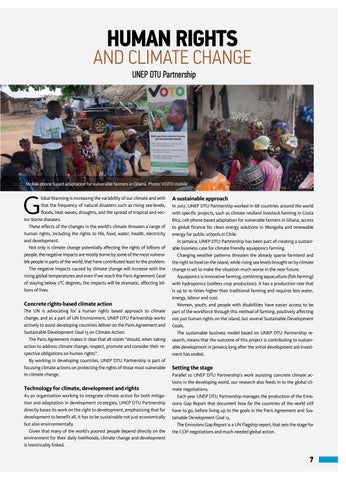
Mobile phone based adaptation for vulnerable farmers in Ghana. Photo: VOTO mobile
G
lobal Warming is increasing the variability of our climate and with that the frequency of natural disasters such as rising sea-levels, floods, heat waves, droughts, and the spread of tropical and vector-borne diseases. These effects of the changes in the world’s climate threaten a range of human rights, including the rights to life, food, water, health, electricity and development. Not only is climate change potentially affecting the rights of billions of people, the negative impacts are mostly borne by some of the most vulnerable people in parts of the world, that have contributed least to the problem. The negative impacts caused by climate change will increase with the rising global temperatures and even if we reach the Paris Agreement Goal of staying below 2°C degrees, the impacts will be dramatic, affecting billions of lives.
Concrete rights-based climate action The UN is advocating for a human rights based approach to climate change, and as a part of UN Environment, UNEP DTU Partnership works actively to assist developing countries deliver on the Paris Agreement and Sustainable Development Goal 13 on Climate Action. The Paris Agreement makes it clear that all states “should, when taking action to address climate change, respect, promote and consider their respective obligations on human rights”. By working in developing countries, UNEP DTU Partnership is part of focusing climate actions on protecting the rights of those most vulnerable to climate change.
Technology for climate, development and rights As an organisation working to integrate climate action for both mitigation and adaptation in development strategies, UNEP DTU Partnership directly bases its work on the right to development, emphasising that for development to benefit all, it has to be sustainable not just economically but also environmentally. Given that many of the world’s poorest people depend directly on the environment for their daily livelihoods, climate change and development is inextricably linked.
A sustainable approach In 2017, UNEP DTU Partnership worked in 68 countries around the world with specific projects, such as climate resilient livestock farming in Costa Rica, cell-phone based adaptation for vulnerable farmers in Ghana, access to global finance for clean energy solutions in Mongolia and renewable energy for public schools in Chile. In Jamaica, UNEP DTU Partnership has been part of creating a sustainable business case for climate friendly aquaponics farming. Changing weather patterns threaten the already sparse farmland and the right to food on the island, while rising sea levels brought on by climate change is set to make the situation much worse in the near future. Aquaponics is innovative farming, combining aquaculture (fish farming) with hydroponics (soilless crop production). It has a production rate that is up to 10 times higher than traditional farming and requires less water, energy, labour and cost. Women, youth, and people with disabilities have easier access to be part of the workforce through this method of farming, positively affecting not just human rights on the island, but several Sustainable Development Goals. The sustainable business model based on UNEP DTU Partnership research, means that the outcome of this project is contributing to sustainable development in Jamaica long after the initial development aid investment has ended.
Setting the stage Parallel to UNEP DTU Partnership’s work assisting concrete climate actions in the developing world, our research also feeds in to the global climate negotiations. Each year UNEP DTU Partnership manages the production of the Emissions Gap Report that document how far the countries of the world still have to go, before living up to the goals in the Paris Agreement and Sustainable Development Goal 13. The Emissions Gap Report is a UN Flagship report, that sets the stage for the COP negotiations and much needed global action.
7