UN CITY SUPPLEMENT
UTILISING TECHNOLOGY TO IMPROVE HUMAN RIGHTS UNIDO, the UN Industrial Development Organization
C
limate change is one of the greatest threats to human rights in our generation. A healthy and functional environment is integral to the enjoyment of human rights, such as the right to life, health, food and shelter. Climate change action, therefore, requires a global rightsbased response to ensure that all persons have the necessary capacity to adapt to climate change. The UN Industrial Development Organization (UNIDO) is working through its Climate Technology Centre and Network (CTCN) to accelerate action on the ground and ensure human rights in the context of climate change.
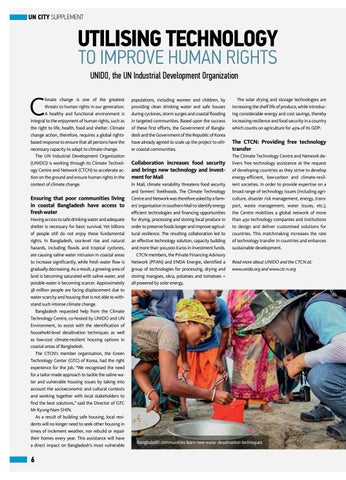
Ensuring that poor communities living in coastal Bangladesh have access to fresh water Having access to safe drinking water and adequate shelter is necessary for basic survival. Yet billions of people still do not enjoy these fundamental rights. In Bangladesh, sea-level rise and natural hazards, including floods and tropical cyclones, are causing saline water intrusion in coastal areas to increase significantly, while fresh water flow is gradually decreasing. As a result, a growing area of land is becoming saturated with saline water, and potable water is becoming scarcer. Approximately 38 million people are facing displacement due to water scarcity and housing that is not able to withstand such intense climate change. Bangladesh requested help from the Climate Technology Centre, co-hosted by UNIDO and UN Environment, to assist with the identification of household-level desalination techniques as well as low-cost climate-resilient housing options in coastal areas of Bangladesh. The CTCN’s member organisation, the Green Technology Center (GTC) of Korea, had the right experience for the job. “We recognised the need for a tailor-made approach to tackle the saline water and vulnerable housing issues by taking into account the socioeconomic and cultural contexts and working together with local stakeholders to find the best solutions,” said the Director of GTC Mr Kyung-Nam SHIN. As a result of building safe housing, local residents will no longer need to seek other housing in times of inclement weather, nor rebuild or repair their homes every year. This assistance will have a direct impact on Bangladesh’s most vulnerable
6
populations, including women and children, by providing clean drinking water and safe houses during cyclones, storm surges and coastal flooding in targeted communities. Based upon the success of these first efforts, the Government of Bangladesh and the Government of the Republic of Korea have already agreed to scale up the project to other coastal communities.
Collaboration increases food security and brings new technology and investment for Mali In Mali, climate variability threatens food security and farmers’ livelihoods. The Climate Technology Centre and Network was therefore asked by a farmers’ organisation in southern Mali to identify energy efficient technologies and financing opportunities for drying, processing and storing local produce in order to preserve foods longer and improve agricultural resilience. The resulting collaboration led to an effective technology solution, capacity building and more than 300,000 Euros in investment funds. CTCN members, the Private Financing Advisory Network (PFAN) and ENDA Energie, identified a group of technologies for processing, drying and storing mangoes, okra, potatoes and tomatoes – all powered by solar energy.
The solar drying and storage technologies are increasing the shelf life of produce, while introducing considerable energy and cost savings, thereby increasing resilience and food security in a country which counts on agriculture for 45% of its GDP.
The CTCN: Providing free technology transfer The Climate Technology Centre and Network delivers free technology assistance at the request of developing countries as they strive to develop energy-efficient, low-carbon and climate-resilient societies. In order to provide expertise on a broad range of technology issues (including agriculture, disaster risk management, energy, transport, waste management, water issues, etc.), the Centre mobilizes a global network of more than 450 technology companies and institutions to design and deliver customised solutions for countries. This matchmaking increases the rate of technology transfer in countries and enhances sustainable development. Read more about UNIDO and the CTCN at: www.unido.org and www.ctc-n.org
Bangladeshi communities learn new water desalination techniques