S
PROTECTING THE HUMAN RIGHTS OF MIGRANTS International Organization for Migration (IOM)
eventy years have passed since the General Assembly adopted the Universal Declaration of Human rights, aspiring to protect, respect and fulfil the human rights of all people around the world.
Although much improvement has taken place since then to advance the human rights situation of individuals, migrants are still one of the groups that continue to face significant challenges when trying to access their human rights.
Migrants at risk Migrants are often disproportionately affected by human rights violations and abuse, and the risk increases greatly when they migrate irregularly. We see daily how the right to life of migrants is at risk as they resort to smugglers when trying to cross borders by sea, in deserts, travelling in unsafe and overcrowded trucks, containers and boats. During their journey, they are at risk of exploitation and many end up in human trafficking without any respect for their right to liberty and to freedom from slavery. Even when migrants find employment they regularly continue to face discrimination at the work place. They do the same kind of work as nationals but are only paid a fraction of the salary. Some migrants have their rights violated even before their journey has begun as certain states deny them their right to leave their own country to prevent them from migrating irregularly to another. Other migrants manage to leave but during their travel they end up in unlawful and arbitrary detention where the conditions are deplorable and their access to justice is limited – if they have any justice at all. Migrants, in particular irregular migrants, often live among those who are already marginalised in society and struggle with accessing the right to education, health, adequate housing, nutritious food and potable water.
A rights-based approach This is not the story of all migrants but the reality for far too many. It is for this reason that IOM takes a rights-based approach to migration. At a policy level IOM works with governments to develop law and policy in line with the international legal framework, protecting the rights of all migrants, including those with an irregular status. Similarly, IOM works to raise awareness on human rights amongst professionals and others who directly assist migrants. IOM recently trained over 100 health workers in El Salvador on vulnerabilities faced by migrants and how to identify human rights violations against migrants. In other cases, IOM supports the capacity of migrants themselves to claim their rights. In Hong Kong, IOM runs a project that fosters the protection of migrant domestic workers’ rights by enhancing their access to justice. This involves private sector entities such as pro bono lawyers to undertake legal action and submit cases of labour exploitation.
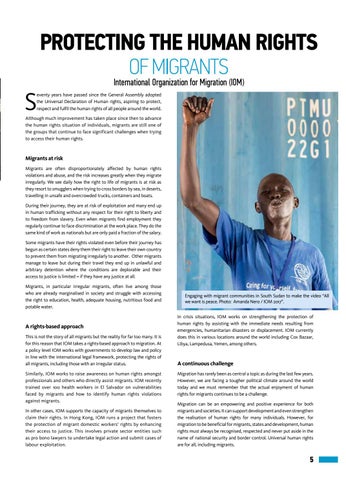
Engaging with migrant communities in South Sudan to make the video “All we want is peace. Photo: Amanda Nero / IOM 2017”. In crisis situations, IOM works on strengthening the protection of human rights by assisting with the immediate needs resulting from emergencies, humanitarian disasters or displacement. IOM currently does this in various locations around the world including Cox Bazaar, Libya, Lampedusa, Yemen, among others.
A continuous challenge Migration has rarely been as central a topic as during the last few years. However, we are facing a tougher political climate around the world today and we must remember that the actual enjoyment of human rights for migrants continues to be a challenge. Migration can be an empowering and positive experience for both migrants and societies. It can support development and even strengthen the realisation of human rights for many individuals. However, for migration to be beneficial for migrants, states and development, human rights must always be recognised, respected and never put aside in the name of national security and border control. Universal human rights are for all, including migrants.
5