UN CITY SUPPLEMENT
REDUCING INEQUALITY, DISCRIMINATION AND EXCLUSION
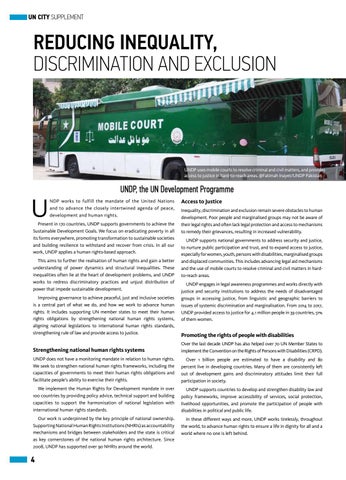
UNDP uses mobile courts to resolve criminal and civil matters, and provides access to justice in hard-to-reach areas. @Fatimah Inayet/UNDP Pakistan
U
UNDP, the UN Development Programme NDP works to fulfill the mandate of the United Nations and to advance the closely intertwined agenda of peace, development and human rights.
Present in 170 countries, UNDP supports governments to achieve the Sustainable Development Goals. We focus on eradicating poverty in all its forms everywhere, promoting transformation to sustainable societies and building resilience to withstand and recover from crisis. In all our work, UNDP applies a human rights-based approach. This aims to further the realisation of human rights and gain a better understanding of power dynamics and structural inequalities. These inequalities often lie at the heart of development problems, and UNDP works to redress discriminatory practices and unjust distribution of power that impede sustainable development. Improving governance to achieve peaceful, just and inclusive societies is a central part of what we do, and how we work to advance human rights. It includes supporting UN member states to meet their human rights obligations by strengthening national human rights systems, aligning national legislations to international human rights standards, strengthening rule of law and provide access to justice.
Access to Justice Inequality, discrimination and exclusion remain severe obstacles to human development. Poor people and marginalised groups may not be aware of their legal rights and often lack legal protection and access to mechanisms to remedy their grievances, resulting in increased vulnerability. UNDP supports national governments to address security and justice, to nurture public participation and trust, and to expand access to justice, especially for women, youth, persons with disabilities, marginalised groups and displaced communities. This includes advancing legal aid mechanisms and the use of mobile courts to resolve criminal and civil matters in hardto-reach areas. UNDP engages in legal awareness programmes and works directly with justice and security institutions to address the needs of disadvantaged groups in accessing justice, from linguistic and geographic barriers to issues of systemic discrimination and marginalisation. From 2014 to 2017, UNDP provided access to justice for 4.1 million people in 39 countries, 51% of them women.
Promoting the rights of people with disabilities
Strengthening national human rights systems
Over the last decade UNDP has also helped over 70 UN Member States to implement the Convention on the Rights of Persons with Disabilities (CRPD).
UNDP does not have a monitoring mandate in relation to human rights. We seek to strengthen national human rights frameworks, including the capacities of governments to meet their human rights obligations and facilitate people’s ability to exercise their rights.
Over 1 billion people are estimated to have a disability and 80 percent live in developing countries. Many of them are consistently left out of development gains and discriminatory attitudes limit their full participation in society.
We implement the Human Rights for Development mandate in over 100 countries by providing policy advice, technical support and building capacities to support the harmonisation of national legislation with international human rights standards.
UNDP supports countries to develop and strengthen disability law and policy frameworks, improve accessibility of services, social protection, livelihood opportunities, and promote the participation of people with disabilities in political and public life.
Our work is underpinned by the key principle of national ownership. Supporting National Human Rights Institutions (NHRIs) as accountability mechanisms and bridges between stakeholders and the state is critical as key cornerstones of the national human rights architecture. Since 2008, UNDP has supported over 90 NHRIs around the world.
In these different ways and more, UNDP works tirelessly, throughout the world, to advance human rights to ensure a life in dignity for all and a world where no one is left behind.
4