UN CITY SUPPLEMENT
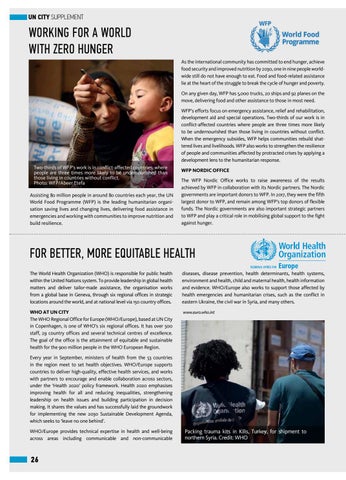
WORKING FOR A WORLD WITH ZERO HUNGER As the international community has committed to end hunger, achieve food security and improved nutrition by 2030, one in nine people worldwide still do not have enough to eat. Food and food-related assistance lie at the heart of the struggle to break the cycle of hunger and poverty. On any given day, WFP has 5,000 trucks, 20 ships and 92 planes on the move, delivering food and other assistance to those in most need. WFP’s efforts focus on emergency assistance, relief and rehabilitation, development aid and special operations. Two-thirds of our work is in conflict-affected countries where people are three times more likely to be undernourished than those living in countries without conflict. When the emergency subsides, WFP helps communities rebuild shattered lives and livelihoods. WFP also works to strengthen the resilience of people and communities affected by protracted crises by applying a development lens to the humanitarian response. Two-thirds of WFP’s work is in conflict-affected countries, where people are three times more likely to be undernourished than those living in countries without conflict. Photo: WFP/Abeer Etefa Assisting 80 million people in around 80 countries each year, the UN World Food Programme (WFP) is the leading humanitarian organisation saving lives and changing lives, delivering food assistance in emergencies and working with communities to improve nutrition and build resilience.
WFP NORDIC OFFICE The WFP Nordic Office works to raise awareness of the results achieved by WFP in collaboration with its Nordic partners. The Nordic governments are important donors to WFP. In 2017, they were the fifth largest donor to WFP, and remain among WFP’s top donors of flexible funds. The Nordic governments are also important strategic partners to WFP and play a critical role in mobilising global support to the fight against hunger.
FOR BETTER, MORE EQUITABLE HEALTH The World Health Organization (WHO) is responsible for public health within the United Nations system. To provide leadership in global health matters and deliver tailor-made assistance, the organisation works from a global base in Geneva, through six regional offices in strategic locations around the world, and at national level via 150 country offices.
diseases, disease prevention, health determinants, health systems, environment and health, child and maternal health, health information and evidence. WHO/Europe also works to support those affected by health emergencies and humanitarian crises, such as the conflict in eastern Ukraine, the civil war in Syria, and many others.
WHO AT UN CITY The WHO Regional Office for Europe (WHO/Europe), based at UN City in Copenhagen, is one of WHO’s six regional offices. It has over 500 staff, 29 country offices and several technical centres of excellence. The goal of the office is the attainment of equitable and sustainable health for the 900 million people in the WHO European Region.
www.euro.who.int
Every year in September, ministers of health from the 53 countries in the region meet to set health objectives. WHO/Europe supports countries to deliver high-quality, effective health services, and works with partners to encourage and enable collaboration across sectors, under the ‘Health 2020’ policy framework. Health 2020 emphasises improving health for all and reducing inequalities, strengthening leadership on health issues and building participation in decision making. It shares the values and has successfully laid the groundwork for implementing the new 2030 Sustainable Development Agenda, which seeks to ‘leave no one behind’. WHO/Europe provides technical expertise in health and well-being across areas including communicable and non-communicable
26
Packing trauma kits in Kilis, Turkey, for shipment to northern Syria. Credit: WHO