UN CITY SUPPLEMENT I would like to ask you about protecting those who protect: human rights defenders are often targets of abuse and violence. How can they be better protected? MB: Well, the curious thing is that, as we are celebrating the 70th year of the Universal Declaration of Human Rights, we are celebrating 20 years of the Declaration on the Protection of Human Rights Defenders. And in November 2017, a resolution on the protection of human rights defenders was approved unanimously by the General Assembly. No country voted against it. So, the issue is: on paper things can look very good, but reality is another thing. I think we have the task of making people accountable for the things they have approved. Second, to monitor implementation of those agreements that everybody has made, and engage governments, and in the cases where things are happening, holding them accountable and responsible for the killings, the torture, the detentions of many human rights defenders. One of the most pressing issues for the entire world is climate change. How are human rights linked to the environment? MB: Well they are very important. First of all, because if we are not able to stop climate change, the people who will suffer most are the poorest, the women, the children, and most the vulnerable ones. They will have challenges accessing water, food or agriculture. Many of them, for example, from the small islands, they will have to leave the island if the sea level rises, they will have to go somewhere as a migrant. There are so many concrete consequences that will affect people’s lives and their rights. That is why we also believe that working strongly to combat climate change is a very essential task, including of the High Commissioner. I think also that
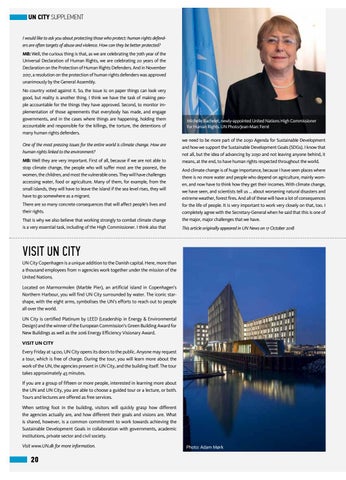
Michelle Bachelet, newly-appointed United Nations High Commissioner for Human Rights. UN Photo/Jean-Marc Ferré
we need to be more part of the 2030 Agenda for Sustainable Development and how we support the Sustainable Development Goals (SDGs). I know that not all, but the idea of advancing by 2030 and not leaving anyone behind, it means, at the end, to have human rights respected throughout the world. And climate change is of huge importance, because I have seen places where there is no more water and people who depend on agriculture, mainly women, and now have to think how they get their incomes. With climate change, we have seen, and scientists tell us … about worsening natural disasters and extreme weather, forest fires. And all of these will have a lot of consequences for the life of people. It is very important to work very closely on that, too. I completely agree with the Secretary-General when he said that this is one of the major, major challenges that we have. This article originally appeared in UN News on 17 October 2018
VISIT UN CITY UN City Copenhagen is a unique addition to the Danish capital. Here, more than a thousand employees from 11 agencies work together under the mission of the United Nations. Located on Marmormolen (Marble Pier), an artificial island in Copenhagen’s Northern Harbour, you will find UN City surrounded by water. The iconic starshape, with the eight arms, symbolises the UN’s efforts to reach out to people all over the world. UN City is certified Platinum by LEED (Leadership in Energy & Environmental Design) and the winner of the European Commission’s Green Building Award for New Buildings as well as the 2016 Energy Efficiency Visionary Award. VISIT UN CITY Every Friday at 14:00, UN City opens its doors to the public. Anyone may request a tour, which is free of charge. During the tour, you will learn more about the work of the UN, the agencies present in UN City, and the building itself. The tour takes approximately 45 minutes. If you are a group of fifteen or more people, interested in learning more about the UN and UN City, you are able to choose a guided tour or a lecture, or both. Tours and lectures are offered as free services. When setting foot in the building, visitors will quickly grasp how different the agencies actually are, and how different their goals and visions are. What is shared, however, is a common commitment to work towards achieving the Sustainable Development Goals in collaboration with governments, academic institutions, private sector and civil society. Visit www.UN.dk for more information.
20
Photo: Adam Mørk