UN CITY SUPPLEMENT
ADVANCING HUMAN RIGHTS, A ‘NEVER ENDING PROCESS’ SAYS NEW UN RIGHTS CHIEF
I
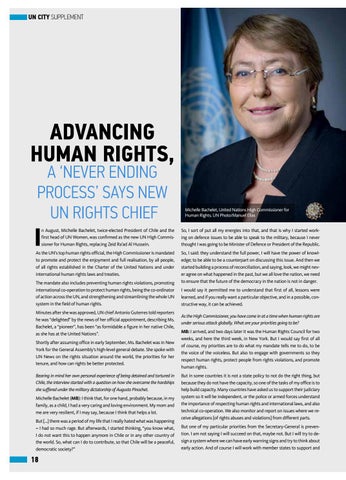
Michelle Bachelet, United Nations High Commissioner for Human Rights. UN Photo/Manuel Elias
n August, Michelle Bachelet, twice-elected President of Chile and the first head of UN Women, was confirmed as the new UN High Commissioner for Human Rights, replacing Zeid Ra’ad Al Hussein.
So, I sort of put all my energies into that, and that is why I started working on defence issues to be able to speak to the military, because I never thought I was going to be Minister of Defence or President of the Republic.
As the UN’s top human rights official, the High Commissioner is mandated to promote and protect the enjoyment and full realisation, by all people, of all rights established in the Charter of the United Nations and under international human rights laws and treaties.
So, I said: they understand the full power, I will have the power of knowledge; to be able to be a counterpart on discussing this issue. And then we started building a process of reconciliation, and saying, look, we might never agree on what happened in the past, but we all love the nation, we need to ensure that the future of the democracy in the nation is not in danger.
The mandate also includes preventing human rights violations, promoting international co-operation to protect human rights, being the co-ordinator of action across the UN, and strengthening and streamlining the whole UN system in the field of human rights. Minutes after she was approved, UN chief Antonio Guterres told reporters he was “delighted” by the news of her official appointment, describing Ms. Bachelet, a “pioneer”, has been “as formidable a figure in her native Chile, as she has at the United Nations”. Shortly after assuming office in early September, Ms. Bachelet was in New York for the General Assembly’s high-level general debate. She spoke with UN News on the rights situation around the world, the priorities for her tenure, and how can rights be better protected. Bearing in mind her own personal experience of being detained and tortured in Chile, the interview started with a question on how she overcame the hardships she suffered under the military dictatorship of Augusto Pinochet. Michelle Bachelet (MB): I think that, for one hand, probably because, in my family, as a child, I had a very caring and loving environment. My mom and me are very resilient, if I may say, because I think that helps a lot. But […] there was a period of my life that I really hated what was happening – I had so much rage. But afterwards, I started thinking, “you know what, I do not want this to happen anymore in Chile or in any other country of the world. So, what can I do to contribute, so that Chile will be a peaceful, democratic society?”
18
I would say it permitted me to understand that first of all, lessons were learned, and if you really want a particular objective, and in a possible, constructive way, it can be achieved. As the High Commissioner, you have come in at a time when human rights are under serious attack globally. What are your priorities going to be? MB: I arrived, and two days later it was the Human Rights Council for two weeks, and here the third week, in New York. But I would say first of all of course, my priorities are to do what my mandate tells me to do, to be the voice of the voiceless. But also to engage with governments so they respect human rights, protect people from rights violations, and promote human rights. But in some countries it is not a state policy to not do the right thing, but because they do not have the capacity, so one of the tasks of my office is to help build capacity. Many countries have asked us to support their judiciary system so it will be independent, or the police or armed forces understand the importance of respecting human rights and international laws, and also technical co-operation. We also monitor and report on issues where we receive allegations [of rights abuses and violations] from different parts. But one of my particular priorities from the Secretary-General is prevention. I am not saying I will succeed on that, maybe not. But I will try to design a system where we can have early warning signs and try to think about early action. And of course I will work with member states to support and