UNHCR SECURES HUMAN RIGHTS FOR MILLIONS OF REFUGEES
UNHCR, the UN Refugee Agency
“I begged them not to torture my family”
T
he Somali refugee mother Amina recalls the 15 months she was captured and tortured by human traffickers in Libya. The struggles for her and her family began when their home in Mogadishu was destroyed by a bomb that killed both her husband and brother. Together with her niece and sons, in danger of forced recruitment by the armed group al-Shabaab, Amina took to flight. After a long journey the family ended up in Libya and in the hands of criminals. Amina was given electric shocks. She was beaten. She was tied up and left outside in the cold. For months the abuse continued and her body began shutting down. Now, Amina and her family are safe.
Respect for rights at the core UNHCR, the UN Refugee Agency, has rescued hundreds of refugees from detention in Libya and has evacuated more than 1,800 of the most vulnerable out of the country, seeking long-term solutions in safe third countries. The respect and safeguard of the human rights of Amina as well as millions of other forcibly displaced people stand at the very core of the work of UNHCR. Refugee protection is essentially human rights in action. And refugee protection is also the inseparable requirement when serious violations of human rights, both in times of peace and war, continue to trigger flight – and force women, men and children to leave their homes. At the end of 2017, a record high 68.5 million people were uprooted, and it’s the duty of UNHCR to seek to uphold the human rights and fundamental freedoms for these people.
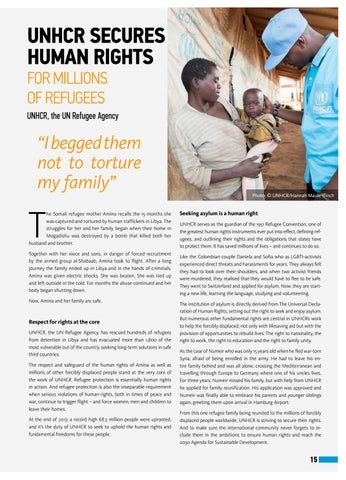
Photo: © UNHCR/Hannah Maule-ffinch
Seeking asylum is a human right UNHCR serves as the guardian of the 1951 Refugee Convention, one of the greatest human rights instruments ever put into effect, defining refugees, and outlining their rights and the obligations that states have to protect them. It has saved millions of lives – and continues to do so. Like the Colombian couple Daniela and Sofia who as LGBTI-activists experienced direct threats and harassments for years. They always felt they had to look over their shoulders, and when two activist friends were murdered, they realised that they would have to flee to be safe. They went to Switzerland and applied for asylum. Now, they are starting a new life, learning the language, studying and volunteering. The institution of asylum is directly derived from The Universal Declaration of Human Rights, setting out the right to seek and enjoy asylum. But numerous other fundamental rights are central in UNHCRs work to help the forcibly displaced, not only with lifesaving aid but with the provision of opportunities to rebuild lives: The right to nationality, the right to work, the right to education and the right to family unity. As the case of Numeir who was only 15 years old when he fled war-torn Syria, afraid of being enrolled in the army. He had to leave his entire family behind and was all alone, crossing the Mediterranean and travelling through Europe to Germany where one of his uncles lives. For three years, Numeir missed his family, but with help from UNHCR he applied for family reunification. His application was approved and Numeir was finally able to embrace his parents and younger siblings again, greeting them upon arrival in Hamburg Airport. From this one refugee family being reunited to the millions of forcibly displaced people worldwide, UNHCR is striving to secure their rights. And to make sure the international community never forgets to include them in the ambitions to ensure human rights and reach the 2030 Agenda for Sustainable Development.
15