UN CITY SUPPLEMENT
WOMEN’S RIGHTS
= HUMAN RIGHTS UN Women
T
he right to education. The right to work and to receive a just remuneration for your work. The right to a standard of living adequate for the health and well-being for you and your family. The right to take part in the governance of your country.
These are some of the rights that were endowed to all of us in the Universal Declaration of Human Rights 70 years ago. For many of us living in Denmark they may now seem self-evident but for many, enjoyment of these rights is still an unrealised reality. Often it is the women and girls who are left behind.
Helping women to realise their economic rights Alta Verapaz is one of the poorest regions of Guatemala. Finding a dependable source of income is a struggle. Women in particular have limited options for livelihood. Olga Macz was one of these women. She still remembers the days when she had almost no income and every day was a struggle for survival for her and her four-year-old daughter. Now Olga runs a thriving business producing shampoo from local plants. She sells her products in Guatemala City and speaks with excitement about her brand and how she has diversified her production. Her voice bubbles with enthusiasm when she talks about her plans to invest some of the money she has earned and saved. A turning point for Olga was the training and support she received from a UN joint programme for rural women. The programme has enabled her and 1,600 other women to develop small businesses based on traditional practises – like shampoo making – but applying modern production, packaging and marketing tools. The programme combines UN Women’s gender knowledge with expertise of the World Food Programme and the International Fund for Agricultural Development to help rural women in
14
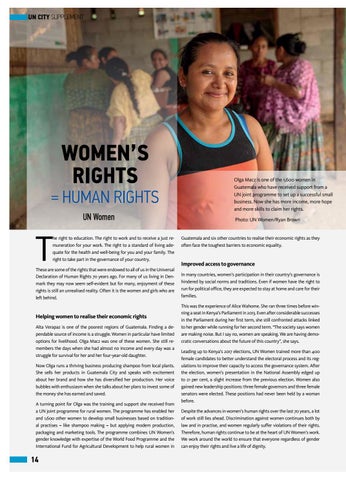
Olga Macz is one of the 1,600 women in Guatemala who have received support from a UN joint programme to set up a successful small business. Now she has more income, more hope and more skills to claim her rights. Photo: UN Women/Ryan Brown
Guatemala and six other countries to realise their economic rights as they often face the toughest barriers to economic equality.
Improved access to governance In many countries, women’s participation in their country’s governance is hindered by social norms and traditions. Even if women have the right to run for political office, they are expected to stay at home and care for their families. This was the experience of Alice Wahome. She ran three times before winning a seat in Kenya’s Parliament in 2013. Even after considerable successes in the Parliament during her first term, she still confronted attacks linked to her gender while running for her second term. “The society says women are making noise. But I say no, women are speaking. We are having democratic conversations about the future of this country”, she says. Leading up to Kenya’s 2017 elections, UN Women trained more than 400 female candidates to better understand the electoral process and its regulations to improve their capacity to access the governance system. After the election, women’s presentation in the National Assembly edged up to 21 per cent, a slight increase from the previous election. Women also gained new leadership positions: three female governors and three female senators were elected. These positions had never been held by a woman before. Despite the advances in women’s human rights over the last 70 years, a lot of work still lies ahead. Discrimination against women continues both by law and in practise, and women regularly suffer violations of their rights. Therefore, human rights continue to be at the heart of UN Women’s work. We work around the world to ensure that everyone regardless of gender can enjoy their rights and live a life of dignity.