HEALTH IS A HUMAN RIGHT WHO, the World Health Organization
“I’m used to taking care of my sister, I know how to move her to avoid bed sores and infections, to maintain good hygiene and feed her,” explains Aaliyah*.
E
ach day, Aaliyah wakes up to a dark sky in her home near the Mediterranean city of Mersin, in southern Turkey. Before leaving the house to catch the first bus of the day, she checks on her sister Lilah*, bedridden since a bomb hit the family house in the Syrian city of Homs. The explosion caused burns all over her body as the roof fell over her head. She is now unable to walk, move her hands or even talk.
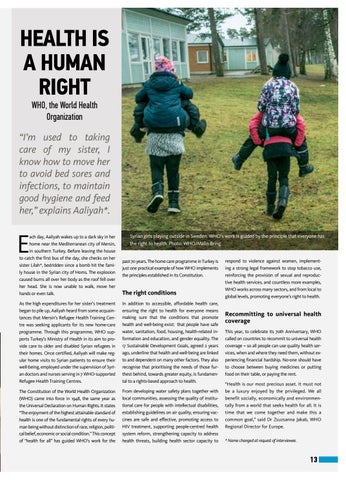
Syrian girls playing outside in Sweden. WHO’s work is guided by the principle that everyone has the right to health. Photo: WHO/Malin Bring past 70 years. The home care programme in Turkey is just one practical example of how WHO implements the principles established in its Constitution.
The right conditions
As the high expenditures for her sister’s treatment began to pile up, Aaliyah heard from some acquaintances that Mersin’s Refugee Health Training Centre was seeking applicants for its new home-care programme. Through this programme, WHO supports Turkey’s Ministry of Health in its aim to provide care to older and disabled Syrian refugees in their homes. Once certified, Aaliyah will make regular home visits to Syrian patients to ensure their well-being, employed under the supervision of Syrian doctors and nurses serving in 7 WHO-supported Refugee Health Training Centres.
In addition to accessible, affordable health care, ensuring the right to health for everyone means making sure that the conditions that promote health and well-being exist: that people have safe water, sanitation, food, housing, health-related information and education, and gender equality. The 17 Sustainable Development Goals, agreed 2 years ago, underline that health and well-being are linked to and dependent on many other factors. They also recognise that prioritising the needs of those furthest behind, towards greater equity, is fundamental to a rights-based approach to health.
The Constitution of the World Health Organization (WHO) came into force in 1948, the same year as the Universal Declaration on Human Rights. It states “The enjoyment of the highest attainable standard of health is one of the fundamental rights of every human being without distinction of race, religion, political belief, economic or social condition.” This concept of “health for all” has guided WHO’s work for the
From developing water safety plans together with local communities, assessing the quality of institutional care for people with intellectual disabilities, establishing guidelines on air quality, ensuring vaccines are safe and effective, promoting access to HIV treatment, supporting people-centred health system reform, strengthening capacity to address health threats, building health sector capacity to
respond to violence against women, implementing a strong legal framework to stop tobacco use, reinforcing the provision of sexual and reproductive health services, and countless more examples, WHO works across many sectors, and from local to global levels, promoting everyone’s right to health.
Recommitting to universal health coverage This year, to celebrate its 70th Anniversary, WHO called on countries to recommit to universal health coverage – so all people can use quality health services, when and where they need them, without experiencing financial hardship. No-one should have to choose between buying medicines or putting food on their table, or paying the rent. “Health is our most precious asset. It must not be a luxury enjoyed by the privileged. We all benefit socially, economically and environmentally from a world that seeks health for all. It is time that we come together and make this a common goal,” said Dr Zsuzsanna Jakab, WHO Regional Director for Europe. * Name changed at request of interviewee.
13