UN CITY SUPPLEMENT
MEALS NOT MARRIAGE WFP, the UN World Food Programme
Warm food at school can keep children nourished, educated and in the classroom until they are ready to graduate. School meals – getting girls to school
Pabitra Nayak (10) and Roshika Nayak (9) on their way to school. Photo: WFP/Lilu KC
I
n far Western Nepal boys eat first, are given more food than their sisters, do less housework and they marry later. Here, as well as in several other places around the world, boys and girls often have a different start to their lives. For girls, marriage and not school work can dominate their childhoods. Nepal is home to the third highest levels of child marriage in Asia. Thirty seven percent of girls marry before the age of 18, and 10 percent marry before they are 15. The legal age for marriage in Nepal is 20. High levels of poverty, a low value attached to daughters, a patriarchal culture and a lack of access to education drive the high levels of child marriage in Nepal. The repercussions of child marriage are devastating. Married girls in Nepal are ten times more likely not to attend school than their unmarried peers. Once married, girls lose the opportunity to overcome the cycle of poverty through education. By staying at home and raising children, their ability to earn their own income to support their families is limited.
The UN World Food Programme (WFP) is working to keep all children in school by providing them with nutritious meals. These meals are a powerful incentive for parents to send their children to school — and to keep them there. WFP provides school meals for 260,000 school children in Nepal daily. The remote area of Far Western Nepal, an eighthour drive from the capital Kathmandu, offers few opportunities for women and girls to break the cycle of poverty, start their own businesses and further their education. Where parents struggle to feed their children, WFP’s School Meals Programme serves as an incentive for parents in these communities to send their daughters to school.
Discussing the taboo subject of child marriage Bir Bahadur Bohra’s two children attend Shree Kalika Primary School in Dadeldhura district in Far Western Nepal. Bohra himself was a student in this school and returned to serve as an English teacher soon after completing his education. “I got married when I was 15 and my wife was only 13 years old,” Bir Bahadur Bohra says. “It is a cultural norm for children to get married so young in the far west. However, things are slowly changing for the better.”
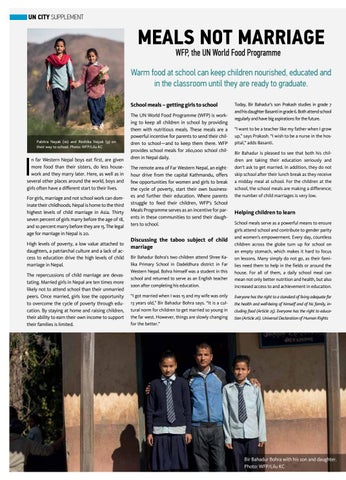
Today, Bir Bahadur’s son Prakash studies in grade 7 and his daughter Basanti in grade 6. Both attend school regularly and have big aspirations for the future. “I want to be a teacher like my father when I grow up,” says Prakash. “I wish to be a nurse in the hospital,” adds Basanti. Bir Bahadur is pleased to see that both his children are taking their education seriously and don’t ask to get married. In addition, they do not skip school after their lunch break as they receive a midday meal at school. For the children at the school, the school meals are making a difference; the number of child marriages is very low.
Helping children to learn School meals serve as a powerful means to ensure girls attend school and contribute to gender parity and women’s empowerment. Every day, countless children across the globe turn up for school on an empty stomach, which makes it hard to focus on lessons. Many simply do not go, as their families need them to help in the fields or around the house. For all of them, a daily school meal can mean not only better nutrition and health, but also increased access to and achievement in education. Everyone has the right to a standard of living adequate for the health and well-being of himself and of his family, including food (Article 25). Everyone has the right to education (Article 26). Universal Declaration of Human Rights
Bir Bahadur Bohra with his son and daughter. Photo: WFP/Lilu KC