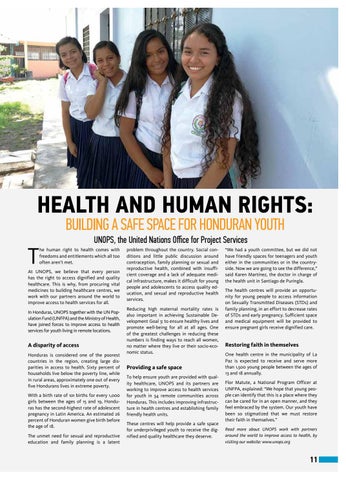
HEALTH AND HUMAN RIGHTS: BUILDING A SAFE SPACE FOR HONDURAN YOUTH
T
UNOPS, the United Nations Office for Project Services
he human right to health comes with freedoms and entitlements which all too often aren’t met.
At UNOPS, we believe that every person has the right to access dignified and quality healthcare. This is why, from procuring vital medicines to building healthcare centres, we work with our partners around the world to improve access to health services for all. In Honduras, UNOPS together with the UN Population Fund (UNFPA) and the Ministry of Health, have joined forces to improve access to health services for youth living in remote locations.
A disparity of access Honduras is considered one of the poorest countries in the region, creating large disparities in access to health. Sixty percent of households live below the poverty line, while in rural areas, approximately one out of every five Hondurans lives in extreme poverty. With a birth rate of 101 births for every 1,000 girls between the ages of 15 and 19, Honduras has the second-highest rate of adolescent pregnancy in Latin America. An estimated 26 percent of Honduran women give birth before the age of 18. The unmet need for sexual and reproductive education and family planning is a latent
problem throughout the country. Social conditions and little public discussion around contraception, family planning or sexual and reproductive health, combined with insufficient coverage and a lack of adequate medical infrastructure, makes it difficult for young people and adolescents to access quality education, and sexual and reproductive health services. Reducing high maternal mortality rates is also important in achieving Sustainable Development Goal 3: to ensure healthy lives and promote well-being for all at all ages. One of the greatest challenges in reducing these numbers is finding ways to reach all women, no matter where they live or their socio-economic status.
Providing a safe space To help ensure youth are provided with quality healthcare, UNOPS and its partners are working to improve access to health services for youth in 34 remote communities across Honduras. This includes improving infrastructure in health centres and establishing family friendly health units. These centres will help provide a safe space for underprivileged youth to receive the dignified and quality healthcare they deserve.
“We had a youth committee, but we did not have friendly spaces for teenagers and youth either in the communities or in the countryside. Now we are going to see the difference,” said Karen Martínez, the doctor in charge of the health unit in Santiago de Puringla. The health centres will provide an opportunity for young people to access information on Sexually Transmitted Diseases (STDs) and family planning, in an effort to decrease rates of STDs and early pregnancy. Sufficient space and medical equipment will be provided to ensure pregnant girls receive dignified care.
Restoring faith in themselves One health centre in the municipality of La Paz is expected to receive and serve more than 1,500 young people between the ages of 13 and 18 annually. Flor Matute, a National Program Officer at UNFPA, explained: “We hope that young people can identify that this is a place where they can be cared for in an open manner, and they feel embraced by the system. Our youth have been so stigmatized that we must restore their faith in themselves.” Read more about UNOPS work with partners around the world to improve access to health, by visiting our website: www.unops.org
11