UN CITY SUPPLEMENT
1968
REPRODUCTIVE RIGHTS RECOGNISED
T
UNFPA, the United Nations Population Fund
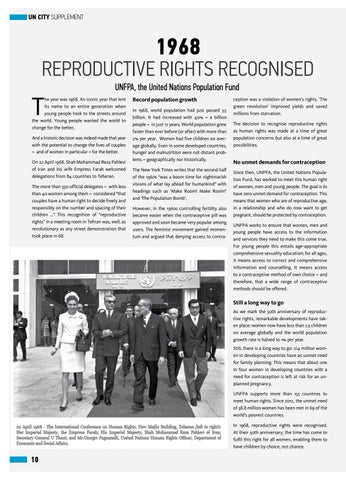
he year was 1968. An iconic year that lent its name to an entire generation when young people took to the streets around the world. Young people wanted the world to change for the better. And a historic decision was indeed made that year with the potential to change the lives of couples – and of women in particular – for the better. On 22 April 1968, Shah Mohammad Reza Pahlevi of Iran and his wife Empress Farah welcomed delegations from 84 countries to Teheran. The more than 350 official delegates – with less than 40 women among them – considered “that couples have a human right to decide freely and responsibly on the number and spacing of their children …” This recognition of “reproductive rights” in a meeting room in Tehran was, well, as revolutionary as any street demonstration that took place in 68.
Record population growth In 1968, world population had just passed 3.5 billion. It had increased with 40% – a billion people – in just 17 years. World population grew faster than ever before (or after) with more than 2% per year. Women had five children on average globally. Even in some developed countries, hunger and malnutrition were not distant problems – geographically nor historically. The New York Times writes that the second half of the 1960s “was a boom time for nightmarish visions of what lay ahead for humankind” with headings such as ‘Make Room! Make Room!’ and ‘The Population Bomb’. However, in the 1960s controlling fertility also became easier when the contraceptive pill was approved and soon became very popular among users. The feminist movement gained momentum and argued that denying access to contra-
ception was a violation of women’s rights. ‘The green revolution’ improved yields and saved millions from starvation. The decision to recognise reproductive rights as human rights was made at a time of great population concerns but also at a time of great possibilities.
No unmet demands for contraception Since then, UNFPA, the United Nations Population Fund, has worked to meet this human right of women, men and young people. The goal is to have zero unmet demand for contraception. This means that women who are of reproductive age, in a relationship and who do now want to get pregnant, should be protected by contraception. UNFPA works to ensure that women, men and young people have access to the information and services they need to make this come true. For young people this entails age-appropriate comprehensive sexuality education; for all ages, it means access to correct and comprehensive information and counselling. It means access to a contraceptive method of own choice – and therefore, that a wide range of contraceptive methods should be offered.
Still a long way to go As we mark the 50th anniversary of reproductive rights, remarkable developments have taken place: women now have less than 2.5 children on average globally and the world population growth rate is halved to 1% per year. Still, there is a long way to go: 214 million women in developing countries have an unmet need for family planning. This means that about one in four women in developing countries with a need for contraception is left at risk for an unplanned pregnancy. UNFPA supports more than 155 countries to meet human rights. Since 2012, the unmet need of 38.8 million women has been met in 69 of the world’s poorest countries. In 1968, reproductive rights were recognised. At their 50th anniversary, the time has come to fulfil this right for all women, enabling them to have children by choice, not chance.
10