News
The Copenhagen Post cphpost.dk
21 December 2012 - 4 January 2013
3
Grave concerns raised over nation’s oil spill-response capability Søværnet
Christian Wenande The increasing transport of oil through domestic waters coupled with the country’s out-of-date environmental response ships are a dangerous mix that leaves US vulnerable to a major disaster
D
enmark’s ability to respond to a major maritime oil or chemical spill has come under fire from a number of fronts for being out-of-date, fragmented and “unacceptable”. An internal military report concluded that the two primary clean-up ships, ‘Gunnar Seidenfaden’ and ‘Gunnar Thorson’, are only able to deal with non-dangerous oil spills. The reason is that the ships, which fall under naval command, are not equipped with crew areas that can prevent harmful gases from being released from substances the ships collect. The areas also lack the electrical and machine installations that ensure that explosive gases are not ignited. “If we arrive at the scene of a oil or chemical spill that we don’t know the contents of, then I have to tell the Navy that it is a task that I’m unable to accept because it will endanger the lives of my
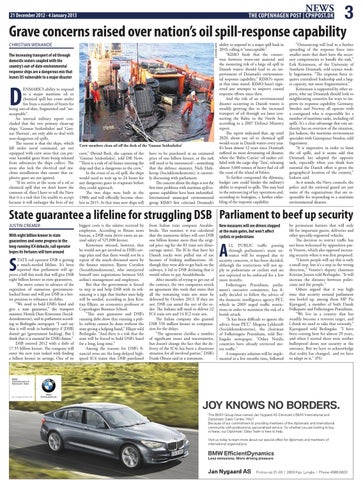
Crew members clean oil off the deck of the ‘Gunnar Seidenfaden’
crew,” Øjvind Bach, the captain of the ‘Gunnar Seidenfaden’, told DR News. “There is a risk of oil fumes entering the ship and that is dangerous to the crew.” In the event of an oil spill, the ships would need to wait up to 24 hours for any dangerous gases to evaporate before they could approach. The two ships were built in the 1980s and will officially become obsolete in 2015. At that time new ships will
have to be purchased at an estimated price of one billion kroner, or the task will need to be outsourced – something that the defence minister, Nick Hækkerup (Socialdemokraterne), is currently discussing with parliament. The concern about the ships is not the first time problems with maritime spill-response capabilities have been indentified. International municipal environmental group KIMO first criticised Denmark’s
ability to respond to a major spill back in 2010, calling it “unacceptable”. “KIMO finds that the connection between worn-out material and the mounting risk of a large oil spill in Danish waters should lead to an improvement of Denmark’s environmental response capability,” KIMO’s report at that time stated. KIMO hasn’t registered any attempts to improve coastal response efforts since then. And the risk of an environmental disaster occurring in Danish waters is steadily growing due to the increased transport of oil through sea lanes connecting the Baltic to the North Sea, according to a 2007 Defence Ministry report. The report indicated that, up until 2020, about one oil or chemical spill would occur in Danish waters every year. It’s been almost 12 years since Denmark suffered its most devastating oil disaster, when the ‘Baltic Carrier’ oil tanker collided with the cargo ship ‘Tern’, releasing almost 3,000 tonnes of heavy fuel oil off the coast of the island of Falster. To further compound the dilemma, budget cuts could hinder the military’s ability to respond to spills. This may lead to the outsourcing of key operations and, according to biologists, a further enfeebling of the response capability.
“Outsourcing will lead to a further spreading of the response force into smaller units that don’t have the necessary competencies to handle the task,” Erik Kristensen, of the University of Southern Denmark, told science weekly Ingeniøren. “The response force requires centralised leadership and a larger capacity, not more fragmentation.” Kristensen is supported by other experts, who say Denmark should look to neighbouring countries for ways to improve its response capability. Germany, Sweden and Norway all operate with a coastguard who is responsible for a number of maritime tasks, including oil spills. It’s a clear advantage that one authority has an overview of the situation, Jan Isakson, the maritime environment specialist with Greenpeace Sweden, told Ingeniøren. “It is imperative in order to limit the oil spills, and it seems odd that Denmark has adopted the opposite tack, especially when you think how essential the Danish effort is given the geographical location of the country,” Isakson said. As it stands, the Navy, councils, the police and the national guard are just some of the organisations that are responsible for responding to a maritime environmental disaster.
State guarantee a lifeline for struggling DSB Parliament to beef up security Justin Cremer With eight billion kroner in state guarantees and some progress in the long-running IC4 debacle, rail operator hopes its fortunes will turn around
S
tate rail operator DSB is getting a much-needed lifeline. It’s been reported that parliament will approve a bill this week that will give DSB eight billion kroner in state guarantees. The move comes in advance of the expiration of numerous governmentbacked loans and will put DSB in a better position to refinance its debts. “We need to hold DSB’s hand and give a state guarantee,” the transport minister, Henrik Dam Kristensen (Socialdemokraterne), said in parliament according to Berlingske newspaper. “I can’t say that it will result in bankruptcy if [DSB] doesn’t get [government backing]. But I think that it is essential for DSB’s future.” DSB entered 2012 with a debt of 17.55 billion kroner. The company will enter the new year tasked with finding a billion kroner in savings. One of its
biggest costs is the salaries received by employees. According to Ritzau news bureau, a DSB train driver earns an annual salary of 525,000 kroner. Kristensen stressed, however, that he would not get involved in DSB’s savings plan and that there would not be a repeat of the much-discussed move by the finance minister, Bjarne Corydon (Socialdemokraterne), who interjected himself into negotiations between SAS airline’s management and employees. But that the government is forced to step in and help DSB with its refinancing is a sign that further state help will be needed, according to Jens Kristian Elkjær, an economics professor at Copenhagen Business School. “This state guarantee and DSB’s running debt show that running a public railway cannot be done without the state giving a helping hand,” Elkjær told Berlingske. “And there is a risk that the state will be forced to hold DSB’s hand for a long, long time.” Among the reasons for DSB’s financial woes are the long-delayed highspeed IC4 trains that DSB purchased
from Italian train company Ansaldobreda. This summer, it was calculated that the numerous delays will cost DSB one billion kroner more than the original price tag for the 83 train sets (fourcarriage units). The IC4s that have hit Danish tracks were pulled out of use because of braking malfunctions. Although they were able to get back on the railways, it led to DSB declaring that it would refuse to pay Ansaldobreda. After months of trying to get out of the contract, the two companies struck an agreement this week that states that all the remaining train sets must be delivered by October 2013. If they are not, DSB can annul the rest of the order. The Italians still need to deliver 22 IC4 train sets and 14 IC2 train sets. The Italian company also granted DSB 550 million kroner in compensation for the delays. “The agreement clarifies a number of significant issues and uncertainties, but doesn’t change the fact that the delivery of the IC4s has been a disastrous situation for all involved parties,” DSB’s Frank Olesen said in a statement.
New measures will see drivers stopped at the main gates, but won’t affect cyclists or pedestrians
A
ll public traffic passing through parliament’s main entrance will be stopped due to security concerns, it has been decided, although the restrictions will not apply to pedestrians or cyclists and are not expected to be enforced for a few more months. Folketingets Præsidium, parliament’s executive committee, has finally decided to follow the advice of the domestic intelligence agency PET, which in 2009 urged traffic restrictions in order to minimise the risk of a bomb attack. “It has been difficult to ignore the advice from PET,” Mogens Lykketoft (Socialdemokraterne), the chairman of Folketingets Præsidium, told Berlingske newspaper. “Other Nordic countries have already restricted motor traffic.” A temporary solution will be implemented in a few months time, followed
by permanent barriers that will only lift for important guests, deliveries and other specially-registered vehicles. The decision to restrict traffic has not been welcomed by opposition party Venstre, which also opposed increasing security when it was first proposed. “I know people will say this is only a small step, but it’s a step in the wrong direction,” Venstre’s deputy chairman Kristian Jensen told Berlingske. “It will increase the distance between politicians and the people.” Others argued that it was high time that security around parliament was beefed up, among them MP Pia Kjærsgard, a member of both Dansk Folkeparti and Folketingets Præsidium. “We live in a country that has steadily become a terrorist target, and I think we need to take that seriously,” Kjærsgaard told Berlingske. “I have been coming here for almost 29 years, and when I started there were neither bulletproof doors nor security at the entrance. But we have to acknowledge that reality has changed, and we have to adapt to it.” (PS)
BMW International and Diplomatic Sales
jan-nygaard.bmw.dk
Sheer driving pleasure
Joy kNowS No borderS. The BMW Group have named Jan Nygaard AS Denmark’s BMW International and Diplomatic Sales Centre. Why? Because of our commitment to providing members of the diplomatic and international community with professional, personalised service. So whether you are looking to buy or lease, our Diplomatic Sales Team is here to help. Visit us today to learn more about our special offers for diplomats and members of international organisations.
Jan Nygaard AS
Firskovvej 31-33 I 2800 Kgs. Lyngby I Phone 4588 6600