News
The Copenhagen Post cphpost.dk
2 - 8 March 2012
3
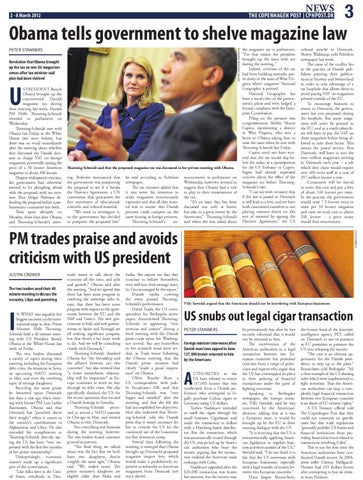
Obama tells government to shelve magazine law Scanpix/Mandel Ngan
Peter Stanners Revelation that Obama brought up the tax on non-EU magazines comes after tax minister said plan had been shelved
U
S President Barack Obama brought up the controversial Danish magazine tax during their meeting last week, Danish PM Helle Thorning-Schmidt revealed in parliament on Wednesday. Thorning-Schmidt met with Obama last Friday at the White House (see story below), but there was no word immediately after the meeting about whether they discussed the Danish decision to charge VAT on foreign magazines, potentially raising the price of a 30 kroner American magazine to about 200 kroner. Despite widespread criticism, the government had otherwise seemed to be ploughing ahead with the proposal, with tax minister Thor Möger Pedersen defending the proposal before a parliamentary committee last week. Then quite abruptly on Monday, three days after Obama and Thorning-Schmidt’s meet-
Thorning-Schmidt said that the proposed magazine tax was discussed in her private meeting with Obama
ing, Pedersen announced that the government was postponing the proposal to see if it breaks the Florence Agreement, a UN convention that guarantees the free movement of educational, scientific and cultural material. “We need to investigate it, so the government has decided to postpone the proposed law,”
he said according to Politiken newspaper. The tax minister added that it was never his intention to make magazines extortionately expensive and that all they wanted was to ensure that Danish printers could compete on the same footing as foreign printers. Thorning-Schmidt’s an-
nouncement in parliament on Wednesday, however, seemed to suggest that Obama had a role to play in their reassessment of the tax. “It’s an issue that has been discussed not only at home, but also to a great extent by the Americans,” Thorning-Schmidt said when she was asked about
the magazine tax in parliament. “For that reason the president brought up the issue with me during the meeting.” Indeed, criticism of the tax had been building stateside, particularly in the state of West Virginia where magazine National Geographic is printed. National Geographic has been a vocal critic of the government’s plans and even lodged a formal complaint with the European Commission. Piling on the pressure was congresswoman Shelley Moore Capito, representing a district in West Virginia, who sent a letter to Obama asking him to raise the issue when he met with Thorning-Schmidt last Friday. Capito need not have worried that the tax would slip below the radar, as a spokesperson for the US Embassy in Copenhagen had already expressed concern about the effect of the magazine tax before ThorningSchmidt’s visit. “I can say with certainty that if the law is passed in Denmark it will lead to a levy, and we have both committed ourselves to not placing customs duties on this sort of material by signing the Florence Agreement,” the US
cultural attaché in Denmark, Shawn Waddoup, told Politiken newspaper last week. The cause of the conflict lies in the practice of Danish publishers printing their publications in Norway and Switzerland in order to take advantage of a tax loophole that allows them to avoid paying VAT on magazines printed outside of the EU. To encourage business to return to Denmark, the government last year proposed closing the loophole. But many magazines will never be printed in the EU, and as a result subscribers will have to pay the VAT on these magazines before being allowed to take them home. This means the postal service, Post Danmark, will have to sort the nine million magazines arriving in Denmark each year – a job which they claim would require over 400 extra staff at a cost of 237 million kroner a year. Consumers will be forced to cover this cost and pay a levy of about 160 kroner per issue. In the process, the government would raise 7.5 kroner extra in taxes per 30 kroner magazine and raise its total cost to about 200 kroner – a price many would find extortionate.
Justin Cremer The two leaders used their 40 minute meeting to discuss the economy, Libya and parenting
I
n what was arguably her biggest moment on the international stage to date, Prime Minister Helle ThorningSchmidt held a 40-minute meeting with US President Barack Obama at the White House last week on Friday. The two leaders discussed a variety of topics during their meeting, including the European debt crisis, the situation in Syria, an upcoming NATO meeting in May, and even the terrifying topic of teenage daughters. Recycling the same praise he bestowed upon Denmark less than a year ago when meeting with former PM Lars Løkke Rasmussen, Obama said that Denmark has “punched above their weight” when it comes to the country’s contributions in Afghanistan and Libya. He also extended his compliments to Thorning-Schmidt directly, saying the US has been “very impressed with the first five months of her prime ministership”. Unsurprisingly, economic matters made up a significant part of the conversation. “Like folks here in the United States, everybody in Den-
mark wants to talk about the economy all the time, and jobs and growth,” Obama said after the meeting. “And we agreed that there has been some progress in resolving the sovereign debt issues, that there has been some progress with respect to the agreements between the EU and the IMF and Greece. The new government in Italy, and new governments in Spain and Portugal are all making significant progress, but that there’s a lot more work to do. And we will be consulting closely with Denmark.” Thorning-Schmidt thanked Obama for “the friendship and the alliance between our two countries”, but also stressed that “a closer transatlantic relationship will be important” as Europe continues to work its way through its debt crisis. She also specifically thanked the US for the recent operation that rescued a Danish hostage in Somalia. Thorning-Schmidt promised to attend a NATO summit in Chicago in May, and invited Obama to visit Denmark. Not everything was business during the meeting, however. The two leaders found common ground as parents. “The final thing we talked about was the fact that we both have two daughters; they’re roughly the same ages,” Obama said. “We traded notes. The prime minister’s daughters are slightly older than Malia and
Sasha. She assures me that they continue to behave themselves, even well into their teenage years. So I’m encouraged by the report.” Danish media covering the event praised ThorningSchmidt’s performance. David Trads, the US correspondent for Berlingske newspaper, characterised ThorningSchmidt as appearing “very nervous and unsure” during a brief meeting with the Danish press corps upon her Washington arrival. But any butterflies in her stomach must have settled, as Trads wrote following the Obama meeting that the Danish prime minister had clearly “made a good impression” on Obama. Oliver Routhe Skov, a US correspondent with public broadcaster DR, said that Thorning-Schmidt was “very happy and satisfied” after the meeting, and that she felt she had accomplished her objectives. Skov also indicated that Thorning-Schmidt told the Danish press that it wasn’t necessary for her to criticise the US for the continued use of the Guantanamo Bay detention camp. Several days following the meeting, it emerged that Obama brought up Denmark’s proposed magazine import levy, which would make it prohibitively expensive to subscribe to American magazines from Denmark (see story above).
Colourbox
PM trades praise and avoids criticism with US president Villy Søvndal argued that the Americans should not be interfering with European businesses
US snubs out legal cigar transaction Peter Stanners Foreign minister intervenes after Danish man loses appeal to have 137,000 kroner returned to him by the Americans
A
uthorities in the US have refused to return 137,000 kroner that was confiscated from a Danish policeman who attempted to legally purchase Cuban cigars in Germany using US dollars. Torben Nødskouv intended to resell the cigars through his small business Cigarhuset and made the transaction in dollars with a Hamburg-based distributor. But the transaction, which was automatically routed through the US, was picked up by American authorities who froze the money, arguing that the transaction violated the American trade embargo with Cuba. Nødskouv appealed after the $20,000 transaction was frozen last autumn, but the money may
be permanently lost after he was recently informed that it would not be returned to him. The intervention of the American authorities in a legal transaction between two European countries has provoked criticism from a range of politicians and experts who argue that the US has overstepped its place in their policing of financial transactions under the guise of fighting terrorism. Speaking to Berlingske newspaper, the foreign minister, Villy Søvndal, said he was concerned by the Americans’ decision, adding that as it was a European issue, it would be brought up by the EU in their running dialogue with the US. “It is worrying that the US is extraterritorially applying American legislation to regulate business activities outside of the US,” Søvndal said. “I do not think it is fair that the US intervenes with European businesses, especially with a legal transfer of money between two European countries.” Hans Jørgen Bonnichsen,
the former head of the domestic intelligence agency PET, called on Denmark to use its position as EU president to pressure the US into releasing the money. “The case is an obvious opportunity for the Danish presidency to step up to the plate,” Bonnichsen told Berlingske. “It’s a clear example of the US abusing rules which were implemented to fight terrorism. That the American authorities can stop a completely legal financial transaction between two European countries is an abuse of EU citizens’ rights.” A US Treasury official told The Copenhagen Post that they could not comment on specific cases but that trade regulations “generally prohibit US banks and financial institutions from providing financial services related to transactions involving Cuba”. This is not the first time the American authorities have confiscated Danish money. In 2008, dress seller Christa MøllgaardHansen had 205 dollars frozen after attempting to buy six dresses from Pakistan.