6
NEWS
THE COPENHAGEN POST CPHPOST.DK
4 - 10 November 2011
Reunification rejection highlights cohabitation Catch-22 JENNIFER BULEY Immigration Service claimed couple needed residency permits just to qualify for a residency permit
Q: Why can’t you live in Denmark, your own country, with your girlfriend?
D
A: This is also what I ask myself. Why not? I was born Danish and have lived here all my life. I own a house. We haven’t done anything wrong. But still the government says, ‘No’. PHOTOS: JENNIFER BULEY
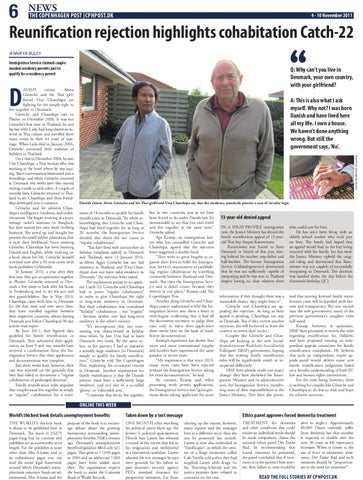
ANISH citizen Alwin Göttsche and his Thai girlfriend Urai Chanthipa are fighting for the simple right to live together in Denmark. Göttsche and Chanthipa met in Phuket in December 2008. It was not Göttsche’s first time in Thailand; he and his late wife, Laila, had long shared an interest in Thai culture and travelled there many times in their 44 years of marriage. When Laila died in January 2006, Göttsche continued their tradition of holidays in Thailand. On a visit in December 2008, he met Urai Chanthipa, a Thai woman who was working at the hotel where he was staying. Short conversations blossomed into a friendship, and when Göttsche returned to Denmark two weeks later they started writing emails to each other. A couple of months later, Göttsche returned to Thailand to see Chanthipa and their friendship developed into a romance. Göttsche said he admires Chanthipa’s intelligence, kindness, and industriousness. She began working as a poor, teenage tailor’s assistant in Bangkok, but later started her own retail clothing business. She saved up and bought her parents the small rubber plantation that is now their livelihood. Since meeting Göttsche, Chanthipa has been learning Danish and English, while working on a book about her life. Göttsche himself is retired now after a 30-year career with book publisher Gyldendal. In January 2010, a year after they first met, they got an apartment together in Phuket. Göttsche returned to Denmark a few times to look after his house in Fredensborg and to see his son and two grandchildren. But in May 2010, Chanthipa came with him to Denmark for the first time and ever since then, they have travelled together between their respective countries, always leaving Denmark just before Chanthipa’s 90-day tourist visas expire. By June 2011, they figured they qualified for family reunification in Denmark. They submitted their application on June 9 and two months later received a confirmation from the Immigration Service that their application and documentation was complete. Just three weeks later, however, their case was rejected on the grounds that they had failed to document a “regular cohabitation of prolonged duration”. Family reunification rules stipulate that couples must live together in steady or “regular” cohabitation for a mini-
Danish citizen Alwin Göttsche and his Thai girlfriend Urai Chanthipa say that the residency standards present a case of circular logic
mum of 18 months to qualify for family reunification in Denmark. Yet while acknowledging that Göttsche and Chanthipa had lived together for as long as 20 months, the Immigration Service decided that theirs did not count as “regular cohabitation”. “You have lived with one another on holidays [emphasis added] in Denmark and Thailand, since 12 January 2010, as Alwin Agger Göttsche has not had residency in Thailand, and [Urai Chanthipa] does not have valid residency in Denmark,” the rejection letter stated. The explanation points to an apparent Catch-22: Göttsche and Chanthipa had to prove “regular cohabitation” in order to give Chanthipa the right to long-term residency in Denmark. But their cohabitation was considered “holiday” cohabitation – not “regular” – because neither one had long-term residency in the other’s country. “It’s incongruous that our commuting was characterised as holiday time when, by law, Urai had to leave Denmark two times. By the same token, as her partner, I had to maintain a suitably large residence [in Denmark] simply to qualify for family reunification,” Göttsche told The Copenhagen Post, explaining his occasional returns to Denmark. Another requirement for family reunification is that the Danish partner must have a sufficiently large residence, and not one in a so-called ‘ghetto’ or ‘vulnerable area’. “I maintain that we do live together,
but in two countries, just as we have been forced to do under Danish law. It’s unreasonable to say that you can’t travel and live together at the same time,” Göttsche added. Åge Kramp, an immigration lawyer who has counselled Göttsche and Chanthipa, agreed that the rejection letter suggested a double-bind. “They went to great lengths to organise their lives to fulfil the Immigration Service’s requirement of establishing ‘regular cohabitation’ by travelling constantly between Thailand and Denmark. But then the Immigration Service said it didn’t count, because they weren’t in one place,” Kramp told The Copenhagen Post. Another thing Göttsche and Chanthipa cannot understand is why the Immigration Service sent them a letter in mid-August confirming that it had all the documents necessary to judge their case, only to reject their application three weeks later on the basis of insufficient documentation. Kramp’s experience has shown that more and more international couples and families have experienced the same paradox in recent years. “My impression is that since 2010, many more cases have been rejected without the Immigration Service asking for extra documentation,” he said. By contrast, Kramp said, when processing work permit applications, the Immigration Service was “quite generous about asking applicants for more
13-year-old denied appeal IN A HIGH-PROFILE immigration case, the Justice Ministry has denied the family reunification appeal of 13-yearold Thai boy Sirapat Kamminsen. Kamminsen was forced to leave Denmark in March of this year, leaving behind his mother, step-father and half-brother. The former Immigration Service (Udlændingeservice) determined that he was not sufficiently capable of integrating and he was sent to Thailand despite having no close relatives there
who could care for him. He has since been living with an elderly school teacher who took pity on him. The family had hoped that an appeal would lead to the boy being reunited with his family, but last week the Justice Ministry upheld the original ruling and determined that Kamminsen was not capable of successfully integrating to Denmark. The decision was handed down the day before his thirteenth birthday. (JC)
information if they thought there was a reasonable chance they might have it”. Göttsche and Chanthipa are appealing the rejection. As long as their appeal is pending, Chanthipa can stay in Denmark. But if they receive another rejection, she will be forced to leave the country on seven days’ notice. Couples like Göttsche and Chanthipa are looking to the new Socialdemokraterne-Radikale-Socialistisk Folkeparti (SRSF) government, hoping that the existing family reunification rules will be significantly eased, or interpreted differently. SRSF have already made one major change: they have abolished the Immigration Ministry and its administrative arm, the Immigration Service, transferring most of their responsibilities to the Justice Ministry. They have also prom-
ised that moving forward family reunification cases will be handled with fairness and transparency. But one month into the new government, many of the previous government’s toughest rules still stand. Kramp, however, is optimistic. SRSF have promised to review the rules regarding reunification for children, and have proposed creating an independent appeals committee for family reunification complaints. He believes that such an independent, expert appeals panel would deliver some new family reunification judgments based on a broader understanding of both EU law and human rights conventions. For the time being, however, there is nothing for couples like Göttsche and Chanthipa to do but to wait and hope for a better outcome.
ONLINE THIS WEEK World’s thickest book details unemployment benefits
Taken down by a text message
THE WORLD’S thickest book is about to be published here in Denmark. The book is 23,675 pages long, but its contents and publisher are as noteworthy as its length. For the publisher is none other than Min A-kasse, and in its voluminous pages you can read the entire legal framework around which Denmark’s unemployment insurance funds are administered. Min A-kasse said the
ONE MONTH after watching his political career blow up, the former S political spokesperson Henrik Sass Larsen has released a record of the events that led to his resignation and withdrawal as a ministerial candidate. Larsen released the text messages he says were grounds for his failure to pass domestic security agency PET’s standard clearance for prospective ministers. Far from
purpose of the book is to encourage debate about the growing bureaucracy surrounding unemployment benefits. Half a century ago Denmark’s unemployment benefits legislation filled only 421 pages. That grew to 17,000 pages in 2000 and an additional 7,000 pages have been added since then. The organisation expects the book to make the Guinness Book of World Records.
Ethics panel approves forced dementia treatment clearing up the matter, however, many experts said the messages hint at a different story than the one he presented last month. Larsen is now also embroiled in ‘Vanilla-gate’, in which the owners of a Køge restaurant called Cafe Vanilla told police they had supplied Larsen with drugs. So far, Thorning-Schmidt and the justice minister have refused to comment on the case.
TREATMENT for dementia and other conditions that could render an individual senile should be made compulsory, claims the national ethics panel Det Etiske Råd. In recommending that forced treatment be permitted, the panel concluded that if treatment is in the patient’s best interest, then failure to treat would be
akin to neglect. Approximately 80,000 Danes currently suffer from dementia but that number is expected to double over the next 30 years as life expectancy increases. When it comes to the use of force to administer treatment, Det Etiske Råd said such measures should be “proportionate to the need for treatment”.
READ THE FULL STORIES AT CPHPOST.DK