INDEPENDENT SINCE 1880
The Corne¬ Daily Sun WEDNESDAY, SEPTEMBER 30, 2026 n ITHACA, NEW YORK
Vol. 143, No. 7
16 Pages – Free
D.A. REOPENS CHI PHI CASE By CEREESE QUSBA Sun Senior Editor
Editor’s note: This article references sexual assault. Sept. 28 —The district attorney for Tompkins County told ABC News that his office is reopening the criminal investigation into the alleged gang rape at Cornell’s Chi Phi house in 2024 after a civil lawsuit was filed by the plaintiff, Jane Doe, on Sept. 14. The plaintiff is suing Cornell University, several Chi Phi fraternity organizations, seven current and former students, several sorority organizations, the former president of Cornell’s Chi Phi chapter, a local bar and several unnamed individuals. Tompkins County District Attorney Matthew Van Houten said that the allegations in the civil lawsuit are “dramatically different” than the plaintiff’s statement to police in 2024, according to ABC News. “We want to reexamine whether there’s additional evidence that we were not aware of in November of 2024, that exists now that would change our assessment of the case and would result in the grand jury finding that there was criminal conduct,” Van Houten said to ABC News. Van Houten added that his office has not decided whether to bring criminal charges related to the incident yet, according to ABC News.
ITHACA POLICE DEPARTMENT SAYS ALLEGED GANG RAPE WAS NEVER REPORTED TO THEM
In a statement to The Sun, Jeremy Saland, attorney for Scott Kretzschmar, said that no investigative body found Kretzchmar liable for sexual assault as alleged by the lawsuit. “Even the District Attorney’s Office, led by a chief prosecutor with the duty to pursue justice and uphold the rule of law without bias or favor, By KATE TURK filed no charges against Scott because what alleged Sun Assistant Managing Editor Sept. 28 — The Ithaca Police Department stated that the did not happen,” Saland wrote. “This isn’t a conspiracy. It is just a fact and evidence-based reality, alleged 2024 Chi Phi gang rape was never reported to their department in a Monday press release. even if an inconvenient one for the plaintiff.” The release comes after the Sept. 14 lawsuit stated that the Van Houten claims that the plaintiff’s statement incident was still under investigation by the IPD. to the Cornell University Police Department two years prior did not allege that she was drugged or that she did not consent to engage in sexual activities. “She never says that she was drugged without her knowledge. She admits to taking drugs and alcohol voluntarily and with knowledge. She does By VARSHA BHARGAVA, MARY CAITLIN CRONIN not allege that she was forced to engage in any acts. Sun Managing Editor and Sun News Editor She does not say that she was physically helpless or Sept. 28 — Cornell has denied that essay-writing was unconscious or incapacitated at any point during the “sole consequence” offered by the University to defenthe time at the fraternity house,” Van Houten said. dants in the alleged 2024 Chi Phi gang rape, according to a Thomas P. Giuffra, attorney for Jane Doe, Monday morning statement by Kyle Kimball, vice president responded to Van Houten’s comment on the plainfor university relations. tiff’s initial statement to authorities in an interview with ABC News, saying that in his experience, “speaking with an abuse survivor requires delicacy, To continue reading these stories, see CHI PHI pages 8 and 9 understanding and specialized training.”
MAYOR CALLS FOR BAN ON STUDENT EVENT PERMITS By VARSHA BHARGAVA Sun Managing Editor
CORNELL DENIES THAT ESSAYS WERE A ‘SOLE CONSEQUENCE’
NATHAN ELLISON / SUN PHOTOGRAPHY EDITOR
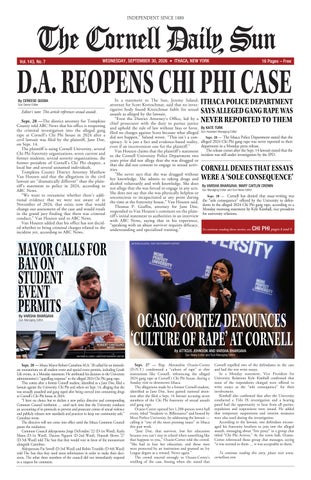
OCASIO-CORTEZ DENOUNCES ‘CULTURE OF RAPE’ AT CORNELL By ATTICUS JOHNSON AND VARSHA BHARGAVA
NATHAN ELLISON / SUN PHOTOGRAPHY EDITOR
Sept. 28 — Ithaca Mayor Robert Cantelmo M.A. ’20 called for an immediate moratorium on all student event and special event permits, including Greek Life events, in a Monday statement. He attributed his decision to the University administration’s “appalling response” to the alleged 2024 Chi Phi gang rape. This comes after a former Cornell student, identified as a Jane Doe, filed a lawsuit against the University, Chi Phi and others on Sept. 14, alleging that she was sexually assaulted and gang raped after being coerced into consuming drugs at Cornell’s Chi Phi house in 2024. “I have no choice but to declare a new policy directive and corresponding Common Council resolution … until such time that the University conducts an accounting of its protocols to prevent and prosecute crimes of sexual violence and publicly releases new standards and practices to keep our community safe,” Cantelmo wrote. The directive will not come into effect until the Ithaca Common Council passes the resolution. Common Council alderpersons Jorge DeFendini ’22 (D-1st Ward), Kayla Matos (D-1st Ward), Ducson Nguyen (D-2nd Ward), Hannah Shvets ’27 (D-5th Ward) told The Sun that they would vote in favor of the moratorium alongside Cantelmo. Alderpersons Pat Sewell (D-3rd Ward) and Robin Trumble (D-4th Ward) told The Sun that they need more information in order to make their decisions. The other three members of the council did not immediately respond to a request for comment.
Sun News Editor and Sun Managing Editor
Sept. 27 — Rep. Alexandria Ocasio-Cortez (D-N.Y.) condemned a “culture of rape” at elite institutions like Cornell, referencing the alleged 2024 gang rape at Cornell’s Chi Phi house, during a Sunday visit to downtown Ithaca. The allegations made by a former Cornell student, identified as Jane Doe, have gained national attention after she filed a Sept. 14 lawsuit accusing seven members of the Chi Phi fraternity of sexual assault and gang rape. Ocasio-Cortez opened her 1,200-person town hall event, titled “Students vs. Billionaires” and hosted by More Perfect University, by addressing the lawsuit — calling it “one of the most pressing issues” in Ithaca this past week. “Jane Doe, that survivor, lost her education because you can’t stay in school when something like that happens to you,” Ocasio-Cortez told the crowd. “She had to lose her education, and those men were protected by an institution and granted an Ivy League degree as a reward. Never again.” The crowd reacted strongly to Ocasio-Cortez’s retelling of the case, booing when she stated that
Cornell expelled two of the defendants in the case and had the rest write essays. In a Monday statement, Vice President for University Relations Kyle Kimball confirmed that none of the respondents charged were offered to write essays as the “sole consequence” for their involvement. Kimball also confirmed that after the University conducted a Title IX investigation and a hearing panel had the opportunity to hear from all parties, expulsions and suspensions were issued. He added that temporary suspensions and interim measures were also used during the investigation. According to the lawsuit, one defendant encouraged his fraternity brothers to join inw the alleged assault, messaging about “free pussy” in a group chat titled “Chi Phi Actives.” At the town hall, OcasioCortez referenced those group chat messages, saying “it was normal to them … it was acceptable to them.” To continue reading this story, please visit www. cornellsun.com.
2 The Cornell Daily Sun | Wednesday, September 30, 2026
ADS
The Cornell Daily Sun | Wednesday, September 30, 2026 3
PHOTO
SUNBURSTS: Applefest 2026 Sun photographers ate their way through Applefest, occasionally capturing pictures of your favorite vendors and performances.
By SUN PHOTOGRAPHY DEPARTMENT
Adelaide Chow / Sun Assistant Photography Editor MAGIC MIX | The Amish vendors flip fresh apple cider donuts as a line of students and locals wrap around the corner waiting for them.
Eleni Puzas / Sun Staff Photographer CRUMBLE AWAY | Purity Ice Cream scoops fresh ice cream onto a bed of apple crumble.
Eleni Puzas / Sun Staff Photographer APPLES EVERYWHERE | People wander the streets of Applefest, looking at all the apple-themed food and local vendors.
Zaid Patankar / Sun Staff Photographer MASTER ARTISAN | A vendor hand-makes leather belts at his tent in Applefest.
Jaein Ku / Sun Staff Photographer CHEER ON | The Cornell Cheer Team performs their routine in front of the Applefest goers.
Jaein Ku / Sun Staff Photographer TRINKETS, TRINKETS | People browse the trinket selection, spanning from rings to necklaces, at a table in Applefest.
Adelaide Chow / Sun Assistant Photography Editor BARK OF JOY | Ithacans bring their dogs to the Commons to enjoy the weather and sweet treats at Applefest.
Adelaide Chow / Sun Assistant Photography Editor SMASHING APPLES | The Yamatai Club at Cornell showcases “Poseidon,” one of their many drumming performances.
To see more photos, please visit cornellsun.com.
NEWS
4 The Cornell Daily Sun | Wednesday, September 30, 2026
Students Express Worry Over Ujamaa’s Identity and Future at BSU Discussion house in August. Titled “Ujamaa: A Discussion of History, Preservation, and Next Steps,” the discussion explored different perspectives on why fewer Black students are living in Ujamaa, with attendees pointing to University housing practices and the building’s aging facilities and accessibility issues. Ujamaa residents previously told The Sun that the house’s Black residential population had declined significantly. In May 2026, resident adviser Amadou Agne ’27 estimated that about 30% of Ujamaa residents were Black, down from approximately 60% during his first-year in 2023. “Being a minority student at Cornell … there aren’t very many places to connect
with other Black Cornellians,” Agne told The Sun. “If Ujamaa is not serving that purpose, that’s a major loss for Black students on the Cornell campus.” Sept. 25 — Around two dozen stuUjamaa’s roots go back to Black student dents gathered in Ujamaa Residential activism in 1969, as the historical portion College’s main lounge on Sunday to of the event noted. discuss changes in the program house’s In the presentation, Nichols empharesidential community and what it will sized the necessity of establishing Black take to preserve its historic role as a censpaces like Ujamaa “back then” due to the ter of Black student life. “very toxic environment” of “divisive racial The discussion, hosted by Jordanne dynamics” on campus. Nichols ’27 and Kennedy Young ’28, In the early morning hours of April 18, executive officers of Black Students 1969, a burning cross was discovered outUnited, comes after Ujamaa communiside of Wari Cooperative, a house for Black ty members stated that the University women on campus. removed historical and culturally-signifThe following morning, members of icant Black artwork from the program Cornell’s Afro-American Society occupied Willard Straight Hall for roughly 36 hours until peaceful negotiations were reached with Cornell officials. Among their demands were an Africana center, recognition of Black studies and a residential space for Black students –– demands that helped lay the groundwork for Ujamaa’s establishment in 1972. A Shifting Residential Community Black students make up 3.4% of firstyears in the Class of 2030, while another 1.6% identify as multiracial with Black and/or Indigenous heritage, according to newly released admissions data. Black student enrollment has remained substantially below pre-affirmative action levels following the Supreme Court’s 2023 decision restricting the consideration of race in college admissions. Black students made up 4.7% of firstyear admissions in the Class of 2029, 4.3% EMMA SPINDLER / SUN SENIOR WRITER for the Class of 2028 and 7.3% for the Students speak | Students met at Ujamaa to discuss changes in the program house’s residen- Class of 2027. These numbers show a significant decline from data released for Fall tial comunity on Sunday.
By EMMA SPINDLER Sun Senior Writer
2021, when Black students made up 9% of first-years. At Sunday’s discussion, some students blamed the University for changes at Ujamaa. “We’ve also had issues in the past of Black students applying to be in [Ujamaa] but being placed elsewhere,” Young said during the presentation. “[The University is] actively attacking the community by not allowing us to be in this space.” In a statement to The Sun, Housing and Residential Life stated its intention is “to always match as many students that preference program houses with their selection as possible,” except when Student Disability Services accommodations or conflicting roommate preferences cannot be met by a given Program House’s facilities. HRL also pointed to the Priority Program House Selection process introduced in the 2025-2026 academic year, which allows rising juniors and seniors to express interest in up to three program houses and receive priority selection timeslots for those communities. Removal of Historic Artwork Nichols said BSU was concerned about the recent removal of artwork and murals from Ujamaa by the University. She shared that a common space painted in green, a color of the Pan-African diaspora representing the abundant, natural wealth of the African continent, had been painted white by maintenance staff over the summer in addition to dozens of art pieces being removed. To continue reading this story, please visit www.cornellsun.com. Emma Spindler can be reached at espindler@ cornellsun.com.
Cornell Slides to No. 14 in U.S. News National Rankings By ATTICUS JOHNSON Sun News Editor
Sept. 23 — Cornell was ranked the 14th best university in the 2027 U.S. News Best National University Rankings published Tuesday morning, the second consecutive decline in Cornell’s ranking. Previously, Cornell was ranked No. 12 in 2026 and No. 11 in 2025. Cornell now shares the No. 14 spot with Carnegie Mellon University. That puts the University behind its only other Ivy League colleague in New York state, Columbia University, which jumped to the 12th spot from 15th in 2026. Cornell was the second-worst ranked Ivy League university overall, beating Brown University, which dropped to 16th. The 2027 version of U.S. News’ annual ranking included one change from its 2026 methodology: post-graduation earnings by major, which comprised 5% of the school’s final scores.
Columbia slightly edged Cornell in that metric — the median Columbia student receiving financial aid made $115,519, while the median Cornell student receiving aid made $113,372. U.S. News’ methodology involves 17 categories ranging from research output to graduation outcomes and resources available to students. Cornell ranked No. 28 in best value schools, another decline from its peak at No. 10 in 2014 and No. 23 spot in 2026. It dropped to No. 2 in best schools for veterans from its place at the top spot in last year’s rankings. The good news for Cornell’s rankings came in its undergraduate business program ranking, which climbed to No. 6 from No. 8 in the 2026 rankings to tie with Carnegie Mellon and Indiana University Bloomington. Cornell’s engineering program remained at No. 10. Atticus Johnson can be reached at ajohnson@cornellsun.com.
The Cornell Daily Sun | Wednesday, September 30, 2026 5
News
Black, Hispanic, Indigenous Enrollment at Cornell Falls to Lowest Level Post-Affirmative Action Ban By CHRISTINE SAVINO Sun Senior Writer
Sept. 27 — Black, Hispanic and Indigenous enrollment at Cornell has fallen to its lowest level since the Supreme Court struck down race-conscious college admissions in June 2023, according to newly released University data. The latest figure leaves BHI representation 11.3% below its pre-ruling level, a decline of nearly 45%.
BHI students, who are grouped together in the data report, represent 14% of the 3,681 first-year students expected to make up the Class of 2030, down from 17.9% in the Class of 2029. Hispanic students account for 8.9% and Black students 3.4% of this year’s expected class. Another 1.6% are multiracial students identifying as Black and/or Indigenous. Two students — 0.1% of total expected enrollment — are American Indian.
“With every incoming class, fluctuations in the overall composition are to be expected,” wrote Pamela Tan, director of undergraduate admissions, in a statement to The Sun. 67% of first-year students are Asian and/ or white, with Asian students comprising 30.6% and white students 31%. Multiracial Asian and white students constitute the remaining 5.4%.International students are grouped separately, regardless of race, and make up 10.2% of the expected Class of 2030. The figure represents a reversal of last year’s partial rebound in BHI enrollment. BHI enrollment fell from 25.3% in the Class of 2027 — the last class admitted before the Supreme Court’s 2023 affirmative-action ruling — to 15.6% in the Class of 2028, before recovering to 18% last year. Cornell acknowledged an “overall decline in the racial diversity” of its first class admitted after the ruling, when Black and Hispanic representation both fell substantially. The University said at the time that the shifts were “not unexpected” following the prohibition on considering race in admissions and that this decline in racial diversity was “similar to many of our peers.” Black and Indigenous enrollment separately declined by more than 50% each — indicating that both populations have more than halved since 2023. Black enroll-
ment experienced a 53.42% decrease, while Indigenous enrollment experienced a 66.67% decrease. The preliminary figures also indicate a smaller first-year class than last year. The University expected 3,681 first-years, compared with 3,827 enrolled in the Class of 2029. Following plans made in 2024, the Class of 2030 is also the first admitted under Cornell’s reinstated standardized testing requirement following its pandemic-era suspension of testing requirements. Cornell’s own 2024 review acknowledged that standardized test scores correlate with indicators of privilege, but found there was “not a clear indication” that suspending the requirement increased incoming-class diversity. The review also found that, among surveyed students scoring above 1400 on the SAT, Black students were less likely than white or Asian students to submit their scores, potentially withholding information that could strengthen their applications. The University noted that the fall figures represent an admissions snapshot taken in late summer and that final enrollment figures will be released at a future date. Christine Savino can be reached at csavino@cornellsun.com.
Hasan Piker Rallies Socialist Support at Sage Chapel, Garners National Attention By MARY CAITLIN CRONIN and GISELLE REDMOND Sun News Editor and Assistant News Editor
Sept. 25 — Following a week of backlash from student organizations, conservative news outlets and prominent political figures, including President Donald Trump ally Laura Loomer, leftist political commentator Hasan Piker spoke to a crowd of 450 students at Sage Chapel on Thursday. Hosted by the Students Not Bombs campaign, Piker discussed “the end of Zionism” and reflected on the rising popularity of the progressive movement ahead of the upcoming midterm elections. Piker streamed the event live on his Twitch channel for his 3.1 million followers, with
26K viewers watching minutes before Piker took the stage. His appearance was broken into a speech and then a Q&A period. Before appearing at Sage Chapel, Piker livestreamed and criticized Cornell’s administration for its response to the alleged gang rape at the Chi Phi house and for expelling students and professors for protesting, in reference to the suspensions of four student protestors and criticism of Prof. Russell Rickford. The leftist streamer’s campus visit drew disapproval from many parties, due to his history of controversial statements — including his “America deserved 9/11” comment, criticism of the Israeli and American governments and inflammatory rhetoric regarding Jewish people. Piker responded to his critics during
his speech — from Cornellians for Israel’s Instagram statement to Cornell Law Prof. William Jacobson on Fox News to Israel Prime Minister Benjamin Netanyahu at the United Nations General Assembly. The event was open to Cornell community members with tickets, had a strict no bag policy and enforced tight security measures. Cornell University Police Department officers stood at each entrance and exit of the chapel, and attendees were required to swipe their Cornell IDs and be scanned by metal detectors upon entry. The Speech Assistant Dean of Students Michelle Guinyard opened the event to remind students of the Expressive Activity Policy. She informed the audience that any violation of
STEPHAN MENASCHE / SUN SENIOR PHOTOGRAPHER
Piker presents | Left-wing political commentator Hasan Piker spoke at Sage Chapel on Thursday, discussing the growing progressive movement.
the policy would result in a warning, and then expulsion from the event. “Cornell values free and open inquiry and expression and strives to create a community where diverse opinions can be expressed and heard,“ Guinyard said. Following Guinyard, Adriana Vink ’27, co-president of Students for Justice in Palestine and Sun opinion columnist, explained the purpose of the Students Not Bombs campaign as a QR code with its petition was passed through the audience. Students Not Bombs is a coalition of student organizations comprising Jewish Voice for Peace, Students for Justice in Palestine and Cornell Young Democratic Socialists of America, urging Cornell to divest from Israel via a petition and on-campus demonstrations. Applause and cheers echoed through the chapel as Piker took the stage, surprising even the streamer himself. “That was a much warmer reception than I thought I was going to get today,” Piker said. “Especially considering the media frenzy around my appearance on Cornell’s campus.” Ahead of Piker’s visit, Fox News interviewed Cornell Law Prof. William Jacobson, who described Piker’s appearance as a “campaign of intimidation” and Piker himself as “incendiary.” In reference to Jacobson’s comments, Piker said “[Jacobson] said this would be akin to a Nazi rally, which is insane, and he said it on Fox News, which is the Nazi network.” Piker also acknowledged that Cornellians for Israel condemned his visit. Piker critiqued CFI’s argument that his “America deserved 9/11” comment encouraged violence, and contrasted it to the group inviting an Israel Defense soldier to campus last spring. “You can’t, on the one hand, say words are violence, and then bring a trigger man of Benjamin Netanyahu to a college campus,” Piker said. “What message does that send to the student body?” See
PIKER page 12
6 The Cornell Daily Sun | Wednesday, September 30, 2026
Opinion
The Corne¬ Daily Sun Dylan Jackaway Independent Since 1880 144th Editorial Board SOPHIA DASSER ’28 Editor in Chief
SOPHIA ROMANOV IMBER ’28 Associate Editor
VARSHA BHARGAVA ’27 Managing Editor
RAYEN ZHOU ’29 Opinion Editor
KATE TURK ’27 Assistant Managing Editor
ZARA CHEEK ’28 Opinion Editor JADE DUBUCHE ’27 Multimedia Editor KENDALL MURPHY ’28 Business Manager
CORAL PLATT ’29 News Editor ATTICUS JOHNSON ’28 News Editor MARY CAITLIN CRONIN ’28 News Editor EVERETT CHAMBALA ’27 Assistant News Editor
CHARLIE CLARK ’29 Director of Revenue & Partnerships VICTORIA WROBLEWSKI ’28 Human Resources Manager MELISSA MOON ’28 Arts & Culture Editor JAMES PALM ’27 Assistant Arts & Culture Editor MATTHEW RENTEZELAS ’28 Assistant Arts & Culture Editor HAZEL TJADEN ’28 Assistant Arts & Culture Editor MARC STAIANO ’27 Assistant Arts & Culture Editor KATELYN HALVERSON ’28 Lifestyle Editor AVA BETNAR ’29 Assistant Lifestyle Editor SANIKA SARAF ’28 Assistant Lifestyle Editor KATHERINE ISTOMIN ’29 Marketing Manager JACK MCAULIFFE ’29 Assistant Social Media Editor ASHLIN KWONG ’28 Graphics Editor TAVAN BHATIA ’27 Games Editor RENA GEULA ’28 Layout Editor
SHUBHA GAUTAM ’28 Assistant News Editor GISELLE REDMOND ’28 Assistant News Editor ANGELINA TANG ’28 Science & Technology Editor TANIA HAO ’28 Science & Technology Editor SIMRAN LABORE ’27 Weather & Climate Editor MATTHEW LEONARD ’28 Sports Editor GRACE REUBEN ’28 Sports Editor JANE HAVILAND ’28 Features Editor NATHAN ELLISON ’28 Photography Editor NATHAN BO ’28 Assistant Photography Editor ADELAIDE CHOW ’29 Assistant Photography Editor MIA SOFIA ORENGO ’28 Video Editor OAKLEY DECRISTOFARO ’29 Video Editor AMELIA GARCIA ’27 Data Editor HUNTER PETMECKY ’28 Layout Editor
WORKING ON TODAY'S SUN MANAGING NEWS DESKERS SPORTS DESKER
Varsha Bhargava '27 Kate Turk '27 Sophia Romanov Imber '28 Coral Platt '29 Mary Caitlin Cronin '28 Shubha Gautam ’28 Everett Chambala ’27 Atticus Johnson ’28
Matthew Leonard '28 Rayen Zhou '29 Zara Cheek '28 LIFESTYLE DESKERS Katelyn Halverson '28 Sanika Saraf '28 Ava Betnar '29 ARTS DESKERS Melissa Moon '28 Hazel Tjaden '28 PHOTO DESKERS Nathan Ellison '28 Nathan Bo '28 Adelaide Chow ‘29 OPINION DESKERS
Carl Neuss
SCIENCE DESKER Tania Hao ’28
Carl Neuss ’76 is a Cornell alumnus with a background in civil engineering and real estate development. He can be contacted at cneuss@woodbridgepacific.com.
New Presidents at Cornell and the Ivy League Will Not Solve the DEI Problem U
.S. academia is now reeling under the implications of Professor Jason Arday’s scandal at University of Cambridge. The Ivy League and their alumni must address their own longstanding ‘Jason Arday type’ discriminatory hiring policies. Any hiring or admissions discrimination is egregious enough — but putting unqualified persons in tenure positions puts all Ivy schools on the fast track toward the destruction of the reputations for excellence which these universities (and their alumni) have spent decades building. Further to this, with tenured professorships, our country’s best students will be both cheated and profoundly discouraged for decades as they watch ‘favored identifies’ advance over more deserving persons while merit-based advancement is deemphasized. It must be realized that such harmful DEI-driven actions are not limited to just one unearned position. Apart from hundreds of such university hires, countless students, faculty, staff and members of the public are all now watching and understanding the charade which elite university education, operating under the social justice agenda in America, has now become. Imagine the discouragement to millions of American students and citizens as the Ivies make clear that capabilities and competence pale in comparison to the dominance of social justice and identity politics in selecting faculty, staff and students. All the Ivy League schools have implemented Arday-type hiring practices — a lack of due diligence on the qualifications of DEI candidates, the disregard for transparent accountability by universities in disclosing their hiring policies, the often flagrant disregard for adhering to laws that prevent hiring based on race — as political and social activism have supplanted scholarly merit as the top priority in our country’s most prestigious universities. The presidents of Ivy League institutions are collectively examples of the wrong leadership pushing misguided DEI priorities at Ivy schools.
Dylan Jackaway '24, M.Eng. '25, is an alumus of Cornell University and a former staff writer for The Cornell Daily Sun's News department. He can be reached at dkj27@cornell.edu.
Cornell's Dereliction of Duty
Editor's Note: The content of this article discuss- assortment of atrocities (usually hazing), the es sexual assault and drugging. perpetrators see that the University considers these to be tolerable side effects in exchange n Spring 2024, during my senior year, I for well-connected alumni that can write knew people whom the University admin- fat checks. These fraternities don’t seem istration had arrested for sitting in Day to feel that anything is missing from their Hall calling for divestment from the Israeli circles when, as far as we know, there was siege against Gaza, while Martha Pollack was not a brother that night who said ‘wait a still president. After her departure, which second, guys, this isn’t right,’ despite Chi was widely speculated to have come as the Phi’s purported mission to “build better result of the Board of Trustees’ dissatisfaction men.” Matthew Ingalls, whom Doe’s lawsuit with her relative lenience towards that year’s describes as having been one of her friends pro-Palestine encampment compared to prior to the assault, not only committed her Columbia University counterpart at the unthinkable betrayal against her, but in time, Minouche Shafik, Michael Kotlikoff playing his role in this deplorable script, also was announced as her interim replacement. betrayed the thousands of other Cornellians By September of that year, Kotlikoff was who aspired to establish and develop meanpresiding over the University’s aggressive ingful connections with our peers as a prodresponse to the disruption of the School uct of our time on the Hill. Meanwhile, of Industrial and Labor Relations Career anyone who would’ve intervened on Doe’s Fair by pro-Palestinian student activists. behalf would probably also have been less Punishments for these students entailed likely to be interested in joining a fraternity not only arrests but also months-long dis- in the first place. In these spaces where everyciplinary proceedings and partial campus one has dirt on each other, putting skeletons access bans. Some of these Cornellians, too, I into one’s own closet serves to bolster one’s knew personally. loyalty to the group and vice versa, and can Little did I — or most members of our therefore even become the price of admiscommunity at the time — know, that while sion. the Kotlikoff administration was taking a Meanwhile, less than two weeks before hard line against banging drums within ear- his interim status was made permanent, shot of Boeing’s recruiters, a lawsuit by an Kotlikoff’s hawkishness towards the pro-Palanonymous Jane Doe alleges that they were estine movement continued at the Pathways simultaneously offering the alleged Chi Phi for Peace panel, where a Cornell University rapists amnesty in the form of writing essays Police Department officer was recorded disreflecting on their behavior. Additionally, cussing the amount of student arrests that an Doe’s lawyer, who handled cases involv- unspecified “Mike” had been hoping for. And ing Harvey Weinstein and Sean “Diddy” of course, who can forget his woe-is-me email Combs, has stated that only two of the seven to the student body earlier this year after his perpetrators were expelled, leading one to hit-and-run incident involving two students wonder if those two submitted unsatisfactory who had hoped to discuss his policies on free essays. speech, but before the actual video footage The harm that this state of affairs of the situation was circulated publicly? One has caused, and will continue to cause if can make the argument that those students not changed, cannot be overstated. The should’ve stood further out of the way, but University cannot expect the student body it was the view of myself and many others to treat the campus disciplinary process as that the president’s responsibility to not legitimate when the consequences for violent strike students with his car outweighed the sexual crimes make a slap on the wrist look students’ responsibility to facilitate his egress. harsh in comparison, while the survivors are And now it’s revealed that Kotlikoff’s double met with callous indifference. It’s hard to standard and endangerment of students both imagine that anyone would consider simply went further than we even knew. keeping the Chi Phi chapter barred from The news of the Chi Phi lawsuit comes at operating to be an appropriate substitute for a time when millions of high schoolers are actual repercussions for these individuals. pouring their blood and sweat into finding Cornell’s choice to not protect its students their way to their respective futures, with the ripples out across campus in a number of Nov. 1 Early Decision college application other ways, inducing heightened vigilance deadline rapidly approaching. What will in those concerned with keeping themselves they think when they look up Cornell and safe, while emboldening would-be predators. see this as the first result? Will they want to The result is a community with less trust, make their bid for four years on the campus more alienation and a robust cycle of trauma where “any person can find instruction in that can touch anyone of any gender. This is any study,” or will they and their families made especially consequential by the online see that prospect as too dangerous to risk? If visibility of the alt-right manosphere, fig- Kotlikoff won’t ask himself this question, I ureheaded by the likes of Andrew Tate and hope that the Board of Trustees will. And if Braden “Clavicular” Peters, who have both he’s unable or unwilling to make things right been charged with sexual assault and actively with celerity, then this year ought to be his seek to lure young men to their ideology. last in office, before alumni such as myself Furthermore, despite Greek Life mak- become ashamed of our degrees, and before ing headlines on an annual basis for an he gets his hat handed to him in court.
I
Unfortunately, ridding these schools of such leadership does not solve the problem because ‘personnel = policy.’ The Ivies have been prioritizing social justice for so long, their faculties and administrations are now captured by DEI ideology and social justice operatives. Therefore, as failed Ivy presidents are replaced, subsequent university leaders intend to push the very same DEI-ideology; for example, after Claudine Gay was removed from leadership at Harvard University, her replacement, Alan M. Garber openly defended the DEI practices that lost Gay her position. In other words, these newly promoted administrators hope that today’s anti-DEI storm will soon pass and a return to social justice policy priorities can continue in full force. Thus, current Ivy leadership will likely ‘play possum’ for a bit, then as soon as public scrutiny subsides, return to their discriminatory and anti-merit woke priorities. Like other schools, Cornell is a victim of the cadre of woke administrators waiting to fill the position of past President Martha Pollack. Current President Michael Kotlikoff is an example of the ‘personnel = policy’ obstacles which will prevent needed reform at Cornell. A well-documented Cornell legal case of blatant and unlawful DEI-driven faculty hiring discrimination, Wright v. Cornell University, is now being advanced by the Equal Employment Opportunity Commission. The Cornell Faculty Hiring Discrimination Case exposes the University’s illegal hiring practices and illuminates major obstacles to bringing necessary reform to Cornell and the other Ivies. It should be recognized by all that President Kotlikoff was the University Provost (the second-highest administrator under President Pollack) whose DEI staff designed and implemented the unlawful faculty hiring practices across many academic departments at Cornell. To continue reading this article, please visit www.cornellsun.com.
The Cornell Daily Sun | Wednesday, September 30, 2026 7
COLUMNS
Why Does Government Make Simple Things So Complicated? Lali Tobin
The Tobin Times Lali Tobin MPA '27 is an Opinion Columnist and a master's student at the Jeb E. Brooks School of Public Policy. Her monthly column, The Tobin Times, explores public policy and politics through different lenses. She hopes to engage readers in hearing how politics is the most discussed topic in the media and why it is important to stay on top of current issues. She also hopes to tackle current social trends that can be connected through public policy. She can be reached at ltobin@ cornellsun.com.
T
here is a particular kind of frustration that comes from knowing you are meant to do something and still being unable to figure out how to do it. You open one website, which sends you to another. You search for the right form, realize you need a document you did not know existed and eventually find yourself waiting on hold with an office that is overwhelmed with people asking the same questions. For college students, this experience is almost an everyday routine. We navigate financial aid applications, tax forms, housing systems, health insurance, student employment paperwork and countless administrative portals. Eventually, we learn to treat frustration as part of the process. But studying public policy has made me wonder why we accept that complexity so easily. Public administration scholars have a name for these experiences: administrative burden. Upon my research I stumbled upon two scholars, Pamela Her and Donald Moynihan. Pamela Herd is a sociologist and a professor of social policy at the University of Michigan's Ford School of Public Policy. Her research centers on topics like inequality, health, aging and policy. Her partner, Donald Moynihan, is also a public policy expert, and they often team up to explore the challenges of administrative burdens in government programs. In their research, Herd and Moynihan describe three types of costs people encounter when interacting with public programs: learning costs, or figuring out what a program requires; compliance costs, like completing paperwork and providing
Daniel R. Schwarz Guest Room
Daniel R. Schwarz is the Frederic J. Whiton Professor of English and is a Stephen H. Weiss Presidential Fellow at Cornell University where he was a faculty member for 58 years before becoming an emeritus on July 1, 2026. He can be reached at drs6@cornell.edu.
O
n July 1, 2026, I moved to emeritus status after teaching at Cornell for 58 years. The values I treasure, including the educational values which shaped my teaching, are under existential threat every day from the Trump administration. For Secretary of Education Linda McMahon, the role of colleges is to ”advance American security interests, deliver academic programs that meet urgent work force needs, and contribute materially to the nation’s prosperity.” Reflecting the current administration, McMahon’s objectives do not speak to the development of individuals but to the macrocosmic needs of the state. Authoritarian governments focus on the needs and desires of the state, while regarding universities as possible sites of annoying dissent. Such governments worry that clusters of students and professors are undermining their goals of complete control over every aspect of life. In contrast, for me each student matters not as part of a national purpose but as an individual whose curiosity, knowledge, skill set and confidence will sustain her or him after graduation. Our job as college professors and senior administrators is to create a space for possibility and opportunity to flourish so that each of our students can fulfill her or his potential in terms of learning and personal development. The
documentation; and psychological costs, including the stress and frustration produced by the process. Their research also finds that these burdens can prevent eligible people from accessing services to which they are entitled to such as social welfare programs; particularly people who have fewer resources available to navigate complicated systems. In other words, paperwork is not always just paperwork. Consider the FAFSA. Congress sought to simplify the notoriously complicated federal financial aid application, reducing a form that once contained more than 100 questions to as few as 18 for some applicants. The intention seems almost obvious: applying for financial aid should not itself require an education in federal bureaucracy. But when the redesigned FAFSA was introduced for the 2024-25 aid cycle, simplification on paper became complicated in practice. The Government Accountability Office found that the Department of Education identified more than 40 technical problems during the rollout. Some students could not start or complete their applications. Others encountered deleted information, erroneous messages and incorrect estimates of their federal aid eligibility. Most strikingly, 74% of calls to the department's call center went unanswered during the first five months of the rollout. Those numbers matter because behind every unanswered call was someone waiting with a question that could influence whether or not they can afford college. Cornell students do not have to look far to understand that experience. In 2021, The Sun reported that some admitted students committed to Cornell without having received their financial aid packages. One incoming student described repeatedly contacting the financial aid office while approaching commitment deadlines at other universities. Another said that incomplete items appeared in his financial aid portal without clear instructions for resolving them. The following year, The Sun reported that vacancies within Cornell's Office of Financial Aid and Student Employment had contributed to delayed reviews and aid packages. At one point in 2019, 16 of the office's 33 paid positions were vacant. Cornell subsequently began restructuring the office, filling vacancies and changing its business processes and technology. These examples are not an argument that administrators are indifferent. In fact, they demon-
strate something more important: even institutions trying to provide assistance can create burdens through understaffing, complicated rules, poor technology or unclear communication. And that distinction matters. We often judge social programs by what they promise. Is the financial aid system effective? Does housing assistance even support students? Does Medicaid help? Does a university provide emergency funding? But there is another question that deserves just as much attention: How difficult is it to actually receive these things? Imagine two students who qualify for the same assistance. One has parents who understand financial paperwork, enough savings to absorb a delayed payment and free time during business hours to call an office. The other student works between classes, is the first person in their family navigating the process and needs the money before rent is due. Formally, both students have access to financial aid. Practically, they do not have the same access. That is why administrative burden is ultimately an equity issue. Herd and Moynihan argue that people with fewer resources and greater needs can have more difficulty overcoming bureaucratic frictions, allowing administrative processes themselves to reinforce existing inequalities. The problem has not disappeared at Cornell. At a Black Students United town hall this March, students raised concerns about transparency and consistency in financial aid, housing and access to student support. Administrators, meanwhile, pointed to existing processes and resource constraints. The tension between a system existing and a person successfully navigating it is exactly where public administration matters. Of course, some bureaucracy is necessary. Financial aid cannot simply be distributed without determining eligibility. Public agencies need safeguards against fraud, universities need documentation and rules can create consistency. But complexity should have to justify itself. Perhaps one of the simplest tests of good public policy is not just whether we created a program with good intentions, but whether the person standing on the other side of the bureaucracy can actually use it. A benefit someone cannot access is not much of a benefit at all.
Possibility and Opportunity for Each Student
college experience includes students learning from others when participating in extracurricular activities — sports, theatre, musical groups, journalism — and when making lifetime friendships. While striving for merit-oriented admission, we also know that we have a plethora of able candidates and that diversity on campus enables all of us to learn from others whose life experiences are different from our own. Passionate about my subjects — modern literature and Holocaust studies — and dedicated to teaching, I felt honored and privileged to contribute to the education and development of undergraduates who, as they grow and evolve, become part of the coming generations of leadership in virtually every field. Our current students have two relatively new issues with which to deal in the coming years. They need to harness artificial intelligence, which is rapidly transforming the day-to-day world we live in in ways that most of us can only guess. At the same time, they will need to take part in restoring trust in our now very shaky democracy. Our educational mission is more difficult when the country is under daily threat from an authoritarian government which carries on a war on the Constitution, the courts and the press. Nor should we ignore the war on science including on climate change and proven health practices such as necessary vaccines for infants. We need to challenge our students to write lucidly, read powerfully, speak articulately, think
critically and rigorously, as well as organize evidence to make an argument. The role of colleges is to unlock each student’s intellectual potential but also to make students aware of the responsibilities of citizenship and community. These include belief in truth and fairness as cornerstones of human decency and respect for others. If we as professors can contribute to these goals, we are doing our students and the world a service. Each of our students should leave with the necessary skills to either enter the job market or to earn advanced degrees but also with an appreciation of the value of the humanities and the arts. We need to encourage our students to take courses and have conversations that will help them understand and appreciate different cultures and ways of living. Our seminars are opportunities to teach students how to muster evidence to support their positions and to listen carefully to what others are saying. Listening to multiple perspectives is part of preparing our students to participate in democracy. This means allowing campus groups to sponsor lecturers who have views that may be different from ours, including the Cornell visits of Hasan Piker on the left and Ben Shapiro on the right. But we do need to monitor the privilege of free expression when it crosses the borderline that separates civil discourse from racism and hate speech. To continue reading this article, please visit www.cornellsun.com
CHI PHI
8 Editor’s note: These articles reference sexual assault.
Cornell Denies That Defendants Only Wrote Essays, Confirms Expulsions ESSAYS
Continued from page 1 Kimball also confirmed that expulsions and suspensions were issued after the University originally investigated the incident. He did not clarify how many were expelled or suspended. A former Cornell student, identified as a Jane Doe, filed a lawsuit against the University, Chi Phi and others on Sept. 14. She alleged that she was sexually assaulted and gang raped after being coerced into consuming drugs at Cornell’s Chi Phi house in 2024. The lawsuit claims that several of the seven named defendants were issued temporary suspensions in November 2024 and “were afforded the opportunity to mitigate their conduct by submit-
ting essays” to the University. Doe’s attorney has claimed that two defendants were expelled, according to CBS News. The University opened a monthslong Title IX investigation, followed by a hearing panel, according to Kimball. The lawsuit noted that the investigation opened in January 2025. During the investigation, temporary suspensions and other “restrictive” measures were used, Kimball added. The Chi Phi chapter at Cornell closed in 2024 and currently remains closed, he wrote. In her lawsuit, the plaintiff brought claims against the University for negligence, negligent supervision, breach of contract, violations of state human rights and education laws and negligent infliction of emotional distress. Previously, in a Sept. 21 statement, Kimball declined to provide any further information on the details or consequences of the University’s inves-
BENJAMIN LEYNSE/SUN SENIOR PHOTOGRAPHER
tigation. “Federal privacy law prohibits Cornell from disclosing specific information regarding individual students and we therefore are unable to make a public statement on any other disciplinary response,” the statement reads. The University has faced widespread scrutiny for allegedly administering essays as punishment in the case. Kimball’s most recent statement comes after Rep. Alexandria Ocasio-Cortez spoke about the lawsuit and condemned a “culture of rape” at Cornell during a Ithaca town hall on Sunday. “We have an institution that issues a suspension on track for deportation … but we make rapists write an essay in private,” Ocasio-Cortez said during the event, in reference to Cornell. In his Monday statement, Kimball also conveyed the University’s support for the Tompkins County District Attorney’s recent decision to reopen the criminal investigation into the case. Tompkins County District Attorney Matthew Van Houten said the investigation has been reopened due to the allegations in the civil lawsuit being “dramatically different” than the plaintiff’s statement to police in 2024, according to ABC News. “We want to reexamine whether there’s additional evidence that we were not aware of in November of 2024, that exists now that would change our assessment of the case and would result in the grand jury finding that there was criminal conduct,” Van Houten said to ABC News. Kimball additionally responded to accusations of the University’s inaction in his Monday statement. “Any suggestion that the university did not impose consequential punishments for those involved is false,” he wrote. Varsha Bhargava and Mary Caitlin Cronin can be reached at vbhargava@cornellsun.com and mcronin@ cornellsun.com.
VARSHA BHARGAVA/SUN MANAGING EDITOR
LETTER FROM THE EDITOR
Cornell Won’t Listen, We Will By SOPHIA DASSER Sun Editor in Chief 321-203-6550
A week after insisting that federal privacy law precluded the University from discussing its disciplinary response, Kyle Kimball, vice president for university relations, assured the public that the punishments in this case were consequential, cautioning that the narrative of minimal consequences “will make survivors feel less safe and supported” and will entrench the underreporting of sexual assault. That the University found its voice only after a lawsuit, a reopened criminal investigation and a week of national headlines is itself instructive, for the account it now offers so readily was owed to this community in 2024, not after 23 months of silence in which the Jane Doe went from confiding in the University to suing it. If that statement’s allusion to “false narrative” is targeted at coverage like ours, The Sun rejects it, because we know reporting on a case does not make survivors less safe; silence does. At The Sun, we know that Jane Doe is not alone, responses have poured into every voicemail box, channel and inbox we have, our sexual misconduct tip line included, and we applaud Jane Doe for the courage it took to file publicly. The question now turns to you: What does the community we all belong to make of it? When Jane Doe chose to speak publicly, she chose to speak with The Sun, and we have worked tirelessly to honor that choice by reporting the story and all following updates fully and without flinching, which is now the very same trust we are asking you to place in us. Through this form, we are gathering reactions from students, from faculty, from staff, from alumni, from parents, from members of the Ithaca community and from Cornell at large. To continue reading this letter, please visit www.cornellsun.com.
BIT.LY/CORNELLREACTS
Chi Phi Case is Reopened D.A.
Continued from page 1 A typical University police officer would not have the specialized training needed, according to Giuffra, and that expertise would generally come from a trained detective or district attorney. “However, Ms. Doe was never contacted by anybody with those skills,” Giuffra told ABC News. Van Houten noted in the interview with ABC News that his office relied on CUPD’s investigation and acknowledged that his office did not independently investigate the issue. Van Houten also said his office was never provided with an image of a Snapchat group titled “Chi Phi Actives,” which is included in the lawsuit and allegedly shows an invitation for other Xi chapter members to come upstairs and join the assault. Criticizing the legal system, Saland wrote to The Sun that anyone can make a complaint, but it does not mean they should. He added that “we look forward to confronting the plaintiff for her selfishly false claims.” He maintains that “Scott [Kretzchmar] never sexually assaulted or even touched the plaintiff in any way.” Giuffra said that his client reported the incident to CUPD because a crime was committed, according to ABC News. “It was the obligation of the police to investigate the complaints,” he said to ABC News. “They were given the group chat inviting the members of the fraternity to rape my client. This was a critical piece of evidence supporting that a crime had occurred. Despite this there was no follow-up with Ms. Doe either by the Cornell Police or the Tompkins County District Attorney.” Cereese Qusba can be reached at cqusba@cornellsun.com.
LAWSUIT COVERAGE
9
Ithaca Mayor Calls for Moratorium on All Student Event Permits, Greek Life Included MAYOR
Continued from page 1 Cornell has faced scrutiny for allegedly administering essays as punishment in the case. Rep. Alexandria Ocasio-Cortez (D-N.Y.) spoke about the lawsuit and criticized the University for temporarily suspending protestors while “mak[ing] rapists write an essay in private,” during an Ithaca town hall on Sunday.
In a Monday statement, the University denied that essay-writing was the “sole consequence” offered to any of the defendants and confirmed that Cornell issued expulsions and suspensions following a Title IX investigation and hearing panel. Doe’s attorney has claimed that two of the seven defendants were expelled, according to CBS News. The University did not clarify how many students were expelled or suspended. Cantelmo wrote that Cornell “failed
to hold the perpetrators to account.” He added that the University did not contact the Ithaca Police Department despite “the severity of the crimes.” IPD confirmed that it was not contacted in a Monday statement, while the lawsuit claimed that “upon information and belief,” the incident was still under IPD investigation. The mayor’s statement comes after Tompkins County District Attorney Matthew Van Houten announced on Monday that his office would be re-opening a criminal investigation
into the incident. “[The University’s response] is a miscarriage of justice and continues to pose a significant threat to students and residents who may be victimized at unsafe and under-monitored on- or off-campus student events,” Cantelmo wrote. Shubha Gautam ’28 and Atticus Johnson ’28 contributed reporting. Varsha Bhargava can be reached at vbhargava@cornellsun.com.
IPD States Alleged Sexual Assault, Gang Rape Was Never Reported to Them IPD
Continued from page 1 In the lawsuit, a former Cornell student alleged that she was sexually assaulted and gang raped by seven current and former students after being coerced into consuming drugs at Cornell’s Chi Phi house in 2024. “The Ithaca Police Department was disturbed to hear about the allegations related to the sexual assault of a Cornell Student during October of 2024,” the release reads. “This incident was not reported to the Ithaca Police Department. The Ithaca Police Department learned of these allegations recently
through the media.” The statement comes after Tompkins County District Attorney Matthew Van Houten announced that his office would be re-opening a criminal investigation into the incident on Monday. Van Houten stated that his office has not decided whether to bring criminal charges related to the incident yet, according to ABC News. The University also conducted a non-criminal Title IX investigation into the incident after it was initially reported. Kyle Kimball, vice president for university relations, confirmed that expulsions and suspensions were issued after a monthslong investigation in a Monday
statement. He did not clarify how many students were expelled or suspended. Doe’s attorney has claimed that two defendants were expelled, according to CBS News. IPD’s statement acknowledged the severity of the incident and encouraged community members to make reports to the department. “We understand these allegations are being taken very seriously by Cornell University and the Tompkins County District Attorney’s Office,” the release reads. “We encourage members of our community to report allegations to the Ithaca Police Department.” Kate Turk can be reached at kturk@cornellsun. com.
Gov. Hochul Requests ‘Independent Review’ of University’s Response to Allegations By VARSHA BHARGAVA Sun Managing Editor
Sept. 29 — Gov. Kathy Hochul (D-N.Y.) called for a “transparent, independent review” of the University’s response to the allegations of sexual assault and rape at Cornell’s Chi Phi house in 2024, in a Tuesday statement. This comes after a former Cornell student, identified as a Jane Doe, filed a lawsuit against the University, Chi Phi and others on Sept. 14, alleging that she was sexually assaulted and gang raped after being coerced into consuming drugs at Cornell’s Chi Phi house in 2024. The lawsuit claims that the University failed to “exercise reasonable care” to prevent the defendants from allegedly assaulting Doe while she was a fulltime student at Cornell. “No student should ever be left wondering whether the institutions meant to protect them will listen and act,” Hochul wrote. “There are also serious questions about Cornell’s campus culture and its systems for prevention, reporting, and response.” In addition to voicing her support for the Tompkins County District Attorney reopening the investigation into the allegations, Hochul called for “outside counsel” to “determine whether Cornell met every obligation to protect its students and pursue justice.” In a Monday statement, Kyle Kimball, vice president for university relations, cast light on the University’s investiga-
tion after previously declining to provide further information. He stated that the University issued expulsions and suspensions following a Title IX investigation and hearing panel, in addition to enforcing temporary suspensions and “restrictive” measures during the proceedings. Doe’s attorney has claimed that two of the seven defendants were expelled, according to CBS News. Kimball did not clarify how many students were expelled or suspended. The Chi Phi chapter at Cornell closed in 2024 and currently remains closed, Kimball added. The lawsuit claims that several of the defendants “were afforded the opportunity to mitigate their conduct by submitting essays” to the University. In his Monday statement, Kimball wrote that essay-writing was not offered as a “sole consequence” to any of the defendants. In a Monday move to establish an immediate moratorium on student event permits, including Greek Life event permits, because of the Chi Phi lawsuit, Ithaca Mayor Robert Cantelmo M.A. ’20 criticized Cornell. “The University failed to hold the perpetrators to account,” Cantelmo wrote. He added that the University did not contact the Ithaca Police Department despite “the severity of the crimes.” IPD confirmed that it was not contacted in a Monday statement, while the lawsuit claimed that “upon information and belief,” the incident was still under IPD
investigation. “Cornell shares Governor Hochul’s commitment to addressing campus culture issues, which affect universities across the nation and New York,” a University spokesperson wrote in a statement sent to The Sun after publication. “We are committed to continuing to work with state officials to advance student safety and wellbeing.”
Hochul opened her statement by addressing the alleged actions outlined in the case, calling them “nothing short of horrifying.” “For any student to come forward after an experience like this takes extraordinary courage,” she wrote. Varsha Bhargava can be reached at vbhargava@cornellsun.com.
COURTESY OF MARC A. HERMANN/WIKIMEDIA COMMONS
10 The Cornell Daily Sun | Wednesday, September 30, 2026
Science
SCIENCE & TECHNOLOGY
From Community to Career: Society of Hispanic Professional Engineers Supports Students in STEM By GABBY COLEMAN Sun Staff Writer
In the Cornell Chapter of The Society of Hispanic Professional Engineers, students might come for the tamales. They might stay for the people. And they might leave with a resume polished for their next job interview. Through community building, professional development and academic support, SHPE is working to create a space that Hispanic and underrepresented students in engineering can call home.
“We want to make it so that Hispanics trying to go into engineering don’t veer off just because they don’t see representation.” Ruby Penafiel-Gutierrez ’27 “We plan to serve all of the Cornell community, not just Hispanics,” said Emilio Ceballos ’26, the SHPE advice chair. “[We want to] make a safe space for the congregation to meet new people [and] to spread the culture while giving our members the opportunity to grow professionally and academically.” Creating a Place to Belong For Hispanic students in engineering, finding belonging can be difficult.
“When I first got here, I noticed that in a lot of my engineering classes, pretty much no one was Hispanic. I felt very lonely and lacked community because I didn’t know it existed,” said Ruby Penafiel-Gutierrez ’27, internal vice president of SHPE. “We want to make it so that Hispanics trying to go into engineering don’t veer off just because they don’t see representation.” For members of SHPE, fostering representation and belonging starts with general body meetings. The events are intentionally low-key, Penafiel-Gutierrez noted, giving members space to talk, socialize and get to know each other. While these meetings tend to serve as the first point of contact for newcomers, the SHPE community building process goes deeper. According to Valerie Ruiz ’28, a current events chair, programming selection is intentional. “One thing we consider is past events, ones we had good feedback on and participation in,” Ruiz said. “We shape, especially the fall semester, around the [SHPE] national convention,” she said. But SHPE’s largest event in Fall 2025 wasn’t professional in nature, Ruiz said — it was Friendsgiving. Members connected in informal ways, and Ruiz hopes that they will “be excited and willing to come back for more events,” Ruiz said. Rooted in past success, Friendsgiving is expected to return in 2026
COURTESY OF CORNELL SOCIETY OF HISPANIC PROFESSIONAL ENGINEERS
Family focus | The Cornell chapter of the Society of Hispanic Professional Engineers hopes to create a space that underrepresented students in engineering can call home.
Even outside of large events like Friendsgiving, SHPE uses food to educate members on Hispanic culture. “We held an event where we served tamales, and it was a history lesson on tamales,” Ceballos said. “We’ve made arroz con leche as part of our event, [and] we have been part of the café con leche series at the Latino Living Center.” SHPE’s goal is “to provide professional opportunities as well as good food. A lot of our events have good food,” PenafielGutierrez said. SHPE is expanding community building efforts with the launch of an intramural soc-
cer team this semester. “With the World Cup being held, one of the key observations I saw was that it brought a lot of people together, watching the game,” said Daniel Guevara ’27, a current events chair. “I wanted to make an environment that was non-academic, non-professional, yet [members] could still get to know others from the organization.”
To continue reading this story, please visit www.cornellsun.com. Gabby Coleman can be reached at gcoleman@cornellsun.com.
Improving Disability Wellness at The Center for Discovery By DANBI LEE
surrounding community. At the center, individuals receive access to nutrition The CHE + The Center For Discovery services, nature activities, medical care Summer Internship offers Cornell and education. Prof. Nancy Wells M.S. ’94, human human ecology students an immersive centered design, the senior associate dean experience in disability care and research. for research and graduate education, Students shadow health professionals launched the collaboration between the and conduct research trials with disabled individuals during an eight-week stay at College of Human Ecology and TCFD The Center for Discovery, a nonprofit after the center proposed research collabproviding care for people with disabili- oration in 2021. “They were interested in nature-based ties such as autism. The Sun spoke to three interns who curriculum, environmental design, therresearched eating behavior, nutrition and apeutic interventions,” Wells said, “and they had a real theme of sustainability in apparel design this summer. Based in Harris, New York, TCFD the mix.” The internship partners undergraduserves more than 1,700 adults and children who live in the center and the ates from Cornell’s College of Human Ecology with a Cornell faculty mentor and a mentor from TCFD. Each intern executes an individual project with a research theme crafted in collaboration with Cornell faculty and TCFD. In past summers, Wells served as a mentor for interns researching how exposure to nature before classroom learning can impact engagement in students with autism. This summer, three interns were chosen to help research autistic eating behavior and clothing design for individuals with Cerebral palsy at the center, Wells said. Alan Van ’28 and Prof. Heeju Park, human centered design, explored adaptive apparel design for individuals with Cerebral palsy, a condition which causes difficulty in speech and movement, requiring many with the condition to use wheelchairs. Van shadowed direct care staff and COURTESY OF ALI SHIEKH occupational therapists to observe Disability and diet | Ali Shekh ’28 studied the rela- their interactions with individuals with tionship that people with autism have with food. Cerebral palsy, particularly routines such Sun Staff Writer
as helping individuals get dressed and transferring them to and from different locations. After noting these individuals’ muscle tone, range of motion, positioning and wheelchair equipment, Van designed the Hybrid Poncho-Jacket, a piece of winter clothing designed to make getting dressed easier. According to Van, the poncho-jacket has wide side openings which can be easily secured around the arms with underarm zippers and uses zippered or magnetic openings so that it can be taken on and off without interfering with wheelchair equipment. The poncho-jacket also has a contemporary design to avoid looking clinical. Van added that the piece was faster to take on and off than a regular jacket, which would reduce the amount of time staff would have to spend dressing residents with Cerebral palsy. Each prototype of the poncho-jacket that Van made was assessed by the direct care staff and occupational therapists, and he used their feedback to improve his design. To fit the design, Van worked closely with a non-verbal adult with Cerebral palsy and his caregiver. Van said that one of his favorite moments of the internship program was when he gave the finalized poncho-jacket to the individual with Cerebral palsy. “He got really excited, wheeled himself toward me and gave me a high five with his foot. After months of design work, I really got to see how my work had a tangible impact on someone’s life,” Van said. Joelle Lee ’29 worked with Prof. Angela Odoms-Young, M.S. ’94 Ph.D. ’99, nutritional sciences, on researching what parents need to create a healthy eating environment in their homes for their
children with autism spectrum disorder. “My project look[ed] at the gaps and difficulties around feeding, nutrition and healthy eating for children and families with ASD, but from a different angle: focusing on the family’s struggles rather than just the child’s,” Lee said. “I think that perspective hasn’t been fully explored in existing research, and it’s important for other researchers and clinicians to understand the social side of ASD, not just the clinical side.”
“It’s important for other researchers and clinicians to understand the social side of autism spectrum disorder, not just the clinical side.” Joelle Lee ’29 In addition, Ali Shiekh ’28 and mentor Prof. Paige Cunningham, nutritional sciences, studied if people with ASD respond in the same way to satiety, or fullness, signaling and how this impacts food intake and weight gain. Jennifer Franck, a chief of the department of nourishment arts at TCFD, mentored Lee and Shiekh this summer. As a registered dietitian, Franck wants to use nutrition science to improve the health of individuals at the center, using food for general wellness and therapeutically. To continue reading this story, please visit www.cornellsun.com. Danbi Lee can be reached at dalee@ cornellsun.com.
Comics
The Cornell Daily Sun | Wednesday, September 30, 2026 11
CLASSIFIEDS CLASSIFIED AD RATES
Ads are accepted at The Sun’s office at 139 W. State Street downtown, by phone or e-mail. Deadline: Noon at The Sun’s office two days preceding publication.
Standard Rate: $3.95 per day for first 15 words, 39 cents per day per word thereafter. Five or more consecutive insertions, $3.70 per day for first 15 words, 37 cents per day per word thereafter. Commercial Rate: $5.95 per day for first 15 words, 40 cents per day per word thereafter. Five or more consecutive insertions, $5.75 per day for first 15 words, 38 cents per day per word thereafter. The Sun is responsible for only one day makegood on ads.
607-273-3606 classifieds@cornellsun.com
Last week’s solution:
Twitch Breach By Jesus Garcia ’29
Exam Rush By Elliot Kim ’28
12 The Cornell Daily Sun | Wednesday, September 30, 2026
NEWS
Cornell’s Committee on the Future of the American University Releases Final Report By VARSHA BHARGAVA and HARLAN FLAMM
Sun Managing Editor and Sun Contributor
Sept. 29 — The Committee on the Future of the American University completed its yearlong charge to envision “the long-term future of Cornell as an American university” via a 238page final report and a shorter vision statement released on Tuesday. Both documents consider how the University should address issues including: artificial intelligence in higher education, Cornell’s relationship with the federal government, eroding public trust and how to move forward as the “first American university.” The 18-member committee, comprising faculty members from eight undergraduate colleges and five graduate colleges, described the “American university” as an institution which has evolved to “serve the practical needs of an industrializing nation” by increasing accessibility to higher education and prioritizing research advancement through agriculture, engineering and science-focused curricula. The FAU committee was convened in October 2025 by Provost Kavita Bala to address current issues affecting Cornell and make recommendations for the future of the University. Over the past year, the committee engaged with over 6,000 community members through town halls, webinars and one-on-one meetings. The committee wrote both reports while using AI to synthesize feedback from stakeholders, according to the final report. Committee member Prof. Drew Margolin, communication, believes the committee answered the charge it was given, he wrote in a statement to The Sun. “I see the findings providing a kind of spiritual ideal — this is who we want to be,” Margolin wrote to The Sun. “This report is declaring an ‘ideal self’ for the university, something to aspire to and to keep in [mind] when making the very hard choices that are always on the horizon.” Institutional Commitments In the vision statement, the committee suggests five institutional commitments that work toward a “renewal” of the University’s purpose.
The commitments include “Rigorous Deliberation and Engaged Discourse,” “Robust Impact,” “Innovation and Resiliency in Research,” “Strongly Connected Community” and “Purposeful Integration and Coordination.” The committee made recommendations for each commitment, including creating a task force to address rising tuition costs and assess financial aid, prioritizing research quality over quantity, renovating doctoral and postdoctoral programs, evaluating which University spaces should be technology-free and which should incorporate institution-hosted technologies and establishing a Future of the American University Forum for further conversation. “The pressures facing higher education must not be underestimated,” the vision statement reads. “While the work ahead will not be easy, it is critical that the urgency of this moment and the importance of higher education guide the actions taken to ensure that the future of the American university is bright.”
“I see the findings providing a kind of spiritual ideal — this is who we want to be.” Prof. Drew Margolin Artificial Intelligence As AI expands into educational spaces, the committee asked, “What is a university actually for?” The committee acknowledged that the rapid development of AI poses threats to students’ learning and judgment in its final report, though it added that AI advancements offer opportunities for research and creative work. After hearing concerns about AI replacing the value of an education, the committee asserted that “learning is at the heart of the university.” The committee argued that the University can still offer a “transformative education” despite the pressures of AI by treating the technology with “intellectual curiosity” and centering sound judgment. The committee also recommended a new
PIKER
Continued from page 5 Piker said he came to Cornell to discuss what he described as “a new political reality” that is “shaping all around us,” which he said will give rise to “radical political opportunities.” He pointed to recent successes of several Democratic Socialists of America candidates who secured their Democratic primaries – Melat Kiros, Darializa Avila Chevalier and Claire Valdez – and New York City mayor Zohran Mamdani. Piker said their constituency is in “the moral majority.” “There are more good, decent people with moral conviction who find it unfathomable that the wealthiest nation on earth chooses to spend its billions on blowing up schools overseas rather than building schools in our neighborhoods,” Piker said. Piker also claimed he has noticed a shift in voters’ attitudes towards the traditional two-party system. “They [are] saying no more to Trumpism. They [are] also saying no more to do-nothing-Democrats,” Piker said. “That’s when I realized it’s time to seize control over the system a little bit more, and get people elected in positions of power.” Several prominent DSA politicians have been endorsed by and featured on Piker’s streams, including Democratic nominee for Senate in Michigan Abdul El-Sayed, New York mayor Zohran Mamdani and Rep. Alexandria OcasioCortez (D-N.Y.). Netanyahu condemned Piker in his address to the U.N. General Assembly on Thursday. While criticizing Mamdani, Netanyahu added that, “[Mamdani] counts as friends people like Hasan Piker, who said America deserved 9/11. Some friends you have.” Piker rebutted this criticism in his speech, pointing to a Sept. 12, 2001 New York Times interview where Netanyahu referred to 9/11 as “very good” for U.S.-Israel relations. Piker claimed the “pushback” to his speech at Cornell
center dedicated to AI training, workshops and discussions and for the University to deepen its connections with policymakers statewide. It added that students should be equipped for an AI-infused workplace, but stated that AI cannot replace human relationships or engagement in learning. Prof. David Rand, information science, served on the AI subcommittee. In a statement to The Sun, he wrote that the recommendations will guide students to developing critical skills in the AI age. “The core of the FAU recommendations — focusing on helping students develop sound judgment — aligns very well with empirical evidence around success in the era of AI,” Rand wrote to The Sun. “It is clear that AI can augment learning, but it cannot replace what needs to be learned,” Margolin wrote to The Sun. Relationship with the Federal Government The committee also set out to examine the “fissures” in the University’s relationship with the federal government, it wrote in the final report. Currently, this relationship is “under severe strain,” it stated. “The independence that has always been the precondition for the university’s public value … is being challenged in ways that have not been seen in generations,” the report reads. “A university that can only ask the questions its funders approve is no longer a university in any meaningful sense. It is simply another contractor.” Regarding research funding, the committee emphasized in its final report that the University should appreciate and devote “significant attention” to its “historically-unmatched” relationship with the government. It suggests creating a new University foundation for funding, building on partnerships with focused research organizations and arranging a consortium between research universities. Public Trust The committee also examined the erosion of public trust in higher education, identifying cultural and economic factors as the two “griev-
and other college campuses is out of fear. “[They] are most afraid of popular action. They’re afraid of democracy. They’re afraid of all of us. They’re afraid of the people,” Piker said. The Q&A The event then switched to a Q&A, moderated by Vink, who began by asking: “Why do you think that you, as an individual, have been receiving so many attacks from the political mainstream on both sides?” Piker answered by critiquing traditional media for avoiding criticism of Israel but “demand[ing] the silencing, cancelation and deplatforming of all who oppose [Israel’s] violence.”
“[They] are most afraid of popular action. They’re afraid of democracy. They’re afraid of all of us. They’re afraid of the people.” Hasan Piker “Israel enjoyed tremendous support from both parties and from mainstream media for almost 80 years of its entire existence, and that’s now changing,” Piker said. “It’s changing as a direct consequence of Israel’s actions in Gaza, heinous war crimes that many of you have seen and can never unsee.” He argued that this change would soon lead to “the end of Zionism,” referencing a claim originally made by Israeli historian Ilan Pappé. “I don’t think [Pappé is] being too hopeful when he says that, I think that is a reality,” Piker said, adding that Israel supporters keep using “the old ways of defending Israel,” which are limited to “calling its opponents antisemitic.” Vink also raised that Cornell Career Services has hosted job opportunities with U.S. Immigration and Customs Enforcement, to which Piker responded: “If you got a Cornell education and then you f*cking work at ICE, holy sh*t, you’re a loser … you gotta be extra racist at that point.” The streamer was also asked by Vink to elaborate on his experience in Cuba, where Piker traveled in March 2026 on
ances” behind this erosion in the final report. The committee noted growing scrutiny over the value of a university degree as tuition prices rise and many raise concerns about “intellectual conformity” on campuses. “A university that cannot model genuine pluralism of thought, that cannot hold and argue across deep disagreements without dissolving into either enforced consensus or performative conflict, is not promoting learning,” the report reads. To address lessened public trust, the committee recommended reassessing the criteria for tenure and promotions in the public engagement field, creating new “public impact” professor positions in every college, establishing a “funding boost” program for research involving public engagement and scheduling a monthly “Cornell Day” where the public can tour each college. Cornell’s Purpose The committee concluded that in order for Cornell to renew its purpose as “a human-centered, integrated learning ecosystem that cultivates sound judgment,” it must be committed to rigorous deliberation and open discourse, deeper two-way ties with the public, innovative and resilient research, a more connected campus community through “academic civics” and better coordination across the University. In a Tuesday message to the Cornell community, Bala wrote that she “accepts and endorses” the committee’s report and vision statement. She added that “concrete next steps” to implement the report’s recommendations will be shared with the Cornell community in the coming weeks. “Throughout the committee’s work, one fundamental question rose to the top: ‘Is a university education still worth it?’” Bala wrote. “The committee’s answer is a resounding yes — if we clarify and renew the university’s purpose.”
Varsha Bhargava and Harlan Flamm can be reached at vbhargava@cornellsun.com and hpf7@cornell.edu.
a humanitarian aid trip. “I saw such devastating poverty, and it was man-made,” Piker described. He argued that while Republicans or the American government may claim that poverty was a “byproduct of communism,” it was actually the result of the actions of the American government. The humanitarian mission, named the Nuestra América Convoy, was subject to public scrutiny as a result of some members, including Piker, staying at a hotel that was able to maintain power via a generator while the rest of the island suffered from the blackout. The blackouts in Cuba have been further exacerbated by a U.S. energy blockade of the island, according to NPR. In his closing remarks, Piker encouraged the audience to get politically active, stating, “if it didn’t work, then they wouldn’t try to stop you from doing it.” “Maintain solidarity and maintain revolutionary optimism always, and we will win,” Piker concluded. Vink then led the crowd in a chant: “From the river to the sea, Palestine will be free,” in which Piker and the audience joined in as the event came to a close. Student’s Reactions Second-year MPA student Nathaniel Favors told The Sun that he has been a fan of Piker’s since 2018, but said he was surprised that the University would allow Piker to speak on campus. Not all students that attended the event agreed with Piker, including Yehoshua Graham ’30. “I don’t hate Hasan … but I really disagree with a lot of his takes,” Graham told The Sun, noting that Piker has made “rape jokes” and uses “violent rhetoric” when talking about Israel. “He is not the leader that the American people or Cornell needs to actually support things like pro-Palestine,” an issue that Graham himself supported, he said. To continue reading this story, please visit www.cornellsun. com. Mary Caitlin Cronin and Giselle Redmond can be reached at mcronin@cornellsun.com and gredmond@ cornellsun.com.
A & C
The Corne¬ Daily Sun | Wednesday, September 30, 2026 | 13
ARTS & CULTURE
The New Stanford Prison Experiment By BRAYDEN ROGERS Arts & Culture Columnist
In 1971, 24 college students were sent into a mock prison (the basement of the Stanford Psychology Department) to play out an experiment on the human psyche and how people react to shifting power dynamics. Nowadays, this is known as one of the most infamous psychological tests: the Stanford Prison Experiment. Run by Professor Philip Zimbardo, the experiment paid healthy college-aged men $15 per day to participate. Prior to the beginning of the experiment, a coin was flipped to determine if each participant would act as a guard or a prisoner. Months of planning and screening applicants fell to the wayside right away. The experiment, which was originally scheduled to take two weeks, barely lasted six days. In those six days, prisoner rebellions, strip searches and abuse ran rampant in the mock prison. Zimbardo concluded that power had the ability to corrupt human behavior. In the years since the experiment, Zimbardo has been scrutinized and his experiment torn apart. Uncovered tapes saw Zimbardo coaching his guards to exhibit brutality and dehumanize the prisoner participants more. Ultimately, the Stanford Prison Experiment is a sham to the psychology community. Now, in 2026, 30 regular people have been sent into a prison to play out an experiment on the human psyche and how people react to shifting power dynamics. This new experiment is a reality TV show created by Netflix, called The New Stanford Prison Experiment. Debuting on Oct. 21, The New Stanford Prison Experiment will be a mini-series of six episodes recreating the infamous trials. Netflix described the experiment by saying, “As the pressure builds and the balance of power begins to shift, the central question feels more urgent than ever: Does power corrupt?” With a similar mission to the first prison
experiment, the new conductors, Netflix, do not move the needle on making this any less controversial. While the recent discoveries of audio tapes from Zimbardo and other instructions to teach his guards to be more brutal are what completely discredits the original experiment, it already was controversial to its contemporaries in the first place. If power does corrupt, without Zimbardo or other human intervention, then participants will be subjected to dehumanization and harsh treatment. Another source of controversy for the new experiment is that it will be filmed, edited and aired as a reality show. When loading into Netflix and searching for the show, Netflix themselves write in the description: “This Show Is: Provocative.” A major streaming company turning this brutal experiment into content is deplorable behavior. The reality TV space is already heavily scrutinized for subjecting participants to harsh conditions. While the popular and heavily funded shows like Big Brother and Survivor try their best to keep contestants out of harm’s way, even a major backer such as CBS does not protect everyone. Big Brother is infamous for allowing racist individuals onto the show, resulting in the removal of a previous houseguest for using racial slurs. Furthermore, Season 39 of Survivor was plagued by contestant Dan Spilo inappropriately touching both female contestants and crew members. When it comes to smaller producers of reality shows, they treat their contestants even worse. Amazon’s Beast Games, hosted by YouTuber MrBeast, is currently facing lawsuits for not providing proper meals and neglecting medical needs of contestants. So, a televised experiment where the central question is whether power corrupts is inherently an abuse of power over the participants. These participants are regular people hoping to make it on TV, break into the reality show space or simply make money. Profiting off of them for the sole purpose of shock value
and trying to pass this reality show as an “experiment” of any kind is in poor taste from Netflix. A “modern reimagining of the infamous study,” as Netflix reports, is simply not needed. The reality TV space is an industry which forces its participants into uncomfortable situations where they must show their true colors as humans. This is an industry that is much deserving of scrutiny, and no amount of mental health care after can make up for subjecting contestants to the psychological torture that can occur on these shows. So, recreating an experiment that is infamous for abuse, torture and rioting feels like a mockery of an already scrutinized industry. The New Stanford Prison Experiment now has both of these contentions working against it — the controversy of the original experiment and the general mistreatment of reality TV show participants. With Netflix at the helm, I imagine they will stay about as neutral as Zimbardo, that being not at all. While Zimbardo tried to give his experiment results more meaning by pushing guards to be more brutal, Netflix will do none of that. Instead, Netflix can put their hand on the scale to create more entertainment value out of the show in a different capacity. Having “experiment” in the title of the series is a disservice to other legitimate psychological studies. Netflix knows that viewers want to see shocking events and twists, so modifying the test to push people into those situations is likely to occur. The only corrupting power is the power that Netflix possesses over these participants and the viewers who will tune in to watch. So, will this new ‘experiment’ last the full two weeks, or will it too be cut short?
Brayden Rogers is a member of the Class of 2028 in the College of Arts and Sciences. He is a columnist for the Arts & Culture department and can be reached at brogers@cornellsun.com.
The Turbulent History of Women at Cornell By ABIGAIL WINSETT Arts & Culture Writer
Although Cornell was the first Ivy to admit women, priding itself on the founding principle of “... any person … any study” and now boasting around 10% more women than men in the student body, the University has a rockier history with women than they might want you to believe. Allegedly, that famous 1865 principle was, at conception, meant to be inclusive of women. It was not until 1867, however, that Ezra Cornell stated in a letter that he wanted to “have girls educated in the university as well as boys so that they may have the same opportunity [sic] to become wise and useful to society that the boys are [sic].” A nice sentiment, to be certain, but one that was not followed through — even under the pressure of many prominent figures like Susan B. Anthony — until 1870, when Jennie Spencer enrolled in the University on a state scholarship. Unfortunately, due to a lack of housing provided for her — on account of there being no women’s dorms — Spencer was forced to withdraw. Women were officially accepted in 1872 on a vote from the Board of Trustees, and construction on
Sage College for Women, now Sage Hall, was completed in 1875. Emma Sheffield Eastman, a transfer from Vassar, was the first woman to graduate from Cornell in 1873. While the journey toward female enrollment at Cornell was turbulent, you might be asking: Shouldn’t we give Cornell credit for matriculating women so much sooner than other schools of its kind? A mere five-ish years after its founding? Sure, it’s better than Princeton, where women weren’t admitted until 1969, but there still, 160 years later, are glaring issues in how Cornell interacts with its female students. It’s easy to pretend, as seems to be the favored strategy of the University, that all the big, founding names of the institution were in favor of women being educated here. Unfortunately, this wasn’t really the case. Goldwin Smith (the man, not the building) was brought to Cornell University in 1868 to work in the Department of History. Smith, an already famous British professor, gave the young university some much-needed “instant credibility.” However, Smith only remained at Cornell for a short four years, leaving in 1872, a choice that is largely attributed to the University’s decision to admit
women. Smith told A.D. White that in admitting women, Cornell would “sink at once from the rank of a University to that of an Oberlin or a high school” and that all “hopes of future greatness” would not be achieved. So, how am I, a woman, meant to feel when I spend nearly all of my time, as both a student in the College of Arts and Sciences studying English Literature, in Goldwin Smith Hall? Especially when the hall was dedicated in 1906, well after Smith made his misogynistic remarks. I’m not the only one to feel disquieted by Smith’s legacy. There have been multiple pushes to remove Smith’s name from university happenings, over both his sexist comments and antisemitism. In 2020, his name was removed from professor titles, but the Board would not go so far as to remove his name from the building. This begets the question: Why? Goldwin Smith was a professor here for only four years, a four years that happened long, long before any of us were even alive. I think many of us would be hard-pressed to even name a single achievement of Smith’s beyond having a building named after him. Cornell has had a number of wildly impressive and certainly less controversial alumni who the building could take
the name of. Why is it that the likes of Toni Morrison M.A. ’55 and Ruth Bader Ginsburg ’54 are relegated to having dorms named after them while Goldwin Smith continues to be honored with such a large and integral academic building? While it is true that the University is not doing anything to actively celebrate Smith anymore, it is still a form of honor and remembrance to his hateful legacy every time I or any other student so much as says the name of his building. I might as well be saying, “Sorry, got to run! I have a class in the misogyny building.” If the University was truly committed to its female students and their long and turbulent history at this institution, they would’ve long ago renamed the building or never had given it that name in the first place. Pull up a list of Cornell’s many influential alumnae and pick one. Genuinely any single one of them. Better yet, name it after one of the first women at this school who had to struggle so much and never even earned a degree. Jennie Spencer Hall has a much nicer ring to it. Abigail Winsett is a member of the Class of 2029 in the College of Arts and Sciences. She is a staff writer for the Arts & Culture department and can be reached at agw66@cornell.edu.
ARTS
&
CULTURE
A & C
14 | Wednesday, September 30, 2026 | The Corne¬ Daily Sun
&
‘People to Love, Music to Write’: ‘Angel’ RAINA LOCKWOOD ARTS & CULTURE WRITER
With her newest album Angel, released Sept. 18, singer-songwriter Lizzy McAlpine delivers a cohesive, reflective and tender collection of music. The album foregrounds acoustic guitar plucking and piano sounds, with McAlpine’s soft voice and heartfelt lyrics keeping emotional storytelling at the center. Angel’s lead single, “The light in the painting,” opens the album with ethereal synths, later incorporating a sparkling mix of guitar and piano. Though McAlpine is often primarily associated with her songs about heartbreak, “The light in the painting” captures the reverence and pure joy of a brand-new relationship. In a Substack post, McAlpine explains that she wrote this song about a relationship that “felt expansive and free, like I could be myself completely and that was okay, even desired.” Though this relationship eventually ended, McAlpine continues, “I look back on the moments that inspired this song with tenderness and compassion.” This feeling of joy, though it did not last forever, helped the singer heal and grow, and this sense of personal growth sets the scene for the following songs. Almost every song on the album deals with love in its various forms. Romantic love, friendship, family and self-love all play key roles in Angel’s story arc. Through all these forms of love, however, an essential undercurrent of personal growth and self-knowledge colors McAlpine’s approach to her relationships. “Peach” illustrates a simple, solitary moment of self-understanding while a partner is away, “Two elevens” dwells on memories of a past relationship but recognizes that its end was necessary and “Mason’s song,” co-written with McAlpine’s close friend and collaborator Mason Stoops, celebrates the beauty of experiencing change and maturation alongside close friends. Track three, titled “A car wash and a new pair of pants,” introduces another of the album’s core
themes: fame. With strong, full-voiced high notes that mark a striking departure from her customary soft crooning, McAlpine sees her former relationship in a new light with the realization that her partner cared more for her fame than for her as an individual. Despite anger with this betrayal, however, the song seems to carry a sense of freedom after leaving this relationship behind. Halfway through the album, “Soldier of the road” tackles McAlpine’s relationship with celebrity more explicitly. This song, featuring Fleet Foxes, sheds light on her experience working in a music industry bent on achieving high streaming numbers rather than cultivating authentic, meaningful art. In the past, McAlpine has been open about her struggle to thrive in traditional touring structures. She canceled the second half of her 2023 tour due to its toll on her mental and physical health. In “Soldier of the road,” she describes fighting to make room for her needs under the industry’s constant, soul-crushing pressure. It seems she has found a sweet spot; eventually, she sings, “I have people to love / I have music to write,” closing the track with an affirmation of what truly matters to her. The album’s heart-wrenching penultimate song, “The crowd,” offers another perspective on McAlpine’s reasons for continuing to pursue fame. This poignant tribute to her father, who passed away in 2020, continues her tradition of dedicating the 13th track on each album to him. This song is relatively sparse lyrically, but packs a strong emotional punch. The lines “Everything I do / I do so I can make you proud / Everything I do / I make it big so you can hear the crowd” contain oceans of grief and love. McAlpine’s love for her father sparks a much more meaningful drive to succeed than the industry’s pragmatic pressure to “keep the numbers moving” could ever inspire. The title track, “Angel,” is also the album’s closer. This song intertwines the themes of love and personal growth that run throughout the album. The song
begins, much like the opening track, with the bliss of a new relationship; McAlpine casts her partner as the titular “angel.” However, as the song closes, she discovers her own intrinsic value and describes herself, instead, as the angel. McAlpine described the final line, “I have always been here waiting / Just to be,” as the album’s thesis statement. Angel is a deeply reflective body of work. Across its 14 tracks, McAlpine reflects on love, friendship, fame, family and, most importantly, her own feelings and identity. On musical, emotional and relational levels, she uses her music to facilitate and celebrate personal growth, as well as to gain perspective on the past. Far beyond merely describing McAlpine’s emotional development, Angel embodies this growth through each song’s careful reflection on the past and internalization of the lessons she will bring with her into the future.
COURTESY OF RCA RECORDS
Raina Lockwood is a member of the Class of 2027 in the College of Arts and Sciences. She is a staff writer for the Arts & Culture department and can be reached at rl978@cornell.edu.
‘Interior Motives’ and Playful Stereotyping ALEXANDER WALTERS ARTS & CULTURE WRITER
This article could not have been made possible without Theodora Curtin ’28. What do an ex-Bernie Sanders campaign staffer and a campy interior design critic have in common? On Interior Motives, a social media guessing-game series, host Ben Mora is one and the same. As for describing Interior Motives, there’s not much to say beyond its tagline: “You show us your bed and we guess who’s been in it.” Viewers anonymously submit two photos of their bedroom, one extra photo and a hint for Mora and his rotating cadre of specially selected, (typically) micro-celebrity co-hosts to try and guess the inhabitant’s age, gender, sexuality and location. What ensues is a clocky typification of queer lifestyles. That’s not to say all submissions are from queer people — most of them are, but there are some exceptions. In scrolling through the “Sunday Reveal” posts put up every week, the last submission from a cisgender, heterosexual person featured was the week of Aug. 16, when a bedroom photo was analyzed that featured a pink leatherbound Bible, a mounted camo-cap collection and a Trump 2020 flag. As one might expect of gay people dissecting design choices, ARTS & CULTURE
a shocked gasp erupted from the hosts. Immediately, they muttered some combination of identity tropes including heterosexual, cisgender woman, mid-20s and Southern or Midwestern — which, according to Mora, “is where you get gendered, boy and girl Bibles.” In an attempt to keep guesses from jumping to stereotypical conclusions, guest host Amber Later offered: “Well, in 2018 I did know this trans girl that lived in Ridgewood and had an ISIS flag in her bedroom.” The instinct to not draw generalizations about a person based on exterior belongings or appearances is a good one; since we were kids, we’ve all been told not to judge a book by its cover. People have levels, and whatnot. Interior Motives puts that to the test. After drawing their preliminary conclusions about the bedroom’s inhabitant from the photos, they revealed the accompanying hint, written by the inhabitant, which explained that they have mental health issues and that the “Trump shit” was their brother’s before he died. It threw me for a loop as much as it did the hosts. Nevertheless, the hosts stuck by their intuited guess of a heterosexual, cisgender woman in her mid-20s living in the South or Midwest — and were right. The submission was revealed to be from a 19-year old cisgender, heterosexual woman from Germantown, Ohio.
The host himself, Mora, scored the highest, getting all but location correct (he guessed Lincoln, Nebraska). What makes this guessing game so fun is its playfulness in assigning stereotypes to otherwise mundane objects on the fly. Before seeing that clip, I’d never thought about the predominance of colored Bibles region-by-region. When Mora is able to recruit the likes of Ivy Wolk, Courtney Love and Hasan Piker to weigh in, there’s no guessing where the typification might go. The show’s campiness generally attracts a queer crowd. Its outrageous, matter-of-fact identity associations and consistently emotive hosts tend to appeal to that demographic (myself included). There’s also much to be said for the flippancy with which Interior Motives invents and propagates incredibly niche stereotypes within the queer community. In last week’s episode, featuring guest hosts Edy Modica and Rachel Kaly, a lush bedroom decked to the nines in dark shades of red was featured. One of the images submitted was of the bed itself (a canopy, naturally), and hanging above the headboard in place of a crucifix was an abstract painting of two men having sex. The debate erupted around whether having gay pornographic art as interior design is more trans woman or gay cis man. “When gay, cis men have pornographic imagery on the wall, especially when it’s artis-
tic, it’s never really abstract because they want it to be more graphic,” began Mora to oohs and aahs from his co-hosts. “And because this is so kind of Picasso-abstract, that to me is more trans woman.” As absurd as that likely sounds to any straight people that haven’t seen Interior Motives and are for some reason still reading this, it tracks. Some people say that self-deprecating humor is the funniest of all; perhaps the innate self-awareness within queer people that comes from an asymmetrical (or atypical) development of identity makes the advent of intracommunity stereotypes so funny. Or, maybe we just live for the gag. COURTESY OF JASON WUN / CREATIVE COMMONS
Alexander Walters is a member of the Class of 2028 in the College of Arts and Sciences. He is a contributor for the Arts & Culture department and can be reached at apw65@cornell.edu.
The Cornell Daily Sun | Wednesday, September 30, 2026 15
Lifestyle
The Corne¬ Daily Sun
A Comprehensive Guide to Apartment Hunting By KRYSTAL KYMN Staff Writer
MATTHEW KORNICZKY / SUN SENIOR PHOTOGRAPHER
disastrous on-campus housing selection. t felt like I had just gotten used to So, although there will be less options being back at Cornell when I was met available, there definitely won’t be none. with the jarring realization that it was 2. Don’t be afraid to have difficult already time to start looking at off-campus housing for the next year. I currently conversations with the people you’re live in an apartment with three friends, considering living with. but we don’t anticipate living in the People have different plans, such as same place again, which meant that the search was on. I’m certainly not alone studying abroad, that can affect what in this situation, and apartment hunting they’re looking for when apartment can be a stressful and time-consuming hunting. Your closest friends may not be who you actually end up living with. process for many. So, for those of you who haven’t It’s crucial to have conversations about braved the off-campus housing search your needs and expectations even before before — or, if you just need a little actively searching. Living off-campus help — here is a guide to apartment comes with additional responsibilities, hunting to hopefully make your process such as cleaning shared spaces and paying rent, which can pile up during busy as smooth as possible. academic seasons. Being clear about your lifestyle and the distribution of shared 1. Start early. responsibilities will ease points of tension The off-campus housing window for that might pop up if left unaddressed. Moreover, leases for multiple individCornell students is short. With so many uals will almost always feature a joint students wanting to live off-campus, housing options that are both affordable and several liability clause, which means and convenient in location go off the that each individual is responsible for the market quickly. It’s best to start looking others’ timely rent payments. Therefore, in late August or early September to it’s helpful to look for roommates with not only give yourself a wider variety similar budget requirements to you. of options, but also a window of time 3. Have (many) backup plans. You that accommodates for any unexpected changes in your plans for the following may need to compromise. year. Building off of the last tip, because With that being said, don’t panic if plans change and every individual’s you weren’t able to secure a place that early on for whatever reason. Many preferences are different, there may be students search for housing through an unanticipated need for last-minute September into October; my friends adjustments. Be open to fluctuating and I found our current apartment, group sizes and be ready to possibly for a reasonable price and location, in pivot to looking at different options that late October following a particularly you might not have initially considered.
I
There are also tradeoffs between the different places that you might look at. Apartments near West Campus, such as ones on Stewart Avenue, are usually cheaper but are farther from classes. Apartments in Collegetown are in an ideal location but can be expensive. House-style apartments, rather than formal apartment buildings, may offer more privacy but also have less community amenities. Consider factors such as noise level as well: Are you a light sleeper who goes to bed early? If so, Eddy Street may not be the street for you. A spreadsheet is a helpful method to visually organize the pros and cons of each place you look at. Make a spreadsheet with column headers for rent price, utility cost, location, number of beds/ baths and other miscellaneous notes.
included in rent may vary. Additionally, not every rental company posts all their available units on online rental search platforms. A resource I found super helpful during my search was CUAPTS, a resource created by Cornell students that contains apartment reviews from students. Not only can CUAPTS help you gauge what living in a certain apartment may be like, but it can also help you find potential buildings that you can look into and tour. I would also recommend checking a rental company’s website for available listings and up-to-date prices. Some rental companies you can look into are Ithaca Renting, Urban Ithaca, Modern Living Rentals, PJ Apartments and Ridgetop Apartments.
To continue reading, please visit www. 4. Don’t rely solely on Apartments. cornellsun.com com. This is my most important tip. Listings on Apartments.com are not always accurate; for example, actual rent prices may be slightly different or the utilities
Krystal Kymn is a member of the Class of 2028 in the College of Arts and Sciences. She can be reached at klk239@cornell.edu.
The Price of Looking Like a Cornellian By AARIYANA EDWARDS Staff Writer
A
s we settle deeper into the fall semester, new students are starting to find their footing here at Cornell, discovering things like knowing when to catch the TCAT 81 in the mornings and when not to go to Okenshields. Another thing that freshmen are trying to discover is their own personal style. Dressing yourself seems like such a minor thing. You wake up, pick out your outfit, get dressed and then walk to class before your TA marks you late. But for some, those 10 minutes spent picking out an outfit carries more weight than they’d care to admit — it’s the first impression you give to a room of strangers. Fashion is subjective, or at least, that’s what I like to believe. Personal style is supposed to be shaped by individual taste, like the colors we gravitate towards or the silhouettes we feel most comfortable in. Yet fashion rarely exists outside of social influence. What we wear is shaped by where we live, who we spend our time with and what we can afford. The idea that style is purely personal starts to crack once you step on Cornell’s campus. Like any college, Cornell has its own fashion culture. Of course, there is no single way a Cornell student dresses — walking from Ag Quad to Statler Hall provides enough evidence of that. Still, certain brands and trends become difficult to ignore. I remember looking around my classrooms and noticing how put together everyone seemed during my first year of Cornell. Every classroom was packed with designer ELENI PUZAS/SUN STAFF PHOTOGRAPHER bags and jewelry brands I had never
heard of before. Accessories like the Goyard Saint Louis GM Bag or Longchamp Le Pliage Tote became a fun little game for me to point out while walking around campus. Yet, that fun game can turn into something deeper when you start self-reflecting, wishing you could dress like the fashion trends you see around campus and become part of the sea of other students. I remember feeling ashamed of the clothes I had brought with me, and I’d spend way too much time in my dorm trying to string an outfit together. This deep anxiety stems from an undercurrent of wealth that runs through Cornell’s student body. Cornell can feel like its own little ecosystem, with wildly different financial realities and personalities. Even though the average student here is only paying roughly $28,690 a year, there is still a big gap between lower-income students and those who pay the full $96,318. On any given day, you might sit next to someone whose family can cover full tuition or someone who has spent countless hours pleading with the Office of Financial Aid to continue their studies at Cornell. This gap that may be otherwise invisible is very clear in the fashion world. This divide isn’t contained within the closet. It follows you into networking events, where you may be surrounded by blazers which cost more than your monthly campus job paycheck or into Fraternity parties where girls are bringing their $200 Coach Teri S+98/houlder Bags, and guys are wearing Tudor Monarch watches with no care in the world if it gets scuffed. Unlike a financial aid package, an outfit is worn for the world to see. It becomes a socioeconomic marker that others silently judge while walking through the Arts Quad.
STEPHAN MENASCHE / SUN STAFF PHOTOGRAPHER
A Canada Goose jacket isn’t just a thick coat protecting you from the harsh winters but a point of financial security that not everyone at Cornell shares. For a first-generation or low-income student, that jacket doesn’t just say something about taste — it says something about income. At Cornell, it’s hard to distance yourself from the pocket-watching game. With Cornell’s tuition sitting at a pretty $100,000, fashion is a physical reality of wealth distribution on campus. A reality that is constantly being reminded to the students on campus. In all honesty, there’s no magic way to break free of this anxiety. However, it helps to realize that next to every Cornell student wearing Canada Goose is another student wearing their winter jacket from their sophomore year of high school. The first step is simply recognizing that the Cornell bubble exists and then starting to notice when the comparison games are happening. Once you can do that, it gets easier to low-
er how much weight you let any single outfit hold. Let those 10 minutes each morning fuel you throughout the day instead of draining you before it even starts — as long as you’re dressing for yourself and not others. That might mean visiting those small clothing popups in Downtown Ithaca or hitting Plato’s Closet on a college discount day, repping the comfort pieces that make you feel good. Outside of the internal battle, it helps to surround yourself with people who don’t make you feel judged for your own financial situation. Fashion will always be a mix of self-expression and social pressure, and finding that balance may seem impossible, especially in a space like Cornell. But recognizing that difference and not allowing it to dictate what you do is something I wish I knew when I set foot on this campus. Aariyana Edwards is a member of the Class of 2029 in the College of Arts and Sciences. She can be reached at aae49@cornell.edu.
16
WEDNESDAY SEPTEMBER 30, 2026
Sports
The Corne¬ Daily Sun
Football Dominates Yale in Home Opener By MATTHEW LEONARD Sun Sports Editor
The gates of Schoellkopf Field are open and new legends are ready to be made. In a game that saw NFL scouts from the Minnesota Vikings, Los Angeles Chargers and Houston Texans in attendance, neither team disappointed. Last time the two teams played, No. 19/20 Yale (1-1, 0-1 Ivy) defended their home turf. Now, the Red did the same. The Red’s energy could be felt the second the team stepped on the field. The Red’s sideline could not stand still, jumping and screaming throughout Yale’s first drive. Senior safety Tommy MacPherson, who showed defensive excellence in the Red’s season opener, read the Yale pass route and intercepted the football. MacPherson was able to run the ball to first-and-goal before getting tackled, giving the Red a prime opportunity to strike first. After an offensive interference penalty on Yale, senior quarterback Garret Bass-Sulpizio was able to easily push his way into the end zone for a Red touchdown. “It’s important to play off each other,” head coach Dan Swanstrom said about the Red’s offensive and defensive units. “As much as you don’t want momentum to be a thing, it is a thing, and you got to work through that. I thought the guys did a great job today.” The Red, now leading 7-0 after senior kicker Alan Zhao converted the extra point, once again needed a big stop from defensive coordinator Michael Toerper’s defense. This is exactly what the defensive unit provided, shutting Yale down before it could get anywhere near a scoring position. While the Red’s offense was not able to put any more points on the board, the special teams unit came up with a big play of its own. Junior punter Caden Lesiewicz punted the ball 75 yards, dropping the ball on Yale’s 1-yard line. Lesiewicz’s punt helped the Red as it tallied another defensive stop to end the first quarter. The Red’s opening second-quarter drive did not amount to anything substantial, giving the football back to the Bulldogs. After a drive that saw Yale secure two first downs, the Bulldogs successfully converted a 40-yard field goal that put the score at 7-3 in favor of the Red.
The two teams traded the ball back and forth a few times before the Red struck again. Bass-Sulpizio threw a 41-yard missile to sophomore wide receiver Ja’Von Broussard, putting the Red only 4 yards away from the Bulldogs’ end zone. This was followed by another offensive interference penalty called on the Bulldogs in the red zone, putting the Red on the 1-yard line. Just as he did last time, BassSulpizio forced his way into the end zone with the help of the Red’s offensive line, scoring the Red’s second touchdown of the game. With the score now at 14-3, the Red’s defensive unit needed to continue its strong play. It followed its touchdown with a six-and-out. After shutting down the Bulldogs after three plays, a penalty threatened to give Yale another opportunity to put points on the scoreboard. The Red’s response: hold the Bulldogs to a second straight three-and-out.
“They bought into the plan earlier this week. We worked it, worked it, and came out here and executed it.” Michael Toerper After finally receiving the ball back, the Red opted to run out the remaining seconds in the second quarter, sending the Red into the locker room with a 14-3 lead. As the third quarter began, it became clear the Red was not planning on letting up on the intensity it had shown in the first half. Bass-Sulpizio found senior tight end Ryder Kurtz and senior wide receiver Brendan Lee for back-toback first downs. Then senior running back Ean Pope got the ball and never looked back. After breaking through the defensive line, Pope juked around the remaining Yale defenders in the backfield, allowing him to secure a 31-yard rushing touchdown, the Red’s third of the game. Zhao once again converted the extra point, giving the Red a 21-3 lead over the Bulldogs. The Red’s dominance on the defensive end continued as MacPherson secured his second interception, his third of the season.
“It’s the guys around us. We have a new coaching staff this year, and I’m playing with all my brothers,” MacPherson said when asked what has contributed to his defensive excellence. “They push me to get better every week. I’ve got the opportunity to make a couple plays, but there’s no doubt a lot of guys on the field can make those plays, or have [already] been making plays.” Following this interception, the Red marched down the field on rushes from Bass-Sulpizio, Pope and junior running back John McAuliffe. Once in the red zone, it was Lee who took the football, swinging around the Bulldog defense for the Red’s fourth touchdown. Despite the Red’s excellence, the Bulldogs were not planning to go down without a fight. They progressively made their way down the field before finding the end zone. After a successful 2-point conversion, the Red still held a comfortable but smaller 28-11 lead over the Bulldogs. As the third quarter came to a close, neither team was able to put additional points on the board, though it would not take the Bulldogs long to strike once the fourth quarter began. Only two minutes into the final quarter, the Bulldogs scored their second consecutive touchdown. After converting the extra point, the Red’s lead was cut down to 28-18. With its lead now in jeopardy, the Red offense needed to put more points on the scoreboard. Bass-Sulpizio found junior wide receiver TJ Hamilton for a 32-yard reception, sending the Red into striking territory of the Yale end zone. Over the course of the next three plays, the Red accumulated another 23 yards of offense. After getting stopped at the 17-yard line, it was once again Zhao’s job to put more points on the board for the Red. He successfully did so, putting a 34-yard field goal through the uprights. The football was then returned to the Bulldogs with the score sitting at 31-18 in favor of the Red. In the biggest drive of the game, the Red came up big, shutting down the Bulldogs’ offense in a four-and-out drive. To continue reading this story, please visit www.cornellsun.com. Matthew Leonard can be reached at mleonard@cornellsun. com
Men’s Soccer Enters Ivy League Play Against Harvard By LYDIA LEKHAL Sun Staff Writer
Men’s soccer headed into the most important part of its season this Saturday: Ivy League play. This team has a countless number of goals they would like to reach and an overall experienced team to help them achieve those goals. This showed when it played the Harvard Crimson (1-5-1, 0-1-0 Ivy). Defense Cornell’s defense starts off strong with the new transfer, junior goalkeeper Filip Versterre. Versterre started all 35 games across his two seasons with the Gamecocks. He totaled 108 saves, a .679 save percentage, seven shutouts and 1.48 goals-against average. Versterre has already proven vital for the Red’s defense. After his debut, he won Ivy League Defensive Player of the Week for the season-opening win against Marist University where he posted his first clean sheet of the season. Head coach John Smith had the task of looking for a replacement for the center back position since Andrew Johnson ’26 graduated. Junior defenders Justin Melly and Griffin Eck have started every game so far, establishing their defensive dynamic throughout the pre-season. Melly has already established his presence on the back line, starting 18 games his freshmen year and playing in all 20 matches his sophomore year. Eck appeared in a total of 5 matches through his first two years at Cornell, making this season his first to start a game and play all 90 minutes. The Red have a diverse range of experience levels on the backline and it is something to watch out for especially as the team reaches closer to playoff season. Midfield Cornell has a strong midfield in senior captain
midfielder Connor Miller. Miller is currently the Red’s highest goalscorer with 3 goals. Miller has also proven to be a clutch player so far this season. In a tied game against the University of California, Santa Barbara (4-32, 0-0-0 Big West) Miller netted the go ahead goal for Cornell, giving the team their first win against a ranked team for the season. “In my opinion, [Miller’s] the best central midfielder in the country at the college level,” coach Smith said. “Two time All-American, he’s consistently extremely good, which is the hardest thing in life in general, is to be consistent.” Miller currently sits on the Hermann Trophy Watchlist, an accolade that has never been won by a Cornell player in the program’s history. Although Miller is very talented, he does not run the midfield on his own. Junior midfielder Dominik Kolbl aids in gapping the defense and midfield together in the 6 position. Kolbl has started every game thus far this season and brings more experience on the team. A new addition to the defense and midfield has been freshman defender and midfielder Lennon Harrington. Harrington has started the season at the full-back position, sometimes getting involved in the attack as well. Harrington has already recorded two goals in the opening six matches thus far. Senior midfielder Liam May has also contributed to wins for the Red, scoring twice and slotting one assist. May is also a versatile player who has moved back into a defensive position if needed by the team. Cornell’s midfield does a good job of establishing its presence defensively and offensively, truly filling in the gap between the forwards and backline. Forwards Cornell (5-2-0, 1-0-0 Ivy) has a versatile number of options in this position. Not only does Cornell have goalscorers in their front three, but playmakers as well.
Sophomore forward Sergio Zapata was tied for Cornell’s highest goal scorers last year, but currently holds the record for most assists this season with 3. Zapata also scored his first of the season this past Tuesday against Binghamton. The Red also have experienced senior forward Adam Schaban. Schaban has been a balanced player in terms of goalscoring and play making, scoring 4 goals last year with 3 assists to pair with it. The Red have options coming off the bench as well. As one of the taller members of the team, junior forward Kasper Wollstein provided four goals for Cornell last season and has seen minutes in every match thus far. Cornell is not lacking in forwards and has proven that averaging 2.0 goals per game to open the season. Ivy League Tournament Coach Smith may have the most wins in the program’s history, but he is hoping that the wins from this season will result in silverware. “The goal each year is to win it,” Smith said. “It’s been the one thing that has eluded us. We haven’t had that taste of any silverware up until this point.” Cornell tied Harvard last year in a scoreless match, ultimately scrapping any chances of being the No. 1 seed and hosting the Ivy League Tournament. “The ability to start [the journey] on Saturday is huge and is exciting,” Miller said prior to the Red’s win over the Crimson. “Especially considering the result against Harvard last year. I think it’s a chance to… overwrite a bad performance last year and really start off on the right foot.” To continue reading this story, please visit www.cornellsun.com. Lydia Lekhal can be reached at ll962@cornell.edu