INDEPENDENT SINCE 1880
The Corne¬ Daily Sun WEDNESDAY, SEPTEMBER 23, 2026 n ITHACA, NEW YORK
Vol. 143, No. 6
16 Pages – Free
Cornell, Chi Phi Sued by Alleged Gang Rape, Drugging Victim
By CEREESE QUSBA Sun Senior Editor
Editor’s Note: The content of this article contains detailed descriptions of sexual assault and drugging.
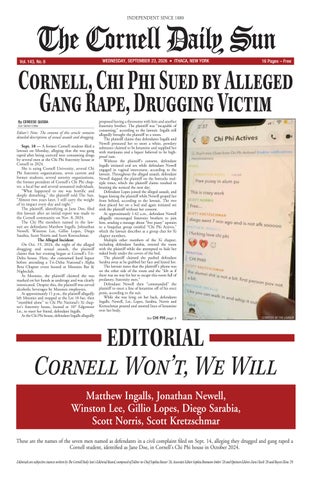
Sept. 18 — A former Cornell student filed a lawsuit on Monday, alleging that she was gang raped after being coerced into consuming drugs by several men at the Chi Phi fraternity house at Cornell in 2024. She is suing Cornell University, several Chi Phi fraternity organizations, seven current and former students, several sorority organizations, the former president of Cornell’s Chi Phi chapter, a local bar and several unnamed individuals. “What happened to me was horrific and deeply disturbing,” the plaintiff told The Sun. “Almost two years later, I still carry the weight of its impact every day and night.” The plaintiff, identifying as Jane Doe, filed this lawsuit after an initial report was made to the Cornell community on Nov. 8, 2024. The Chi Phi members named in the lawsuit are defendants Matthew Ingalls, Johnathan Newell, Winston Lee, Gillio Lopes, Diego Sarabia, Scott Norris and Scott Kretzschmar. The Alleged Incident On Oct. 19, 2024, the night of the alleged drugging and sexual assault, the plaintiff claims that her evening began at Cornell’s TriDelta house. Here, she consumed hard liquor before attending a Tri-Delta National’s Alpha Beta Chapter event hosted at Moonies Bar & Nightclub. At Moonies, the plaintiff claimed she was marked on her hands as underage and was clearly intoxicated. Despite this, the plaintiff was served alcoholic beverages by Moonies employees. At approximately 11 p.m., the plaintiff allegedly left Moonies and stopped at the Lot 10 bar, then “stumbled alone” to Chi Phi National’s Xi chapter’s fraternity house, located at 107 Edgemoor Ln., to meet her friend, defendant Ingalls. At the Chi Phi house, defendant Ingalls allegedly
proposed having a threesome with him and another fraternity brother. The plaintiff was “incapable of consenting,” according to the lawsuit. Ingalls still allegedly brought the plaintiff to a room. The plaintiff claims that defendants Ingalls and Newell pressured her to snort a white, powdery substance claimed to be ketamine and supplied her with marijuana and a liquor believed to be highproof rum. Without the plaintiff’s consent, defendant Ingalls initiated oral sex while defendant Newell engaged in vaginal intercourse, according to the lawsuit. Throughout the alleged assault, defendant Newell slapped the plaintiff on the buttocks multiple times, which the plaintiff claims resulted in bruising she noticed the next day. Defendant Lopes joined the alleged assault, and began kissing the plaintiff while Newell groped her from behind, according to the lawsuit. The two then placed her on a bed and again initiated sex with the plaintiff without her consent. At approximately 1:42 a.m., defendant Newell allegedly encouraged fraternity brothers to join him, sending a message about “free pussy” upstairs to a Snapchat group entitled “Chi Phi Actives,” which the lawsuit describes as a group chat for Xi chapter members. Multiple other members of the Xi chapter, including defendant Sarabia, entered the room with the plaintiff while she attempted to hide her naked body under the covers of the bed. The plaintiff claimed she pushed defendant Sarabia away as he grabbed her face and kissed her. The lawsuit states that the plaintiff’s phone was on the other side of the room and she “felt as if there was no way for her to escape this room full of predatory, fraternity men.” Defendant Newell then “commanded” the plaintiff to snort a line of ketamine off of his erect penis, according to the suit. While she was lying on her back, defendants Ingalls, Newell, Lee, Lopes, Sarabia, Norris and Kretzschmar poured and snorted lines of ketamine over her body. See CHI PHI page 5
COURTESY OF THE LAWSUIT
EDITORIAL
Cornell Won’t, We Will Matthew Ingalls, Jonathan Newell, Winston Lee, Gillio Lopes, Diego Sarabia, Scott Norris, Scott Kretzschmar These are the names of the seven men named as defendants in a civil complaint filed on Sept. 14, alleging they drugged and gang raped a Cornell student, identified as Jane Doe, in Cornell’s Chi Phi house in October 2024. Editorials are subjective stances written by The Cornell Daily Sun’s Editorial Board, composed of Editor-in-Chief Sophia Dasser ’28, Associate Editor Sophia Romanov Imber ’28 and Opinion Editors Zara Cheek ’28 and Rayen Zhou ’29.
2 The Cornell Daily Sun | Wednesday, September 23, 2026
ADS
The Cornell Daily Sun | Wednesday, September 23, 2026 3
PHOTO
SUNBURSTS: Porchfest 2026 Sun photographers traveled downtown to capture the tunes, whimsy and energy of one of Ithaca’s proudest traditions — Porchfest.
By SUN PHOTOGRAPHY DEPARTMENT
Audrey Zhang / Sun Staff Photographer EIGHT-COUNT | Ithacans join each other in dancing to music throughout Porchfest.
Audrey Zhang / Sun Staff Photographer LEAD & FOLLOW | A lady dressed in red takes the lead and teaches a student how to dance.
Audrey Zhang / Sun Staff Photographer TWO-MAN SHOW | Ithacans gather to sit and listen to a two-man band play their set at Porchfest.
Audrey Zhang / Sun Staff Photographer YOU LIKE JAZZ? | A vibrantly dressed band performs a set.
Eleni Puzas / Sun Staff Photographer DECK INTERMISSION | A man smiles and takes a break on the stoop of a porch.
Eleni Puzas / Sun Staff Photographer PORCH-SIDE GIG | A band performs a set in an ambiently lit porch, gathering a crowd of listeners.
Eleni Puzas / Sun Staff Photographer DRY CLOTHES | A band sells colorful merchandise during a soggy Porchfest.
Eleni Puzas / Sun Staff Photographer BRAT BROTHERS | A crowd gathers on both sides of the street to listen to the porch performances by Brat Brothers in downtown Ithaca.
To see more photos, please visit cornellsun.com.
NEWS
4 The Cornell Daily Sun | Wednesday, September 23, 2026
Hasan Piker to Speak at Sage Chapel
Piker is a Twitch streamer who discusses leftist politics and the news; he has come under fire for comments on 9/11, criticisms of the Israeli government and more.
By GISELLE REDMOND Sun Assistant News Editor
Sept. 17 — Hasan Piker, a leftwing political commentator and Twitch streamer with 3.1 million followers, will speak on campus in an event hosted by the Students Not Bombs campaign on Sept. 24. The free event, which sold out within hours of tickets being released, will take place from 6:30 to 7:30 p.m. at Sage Chapel while Piker livestreams on his Twitch channel, according to a Tuesday Instagram post. Students Not Bombs is a coalition comprising Students for Justice in Palestine, Jewish Voice for Peace and Cornell Young Democratic Socialists of America, all of whom are urging Cornell to divest from Israel via a petition and on-campus demonstrations. The 35-year-old socialist streamer has been active on Twitch since 2018, streaming about leftist politics, his opinions on the news and his support for progressive movements, including “ICE out of L.A.” and “No Kings” rallies. He
also advocates for Palestinian liberation and shares his views criticizing the Israeli government. Ahead of the 2024 presidential election, Piker was granted permission to livestream at the Democratic National Convention, and was invited among a group of other influencers. In an April 2025 profile, the New York Times described Piker as “A Progressive Mind in a Body Made for the ‘Manosphere.’” During his time in the public eye, Piker has been no stranger to controversy. Piker has been under fire for his history of strong rhetoric, including a 2019 comment that “America deserved 9/11” in reference to the U.S.’s military interventions in the Middle East — a statement he has since said was “inappropriate.” Piker has received intensified press coverage amid a recent campaign stop alongside Abdul El-Sayed, the Democratic nominee for Senate in Michigan. Piker traveled to Michigan ahead of primary election day, when El-Sayed
eventually triumphed over Rep. Haley Stevens (D-Mich.) by about 1%. Stevens criticized El-Sayed’s proximity to Piker, and other outlets have argued that it may cost Democrats the seat— especially because of Piker’s anti-Israel politics. “People don’t f*ck with Israel any longer,” Piker said on a stream, according to CBS. “If Jews in America keep putting this idea out there that they are singularly invested in Israel, eventually someone’s going to come around and take action, not against the state of Israel, mind you, but against American Jews.” Piker argued that Jewish Americans “tying [their] entire identity to a country that inevitably will be seen as basically Jewish ISIS” is “making antisemitism worse.” El-Sayed has responded to critics, writing “nobody speaks for this campaign besides me and my campaign spokespeople,” in an August statement. When Zohran Mamdani ran for mayor of New York City in 2025, Piker endorsed the Democratic Socialists of America candidate and featured him on his stream. Piker also played Among Us with Rep. Alexandria Ocasio-Cortez
(D-N.Y.) on his Twitch stream in 2020. Piker was born in New Jersey and raised in Turkey, and spent most of his childhood there before moving to the U.S. as an adult. The streamer graduated from Rutgers University in 2013 after studying political science and communications and moved to the Los Angeles area to begin streaming on Twitch soon after. The streamer has been described as the “Joe Rogan” of the left – a label which Piker has rejected. Piker’s Sept. 24 visit to Cornell will not be the first time he has spoken at a college campus. He visited the University of Southern California in 2024, spoke to students at Dartmouth in March 2026 and debated Yale students in April 2026. If Cornell students wish to attend the now-sold out event, they are encouraged by JSP, JVP and YDSA to join the waitlist on CampusGroups. Giselle Redmond can be reached at gredmond@cornellsun.com.
CFI, Cornell Hillel Condemn Hasan Piker’s On-Campus Event By MARY CAITLIN CRONIN Sun News Editor
COURTESY OF ADALI SCHELL/THE NEW YORK TIMES
Streamer speaks | Hasan Piker, a left-wing political commentator, will speak on campus on Thursday at Sage Chapel.
Sept. 21 — Cornellians for Israel and Cornell Hillel released statements on Thursday condemning student coalition Students Not Bombs’ invitation of leftist political commentator and Twitch streamer Hasan Piker to speak on campus Sept. 24. Hillel referred to Piker’s rhetoric as “hateful” and “antisemitic,” and his appearance as an act of “incitement.” Cornell Jewish Voice for Peace, one of the organizations hosting Piker, rejected the characterization of Piker as “antisemitic” in a Friday statement, disputing the notion that hosting Piker reflected hostility toward Jewish students. Students Not Bombs is a coalition of student organizations comprising Jewish Voice for Peace, Students for Justice in Palestine and Young Democratic Socialists of America, who are urging Cornell to divest from Israel via a petition and on-campus demonstrations. The coalition announced on Sept. 15 that Piker will speak at Sage Chapel on Sept. 24. Tickets for the free event sold out just hours after being released. The venue has a capacity of around 600 people. The 35-year-old socialist streamer has 3.1 million followers on Twitch, where he has been active since 2018, streaming about leftist politics, his opinions on the news and his support for progressive movements, including “ICE out of L.A.” and “No Kings” rallies. He also advocates for Palestinian liberation and shares his views criticizing the Israeli government. Piker has been the subject of controversy over several remarks, including stating that “America deserved 9/11” in 2019, calling ultra-Orthodox Jews “inbred” in 2025 and saying that Zionists should be treated like neo-Nazis. CFI began its statement by stating, “[CFI] believes that our campus is at its best when students of every background can hear ideas they disagree with and engage with them seriously.” It continued to express “disappointment” in Piker’s invitation to campus, arguing that the invitation itself amounts to an endorsement of his views. “Inviting a speaker means choosing whom to elevate,” CFI wrote. CFI pointed to controversial statements Piker has made, including calling for the assassination of Sen. Rick Scott (R-Fla.), calling
Zionism a “mental illness” and referring to the United States as “the top terrorist organization.” Hillel similarly asserted its belief in the value of “disagreement, pluralism, and debate,” on campus but ultimately stated that Piker’s “hateful, antisemetic rhetoric is repulsive.” Concerns over the event have been communicated to “university partners,” with whom Hillel remains in “ongoing contact,” according to the post. Cornell JVP released its own statement on Friday, rejecting both the “characterization of Hasan Piker as antisemitic” and that Piker’s invitation “reflects hostility toward Jewish students.” The statement acknowledged the “provocative language” Piker uses, but asserted that “criticism of Israel, Zionism, or U.S. support for Israel should not be treated as evidence of prejudice against Jews.” Its post criticized the “conflation” of anti-Zionism as anti-semitism, particularly when it is used within Jewish communities to “cast anti-Zionist Jews as threats to our own community.” Both Hillel and JVP acknowledged that Piker’s appearance on Thursday will take place just four days after Yom Kippur, a Jewish holiday centered on reflection and repentance, and the holiest day on the Jewish calendar. Hillel asked the organizers to “reflect” on the impact Piker will make on campus during Yom Kippur, while JVP wrote that the commitments of value during the days of Awe require the organization to stand by their hosting of the event. CFI faced backlash last spring, when it invited former Israel Defense Force soldier Sam Fried to speak on campus. The invitation was subject to controversy and criticism, including from members of YDSA and JVP. In a February interview with The Sun, YDSA co-chair Zoe Reisman ’29 criticized Cornell for allowing Fried on campus. “If Cornell… is actually committed to pluralism it needs to refuse to legitimize military propaganda amid documented repression of Palestinian students and political expression on campus,” Reisman told The Sun. To continue reading this story, please visit www.cornellsun.com. Mary Caitlin Cronin can be reached at mcronin@cornellsun.com.
The Cornell Daily Sun | Wednesday, September 23, 2026 5
News
CHI PHI Continued from page 1 Defendants Ingalls and Lee took the plaintiff into another room, which was believed by the defendant to be the office of Orazio Petito, president of Chi Phi at Cornell at the time. Defendants Ingalls and Lee forced oral and vaginal sex upon her simultaneously and made her snort more ketamine. The assault lasted until around 5:45 a.m., according to the lawsuit. The filing states that the plaintiff was completely incapacitated at this point and came into consciousness later that day on Oct. 20, 2024. The lawsuit states that the plaintiff was in a “very vulnerable situation” when she was allegedly sexually assaulted by defendants Ingalls, Newell, Lee, Lopes, Sarabia, Norris and Kretzschmar. The lawsuit claims that the student defendants were “fully aware” of her condition. Jeremy Saland, an attorney for defendant Kretzschmar, disputed the allegations against his client in a statement sent after publication, saying the defense possesses evidence that contradicts the plaintiff’s account. “We wholeheartedly deny the allegations in the complaint against Scott Kretzschmar,” Saland wrote to The Sun. “It is disappointing the claims against him were even made considering we possess documents that thoroughly corroborate our position, including her own words, statements from other parties, and scientific evidence demonstrating they are false.” The student defendants could not immediately be reached for comment. The plaintiff reported the incident to the Cornell University Police Department on Nov. 8, 2024, and that same day, the Xi chapter was placed on temporary suspension for alleged violations of the Student Code of Conduct. Temporary suspensions were also issued for defendants Ingalls, Newell, Lee, Lopes, Sarabia, Norris and Kretzschmar, according to the lawsuit. The defendants were offered the opportunity to mitigate their conduct by submitting essays to the University, according to the lawsuit. On Nov. 26, 2024, the University released a statement, titled “Update on disturbing allegations of sexual violence,” explaining that the University was continuing to investigate the incident. In January 2025, the University began a Title IX investigation in response to the plaintiff’s Formal Complaint, according to the lawsuit. According to the complaint, Cornell’s Title IX investigation is believed to have concluded, while the Ithaca Police Department is still investigating the incident. The Complaint The complaint brings claims against the University for negligence, negligent supervision, breach of contract, violations of state human rights and education laws and negligent infliction of emotional distress. It also accuses Tri-Delta entities of negligence and breach of contract, Chi Phi defendants of negligent supervision and seven student defendants of sexual assault, sexual battery and intentional infliction of emotional distress. A representative from the Tri-Delta Executive Office did not respond to a request for comment. The plaintiff brings claims against Moonies Bar & Nightclub, alleging that the bar and its employees violated New York’s Dram Shop Act — which can hold alcohol vendors liable in certain circumstances when they knowingly serve persons who are underage. Moonies denied the allegations of negligence and violations of New York’s Dram Shop Act. In a statement sent to The Sun after publication, a Moonies representative wrote that on Oct. 19, 2024, Moonies had a contract in place with Tri-Delta as it hosted the sorority’s private event. Per the contract, Moonies marked the hands of underage guests, provided wristbands to those over 21 years old and “no alcohol was served to guests who had mark[s] on their hands,” according to the representative. “Our bartenders strongly followed the rules and only served guests who had wristbands on their hands,” the representative wrote. The Moonies representative reiterated that the plaintiff’s claim that she was served alcohol at Moonies was “completely inaccurate.” The lawsuit seeks damages from all defendants. The lawsuit “specifically seeks” damages from Cornell, fraternity and sorority organizations, certain faculty, alumni and executive board members and Petito, which the lawsuit described as failing to properly supervise or monitor the seven current and former student defendants. When asked by The Sun about the pending litigation, a University spokesperson declined to comment. Petito did not respond to a request for comment by publication. “In the aftermath, I was deeply disappointed by the lack of support I received from the student community,” the plaintiff told The Sun. “What I experienced was already devastating, but that pain was compounded by being criticized and ostracized at a time when I needed compassion, support and care the most.” Editor’s note: Cereese Qusba is a member of Tri-Delta at Cornell. Cereese Qusba can be reached at cqusba@cornellsun.com.
‘Students Not Bombs’ Protests GE Aerospace Information Session By SOPHIA RILEY SIM Sun Senior Writer
Sept. 16 — Nearly 20 students held a demonstration during a General Electric Aerospace internship information session attended by roughly 60 students on Wednesday evening in Caldwell Hall. The demonstrators protested against GE Aerospace’s role in supplying engines and turbines used in Israeli military operations in Gaza and Cornell’s decision to host the company’s recruiting session. GE Aerospace is an aviation engine supply company that provides engines and other parts to “commercial, military, business, and general aviation aircraft,” according to its website. The demonstration was organized by Students Not Bombs, a student campaign comprising Jewish Voice for Peace, Cornell Young Democratic Socialists of America and Students for Justice in Palestine demanding that the University divest from Israel, end Cornell Career Services recruitment for weapons manufacturers and U.S. Immigration and Customs Enforcement, sever its ties with the Technion - Israel Institute of Technology and invest in Ithaca. “We believe that as Cornell Career Services continues to host companies like [GE Aerospace], they are continuing our complicity in genocide,” said Adriana Vink
’27, SJP co-president and opinion columnist for The Sun. “We came here today to stand against that.” SJP Co-President Yasmeen Masoud ’28 said that the demonstration is one of many ways the Student Not Bombs campaign plans to pressure the administration to divest. “We will be continuing to push for Cornell to divest from weapons manufacturers and stop behavior like this, where Career Services invites recruiters like GE Aerospace who have a direct hand in the creation, engineering and manufacturing that contribute[s] to fighter jets that are being used in Gaza against innocent civilians and journalists,” Masoud said. The information session, hosted by GE Aerospace engineers Kelly Irons ’22 and Katie Sternkopf ’23, was intended for mechanical and aerospace engineering and material sciences engineering students to learn more about the company and career opportunities. Demonstrators and students gathered at 6 p.m. in Caldwell Hall, with demonstrators occupying the first two rows of the classroom and the remaining students filling the seats behind them. The event was monitored by the Cornell University Police Department, with multiple officers outside of the building and inside the classroom throughout the whole event, along with one Cornell University Public Safety ambassador and University staff
who were present. Before the GE Aerospace representatives gave their presentation, Greta Kenney, senior associate dean of students for student support and advocacy services, read the University’s Expressive Activity Policy, stating that speakers “have a right to speak without intimidation, and the audience has a right to hear what the speakers have to say.” Kenney also told the crowd that students who violate these policies may be referred to the Office of Student Conduct and Community Standards. After Kenney reminded the crowd of University policy, Irons and Sternkopf gave their presentation on GE Aerospace’s work in aviation technology and internship opportunities, while protesters silently held up signs reading “Free Free Palestine” and “Genocide Enabling Aerospace.” After Irons and Sternkopf finished their presentation, they opened up the room to a Q&A session. Multiple demonstrators raised their hands from the first two rows, but the speakers only took questions from the students in the back, who asked questions about internships and the company. To continue reading this story, please visit www.cornellsun.com. Sophia Riley Sim can be reached at ssim@cornellsun.com.
6 The Cornell Daily Sun | Wednesday, September 23, 2026
Opinion
The Corne¬ Daily Sun The Editorial Board Independent Since 1880 144th Editorial Board SOPHIA DASSER ’28 Editor in Chief
SOPHIA ROMANOV IMBER ’28 Associate Editor
VARSHA BHARGAVA ’27 Managing Editor
RAYEN ZHOU ’29 Opinion Editor
KATE TURK ’27 Assistant Managing Editor
ZARA CHEEK ’28 Opinion Editor
CORAL PLATT ’29 News Editor ATTICUS JOHNSON ’28 News Editor MARY CAITLIN CRONIN ’28 News Editor EVERETT CHAMBALA ’27 Assistant News Editor
JADE DUBUCHE ’27 Multimedia Editor KENDALL MURPHY ’28 Business Manager CHARLIE CLARK ’29 Director of Revenue & Partnerships VICTORIA WROBLEWSKI ’28 Human Resources Manager MELISSA MOON ’28 Arts & Culture Editor JAMES PALM ’27 Assistant Arts & Culture Editor MATTHEW RENTEZELAS ’28 Assistant Arts & Culture Editor HAZEL TJADEN ’28 Assistant Arts & Culture Editor MARC STAIANO ’27 Assistant Arts & Culture Editor KATELYN HALVERSON ’28 Lifestyle Editor AVA BETNAR ’29 Assistant Lifestyle Editor SANIKA SARAF ’28 Assistant Lifestyle Editor KATHERINE ISTOMIN ’29 Marketing Manager ASHLIN KWONG ’28 Graphics Editor TAVAN BHATIA ’27 Games Editor RENA GEULA ’28 Layout Editor
SHUBHA GAUTAM ’28 Assistant News Editor GISELLE REDMOND ’28 Assistant News Editor ANGELINA TANG ’28 Science & Technology Editor TANIA HAO ’28 Science & Technology Editor SIMRAN LABORE ’27 Weather & Climate Editor MATTHEW LEONARD ’28 Sports Editor GRACE REUBEN ’28 Sports Editor JANE HAVILAND ’28 Features Editor NATHAN ELLISON ’28 Photography Editor NATHAN BO ’28 Assistant Photography Editor ADELAIDE CHOW ’29 Assistant Photography Editor MIA SOFIA ORENGO ’28 Video Editor OAKLEY DECRISTOFARO ’29 Video Editor AMELIA GARCIA ’27 Data Editor HUNTER PETMECKY ’28 Layout Editor
WORKING ON TODAY'S SUN MANAGING
NEWS DESKERS
SPORTS DESKER OPINION DESKERS LIFESTYLE DESKERS ARTS DESKER PHOTO DESKERS
Sophia Dasser '28 Varsha Bhargava '27 Kate Turk '27 Sophia Romanov Imber '28 Everett Chambala '27 Mary Caitlin Cronin '28 Giselle Redmond '28 Shubha Gautam '28 Grace Reuben '28 Rayen Zhou '29 Zara Cheek '28 Sanika Saraf '28 Hazel Tjaden '28 Nathan Ellison '28 Nathan Bo '28 Adelaide Chow '29
Letter from the Editors Atticus Johnson ’28 is a news editor for the 144th Editorial Board. He can be reached at ajohnson@cornellsun. com. Sophia Dasser ’28 is the editor in chief of the 144th Editorial Board. She can be reached at sdasser@ cornellsun.com or at (321) 203-6550.
The Sun Wants to Know W
hen you heard that President Trump was launching a major military operation against Iran, what did you feel? When you see Governor Kathy Hochul’s name on your ballot this November, what will you think? What are you struggling with, and what are your hopes for our community and our country? The Sun wants to know. That is why we are thrilled to share with you a special project, the first-of-its-kind for The Sun: this October, in collaboration with The Ithacan, we will be sitting down with Ithaca voters to hear your hopes, worries and thoughts about our city and our country. You’ll be asked questions about how you feel about our economy, what you think about our elected leaders and much more, in the hopes of accurately representing the general mood of our community ahead of the 2026 midterm elections. We also want to make clear we are serious about accurate representation — whether that be political ideology, ethnicity, income, sexual orientation, age, gender identity and so much more. We want to portray Ithaca as it is. If you are interested (and registered to vote in Ithaca) our focus group will start at 10 a.m. on Oct. 3, at The Sun’s office on 139 W. State St. You can sign up on our website, cornellsun.com.
The Cornell Daily Sun’s Editorial Board is a collaborative team composed of Editor-in-Chief Sophia Dasser ’28, Associate Editor Sophia Romanov Imber ’28 and Opinion Editors Zara Cheek ’28 and Rayen Zhou ’29. The Editorial Board’s opinions are informed by expertise, research and debate to represent The Sun’s long-standing values. The Sun’s editorials are independent of its news coverage, other columnists and advertisers.
Cornell Won’t, We Will
M
atthew Ingalls. Jonathan Newell. Winston Lee. Gillio Lopes. Diego Sarabia. Scott Norris. Scott Kretzschmar. These are the names of the seven men named as defendants in a civil complaint filed on Sept. 14 alleging they drugged and gang raped a Cornell student, identified as Jane Doe, in the Chi Phi house in October 2024. A university's obligation to the physical safety of its students is not one commitment among several, to be weighed against reputation or litigation exposure. It is antecedent to everything else the institution does. Cornell exists to teach and to educate, and instruction presupposes a student capable of receiving it, which presupposes, in turn, a student who is not afraid to attend their lecture hall. Safety is not adjacent to the educational mission — safety is, in fact, its precondition. Cornell has said as much, in the document that governs the student conduct, which announces that it is “intended to preserve a higher education community and residential campus where ‘any person’ in the community can pursue their education in a secure and nourishing environment.” The promise was invoked again on Feb. 21, 2025, when then-Interim President Michael Kotlikoff published Cornell’s guiding principles organized around opportunity, access, diversity, merit and the assurance that “Cornell follows the law.” The statement appeared just four months after the October 2024 assault. So we ask the questions the University has left unanswered. If Cornell follows the law, then we should have access to a public deposition issued from the school, the Title IX investigation opened in January 2025 and how it concluded. Why were these men allowed to “pursue their education in a secure and nourishing environment” and she was not? Why was she not informed of the outcome of her own Title IX investigation? Who benefited from the 23 months of elapsed time when the public knew nothing? Cornell wrote that the suspensions of the men were issued “to protect the immediate physical health and safety of all students.” The Faculty Senate, voting 80-16 in November 2025, held that interim suspensions should cease when the risk of harm ceases. For the men to be back on campus, either the danger passed at some identifiable moment, and thus this community is owed an account of what changed, or it did not and the suspensions were lifted anyway. Cornell has explained neither. The lawsuit alleges the suspended students were offered the chance to mitigate conduct by submitting essays. A student accused of copying on a prelim receives a written notice with the evidence, three business days to demand a hearing and resolution of their case within two weeks, under the Accepting Responsibility Program written into the Code of Academic Integrity, which passed by a vote of 97-3. Cornell is capable of speed, of structure and most definitely of proportion — at least for the chemistry department.
Though when it comes to sexual assault, Cornell’s five-month-late response was a task force. During an interview with The Sun, the sexual assault task force co-lead and Dean of Students Marla Love said that “the charge was never for us to solve the problem.” In the interim, the University saw an increase in “nonconsensual sexual contact” to 15% of survey respondents from 11% in 2023, with a fifth of the incidents against undergraduate women occurring in fraternity houses or annexes. If the task force’s mission was not supposed to solve the problem of sexual assault, as Love has stated, then it has been a resounding success. Tackling sexual assault as an academic matter — complete with its charts and facts and figures — offers no respite to the victims who have undergone physical and mental abuse. Academic “solutions,” like the essays, allegedly offered to the defendants to mitigate their suspensions, is belittling to the severity of the crime. It offers no concrete, feasible solutions beyond the usual passivities of “communication” and “understanding” that assume we live in a world of saints and angels. Cornell administrators and researchers surely know this — they understand the futility of their reports and the minimal impact these studies and prevention classes will have on the campus culture that has continued for generations. It takes no statistician to see the selection bias in the fact that the people who attend sexual assault prevention meetings and listen to them are quite likely not the ones most likely to commit acts of sexual assault. This is not a dark chapter in Cornell’s history, it’s a morbid pattern, only rectified with thorough criminal investigations in the hands of parties independent of the University — the Ithaca Police Department and the Tompkins County district attorney. As for Cornell, administrators have allowed the idea that enough ambiguity, enough he-said-she-said, enough familial connections, enough money will allow you to get off scot-free. We call on Cornell to publish the standard by which a suspension in a sexual assault case is lifted. We call on them to state whether an allegation of sexual assault is eligible for emergency suspension at all under the revised Article VIII. Finally, we expect that the University shares with the complainant the outcome of her own investigation. In Cornell’s own words, in the very letter it published on Nov. 26, 2024 — “Only those who perpetrate sexual violence benefit from its concealment.” We refuse for this victim to be reduced to just another story. Cornell has failed to protect its students. Cornell has failed to address the growing issue of sexual assault on campus with its pathetic task force. Cornell has failed the student allegedly raped by those seven men at Chi Phi in October 2024. Cornell has failed her. Cornell has failed us. To Matthew Ingalls, Jonathan Newell, Winston Lee, Gillio Lopes, Diego Sarabia, Scott Norris and Scott Kretzschmar: We know who you are and we refuse to let you benefit from this University's concealment.
The Cornell Daily Sun | Wednesday, September 23, 2026 7
COLUMNS
When Neo-Nazis Get Invited to Campus Ezra Galperin Ezra's Cornell
Ezra Galperin '27 is an Opinion Columnist and a Government and Jewish Studies student in the College of Arts and Sciences. His fortnightly column, Ezra's Cornell, discusses campus politics and how they are affected by the wider political climate. He can be reached at egalperin@cornellsun.com.
O
n Sept. 15, Austin Franco’s new student organization, the Cornell Groypers, announced that Nick Fuentes will be giving a talk on campus on Sept. 24. The same Nick Fuentes, who said on a stream that “when it comes to the Jews, here’s the silver lining: it tends to go from zero to 60” and that “the Jews had better start being nice to people like us, because what comes out of this is going to be a lot uglier and a lot worse for them than anything that’s being said on this show,” will be speaking in the same building where Ezra Cornell, the man who founded a university “where any person can find instruction in any study” is buried. The irony of this situation cannot be overstated. Well, that would be the case, except for one thing: this didn’t actually happen. Whatever the University’s policies are on the matter, it seemed pretty clear to us that nobody would be able to get away with bringing a neo-Nazi who incites violence to campus. Kehlani’s disinvitation from headlining
Slope Day in Spring 2025 after she called Zionists “scum of the earth” and Austin Franco’s near-universal ostracization, including a scathing editorial by The Cornell Daily Sun’s editorial board, proved that any attempt to bring such a person to campus would be shot down and that such a person on campus would face what can be described lightly as social barriers. Then came the real announcement. On Sept. 15, the Students Not Bombs coalition of Students for Justice in Palestine at Cornell, Jewish Voice for Peace at Cornell and the Cornell Young Democratic Socialists of America announced that Hasan Piker will be giving a talk on campus on Sept. 24. The same Hasan Piker who said, “if Jews in America keep putting this idea out there that they are singularly invested in Israel, eventually someone is going to come around and take action, not against the state of Israel, mind you, but against American Jews” and that Orthodox Jews are “fucking untrained, inbred asses,” will be speaking in the same building where Ezra Cornell, the man who founded a university “where any person can find instruction in any study” is buried. The irony of this situation cannot be overstated. This article is not a call for Cornell to disinvite Piker from campus. We do not view this situation the same way we did that of Kehlani, because this is not a University-wide event meant to cater to everyone. We firmly believe that all groups on campus, including those with whom we disagree, have the right to invite speakers to campus. We have no plans to disrupt Piker’s appearance as SJP did with the Pathways to Peace panel and the Fall 2024 disruption at the Statler Hotel career fair. We have no plans to call on Cornell to “refuse to legitimize” (not allow on campus) a speaker with whom we disagree, as YDSA did when Cornellians for Israel brought Sam Fried, a former Israeli Defense Forces
soldier, to campus to talk about his experience fighting Hamas in Gaza, thereby forcing us to only disclose the locations of our events to registered participants. We are simply exercising our First Amendment right to condemn the organizations platforming this man. SJP, YDSA and JVP have repeatedly tried to shut down that right when others used it. We will not return the favor. If we told you that a famous streamer invoked classic antisemitic caricatures about Jews being inbred, said that Jews invited violence against themselves and compared the Houthis, whose flag reads “Death to America, Death to Israel, Curse on the Jews,” to Anne Frank, implying that a terror group is the real victim, who would you assume we were describing? If we told you that a student group invited that streamer to campus, which group would you assume we were referring to? You would probably assume we were talking about some alt-right group inviting Nick Fuentes or Myron Gaines. Yet, we find ourselves talking about SJP, JVP and YDSA inviting Hasan Piker. In doing so, these organizations now appear to be endorsing many of Piker’s viral moments, including but not limited to his statement that "America deserved 9/11,” his dismissal of reports of sexual violence during the Hamas-led massacres on Oct. 7, 2023, in which he declared that "it doesn't matter if rapes fucking happened on Oct. 7," and his tirade against an elderly Vietnamese refugee, telling her to “go back and live in fucking South Vietnam.” If a far-right group on campus announced plans to bring Nick Fuentes to Cornell, we, along with the rest of the campus community, would be quick to condemn that group because such an event can incite violence. It is imperative that we ensure that standard is applied universally across the political spectrum. That obligation is why we call on other student organizations on campus to do the same.
Closing a New Overton Francis X. Jaso
A Contrarian's Calamity Francis Xavier Jaso '28 is an Opinion Columnist and a Government and Economics student in the College of Arts & Sciences. His fortnightly column, A Contrarian’s Calamity, defies normative, dysfunctional campus discourse in the name of reason, hedonism and most notably, satire. He can be reached at fjaso@cornellsun.com.
L
ast autumn, former establishment media deviant and founder of The Free Press, Bari Weiss, took the stage at the Jewish Leadership Conference in a rare break from her habitual public isolation. After spending the last half-decade on the frontlines of new media, leaving her mid-tier post at The New York Times over editorial gridlock that nearly consumed its newsroom in the rubble of Black Lives Matter politics to start anew, and having been installed as the editor-in-chief of CBS News the prior month, she seemingly changed her mind. Invoking a new manifesto, Weiss charged herself with resurrecting the stalwart institutions that betrayed “the vast majority of Americans,” the rough-cut “70%” of centrists who’d been sidelined by ascendants like Nick Fuentes, Hasan Piker and Tucker Carlson, promising those flanking the very ends of either political wing a crushing defeat at the hands of an establishment she briefly detested. Centrism, the timeless potty word of an American politic marked by its ideological ebbs and flows, is now Weiss’s endgame. But she is no longer the sole proprietor of an ideal that — between the President’s 2015 ride down the golden escalator, Biden’s headfirst affair with an ever-colorful, obtuse wokeism and Trump 2.0 — might as well be an anomaly now lost to time. Elite domestic actors are following in her muddied footsteps to rebalance America’s shattering political mosaic. They have concluded our
Overton Window, too far widened and culpable to a brewing storm of alleged ‘extremism’ (read: popular sovereignty), should be shuttered for the sake of control. Longstanding media agenda-setters like The Atlantic have pivoted from a traditionally offensive posture against the GOP to routine attacks against the Democratic Socialists of America and its bid to reshape a Democratic party whose old-guard stands no chance against a Rubio/ Vance ticket in 2028. Attempts to scuttle the widely unpopular Flock epidemic beneath a technocratic visage and overstatements about the pre-war resistance to the Islamic Republic comprise the majority of their pages. A $110 billion Warner-Paramount deal, negotiated by the same oligarchs who generously donated to The Free Press, despite receiving a greatly overinflated valuation, vows to bulldoze the few sources of independent press to consolidate national media. Even the likes of rightist outlets, notably Fox News and Newsmax, clamour to broadcast centrist voices, prompting working-man cosplayer Sen. John Fetterman (D-Pa.) and Florida’s Rep. Jared Moskowitz (D-Fla.) to forgo a ‘big tent’ with the comrades. This isn’t the first instance of the establishment trying to correct the direction and substance of the nation’s public opinions. After all, the people have endured red scares, maligned fears about the Islamic world after 9/11 and recurring scandals each election year that consign moral qualms to the media battlefield. Yet this time is harder to stomach; the political class has drawn new boundaries for which recent history has no precedent. As Frank Furedi, scholar of sociology at the University of Kent, has formulated, “militant centrism” has all but defined our bleak reality which deserves a more daring opportunity for change. Europe’s ideological jihad against ‘farright’ parties portends a similar path of destruction in the American mainstream, albeit their judicial systems exert more decisive power over using anti-democratic measures, ironically, to defend democracy. Although we may be spared the Orwellian power trips ingrained in their parliamentary democracies, fraternization between lobbyist groups and media counterparts has sheathed contemptuous consensus making under a guise of maintaining stability — or keeping the
imaginary “70%” in line with their agenda. So who is the real purveyor of bad faith manipulation? Is it the supposedly easily manipulated citizens who’ve experienced, in realtime, mass deployment of surveillance apparatus? Commentators decrying corporate interests and slander campaigns in their elections? Or activists — even many ordinary citizens — concerned with their tax dollars being spent to incinerate families via allied occupiers overseas? Of course not: that’s what those combatting our New Overton hope to legislate. Soft mandates, through cable outlets, PAC advertising campaigns and the like, are wholly responsible for shoring up artificial outrage against so-called extremists. They have, and continue to use, countersignaling ploys straight from the McCarthyist playbook, hoping not to create resentment over a specific enemy or idealogue, but shrink the scope of popular opinion to accommodate a narrow range of principles no longer held by us, a growing majority of disillusioned young Americans. Observers of these centrist developments should be diligent not to let such ‘experts’ and historically respected moguls remake the wheel and backtrack on bids that have the potential to mobilize voters against parasitic norms. They should be especially cautious when participating in half-assed programs engineered to vilify public expression in favor of civilizing projects. Cornell’s very own GOVT 1109: “Disagreement,” that assumes valid contradictions rest only in “moderated discussion,” or initiatives that claim to defeat campus polarization but coddle viewpoints through the “Civility Industrial Complex,” a band of mostly center-right and pro-Israel nonprofits, ought not be mistaken for good-faith mediums for dialogue. Others who’ve mustered enough courage to challenge the mainstream that commands its center must hold might face short-term ostracization but, holding their ‘radical’ opinions in line, could fare far better once our generation enters maturity and the older ones fizzle into oblivion. It’d be much less begrudging to sit back as the Larry Ellisons, Susan Collinses, Jake Tappers and Jeff Bezoses of our world pontificate against lapping currents in the vox populi, but we mustn't forget their world is as much ours to inherit. In short: Leave the window open, and may the superior opinions win.
8 The Cornell Daily Sun | Wednesday, September 23, 2026
Science
SCIENCE & TECHNOLOGY
So, You Want to Find Research at Cornell? By HELEN QIAN Sun Contributor
Welcome, freshmen! As you settle into life at Cornell, you may have heard one particular extracurricular come up among your peers — research. As a research university, getting involved with research is extremely popular at Cornell. For many incoming students, however, the word research may still be a black box. Does “doing research” mean curing cancer, or tending to overgrown cells? How does one get started with this so-called research? Where does research even happen on campus? Fear not: The Sun has compiled some answers to your many questions, and more. What is research? Loosely defined, research is the study of any particular topic in depth. At Cornell, structured research is often conducted with a faculty member known as a principal investigator, who runs their own research lab often dedicated to one or a few specific research questions. Most professors who teach classes on campus are PIs of their own labs, and students may hear them mention papers that their own lab has published. In fact, reaching out to professors can be a first step towards finding research experiences. How do you know what you want to research? Perhaps the most important step in one’s research journey is determining what interests you. Tiffany Chen ’28, a current undergraduate researcher in the Donnelly Lab at the College of Veterinary Medicine,
recalls how she found her current lab, which studies horse maternal-fetal medicine, or theriogenology. “I have a lot of animal-related interests, so I looked for a lab that I would genuinely enjoy being a part of,” Chen said. “For me, that ended up being theriogenology.” Undergraduate research can become a significant time commitment, especially if students choose to pursue an undergraduate honors thesis. Selecting a lab that you find interesting and will enjoy is key. Start by working through the list of professors in a particular field, their interests, and note what really piques your interest. Then, learn more about them — explore papers in that area and pick out key topics that keep you reading more. How do you get started with research? You may have heard the dreaded term before: the cold email. Approaching a professor with no prior connection can seem intimidating, but more often than not, professors are highly receptive to students who show interest in their work. Many professors have undergraduates in their labs and expect to receive inquiries from prospective student researchers. Prof. Audun Dahl, psychology, advises students that it is okay to reach out with no prior research experience. “We look for students who genuinely care about the questions we study,” Dahl said. As the PI of the Developmental Moral Psychology Lab, Dahl’s research dives into questions like, “How do children
BEN PARKER / SUN FILE PHOTO
Research recommendations| There are many routes to take for students seeking research on campus.
begin to think about right and wrong?” or “Why do adults sometimes disagree about controversial moral issues?” He looks for interest in these topics when meeting prospective lab members. “The more students know before they apply — about the questions we study, the methods we do, or the articles we publish — the better they can explain why they want to join our lab in particular, not just any lab,” Dahl said. A cold email to a professor should not be a fill-in-the-blank template. Personalize each email to the research that each professor does — professors can tell when you haven’t done your homework (that is their job, of course!). And don’t be afraid to follow up on emails as well — if you don’t get a response, likely, a professor is simply busy rather than
ignoring you outright. What can you do aside from cold emails? There are a myriad of ways to find a lab if cold emailing seems too daunting. Approach your favorite professor after class. Ask your friends or peer advisors which labs they are in, too — a lab with undergraduates already is more likely to accept another. Dahl also emphasizes that, should students have any specific questions, they “can always reach out to our lab or come to office hours.” To continue reading this story, please visit www.cornellsun.com Helen Qian can be reached at hq68@cornell.edu.
The Death of the Physics Auto-tutorial Sequence By ASHLEY KIM Sun Staff Writer
PHYS 1101: “General Physics I” and PHYS 1102: “General Physics II,” the self-paced two-semester auto-tutorial physics sequence, has been discontinued starting this semester. Previously, many Cornell life sciences students used these asynchronous classes to satisfy their physics requirement as an alternative to the in-person sequence, PHYS 2207: “Fundamentals of Physics I” and PHYS 2208: “Fundamentals of Physics II.” For students who had planned around the auto-tutorial courses, particularly pre-med students who map out their four years of coursework in advance, the change arrived without much explanation. The decision to remove the class was made through a vote of the physics faculty following a four-year evaluation of
Cornell’s introductory physics offerings, funded by a College of Arts and Sciences Active Learning Initiative grant, according to Prof. Natasha Holmes, physics. “There were a lot of assumptions made about who takes these courses and what students get out of them that we wanted to actually put data to and get some evidence for,” said Prof Holmes. Prof. Holmes co-led the project with Charlotte Zimmerman, a postdoctoral researcher in the physics department. Under the Active Learning Initiative grant, Zimmerman observed classes, interviewed students, administered comprehension tests before and after the courses and pulled enrollment records. The two courses drew similar students, she found, and produced the same results. “There was no meaningful, statistical difference between the students that
BORIS TSANG / SUN FILE PHOTO
Auto-tutorial away | The self-paced auto-tutorial physics sequence was discontinued starting this fall.
took the class,” Zimmerman said. “Their starting scores in both classes were exactly the same, and their ending distributions were very, very similar.” Instead, the gap was in who completed the course. According to Zimmerman, more than 100 students dropped the auto-tutorial every semester for the past several years, out of the 200-300 students initially enrolled. In contrast, in PHYS 2207 and 2208, which covers the same material but through in-person lectures, discussions and labs, only about 10 students out of 200-300 dropped per semester, Holmes said. Flexibility and self-pace, which were considered to be the auto-tutorial sequence’s greatest benefits, came at a hidden cost. Those classes were missing something education research identifies as central to learning physics: collaboration with other students. “On paper, it’s this class where students have tons of access to TAs for oneon-one help. There are lots of activities for them to engage in,” Zimmerman said. “In practice, it was missing… peerto-peer interaction.” Senior Lecturer Glenn Case, physics, who is in his third year as course head for PHYS 2207, emphasized the lack of social interaction in the auto-tutorial format. “It was a course that was possible to take in isolation. You could do it all by yourself and really never have to talk to another person,” Case said. Taylor Birkey ’26, who took auto-tutorial as her first physics course, said the flexibility felt short of expectations. “For a class that was supposed to work around your own schedule, it didn’t feel that way in practice,” she said. “After one semester of auto-tutorial physics, I
knew it would be the last ‘auto’ class I’d ever take.” Staffing and resources added to the case for discontinuing the auto-tutorial. Because the PHYS 1101 and 1102 offered a learning center that had to be staffed whenever it was open, the number of staff required did not fall as enrollment fell. “Especially the weekend was the time that students really wanted to be in that learning center working on stuff, and we just couldn’t support that,” Holmes said.
“On paper, it’s this class where students have tons of access to TAs for one-on-one help. ... In practice, it was missing ... peerto-peer interaction.” Charlotte Zimmerman Still, little of that reasoning was visible to students while it was happening. Holmes said the physics faculty debated the courses over four years of research and meetings before voting, and that the data behind the decision functions as an internal department evaluation that cannot be released. Asked where that reasoning could have been shared with students, Holmes said she was not sure such a place exists. “There’s no outlet to publish our curricular decision making,” she said. To continue reading this story, please visit www.cornellsun.com. Ashley Kim can be reached at alk282@ cornell.edu.
The Cornell Daily Sun | Wednesday, September 23, 2026 9
Lifestyle
The Corne¬ Daily Sun
How To Make Corporate Cute By SELINA CHEN Staff Writer
A
button-down, blouse and blazer circle my weekly laundry rotation for my first professional internship. This past summer, these staples began to replace my trusty monochrome tanktops and washed jeans. If you are anything like me, your taste in clothes come and go almost as quickly as the Ithaca winds, and I have always enjoyed the freedom of following where they take me. You can imagine my horror when I learned that 9 to 5s required an everyday nonnegotiable template. I am what I wear, to the extent that colors and patterns reflect my mood for the day. At first, consistent with the common consensus, I struggled to make corporate cute. As someone with a highly specific taste in clothes and accessories, I grew up expressing myself through fashion, experimenting with different styles to accompany different times in my life. A dress code has never existed in my mind. There may have been phases I wouldn’t dare share with the public, but the becoming is just as integral as the result — like a butterfly out of the cocoon. Pinterest is my all-time favorite inspo platform for color and pattern matching, as well as visualizing different silhouettes. In addition to black and white, navy and light blue pair well with grey, beige, and sage green options. When I have some free time (and money), I’ll browse Depop, Cider, Banana Republic, and even Loft if I need a staple piece. Don’t be afraid to dress up popular patterns and make them your own; they’re trendy for a reason! Yes, I’m talking about the polka dot epidemic. Whether you are just starting your first corporate internship, or simply wondering how to dress up (and still dress like you) for recruitment season, it can be tough to balance personal style with strict professional dress codes.
LE WANG/SUN GRAPHICS STAFFERR
Here’s how I do corporate my way. 1. Accessorize, accessorize, accessorize. Corporate accessories should be statements yet simple, elegant yet versatile. Anyone who knows me knows my 925 silver jewelry, from rings to bracelets to my timeless Return to Tiffany Heart Tag pendant my parents gifted me for my 18th birthday. Unfortunately, I don’t have my ears pierced, but once I do, silver earrings will be on the list as well. Of course, every item on this list has a story. My current ring stack consists of three minimalistic, yet striking designs from a handmade brand I discovered gallivanting in New York City with an old friend. During her last visit, my grandmother from China gifted me a chain bracelet with small lock-shaped gems in green, yellow and pink. They dangle perfectly on my wrist, which means a lot for someone with a wrist size that won’t fit most bracelets. Last but not least, I had been eyeing the Tiffany heart pendant for months leading up to my big day. If I ever lost it, I’d lose myself. 2. Don’t forget to customize your footwear. You may think your feet are the last place someone would look, but a pair of professional shoes to your liking is the ribbon tying your outfit together. Kitten heels and leather ballet flats are my personal favorites recently, especially in black, brown or red. Black is always a safe option, while brown is paired best with similar tones or contrasting colors, and red is an occasional statement piece. 3. Personalize your bag with charms, keychains and color.
with meticulously strung keychains. Each carries its own sentimental value: some I bought at miscellaneous locations, and some were made by my crafty friends. It feels like I’m taking a piece of everything and everyone I love with me wherever I go.
messy bun to save time when I wake up. If you prefer it straightened, no frizz, no nonsense, I’m no expert in that department, but my roommate takes around 10 minutes every day to work her magic. If I’m having a bad hair day, I’m having a bad day.
Most importantly, never forget yourself in the world of low-hanging fruit and griIt’s all in the details. For example, a simple mace-inducing small talk that nobody will top can be elevated with lace, and midi skirts remember. don’t feel complete without knee-high socks. Despite the polished plainness of corporateWhenever I felt too plain during my internship, I’d reach into the depths of my endless wear, cuteness comes from within. If you look closet for something, anything, more person- good, you feel good, and looking good looks al. I struck gold when my mom gave me a different for everybody. In fact, I am loyal to loose cream tank of hers with lace outlining. my heelbitten jeans outside of the office. A Nothing crazy is necessary; just find an extra friend I interned with saw me on campus the piece that turns your head in every reflective other day and gasped at seeing me in casual clothes for the first time. I think it’s safe to say surface you pass. my preferred style diverges greatly from the 5. Good hair days make the world go typical corporate agenda. But we can always circle back to this later, right? round. 4. Layer up like it’s an Ithaca winter.
Do your hair, even if it’s a simple brush in I like muted neutral tones, so I alternate the mornings before heading out the door. I between black and dark brown leather bags enjoy more volume in my painfully flat, fine Asian hair, so I’ll sleep in rollers or a loose
Selina Chen is a member of the Class of 2028 in the College of Arts and Sciences. She can be reached at sc3543@cornell.edu.
Ithaca’s Taste of Shanghai: Steamy Dumpling By ANGELINA LEI Staff Writer
X
LB is my favorite acronym — well, at least when Chinese food is concerned. XLB is short for xiaolongbao, or soup dumplings. I’ve been an avid soup dumpling fan ever since childhood and I’m quite the regular at my favorite dumpling restaurant in New York City’s Chinatown. When I heard about the Ithaca Commons’ newly opened Steamy Dumpling, I couldn’t help but notice those three letters practically singing up at me from the menu. As soon as I realized that I could have my favorite delicacy from only a few minutes drive from campus, I found myself standing under the restaurant’s awning at 3 p.m. on a Saturday. In hindsight, I am grateful that I did not go during peak lunch or dinner hours. Those that came even 30 minutes after me had to wait approximately 15 minutes for a table to become available. But large crowds are indicative of a great restaurant, and even though the restaurant was busy, service was fast and
ELENI PUZAS/SUN STAFF PHOTOGRAPHER
the waiters were patient and cheery. I ordered pork soup dumplings, wontons, hot and sour soup, pork bao and pan-fried dumplings — the classics I believe everyone should sample at any dumpling restaurant. While waiting, I had the chance to look around at the restaurant’s interior design, which was modern, well-lit and neat. There was a glass window that allowed people to see into the kitchen, to observe one of Steamy Dumpling’s bragging points: the soup dumplings are folded by hand from start to finish, a feat that not only takes an extraordinary amount of time and skill, but also tends to result in a tastier and more authentic dumpling. The hot and sour soup came first. It had a searing flavor and plethora of ingredients, including tofu, seaweed and mushrooms, which added to the aroma, flavoring and texture of the soup. Next, I had the wontons. Surprisingly, my favorite part about this dish was not the actual wontons but rather the broth that the wontons were in. Instead of being bland, like some other sub-optimal wonton broths, this broth had a distinct flavor that was oddly comforting. A broth like this would warm someone to the bone in the winter, offering the equivalent of an embrace to the soul. To my further delight, the pan-fried dumplings came paired with chili oil, which elevated the experience. The pan-fried dumplings had a thin, crispy outer layer, which encapsulated a tender filling made of pork and chives. Unfortunately, I did not like the pork bao too much. Although the dough was the right texture, the meat filling did not take up enough of the space inside the dough. This resulted in some bites being purely dough, while the pork remained an untouched sphere in the middle. The filling was also too dense,
ELENI PUZAS/SUN STAFF PHOTOGRAPHER
causing the meat to be dry and compact, instead of being airy and juicy like a bao filling should be. Further, I had a gripe with the size of the soup dumplings as they were smaller than others I’ve had. These soup dumplings just felt like a miniature version of the real thing. The restaurant also ran out of them around 4 p.m., causing a small line of customers to have to order something else. I’m wary that if I arrive too late one day, Steamy Dumpling might fail to carry the one menu item I came for. I also noted that Steamy Dumpling did not have any meatless dumpling options; every dumpling or wonton on their menu includes pork, which excludes people who eat vegan, vegetarian or halal diets. However, after looking at the Steamy Dumpling website, they note that they have vegetable and chicken dumpling fillings coming soon, which is an exciting and inclusive addition. In the end, my bill came out to be around $60, which I thought was a fair
price point for the amount I ordered. However, I left slightly dissatisfied, probably because Steamy Dumpling is not the Chinatown soup dumpling dupe I had hoped for — though admittedly, this is an extremely high and almost unfair standard, especially since some places in Chinatown are neckand-neck with some of the best soup dumplings in China. Steamy Dumpling’s craft is tasty enough for it to be an authentic, pleasing experience. And, it gets the job done: it satisfies the XLB and dumpling craving. But next time, I will probably change some of the items I order. I will also be sure to arrive on the earlier side to avoid waits and menu item shortages. If they increased the size of their soup dumplings and fixed their pork bao ratios, I would probably even become a regular. Angelina Lei is a member of the Class of 2028 in the College of Human Ecology. She can be reached at alei@cornellsun.com.
10 The Cornell Daily Sun | Wednesday, September 23, 2026
NEWS
University Releases Statement on Alleged Gang Rape at Chi Phi a substance claimed to be ketamine. In the statement, Kyle Kimball, vice president for university relations, confirmed that Cornell’s investigation of the incident has concluded and stated that the Xi chapter of the Chi Phi fraternity “remains barred from our campus.” The University also declined to share further information regarding consequences for individual students involved after the lawsuit alleged that the defendants were offered the opportunity to mitigate their conduct by submitting essays to the University. “Federal privacy law prohibits Cornell from disclosing specific information regarding individual students and we therefore are unable to make a
public statement on any other disci- measures of sexual assault and misconplinary response,” the statement reads. duct at Cornell. Sun Senior Editor The University is generally not subThe recommendations call on the ject to state or federal laws regulating University to strengthen how it shares Editor’s Note: This article references sexaccess to public agency records as a information with students, including ual assault and drugging. private university, though it is obligat- by improving its sexual violence preed to share records to New York State vention and accountability websites, Sept. 22 — Cornell released a concerning public funding of colleges developing new “sexual citizenship” Monday statement in response to a operated under contract with the state. courses, expanding physical safety meaSept. 14 lawsuit against the University, “Violations of university policies sures and increasing non-classroom Cornell’s chapter of the Chi Phi fratercould lead to sanctions up to and programming. nity and others for an alleged drugging The recommendations are intendincluding suspension or expulsion,” the and gang rape that occurred in the Chi statement reads. “We will respond in ed to improve “communication, eduPhi house in 2024. cation, transparency, and access to detail through the legal process.” The lawsuit alleges that the plaintiff, The lawsuit alleged that temporary resources” and ensure students are identifying as Jane Doe, was sexually suspensions were issued to the defen- “well-informed and supported as we assaulted and gang raped by seven dants Matthew Ingalls ’27, Jonathan work to confront sexual assault at members of Chi Phi while incapacitatNewell ’27, Winston Lee ’27, Gillio Cornell,” according to an email sent ed after being coerced into consuming Lopes ’27, Diego Sarabia ’25, Scott to the Cornell community, which was Norris ’26 and Scott Kretzschmar ’26. signed by President Michael Kotlikoff The Cornell Directory lists Lee and and Provost Kavita Bala. Lopes as current Cornell students in the The University has already impleCollege of Arts and Sciences. Sarabia is mented several of the recommendations, while other recommendations listed as an alumnus. The Sun was unable to confirm are being developed, according to the the academic status of Ingalls, Newell, statement. “We take sexual violence extremeNorris or Kretzschmar, whose colleges are listed as“not applicable,” on the ly seriously,” the University statment reads. directory. An online reporting tool and a list The University statement points to The Presidential Task Force on of confidential resources for individuals Campus Sexual Assault which was looking for confidential support were “launched shortly after this incident,” linked at the end of the statement. in Spring 2025. The task force issued a March 2026 report with recommen- If you have information about the lawsuit dations for the University to com- or the events surrounding the allegations, bat sexual assault. The recommenda- you can share it with The Sun through tions addressed the results of the 2025 our confidential tip line. Cornell Survey on Sexual Assault and VARSHA BHARGAVA / SUN MANAGING EDITOR Chi Phi House | The Xi chapter of Chi Phi fraternity house, the location of the alleged gang rape Related Misconduct, which demon- Cereese Qusba can be reached at cqusba@ and drugging, is located just past West Campus. The fraternity remains "barred" from campus. strated a campuswide increase in all cornellsun.com. By CEREESE QUSBA
Cornell University Ranks 219 out of 261 Schools in
This Year's FIRE’s College Free Speech Rankings By HARLAN FLAMM Sun News Contributor
Sept. 22 — Cornell received an F grade in the Foundation for Individual Rights and Expression’s 2027 College Free Speech Rankings for the sixth year in a row, with a score of 55.5 out of 100. This score ranks Cornell 219 out of the 261 schools studied, which is eight spots higher than last year’s report. FIRE is an independent watchdog organization dedicated to protecting free speech on college campuses. Their annual free speech report uses data from policies, controversies and student surveys administered by College Pulse to rank free speech at U.S. universities. Of the 261 universities studied, 121 received an F for their speech climate, while only 24 schools received a score of C or higher. This marked an improvement from last year’s report, in which 166 universities received an F grade and only 11 boasted a grade of C or higher. This year's rankings saw the highest overall score across universities in seven years, according to a press release from FIRE. FIRE President and CEO Greg
Lukianoff pointed to “some progress in campus free speech policies,” but characterized the overall state of campus free speech as “grim” in the press release. The release also pointed to the influence of recent events on free speech climates. “The assassination of Charlie Kirk generated a wave of censorship at America’s colleges over the past year, further contributing to a climate in which too many students fear expressing themselves on campus,” FIRE wrote. The score is broken down into six categories: comfort expressing ideas, disruptive conduct, openness, self-censorship, administrative support and political tolerance. Cornell’s scores for self-censorship improved, while scores for administrative support and political tolerance decreased from 2025. Comfort expressing ideas, disruptive conduct and openness all stayed the same. To continue reading this story, please visit www. cornellsun.com. Harlan Flamm can be reached at hpf7@cornell. edu.
Comics
The Cornell Daily Sun | Wednesday, September 23, 2026 11
CLASSIFIEDS CLASSIFIED AD RATES
Ads are accepted at The Sun’s office at 139 W. State Street downtown, by phone or e-mail. Deadline: Noon at The Sun’s office two days preceding publication.
Standard Rate: $3.95 per day for first 15 words, 39 cents per day per word thereafter. Five or more consecutive insertions, $3.70 per day for first 15 words, 37 cents per day per word thereafter. Commercial Rate: $5.95 per day for first 15 words, 40 cents per day per word thereafter. Five or more consecutive insertions, $5.75 per day for first 15 words, 38 cents per day per word thereafter. The Sun is responsible for only one day makegood on ads.
607-273-3606 classifieds@cornellsun.com
Last week’s solution:
Cookies Versus Suits By Sophie Cheng ’28
Lunch Line By Le Wang ’29
12 The Cornell Daily Sun | Wednesday, September 23, 2026
Features
Dilmun Hill Student Farm Celebrates 30 Years
By ROWAN WALLIN Sun Senior Writer
Sept. 21 — The gravel road of Dilmun Hill Drive, just minutes from Cornell’s main campus, passes nothing but trees and open fields. As it rounds its final bend, a barn comes into view. More than 100 visitors took that turn on Friday afternoon, arriving for Dilmun Hill Student Farm’s 30th anniversary open house. The event ran from 3 to 6 p.m., allowing visitors to walk around nine stations spread across the farm before a catered reception and a performance from Cousins, a 3-man band of graduate students. Dilmun Hill is a student-run farm, operating since 1996 by a group of students in the College of Agriculture and Life Sciences who wanted hands-on farming experience. The farm got its start when Cornell Orchards donated three acres to the students, according to a poster explaining Dilmun Hill’s history at the event. Visitors were able to roam the farm for the afternoon and learn more about what students who work there do. Four student managers now run the farm full-time each summer and part-time during the academic year, according to Shabana Mahdis ’29, a student manager at the farm. “The farm has been evolving, it has been changing every year,” Mahdis said in an interview with The Sun. “Managers learn to do all this work — they choose to order the seed, plan where they want to plant every crop. It’s very
AVA TAFRESHI / SUN CONTRIBUTOR
Fresh food | Four students run the farm full-time during the summer.
hands-on, and you get to lead, and you get to decide and make decisions about what you want to do on the farm.” That student responsibility is documented in a stack of annual reports the farm’s managers have kept since its founding. Mahdis said student managers began planning the open house over the summer, meeting weekly in the month before the event with Organic Farm Coordinator Ryan Maher to set up stations and coordinate catering and outreach. Mahdis said this process drew on projects and courses already embedded at the farm, from a student beekeeping club to ongoing faculty research. The stations featured a variety of the work done on the farm: shiitake mushroom cultivation on logs, strawberry patches, beehives, a make-your-own flower bouquet table, a tasting of six tomato varieties grown across 300 feet of rows and a silvopasture research plot studying sheep grazing among pawpaw and black walnut trees. Two stations covered research led by Prof. Rebecca Nelson, plant science, whose lab has spent about five years developing a fertilizer system that treats human urine and applies it to raised beds of wheat straw, compost and biochar. This helps crops grow safely above the certain areas of the farm where the soil is lead and arsenic-contaminated, a legacy of the orchard once there. Xochitl Cuevas ’30, who hadn’t been to Dilmun Hill prior to Friday’s event, said the research reflects a direction AVA TAFRESHI / SUN CONTRIBUTOR she hopes the farm leans further into. students | Dilmun Hill was founded in 1996 focused on “With all of this climate change, we’re going to have to Sustainable sustainable and accessible agriculture near Cornell students. start looking forward to more sustainable practices,” she said. “It’s going to have to be our final line of defense — or Instagram post, said touring the stations reshaped her sense of how the farm operates. just a chance for evolution.” “When I first heard it was a farm, I kind of assumed it Friday also marked graduate students Becky Mai’s and Zhimeng Zhang’s first visit to the farm. They said that a would be [managed] under professors, and students would trip to the Ithaca Farmers Market inspired them to learn volunteer,” Cuevas said. “Learning that there are student managers … puts in perspective how student-led this is.” more about Ithaca’s farms. Mahdis said the farm hosts volunteer work parties every “[The Ithaca Farmers Market] left us [with] a really good impression,” Mai said. “That is why we would like to Friday and posts ways to get involved on its Instagram and Substack newsletter. explore more about Ithaca and the farm culture.” “We’d love for people to find their way to come over Walking the grounds, Zhang said she hoped the farm would stay the same even as Cornell’s campus continues to here, learn about our work and get involved in any way,” she said. “This is a great place for them to experiment, do grow around it. “We really enjoy the view and the nature, and I really their work, lead and not be afraid to do that.” hope this kind of place will not be destroyed or have a new building here,” Zhang said. Cuevas, who learned about the open house from an Rowan Wallin can be reached at rwallin@cornellsun.com.
How Visiting Professor Menachem Rosensaft Works to Preserve the Memory of the Holocaust By DINA SHLUFMAN Sun Senior Writer
Sept. 15 — Menachem Z. Rosensaft was born in 1948 in the Bergen-Belsen displaced persons camp, the largest of the temporary housing facilities built for survivors in the aftermath of the Holocaust. Now, after an illustrious career serving Jewish political and community organizations, he is a visiting professor of the practice at Cornell Law School. He also serves as advisor to the Cornell Jewish Law Students Association as well as a lecturer in law at Columbia Law School. He obtained both his law degree and master’s degree in modern European history from Columbia. He also holds a master’s degree in
creative writing with a poetry concentration from Johns Hopkins University. Family, Childhood and the Birth of an Activist Throughout Rosensaft’s career, he has demonstrated a strong commitment to preserving the memory of the Holocaust, particularly through law, a commitment that was born out of the lessons he learned from his parents, who are both Holocaust survivors. “I grew up in a home in which my parents were very open about their experiences without being morbid,” Rosensaft said. He was raised without the presence of an extended family, a common experience shared by many children of survivors. “I knew I didn’t have grandparents,”
PHOTO COURTESY OF MENACHEM ROSENSAFT
Professor meets pope | The Pope reached out to Rosensaft discussing his sermon on God and the Holocaust.
Rosensaft said. “When we had a Passover Seder, it was the three of us.” His mother, Hadassah Rosensaft, saved hundreds of lives at Auschwitz-Birkenau after her parents, husband and five-year-old son were immediately sent to the gas chambers upon arrival at the concentration camp. She worked in the infirmary, treating women’s ailments, performing surgeries with limited supplies and stealing medication to help inmates. Rosensaft learned of his mother’s work from hearing women whose lives she saved thank her at survivor gatherings he attended as a child. According to Rosensaft, she also helped to keep 149 Jewish children alive in the BergenBelsen displaced persons camp during a cold winter and amid a Typhus epidemic. Following the war, Hadassah gave testimony at the first Nazi war crime trial. “[It] gave me a very early appreciation for law…[and] for the judicial process as something that wasn’t an abstract,” Rosensaft said. “This was the mechanism through which my mother was able to prevail over the men and women who had tortured and mistreated her and hundreds of thousands or tens of thousands of others.” His father, Josef Rosensaft, escaped and was recaptured at least three times from Nazi captivity. After the British army liberated BergenBelsen, Josef became a leader of Jewish survivors in both Bergen-Belsen and in Germany’s British zone, according to Rosensaft. Hearing about his parents’ experiences gave him the impetus to do what he sees as the right thing without regard for how he would be perceived, he said. “If I believe in something, what good is it…
if I don’t act on those beliefs?” Rosensaft said. Political Activism Rosensaft has worked to fight antisemitism while promoting Israeli-Palestinian peace throughout his career. He was one of five American Jews who met with Yasser Arafat, former chairman of the Palestinian Liberation Organization in Stockholm in 1988, and afterwards Arafat recognized the State of Israel. This meeting, he said, was initially unpopular with both the law firms he worked for and the Jewish community at large. Rosensaft has also supported the work of the Israeli Labor Party and acted as the National President of the Labor Zionist Alliance. “As a liberal Zionist, I believe that the solution to the Israeli-Palestinian conflict must be one in which both sides have their own right to self determination,” Rosensaft said. Rosensaft is the General Counsel Emeritus and former Executive Vice President of the World Jewish Congress, where he focuses on fighting antisemitism in smaller Jewish communities around the world. Rosensaft gave the keynote address twice at the annual commemoration of the 1995 genocide in Srebrenica, as part of his effort to foster Jewish-Muslim relations in Bosnia. In 2023, he led a WJC delegation to participate in the Srebrencia commemoration, Rosensaft wrote in an email to The Sun. To continue reading this article, please visit www.cornellsun.com. Dina Shlufman can be reached at dshlufman@ cornellsun.com.
FEATURES
The Cornell Daily Sun | Wednesday, September 23, 2026 13
Former Mayor Svante Myrick ’09 Talks Democracy By LILA DAVIS Sun Staff Writer
Sept. 16 — “Do you think you are doing enough?” asks Ithaca’s former mayor, Svante Myrick ’09, to those who feel that the country is “in crisis.” Myrick returned to the city to present his new action kit, The Art of Saving Democracy: An Action Kit for Making Change at the Ithaca is Books festival, joining New York State Assemblymember Anna Kelles (D-125th District) in a discussion titled, “The Art of Saving Democracy,” at Buffalo Street Books on Sept. 10. The Art of Saving Democracy, released in June 2026 and now a USA Today Bestseller, is a tool for people “ready to move from worry to action,” Myrick said. The kit features artwork, tools and sources of inspiration for citizens who want to make political change. In an interview with The Sun, Myrick reminisced on his time in city government, discussed the importance of art in activism and introduced his action kit. Myrick as Mayor In 2007, Myrick, then a junior at Cornell and a member of The Sun’s editorial board, joined the Ithaca Common Council. Myrick said he was motivated to run because “standing around and saying what other people ought to do is not quite the same as doing something myself.” In 2012, he was elected as the youngest and first mayor of color in the history of New York state at just 24 years old. During his time as mayor, Myrick was known for
READ THE SUN cornellsun.com
inheriting a 3.5 million dollar budget deficit and closing it in his first two years of leadership. He was also responsible for proposing the first heroin injection centers in the country. Myrick held the office for 10 years until 2022, when he resigned to serve as the executive director and later the president of People For the American Way, a political advocacy organization based in Washington D.C. that fights for fair courts, protects voter rights and opposes far-right extremism. Art as Activism “The best way to change political outcomes is to change the stories that people are seeing,” Myrick told The Sun. Myrick said this change needs to come from the people, whether they see themselves as protestors or artists. In Myrick’s view, there has never been a successful social movement without art. Art has been the impetus for social change, he said, pointing to the “Hope” poster for Barack Obama’s presidential campaign and the “Make America Great Again” slogan for Trump’s campaign. “[These pieces] communicate a lot in a very little amount of space and help galvanize a movement,” Myrick said. Art can also be another outlet for those who are frustrated with a lack of outcomes from protest. Myrick’s advice is, “don’t get disenchanted, but find new methods and avenues to have influence.” The action kit he developed is designed to help people create these new ways of making change, Myrick said.
The kit is made for those who wish to channel creative pursuits into social change. “If we’re going to succeed [in saving our democracy], we have to get more and more people into our democratic practice,” Myrick said. The Art of Saving Democracy With a foreword written by Golden Globe winning actress Jamie Lee Curtis and works from artists such as Shepard Fairey, Roy Lichtenstein and Carrie Mae Weems, the action kit features “25 examples of political pieces that have altered the social movements,” Myrick explained. Myrick developed the kit through People for the American Way with Chief Creative Director Na Eng. It includes physical materials such as postcards, posters and conversation starters. Myrick chose to include these materials because he believes “the future of these [social] movements is going to blend back and forth from online to digital.” People For the American Way has “worked with hundreds of artists over 45 years,” according to Myrick. He said he hopes people will appreciate and share what he called “world masterpieces” in the accessible forms included. The goal of the kit is to “guide people and motivate people to use their talents towards saving our country.” “Everyone has to do something,” Myrick said. “Just watching the news is not enough. You gotta take at least some small action to shape the news.” Lila Davis can be reached at ldavis@cornellsun.com.
A & C
14 | Wednesday, September 23, 2026 | The Corne¬ Daily Sun
&
Author Patricia Lockwood on Strangeness RAINA LOCKWOOD ARTS & CULTURE WRITER
When author Patricia Lockwood contracted COVID-19 in March 2020, one effect was that, during her illness-induced delirium, she found herself no longer able to read. This disorienting experience inspired Lockwood’s London Review of Books article “Insane after coronavirus?” as well as her most recent novel, Will There Ever Be Another You. The ordeal was also featured prominently during Lockwood’s Sept. 13 talk at Buffalo Street Books, which took place as part of the Ithaca is Books Festival. Prof. Anna Shechtman, English, discussed Lockwood’s writings with the author during the event. Early in the conversation, Shechtman observed that scenes of reading instruction recur throughout Lockwood’s body of work, most notably in Will There Ever Be Another You; the protagonist, experiencing a similar type of delirium and sudden illiteracy to Lockwood’s own COVID episode, must re-teach herself how to read. At one point, the novel follows the protagonist’s journey through reading Leo Tolstoy’s Anna Karenina. During her talk, Lockwood explained that this scene was heavily based on her own experience of reading Tolstoy’s novel in the cognitive haze of illness. As Shechtman pointed out, Lockwood pays very little attention to the concrete physical symptoms of COVID in her novel. Lockwood explained that she was less interested in how her sickness manifested physically and much more interested in the strange, altered mental state experienced by both herself and her protagonist. Strangeness seems to be a recurring topic of interest in Lockwood’s work. In fact, during her conversation with Shechtman, she recounted offering writing advice to her niece in the form of a guiding question: “Is there a time you have ever
felt weird, and what was that like?” Beyond the illness-induced delusion that is the focus of Will There Ever Be Another You, Lockwood’s work explores other kinds of strangeness as well. Her 2017 memoir Priestdaddy, which chronicles her experience of moving back in with her Catholic priest father, approaches family dysfunction with her characteristic attunement to the absurdity of the people around her. On another note, her 2021 novel No One Is Talking About This captures the chaos, vitriol and utter ridiculousness of the internet through fragments of content that the protagonist sees in “the portal.” Many contemporary novels completely miss the mark when trying to capture online life, but Lockwood’s willingness to embrace the absurd allows her to vividly convey the paradoxical feeling of isolation that can emerge amid the constant connectivity afforded by the internet. Leaning into strangeness can also be a valuable way to address difficult life experiences. During the Q&A session after the talk, one audience member made the observation that, though Lockwood’s literary criticism focuses on authors who are now dead, she writes with brutal honesty about her still-living family members. In response, Lockwood shared that, as raw and unfiltered as her work feels to readers, she keeps some experiences to herself. “I write more lovingly than I am able to feel,” she said. She tends to gravitate toward depicting the aspects of the characters in her life that make them lovable. (How can you hate a father who describes a shark as “nature’s perfect shape”?) As a result, her writing keeps its characteristic deadpan humor even when tackling heavy, potentially traumatic subjects. This capacity to bring humor to situations that feel hopeless, infuriating or deeply hurtful is one of Lockwood’s powers as a writer. She expressed a sentiment, undoubtedly resonant to many of the
lifelong readers present at Buffalo Street Books, that reading has always been her primary mechanism for making sense of the world; writing, too, can bring her perspective and understanding. Because reading and writing are such essential processing tools, Lockwood’s sudden inability to read during her illness suggests far more than a simple loss of an enjoyable pastime. Without reading, the fundamentals of her relationship to the world around her had to change. I find it poetic that, once she regained her reading and writing abilities, she wrote a novel inspired by this very experience. Though she was unable to make sense of her experiences using the written word at the time, she has now been able to process the situation through writing in retrospect. COURTESY OF RIVERHEAD BOOKS
Raina Lockwood is a member of the Class of 2027 in the College of Arts and Sciences. She is a staff writer for the Arts & Culture department and can be reached at rl978@cornell.edu.
Secure Your Soul: Cyberpunk 2077 MATTHEW CAROLAN ARTS & CULTURE CONTRIBUTOR
Authentic Interactions, Inc. and the Arasaka Corporation would like to invite you to speak to the dead. Authentic Interactions purportedly offers on its homepage the “most authentic digital humans in the world.” Nobody, of course, has any idea what exactly constitutes a “digital human,” so A.I. Inc. provides several examples of its work. The first is a “Lookalike,” a “digital twin” that you can “share with friends, family, or fans” so that you don’t have to bother yourself with tedious interpersonal interaction. Remember wishing for a clone to go to school and do your homework? Silly! You can focus on doing exactly those tasks while your new A.I. clone handles all the talking to friends and loved ones — thank goodness! I was growing tired of keeping in touch with all of those real people. Hopefully they buy Lookalikes too, so they don’t have to answer any pesky calls or texts from my clone. The second type of “digital human,” however, is what concerns me the greatest. A.I. Inc. is one of many startups in the “digital afterlife industry.” This industry creates digital mimicries of friends and family to allow for others to continue interacting with them after their death. Some users of these “deadbots” rely on them for grieving their losses, imagining themselves maintaining a direct connection to the deceased that was hitherto impossible. A.I. Inc. labels these bots “StoryFiles,” a combination of recorded questions-and-answers and algorithmic inferences that result in your artificial impersonation, ready to be consulted once you have died. StoryFile services public institutions as well, through the creation of digital simulacra for museums, digitally replicating the testimonies
and personal histories of Holocaust survivors and World War II veterans (there is merit to such digitization, though I would hope recorded interviews could suffice — how an A.I. can handle questions the subjects themselves never answered is a concerning concept). Should we embrace these digital avatars of the deceased? How “real” are they — does that even matter? Science-fiction film and television have skillfully explored the realm of human-digital replication, mimicry or even immortality in many great works (Star Trek, Altered Carbon, Black Mirror, etc.), and I nominate the video game Cyberpunk 2077 as a stellar addition to this discourse with a particularly prescient narrative that offers great clarity in the face of the “digital afterlife.” Developed and published by Polish studio CD Projekt Red in 2020, Cyberpunk takes place in a dark, dystopian world crafted by climate disasters, rogue artificial intelligences and world wars sponsored by mega-corporations. The game follows V, a mercenary seeking fame and fortune in the Blade Runner-inspired Night City. Central to the game’s narrative is a cutting-edge biochip designed by the multinational conglomerate Arasaka, known as the “Relic.” The Relic is advertised to the wealthiest of the elite as a means of surpassing StoryFile, digitizing an individual’s psyche and encoding it onto the chip as what is known as an “engram.” That chip is then implanted into another’s mind to create a digital avatar perceptible only to the user — a “companion for life.” Celebrities and politicians swiftly purchase copies, securing their digital perpetuity in cyberspace. While several characters laud the Relic as a means of finally bridging the gap between the living and the dead (one promoter describes the chip as “immortality”), the evil of the Relic is
unambiguously clear. Secret Arasaka reports reveal the engrams of celebrities will be commercialized without consent, and V is forced to implant themselves with a prototype Relic that overwrites the brain of the host to replace their personality with that of the chip’s engram. V must find a way to remove the Relic before the engram of a rockerboy-turned-revolutionary (Keanu Reeves) involuntarily steals his body. This prototype is revealed to be intended for the CEO of the Arasaka Corporation, Saburo Arasaka (Masane Tsukayama), so that he can install his psyche in successive new bodies (a la Altered Carbon). In the worst-case ending the player can achieve, Saburo is successful, forcibly overwriting the mind of his rebellious son Yorinobu and returning from the dead at age 150, in a dreadful denouement to a narrative arc aptly entitled “The Devil.” Saburo achieves immortality and ensures Arasaka’s hypercapitalist despotism will enjoy an immutable body politic for the foreseeable future. The game leaves no shortage of hints, however, that this is not actually immortality. The software used by the Relic is christened “Soulkiller” by Arasaka, because they admit that engrams possess no consciousness, merely husks of memories and speech patterns without soul or awareness. Furthermore, the program’s creator Alt reveals that engrams invariably degrade with time; even the cybernetic science of the future cannot deliver immortality any more than it can create an “authentic digital human” to begin with. To continue reading this story, please visit www.cornellsun.com. Matthew Carolan is a member of the Class of 2028 in the College of Arts and Sciences. He is a contributor for the Arts and Culture department and can be reached at mfc89@cornell.edu.
ARTS & CULTURE
A & C
The Corne¬ Daily Sun | Wednesday, September 23, 2026 | 15
&
The Darker Side of the Biopic Genre JORDAN WHITE ARTS & CULTURE WRITER
“I’d love nothing more than a feature length film making fun of my brother,” joked Jack Altman, brother of Sam Altman, in an X post referring to the upcoming biopic Artificial, starring Andrew Garfield as the OpenAI CEO. “The reality is, the studio and the director set out to make a completely dark work of fiction,” asserted Chris Hansen in an interview with the New York Post, referring to the upcoming biopic Primetime, starring Robert Pattinson as the Dateline NBC correspondent and host of To Catch a Predator. “It was weird, man … They got all these specific details of what I was wearing, or these specific things correct, but then the whole narrative arc around my motivations and all this stuff were like, completely wrong,” stated Meta CEO Mark Zuckerberg in a 2025 appearance on the YouTube podcast “The Colin and Samir Show,” referring to the classic 2010 biographical drama The Social Network, starring Jesse Eisenberg as Zuckerberg. Biopics. You know and love them, and so does the entire film industry as of late. Just in the past few years, we’ve seen massive box office successes telling stories of pop culture legends like Michael Jackson, Bruce Springsteen, Bob Dylan and Elvis Presley, featuring the biggest names in Hollywood portraying their historic protagonists, among them modern film giants like Timothée Chalamet and Austin Butler. This is without mentioning the countless upcoming biopics that, when all is said and done, may very well grant this period in film history the moniker of the “biopic era.” But not all biographical dramas depict pop stars or rock n’ roll legends. In fact, a significant number of upcoming biopics notably do not: the object of these projects’ production teams may not be to tell an inspiring tale, but rather to provoke speculation, scrutiny and even controversy with regards to their subjects. Primetime, an upcoming film directed by Lance
Oppenheim, will tell a dramatized story of Chris Hansen’s endeavors as the host of To Catch a Predator. The trailer and other promotional material suggest that Hansen is to be depicted as an industry-motivated showboat, his work being satirized for dramatic effect rather than portrayed in a purely positive light. Artificial, listed on IMDb as a biographical comedy drama, will star Andrew Garfield as Sam Altman, CEO of OpenAI. The trailer, having just released Sept. 8, is backdropped with dialogue featuring lines in which Altman speaks enthusiastically of the fall of countries and the collapse of industries as a result of AI innovation — not very good signs for how Altman’s moral character will be presented in this inevitably controversial film. The Social Reckoning, the upcoming companion piece to The Social Network, is to be directed by Aaron Sorkin and will follow the endeavors of Facebook employee Frances Haugen (Mikey Madison) and journalist Jeff Horowitz (Jeremy Allen White) to blow the whistle on the infamous “Facebook Files,” much to the dismay of an older Zuckerberg (Jeremy Strong). Now, it goes without saying that the controversial endeavours of these sorts of biopics typically come with a side effect of disapproval from their subjects, as evidenced by the quotations at the beginning of this article. Yet, all of the aforementioned films, as with any biopic hoping to achieve any kind of monetary success, were produced with the aid of meticulous counsel from an in-house legal team, making the success of defamation suits highly unlikely — though they may be considered on occasion. Given all of the controversy stirred up by these projects, one important question comes to mind: What’s the point? What are storytellers trying to achieve when they take on all of the social, legal and economic risks associated with a creative endeavor that relies on the portrayal of real, powerful figures in a negative light? Well, the truth is, there isn’t just one answer, and it varies from filmmaker to filmmaker. “What brought me to the project was that it felt like this timeless story about friendship and loyalty and power, betrayal, class, jealousy. The kind of
thing that Aeschylus or Shakespeare or a few decades ago Paddy Chayefsky would have written about,” Sorkin told Gold Derby at the 2010-2011 Critics’ Choice Awards, referring to The Social Network, for which he wrote the screenplay. In film, you can’t really pin down a filmmaker’s motivations as purely political or activist in nature, even when it comes to media of this nature. There will always be an element that’s just purely about art; telling a story, entertaining people. To me, however, biopics surrounding powerful and controversial figures accomplish something very unique. As the most widespread medium of entertainment and social commentary, they give the public a new way of interacting with these individuals. Filmmakers present to their viewers a dramatized lens into what is believed to be a more candid viewpoint of the subjects’ lives, while maintaining legal protection (at least for the most part). Viewers are then able to interpret and scrutinize these stories, often gaining a perspective they wouldn’t have otherwise taken on. En masse, these projects can vastly and significantly impact the public perception of authoritative figures, like the way Mark Zuckerberg’s image was tangibly and irreversibly impacted by The Social Network. All of a sudden, the authoritative role that influential people exercise over the public is challenged, and altered public perception becomes a force to be reckoned with. When you ask the average person on the street to comment on Zuckerberg’s moral character, you don’t have a lot of statistical backing to expect a positive response. Impacts like these can be majorly, or at least in part, attributed to the ‘darker’ side of biographical film. The demonstrable power of these sways in public opinion resulting from biopics should not be underestimated — given the right circumstances, they very well could be catalysts for social movement or political change. To me, that’s one of the many things that makes film an art to be treasured.
Jordan White is a member of the Class of 2029 in the College of Arts and Sciences. He is a columnist for the Arts & Culture department and can be reached at jiw39@cornell.edu.
The Arabizi Music Revolution AVA TAFRESHI ARTS & CULTURE CONTRIBUTOR
On Aug. 21, multilingual singer-songwriter Saint Levant released his long-awaited third fulllength album AFANDI. This record majestically blends Levantine melodies and laces them with contemporary Western beats. While I haven’t the faintest idea of what the songs mean, I can confirm the vibes are immaculate, and I have been playing each on loop. This album is a perfect example of a budding music genre known as Arabizi music that seamlessly integrates Arabic and English lyrics with traditional Middle Eastern instrumentals and Western harmonies. Saint Levant’s newest tracks “MASKARA” and “MASLA7JIYA” have quickly taken social media by storm, with engagement from the third-culture diaspora of Arab youth. While these new tracks include less English than his past works like “KALAMANTINA” and “EXILE,” they are still prime examples of the versatility and originality of Arabizi music. While the beautifully crafted album is worth a listen or two (or a hundred), it makes me fearful for the state of my upcoming Spotify Wrapped. I fear I have spiralled into a bottomless rabbit hole of exploring other up-and-coming Arabizi artists. I very quickly uncovered the hybrid traditionalist and R&B Egyptian pop songs by Bayou. He is a truly underrated musician — his best multilingual songs like “Maghreb” and “Neshar Belel” hit just under 7 million streams on Spotify. Truthfully, half of those streams were likely from me this past week. While incessantly scrolling through Spotify,
I rediscovered Elyanna long after her historic performance at Coachella 2023. She became the first performer to sing exclusively in Arabic at this world-renowned concert, setting a new precedent and introducing Arabizi music to the world. In fact, Saint Levant and Bayou performed at Coachella 2024, following in Elyanna’s footsteps. Her experimental yet enchanting Latin-Arab pop tunes seamlessly blend her unique heritage, elevating their superlative histories to the mainstream. While eclectically illustrating her story through music, she concurrently secures our attention with her formidable yet tranquil voice and awe-inspiring hits, like “Sokkar” and “Ganeni.” And as I kept doomscrolling and relentlessly adding songs to my playlist, I began to wonder how music — particularly Arabizi music — that I couldn’t relate to somehow felt simultaneously painfully and serenely familiar. So I began pondering ways to justify my binge-listening of this trending musical category (and so you too can guiltlessly blast music in your oversized headphones). My culturally ambiguous obsession with Saint Levant, Bayou and Elyanna transcends linguistic limitations. These modern Arab artists project an unapologetic pop and R&B genre that doesn’t inordinately borrow from Western trends. Instead, they authentically embrace their cultural roots while effortlessly weaving English or French verses and harmonies into their musical masterpieces that would sell millions of records alone. Each of their songs illustrates a cultural mosaic, carefully coloring outside the lines to produce groundbreaking masterpieces. Undoubtedly, their music defies cultural boundaries and embraces the broader dark historical contexts while also instill-
ing a sense of unity through the power of music. By giving young multiracial and immigrant Arabs a glimpse into their roots, Arabizi artists simultaneously introduce the rest of the world to their region’s distinct melodic acoustics while emphasizing the universality of human experiences through cadence. In fact, the vulnerable embrace of their conflicting cultural identities resonates with a global audience, no matter their heritage. Listening to artists lyrically and melodically honor their homelands offers an unfeigned experience for foreign audiences, one that surely cannot get lost in translation. In a sense, not only are we respecting other cultures by immersing ourselves in their most vulnerable innovation, but we are also strengthening our own emotional intelligence. Our ineloquence forces us to feel changes in pitch and euphonies, rather than assigning unwarranted meaning to lyrics. The aural purity of these tracks allows us to listen passively and truly feel the phonetic textures and memorable acoustics, rather than intellectualize the lyrics and symbolically analyze the track verse-by-verse. Beneath a media landscape brimming with atrocities against Middle Easterners, you can unveil the hidden gems of these often-silenced hyphenated identities through their influential music. As prelim season is in full swing, I’d advise taking a much-needed study break to revamp your playlist from strictly bland lofi beats and redundant rap songs to include Arabizi music.
Ava Tafreshi is a member of the Class of 2028 in the College of Arts and Sciences. She is a contributor for the Arts & Culture department and can be reached at ant63@cornell.edu.
ARTS
&
CULTURE
16
WEDNESDAY SEPTEMBER 23, 2026
Sports
The Corne¬ Daily Sun
Volleyball Dominates in the Bearcat Classic By BUZMAEL JOANUS Sun Senior Writer
“Every single time we’re in a set, we have the belief that we can win the game. We haven’t gone down, unless it’s been five [sets] so far,” said senior middle blocker Ava Bogan. Despite a frustrating start to the season, volleyball has demonstrated an incredibly high floor in each of its matchups, and this past weekend was no different. The Red (3-3, 0-0 Ivy) took on the Binghamton Bearcats (6-3, 0-0 AEC), Temple Owls (5-4, 0-0 American) and University of New Haven Chargers (1-8, 0-0 NEC) on Sept 11 and 12, and ultimately went 2-1 in games, dropping a five-set thriller to the Bearcats in its first game before beating out the Owls and the Chargers.
“We’ve been able to learn so much about our team and what it looks like, and different things that we can do.” Ava Bogan In the first set of the matchup against Binghamton, the Red suffered numerous attack errors early on and found itself down 6-11. Strategic plays for the middleblockers helped Cornell cut the deficit, but two 4-0 runs by the Bearcats ensured that Cornell would not make a comeback. The Red went on to drop the first set 19-25 on a final service error. The second set was a matchup of runs, with both sides trading blows. Cornell went on an early 5-1 run, fueled by freshman outside hitter Kiran Rio’s three kills and one service ace.
Cornell would not relinquish its lead, utilizing another 7-1 run to take the set 25-18. This particular set featured key contributions from players such as Bogan, junior middle blocker Mackenzie Parsons, sophomore setter Mary Wolcott and senior libero Sara Pomar. The offensive showing and defensive tenacity culminated in a well-rounded set-two win, showing Cornell’s true potential. Sets three and four featured complementary volleyball play from both squads — with each side taking one set, the crowd was in for a down-to-the-wire finish. The fifth set started with a quick offensive burst from the Red, with three straight kills coming by way of junior middle blocker Avarie Adams, freshman outside hitter Charlotte Nowak and senior outside hitter Jaida Sione. Two kills from the Bearcats’ Maya Coblentz-Brown and service-receive errors from the Red gave Binghamton the lead and the momentum. Some miscues by the Red’s back line allowed the Bearcats to go on a late 3-0 run, shutting the door on a potential Cornell comeback. Binghamton went on to win the set 15-11 and handed the Red its third straight loss in a best of five match. “We’ve been able to learn so much about our team and what it looks like, and different things that we can do,” Bogan said. “It’s been really helpful early on to have a lot of growth and learning.” On Saturday morning, the Red took the Owls and turned the five-set tide, winning this matchup 3-2. In the opening set, it was immediately clear that these two teams were evenly matched. They went back-andforth, trading kills until the Red caught fire and went on a 6-0 run, in large part due to Sione’s three kills, along with a block and kill combo from senior middle blocker Amrit Dhaliwal. The Owls remained calm despite this run, and slowly chipped away at its 14-7 deficit. As the set neared the end,
Temple saw its chance and capitalized on the Red’s mistakes. Using a late 5-0 run, the Owls stole the set 25-22, stunning the Red. The second set did not feature such mistakes from Cornell. After going on another 6-0 run, the Red kept its foot on the gas and refused to give its opponent any momentum. Despite a valiant fight from the Owls, Cornell took the set in dominant fashion, winning 25-14. After suffering a defeat, Temple regrouped as a team and came out with a renewed fire. The third set saw both sides dominate back and forth in short spurts. With neither side holding a lead greater than five, the audience knew this would be a close finish. As the Owls held a 23-20 lead, the Red needed a pivotal stop to regain service rights. However, a well-placed set by Temple’s Jaya Moore gave outside hitter Olivia Hummel just enough daylight to squeak a kill by Cornell’s front line. A final kill by the Owls gave the team a 25-21 victory and a 2-1 match lead. In the fourth set, the Red flipped the script. Sophomore outside hitters Sophia Ahrens and Sydney Zanca delivered standout performances, accounting for six pivotal points in Cornell’s victory. The squad would go on to win 25-21, setting up its fourth straight five-set showdown. In the fifth set, the Red got off to a blistering start. A 9-3 run saw Bogan take over on both sides of the ball, garnering two kills and two blocks in that frame. The Owls attempted a furious comeback, cutting its deficit to 11-13, and it felt as though the Red’s fifth-set woes would make an appearance again. To continue reading this story, please visit www.cornellsun.com. Buzmael Joanus can be reached at bjoanus@cornellsun.com
Eight New Players Join the Men’s Hockey Lineup By NORA KENZI Sun Staff Writer
With the loss of five cornerstone players, men’s hockey took an aggressive approach to the offseason, filling in gaps in the defense, offense and goaltending. It welcomed eight new standout players to the lineup, a mix of developed transfers and high-potential recruits to keep the Red competitive at the top of the conference. Coming into his second season with the Red, Head Coach Casey Jones ’90 emphasized the importance of team bonding and building a disciplined team culture both on and off the ice. “Preseason for me is about getting our team connected and wanting to work for each other and making sure our base is good for conditioning,” Jones said. With eight new faces entering the program, this preseason stretch serves as a critical window for the incoming players to build chemistry with returning veterans before conference play begins. After securing a podium spot with 47 points last season, the Red’s playoff run was cut short by a narrow loss to Princeton in Lake Placid. This year, the Red is determined to reclaim its place at the top of the ECAC and beyond. With a roster reshaped by turnover but strengthened by new talent, the Red looks to prove that last year’s near-miss was a stepping stone rather than a ceiling. The transformation starts now, with these new recruits. Forwards: Charles Arend / Wilmette, IL / Dubuque Fighting Saints (USHL) / Freshman Charles Arend enters his first year with the Red with a strong sense of leadership, after serving as alternate captain with the U.S. Hockey League’s Dubuque Fighting Saints last season. He recorded 43 points over 52 regular-season games with the Fighting Saints in the 20252026 campaign. Following the loss of several offensive players in the previous year, the Red may look to Arend to fill those empty spots. Over a span of 161 regular-season USHL games, he accumulated 87 career points and helped lead Dubuque to a showing in the 2024 Clark Cup finals. With championship experience, the Illinois-born forward gives the Red a strong asset who is built to rise into a
leadership role. Coco Armstrong / West Vancouver, British Columbia / Spokane Chiefs (WHL) / Freshman Speedy and effective, Coco Armstrong has a remarkable sense of intelligence on the ice. During the 20252026 season, he put up 49 points across 67 games with the Spokane Chiefs of the Western Hockey League and was named one of the team’s MVPs. Across 161 career games with Spokane, Armstrong recorded 75 points and helped lead the team to a 2025 Western Conference championship win. Known for his versatile style of play, he serves as both a fierce competitor on the ice and a supportive teammate, making him a major all-around asset. Brad Gardiner / Aurora, Ontario / Barrie Colts (OHL) / Freshman Brad Gardiner elevates the Red’s offensive control with his sophisticated puck-handling skills. Alongside 49 points across 133 games with the Ontario Hockey League’s Barrie Colts, Gardiner brought a level of leadership and commitment as an alternate captain during his 2025-26 season. In his OHL career, he played 300 games, in which he posted 77 goals, 98 assists and 175 points, leading to the Dallas Stars selecting the forward 79th overall in the 2023 NHL Draft. Awarded the Roger Neilson Memorial Award for Academic Excellence, he is celebrated for bringing sharp intellect both on and off the ice. Callum Hughes / Westwood, MA / Erie Otters (OHL) / Freshman While Callum Hughes divided his time between the British Columbia Hockey League’s West Kelowna Warriors and the OHL’s Erie Otters, his performance remained consistent across leagues and teams. Described by Elite Prospects as “a lightning bolt on ice,” Hughes impresses with his ability to manipulate the dynamic on the ice and draw penalties from opposing defenders. During his 2025-26 season with the Otters, he posted 23 points across 58 games, following a split 2024-25 campaign where he recorded 37 points in 65 games between the two teams. Louie Wehmann / Wayzata, MN / Penticton Vees (WHL) / Freshman A two-time captain at Providence Academy, Louie Wehmann brings a level of innovation and leadership
that looks to mesh well with the rest of the rookies this upcoming season. During the 2025-26 season, he put up 37 points across 68 games with the Vees in their first-ever season in the WHL. The year prior, he split his time between Penticton and the USHL’s Youngstown Phantoms, collecting 27 points over 47 games across the two teams. His play style remains consistent across teams, and while not a player who focuses heavily on skating style, he is remarkably effective at faceoffs and gaining possession of the puck. Ivan Zadvernyuk / Moscow / Brown University (ECAC) / Junior A 6’ 3” Russian transfer from Brown University, Ivan Zadvernyuk has the capabilities to lead the Red’s offense in this upcoming season. Coming off a season in which he served as Brown’s leading point producer with 22 points (eight goals, 14 assists) across 30 games, his elite scoring ability makes him an immediate game-changer for the team. Following the loss of Jonathan Castagna to the Calgary Flames, Zadvernyuk seems to be a prime successor, thanks to his elite face-off presence and size. The Red may look to Zadvernyuk’s veteran leadership, as prior to attending Brown, he was an alternate captain for the North American Hockey League’s Lone Star Brahmas. Defenders: Cole Tuminaro / South Beloit, IL / Chicago Steel (USHL) / Freshman The 6’ 4” defenseman is described as mean on the ice, with aggressive plays, elite stick work and nonstop blocking. During his time with the USHL’s Chicago Steel, he posted 16 points in 54 regular-season games and ranked eighth-highest in the USHL for penalty minutes. Beyond his potential to elevate the Red’s offense, his physical presence is an asset, as his looming stature paired with his aggressive style consistently poses a challenge for opposing offensive players. His value was affirmed when he was drafted 140th overall by the Colorado Avalanche in the fifth round of the 2026 NHL Draft. To continue reading this story, please visit www.cornellsun.com. Nora Kenzi can be reached at nmk55@cornell.edu.