INDEPENDENT SINCE 1880
The Corne¬ Daily Sun FIRST DAY OF CLASS SUPPLEMENT 2026
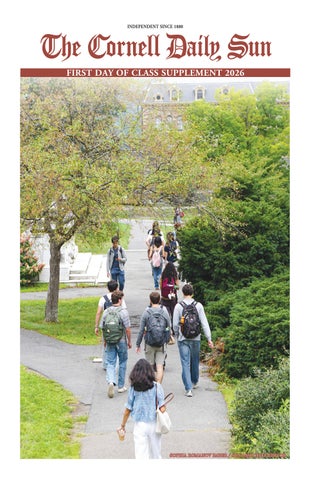
SOPHIA ROMANOV IMBER / SUN ASSOCIATE EDITOR
2 The Cornell Daily Sun | Wednesday, August 26, 2026
FDOC EDITION SUPPLEMENT
INDEPENDENT SINCE 1880
The Corne¬ Daily Sun Vol. 143, No. 2 News Sex abuse settlement
Arts
WEDNESDAY, AUGUST 26, 2026 n ITHACA, NEW YORK Sports Okereke inks contract
Get grinding
Weill Cornell reached a $1 billion dollar settlement over a former urologist’s abuses.
A book is too long. Instead, read a couple of quotes, courtesy of culture writer Wyatt Tamamoto.
| Page 3
| Page 13
20 Pages – Free
AK Okereke ’25 signed a two year, two-way contract with the Los Angeles Lakers. | Page 16
Austin Franco ’28 Writes ‘Not Interested in Working for a Jew’ on Handshake By EVERETT CHAMBALA Sun Assistant News Editor
June 13 — The University reported Austin Franco ’28 to the Office of Civil Rights for a bias incident in which he responded to a job offer with “Not interested in working for a jew. Thanks.” on Handshake, according to a June 8 X post from Gabe Einhorn, co-founder and CEO of the company which Franco was accepted to. The Sun spoke to Franco and Einhorn following the incident. Franco initially applied to a growth/sales role at Einhorn’s real estate startup, VrfyID, on May 26 through Handshake, a digital hiring platform, according to Einhorn. He was accepted in the first round and Gabe’s brother Aiden, who co-founded VrfyID, asked to set up a time for a meeting on May 29. Franco responded the same day with times he was available. Gabe told The Sun that both him and Aiden then offered two dates for students to attend, neither of which Franco went to. When Aiden followed up on June 8 to ask Franco about his attendance, Franco responded with “Not interested in working for a jew. Thanks.” Gabe, who describes himself as a “proud Jew” who always wears a kippah, and Aiden were both “taken aback” when they initially read the message and did not know how to react, Gabe told The Sun. Franco found out Gabe and Aiden were Jewish based on their “first and last name, LinkedIn, and physiognomy,” according to a statement Franco wrote to The Sun. Physiognomy is an 18th and 19th century practice of studying facial features to determine character and temperament. The practice is now regarded as pseudoscience. Gabe’s post was shared on X on June 8 and amassed over two million views in less than a week. In the post,
he attached a screenshot of his exchange with Franco and described the hiring process, ending his caption with “Sad world.” Gabe had previously posted about facing antisemitism while attempting to film street interview content and faced many comments denying that antisemitism existed, he told The Sun. Gabe posted the screenshot with Franco’s name crossed out, hoping to “prove a point to people that antisemitism exists” without causing personal damage to Franco, he said. “He’s just a student, he might not know any better — it could be people in his environment, or on social media he saw something about Jewish people and he is just following the wave,” Gabe said.
However, comments on the post revealed Franco’s crossed out last name through a photo editing software, leading to his identity being revealed to the public. Franco learned about the X post on Monday morning and wrote that he began facing doxxing and intimidation, which included “digging up personal information, harassing via email and phone employers, and receiving threats,” according to a statement from Franco to The Sun. “The whole debacle caused undue stress for my family, and they were assumed guilty by association. I was unperturbed by the events and hope to come out of this experience with a better idea on life,” Franco wrote in a follow-up statement to The Sun. On the morning of June 9, Franco took to X to respond to Gabe’s post and the responses, criticizing Gabe and the response from “[Gabe’s] community.” “My experiences with Jews have not been pleasant … this is not to say I havent had positive experiences, but on the aggregate that is not the case,” Franco wrote on X. “Given that I have been doxed and intim[id]ated by your community including having my personal life investigated for no other reason than a single comment I cant imagine any reasonable person not coming to a similar conclusion.” To continue reading this story, please visit www.cornellsun.com. Everett Chambala can be reached at echambala@cornellsun.com.
PHOTO COURTESY OF AUSTIN FRANCO
Community Takes Center Stage at 49th Annual Ithaca Fest By EVERETT CHAMBALA
Food and craft vendors then set up their booths from Friday through Sunday, workJune 4 — When the students leave town, ing from morning until night. Vendors and participants described the the Ithaca community comes together. Over event as an opportunity to reunite with the past weekend, the 49th annual Ithaca friends and community members while Festival was held in the Ithaca Commons also celebrating the start of summer. and throughout the downtown area, featuring live music, over 150 crafts vendors and Approximately 45,000 people attend the festival each year, according to its website. cuisine from around the world. For Allison DeDominick, president of The festival kicked off with a parade on the Ithaca Festival Board of Directors since Thursday where participants made floats 2023 and board member since 2019, the and decorations inspired by this year’s festival is a meaningful way to showcase local theme: Downtown Disco. The design for art. The event originated in 1977 as a way to Downtown Disco was made by local artist “celebrate the creative culture of Ithaca,” she Leonora Petronzio. wrote to The Sun. “I really love just organizing people to embrace art in some way, shape or form,” DeDominick said. “So that’s what drew me, and I think that’s what this festival embraces too, giving people a platform to come and share their crafts, share their performances.” Food vendors were mainly located on West EVERETT CHAMBALA / SUN ASSISTANT NEWS EDITOR State Street with picnic Brass bangers | The Fall Creeks Brass Band jammed out at the tables for people to eat Bernie Milton Pavilion in downtown Ithaca on May 29 their food. Festivalgoers Sun Assistant News Editor
could try a wide mix of options – jerk chicken, bánh mi, arepas, Cuban sandwiches, pitas and more. “Food is art,” added DeDominick. Live music also filled the streets. Local musicians and dance groups performed at every corner, making music at Bernie Milton Pavilion, Cayuga Circle and Dewitt Park. The Ithaca Festival was dog-friendly, with many craft booths offering dog treats and dog accessories for purchase. Many well-behaved dogs could be seen walking around with their owners as well. Colleen Burke, a traveling nurse who drove three hours from Buffalo to attend the festival, appreciated its welcoming atmosphere. “There’s arts and crafts all the time, there’s food all the time,” Burke said. “It’s a cool combo, [and it’s] very family friendly [and] dog-friendly, which is awesome.” Eve Duff, a senior at Ithaca High School, has attended Ithaca Festival every year since ninth grade. When asked about if she has observed a change over the years, she said that the festival “always has the same backbone.” To continue reading this story, please visit www.cornellsun.com.
EVERETT CHAMBALA / SUN ASSISTANT NEWS EDITOR
Downtown dancers | Ballet dancers were one of the many performances at the intersection of Cayuga and State Street Everett Chambala can be reached at echambala@cornellsun.com.
2 The Cornell Daily Sun | Wednesday, August 26, 2026
Daybook
Daybook
Wednesday, August 26, 2026
A LISTING OF FREE EVENTS ON CAMPUS AND IN ITHACA
The Corne¬ Daily Sun
Today
INDEPENDENT SINCE 1880
International Fair 11 - 1:30 p.m., outside of Uris Hall
Editor in Chief
Sophia Dasser ’28
ALL DEPARTMENTS
(607) 273-3606
Business: For questions regarding advertising, classifieds, subscriptions or delivery problems, please call from 9 a.m. to 5 p.m., Monday-Friday. News: To report breaking news or story ideas, please call after 5 p.m., Sunday-Thursday.
SEND A FAX VISIT THE OFFICE THE SUN ONLINE E-MAIL
(607) 273-0746 139 W. State Street, Ithaca, N.Y. www.cornellsun.com sunmailbox@cornellsun.com
Postal Information: The Cornell Daily Sun (USPS 132680 ISSN 1095-8169) is published by the Cornell Daily Sun, a New York corporation, 139 W. State St., Ithaca, N.Y. 14850. The Sun is published Wednesdays during the academic year and every weekday online. Three special issues — one for seniors in May, one for reunion alumni in June and one for incoming first-year students in July — make for a total of 33 issues this academic year. Subscriptions are: $35.00 for fall term, $37.50 for spring term and $72.50 for both terms if paid in advance. Standard postage paid at Ithaca, New York. Postmaster: Send address changes to The Cornell Daily Sun, 139 W. State St., Ithaca, N.Y. 14850.
Author Talk: Luisa Pastor 4:30 p.m., Goldwin Smith Hall 258 Trivia Night 7 - 9 p.m., Ithaca Beer Company Hot People Read Book Club 5 - 6 p.m., Buffalo Street Books Verano de Jazz 9 p.m. - midnight, Tres Leches
Tomorrow From Spheroids to Organoids: Seminar Series 11:45 a.m. - 1 p.m., Biotechnology Building G01 Southeast Asia Program Undergraduate Open House 3:30 to 6 p.m., Kahin Center Summer Concert Series 5 p.m., Bernie Milton Pavilion Tock the Gnome, Volune 1 Release Party 6 - 4 p.m., Olin Library 303 Karaoke on Thursday’s 10 p.m. to 1 a.m., 130 East Seneca St.
The Corne¬ Daily Sun FRESHMEN SURVEY
Welcome Class of 2030! As you embark on your journey at Cornell, we invite you to take some time and reflect on who you are at this point in your lives. Last year, The Sun launched its inaugural Senior Sunset Survey. To continue this effort to connect with students, we now are creating our first annual Freshman Survey. You can fill it out at the QR code above.
- The Sun’s Data Team
The Cornell Daily Sun | Wednesday, August 26, 2026 3
News
University Prohibits Processing Wild Game in Communal Kitchens By EVERETT CHAMBALA Sun Assistant News Editor
July 26 — Cornell has updated its Community Living Standards to include a clause banning the processing of wild animals in communal kitchens. The update follows a September incident in which students skinned and butchered a legally hunted bear in a shared kitchen in Ganedago: Hall, a residence hall on North Campus. A University spokesperson confirmed that the update is a response to the Ganedago: Hall incident. “The policy aims to provide clarity regarding what is or is not appropriate to do in a communal kitchen space,” the spokesperson wrote. On Sept. 6, two students hunted and killed an adult black bear in the Department of Environmental Conservation’s Region 4, approximately two hours from campus, before bringing it back to Ganedago: Hall to process it. Aaron Chin ’27, one of the bear skinners who revealed himself on the MeatEater Podcast, explained on the podcast that they intended to process the bear at a friend’s place, but they ran into an “emergency” and took it to the dormitory kitchen, not wanting to let the meat
spoil. The skinning was met with online backlash on Reddit and Sidechat, an anonymous social media platform, as images circulated showing the bear’s remains on the shared kitchen table and meat stored in ziploc bags in the dorm’s communal fridge. The skinning also resulted in the kitchen being shut down for two days and fully sanitized by staff from Cornell’s Building Care Department. The bear was hunted legally, per New York State’s bear hunting regulations, and no code violations were found following an investigation from the DEC. Despite the two students involved not facing disciplinary action from the University, the incident received national coverage — even inspiring an opinion piece from The Dartmouth. Chin did not respond to a request for comment by the time of publication. “Cooking in the University residences can be a great activity to bring people together, but it can also create unsafe and unsanitary conditions for the community if not done in a manner that respects all members of the community,” the living standards state.
Everett Chambala can be reached at echambala@cornellsun.com.
Weill Cornell Settles Over $1 Billion in Sexual Abuse Claims, Announces $30 Million Patient Safety Initiatives By ZEINAB FARAJ Sun Senior Editor
Aug. 3 — Weill Cornell Medicine agreed to pay over $1 billion to settle civil claims of patients who were sexually abused by former assistant professor and urologist Dr. Darius Paduch, and established a $10 million yearly fund for three years to support sexual misconduct prevention, according to a U.S. Department of Justice release. The settlement comes after a federal investigation into Weill Cornell Medicine exposed institutional failures in how patient complaints against Paduch were handled, including a lack of centralized processes or standards for documenting or investigating complaints. The release also states that for-
mer urology chair Dr. Peter Schlegel received several reports of Paduch’s inappropriate behavior and failed to escalate the allegations or conduct proper investigations into the claims. Paduch was sentenced to life in prison in November 2024 for his yearslong sexual abuse of more than 50 male patients, including six minors, from at least 2009 to 2019 under the guise of medical care. He was sentenced after being convicted on six counts of inducing a person to travel to engage in unlawful sexual activity and five counts of inducing a minor to engage in unlawful sexual activity. “Thanks to the work of our dedicated Assistant U.S. Attorneys, Darius Paduch is spending his life in prison
COURTESY OF WEILL CORNELL
Sexual abuse settlement | Weill Cornell paid over $1 billion to settle civil claims of patients sexually abused by Dr. Darius Paduch, who in 2024 was sentenced to life in prison.
for his horrific crimes and, importantly, WCM, a leader in healthcare for New Yorkers, is committed to maintaining an industry-leading sexual-abuse prevention program and to self-reporting any future federal crimes involving sexual misconduct to our Office,” wrote Criminal Division Chief Amanda Houle in a federal press release.
“As always, we want to be very clear that there is no place in our community — or in any medical institution — for the type of misconduct that occurred here.” Michael Kotlikoff and Robert Harrington Paduch, who worked at Weill Cornell from 2003 to 2019, often conducted examinations with patients alone, and directed victims — including boys as young as 13 years old — to masturbate in his presence or with his help, in several instances penetrating patients’ rectums without gloves while masturbating them, according to the released federal indictment. Paduch also “took various steps to cause, induce, and entice certain victims to return to see him,” and inappropriately communicated with patients using his personal cell phone. He invited several patients to his personal residence or boat where he “engaged in similar sexual abuse under the guise of medical treatment,” according to the settlement between Weill Cornell and the federal government.
Sentencing Judge Ronnie Abrams ’90 said that Paduch’s crimes were so horrific that it was the first time she sentenced someone to life in prison when it was not required, the Associated Press reported. In a July 27 statement to the Cornell community, President Michael Kotlikoff and Dean of Weill Cornell Robert Harrington elaborated on the $30 million initiatives aimed at preventing future misconduct. The initiatives include expanding Weill’s chaperone requirements for sensitive medical treatments, creating “a centralized process” for patient complaints, reporting and investigation of alleged sexual misconduct and developing “new escalation protocols” aimed at reducing the risk that sexual misconduct “could ever go undetected.” The statement also announced the creation of the Institute for Safe Patient Care and Patient Empowerment, which will drive “dialogue and action by healthcare organizations for early identification and prevention of sexual misconduct.” “As always, we want to be very clear that there is no place in our community — or in any medical institution — for the type of misconduct that occurred here,” Kotlikoff and Harrington wrote. “All of us at Cornell University and Weill Cornell Medicine are committed to learning from these events, continuing to strengthen our safeguards, and continuing to advance our mission of patient care, research, and education.” Zeinab Faraj can be reached at zfaraj@cornellsun.com.
Photo
4 The Cornell Daily Sun | Wednesday, August 26, 2026
SUNBURSTS: Shining Anew Devices charged and bags packed, Cornellians start a bright new semester.
By SUN PHOTOGRAPHY DEPARTMENT
Adelaide Chow / Sun Assistant Photography Editor A NEW CHAPTER | A student focuses on their work ahead of the semester during a quiet morning in the Physical Sciences Building.
Adelaide Chow / Sun Assistant Photography Editor PENCILS READY | Students pack into Baker Lab for one of Cornell’s infamous chemistry classes.
Samantha Miculinich / Sun Staff Photographer MORNING RUSH | Flocks of students pass by McGraw tower as they trek to their classes.
Sophia Romanov-Imber / Sun Associate Editor SAGE SEMESTER | Students roam central campus as they navigate their way to class.
Danica Lee / Sun Staff Photographer LOOKING AHEAD | Crowding around Zeus tables, students catch up on summer and share excitement for the semester ahead.
Danica Lee / Sun Staff Photographer NEW DAY | Students enjoy the warm weather, taking a break next to the A.D White Statue.
Danica Lee / Sun Staff Photographer BRANCHING OUT | Underneath a white oak on the Arts Quad, students enjoy the greenery and socialize.
Nathan Bo / Sun Assistant Photography Editor LAST BELL | After a long, exciting day, students walk back to their dorms.
To see more photos, please visit cornellsun.com.
The Cornell Daily Sun | Wednesday, August 26, 2026 5
News
Cornell Removes Essay Question Hochul Signs Moratorium on for 2026-2027 Application Cycle Data Center Permitting in NY By EVERETT CHAMBALA Sun Assistant News Editor
Aug. 20 — Applicants to colleges for the 2026-27 application cycle will see a distinct change in how they apply to the No.1 school in New York — for the first time since 2024, Cornell’s application will not include a 350-word universitywide essay question. According to a statement from Pamela Tan ’97, director of undergraduate admissions, the University “determined that the college/school-specific essays were sufficient to help [it] see a student’s fit for Cornell.” The removal of the universitywide essay question was the only change for this application cycle, and the college/ school-specific essays will remain a part of the application, according to Tan. The previous year’s universitywide essay question asked students to write about the importance of community in their lives. “We all contribute to, and are influenced by, the communities that are meaningful to us. Share how you’ve been shaped by one of the communities you belong to,” last year’s 350-word question read. “Define community in the way that is most meaningful to you. This community example can be drawn from your family, school, workplace, activities or interests, or any other group you belong to.” By removing the universitywide essay question, the University wanted to send the message that an applicant’s desired college or school is distinct from the rest of campus. “You’re not just applying to Cornell; you’re applying to [a] specific part of campus, with a unique academic approach
and mission,” Tan wrote to The Sun. “Researching this and expressing your interest in one of the colleges/schools through the program-specific essay is one of the most important parts of your application to Cornell.” Multiple other universities also removed supplemental essays for this application cycle, according to Inside Higher Ed. Washington University St. Louis removed an optional essay question, Tulane University paused its “Why Tulane?” essay question and the University of Georgia removed an essay question asking students to discuss a book they read and enjoyed. The University of Virginia made a similar decision the year prior, choosing to remove a prompt which asked applicants about a part of their background that would serve as a strength for them at the school, according to The Cavalier Daily. Following this decision, the University of Virginia saw a surge in applicants for the class of 2030. Cornell’s decision to remove its universitywide essay question was not made in response to other universities removing their essay questions, Tan wrote in a statement to The Sun. The 350-word universitywide essay question was originally introduced in 2024, based on a recommendation from the Presidential Task Force on Undergraduate Admissions, according to Tan. To continue reading this story, please visit www.cornellsun.com. Everett Chambala can be reached at echambala@cornellsun.com.
By ATTICUS JOHNSON Sun News Editor
July 18 — New York Gov. Kathy Hochul signed an executive order Tuesday morning placing a one-year hold on permits for new “hyperscale” data centers — those with a capacity above 50 megawatts. The moratorium, the first of its kind in the nation, was taken so that the state can have more time to plan regulations, according to a release from the governor’s office. “New York will lead the way in creating the strongest standards in the nation for data center development,” Hochul said in the statement. Her action brings New York to the forefront of a national debate on data centers and their long-term effects on the communities they are built in, though the state was not yet a top destination for data center developers. It puts the development of around 20 hyperscale centers around the state on hold — including data center developer TeraWulf’s plans for a 400 megawatt center in Lansing. That center, set to be built on the site of the old Milliken power plant and entitled Cayuga Data in official filings, faced strong opposition from local groups like No Data Center FLX and environmental watchdog Cayuga Lake Environmental Action Now! More than 20,000 people have signed a petition opposing the proposed center. The groups backed Hochul’s effort but urged her to take stronger steps to limit data center development. “The EO is a good start,” a No Data Center FLX spokesperson wrote to The Sun, “and we will continue advocating
for Gov Hochul to sign the Responsible Data Center Act,” a sweeping bill that contains a moratorium on data center development and separates the rates consumers pay for utilities from those data center operators do. John Dennis, the founder and president of CLEAN!, wrote that he was “delighted” with the news. “We absolutely expect this will impact [TeraWulf’s] process,” No Data Center FLX added, because the order targets developments without any permit or “other form of permission.” TeraWulf’s Lansing site does not currently have any approved permits. A Lansing Planning Board meeting in April was packed with No Data Center FLX protestors, who wore red shirts to signal opposition to the 438acre project. While the board determined TeraWulf’s plans were incomplete at the time, the organization called the proposal an “irrevocable change” to the area. No Data Center FLX and CLEAN! are also suing TeraWulf and the Lansing Board of Zoning Appeals for the center’s current classification as a “general processing facility,” a term not defined in Lansing’s zoning code, that makes it easier for the development to proceed. That lawsuit will continue, Stephen Daly, the lead attorney for the environmental groups, told The Sun, because the Lansing ZBA’s decision remains in effect. TeraWulf and its attorney did not respond to a request for comment. Atticus Johnson can be reached at ajohnson@cornellsun.com.
6 The Cornell Daily Sun | Wednesday, August 26, 2026
Opinion
The Corne¬ Daily Sun Defne Yucesir Independent Since 1880 144th Editorial Board SOPHIA DASSER ’28 Editor in Chief
SOPHIA ROMANOV IMBER ’28 Associate Editor
VARSHA BHARGAVA ’27 Managing Editor
RAYEN ZHOU ’29 Opinion Editor
KATE TURK ’27 Assistant Managing Editor
ZARA CHEEK ’28 Opinion Editor
CORAL PLATT ’29 News Editor ATTICUS JOHNSON ’28 News Editor MARY CAITLIN CRONIN ’28 News Editor EVERETT CHAMBALA ’27 Assistant News Editor
JADE DUBUCHE ’27 Multimedia Editor BENJAMIN LEYNSE ’27 Multimedia Editor KENDALL MURPHY ’28 Business Manager CHARLIE CLARK ’29 Director of Revenue & Partnerships VICTORIA WROBLEWSKI ’28 Human Resources Manager MELISSA MOON ’28 Arts & Culture Editor JAMES PALM ’27 Assistant Arts & Culture Editor MATTHEW RENTEZELAS ’28 Assistant Arts & Culture Editor HAZEL TJADEN ’28 Assistant Arts & Culture Editor MARC STAIANO ’27 Assistant Arts & Culture Editor KATELYN HALVERSON ’28 Lifestyle Editor AVA BETNAR ’29 Assistant Lifestyle Editor SANIKA SARAF ’28 Assistant Lifestyle Editor KATHERINE ISTOMIN ’29 Marketing Manager JOIE JEAN-PAUL ’29 Assistant Social Media Editor ASHLIN KWONG ’28 Graphics Editor TAVAN BHATIA ’27 Games Editor RENA GEULA ’28 Layout Editor
SHUBHA GAUTAM ’28 Assistant News Editor GISELLE REDMOND ’28 Assistant News Editor ANGELINA TANG ’28 Science & Technology Editor TANIA HAO ’28 Science & Technology Editor SIMRAN LABORE ’27 Weather & Climate Editor MATTHEW LEONARD ’28 Sports Editor GRACE REUBEN ’28 Sports Editor JANE HAVILAND ’28 Features Editor NATHAN ELLISON ’28 Photography Editor NATHAN BO ’28 Assistant Photography Editor ADELAIDE CHOW ’29 Assistant Photography Editor MIA SOFIA ORENGO ’28 Video Editor OAKLEY DECRISTOFARO ’29 Video Editor DEAN THAKUR ’27 Newsletter Editor SMRITHE RAJESH ’29 Newsletter Editor AMELIA GARCIA ’27 Data Editor HUNTER PETMECKY ’28 Layout Editor
WORKING ON TODAY'S SUN MANAGING
NEWS DESKERS
SCIENCE DESKERS SPORTS DESKERS OPINION DESKERS LIFESTYLE DESKERS ARTS DESKERS
Sophia Dasser '28 Varsha Bhargava '27 Kate Turk '27 Sophia Romanov Imber '28 Giselle Redmond '28 Mary Caitlin Cronin '28 Atticus Johnson '28 Shubha Gautam '28 Angelina Tang '28 Grace Reuben '28 Rayen Zhou '29 Katelyn Halverson '28 Ava Betnar '29 Melissa Moon '28
Adriana Vink Adriana Vink '27 is an Opinion Columnist and a student in Cornell's School of Industrial and Labor Relations. Her fortnightly column One Day Longer takes aim at campus politics, international relations and labor exploitation. She can be reached at avink@cornellsun.com.
The Welcome Cornell Won’t Give You
C
lass of 2030 — welcome to your first day of class! You’ve just completed a week full of orientation events, but I bet none of them introduced you to the real Cornell. I came to Cornell for the world-class School of Industrial and Labor Relations, bright-eyed and searching for my path to “do the greatest good” — this is probably where many of you find yourself today. When I discovered my path at Cornell, it wasn’t in a particular class or your average club, it was in organizing. I realized that the institution I was paying tens of thousands of dollars in tuition, was turning around and investing that money into weapons manufacturers like Lockheed Martin and Elbit Systems. In turn, those companies were creating the missiles, planes, drones and guns being used to massacre Palestinians in Gaza. Take Elbit Systems, whose CEO said in 2025, “Elbit Systems is proud to continue serving as a key partner of the Israel Ministry of Defense and the Israel Defense Forces in advancing their technological capabilities.” Elbit creates core components for the Merkava battle tank, used by the IDF. In a horrific story many of you might be familiar with, Israeli soldiers fired 335 bullets on
Defne Yucesir is an Opinion Columnist and a student in the College of Arts & Sciences. Her column, In Transit, explores the relationship between politics and the academy, examining questions of disciplinarity, identity politics and the purpose of higher education from a global perspective. She can be reached at dy362@cornell.edu.
The Death of Critique in the Humanities
O
f all the clichés that literature has taught me to avoid, none seems quite as unavoidable as the “death of the humanities.” With each new threat — from artificial intelligence to academic job scarcity — arrives yet another announcement, then another defense as to why the humanities remain valuable. Perhaps one of the simplest and most compelling defenses is that students turn to these disciplines for a sense of ownership, but ownership of what exactly? During the first semester of my year abroad at Cornell, I found myself worrying about the release of grades. I had taken primarily humanities classes for the first time in my undergraduate degree, with little idea as to how I had performed. When I mentioned this to a classmate, they reassured me, "Well, it's not like they can tell you your opinion is wrong, and anyway, the professor likes our class." In the humanities, rhetoric had its own arithmetic, one that my studies in the United Kingdom had taught me could be difficult to predict. So how had my classmate come to decide that these disciplines were simply a matter of opinion, or of taste? Since the 1960s and 1970s, universities have seen an increasing and necessary pressure to diversify the voices represented in the humanities disciplines. Debates around the existence and makeup of the literary canon, emerging through events such as the Stanford Western culture controversy, have seen a greater push on efforts to diversify the humanities. One form of this diversification is ensuring that a greater breadth of positionalities is represented both in the works studied and among the scholars, including the students studying them. This is by no means an attack on the value of diversification. However, in a culture that accentuates the relationship between scholarship and positionality, it becomes increasingly difficult to separate critique from the individual who expresses it. During my studies in the United States, I became more aware of the propensity for disagreement in the humanities to become politicized and to influence the way classes in these disciplines are approached. The reputation of humanities classes as grade boosts was foreign to me, coming from the U.K., where students fear a final year Nietzsche module at least as much as they do calculus. For the first time, I encountered students who attributed the alleged ease of achieving high grades in the humanities to the fact that their arguments were “opinions,” and as such, less readily deemed incorrect. As an opinion columnist, I believe relaying an idea as opinion does not grant the exemption from criti-
a black Kia Picanto, in which six-year-old Hind Rajab was trapped with her family. They killed Rajab’s entire family and two paramedics sent to rescue them, with full knowledge of their victims’ civilian statuses. My tuition money is funding genocide across the world? My school was complicit in the killing of Palestinians like Hind Rajab? I knew I couldn’t sit by and allow that to happen. I joined Students for Justice in Palestine, and the broader movement for Palestine at Cornell, in fighting for divestment. As you may have seen, students at Cornell and at universities across the country have established encampments for Palestine on their campuses. Over the past three years, Cornell students have led a referendum, kicked weapons manufacturers off our campus, occupied Day Hall and protested Israeli war criminals, all of this in the face of intense University repression. Pro-Israel zealots alongside their allies in the mainstream media want you to believe that the student movement is dead, either reveling in our defeat or condescendingly opining, “Where are all the campus protests?” I’m here to tell you: the campus protests are
cism for which one might hope. However, if accepted as opinion, ideas become more difficult to criticize, without implicating the wider belief system of the individual. This does not simply operate at an individual level, but as positionality gains relevance, at a collective level, the personhood of the author becomes increasingly significant to the views they advance. Yet even if the assumption that it is easier to do well in the humanities is misguided, perhaps the sense of relief certain students find in the humanities is productive for the growth of these disciplines. At a time when the number of humanities majors is decreasing, less grading pressure could help make these majors more attractive to students. And what if the odd critical theory class were to produce the next Susan Sontag or Zadie Smith? There is nothing to say it could not. However, there would be little point in welcoming students into the humanities if this comes at the expense of the very critical faculties these disciplines are designed to cultivate. Within these disciplines, we choose interlocutors, frameworks, or traditions, and are responsible for these choices. Critique therefore requires different perspectives, but it equally requires preserving a pedagogical structure in which an American professor with a doctorate in Ottoman studies is allowed to tell me, as someone of Turkish heritage, that my reading of a Turkish ghazal is weak, without fearing that this will somehow be construed as silencing the voice of a Turkish woman. Yet this fear is now so felt within the humanities that even in making this argument, I reach for a hypothetical to which I feel I have a claim. I reach for the shelter of that infamous “as a blank,” supposedly limiting my critics to only other people who fall within the smaller group of blank. I cannot escape the object of my critique. If we create a climate in which positionality can take precedence over the authority we acquire through education, then we devalue that education. Education, by definition, is about acquisition and process. It is a state of becoming. To defend the humanities is to defend this state of becoming, to take comfort in it. This defense requires the preservation of an academic culture in which inclusion is not the same as the suspension of critique. It means identity in scholarship is understood as intellectual, shaped by research interests, educational backgrounds and views taken in their own right, the crafted rather than the inherited. Only then can we hope to prop open the door to the humanities, and still make the room worth entering.
here. The welcome I offer to you is to the student movement, where the fight for a more just Cornell has never stopped. This fall, the student body is renewing our call to end our University’s complicity in Israel’s genocide in Palestine. Students for Justice in Palestine, Young Democratic Socialists of America and Jewish Voice for Peace are united in fighting for our shared demands. We demand Cornell follow its own ethical investment guidelines and divest from weapons manufacturers complicit in “apartheid, genocide, human trafficking, slavery, and systemic cruelty to children.” We demand Cornell sever its ties to the Technion – Israel Institute of Technology, end Career Services collaboration with U.S. Immigration and Customs Enforcement and weapons manufacturers and stop housing research into arms and surveillance technology. At the same time, Cornell must invest in affordability efforts for the Ithaca community and its own students. Welcome to Cornell, Class of 2030. Join us. Free Palestine.
The Cornell Daily Sun | Wednesday, August 26, 2026 7
COLUMNS
Wake Up With The Sun
ISABELLE JUNG / FORMER GRAPHICS STAFFER
Class of 2030, You Are on the Record Sophia Dasser
Letter From The Editor
Sophia Dasser '28 is the Editor in Chief of the 144th Editorial Board and was the Opinion Editor of the 143rd Editorial Board. She is a Computer Science and Philosophy student in the College of Arts and Sciences. Her column Dass(er) The Point explores the intersection of technology, ethics and social justice, with a focus on the overlooked and underrepresented. She can be reached at sdasser@cornellsun.com or at (321) 203-6550.
W
elcome to Cornell, Class of 2030 and congratulations. You arrive from all 50 states and 102 countries, from nearly every language and tradition a college
campus can hold, to spend the next four years on a campus that is now, undeniably, yours. The Cornell Daily Sun has been Cornell’s living record since 1880, which is to say that for 145 years a rotating cast of undergraduates has walked into our downtown office and decided, against most reasonable advice, that Cornell in all of its dimensions, the shadowy parts and the glistening ones, the assemblies and the protests and the snowstorms and the Saturday games and the meetings nobody else sits through, is worth putting on the record — and starting this month you are worth putting on it too, because you are what happens to Cornell next, and what happens to Cornell is kind of our thing. Over the next four years, you will come to understand Cornell not through a brochure or a tour or a welcome speech but through the slow accumulation of our record, day by day, and by extension through what it comes to hold about you. But, our record is only as true as it is representative, and a paper written entirely by undergraduates is only as repre-
sentative as the undergraduates who write it. Which is where you come in. The Sun is written, edited, photographed and published entirely by students who decided, at some point in a semester like the one you are about to start, that they wanted to be one of the people keeping that record rather than one of the people kept in it. If you feel that same pull at all, follow us on Instagram at @ cornellsun for recruitment updates, walk into our office at 139 W. State St., submit a guest piece to our Associate and Opinion editors or write to me directly. There is always room on the masthead for the next class of folks willing to help keep the record true. You will hear the chimes soon. You will cross the gorges in the fog and stare down the slope at a sunset that will embarrass every sunset you have seen before it. You will build a version of yourself that you have only just started to imagine. And through all of it, The Sun will keep the record, on you and with you.
Welcome, We Hope You Enjoy Your Stay Sophia Romanov Imber
Letter From The Associate Editor Sophia Romanov Imber is a member of the Class of 2028 in the College of Arts and Sciences. She is the associate editor for the 144th Editorial Board and was a former assistant arts editor for the 143rd Editorial Board. She can be reached at sromanovimber@cornellsun.
W
elcome to Cornell, Class of 2030! As you make your trek to Ithaca — whether it’s a 5-hour drive or a 15-hour flight — you’re entering an entirely new stage of your life. It’s easy to dive headfirst into class schedules, coffee chats and club recruitment, but take a moment to celebrate what an amazing accomplishment it is to begin college. Celebrate that you made it here because there’s simply no diminishing the time, effort and dedication you devoted to arriving at this moment. Familiarity will take time, and for the next few months, every step will be new territory. But you must embrace it rather than reject it
for the path of least resistance. College is a chance to learn more about yourself, so stay open-minded, talk to anyone and everyone — you’ll realize that people are more willing to help than you might think. This significant change is an opportunity to build a life of your own, one that is not confined to the social expectations set by your previous chapter. Our ideas of college can largely differ from the reality of being on campus. The imagination can prepare us for what’s to come, but it can also disappoint us when we’re faced with different outcomes. Remember that you don’t need to adhere to your own expectations. Your major can change; you might join a comedy club; you might even study abroad 10,000 miles away. You truly never know what can happen, so don’t be dissuaded when things change; often, it’s for the better. Now, while you’re going through this stage of self-growth, remember that college isn’t just about you. You’re building new relationships and discovering the world from a new perspective. At Cornell, you’re also contributing to a long history of brave individuals; you’re joining the likes of Toni Morrison M.A. ’55, Ruth Bader Ginsburg ’54 and Bill Nye ’77, just to name a few. So challenge yourself because growth doesn’t happen when you're comfortable. A bold university demands boldness, for both its
legacy and yours. Learn from our history: the power of our campus and the power of your voice. From the Willard Straight Hall occupation in 1969 to the Arts Quad encampment in 2024, you can join the long line of students who have fought for their convictions. Ithaca may be isolated, but a college campus can ignite powerful conversations about how we engage with our communities and the world at large. Physically, our university is nothing more than a collection of buildings and students, so as students, we shape what Cornell is every day by standing up for what we believe in. If we make up Cornell, then collectively we are Cornell. It’s a responsibility we accept with grace through every course and every semester. Now, enjoy the time you have here. Sure, time will fly. Sure, four years will pass by before you know it. But enjoying your time looks like embracing each day and the agency that comes with it. Curate your life to look the way you want it to look. A new environment and new people bring novelty to each day, and you can decide how each day goes. It’s going to be great, and we can’t wait to see you on campus. Oh, and if you’re ever wondering what’s going on, pick up a copy of The Sun on your way to class. We’re always here for you.
8 The Cornell Daily Sun | Wednesday, August 26, 2026
The Cornell Daily Sun | Wednesday, August 26, 2026 9
The Corne¬ Daily Sun
What Your College Says About You So, to celebrate the start of a new school year, let’s discuss what your college says about you. Let’s also examine job opporBy LIFESTYLE DEPARTMENT tunities before the Bermuda Triangle of y darling freshmen, it’s time for Talent (consulting, finance, Big Law) captures us all. your first existential crisis! During the great torture that College of Arts and Sciences is the Common Application process, you had to pick a major. But how to Starting off strong, we have Arts and decide? Do you pick what interests you or what your college counselor says is best? Sciences: the college where a double or Luckily for you, at Cornell, you are initial- triple major is more frequent than an ly only trapped within a college. Choosing internship offer. Joking … I promise. If you’re in A&S (emphasis on the between internal schools is often the least important decision, right? You pick the ampersand), you’re ambitious and enjoy a easiest major to get into, and you can just variety of courses. Don’t fret; that variety change it when you get on campus. So is imposed. The downside of such a large college is that it’s easy to get lost in the simple! That is, until you find yourself reload- shuffle. It’s the only college you can apply ing the website, absolutely stunned by undecided to, so for all you indecisive your college’s distribution requirements people, you’re just delaying the inevitable. and your major’s core classes. College of You can procrastinate your homework, Arts and Sciences? Yes, you need to study but no one wants to see a ninth-semester a foreign language. Pre-med? Kiss study senior. You probably spend all your time in the abroad goodbye. When you get on campus, you’ll hear Arts Quad or only take classes adjacent to the same monotonous introductory ques- your major. But that’s no fun. Instead of tions: Where are you from? What dorm letting A&S consume you, try getting a are you in? What major are you? Oh, what taste of courses away from the quad. Sure, do you want to do with that? [Insert mini- we’re all going to take HADM 4300: mal job prospects answer.] Conversations “Introduction to Wines,” but why not fade into the background… Westchester, sample a business-focused course? There Donlon, government, lawyer (of course). … is really no need to zero in on one field; Bay Area, High Rise 5, Dyson, consulting we won’t all go into academia. Actually, we can’t. Have you seen those terminated (naturally). These questions are perfect for Grad PLUS loans? So, I take what I said Orientation Week and navigating the back: Let’s surrender to the Bermuda start of classes, but the repetitiveness starts Triangle of Talent. Who are we kidding? to wear away at the questions’ signifi- It was bound to happen anyway. cance, and even in your junior and senior Cornell SC Johnson College of years, they won’t go away. It’s sort of like Business family holidays: You come up with an answer just to get out of the conversation, Speaking of business, we have the but then the answer becomes your reality, SC Johnson College of Business, which and all of a sudden you’re pre-law.
M
SOPHIA ROMANOV IMBER/ASSOCIATE EDITOR
includes the Dyson School of Applied Economics and Management and the Nolan School of Hotel Administration. But Dyson for undergrads is under the College of Agriculture and Life Sciences? I don’t know; I’m still very confused, but oh well. If you’re in Dyson or Hotel, you must love wearing a suit. Which reminds me: FIND A SUIT! (Cornell offers resources for free rentals!) You’ll need it for club recruitment and job recruitment and interviews and presentations and, oh goodness, when are you not wearing a suit? Probably when you’re traveling because you all seem to leave early for every break. This comes from a place of envy. The stereotype for Dyson kids and Hotelies is that your rigorous coursework demands proficient knowledge in the politics of coloring books and artisanal craftsmanship of folded towel swans, but that’s too reductionistic, so I’ll opt for something better: Excel sheets, food & bev and LinkedIn. Y’all love coffee chats but probably don’t have a stable coffee order, and that’s okay. We can’t all be
baristas. Don’t worry — the English majors will hold down the fort. College of Agriculture and Life Sciences Oh, CALS, I can’t tell if you love the environment in an “I study sustainability” way or an “I support data centers” way. You’re probably all following the ever-changing legal environment that does not care about the environment. When you’re not hugging trees, you’re admiring how sustainable Cornell is with all of the flights we take to reach Ithaca and escape it. You’re in a great college to help the world, but the world seems to be hell-bent on ending. Save the bees, I guess. To continue reading, please visit www. cornellsun.com. The Lifestyle Department covers campus life, academics, dining and housing, fashion trends, restaurants and events in Ithaca, among much more. They can be reached at style@cornellsun.com.
An Introvert’s Guide to the First Week of Classes By AARIYANA EDWARDS Staff Writer
A
lot of freshmen put major pressure on themselves to find their best friends or perfect their routines during Orientation Week. As an introvert, just hearing this expectation sends a chill down my spine. After what some would call the hell of O-Week — socializing with randoms and setting up plans you know aren’t going to happen for the following week — someone like me might become scared of the friendless possibilities of the next four years. Good thing I’m here to tell you that the world doesn’t end after O-Week. The first week of classes can be the perfect time to make new friends and find your groove here at Cornell. Plan out your first day. As an introvert, I despise having to talk to people when I’m stressed, so getting over that hurdle by planning out your first day is huge. Walk the route to all your classes to minimize any extra stress that could arise. With the size of Cornell’s campus, it’s easy to get lost and end up on the Engineering Quad when your class was actually by Mann Library. It might sound excessive to take an extra hour to walk around campus, but knowing those details can save every bit of the social battery that might have been used for asking for directions. Go to that club meeting. Go to random General body meetings for clubs that you might even be slightly interested in. These G-body meetings are the perfect opportunity to meet new people without having to be in the spotlight. It is especially helpful if it’s a non-academic club, so you feel freer
to talk with like-minded people. You don’t have to commit to anything on the spot, either. Half the appeal of a first meeting is that everyone else is just as unsure about joining as you are, which makes it a lowstakes place to strike up a conversation and allow yourself to have fun. Don’t be afraid to eat lunch alone. It might seem daunting to walk into one of Cornell’s many dining halls alone, but I promise — no one is thinking about what you’re doing. If anything, there are countless other students facetiming their friends back home, or doom scrolling all by themselves, too. Some of my favorite lulls of the day are putting on some good music and eating a quick lunch between classes. Having that time to recharge, especially during the first week of classes, is a must. Go to that party the guy on your floor talked about. As someone who loves their quiet time alone, I’ve learned I can’t really appreciate it without a good mix of social events thrown in. And what’s a more perfect time for that than a party? First week parties bring a short-lived wave of joy— upperclassmen are happy to be back on campus, and freshmen are riding the high of their new found freedom. This combination makes it the perfect time to talk to random people. I met one of my closest friends by going to a random party and talking her ear off. If I hadn’t gone, I would’ve never met her! But even setting that instance aside, parties offer a free space to meet and swap numbers with someone who happens to be in your CS 1110: “Introduction to Computing: A Design and Development Perspective” class — and suddenly, you’ve got a study session set up. Talk to people in your classes. This
KARLIE MCGANN/ SUN SENIOR EDITOR COURTESY OF MEDIOCRE MELODIES
might seem like a no-brainer, but actually conversing with the people around you beyond just — “Can I borrow a pen?” or “What did that last slide say?”— can make a big difference. Connecting with peers in class who share your major is one of the easiest ways to form friendships. Even if you don’t become friends right away with the people around you, being able to put a name to a familiar face during your 8 a.m. lectures helps you not to feel completely alone. I’ve personally found my closest friends in the shared trauma of STEM classes — nothing truly bonds two people faster than a looming prelim. Attend a free event. As materialistic as it may sound, one thing that always pushes me out of my comfort zone is the promise of something free. Luckily, during the first week, countless clubs host free pop-ups, often with the promise of a sweet treat or a cute stuffed animal. Even your own dorm
building will likely host something similar, which brings the added comfort of staying close to home while still meeting the people you’ll be living with for the next year. And what’s a better way to feel more connected than free food and a built-in excuse to ask a new friend to hang out? None of these tips mean saying yes to every opportunity, or forcing yourself into a version of college life you saw on TV. Some days that random party might sound awesome, and some days you desperately need to stay in and rewatch New Girl — both are amazing options. It’s less about pushing past your introverted qualities and more about finding your own balance. The first week of classes is as good a time as any to start. Aariyana Edwards is a member of the Class of 2029 in the College of Arts and Sciences. She can be reached at aae49@cornell.edu.
10 The Cornell Daily Sun | Wednesday, August 26, 2026
Features
Ithaca Cyclist Turns His Bike Shop Into a Community By EVERETT CHAMBALA Sun Assistant News Editor
Aug. 13 — Nested approximately a mile up Mount Pleasant Road — ‘Mount Unpleasant’ as the locals call it — sits a white farmhouse with a long gravel driveway where the sun sets over a farm field. From 6 to 8 p.m. every weekday, this house and its two garages are abuzz with sounds of dogs barking, chickens clucking and, most importantly, chatter about biking. Glenn Swan, a 73-year-old former sponsored cyclist who spends his working hours as a research support specialist in Cornell’s R.F. Smith School of Chemical and Biomolecular Engineering, is the main reason for the chatter, as he runs Swan Cycles out of his garage. The bike shop doesn’t have a website and is advertised solely through word-of-mouth — an intentional choice, he told The Sun. “I’m not focused on earning massive amounts of
VARSHA BHARGAVA / SUN MANAGING EDITOR
money,” he said. “I want people to be able to trust me, and I give them a lot of trust. And people live up to it.” Swan first opened the shop in 1979 after biking across the United States. It started as “$300 worth of bicycle parts in a cardboard box,” and its mission was exclusively geared toward building custom, high-end race bike frames and stocking the best available components. This was congruent with his budding career in the Union Cycliste Internationale World Masters Cycling games, where he said he competed across various continents including Europe, Australia and Canada, winning
multiple medals including a hill climb in Austria. “We used to be the masters of pain,” he said, describing how he and an elite group of about six riders would stay in constant competition across events. Since having a daughter in 2008 and stopping racing in 2010, his business model shifted to become “much more family-oriented,” and “much more recreationally-oriented,” he said. “If I get more people riding and happy, that’s a success,” he said.
“If I get more people riding and happy, that’s a success.” Glenn Swan Because Swan makes most of his living at Cornell’s machine shop, profit comes secondary to him. Much of his work includes explaining how to fix problems that arise, sometimes free of cost or at reduced prices if the problem doesn’t take long to solve. Building relationships is his main focus, though, because “when [people run into] a real problem, I know [they will] bring it to me,” he told The Sun. Swan prides himself on the uniqueness of his store, calling it the “Swan Cycles Experience.” Because Swan can only tend to one customer at a time, people end up socializing and enjoying the scenery at his house while waiting to be helped. He explained that oftentimes children end up fishing at his pond or playing with chickens while their parents shop. People also walk their dogs to his house, or even stop by to play with his two “mostly” Labrador retrievers, Blackie and Flash, named by his daughter when she was nine years old according to Swan. The pair were litter mates since birth and were adopted from a pound. He recalled one Ithaca College student who wanted to make a video about his shop for a class project and ended up helping him transport chickens — and briefly “chasing a chicken around the woods in the dark” — from a neighbor’s house back home. “That was a very eye-opening experience for her — which isn’t usually what you find when you go to a bike shop,” he said.
He told The Sun he feels like a “caretaker” for his property, which features over 100 acres of woods and trails used by cyclists and Cornell Nordic Ski Racing at Cornell in the winter. “That’s just as important to me as business or as my job at Cornell. … I know all of my trees,” he said. “The whole thing is a lifestyle.” Although Swan is the only current employee, he previously employed workers, many who went on to achieve successful careers in the cycling industry or in engineering. He explained how one of his previous employees worked for Cannondale, designing bicycles for European professionals. Swan told the story of another past employee who designs medical devices and sent him a device typically used to help pull out blood clots in the heart through a non-invasive tube — which Swan used to pull bike cables through his frames. Outside of just working at his store, Swan has helped organize community bike rides since the 1980s, including the Hollenbeck’s Spring Classic, Tuesday Night Races and the Swandrome Cyclocross Race, which is “quite possibly the longest continuously running cyclocross race in the US,” according to the Finger Lakes Cycling Club’s website and Swan himself. To continue reading this story, please visit www.cornellsun.com. Everett Chambala can be reached at echambala@cornellsun.com
EVERETT CHAMBALA / SUN ASSISTANT NEWS EDITOR
‘This Is the Place I Want to Be’: Incoming Freshmen Make the Move to Campus By VARSHA BHARGAVA Sun Managing Editor
Aug. 20 — After packing their suitcases and stuffing their car trunks, 3,681 freshmen made their way to Cornell on Monday, bringing a lively commotion back to a quiet North Campus. From 8 a.m. to 8 p.m., Cornell welcomed its new freshmen with friendly smiles, sunshine and a mid-day drizzle. Red pom poms and a chorus of orientation leaders yelling “Welcome to Cornell!” greeted the incoming freshmen and their families, introducing the
students to their new home. One incoming freshman, Mikhail Ahmad ’30, traveled 12 hours with his dad, Sami Ahmad, to get to the Hill for move-in. Driving up from North Carolina was a “journey,” Mikhail said, but he was excited to be on campus. “Hearing the cheering made me feel confident, like this is the place I want to be,” he said about the orientation leaders’ welcome. Sami called the move-in “bittersweet,” but found some comfort in his son’s rooming arrangements — by coin-
VARSHA BHARGAVA / SUN MANAGING EDITOR
Coming to campus| Welcomed by the cheers and waving pom poms of Cornell’s orientation leaders, thousands of incoming freshmen moved onto campus on Monday.
cidence, Mikhail would be living in the same building and on the same floor as his cousin did years ago. “It’s sad to let go of your firstborn and let them off on their journey, but it has its pluses and minuses,” Sami told The Sun. “He’ll be pretty far away, but he also has to begin his life. I’m excited for him.” Fifty orientation leaders prepared for move-in, rotating four-hour shifts around campus. One orientation leader, Argenis Alas ’29, explained that the team aims to “hype up” the freshmen and make them feel supported. “We’re really trying to create an inclusive and welcoming environment for everyone because Cornell is the place where everyone is seen — ‘any person, any study,’” he said. Besides the orientation leaders’ pom pom waving duties, the leaders chatted with incoming freshmen, answered questions and took pictures of families posing with a “Big Red” sign and balloons. One student even challenged an orientation leader to a game of rock paper scissors, winning the leader’s Cornell bucket hat in the process. “It’s made my heart feel warm seeing all the freshmen who smile back [and] who wave back,” Alas said. “Overall, you can tell that they want to be here and they’re excited to be here.” North Campus looked notably different than a typical school day, as parents, grandparents, pets, family friends and
young children meandered between the buildings. Parents walked hand-in-hand with their now college-age children and lugged their overladen boxes across campus. General volunteers and a moving team worked across North Campus, with the former dressed in bright red tees reading “How can I help?” and the latter easily spottable in neon yellow garb. As freshmen arrived for their movein time slots and left to decorate their dorm rooms, the moving team stayed on campus as a constant source of support. Beycker Perez, a moving team member, worked from 7 a.m. to 8 p.m. on Monday, and was all smiles while describing his experience. “It’s my first time here and I love it,” Perez said. “It makes me happy seeing everybody happy. … It’s been a pretty long day. A happy day too, amazing day.” He added that the moving team kept a lighthearted note of the largest number of moving boxes needed for a single incoming freshman’s possessions — midway through the day, their record was five. To continue reading this story, please visit www.cornellsun.com. Varsha Bhargava can be reached at vbhargava@cornellsun.com.
Comics
The Cornell Daily Sun | Wednesday, August 26, 2026 11
Play our Cornell-themed mini crossword puzzle!
CLASSIFIEDS
Crossword by Kate Turk ’27 and Sophia Romanov Imber ’28
Ads are accepted at The Sun’s office at 139 W. State Street downtown, by phone or e-mail. Deadline: Noon at The Sun’s office two days preceding publication.
CLASSIFIED AD RATES
Standard Rate: $3.95 per day for first 15 words, 39 cents per day per word thereafter. Five or more consecutive insertions, $3.70 per day for first 15 words, 37 cents per day per word thereafter. Commercial Rate: $5.95 per day for first 15 words, 40 cents per day per word thereafter. Five or more consecutive insertions, $5.75 per day for first 15 words, 38 cents per day per word thereafter. The Sun is responsible for only one day makegood on ads.
607-273-3606 classifieds@cornellsun.com
About Our Minis “FDOC 30” by Ashlin Kwong ’28
JOIN The Cornell Sun! NOW RECRUITING: writers, comic and graphic artists, investigative reporters, scientists, crossword enthusiasts, opinionated people, artsy folk, Dyson kids and more!
Our mini crosswords are fresh-offthe-press! We began producing mini crosswords during the 25-26 academic year and they have been a fan favorite ever since. Stay tuned on The Sun’s site for daily mini crosswords and weekly large crosswords during the school year. Perfect for teasing your brain, avoiding paywalls and dillydallying in long lectures!
12 | Wednesday, August 26, 2026 | The Corne¬ Daily Sun
ARTS & CULTURE
A & C
SOLAR FLARE | Songs of (My) Summer
By KATHERINE WINTON Arts & Culture Writer
I’ve noticed that, as the seasons change, so does my music taste. Over the past few months, I’ve frolicked in the sun and at the beach without a care or worry in the world. So, now that school is back in session, here’s a playlist of songs to keep the school year at bay, giving you one last taste of a California summer. 1. The Strokes: “Call It Fate, Call It Karma” Though this track is played by rock band The Strokes, it is a lot slower and quieter than what might be expected of a rock song. The simple, melodic instrumentation in this song gives it a light and airy feel. I especially like that the vocals make no attempt to overpower the instruments. Altogether, the song sounds very carefree and summery — the perfect way to start off our playlist. 2. Olivia Rodrigo: “u + me = <3” Released this summer on Olivia Rodrigo’s latest album, “u + me = <3” is a catchy pop hit. It features fun lyrics, like “I know everybody changes / But I hope that we don’t” and “Carve our names / Into the car seat leather / You plus me equals a heart forever.” The album has been widely popular, showing Rodrigo’s growth as an artist and her ability to produce fun melodies with deep meaning behind them. 3. Royel Otis: “Oysters In My Pocket” This song is for all the coastal Cornellians out there who missed the beach while stuck in Ithaca. “Oysters In My Pocket” is a silly song about saving oysters in your pocket for lunch. However, the carefree tune is also about choosing not to let stress take over and allowing yourself to enjoy life and have fun. Especially at a school as rigorous as Cornell, the message of “Oysters In My Pocket” is a great reminder, both during the summers and back at school. 4. Noah Kahan: “Willing and Able”
Released in late April on Noah Kahan’s latest album, “Willing and Able” tells the bittersweet story of reconciling with an old friend, sibling or loved one. The song, which has stayed on the Billboard Hot 100 for the past 16 weeks, has been a fan favorite throughout the star’s national tour this summer. Though I find this song devastating, the notion of being able to sit in peaceful reconciliation with an old friend and rehash old memories hits deep, and the track has definitely been on repeat for me since its release. 5. Malcolm Todd: “Earrings” The layering, synth and overall production of this song are well done. Although it is quite short, it is a fun little tune that has caught some fame via social media platforms. I love the ending of the song, where Malcolm Todd repeats, “Extra, extra, read all about it / Mac is in his feelings and he can’t get out of it.” 6. Olivia Rodrigo: “expectations” It is by no means my favorite song on you seem pretty sad for a girl so in love, but “expectations” has held a special place in my playlist this summer. Rodrigo, a Southern California native, sings about the area in this track, specifically saying, “Don’t think my future husband’s at this bar in Silver Lake.” Though “expectations” sounds much like her previous albums, showing little musical growth in comparison to the other tracks, having spent my summer around the neighborhoods about which she sings, I got a little kick out of listening to it. 7. The Killers: “Mr. Brightside” What screams summer more than driving for hours on end, doing carpool karaoke with friends? This several-decade-old classic is fast and spunky, perfect for a late-night summer singalong. “Mr. Brightside” has always been my go-to karaoke song and, as a result, will always be one of my songs of the summer.
8. Dominic Fike: “coast2coast” In “coast2coast,” Dominic Fike reflects on his difficult upbringing, leaving behind his past and community in Florida and moving on to his next adventure. Just over a minute long, there is not much to this song, but the themes of leaving home and community behind are perfect for college students finishing up summer and returning to school. 9. Harry Styles: “American Girls” I thought this was one of the standouts of Harry Styles’ long-awaited (yet largely disappointing) fourth studio album. It doesn’t have much substance lyrically, but the buildup and vocal performance makes for a great song. Sonically, the entire album Kiss All The Time. Disco, Occasionally. is very summery and playful. Though it has somewhat decreased in popularity since its release in March, “American Girls” still fits right in with the rest of this playlist. 10. Pinegrove: “Old Friends” Like “Willing and Able,” “Old Friends” is a song that expresses regret over not spending more time with old relationships. The actual sound of the song is very nostalgic, and it reminds me a lot of the band Peach Pit. Especially as the summer came to an end, I found myself listening to this song a lot, thinking of all the old friends I leave behind when I go back to school, as well as the new friends I made this summer whom I hope will soon become old friends too. ‘Solar Flare’ is a weekly playlist column where Sun contributors spotlight a slice of musical taste with the campus community. It runs every Modnay. Katherine Winton is a member of the Class of 2029 in the College of Arts and Sciences. She is a staff writer for the Arts & Culture department and can be reached at kwinton@cornellsun.com.
Summer Devotions: On Books, Music, Movies By KATE LAGATTA Arts & Culture Columnist
Summer is a haze of devotion. Mounting an abundance of time, we find ourselves with room for activities and self-serving interests we often neglect during the school year. Built upon freedom and relaxation, the season encourages a unique engagement with art. I’ve always found summer to be a sanctuary for new infatuations, particularly because of its laissez-faire nature. With school peeking over the horizon, I’m struggling to bid farewell to my recent summer allegiances, which include Paul Newman movies, underrated Kurt Vonnegut books, physical magazines and an old Guns N’ Roses album. I have always been vaguely familiar with Paul Newman as an actor on the classic Hollywood Mount Rushmore, primarily due to his mention in S.E. Hinton’s classic The Outsiders. It wasn’t until this summer, in the midst of various LEGO builds, that I decided to enrich my Newman movie palette, starting with the underrated masterpiece Cat on a Hot Tin Roof. Directed by Richard Brooks, the film stars Newman as Brick Politt and Elizabeth Taylor as his wife Maggie in a dysfunctional marriage. Newman shines as a deeply broken man who masks his pain with cruel indifference towards those who deeply care for him. Cool Hand Luke, directed by Stuart Rosenberg, follows an early mid-century chain gang in Florida. Newman stars as Luke Jackson, a World War II veteran who repeatedly denies authority, gaining the respect and idolatry of his fellow prisoners. Luke is a classic Old Hollywood
ARTS
&
CULTURE
hero, facing the common struggle against cruel and unwavering control. Luke, aware of this, chooses to push against it. He allows himself to be broken by the system, snapping at those who worship him. Even though he is martyred, Newman leaves the audience with the astute awareness that Luke was something more. By November of last year, all I could muster about Kurt Vonnegut was, “When are we ever going to shut up about him?” Then, I actually read his books. A frequent read in schools across the U.S., most people know Vonnegut through Slaughterhouse-Five. And yet, the anti-war masterpiece is far from standalone excellence in Vonnegut’s bibliography. Published in 1965, God Bless You, Mr. Rosewater follows Eliot Rosewater, a billionaire preparing to prove his sanity and, in turn, keep the fortune. Opposite Rosewater is Norman Mushari, a first-generation lawyer who approaches Fred Rosewater, a cousin who is unknowingly the next heir. In a brilliant piece of satire, Eliot Rosewater’s abandonment of high society to instead perform charity for a small Indiana town is what declares him mad. In the novel, Vonnegut perfectly encapsulates the crumbling American dream and skyrocketing wealth inequality that plagues society today. Bluebeard features Rabo Karabekian, a forgotten expressionist artist-turned-collector, as he writes his autobiography. A chance encounter on a Long Island beach leads to Circe Berman, a young widow, moving into his hollow mansion. Berman’s dynamic with Karabekian is both hilarious and semi-infuriating — she shuns all
modern art in favor of Victorian girls on swings. Yet, her criticism teaches him to see his collection as a celebration of humanity, culminating in the public reveal of his formally hidden masterpiece (kept in a potato barn of all places). Vonnegut was truly a master at displaying deep humanity buried under sharp satire. I bought my first copy of Vogue on an afternoon Stop and Shop grocery run with my cousin and brother. Although I had to put back a packet of sour gummy worms, I was confident the sacrifice would be worth it. The magazine sat around my room for a few days before I finally managed to have a beach day. Reading a magazine almost feels religious; there’s reverence in leafing through the thin pages, salivating at new fashion and articles that scream cool. Even if I have no interest in the cover page, there’s always a piece of sage advice waiting to be read somewhere inside. It’s in these pages that I discover new writers and artists, projects I was completely unaware of in spite of my (unfortunately) high screentime. Engaging with culture can often feel cumbersome. Social media demands fast, black-and-white opinions. An article, sandwiched between a perfume and a tobacco ad, alleviates the burden of superficiality. Feet buried in the hot sand, there’s no greater church in which to learn about potato varieties, Celine’s new director and Los Angeles home renovation. One late, humid night, I drove back up to my hometown for a dental appointment. I was cranky about having to leave Cape Cod and miss out on a whole week-
end of work. The only benefit to leaving around 8 p.m. was how empty the roads were, save for a state police officer here and there. Night drives always demand a soundtrack, and for this particular one, I decided to consult my library in search of an old friend. What I found was Use Your Illusion II, the second (and in my opinion, superior) of Guns N’ Roses’ 1991 double album. Including some of my favorite songs from 2023, the album features a more rock-heavy “Knockin’ on Heaven’s Door,” a cover that manages to stand alone against the golden standard of Bob Dylan. Also on the track list is the band’s second-longest song, “Estranged,” a classic ’90s grand piano ballad, and the already released “Don’t Cry” with alternate lyrics. As I drove across long stretches of barely lit highway, I’ve never been so happy to relive the past. The greatest devotions of all, however, are purely reserved for the art I experienced with others. A fine movie was made better only because my friend was there, laughing along. Running to the car with my dad in the midst of a thunderstorm after watching The Odyssey opening weekend. Listening to the same Noah Kahan song with my cousin on the way to and from froyo. My summer sanctuary is entirely built around those I love. They are the greatest parts of art.
Kate LaGatta is a member of the Class of 2029 in the College of Arts and Sciences. She is a columnist for the Arts & Culture department and can be reached at klagatta@cornellsun.com.
A & C
The Corne¬ Daily Sun | Wednesday, August 26, 2026 | 13
&
I’m Just Like Odysseus! Coming Home to Ithaca MELISSA MOON ARTS & CULTURE EDITOR
Christopher Nolan’s The Odyssey was probably my least-anticipated movie of the year. I approached it with a healthy amount of trepidation, and I only bought the opening weekend tickets because my favorite movie enthusiast forced me to (and there’s an IMAX theater near my house). Despite citing Emily Wilson’s translation of Homer’s Odyssey as his inspiration — in particular, the line, “Tell me about a complicated man” — Nolan fell flat on the character front, for me. Wilson herself agrees; after the movie’s release, she wrote a review that was nothing short of scathing, going so far as to invert Nolan’s quote of choice and title her rebuke “An Uncomplicated Man.” Now, any adaptation is going to have its haters. I tend toward being a source material and historical purist as well (I’m studying English and history, sue me). Even I can accept that a movie adaptation is never going to be completely true to its origins, especially if that source is an ancient epic poem. But when you take a compelling narrative and make it worse instead of different, that’s where Wilson and I alike recoil. Nolan tried desperately to write Odysseus as an everyman (heavy emphasis on the ‘man’), relatable and sympathetic. The only thing that I had in common with him was an ardent desire to get back to Ithaca. Normalcy isn’t the point of Odysseus, though. He isn’t every man, he’s the man. Instead of a proud, witty, fallible hero, we got another version of Suffering Man™. It’s evident in everything Nolan chose to cut from the narrative. Take Polyphemus’ island, for example. Where was the Odysseus clever enough to give the name “Nobody” to Polyphemus, so
that when the Cyclops cried to his neighbors that Nobody was hurting him, they thought all was well? Where was the Odysseus cocky and foolish enough to reveal his true name afterward, taking credit for the victory at the expense of Poseidon’s concentrated wrath? Understandably, things had to be cut from the final film, otherwise it would have been unconscionably long. I wish those omissions had not been crucial aspects of Odysseus’ character, however. While Matt Damon’s acting was great, Odysseus felt lackluster in total. Perhaps Nolan felt that, in this age of easily-enflamed media discourse, the audience could not handle a complex character. How could we root for the Odysseus who cheats on the wife he’s so desperately trying to return to? Would the audience be able to handle the problem of consent in the face of a goddess coercing a mortal into a relationship? Better not to chance it, according to Nolan. And in doing so, in removing those aspects, Nolan robbed both Odysseus and his female characters of vital nuance. On that note, I think it’s worthwhile to put in a comment about Nolan’s continued treatment — or mistreatment — of female characters in his films. Unfortunately predictably, the women of The Odyssey were one-note and sparingly used, a few steps up from plot devices. If Odysseus was an uncomplicated man, each and every one of Nolan’s female characters was an uncomplicated woman. In particular, I don’t think I can forgive him for sidelining Athena quite so badly; the goddess was a major driving force behind Odysseus in Homer’s myth, constantly intervening. Instead, Nolan’s Athena spoke a few vague platitudes and did pretty much nothing. Sure, Nolan may have wanted to remove the gods from his film, worrying about crossing the line into gauche (can’t have that in our super serious action movie). So, The
Odyssey didn’t escape the “Christopher Nolan can’t write women” trap, but as common an adage that phrase is in the online film-criticism realm, I don’t think it’s an excuse. Depending on who you ask, either none or only one of Nolan’s movies passes the Bechdel test. He’s a multimillionaire director with all the resources in the world. I’d attribute it to negligence rather than incompetence. On some level, I think I’m just tired of watching movies by men, for men. That’s not to say The Odyssey wasn’t an entertaining watch. It’s a big-budget film, technically beautiful, cinematographically exceptional, et cetera. Objectively, it looks great. I appreciated practical effects in lieu of CGI, particularly the treatment of Polyphemus the Cyclops, and the score was phenomenal. Being shot entirely on IMAX film was a risk I think paid off. Overall, I think Nolan’s The Odyssey was a good movie. I’m less certain that it was a good adaptation. The film was bloated with celebrities and steeped in an unfortunate millennial beige color palette, which are crimes I can’t forgive. It’ll probably win the Oscar for Best Picture. I don’t think it’s a stretch to say that the movie is making major cultural waves. The Odyssey has already grossed over $1 billion in global ticket sales. I’m by no means a film buff, so if you enjoyed it, more power to you. If I’m glad about one thing, it’s that now everyone will understand when I make Ithaca jokes. Everyone coming back to Ithaca for the fall semester (yes, you!) can be Odysseus too! I wouldn’t say that a layover at the Chicago O’Hare International Airport is as harrowing as Odysseus’ stint on Circe’s island, but if we both make it back to Ithaca in one piece, I’m calling it even. Melissa Moon is a member of the Class of 2028 in the College of Arts and Sciences. She is the Arts & Culture Editor on the 144th Editorial Board. She can be reached at mmoon@cornellsun.com.
Quotes to Bolster Your Academic Grindset WYATT TAMAMOTO ARTS & CULTURE WRITER
After returning from trips, internships and hopefully a little relaxation, it’s time to bid farewell to summer and lock back into high gear for the academic rat race ahead. Starting with the Add/Drop period and ending with final exams, learning at Cornell often feels like a marathon run in frantic sprints from weekend to weekend. The obstacle course: Cornell’s libraries, study rooms and dorms transformed into the “dukedom large enough” of Shakespeare’s The Tempest. It’s often exhausting and a bit insane, so to survive many of us employ a steady ‘grindset’ to push ourselves through the slog. A portmanteau of ‘grind’ and ‘mindset,’ the ‘grindset’ imagines the mind as a tool to be sharpened and worn in equal measure. For those thrilled to be back and those resigned to the challenges ahead, here are a few wisps of written wisdom that may bolster your ever-insistent grindset. “I need you to think of solutions to problems we haven’t seen yet. I want you to try things no one has ever tried because they’re absolutely stupid.” — Ender’s Game by Orson Scott Card Cornell, like the other Ivy League schools, and like all selective universities, is competitive. So much so that tests, projects, problem sets and every other assignment can sometimes feel like a list of quests in a crazy game we play for nothing less than 100% completion. Completion we achieve by giving just the right answers at just the right time, every single time. But, as Card’s legendary science fiction novel emphasizes, memorizing the right answers will always leave you below those exploring stupid solutions. “Not everyone knows that water and sunshine have scents, but they do, you just have to get far enough away from all other smells to realize it. You have to be sitting in a boat, relaxing so much that you have time to lie on your back and think. Lakes and
thoughts have that in common, they take time.” — And Every Morning the Way Home Gets Longer and Longer by Fredrik Backman Almost year-round, Ithaca is gorgeous. But, as the air cools from shining summer to crisp winter, it’s easy to lose these beauties to the endless cycle of prelim seasons that culminates in final exams. Like most of his books, Backman’s 76-page novella about love, age and fading memories recalls the little things and reminds us that we can put off breaks as easily as we procrastinate assignments. Sometimes we need to spend time with our own kind of lake and think outside of the grindset. “Do you remember the story I told you about the paper of happiness? And the secret, which was one word written over and over again? … I think, perhaps, the word was faith.” — Where the Mountain Meets the Moon by Grace Lin The experience of being stuck on a problem is frustrating — knowing that there’s a solution that remains just out of your reach. It’s the source that you can’t find. It’s the thesis that doesn’t fit. It’s the experimental variation you haven’t tried. It’s the algebra mistake your eyes pass over again and again. It’s exhausting trying to find what’s wrong and worrying that it’s you. In Lin’s reinvention of traditional Chinese stories, the path to happiness isn’t as universal as people’s problems, but a little faith always takes the characters a long way. This semester, keep a little faith for yourself. “If you take a book with you on a journey … an odd thing happens: The book begins collecting your memories. And forever after you have only to open that book to be back where you first read it. It will all come into your mind with the very first words: the sights you saw in that place, what it smelled like, the ice cream you ate while you were reading it…” — Inkheart by Cornelia Funke Books aren’t for everyone, particularly the recreational fiction novels that the word ‘books’ typically
brings to mind. Still, at any academic institution, books are inevitable. We charge digital textbooks with hours of energy drinks, assemble library books into theses and occasionally peruse required reading. Through our engagement, these fleeting books and other everyday items give us something tangible with which to recall our stories of stress and success. Funke’s reverse portal fantasy reveals an exchange between people, events and the objects they interact with, making them treasure troves of memories that we’ll remember long after we’ve let the grindset go. “Home! That was what they meant, those caressing appeals, those soft touches wafted through the air, those invisible little hands pulling and tugging, all one way.” — The Wind in the Willows by Kenneth Grahame (as quoted in Inkheart by Cornelia Funke) To your grindset and the enduring allure of Cornell’s thousand appeals, welcome back home.
ADELAIDE CHOW / ASSISTANT PHOTOGRAPHY EDITOR
Wyatt Tamamoto is a member of the Class of 2029 in the College of Arts and Sciences. He is a staff writer for the Arts & Culture department and can be reached at wkt22@cornell.edu.
ARTS & CULTURE
14 The Cornell Daily Sun | Wednesday, Augut 26, 2026
Science
SCIENCE & TECHNOLOGY How Andrew Bovenzi Brought a Life-Size Dinosaur to the Museum of the Earth By KITTY ZHANG Sun Staff Writer
When visitors enter the Museum of the Earth, they will no longer see the museum’s old Earth-toned introduction banners. Instead, as of May 2026, they will be greeted by a 19-foot-long, red-and-yellow Hadrosaur, built by a recent college graduate who used to mold dinosaurs out of Babybel cheese wax. The artist is Andrew Bovenzi, a recent graduate of the Rochester Institute of Technology. Three months ago, he coldemailed the museum director with an unusual offer: a life-sized dinosaur he had spent his entire senior year building. “This senior at RIT sent me an email and said that he’s a senior art student and he was
“We can never truly understand these animals, but the creative ability provided by both scientists and artists could give us a good picture of [dinosaurs].” Andrew Bovenzi building a life-sized dinosaur … and he wanted to donate [the Hadrosaur] to a museum and asked if we would be interested,” said Prof. Warren Allmon, earth and atmospheric sciences, the director of the Museum of the Earth. “‘Well, of course!’” The sculpture now stands just inside the entrance, its neck angled slightly inward and mouth agape — as if the Hadrosaur was startled by arriving visitors during its quiet afternoon roaming in search of the dinosaur’s
preferred meal of rotten wood around 70 million years ago. Originally built for Bovenzi’s senior capstone exhibition for RIT’s studio art department, the Hadrosaur also reflects the fruition of his lifelong fascination with dinosaurs. “What got me started was the amount of media I consumed … a bunch of documentaries, books, and scientific research,” Bovenzi said. “All of that post-Jurassic Park dinosaur craze seeped into my mindset, and I just thought ‘Wow, these animals are so cool.’” But what hooked him wasn’t just the cinematic dinosaur moments on screen — it was the possibility of constructing something that no humans have ever seen alive through the juxtaposition of art and science. “We can never truly understand these animals, but the creative ability provided by both scientists and artists could give us a COURTESY OF ANDREW BOVENZI good picture of [dinosaurs],” Bovenzi said. Happy Hadrosaur | Rochester Institute of Technology graduate Andrew Bovenzi spent a “And not everything is 100% for sure, like you have with modern animals, so seeing how year making a life-sized dinosaur out of Babybel cheese wax. Allmon praised both the scientific accu- structure. much creativity you can put into one animal racy and craftsmanship of the piece, espeFor example, instead of painting the is just insane.” Unlike traditional artists who can refer- cially given Bovenzi’s “unexpected” toolkit: eyes directly onto the Hadrosaur sculpture, ence living subjects directly, Bovenzi draws chicken wire, insulation foam, plywood and Bovenzi painted the iris pattern onto the his references from published research find- drywall saw, which resembles a shopping list back of a glass lens. When installed, it allows visitors to see a reflective, glossy sheen and the ings, classical Renaissance sculptures, color one would use to build a barn. What Allmon admired most — Bovenzi’s depth of patterned eyes from all sides. palettes from other paleoartists and his own Bovenzi also dipped the 3D-printed spikes intuition to balance scientific accuracy with attention to detail — comes from years of iteration. Long before constructing a life- in resin to achieve a smooth, glossy finish artistic expression. For example, the Hadrosaur’s proportions, sized dinosaur, as a child, Bovenzi was mak- that heightens the contrast with the grainy, anatomy and toe structure were all grounded ing miniature dinosaur figures out of what- textured skin. in scientific literature. The statue’s vibrant ever materials he could find, including the To continue reading this story, please visit sunset hues were “a combination of some of trademark red wax found on the outside of my favorite colors” and also a reference to Babybel-brand cheese. Over time, his prac- www.cornellsun.com. the environment — the orange and red rock tice expanded into 3D printing and other layers — where some Hadrosaur fossils have mixed-media forms, with each new skill set Kitty Zhang can be reached at kzhang@ refining how he thinks about texture and cornellsun.com. been uncovered, Bovenzi explained.
A Dog Named Dug: The Science Behind Therapy Animals By ANGELA SHI Sun Contributor
After a week averaging four hours of sleep, an innocent Cornell freshman walks out of their first final and realizes they may have genuinely scored a 12/100. With a sinking feeling in their stomach, nothing could possibly interrupt this moment of despair and sorrow — except the golden retriever across the street. His name is Dug, and he looks similar to the dog from the Pixar movie Up, with the same floppy ears, wide eyes
and endearing smile. Traveling with the College of Veterinary Medicine’s Cornell Companions program, Dug and several other therapy animals belonging to volunteers are brought to campus during high-stress periods like finals and preliminary exams. “Now, I mean, we’ve met people that don’t like dogs,” said Janet Gray ’88, director of Cornell Companions, “but they might like another animal.” Hence, the program is home to a wide range of species, including a pygmy hedgehog, cockatoo, horse and llama.
COURTESY OF JANET GRAY
Destressing dog | Cornell Companions houses an array of therapy animals who work to spread cheer and help the campus community recharge.
But let’s return to our precocious student who just bombed their final. Before shuffling back to the library, those ten minutes they spent petting Dug were doing more than one may think. Every time a person positively interacts with an animal, even briefly, there is an almost instantaneous shift in their brain chemistry. Cortisol, often referred to as the “stress hormone,” begins to drop. Oxytocin, often referred to as the “love hormone,” rises. Biochemically speaking, animals are quite good at disrupting the stress response. Oxytocin is the hormone that surges during close human bonding, whether that’s between friends, romantic partners or families. According to Gray, simply petting a dog registers the same warmth and presence that triggers oxytocin’s release. The human brain, it seems, is not too particular about the species on the other end. Part of the effect is also attentional, according to Gray. When the average Cornell freshman is alone calculating, say, the final grade needed to pass CHEM 2070 — a notoriously difficult introductory chemistry class — stress tends to pull one inward. Animals have a way of interrupting this loop simply with their presence, pulling one’s attention out of that mental spiral. "When we go on campus, we have students come up and ... they miss their animals [at home]," Gray said. "It might be even five minutes that they're with the dog and they go, 'oh, I needed this so bad.'" Researchers tend to describe the effects of therapy animals in terms of chemicals
and hormones, but students describe their on-campus animal encounters in more emotional terms. Even encounters that have nothing to do with a therapy animal can have noticeable effects on stress and mood, according to colloquial student accounts.
“We have students come up [who] miss their animals at home ... it might be even five minutes that they're with the dog and they go, 'oh, I needed this so bad.'” Janet Gray “All the animals here are a great distraction from classes,” said Nicholas Ridout ’29. “It’s always nice to see a fluffy, well-fed and carefree squirrel.” Sometimes, stress relief is less scientific and more immediate. “I noticed that my girlfriend will get mad at a lot of things and that spikes my cortisol,” said Liam Richards ’29. “But if I point out some animal when we’re walking, she usually forgets why she was even mad in the first place.” Gray doesn’t seem surprised by any of it. “It’s kind of inside of us to love animals,” she said. As for Dug, it seems like he’s got the best job a golden retriever could ask for. Angela Shi can be reached at as4428@ cornell.edu.
The Cornell Daily Sun | Wednesday, August 26, 2026 15
Features
Buffalo Pothole Bandit Makes Return to Ithaca By EVERETT CHAMBALA Sun Assistant News Editor
June 26 — Rubber chickens, plastic shrimp, little monsters, a crystal ball and Maggie Simpson filled traffic hazards in Ithaca last weekend as the Buffalo Pothole Bandit returned to fill five potholes around town with mosaic art. Originally from Buffalo, the Bandit travels across the country to fill potholes with original art. After visiting Ithaca last July to fill nine potholes, the Bandit returned to fill some more after feeling appreciation from the community, they wrote in a statement to The Sun.
VARSHA BHARGAVA / SUN MANAGING EDITOR
This time, the Bandit did not work alone. One of the five new designs was made by a 6-year-old “bandito” named “Eagle Eye,” and featured a family of green creatures named “Big Mouth” and “Lil Mouth” on E Buffalo Street. According to the Bandit, a “bandito” is anyone who assists with a hole, whether short or long term. Banditos assisted the Bandit with a couple other designs in Ithaca this summer, as well, according to their Instagram posts. Stewart Avenue’s pride-themed electrical box served as inspiration for one of the Bandit’s new designs, according to their Instagram. They designed a new mosaic on the same street that reads, “You’re gay,” on a crystal ball as a tribute to the box. The Bandit also repaired a large piece he made last summer on the corner of Columbia and Aurora Streets. The design depicts Homer Simpson backing into a bush, in reference to a popular meme. Adding a second Simpson to Ithaca’s streets, the Bandit left a mosaic illustrating Maggie Simpson on N Aurora Street. Maggie is kept company by another original design displaying three-dimensional shrimp on the same street. “Fun, utility, or beauty” mark the Bandit’s reasons for taking the potholes into their own hands. They described their new rubber chickens on E Buffalo
Street as a fun project, while they described the Homer mosaic as filling “a really terrible hole that caused people inconvenience.” Potholes, caused from water seeping into cracks in the road and expanding when temperatures drop, are a prevalent issue in Ithaca. The Bandit’s art has made a noticeable impact on the Ithaca community, with children and passerby stopping to stare at the shiny designs as they walk by. Someone even marked the Homer Simpson mosaic as a “historical landmark” on Google Maps, the Bandit mentioned. After building a repertoire of over 270 filled potholes in four years, the Bandit wrote that they have received mostly positive response from the communities they have visited. Their return to Ithaca was announced via Instagram the week before they visited, and they also take requests for holes to be filled around the Western New York area. “In my case I just do it and hope for the best,” the Bandit wrote when asked if they ask for permission to fill the holes. “I usually fill them in artsy towns I think will appreciate them (like Ithaca). However even some smaller more conservative towns have allowed them to stay.” Their work is mostly self-funded, and they rely on donations to continue. Some larger jobs necessitate many materials, like the Homer Simpson design, which took three bags of cement, green dye, tiles and adhesives to complete last summer.
VARSHA BHARGAVA / SUN MANAGING EDITOR
The Bandit opts to stay private in their work, allowing the work to speak for itself. “I like being judged on the work I do not who I am,” the Bandit wrote to The Sun. To continue reading this story, please visit www.cornellsun.com. Everett Chambala can be reached at echambala@cornellsun.com.
VARSHA BHARGAVA / SUN MANAGING EDITOR
Pretty potholes | Buffalo pothole bandit repairs Ithaca’s potholes with whimsical mosaic art.
COURTESY OF DEIRDRE KURZWEIL
Commons closure | Co-owners Dierdre and Todd Kurzweil stand with their son.
Sunny Days of Ithaca to Close By EVERETT CHAMBALA Sun Assistant News Editor
July 11 — Sunny Days of Ithaca, a souvenir shop located on The Ithaca Commons, announced that they will be closing their doors this Labor Day after 12 years of business, and moving to an online-only shop. Since 2014, they have filled the niche of a small-scale souvenir store that sources from local artists, giving community members and tourists alike trinkets to bring home and remember their Ithaca experience. “We feel like we contributed to another great store that was needed on The Commons,” said Ccoowner Todd Kurzweil. He felt that Sunny Days was responsible for bringing back “a real hippie-ish vibe” to Ithaca which the city used to have, but lacked for a period of time. The store first announced their closure with a March 23 Facebook post. Alongside the announcement a poster was hung explaining the reasons for its closure, citing issues with landlords, construction, COVID-19, difficulty paying employees, a drop in business and a need to prioritize their personal lives. Co-owners Deirdre and Todd Kurzweil, who are married with one son, reflected on their time at Sunny Days and their decision to close in interviews with The Sun. “I think it’s a uniquely, amazingly special place for so many reasons,” Deirdre said. “It’s not just that it’s a beautiful environment, but that it’s also beautiful people, which makes the fact that I can’t survive a little more heartbreaking.” Deirdre explained that she plans to continue the business online, carrying on the “story” of Ithaca through “Ithaca is Gorges” merchandise, alongside continuing her screen printing business, T-Shirt Express. She also expressed hopes to create a business plan for another small-scale souvenir shop, something she believes should exist in downtown Ithaca. Multiple businesses have closed in The Commons recently, prompting conversations about local policy issues, the cost of living in Ithaca and concerns about the current presidential administration. A retail study conducted in 2023 over two years and released in March by the Downtown Ithaca Alliance,
the City of Ithaca and Michael J. Berne Consulting, noted “public safety concerns” downtown as having the ability to impact foot traffic and businesses if not addressed. Deirdre and Todd both addressed the City of Ithaca in separate interviews with The Sun, asking for the local government to be mindful of the policies they implement. Todd asked for more clear communication from the “leaders of downtown,” referencing issues including regulations for e-bikes and scooters, smoking, requirements for public bathrooms and panhandling on The Commons. He also raised concerns about parking, referencing the closed Green Street Garage, which he claimed made it more difficult to park. “It would be great if the leaders talked with a little more clarity, a little more prioritization, about the issues that they know are problematic, and communicated that out with some frequency,” he said. Deirdre also expressed concern for the lack of support for small businesses downtown and the issues stemming from Asteri Ithaca, which she believes are “spilling out” into The Commons. “When you feel like you’re not being heard, you scream and yell and hope that somebody hears you,” she said. “I will be super sad if I see more 12 year businesses go out of business because they just aren’t getting the support that we should give them.” In April, Ithaca won a $10 million New York State grant for downtown revitalization, which it will use to improve businesses, housing and its downtown area. On Wednesday, the city announced the launch of planning committees to “identify projects that support economic development, enhance quality of life, and create more resilient, inclusive communities.” Deirdre also pointed to the disconnect between Cornell students and the community of Ithaca. “They don’t even really come down the hill very much,” she said. “I don’t think anyone is encouraging them to come downtown.” To continue reading this story, please visit www.cornellsun.com.
Everett Chambala can be reached at echambala@cornellsun.com.
16 WEDNESDAY AUGUST 26, 2026
Sports
The Corne¬ Daily Sun
Lightweight Rowing Placed on Three-Year Probation By ZEINAB FARAJ Sun Senior Editor
Cornell’s Department of Athletics and Physical Education has placed the men’s lightweight rowing team on a three-year probation, according to a recently released report that found team members engaged in multiple acts of hazing during the 2025-26 school year. According to the report, the team required first-year members and newcomer pairs to give presentations on assigned “humorous” topics “that became increasingly degrading and insulting.” New team members were allegedly held in a basement and directed “to consume a concoction of alcohol and miscellaneous substances.” New team members were also reportedly “pressured” during a team training trip “to be nude” while partaking in races and participate in “a group-sharing activity requiring team members to disclose personal and degrading information about themselves or others.” Athletics placed the team on probation through Spring 2029, delayed its return to competition and has required several extensive hazing prevention education, leadership training and culture development programs. The team was initially temporarily suspended on Feb. 4. A little over a month later, the team was granted a “phased return,” according to email correspondence between the team and Nicki Moore, director of athletics and physical education, obtained by The Sun. “This development adds to prior concerns over the past year and reinforces the need for prompt attention,” Moore wrote in a February email to the team. “This pause allows the University to proceed thoughtfully, responsibly, and in coordination with campus partners.” An anonymous member of the men’s lightweight rowing team disputed the claims in an interview with The Sun, specifically denying that the team’s actions were “forced”
onto others. “The wording is very telling of either they don’t actually know what happened or they are just ignorant, and to me, I don’t even know which one is worse,” the team member said. He told The Sun that he participated in the team presentations when he was a freshman, explaining that they were meant as a way for the team to “get to know the freshmen.” He added that the team was “very, very explicit” that the activities were meant to be for the new members’ enjoyment. He recalled that the upperclassmen told first-year students: “If you are uncomfortable at any time, please say something.” Some of the upperclassmen filled in for freshmen who did not want to participate in the activities, he said.
“This development adds to prior concerns over the past year and reinforces the need for prompt attention.” Director of Athletics Nicki Moore
The member of the team also denied the allegation that the newcomers were forced to consume alcohol or other substances. He explained that the new members were placed in the basement, blindfolded and sorted into Hogwarts houses. The upperclassmen then “danced” with their respective houses, he said. According to the member of the team, the event was designed to divide the larger freshman class into smaller groups to help teammates bond and get to know each other. In an email statement to The Sun, Moore wrote that Athletics “takes seriously its commitment to student-athlete
well-being and holding its programs accountable.” “Following reports of alleged misconduct, the Department of Athletics & Physical Education conducted thorough internal reviews and determined that the Men’s Lightweight Rowing teams engaged in activities that constituted hazing,” Moore wrote. The Sun previously reported that it was unclear whether the team would be allowed to compete at the National Collegiate Lightweight Invitational, its season opener. When asked in March whether the schedule change was related to the investigation, the University did not respond to The Sun’s question. The member of the team told The Sun that the team was not allowed to participate in that competition, and that six others were suspended from the Matthews Trophy and Leonard Cup. Several of the juniors and seniors on the team were dismissed or decided to quit the team, multiple sources told The Sun. The investigation also coincided with significant changes to the program. In a July 13 email to the Cornell rowing community obtained by The Sun, Moore announced the resignation of head coach Tyler Nase, noting that there is “a national search” to find the next head coach. Moore wrote that athletics administrators “will provide additional support to assistant coach David Tigerman.” Four days after Moore announced his resignation, the University of Pennsylvania announced Nase as its next women’s rowing head coach. “I cannot believe that we are at such a prestigious school where things like this can happen without any repercussions,” the member said. “They can straight up just lie to the world about things that did not happen, and what, we are just supposed to accept it?” Zeinab Faraj can be reached at zfaraj@cornellsun.com.
AK Okereke ’25 Signs Two-Way Contract with L.A. Lakers By EVERETT CHAMBALA Sun Assistant News Editor
Former standout forward AK Okereke ’25 signed a two-way contract with the Los Angeles Lakers on June 24 following the conclusion of the 2026 NBA Draft. Okereke is the second Cornell basketball alumnus to make the NBA since 2012, joining his former teammate Chris Mañon ’24, who signed a two-way contract with the Lakers in 2025. A two-way contract allows players to split their time between the NBA and the NBA G League, helping teams with roster flexibility and player development. In an interview with The Sun, Okereke discussed his journey to the NBA and how his time with the Red and other experiences impacted him. Growing Up Okereke said he has been playing basketball “since [he] can remember.” He spent many hours playing in his backyard alongside his older brother, who is three and a half years older. Okereke’s first memory of competitive basketball was in first grade, playing with fourth graders because there was no team for his age group. Okereke said that joining the NBA had been a dream for him “early on,” but as he grew up, he tried to be realistic, thinking he probably wasn’t good enough. But, after he made some “big jumps” athletically in high school, his childhood dream resurfaced. Okereke’s senior year of high school, 2020-2021, was when “the hope really came in.” “I was a bit of a late bloomer,” Okereke said. “My senior year was probably the first year I was a Division I level athlete.” However, he ran into what he referred to as “headwinds,” including COVID-19 and increased competition as a change in longstanding NCAA rules opened up the transfer pool. This led Okereke to spend a year at Golden State Prep, a fifth-year graduate program for student-athletes to become college ready. Despite being in contact with head coach Jon Jaques ’10 throughout high school and his prep year, Okereke was not recruited by the Red coming into college, but instead joined the team as a walk-on.
According to Jaques, the team was initially “interested in him, but ultimately decided he wasn’t good enough.” Cornell was on Okereke’s radar “as a student,” however, which brought him to Ithaca despite the lack of certainty for his basketball career. “I told him that if he really wanted to play basketball, that he go somewhere else,” Jaques said, since walk-on tryouts are not guaranteed by Cornell. “But he showed up anyways.” Resilience at the Red After two months playing recreational basketball at the Helen Newman and Noyes recreational centers, Okereke was offered a workout with the team. Following his workout, he was invited back to practice with the team, and officially joined the roster a couple of weeks later. “ I had a taste o f what it was like to not play competitive basketball for two months, and it might seem like a pretty inconsequential amount of time looking back, but those were a long two months for me,” he told The Sun. PHOTO COURTESY OF CORNELL ATHLETICS After joining the team, Okereke didn’t get many minutes his first year, playing in four games as a reserve. He was “ambitious” and spent many late nights and early mornings improving his game with the goal of obtaining more playing
time, alongside former teammate Adam Hinton ’26, he said. Okereke continued to progress during his three years at Cornell, working his way up to a starter and a primary ball handler for the Red. During his junior and final season, he averaged 13.9 points per game, led the Ivy League and ranked 18th nationally in field goal percentage, and was also awarded second-team All-Ivy. Jaques described how he watched Okereke’s confidence develop over his three seasons, noting improvements in both his ball handling and his fit into Cornell’s system. “Once he had that knowledge of knowing that he belonged, he really took off,” Jaques said. “No one could stop AK from getting to where he wanted on the court.” Jaques also described him as a “sponge” and an “engaged learner,” which helped him develop over the years. Okereke explained that, while at Cornell, he refused to take the buses, opting to walk everywhere because he saw “real virtue” in doing so. “It was always beautiful in the summers and the springs,” he said. “I loved to eat at the dining halls, and I used to spend a bunch of time with my teammates and my coaches. I really enjoyed my time at Cornell.” After completing his undergraduate studies in economics in the College of Arts and Sciences, Okereke transferred as a graduate student to Vanderbilt. There, he would average 9.6 points per game and start 35 of their 36 games played. According to Okereke, the Commodores “overperformed” that season and went 24-7, making it to the second round of March Madness before losing to the Tennessee Volunteers. Okereke described his time at Cornell as closer to the “college experience,” in contrast with a “professional basketball environment” he experienced at Vanderbilt University. To continue reading this story, please visit www.cornellsun.com. Everett Chambala can be reached at echambala@cornellsun.com.
The Cornell Daily Sun | Wednesday, August 26, 2026 3
FDOC EDITION SUPPLEMENT
What If They Were Cornellians? Superlatives for Fictional Characters By Emma Robinson Staff Writer
S
chool superlatives are an age-old tradition, but, at Cornell, these personality assignments are certainly unique. With the first day of class upon us, here are some Cornell-themed superlatives assigned to my favorite fictional characters! Each of these characters were picked based on their core traits in the show, movie or book they are from.
Most Likely to Say Okenshields Is Their Favorite Dining Hall: Kevin Malone from The Office If you’ve watched any season of The Office, then you’ve met big-time foodie Kevin. He is your go-to guy for a vending machine snack break, food-based competition or chili recipe. My favorite foodie moment from Kevin is in the show’s sixth season, during Pam’s baby delivery episodes, when he eats Pam’s impressively large pregnancy diet alongside her everyday. As a Cornellian coming off a long morning of classes, I just know Kevin isn’t walking all the way back to North Campus or down to West Campus for lunch. Okenshields Dining Hall is convenient, consistent and provides the perfect options for Kevin to relish in his midday feast. Most Likely to Bring Fish to the Harvard Hockey Game: JJ Maybank from Outer Banks Although it would be hard to imagine JJ Maybank as a Cornellian, given that he isn’t the academic type, he has the perfect mix of frat boy and fisherman energy for this superlative. Growing up on the East Coast and constantly on boats, JJ would gladly reel in a nice big fish to throw at his least favorite Harvard player. He’s not afraid to stand up to authority and make impulsive decisions (like when he bought a hot tub using money he stole from a drug dealer), so JJ would have no problem breaking the rules to honor a school tradition. Most Likely to Spend All Their Big Red Bucks in the First Week: Lorelei Gilmore from Gilmore Girls One of Lorelei Gilmore’s core character traits is her love of coffee. From the pilot episode, she is constantly begging Luke to give her more coffee — she practically lives off the stuff. Lorelai also loves a good sweet treat and always craves a PopTart in the morning. She would live in Libe Cafe, sipping on mochas and chowing down on baked goods while she takes her Hotelie classes to learn how to run an inn. However, she would definitely need to keep her time at Cornell a secret from her daughter, Rory, and her dad, Richard, as they are both Yale alums. We certainly don’t want any inter-Ivy League drama.
By Brayden Rogers
Most Likely to Get Hit by the TCAT Bus: Neville Longbottom from Harry Potter From his first days at Hogwarts, Neville constantly faces disaster, and I am sure it would be the same at Cornell. Although there are no broom lessons to go awry or teenage witches to freeze him in the middle of the night, Cornell is full of its own hazards. He would probably slip on some ice and end up facing the rumbling TCAT head on. Poor guy — at least Cornell EMS will come help him. Most Likely to Skin a Bear in the Dorm: Katniss Everdeen from The Hunger Games With her hunting skills and hatred of authority, Katniss would earn this superlative in a heartbeat. Growing up in District 13, she learned how to survive off the land and does not let a good kill go to waste. Perhaps Peeta could bake some bread for bear sandwiches! Most Likely to Fall Through the Ice at Beebe Lake: Anne Shirley from Anne of Green Gables Known for her love of bodies of water, such as the lake she dubs the “Lake of Shining Waters,” Anne would be immediately drawn to Beebe. She’s also always looking for adventure and might attempt to enjoy some winter whimsy by going ice skating. Instead, she’d probably end up with a bad case of hypothermia and frostbite. Unfortunately, delusion cannot thicken ice. Most Likely to End Up on the Slope Day Stage: Maddy Perez from Euphoria If you have seen Maddy in the first two seasons of Euphoria, you know she loves to party. She would make it to the front of any concert on Nate Jacob’s shoulders (before he got together with her best friend Cassie). I’m sure her outfit for Slope Day would be a sight to behold, too, since her high school party outfits were always covered in sequins and left little to the imagination.
Most Likely to Befriend the Skunk on North Campus: Wednesday Addams from The Addams Family As Wednesday often finds people extremely irritating and not worth her time, she tends to gravitate towards non-human companions like Thing the hand. Wednesday also loves to play pranks on her least favorite classmates. She and the skunk could team up, spraying unsuspecting freshmen going to RPCC after a night out. Even their uniforms match — both the skunk and Wednesday wear exclusively black and white. Most Likely to Fail Their Swim Test: Bella Swan from Twilight If you have watched the scene of Bella playing volleyball in gym class, you know she has zero athleticism. Instead, she relies on her mysterious vampire boyfriend to carry her on his back through the woods. There is no way she could make it through treading water and swimming a lap in Helen Newman, and I’m sure she’d fail in the most attention-seeking way. At least Edward will jump out from wherever he is lurking to save her. Emma Robinson can be reached at erobinson@cornellsun. com.
The Big Screen Is Big Again
Arts & Culture Columnist
F
Most Likely to Attend Class in a Suit: Chuck Bass from Gossip Girl Growing up the child of successful businessman Bart Bass, Chuck feels best in his suit and tie, even if everyone else were wearing their pajama pants. He would fit in perfectly with Dyson students dressing up to secure their next internship or club invite. Although he might try to weasel his way into the most prestigious business clubs on campus, he would get rejected for being too cocky.
rom 2000 to 2019, with four exceptions, every subsequent year’s worldwide total box office was higher than the previous year. The combined total earnings of every theatrical release makes up the worldwide total box office, a figure that was $13.8 billion in 2000 and $39.1 billion in 2019. Coming off a year where the Marvel Cinematic Universe had its climax, the Star Wars saga concluded and an international feature won Best Picture at the Oscars, 2020 had a tall task to follow up 2019 financially. What was already a long shot was made an impossibility when the film industry shut down as a result of the COVID-19 pandemic. The worldwide total box office limped to a measly $8.6 billion, a far cry from even 20 years prior. In the years since, spectacles have graced the big screen from all the massive franchises — Marvel, Fast & Furious, Jurassic World, Avatar — and yet, the numbers have been unable to reach the heights of pre-pandemic Hollywood. In 2021, the worldwide total box office was $19.5 billion, which was a solid bounce back. However, in 2025, five years removed from the pandemic’s beginning, the figure only amounted to $27.5 billion. Has COVID-19 slowed down the
production of movies in Hollywood by that much? No, 2025 saw 3,500 movies theatrically released (compared to 2019’s 3,400 movies). If not that, then the price of a movie ticket surely skyrocketed? In 2019, the average price of a movie ticket in the United States was $9.16. Five years later, in 2024, this number had increased $1.62 to an average ticket price of $10.78. A definite increase, but not one that constitutes this far of a drop off in the worldwide total box office. All signs point to streaming services as the main cause of theaters and the box office struggling in recent years. Netflix was the only streaming service in the game for years. This was until November of 2019, when Disney+ was released, with HBO Max soon to follow in May of 2020 and Paramount Plus in May of 2021. At the most convenient time for all these streaming services to hit the market, they flooded the industry. With people shut in and theaters closed indefinitely, films were pushed to streaming and streaming exclusives began to be produced. Once theaters reopened, theatrical runs were shortened, and the incentive to go out to the movies and pay for an increasingly expensive movie ticket was lessened because the movie would be on streaming in just a few weeks anyway.
Now, with turmoil in the streaming industry as studios continue to be bought and sold, it seems like 2026 is the year that movies are finally back … in the financial sense. With the summer now over (and you’d think the big blockbusters out of the way) the final tally for worldwide total box office is threatening even 2019. As of Aug. 22, the count stands at $19.8 billion with only 1,800 theatrical releases so far. Even with roughly half as many films released as 2019 or 2025, this year is looking like it will be a return to form for the box office. Why 2026? What sets it apart from the most recent years for film? The movie theater is becoming an escape from solitude again. It’s not something about the films just being better this year. Every year, including 2026, has critically-acclaimed masterpieces, popcorn flicks and bottom-of-the-barrel garbage. Rather, going to the theater is a social event again. This is in part due to some movies being major cinematic events, such as Spider-Man: Brand New Day, Project Hail Mary, The Odyssey and Obsession all raking in millions to billions of dollars. Cultural phenomena films with widespread popularity exist every year, but not to the degree of impact we are seeing this year. There is a calm to watching a movie on a streaming service at home. Not having to worry about
the ticket and concession prices, travel to the theater and risk of sitting next to an unpleasant individual. Furthermore, streaming has a place in being able to watch a film long after its release date. However, there is something to be said about uniting with family, friends or strangers to experience cinema together. It has been over five years since these types of social interactions were first deemed unsafe. In that time, many of us became used to the experience of watching a new release at home. This, along with movie theater trips becoming a hit to the wallet, made me less inclined to go out of my way to see a film on the big screen. I am not going to go as far as to quote the cringe-inducing Nicole Kidman advertisement that plays in AMC theaters, but, it does feel better to be at a theater seeing the movie as it was intended to be displayed. The 2026 box office shows no clear signs of slowing down. While the summer blockbuster window might be over, the awards circuit is ramping up and holiday season releases are fast approaching. Perhaps “Dunesday” is the theater event that causes 2026 to finally beat 2019’s worldwide total box office record. The big screen feels big again, and the theater feels like a trip worth taking. Brayden Rogers can be reached at brogers@cornellsun.com.
4 The Cornell Daily Sun | Wednesday, August 26, 2026
FDOC EDITION SUPPLEMENT
Fall in Love With Fall, Freshmen By SOPHIA ROMANOV IMBER Sun Associate Editor
A Pinterest board for a college fall semester can tell you the tale of study dates at a café, beautiful cardigans and the shades of autumn paving your way to class. Cornell’s campus knows a similar story: coffee chats, Apple Fest in the Commons and sunsets on Libe Slope. However, college students understand the fall semester also brings change, discomfort and growth. Fall falls in love with bildungsroman, or our favorite genre, coming-of-age. Whether you are a freshman exploring novelty with each step on North Campus or a senior retracing your past four years across Collegetown and down Eddy Street, we are always becoming. Sure, a mood board or a video on fall aesthetics with an overlay of “Lovers” by Anna of the North can capture this feeling, but that’s only an aesthetic. The more specific we get, the more universal the idea can become. So it’s only fitting that a few movies and stories should reflect this transformative period: our bildungsroman. Good Will Hunting captures the guilt and fear that comes with adolescence and outgrowing your environment. As Will Hunting (Matt Damon) and his therapist Sean Maguire (Robin Williams) grow closer, they learn how their pasts have unequivocally shaped their present relationships. Will is both the protagonist and antagonist of his own life, like any other young adult. His character development centers on his internal struggles — he must choose between the comfort of his routine, at the expense of throwing away his potential, or finally confronting his fears, even if that means leaving his world behind “to go see about a girl.” Will Hunting and Nadine from The Edge of Seventeen would probably not be friends, or maybe they would; I’m not sure. Either way, they both grow as characters from their relationships with their mentors. For Nadine, her teacher Max Bruner (Woody Harrelson) provides guidance during lunch while she reconciles with her best friend and brother’s newly romantic relationship. The Edge of Seventeen rejects the path of least resistance, with Nadine presenting a deeply flawed protagonist who often regrets her actions and struggles with her relationships, both old and new. This film hits terribly close to the experiences at 17, which mirror the odd age of 19 and again the troubles of being in your 20s. Nothing
and everything changes. O Captain! My Captain! You must watch Dead Poets Society. At Welton Academy, conformity and prestige prevail, but when teacher John Keating (Robin Williams) arrives, he introduces the boys to the wonders of poetry and prose. When Mr. Keating places his hand over Todd Anderson’s (Ethan Hawke) eyes, self-consciousness becomes discovery; hesitation to produce a full “Barbaric Yawp” is replaced by a vivid description of the scene behind Todd’s eyes. Dead Poets Society is a vignette of embracing your own voice and path, where the tragedy of the whole film reminds us that the place we are meant to outgrow may very well destroy us if we stay. These three works have a common thread: the mentor. When it comes to coming of age, guidance is required, and the mentor archetype provides that encouragement. At college, mentors are often found in professors. We’re all here to learn, and it’s important to build relationships with the very people who are the most invested in your growth. Now, one thing about me: I love John Hughes. His films portray teenage life in such an idealistic way that you cannot help but aspire toward it. While they may not take place in college, Ferris Bueller’s Day Off and The Breakfast Club possess the boldness and arrogance that propel young adults forward and beyond obstacles that would turn away any rational person. It is this age period that allows for the highest form of self-pursuit without any responsibilities. Just like Ferris says, “Life moves pretty fast. If you don’t stop and look around once in a while, you could miss it.” Stepping away from the screen, you should read “The Egg” by Andy Weir. This short story follows the absurd theory that, in life, you will live every life that has and will ever exist. You will be every person ever at least once. While this may not be true, the sentiment holds firm for a large part of adolescence — putting others before yourself and remembering that we’re all living life for the first time together. Finally, there are two paintings I think of when it comes to change, autumn and self-discovery. “Where Do We Come From? What Are We? Where Are We Going?” by Paul Gauguin (oil on canvas) is blue hour in its essence — the brief period of twilight just after sunset. Questions are the name of the game. Certainty is
outdated. These questions are essential to understanding ourselves instead of forcing reductionist understandings of youth. We ask these questions when we are young, when we are old and especially when we are reminded of the consequences of age. The second painting is from a scene in Ferris Bueller’s Day Off. Cameron Fry, Ferris’s close friend, stands still in front of George Seurat’s “A Sunday on La Grande Jatte” while the camera flips between himself and the painted child. The camera zooms in each frame on the strokes constituting the girl’s face and Cameron is contemplating everything and nothing. Because coming of age means still being someone’s child while creating your own adult life and wondering where the paths diverge. With the fall semester upon us, consider how we all come of age and how that impacts our existing and future relationships. Growth is inevitable, but acceptance is still demanded. We can at least turn toward art for some guidance, and maybe a mentor or two. Sophia Romanov Imber can be reached at sromanovimber@cornellsun.com.
A Cornellian’s Guide to Cornell Sports By MATTHEW LEONARD Sun Sports Editor
Throughout this academic year, hundreds of games will be played by our hometown heroes, the Red. Sports, both indoor and outdoor, spanning the fall, winter and spring will continue to define Cornell’s rich athletic history in the most renowned amateur athletic conference in the United States, the Ivy League. Listed below are some of the many do-not-miss games the Red will play this upcoming academic year. Homecoming: Men’s Football v. Lehigh – Oct. 17 at 2 p.m. (Home) When making a college to-do list, Homecoming should be on it whether you like sports or not. In a few short weeks, fans of the Red will pack Schoellkopf Field’s 21,000 seats to be part of the most renowned college sporting event there is. This year’s matchup will see the Red take on the Lehigh Mountain Hawks. This will be a rematch of the 2014 Homecoming game that saw the Red fall by a score of 31-14 to the Mountain Hawks. Since head coach Dan Swanstrom took the helm in 2023, Homecoming has never failed to entertain. This year’s game will undoubtedly prove crucial for the Red, who are looking to continue the improvement it has seen under coach Swanstrom. The Mountain Hawks were recently voted No. 11 in the 2026 AFCA FCS Coaches Poll, having secured 12 victories and only one loss in last year’s campaign. A win for the Red would not only represent a non-conference victory over a FCS powerhouse, but possibly the central factor for a potential Football Championship Subdivision Playoffs bid. Outside of the football game, the festivities of Homecoming will be celebrated the entire weekend, kicking off with a drone and laser light show at Schoellkopf on Friday, Oct. 16. Volleyball v. Columbia – Sept. 26 at 2 p.m. (Home) A rivalry that will soon become very familiar to new fans of the Red is its annual conference matchups against the Columbia Lions. This rivalry is larger than sports. It represents a battle for bragging rights.
One of the first opportunities a freshman will have to experience this rivalry is when volleyball takes on the Lions in its Ivy League opener. The last time these teams met, the Red came away with a 3-1 victory over its conference rival. Historically, the Red has consistently outmatched the Lions, winning 64 out of 80 matches. In recent years, the rivalry has leaned especially in favor of the Red, who have not lost to the Lions since 2023. This year, the matchup will provide the Red with an opportunity to build on its momentum from last season, while continuing historical dominance over one of its biggest rivals. Women’s Hockey v. Harvard – Nov. 13 at 6 p.m. (Home) The Harvard matchup is always one of the most anticipated games of the entire season. This is the type of matchup that has helped create the electric atmosphere felt every time you step into Lynah Rink. The teams have split their last 10 games, with each team winning five games apiece. Last season, the teams split a gritty two-game series that included a dominant 5-2 victory for the Red over the Crimson on its home turf. A win in this game would help the Red set the tone early in the season, taking down its historic rival while earning a crucial conference victory. The Red are coming off a solid season that saw it secure 20 wins before losing in the ECAC Hockey Championship Semifinals at Lake Placid to the Yale Bulldogs. This game may reflect a possible matchup in the ECAC playoffs, possibly even the championship. There is no doubt the Lynah Faithful will make their presence felt throughout the game, making it a prime opportunity for new fans of the Red to ingrain themselves within the legendary fandom. Men’s Hockey v. Harvard – Jan. 22 at 7 p.m. (Home) Getting inside Lynah Rink for the annual men’s hockey game against the Harvard Crimson is no easy task. When thinking of sporting events every Cornellian should go to, this matchup will always be at the top of the list. The match will be especially thrilling since it will be the first time the two teams have met since they faced off in the ECAC Hockey Championship Quarterfinals. The series saw the Red bounce back from a game-one loss as it
showed real grit and determination during two clutch wins that punched its ticket to the Semifinals in Lake Placid. This annual matchup has been a tradition for all members of the Cornell community for decades, built on a rivalry that has seen the two teams exchanging blows since the early years of the 20th century. Whether you are lucky enough to watch the game in Lynah Rink or end up watching on a common room TV, this game’s energy will be impossible to ignore. Beyond the rivalry, a unique tradition has added to this game’s allure. Although Cornell prohibits it, fans have made it a tradition to throw fish onto the Lynah ice whenever the Red plays the Crimson. Men’s Lacrosse v. Princeton – TBD While the men’s lacrosse team’s schedule has not yet been released, there is a guaranteed conference matchup: 2025 NCAA National Champion Cornell versus 2026 NCAA National Champion Princeton. When the Red take the field against the Princeton Tigers, it will be more than two conference rivals facing off. The two teams with championship-winning players will look to prove why they are the best team in the nation. The last time these teams faced off was in the Ivy League Championship Game, which saw the Tigers comfortably defeat the then reigning-champion Red. This matchup will undoubtedly be highlighted on both programs’ calendars, as a win would likely bolster either team to the top of the national ranks. This game may be months away, but it will be one of the most anticipated Cornell sporting events. Let the Games Begin If you can not attend any of these games, Cornell has 37 varsity sports teams, each with its own unique rivalries and histories. No matter the sporting event you attend, the Red will always be ready to put together a strong showing of diverse athletic capabilities. Getting out to these different events and supporting our Red is essential to demonstrating just how strong Cornell’s fanbase truly is. Let’s Go Red! Matthew Leonard can be reached at mleonard@cornellsun.com.